


 Скачать презентацию Adapted from T Trimpe 2006 http sciencespot net
d3fcaef38bcd040321d6b34a465078ac.ppt
- Количество слайдов: 12
 Adapted from T. Trimpe 2006 http: //sciencespot. net
 Fingerprint Principles According to criminal investigators, fingerprints follow 3 fundamental principles: • A fingerprint is an individual characteristic; no two people have been found with the exact same fingerprint pattern. • A fingerprint pattern will remain unchanged for the life of an individual; however, the print itself may change due to permanent scars and skin diseases. • Fingerprints have distinct patterns that can be classified and used for comparison.
 Visible vs. Latent Print • Visible prints - left behind by substances that stick to the fingers (ex. : dirt or blood) or form of an impression made in a soft substance (ex. clay). • Latent fingerprints - traces of sweat, oil, or other natural secretions on the skin – not ordinarily visible. – can be made visible by dusting (hard surface) or chemical techniques (porous surface)
 Did you know? Dactyloscopy is the study of fingerprint identification. In 2014, FBI's Integrated Automated Fingerprint Identification System (IAFIS) was replaced with the Next Generation Identification (NGI) program. It includes: • AFIT – Advanced Fingerprint Identification Technology; 99. 6% accuracy • RISC – rapid search in the field of wanted persons • Interstate Photo System – facial recognition • NPPS – latent and national palm print system • Rap Back – notifies agencies if someone on parole/probation has new charges • IR – iris recognition
 Fingerprint Types There are 3 main types of fingerprints based upon their visual pattern: arches, loops, and whorls. Each type is divided into subcategories as seen in the lists below. Arch Plain arch Tented arch Loop Radial Loop Ulnar loop Whorl Plain whorl Central pocket whorl Double loop whorl Accidental
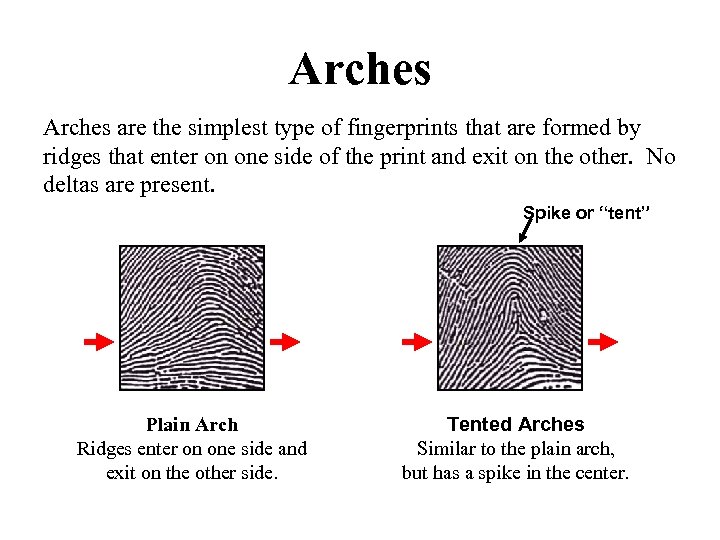 Arches are the simplest type of fingerprints that are formed by ridges that enter on one side of the print and exit on the other. No deltas are present. Spike or “tent” Plain Arch Ridges enter on one side and exit on the other side. Tented Arches Similar to the plain arch, but has a spike in the center.
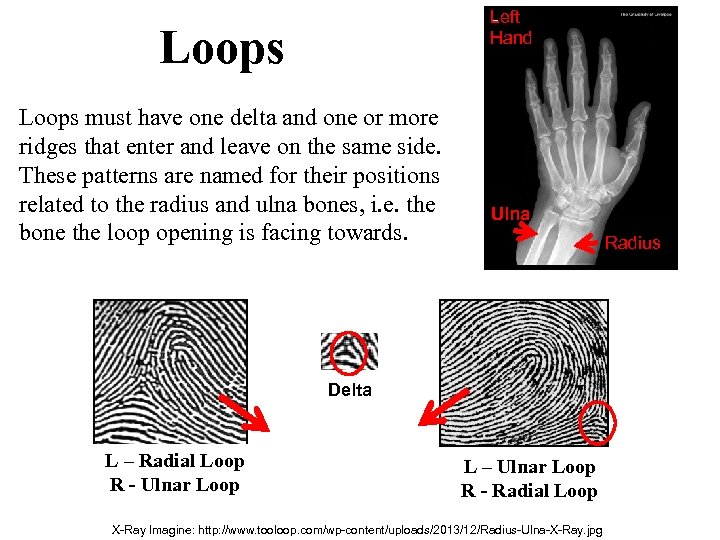 Left Hand Loops must have one delta and one or more ridges that enter and leave on the same side. These patterns are named for their positions related to the radius and ulna bones, i. e. the bone the loop opening is facing towards. Ulna Radius Delta L – Radial Loop R - Ulnar Loop L – Ulnar Loop R - Radial Loop X-Ray Imagine: http: //www. tooloop. com/wp-content/uploads/2013/12/Radius-Ulna-X-Ray. jpg
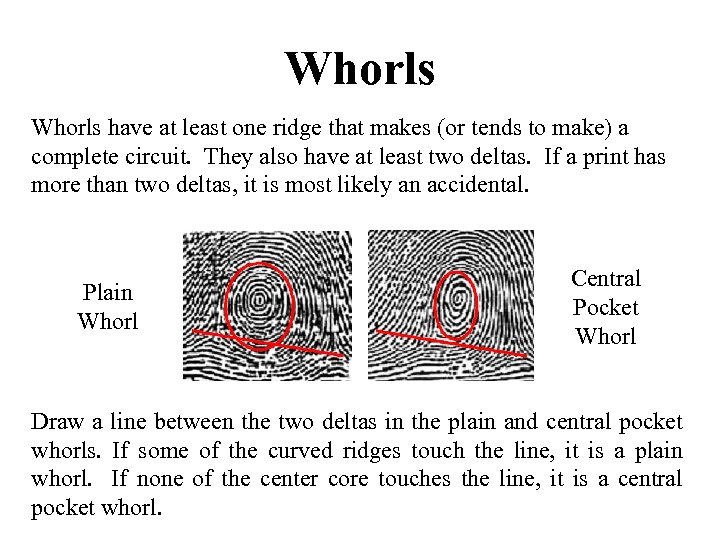 Whorls have at least one ridge that makes (or tends to make) a complete circuit. They also have at least two deltas. If a print has more than two deltas, it is most likely an accidental. Plain Whorl Central Pocket Whorl Draw a line between the two deltas in the plain and central pocket whorls. If some of the curved ridges touch the line, it is a plain whorl. If none of the center core touches the line, it is a central pocket whorl.
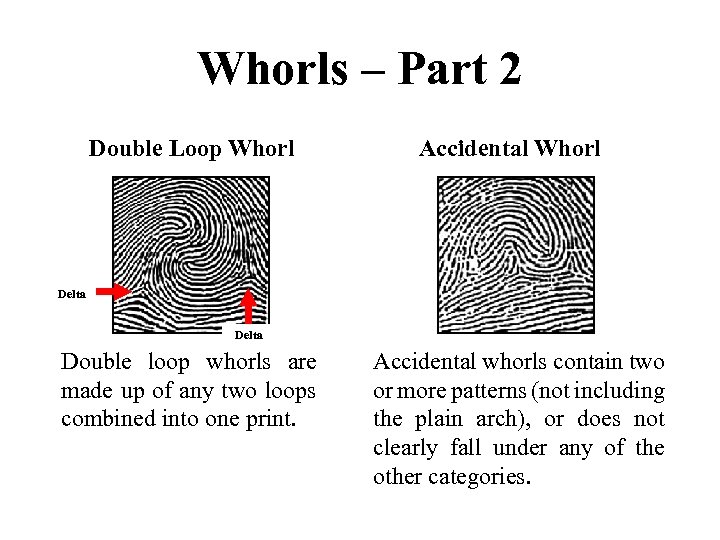 Whorls – Part 2 Double Loop Whorl Accidental Whorl Delta Double loop whorls are made up of any two loops combined into one print. Accidental whorls contain two or more patterns (not including the plain arch), or does not clearly fall under any of the other categories.
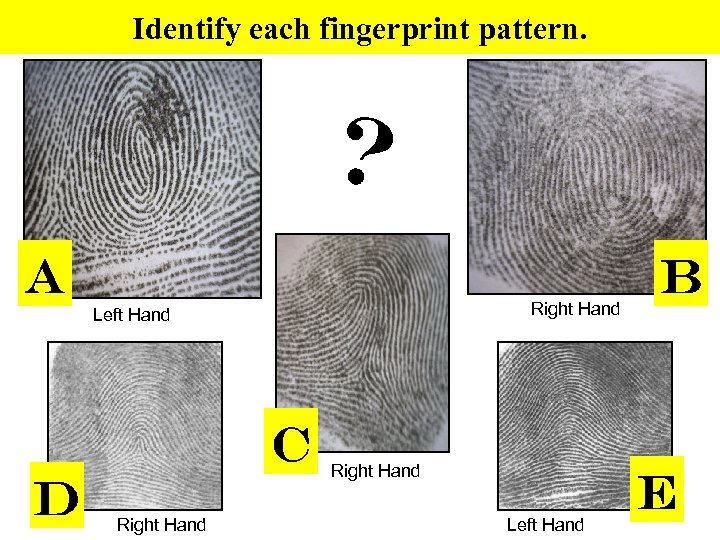 Identify each fingerprint pattern. Right Hand Left Hand
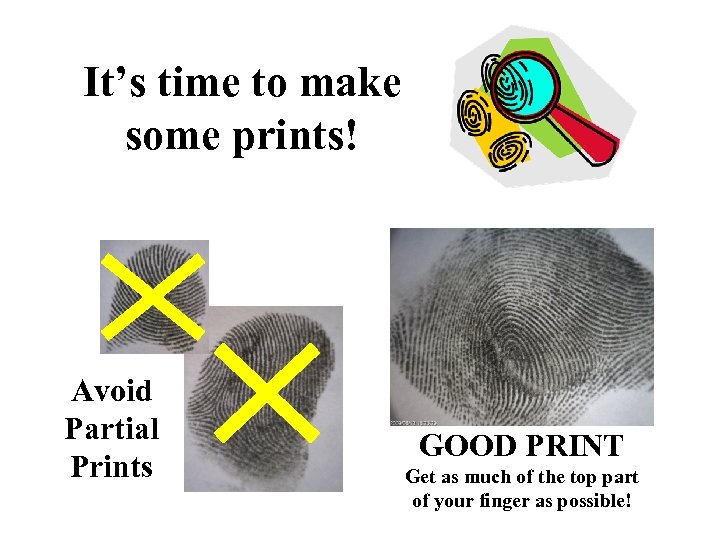 It’s time to make some prints! Avoid Partial Prints GOOD PRINT Get as much of the top part of your finger as possible!
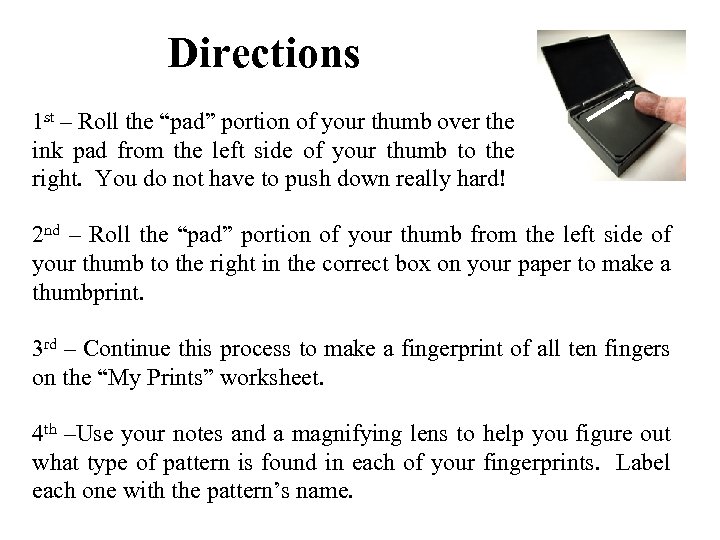 Directions 1 st – Roll the “pad” portion of your thumb over the ink pad from the left side of your thumb to the right. You do not have to push down really hard! 2 nd – Roll the “pad” portion of your thumb from the left side of your thumb to the right in the correct box on your paper to make a thumbprint. 3 rd – Continue this process to make a fingerprint of all ten fingers on the “My Prints” worksheet. 4 th –Use your notes and a magnifying lens to help you figure out what type of pattern is found in each of your fingerprints. Label each one with the pattern’s name.