 Скачать презентацию Adaptation to the climate change Learning for sustainability
8cde3725829702b9ddda53ab12ae1d4d.ppt
- Количество слайдов: 17



Adaptation to the climate change “Learning for sustainability (L 4 S)”
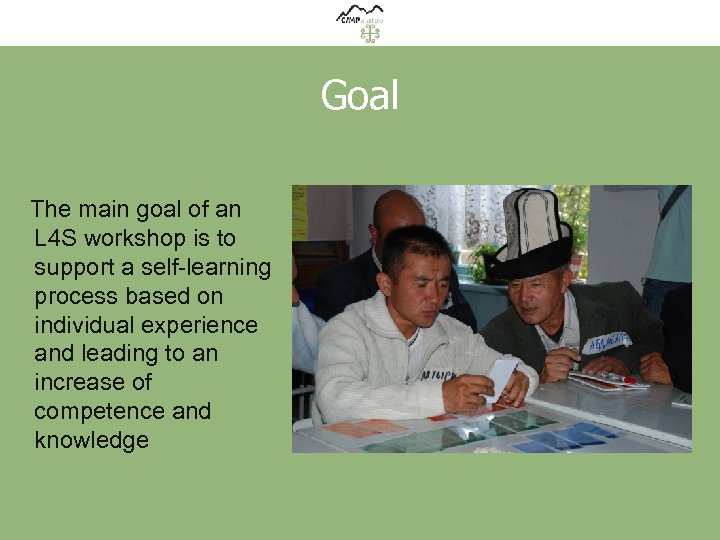
Goal The main goal of an L 4 S workshop is to support a self-learning process based on individual experience and leading to an increase of competence and knowledge
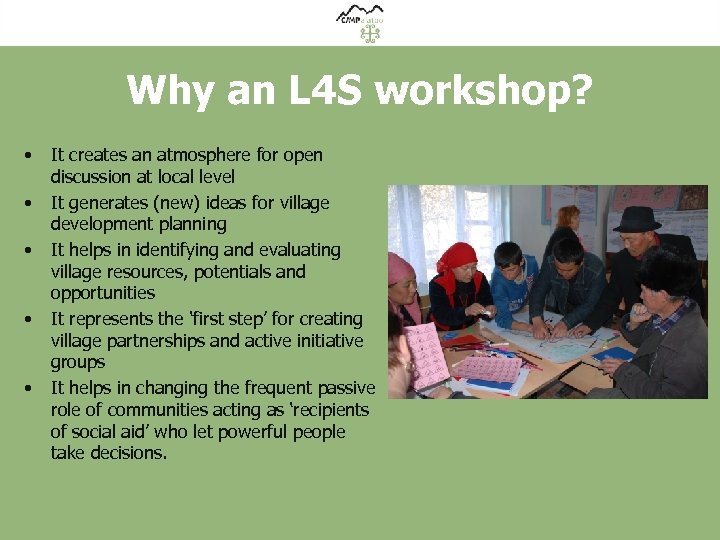
Why an L 4 S workshop? • • • It creates an atmosphere for open discussion at local level It generates (new) ideas for village development planning It helps in identifying and evaluating village resources, potentials and opportunities It represents the ‘first step’ for creating village partnerships and active initiative groups It helps in changing the frequent passive role of communities acting as ‘recipients of social aid’ who let powerful people take decisions.
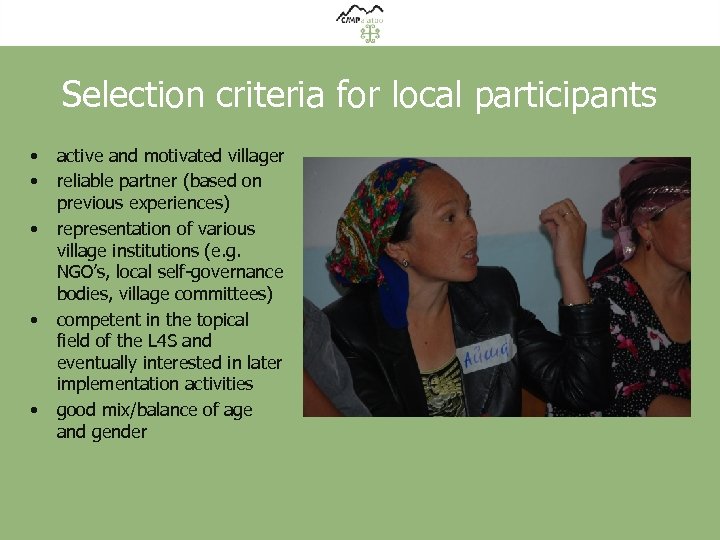
Selection criteria for local participants • • • active and motivated villager reliable partner (based on previous experiences) representation of various village institutions (e. g. NGO’s, local self-governance bodies, village committees) competent in the topical field of the L 4 S and eventually interested in later implementation activities good mix/balance of age and gender
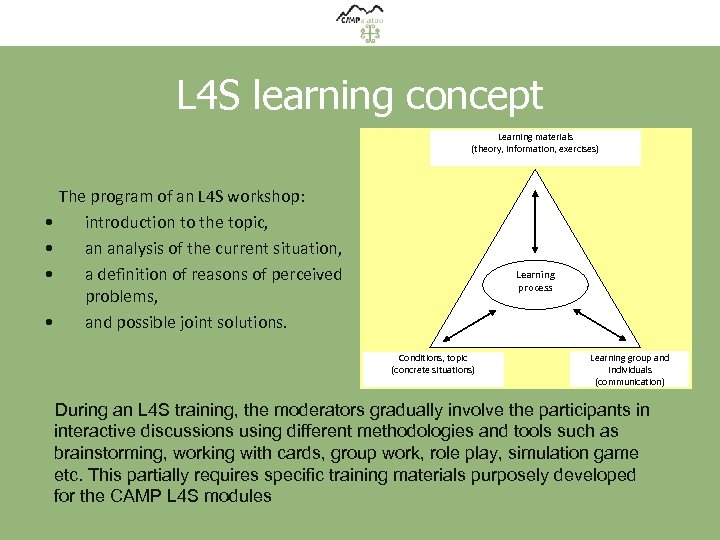
L 4 S learning concept Learning materials (theory, information, exercises) The program of an L 4 S workshop: • • introduction to the topic, an analysis of the current situation, a definition of reasons of perceived problems, and possible joint solutions. Learning process Conditions, topic (concrete situations) Learning group and individuals (communication) During an L 4 S training, the moderators gradually involve the participants in interactive discussions using different methodologies and tools such as brainstorming, working with cards, group work, role play, simulation game etc. This partially requires specific training materials purposely developed for the CAMP L 4 S modules
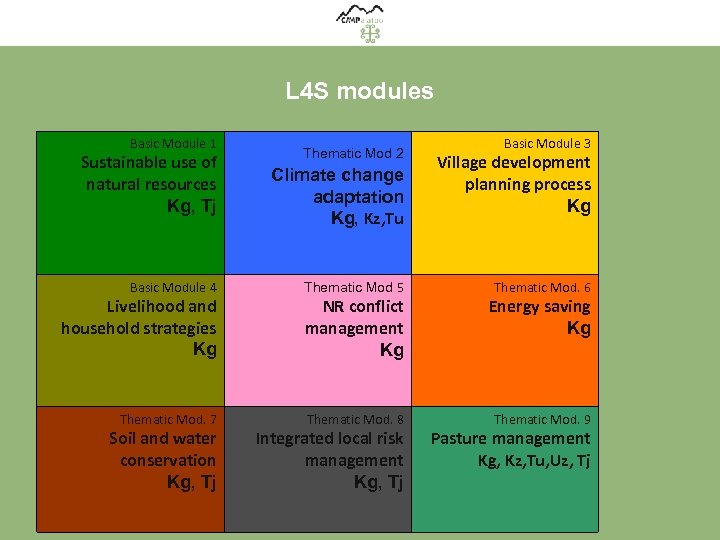
L 4 S modules Basic Module 1 Sustainable use of natural resources Kg, Tj Thematic Mod 2 Climate change adaptation Kg, Kz, Tu Basic Module 3 Village development planning process Kg Basic Module 4 Thematic Mod 5 NR conflict management Kg Energy saving Kg Thematic Mod. 7 Thematic Mod. 8 Thematic Mod. 9 Livelihood and household strategies Kg Soil and water conservation Kg, Tj Integrated local risk management Kg, Tj Thematic Mod. 6 Pasture management Kg, Kz, Tu, Uz, Tj
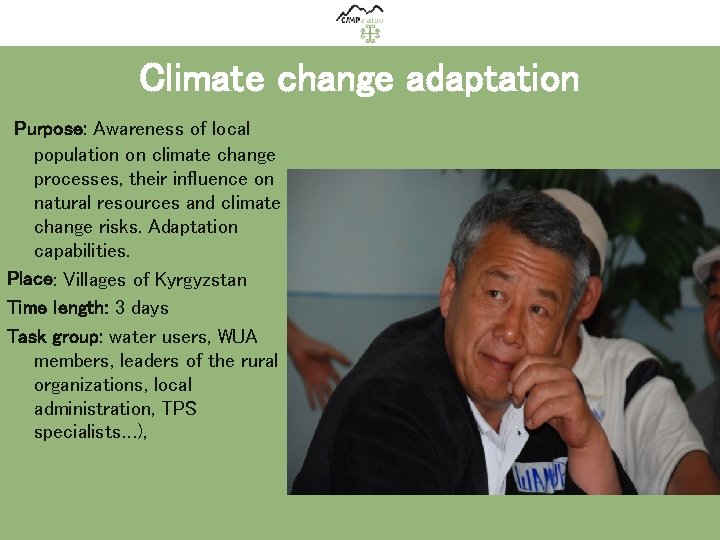
Climate change adaptation Purpose: Awareness of local population on climate change processes, their influence on natural resources and climate change risks. Adaptation capabilities. Place: Villages of Kyrgyzstan Time length: 3 days Task group: water users, WUA members, leaders of the rural organizations, local administration, TPS specialists…),
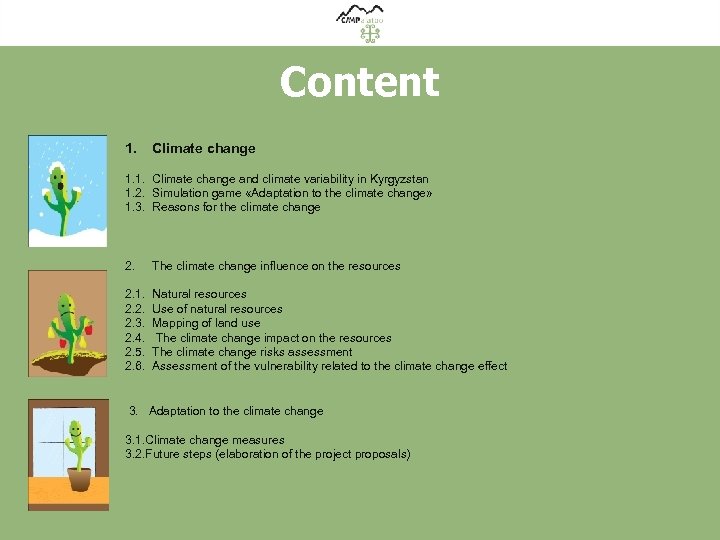
Content 1. Climate change 1. 1. Climate change and climate variability in Kyrgyzstan 1. 2. Simulation game «Adaptation to the climate change» 1. 3. Reasons for the climate change 2. The climate change influence on the resources 2. 1. 2. 2. 2. 3. 2. 4. 2. 5. 2. 6. Natural resources Use of natural resources Mapping of land use The climate change impact on the resources The climate change risks assessment Assessment of the vulnerability related to the climate change effect 3. Adaptation to the climate change 3. 1. Climate change measures 3. 2. Future steps (elaboration of the project proposals)
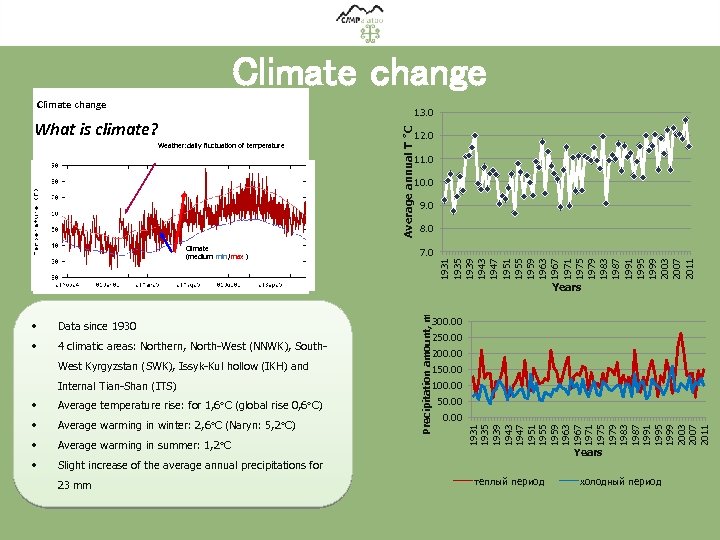
Climate change Weather: : daily fluctuation of temperature Climate (medium min /max ) 12. 0 11. 0 10. 0 9. 0 8. 0 7. 0 1931 1935 1939 1943 1947 1951 1955 1959 1963 1967 1971 1975 1979 1983 1987 1991 1995 1999 2003 2007 2011 What is climate? Average annual Т ˚С 13. 0 • Data since 1930 • 4 climatic areas: Northern, North-West (NNWK), South. West Kyrgyzstan (SWK), Issyk-Kul hollow (IKH) and Internal Tian-Shan (ITS) Average temperature rise: for 1, 6 С (global rise 0, 6 С) • Average warming in winter: 2, 6 С (Naryn: 5, 2 С) • Average warming in summer: 1, 2 С • 300. 00 250. 00 200. 00 150. 00 100. 00 50. 00 Slight increase of the average annual precipitations for 23 mm 0. 00 1931 1935 1939 1943 1947 1951 1955 1959 1963 1967 1971 1975 1979 1983 1987 1991 1995 1999 2003 2007 2011 • Precipitation amount, mm Years теплый период холодный период
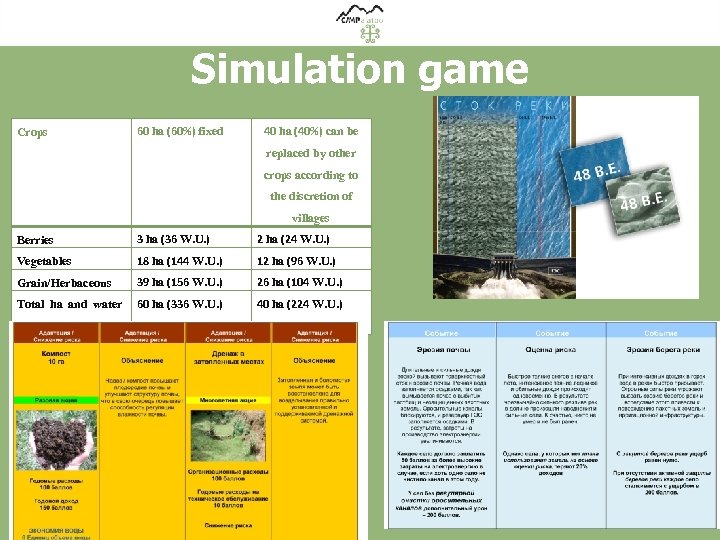
Simulation game Crops 60 ha (60%) fixed 40 ha (40%) can be replaced by other crops according to the discretion of villages Berries 3 ha (36 W. U. ) 2 ha (24 W. U. ) Vegetables 18 ha (144 W. U. ) 12 ha (96 W. U. ) Grain/Herbaceous 39 ha (156 W. U. ) 26 ha (104 W. U. ) Total ha and water 60 ha (336 W. U. ) 40 ha (224 W. U. ) units
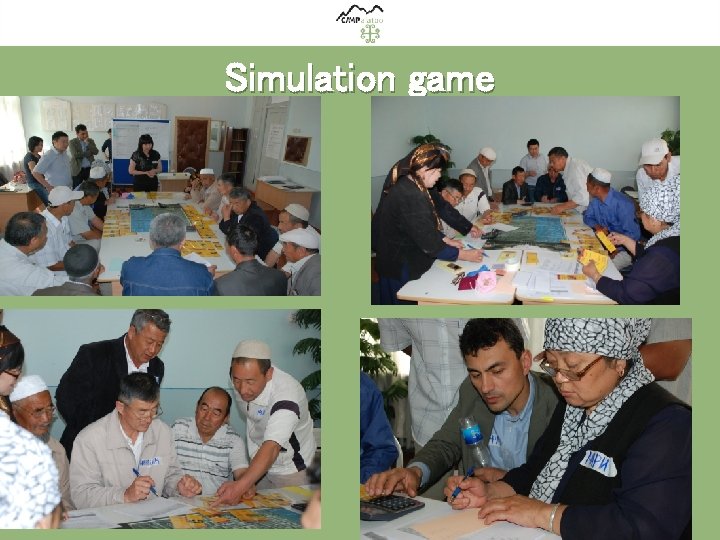
Simulation game
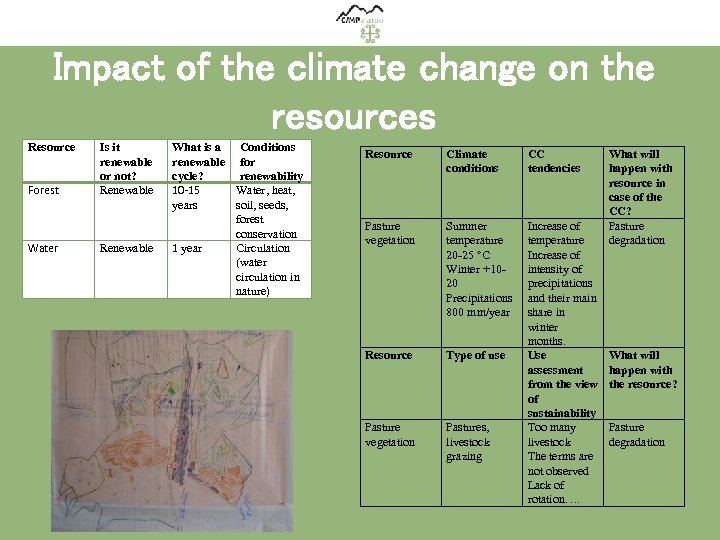
Impact of the climate change on the resources Resource Forest Water Is it renewable or not? Renewable What is a Conditions renewable for cycle? renewability 10 -15 Water, heat, years soil, seeds, forest conservation 1 year Circulation (water circulation in nature) Resource Climate conditions CC tendencies Pasture vegetation Summer temperature 20 -25 С Winter +1020 Precipitations 800 mm/year Resource Type of use Pasture vegetation Pastures, livestock grazing Increase of temperature Increase of intensity of precipitations and their main share in winter months. Use assessment from the view of sustainability Too many livestock The terms are not observed Lack of rotation…. What will happen with resource in case of the CC? Pasture degradation What will happen with the resource? Pasture degradation
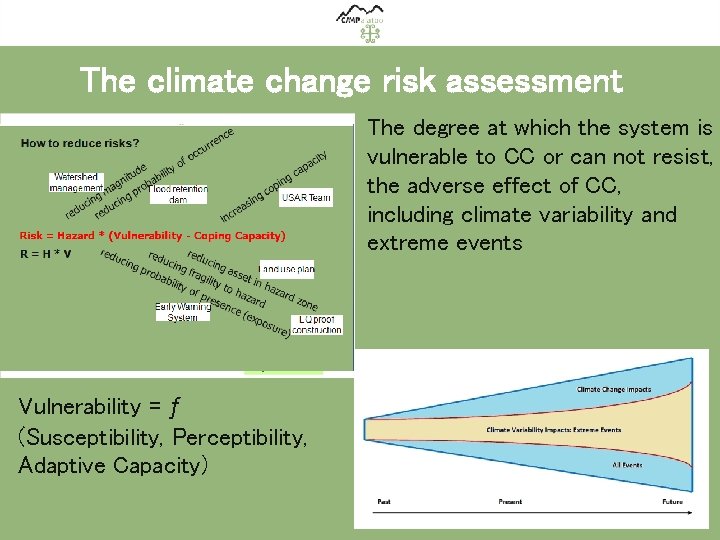
The climate change risk assessment The degree at which the system is vulnerable to CC or can not resist, the adverse effect of CC, including climate variability and extreme events Vulnerability = ƒ (Susceptibility, Perceptibility, Adaptive Capacity)
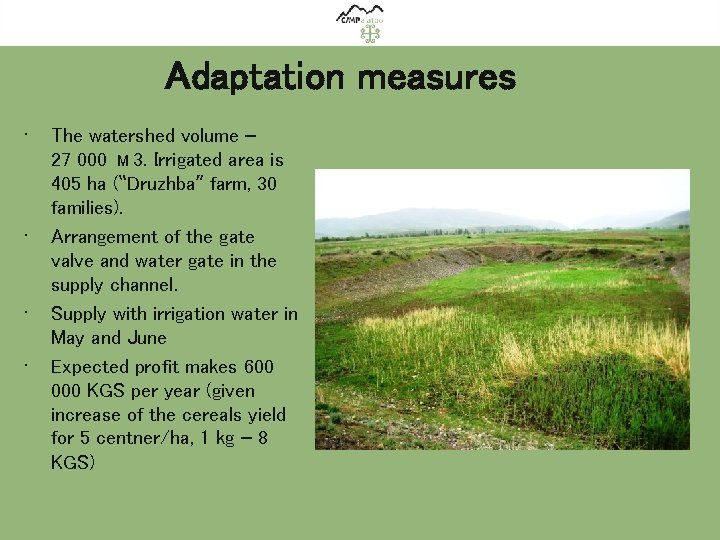
Adaptation measures • • The watershed volume – 27 000 м 3. Irrigated area is 405 ha (“Druzhba” farm, 30 families). Arrangement of the gate valve and water gate in the supply channel. Supply with irrigation water in May and June Expected profit makes 600 000 KGS per year (given increase of the cereals yield for 5 centner/ha, 1 kg – 8 KGS)
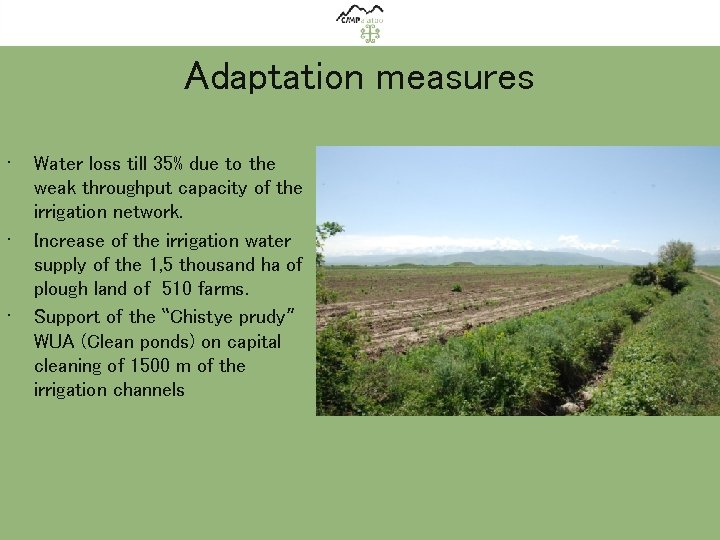
Adaptation measures • • • Water loss till 35% due to the weak throughput capacity of the irrigation network. Increase of the irrigation water supply of the 1, 5 thousand ha of plough land of 510 farms. Support of the “Chistye prudy” WUA (Clean ponds) on capital cleaning of 1500 m of the irrigation channels
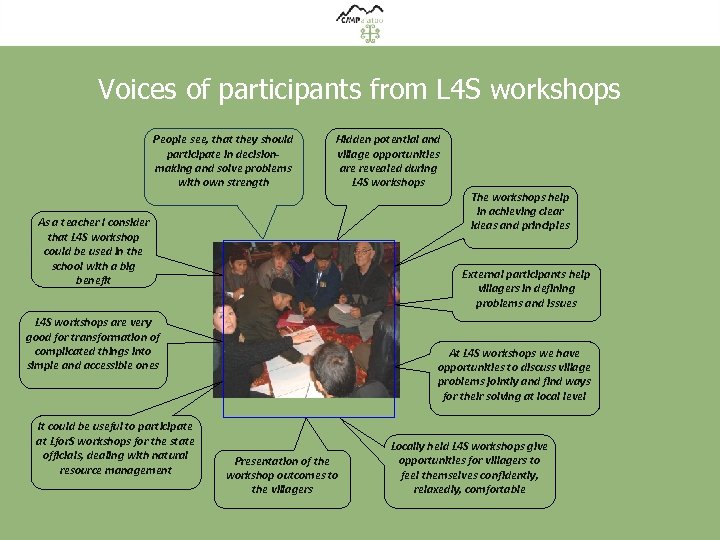
Voices of participants from L 4 S workshops People see, that they should participate in decisionmaking and solve problems with own strength Hidden potential and village opportunities are revealed during L 4 S workshops As a teacher I consider that L 4 S workshop could be used in the school with a big benefit External participants help villagers in defining problems and issues L 4 S workshops are very good for transformation of complicated things into simple and accessible ones It could be useful to participate at Lfor. S workshops for the state officials, dealing with natural resource management The workshops help in achieving clear ideas and principles At L 4 S workshops we have opportunities to discuss village problems jointly and find ways for their solving at local level Presentation of the workshop outcomes to the villagers Locally held L 4 S workshops give opportunities for villagers to feel themselves confidently, relaxedly, comfortable
Thank you for attention CAMP Ala-Too Public Foundation 720035, Kyrgyzstan, Bishkek Uphimskiy, 3 Web-сайт: www. camp. kg Тel. /fax: 00996 (312) 54 05 73, 54 23 46
Скачать презентацию Adaptation to the climate change Learning for sustainability
8cde3725829702b9ddda53ab12ae1d4d.ppt