 Скачать презентацию Adaptation to Climate Change in the Caribbean —
f5cfdfbf1df9f59ef449300eeca356e9.ppt
- Количество слайдов: 57



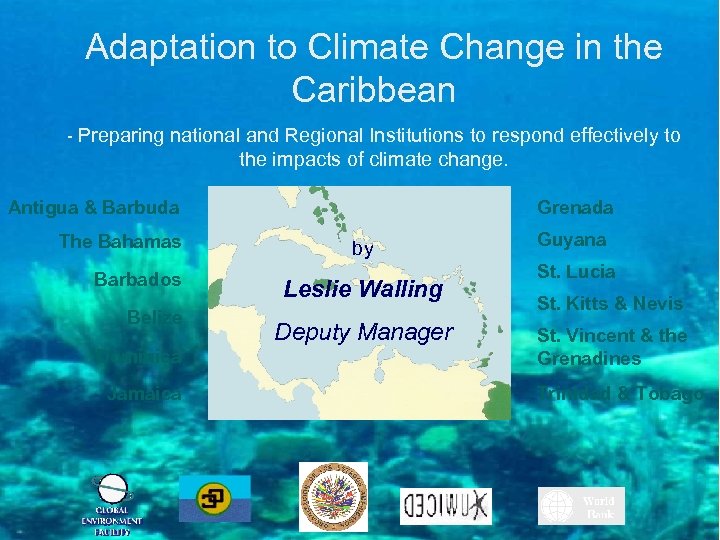
Adaptation to Climate Change in the Caribbean - Preparing national and Regional Institutions to respond effectively to the impacts of climate change. Antigua & Barbuda The Bahamas Barbados Belize Dominica Jamaica Grenada by Leslie Walling Deputy Manager Guyana St. Lucia St. Kitts & Nevis St. Vincent & the Grenadines Trinidad & Tobago
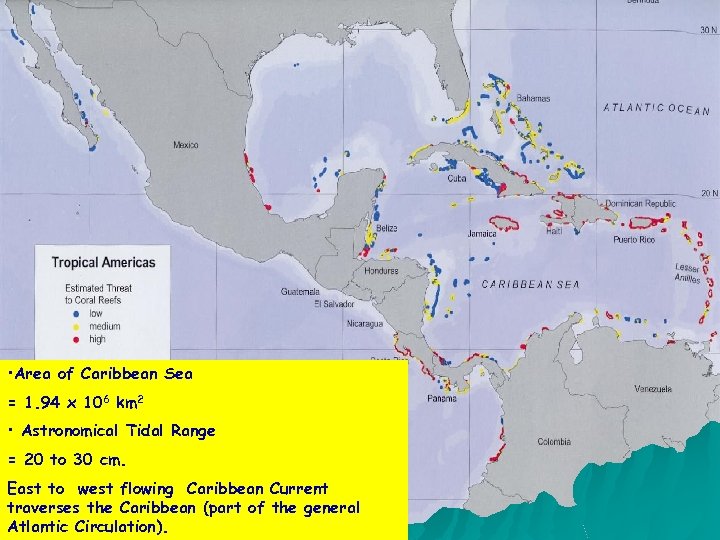
• Area of Caribbean Sea = 1. 94 x 106 km 2 • Astronomical Tidal Range = 20 to 30 cm. East to west flowing Caribbean Current traverses the Caribbean (part of the general Atlantic Circulation).
Regional Response u 1992 - UNCED: Agenda 21 u 1994 May - UNGC SD/SIDS: Barbados Program of Action (BPOA), 15 priorities u 1994 Sept - Regional Tech Consultation: Draft project document u 1995 May – GEF Council approval to
Regional Response u 1995 Sept – 1 st (Regional) Technical Consultation u 1994 Q 4 – National Consultations: NICUs and NFPs formed. u 1996 Jan – 2 nd Regional Consolation: develop work plan and pilot project selection u 1996 May – 3 rd Regional Consultation: pre-appraisal review; structure, finance, operations & activities.
The Caribbean Planning for Adaptation to Global Climate Change Project u The GEF-funded Project (1997 -2001) is executed by the Organization of American States in partnership with the University of the West Indies Center for Environment and Development, (UWICED) for the World Bank as the GEF Implementing Agency.
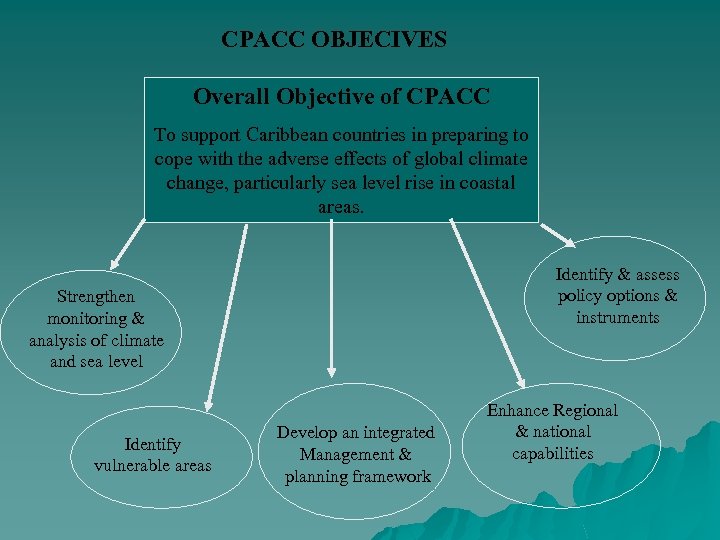
CPACC OBJECIVES Overall Objective of CPACC To support Caribbean countries in preparing to cope with the adverse effects of global climate change, particularly sea level rise in coastal areas. Identify & assess policy options & instruments Strengthen monitoring & analysis of climate and sea level Identify vulnerable areas Develop an integrated Management & planning framework Enhance Regional & national capabilities
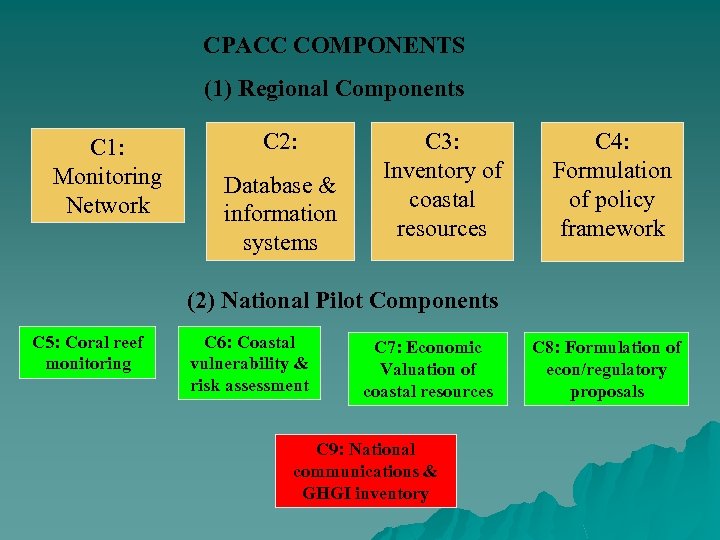
CPACC COMPONENTS (1) Regional Components C 1: Monitoring Network C 2: Database & information systems C 3: Inventory of coastal resources C 4: Formulation of policy framework (2) National Pilot Components C 5: Coral reef monitoring C 6: Coastal vulnerability & risk assessment C 7: Economic Valuation of coastal resources C 9: National communications & GHGI inventory C 8: Formulation of econ/regulatory proposals
Specific Achievements Establishment of a sea level and climate monitoring system u Improved access and availability of data u Increased appreciation of climate change issues at the policy-making level u Meeting country needs for expanded vulnerability assessment u Establishment of coral reef monitoring protocols u Created a network for regional harmonization u
C 1: Design and Establish SL Monitoring Network - Objective u Install a sea-level/climate- observation network in the participating countries, to enable the region to start compiling data relevant for the long-term monitoring of climate change
C 1: Design and Establish SL Monitoring Network - Achievements • 18 monitoring stations installed - Water level, barometric pressure, air temp, Rhumidity, rainfall, SST, wind direction, & gust speed. • CIMH: responsible for coordination, quality control, calibration and special maintenance • Trust fund set up for maintenance • Data download, QA/QC & archiving – RAC established in yr. 3 on UWI campus in Trinidad • www. cpaccrac. org data presentation & products
C 1: Design & Installation of SL Monitoring System - Lessons Learned Varying levels of starting capacity & in-house expertise. u Subsequent development of capacity was uneven. u Need for additional training in; – digital monitoring systems – the use of tidal data: develop applications (CZM & E) – modern SL data collection & GPS surveying (NLS & CZMUs) – for GPS OCRES capacity development in u
C 1: Design & Installation of SL Monitoring System - The Way Forward Stronger local interest & participation in the daily use of the data. u Consider more immediate localized data delivery. u Review objectives & needs in light of improved technology. u Training to all technicians (digital data systems, tidal & GPS surveying). u Address outstanding technical & institutional deficiencies to ensure optimal network performance. u Strengthen Regional Network Coordination function. u
C 2: Establishment of Databases & Information Systems- Objective An enabling activity to facilitate access to information for the wide range of project stakeholders and general users and to meet the needs of the project management team.
C 2: Establishment of Databases & Information Systems. Achievements Information Access, Management and Communication through the internet: • Establishment of CPACC Website www. cpacc. org • Basic information on project objectives activities • Progress reports, workshop reports, methodologies etc • Calendar of CPACC and related activities • Access to data from 18 monitoring stations
C 2: Establishment of Databases & Information Systems- Lessons Learned u Pace with which info technology changes demands flexibility (opportunity/obsolescence). u Web development required stronger , coordinated, PEO support. u Technical emphasis of website met info needs of project and stakeholders.
C 2: Establishment of Databases & Information Systems- The Way Forward Ensure strong PEO component in future projects. u Incorporate strong PEO elopement into future web designs and information strategies. u Place emphasis on the use of the website as a strategic tool for PEO. u In the future the website will project the image of the project/organization. u Support network and related systems through training for staff and participants. u
C 3: Inventory of Coastal Resources and Uses – Objectives u The objective was to developing an application that would allow greater access data and information for decision-making, including the adaptation to climate change. u Emphasis was placed on the capacity-building elements.
C 3: Inventory of Coastal Resources and Uses - Achievements • CRIS delivered to 12 countries. • Provided and installed in 6 countries • Sent to remaining countries • Ikonos Satellite imagery acquired for a countries • Complete technical proficiency in at least one national institution • Facilitate storage, retrieval, updating, analysis and manipulation of coastal resource data
C 3: Inventory of Coastal Resources and Uses Lessons Learned Flexibility in approach to project design and implementation helps to optimize counterparticipation. u Appropriate financial support necessary to alleviate counterpart overload. u Regular reviews among key, knowledgeable practitioners was valuable. u Utilization of national and Regional expertise proved advantageous. u
C 3: Inventory of Coastal Resources and Uses The Way Forward u Commitment by all concerned parties to: – flexibility in implementation to optimize the quality of country participation. – Budgetary support for counterparts to alleviate counterpart overload. – Utilization of national & Regional expertise – Regular technical review among key, knowledgeable practitioners. u Provide technical support & follow-up to address technical issues and those associated with delivery.
C 4: Formulation of Policy Framework for Integrated Adaptation Planning & Management– Objectives Strengthen national capacity for analyzing climate and sea-level dynamics and trends, seeking to determine the immediate and potential impacts of global climate change; u. Identify areas particularly vulnerable to the adverse effects of climate change and sea-level rise; u. Develop an integrated management and planning framework for cost-effective response and adaptation to the impacts of global climate change; and u. Identify and assist in the development of policy options and instruments that could help to initiate a long-term programme of adaptation to
C 4: Formulation of Policy Framework for Integrated Adaptation Planning & Management – Achievements • This was the final component to be implemented • Outputs: (1) National Climate Change Issues Papers, (2) National Climate Change Adaptation Policies and Implementation Plans • 10 policies in draft final stage: M. O for mainstreaming • St. Lucia’s (2001) and Dominica’s (2002) approved by Cabinet • All policies expected to be submitted to local Cabinets by third quarter of 2002
C 4: Formulation of Policy Framework for Integrated Adaptation Planning & Management - Lessons Learned A staggered start to the implementation of this project component allowed it to benefit from lessons learned earlier in the implementation process. u Flexibility: The component addressed issues of concern to policy makers to insure “Buy in”. u Immediate adaptation response measures were justifiable on the basis that u response measures that reduced vulnerability to climate variability would contribute to
C 4: Formulation of Policy Framework for Integrated Adaptation Planning & Management- The Way Forward u Support the formulation of specific adaptation policy responses by developing capacity within the Region to: – conduct in-depth impact/vulnerability studies, – develop and use down-scaled global climate models, – develop and use site-specific climate scenarios. u Employ more precise scientific data as it
C 5: Coral Reef Monitoring for Climate Change Impacts– Objectives Establish a long-term monitoring programme, which over time will show the effects of global warming factors on coral reefs. u Identify methodologies to adjust and extend current efforts to monitor the impacts of global warming on reefs; u Undertake specific activities dedicated to raising public awareness of coral reefs and climate change; and u Disseminate information and methodology to u
C 5: Coral Reef Monitoring for Climate Change Impacts - Achievements • Monitoring systems in place and data analysis implemented in 3 countries • Data centre established at CMS, UWI, Jamaica • Synergies developed with other monitoring programmes allowing comparison and assessment of methodologies • Methodologies adapted, tested and made available through the CPACC website
C 5: Coral Reef Monitoring for Climate Change Impacts - Lessons Learned Government commitment to project activities should embody acknowledgement & and agreement by prospective lead agencies of their respective roles and responsibilities. u Provide lead agencies with sufficient lead time to adjust annual work plans and budgets. u PEO is an essential complimentary activity. u Technical review workshops are invaluable management & planning tools for building and sustaining commitment to project objectives. u Sustainability: Mentoring & the centralized coordination & technical-support functions must be u
C 5: Coral Reef Monitoring for Climate Change Impacts - The Way Forward u Maintain the momentum of the programme through; – capacity building, – Institutionalization of coral reef monitoring, coordination and technical support, Expand programme to Eastern Caribbean u Data contributions to global information networks u Support for coral reef monitoring and capacity building should be continued under the MACC u
C 6: Coastal Vulnerability & Risk Assessment - Objectives u To develop vulnerability and risk assessments for the coastal areas of the pilot countries; u To build capacity in coastalvulnerability and risk assessments at the national and regional levels; and u To inform and educate the general public about coastal vulnerability and the need to plan for climate
C 6: Coastal Vulnerability & Risk Assessment Achievements • Methodology developed and applied • Coastal vulnerability studies in 3 pilot countries completed • Conducted by country teams • Need for vulnerability studies on other sectors (agriculture, water, tourism, health) identified • Long-term capacity building needs to be addressed
C 6: Coastal Vulnerability & Risk Assessment -Lessons Learned This is a requirement that countries must undertake to support the development of GCC adaptation policy/strategies. u National capacity in V&A is deficient. u Lack of data has hampered in-depth analysis necessary for V&A studies. u There is a need for extensive base-line data (bathymetry, contour maps w/ 1 m. resolution below 25 ft, geo-referenced cadastral information, ecosystem status, sea-level… u The necessary regional climate scenarios are not available to support planning and decisionmaking. u
C 6: Coastal Vulnerability & Risk Assessment -The Way Forward Expand the V&A programme to the 9 remaining CPACC countries as originally planned. u Further development of national capacity in V&A assessment. u The development of more robust V&A assessments in the Region by enhancing data availability through; u – Substantial & coordinated support for data collection & monitoring, – Further development of the CRIS,
C 7: Economic Valuation of Coastal & Marine Resources – Objectives u The overall objective was to help the participating countries to apply the tools of resource valuation, environmental accounting, and environmental decision-making in the development of policy frameworks and economic and regulatory approaches for coastal and marine resources.
C 7: Economic Valuation of Coastal & Marine Resources – Achievements • Studies conducted in 3 pilot countries by local team • Country teams trained in the design and development of data collection instruments and surveys • Primary and Secondary data collected analysed • Data collection took into account the need to ensure that outputs are compatible with the CRIS under C 3. • C 3 assessed for useful data • Joint workshop with pilot countries involved in the development of Economic Instruments (C 8)
C 7: Economic Valuation of Coastal & Marine Resources - Lessons Learned (1) Significant emphasis needs to be placed on the development of any methodology and on the capacity to effectively implement it; u More resources need to be made available in support of regional team building and cooperation, and the sharing of material; u The original timeline for the project was too short and severely underestimated the time needed to implement a project such as this and also ensure capacity transfer; u
C 7: Economic Valuation of Coastal & Marine Resources - Lessons Learned (2) The need for software and specific training by experts must be clearly recognized and be integrated into projects as part of the capacity-building and transfer process; u The broadest possible cross-section of technical expertise and backgrounds makes for the most effective country team in performing economic valuation; u Although more time-consuming, data collection by the country teams pays off better in the long term; u
C 8: Formulation of Economic & Regulatory Tools – Objectives u Assess the design and utility of economic and regulatory approaches in coastal and marine resources management in response to threats of sea-level rise; u Demonstrate how the use of economic incentives) can provide flexible, cost-effective alternatives to traditional, regulatory policies in promoting adaptation to climate change.
C 8: Formulation of Economic & Regulatory Tools - Achievements • Antigua and Barbuda: (i) Sand management framework (ii) restructuring of commercial sand sales, (iii) retail sand market -To meet the demand for sand without undermining the environmental integrity of coastal ecosystems. • St. Kitts and Nevis: Implemented strategy of market based instruments to influence the quantity and pattern of hotel development within a coastal area.
C 8: Formulation of Economic & Regulatory Tools – Lessons Learned u u u A consensus-based approach to market-based instruments is critical; These instruments should be developed with political feasibility in mind; Education and outreach must be an integral component of any regulatory and policy strategy; The design of market-based instruments should be based on a review of economic analysis and human health; Regional compacts are important for advancing selected environmental goals of individual countries; and An integrated approach to environmental planning
C 8: Formulation of Economic & Regulatory Tools – The Way Forward u The integration of economic valuation and economic instruments remains an essential but challenging process. These two concepts should be fundamental aspects of any development and implementation of policy, particularly one addressing climate change.
C 9: GHG Inventory in St. Vincent and the Grenadines – Objectives u Preparation of the St. Vincent and the Grenadines Initial National Communications to the UNFCCC
C 9: GHG Inventory in St. Vincent and the Grenadines Achievements • First National Communications of St. Vincent & the Grenadines complete & presented at COP 6 along with others completed under the UNDP/GEF Enabling Activities project • GHG Inventory: +95. 1 Gg C, - 133. 7 Gg C
C 9: GHG Inventory in St. Vincent and the Grenadines – Lessons Learned Lack many of the prerequisites for dealing effectively with climate change, although some progress is being made u Need for effective land-use planning with the enforcement of existing laws and the expansion of authority u Programmes outside the formal education sector can make significant contributions to awareness of climate change u
C 9: GHG Inventory in St. Vincent and the Grenadines – The Way Forward u Immediate development of a broad-based National Environmental Policy Reform Project – updating and strengthening the National Environmental Action Plan – establish the legal authority of the National Environmental Advisory Board – integrate climate-change issues into national economic policies and plans, land-use plans, and sectoral policies – accompanied by educational programs u Build on CRIS to develop a spatially based natural-resource inventory system
Overall Project Accomplishments Nationally, all countries have NFP’s and NICU’s. – In some countries, National committees have been established to address climate change. u Establishment of a sea level and climate monitoring system that contributes to regional and global assessment of the issues u Improved access and availability of data u Increased appreciation of climate change issues at the policy-making level and technical support to better define u
Overall Project Accomplishments Meeting country needs for expanded vulnerability assessment, economic evaluation techniques, developing economic instruments and methodology for coral reef monitoring u Created a network for regional harmonization u Development of National Climate Change Adaptation policies and action plans u
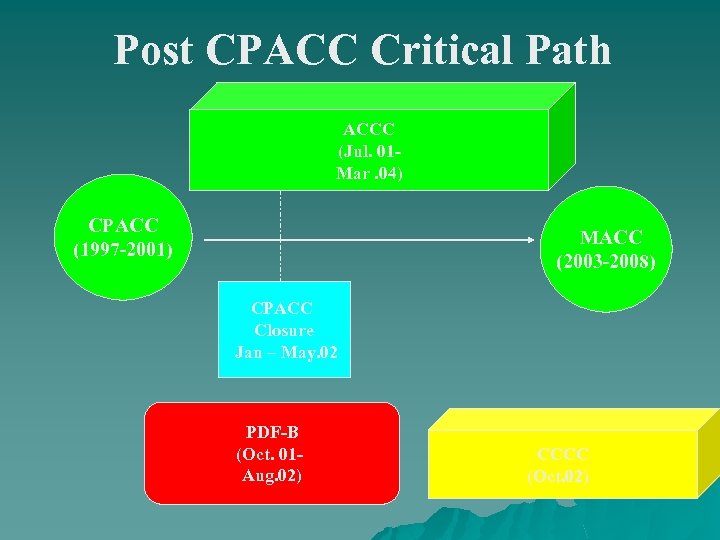
Post CPACC Critical Path ACCC (Jul. 01 Mar. 04) CPACC (1997 -2001) MACC (2003 -2008) CPACC Closure Jan – May. 02 PDF-B (Oct. 01 Aug. 02) CCCC (Oct. 02)
Post CPACC u CARICOM Governments mandated that there was a need to continue the work of adaptation planning and capacity building after CPACC. – Long-term: institutionalizing CC adaptation process in a Regional Climate Change Centre – Short-term: establish a successor project (MACC)
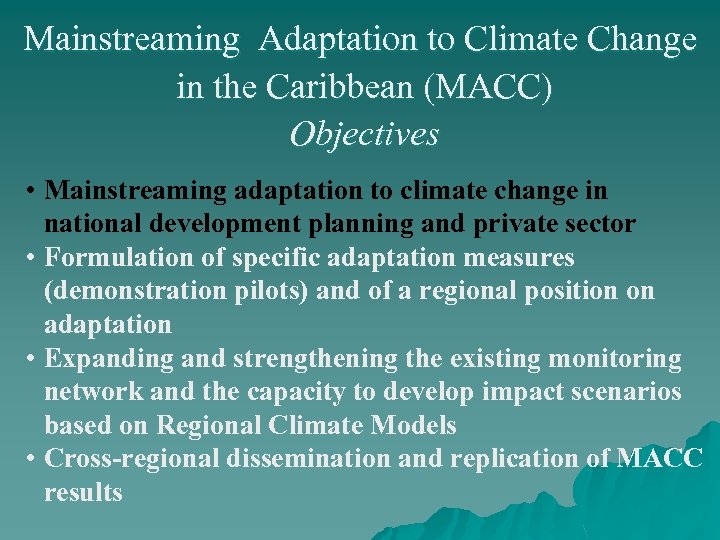
Mainstreaming Adaptation to Climate Change in the Caribbean (MACC) Objectives • Mainstreaming adaptation to climate change in national development planning and private sector • Formulation of specific adaptation measures (demonstration pilots) and of a regional position on adaptation • Expanding and strengthening the existing monitoring network and the capacity to develop impact scenarios based on Regional Climate Models • Cross-regional dissemination and replication of MACC results
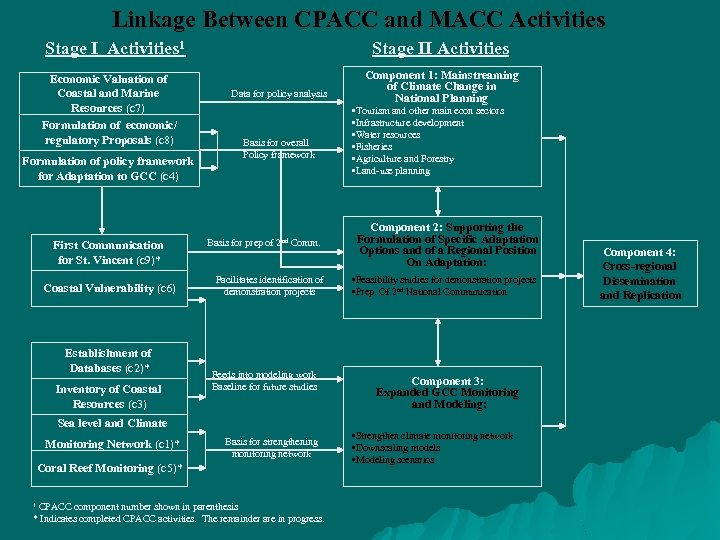
Linkage Between CPACC and MACC Activities Stage I Activities 1 Economic Valuation of Coastal and Marine Resources (c 7) Formulation of economic/ regulatory Proposals (c 8) Formulation of policy framework for Adaptation to GCC (c 4) First Communication for St. Vincent (c 9)* Coastal Vulnerability (c 6) Establishment of Databases (c 2)* Inventory of Coastal Resources (c 3) Stage II Activities Data for policy analysis Basis for overall Policy framework Basis for prep of 2 nd Comm. Facilitates identification of demonstration projects Feeds into modeling work Baseline for future studies Component 1: Mainstreaming of Climate Change in National Planning §Tourism and other main econ sectors §Infrastructure development §Water resources §Fisheries §Agriculture and Forestry §Land-use planning Component 2: Supporting the Formulation of Specific Adaptation Options and of a Regional Position On Adaptation: §Feasibility studies for demonstration projects §Prep. Of 2 nd National Communication Component 3: Expanded GCC Monitoring and Modeling: Sea level and Climate Monitoring Network (c 1)* Basis for strengthening monitoring network Coral Reef Monitoring (c 5)* CPACC component number shown in parenthesis * Indicates completed CPACC activities. The remainder are in progress. 1 §Strengthen climate monitoring network §Downscaling models §Modeling scenarios Component 4: Cross-regional Dissemination and Replication
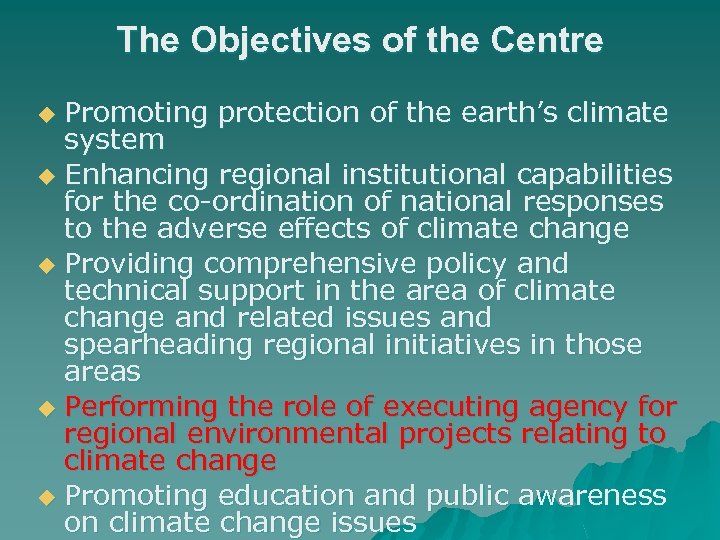
The Objectives of the Centre Promoting protection of the earth’s climate system u Enhancing regional institutional capabilities for the co-ordination of national responses to the adverse effects of climate change u Providing comprehensive policy and technical support in the area of climate change and related issues and spearheading regional initiatives in those areas u Performing the role of executing agency for regional environmental projects relating to climate change u Promoting education and public awareness on climate change issues u
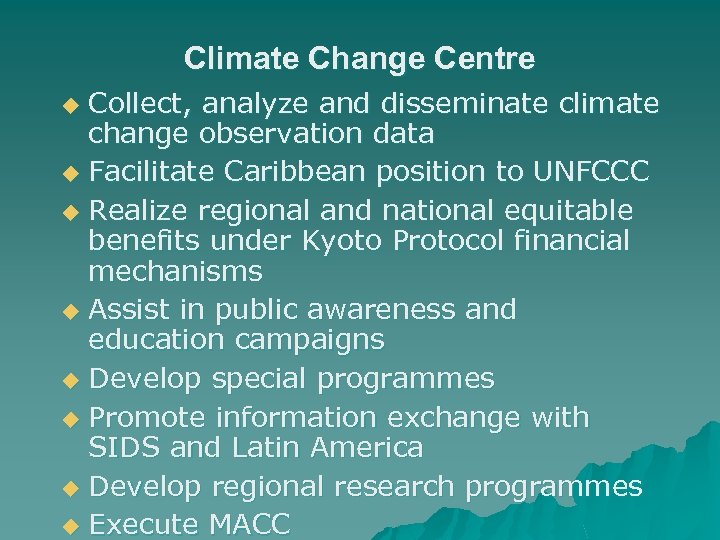
Climate Change Centre Collect, analyze and disseminate climate change observation data u Facilitate Caribbean position to UNFCCC u Realize regional and national equitable benefits under Kyoto Protocol financial mechanisms u Assist in public awareness and education campaigns u Develop special programmes u Promote information exchange with SIDS and Latin America u Develop regional research programmes u Execute MACC u
Supporting Transition - PDF Block B u Objective: – Establish Caribbean Climate Change Centre – Support national and regional consultations – Continue CPACC work on public education and awareness – Prepare full project proposal: MACC
Supporting Transition - Adapting to Climate Change in the Caribbean (ACCC) Funded under the Canadian Climate Change Development Fund (CCCDF) of the Canadian International Development Agency (CIDA) u Total project costs - Cdn$3. 14 million u Canadian Executing Agency – serve as consultants to the project u Project duration - Sept. 2001 to Feb. 2004. u
Adapting to Climate Change in the Caribbean (ACCC) - Components Project 1: Detailed Project Design and Business Plan for Regional Climate Change Centre u Project 2: Public Education and Outreach (PEO) u Project 3: Integrating GCC into Physical Planning Process using a Risk Management Approach u Project 4: Strengthening Technical Capacity– u - CIMH and National institutes, - Masters level course at UWI,
Adapting to Climate Change in the Caribbean (ACCC) - Components Project 5: Integrating Adaptation Planning in Environmental Impact Assessments for National and Regional Development Projects u Project 6: Implementation Strategies for Adaptation in the Water Sector u Project 7: Formulation of Adaptation Strategies to Protect Human Health u Project 8: Adaptation Strategies for Agriculture and Food u Project 9: Fostering collaboration with non-CARICOM Countries u

Thank You
Скачать презентацию Adaptation to Climate Change in the Caribbean —
f5cfdfbf1df9f59ef449300eeca356e9.ppt