 Скачать презентацию ADAGUC — Application Benefits for the Geospatial User
9ec10ed0db791ca52892ca9aa081de78.ppt
- Количество слайдов: 25



ADAGUC - Application Benefits for the Geospatial User Community Michael Schaepman, Joep Crompvoets, Gabriela Schhaepman-Strub, Marc Hoogerwerf 1 st ADAGUC Workshop, October 3 -4, 2006, KNMI (De Bilt, Netherlands)
Content n n From ‘Ada and Trend watch l l l n Policy Technology SDI Products Applications Sensor. Webs Conclusions Guc’ to ADAGUC
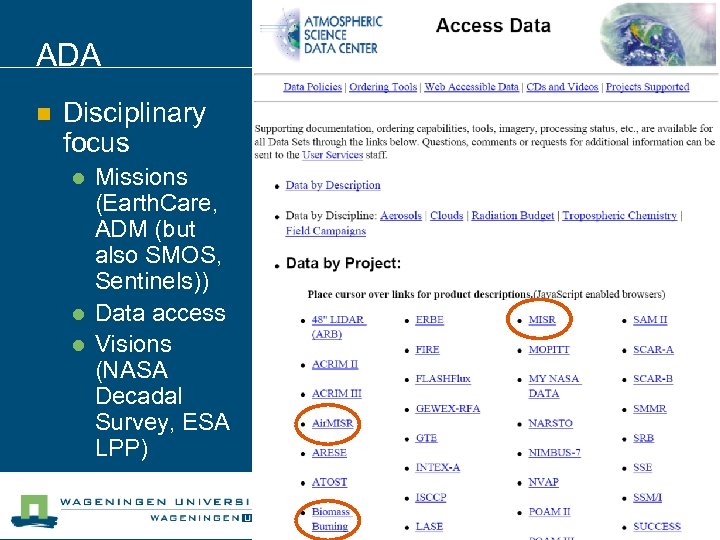
ADA n Disciplinary focus l l l Missions (Earth. Care, ADM (but also SMOS, Sentinels)) Data access Visions (NASA Decadal Survey, ESA LPP)
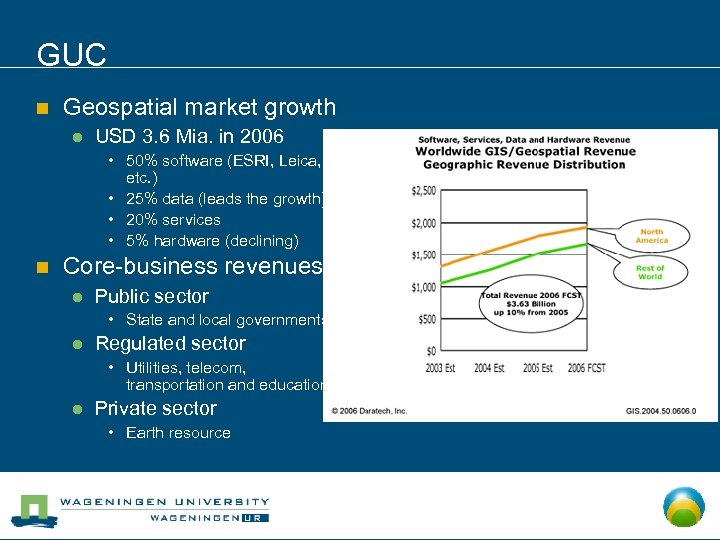
GUC n Geospatial market growth l USD 3. 6 Mia. in 2006 • 50% software (ESRI, Leica, etc. ) • 25% data (leads the growth) • 20% services • 5% hardware (declining) n Core-business revenues l Public sector • State and local governments l Regulated sector • Utilities, telecom, transportation and education l Private sector • Earth resource
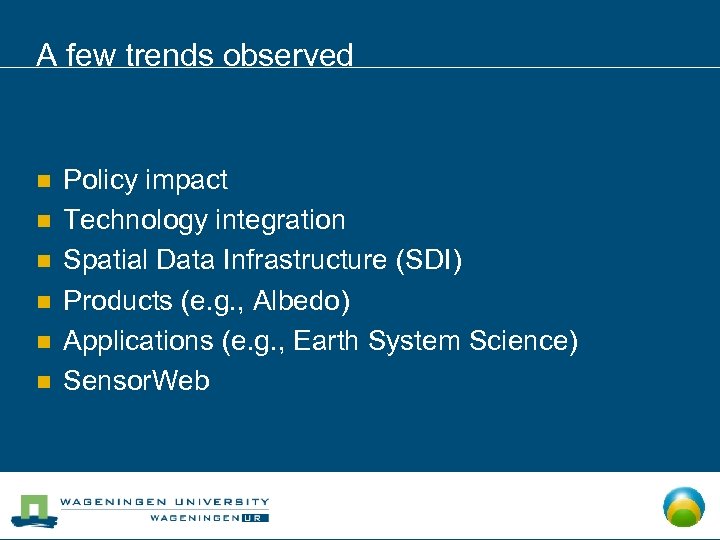
A few trends observed n n n Policy impact Technology integration Spatial Data Infrastructure (SDI) Products (e. g. , Albedo) Applications (e. g. , Earth System Science) Sensor. Web
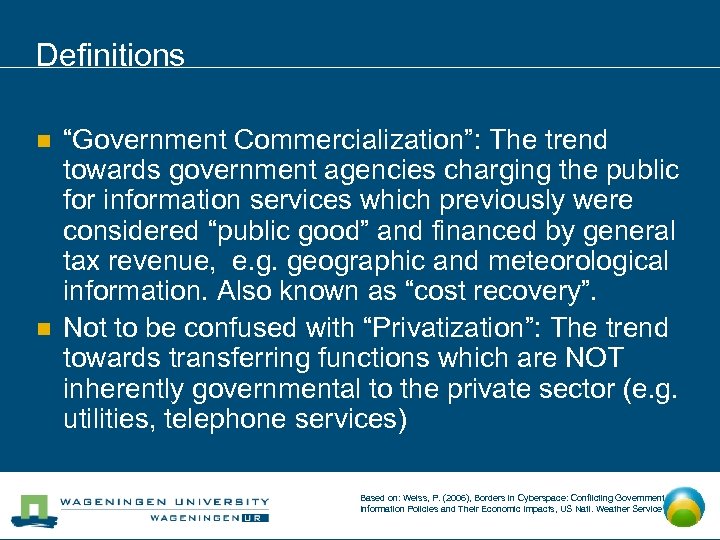
Definitions n n “Government Commercialization”: The trend towards government agencies charging the public for information services which previously were considered “public good” and financed by general tax revenue, e. g. geographic and meteorological information. Also known as “cost recovery”. Not to be confused with “Privatization”: The trend towards transferring functions which are NOT inherently governmental to the private sector (e. g. utilities, telephone services) Based on: Weiss, P. (2006), Borders in Cyberspace: Conflicting Government Information Policies and Their Economic Impacts, US Natl. Weather Service
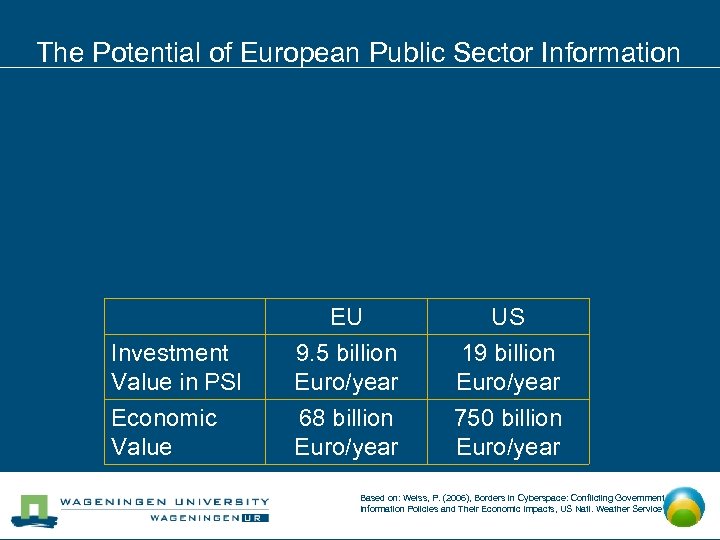
The Potential of European Public Sector Information Investment Value in PSI EU 9. 5 billion Euro/year US 19 billion Euro/year Economic Value 68 billion Euro/year 750 billion Euro/year Based on: Weiss, P. (2006), Borders in Cyberspace: Conflicting Government Information Policies and Their Economic Impacts, US Natl. Weather Service
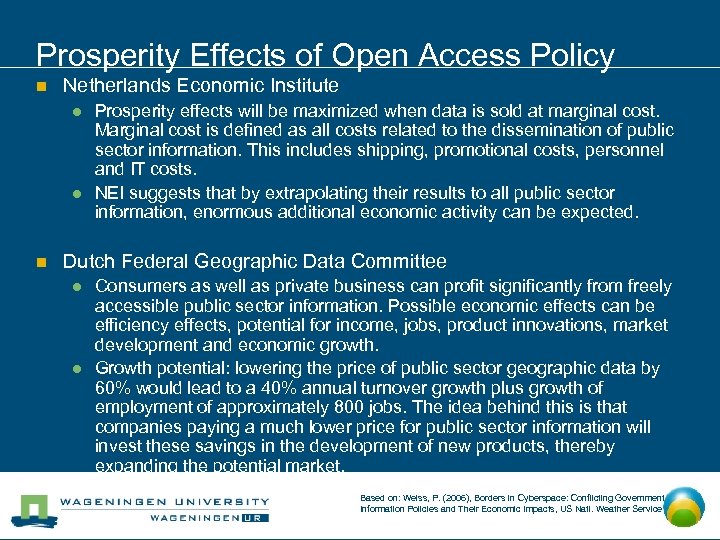
Prosperity Effects of Open Access Policy n Netherlands Economic Institute l l n Prosperity effects will be maximized when data is sold at marginal cost. Marginal cost is defined as all costs related to the dissemination of public sector information. This includes shipping, promotional costs, personnel and IT costs. NEI suggests that by extrapolating their results to all public sector information, enormous additional economic activity can be expected. Dutch Federal Geographic Data Committee l l Consumers as well as private business can profit significantly from freely accessible public sector information. Possible economic effects can be efficiency effects, potential for income, jobs, product innovations, market development and economic growth. Growth potential: lowering the price of public sector geographic data by 60% would lead to a 40% annual turnover growth plus growth of employment of approximately 800 jobs. The idea behind this is that companies paying a much lower price for public sector information will invest these savings in the development of new products, thereby expanding the potential market. Based on: Weiss, P. (2006), Borders in Cyberspace: Conflicting Government Information Policies and Their Economic Impacts, US Natl. Weather Service
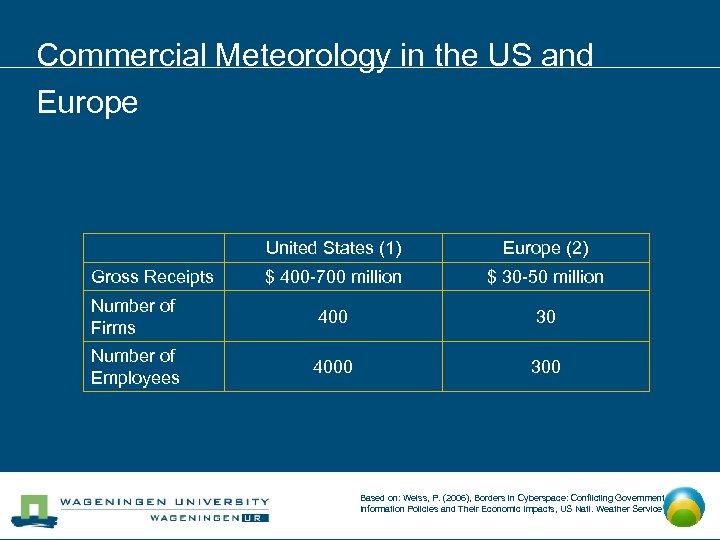
Commercial Meteorology in the US and Europe United States (1) Europe (2) $ 400 -700 million $ 30 -50 million Number of Firms 400 30 Number of Employees 4000 300 Gross Receipts Based on: Weiss, P. (2006), Borders in Cyberspace: Conflicting Government Information Policies and Their Economic Impacts, US Natl. Weather Service
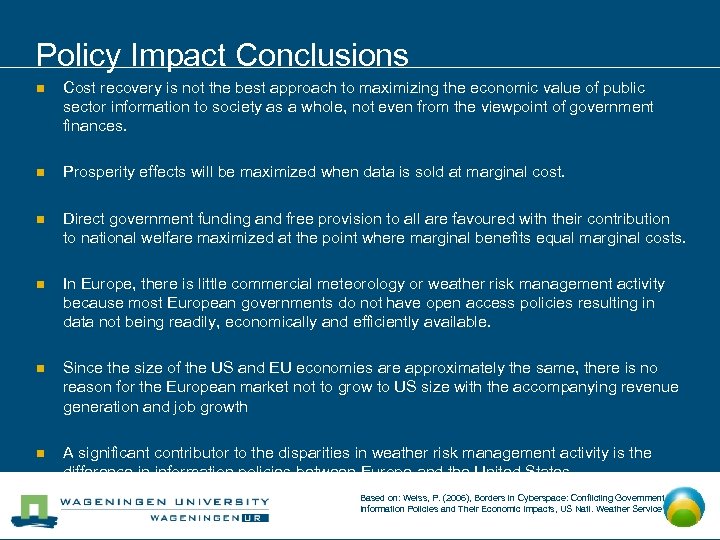
Policy Impact Conclusions n Cost recovery is not the best approach to maximizing the economic value of public sector information to society as a whole, not even from the viewpoint of government finances. n Prosperity effects will be maximized when data is sold at marginal cost. n Direct government funding and free provision to all are favoured with their contribution to national welfare maximized at the point where marginal benefits equal marginal costs. n In Europe, there is little commercial meteorology or weather risk management activity because most European governments do not have open access policies resulting in data not being readily, economically and efficiently available. n Since the size of the US and EU economies are approximately the same, there is no reason for the European market not to grow to US size with the accompanying revenue generation and job growth n A significant contributor to the disparities in weather risk management activity is the difference in information policies between Europe and the United States. Based on: Weiss, P. (2006), Borders in Cyberspace: Conflicting Government Information Policies and Their Economic Impacts, US Natl. Weather Service
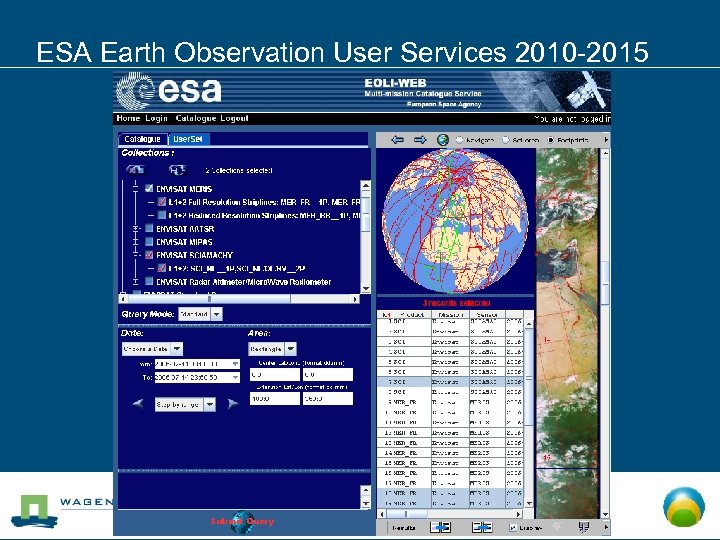
ESA Earth Observation User Services 2010 -2015
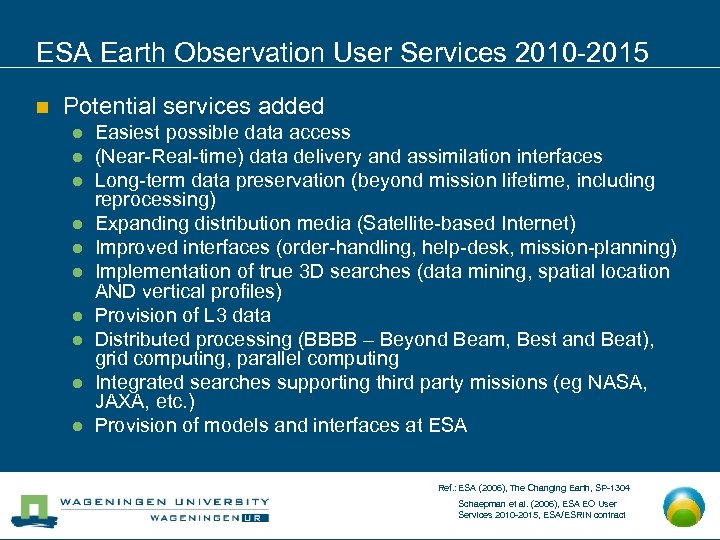
ESA Earth Observation User Services 2010 -2015 n Potential services added l l l l l Easiest possible data access (Near-Real-time) data delivery and assimilation interfaces Long-term data preservation (beyond mission lifetime, including reprocessing) Expanding distribution media (Satellite-based Internet) Improved interfaces (order-handling, help-desk, mission-planning) Implementation of true 3 D searches (data mining, spatial location AND vertical profiles) Provision of L 3 data Distributed processing (BBBB – Beyond Beam, Best and Beat), grid computing, parallel computing Integrated searches supporting third party missions (eg NASA, JAXA, etc. ) Provision of models and interfaces at ESA Ref. : ESA (2006), The Changing Earth, SP-1304 Schaepman et al. (2006), ESA EO User Services 2010 -2015, ESA/ESRIN contract
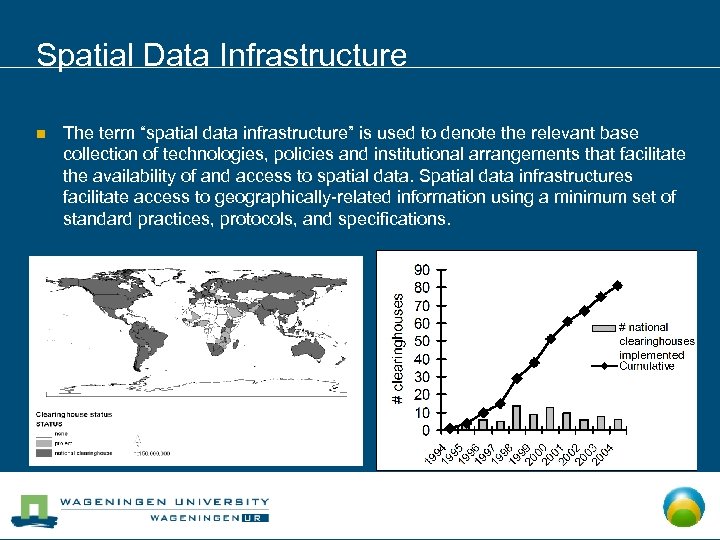
Spatial Data Infrastructure n The term “spatial data infrastructure” is used to denote the relevant base collection of technologies, policies and institutional arrangements that facilitate the availability of and access to spatial data. Spatial data infrastructures facilitate access to geographically-related information using a minimum set of standard practices, protocols, and specifications.
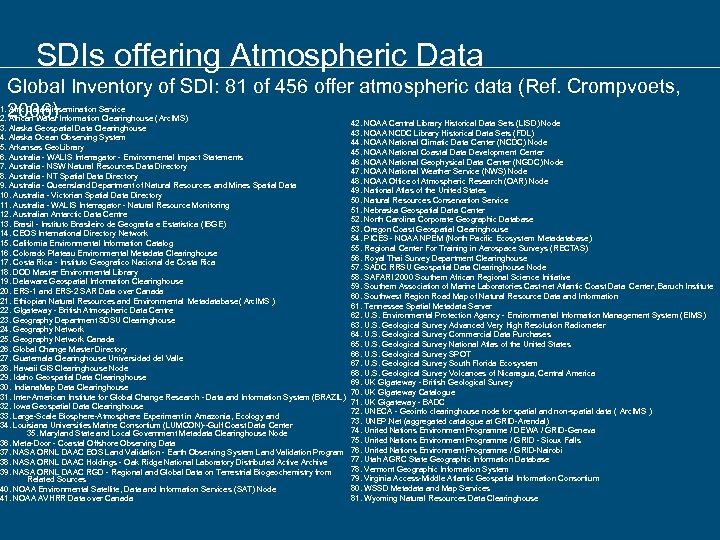
SDIs offering Atmospheric Data Global Inventory of SDI: 81 of 456 offer atmospheric data (Ref. Crompvoets, 2006) 1. Afric Data Dissemination Service 2. African Water Information Clearinghouse ( Arc. IMS) 3. Alaska Geospatial Data Clearinghouse 4. Alaska Ocean Observing System 5. Arkansas Geo. Library 6. Australia - WALIS Interragator - Environmental Impact Statements 7. Australia - NSW Natural Resources Data Directory 8. Australia - NT Spatial Data Directory 9. Australia - Queensland Department of Natural Resources and Mines Spatial Data 10. Australia - Victorian Spatial Data Directory 11. Australia - WALIS Interragator - Natural Resource Monitoring 12. Australian Antarctic Data Centre 13. Brasil - Instituto Brasileiro de Geografia e Estatistica (IBGE) 14. CEOS International Directory Network 15. California Environmental Information Catalog 16. Colorado Plateau Environmental Metadata Clearinghouse 17. Costa Rica - Instituto Geografico Nacional de Costa Rica 18. DOD Master Environmental Library 19. Delaware Geospatial Information Clearinghouse 20. ERS-1 and ERS-2 SAR Data over Canada 21. Ethiopian Natural Resources and Environmental Metadatabase( Arc. IMS ) 22. GIgateway - British Atmospheric Data Centre 23. Geography Department SDSU Clearinghouse 24. Geography Network 25. Geography Network Canada 26. Global Change Master Directory 27. Guatemala Clearinghouse Universidad del Valle 28. Hawaii GIS Clearinghouse Node 29. Idaho Geospatial Data Clearinghouse 30. Indiana. Map Data Clearinghouse 31. Inter-American Institute for Global Change Research - Data and Information System (BRAZIL) 32. Iowa Geospatial Data Clearinghouse 33. Large-Scale Biosphere-Atmosphere Experiment in Amazonia, Ecology and 34. Louisiana Universities Marine Consortium (LUMCON)--Gulf Coast Data Center 35. Maryland State and Local Government Metadata Clearinghouse Node 36. Meta-Door - Coastal Offshore Observing Data 37. NASA ORNL DAAC EOS Land Validation - Earth Observing System Land Validation Program 38. NASA ORNL DAAC Holdings - Oak Ridge National Laboratory Distributed Active Archive 39. NASA ORNL DAAC RGD - Regional and Global Data on Terrestrial Biogeochemistry from Related Sources 40. NOAA Environmental Satellite, Data and Information Services (SAT) Node 41. NOAA AVHRR Data over Canada 42. NOAA Central Library Historical Data Sets (LISD) Node 43. NOAA NCDC Library Historical Data Sets (FDL) 44. NOAA National Climatic Data Center (NCDC) Node 45. NOAA National Coastal Data Development Center 46. NOAA National Geophysical Data Center (NGDC) Node 47. NOAA National Weather Service (NWS) Node 48. NOAA Office of Atmospheric Research (OAR) Node 49. National Atlas of the United States 50. Natural Resources Conservation Service 51. Nebraska Geospatial Data Center 52. North Carolina Corporate Geographic Database 53. Oregon Coast Geospatial Clearinghouse 54. PICES - NOAA NPEM (North Pacific Ecosystem Metadatabase) 55. Regional Center For Training in Aerospace Surveys (RECTAS) 56. Royal Thai Survey Department Clearinghouse 57. SADC RRSU Geospatial Data Clearinghouse Node 58. SAFARI 2000 Southern African Regional Science Initiative 59. Southern Association of Marine Laboratories Cast-net Atlantic Coast Data Center, Baruch Institute 60. Southwest Region Road Map of Natural Resource Data and Information 61. Tennessee Spatial Metadata Server 62. U. S. Environmental Protection Agency - Environmental Information Management System (EIMS) 63. U. S. Geological Survey Advanced Very High Resolution Radiometer 64. U. S. Geological Survey Commercial Data Purchases 65. U. S. Geological Survey National Atlas of the United States 66. U. S. Geological Survey SPOT 67. U. S. Geological Survey South Florida Ecosystem 68. U. S. Geological Survey Volcanoes of Nicaragua, Central America 69. UK GIgateway - British Geological Survey 70. UK GIgateway Catalogue 71. UK Gigateway - BADC 72. UNECA - Geoinfo clearinghouse node for spatial and non-spatial data ( Arc. IMS ) 73. UNEP. Net (aggregated catalogue at GRID- Arendal) 74. United Nations Environment Programme / DEWA / GRID-Geneva 75. United Nations Environment Programme / GRID - Sioux Falls 76. United Nations Environment Programme / GRID-Nairobi 77. Utah AGRC State Geographic Information Database 78. Vermont Geographic Information System 79. Virginia Access-Middle Atlantic Geospatial Information Consortium 80. WSSD Metadata and Map Services 81. Wyoming Natural Resources Data Clearinghouse

Products “Primarily, the chief trouble in straigthening out the matter of albedo has arisen from the fact that the term itself is used in different senses by different writers and sometimes by the same writer. ” Louis Bell, 1917
Products – Albedo n n n n Product variety Semantic interoperability Sensitivity requirements l Lucht, W. (2000): ''In current general circulation models (GCMs), land surface albedo is one important source of radiative uncertainties. Climate modeling requires albedo with an absolute accuracy of +-0. 05 according to Henderson-Sellers and Wilson (1983) and of +-0. 02 according to Sellers (1993). Terminology (‘Coloured’-Sky Albedo, spectral Albedo, geometrical Albedo) Land surface Albedo (Blue-Sky Albedo) Land surface Albedo (Heterogeneity around FLUXNET towers) Radiative transfer of partly clouded atmospheres (combined White/Black-Sky Albedo (Pinty, JGR 2005)) Ref. : Schaepman-Strub, G. et al. (2006), What’s in a Satellite Albedo Product? , EGU
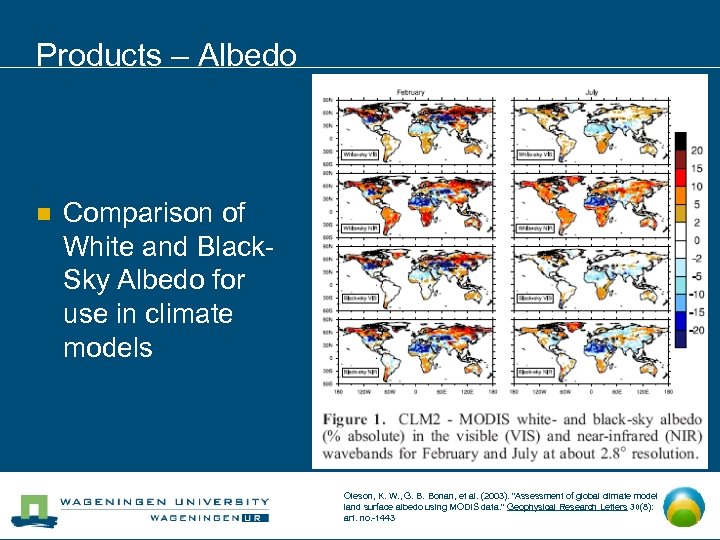
Products – Albedo n Comparison of White and Black. Sky Albedo for use in climate models Oleson, K. W. , G. B. Bonan, et al. (2003). "Assessment of global climate model land surface albedo using MODIS data. " Geophysical Research Letters 30(8): art. no. -1443
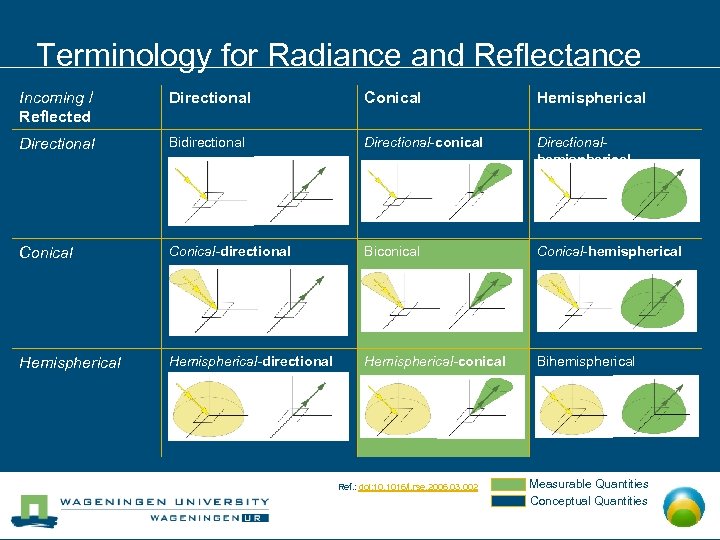
Terminology for Radiance and Reflectance Incoming / Reflected Directional Conical Hemispherical Directional Bidirectional Directional-conical Directionalhemispherical Conical-directional Biconical Conical-hemispherical Hemispherical-directional Hemispherical-conical Bihemispherical Ref. : doi: 10. 1016/j. rse. 2006. 03. 002 Measurable Quantities Conceptual Quantities
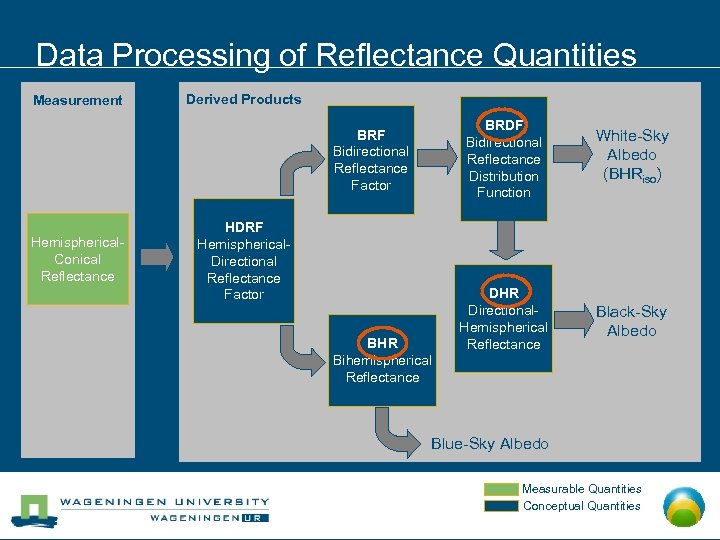
Data Processing of Reflectance Quantities Measurement Derived Products BRDF Bidirectional Reflectance Distribution Function BRF Bidirectional Reflectance Factor Hemispherical. Conical Reflectance HDRF Hemispherical. Directional Reflectance Factor BHR Bihemispherical Reflectance White-Sky Albedo (BHRiso) DHR Directional. Hemispherical Reflectance Black-Sky Albedo Blue-Sky Albedo Measurable Quantities Conceptual Quantities
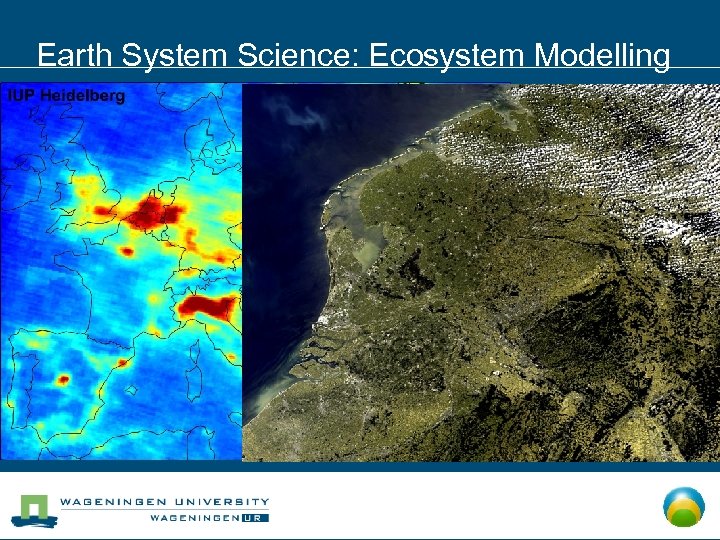
Earth System Science: Ecosystem Modelling
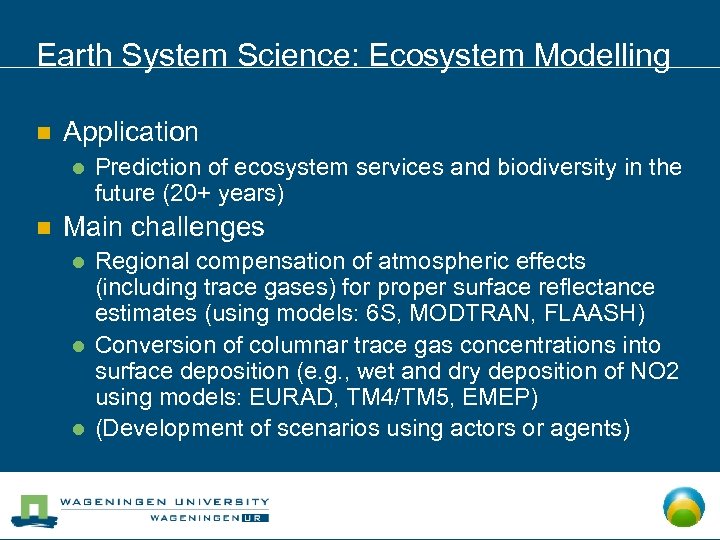
Earth System Science: Ecosystem Modelling n Application l n Prediction of ecosystem services and biodiversity in the future (20+ years) Main challenges l l l Regional compensation of atmospheric effects (including trace gases) for proper surface reflectance estimates (using models: 6 S, MODTRAN, FLAASH) Conversion of columnar trace gas concentrations into surface deposition (e. g. , wet and dry deposition of NO 2 using models: EURAD, TM 4/TM 5, EMEP) (Development of scenarios using actors or agents)
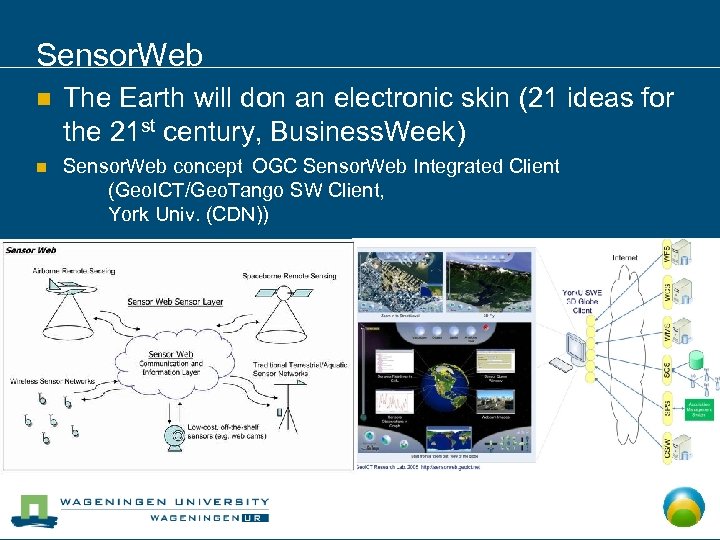
Sensor. Web n The Earth will don an electronic skin (21 ideas for the 21 st century, Business. Week) n Sensor. Web concept OGC Sensor. Web Integrated Client (Geo. ICT/Geo. Tango SW Client, York Univ. (CDN))
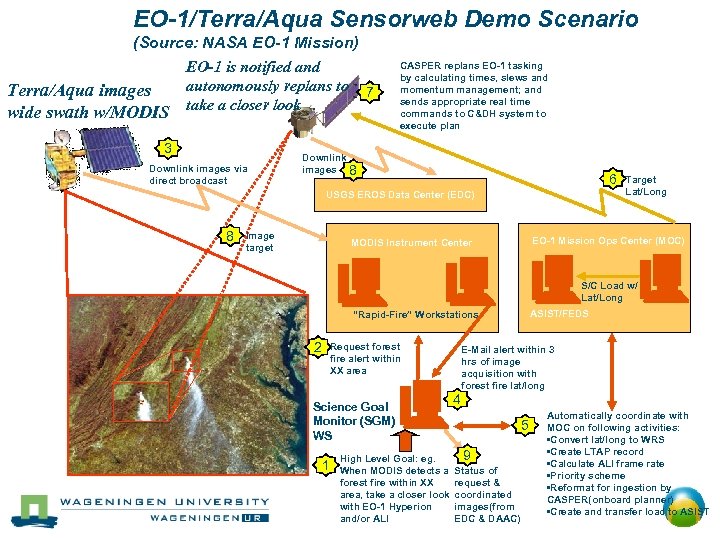
EO-1/Terra/Aqua Sensorweb Demo Scenario (Source: NASA EO-1 Mission) EO-1 is notified and autonomously replans to 7 Terra/Aqua images take a closer look EO-1 Sensor. Web Demo wide swath w/MODIS 3 Downlink images via direct broadcast CASPER replans EO-1 tasking by calculating times, slews and momentum management; and sends appropriate real time commands to C&DH system to execute plan Downlink images 8 6 USGS EROS Data Center (EDC) 8 Image target Target Lat/Long EO-1 Mission Ops Center (MOC) MODIS Instrument Center S/C Load w/ Lat/Long ASIST/FEDS “Rapid-Fire” Workstations 2 Request forest fire alert within XX area Science Goal Monitor (SGM) WS 1 High Level Goal: eg. When MODIS detects a forest fire within XX area, take a closer look with EO-1 Hyperion and/or ALI E-Mail alert within 3 hrs of image acquisition with forest fire lat/long 4 5 9 Status of request & coordinated images(from EDC & DAAC) Automatically coordinate with MOC on following activities: • Convert lat/long to WRS • Create LTAP record • Calculate ALI frame rate • Priority scheme • Reformat for ingestion by CASPER(onboard planner) • Create and transfer load to ASIST
Conclusions n n Atmospheric data access for the geo-spatial user community is an emerging topic! Trends indicate a general increase of atmospheric data use, in particular in the non-classical domains Policy and technology seem to offer plenty of opportunities for enhanced access and use Scientific and operational integration represent most of the challenge

Thank you for your attention! © Wageningen UR
Скачать презентацию ADAGUC — Application Benefits for the Geospatial User
9ec10ed0db791ca52892ca9aa081de78.ppt