


 Скачать презентацию Ad-hoc Networking ADEDAMOLA O SALAKO AMIEE MRes in
31bd2b888f6937e513fb530079addaf8.ppt
- Количество слайдов: 23
 Ad-hoc Networking ADEDAMOLA O. SALAKO (AMIEE) MRes in Telecommunications Department of Electronic & Electrical Engineering University College London mt 01002@ee. ucl. ac. uk
 Outline • Ad-Hoc Networking? • Why? • What? • How? • When? : Past, Present, Future
 Scenario • The advent of cheap microprocessors and wireless technologies • Trend: ~1000 computer devices/person by 2010
 Use Cases
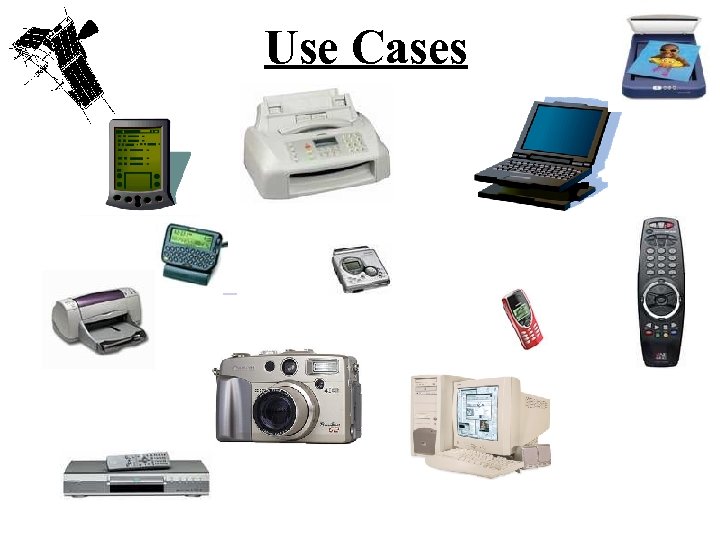
 Possibilities • Telephones (cellular, cordless, other) • Cordless multimedia (headsets, speakers, mic. ) • Portable computers (Laptops, desktop, other) • Cordless computer peripherals (keyboard, mouse) • LAN – Local Area Network peripherals (printer, fax) • PDAs - Personal Digital Assistants (palm top/pilot) • Digital cameras and… the only limitation is your imagination
 Ad-…what? Ad-hoc network… …a LAN or other small network, …with wireless connections …devices are part of the network only for the duration of a communications session or… …while in close proximity to the network
 Ad-hoc Networking Collection of wireless mobile nodes (devices) dynamically forming a temporary network without the use of any existing network infrastructure or centralized administration An ubiquitous type of computing often referred to as pervasive/invisible computing • Ubiquitous: Present, appearing, or found everywhere… • Pervasive: Spread through or into every part of…
 Properties • Requires devices to cooperate autonomously • Without user intervention • Rapid self-organizing wireless network • Independent of infrastructure • Heterogeneous & adaptive
 Why? Microprocessor embedding trend in: • cellular phones, car stereos, televisions, VCRs, watches, GPS (Global Positioning System) receivers, digital camera. • Ensembles of computational devices for: • environmental monitoring • personal area networks • geophysical measurement
 How? Transmission Standards: 1. Piconet 2. Home. RF (Radio Frequency) 3. IEEE 802. 11 Wireless LAN WG (Working Group) 4. Bluetooth SIG (Special Interest Group) • These above use radio waves from licence-exempt ISM (Industrial, Scientific and Medical) frequency band - around 2. 4 GHz 5. Ir. DA (Infra. Red Data Association) • which uses infrared instead of radio waves
 Piconet • A general purpose, low-powered, ad-hoc network • It allows two devices near each other to inter-operate • These devices can be either mobile or fixed • The range is said to be reasonably short
 Home. RF Uses Shared Wireless Access Protocol (SWAP) system • carries both voice and data traffic • inter-operate with the PSTN (Public Switched Telephone Network) and the Internet • the range covers typical home and yard
 IEEE 802. 11 Wireless LAN The principles of Wireless Local Area Network (WLAN) are defined in IEEE 802. 11 standard • It defines two different topologies: ad-hoc network and infrastructure network • This ad-hoc network is able to use only created wireless connection instead of fixed infrastructure
 Bluetooth • The code name for an open specification for short-range wireless connectivity • Effortless, instant wireless connections between a wide range of communication devices in a small environment • The BT range restricts the environment to about 10 meters • Used in virtually any mobile device like that can have Bluetooth radios integrated into them
 Ir. DA Infrared • based on technology similar to the remote control devices • high-speed short range, point-to-point cordless data transfer • in-room cordless peripherals to host-PC • maturity and standardization activities advantage over radio • line-of-sight requirement disadvantage
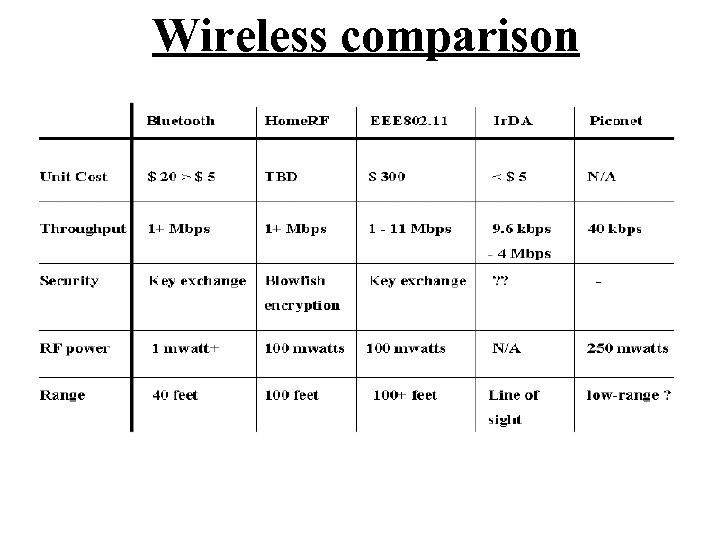 Wireless comparison
 Applications Some current deployments, research and prospects • Cybiko • Sensor Networks e. g. “Smart Dust” • Mobile Commerce (M-Commerce) - proposed
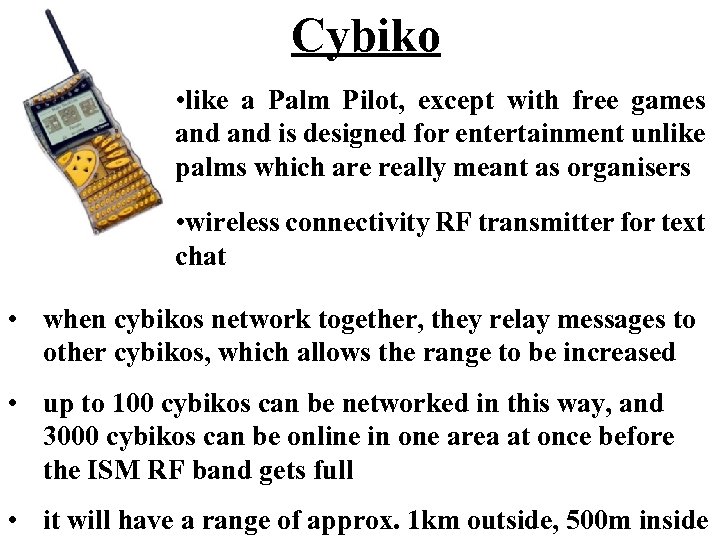 Cybiko • like a Palm Pilot, except with free games and is designed for entertainment unlike palms which are really meant as organisers • wireless connectivity RF transmitter for text chat • when cybikos network together, they relay messages to other cybikos, which allows the range to be increased • up to 100 cybikos can be networked in this way, and 3000 cybikos can be online in one area at once before the ISM RF band gets full • it will have a range of approx. 1 km outside, 500 m inside
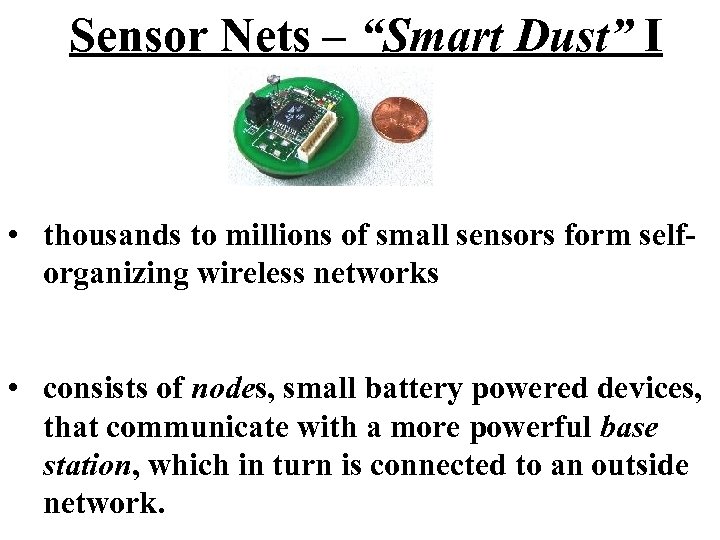 Sensor Nets – “Smart Dust” I • thousands to millions of small sensors form selforganizing wireless networks • consists of nodes, small battery powered devices, that communicate with a more powerful base station, which in turn is connected to an outside network.
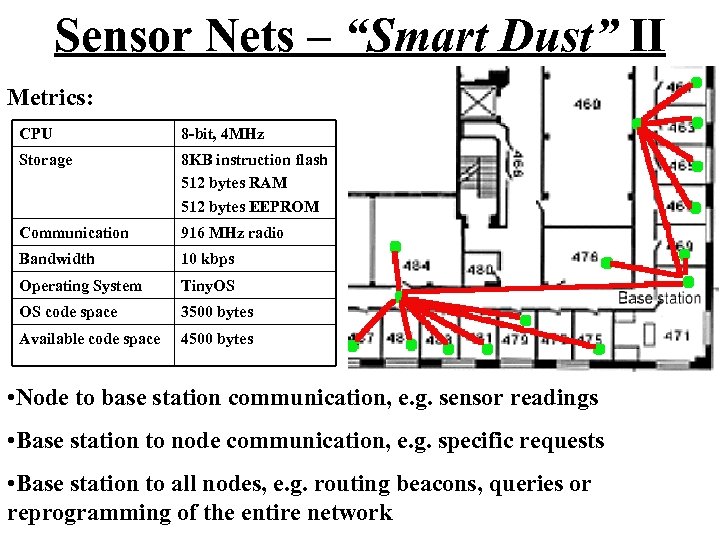 Sensor Nets – “Smart Dust” II Metrics: CPU 8 -bit, 4 MHz Storage 8 KB instruction flash 512 bytes RAM 512 bytes EEPROM Communication 916 MHz radio Bandwidth 10 kbps Operating System Tiny. OS OS code space 3500 bytes Available code space 4500 bytes • Node to base station communication, e. g. sensor readings • Base station to node communication, e. g. specific requests • Base station to all nodes, e. g. routing beacons, queries or reprogramming of the entire network
 M-Commerce • Mobile phones to extend the possibilities of commerce • make commerce platforms more important • electronic and mobile commerce transactions will be open for wide markets
 Issues & Interests • What do you see as the next interesting things in mobile computing? • What potential do you see for wireless networks? • What do you see as the hardest things for us to address? Security for one! • If you could wish for one key piece of technology to come true (for mobility), what would it be?
 Questions? Ad-hoc Networking ADEDAMOLA O. SALAKO (AMIEE) MRes in Telecommunications Department of Electronic & Electrical Engineering University College London mt 01002@ee. ucl. ac. uk