 Скачать презентацию Ad-hoc에서의 Autoconfiguration 기술 안소연 정재훈 ICU ETRI syahn icu
de2b4d1540a0ccb68bc557d6f80cc911.ppt
- Количество слайдов: 31



Ad-hoc에서의 Autoconfiguration 기술 안소연, 정재훈 (ICU, ETRI) syahn@icu. ac. kr, paul@etri. re. kr 1
Contents n n Introduction Ad-hoc Routing Protocols Autoconfiguration Technology for IPv 6 MANET Conclusion 2
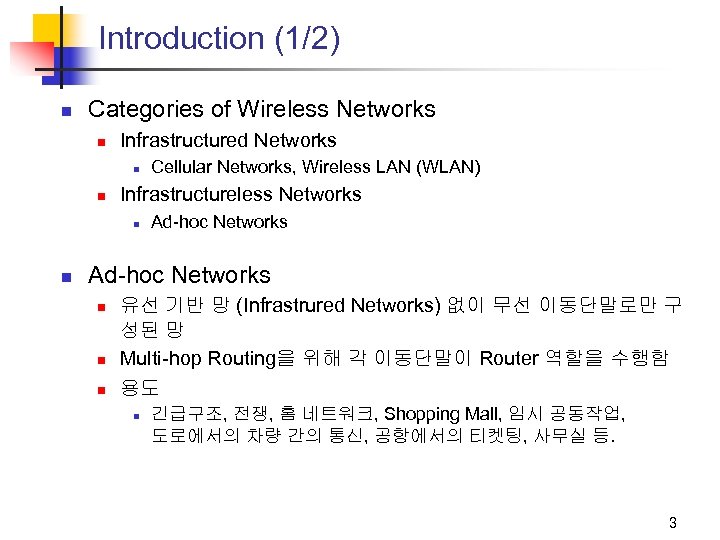
Introduction (1/2) n Categories of Wireless Networks n Infrastructured Networks n n Infrastructureless Networks n n Cellular Networks, Wireless LAN (WLAN) Ad-hoc Networks n n n 유선 기반 망 (Infrastrured Networks) 없이 무선 이동단말로만 구 성된 망 Multi-hop Routing을 위해 각 이동단말이 Router 역할을 수행함 용도 n 긴급구조, 전쟁, 홈 네트워크, Shopping Mall, 임시 공동작업, 도로에서의 차량 간의 통신, 공항에서의 티켓팅, 사무실 등. 3
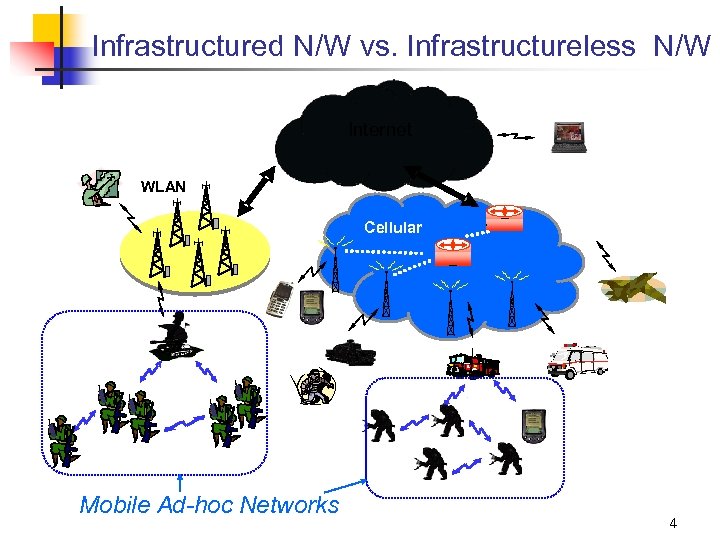
Infrastructured N/W vs. Infrastructureless N/W Internet WLAN Cellular Mobile Ad-hoc Networks 4
Introduction (2/2) n MANET에서의 이슈 n n Ad-hoc Unicast Routing Ad-hoc Multicast/Broadcast Routing Power Saving Automatic Support of Networking Facility in MANET n n Autoconfiguration Technology Global Connectivity for MANET 5
Ad-hoc Routing Protocols 6
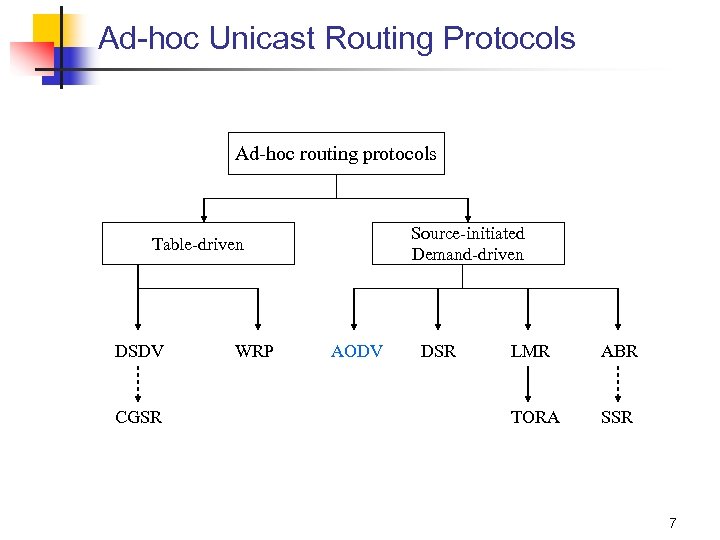
Ad-hoc Unicast Routing Protocols Ad-hoc routing protocols Source-initiated Demand-driven Table-driven DSDV CGSR WRP AODV DSR LMR ABR TORA SSR 7
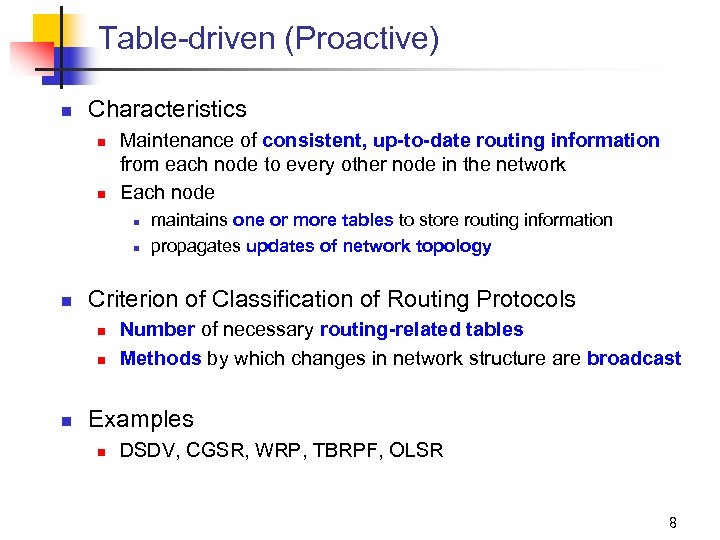
Table-driven (Proactive) n Characteristics n n Maintenance of consistent, up-to-date routing information from each node to every other node in the network Each node n n n Criterion of Classification of Routing Protocols n n n maintains one or more tables to store routing information propagates updates of network topology Number of necessary routing-related tables Methods by which changes in network structure are broadcast Examples n DSDV, CGSR, WRP, TBRPF, OLSR 8
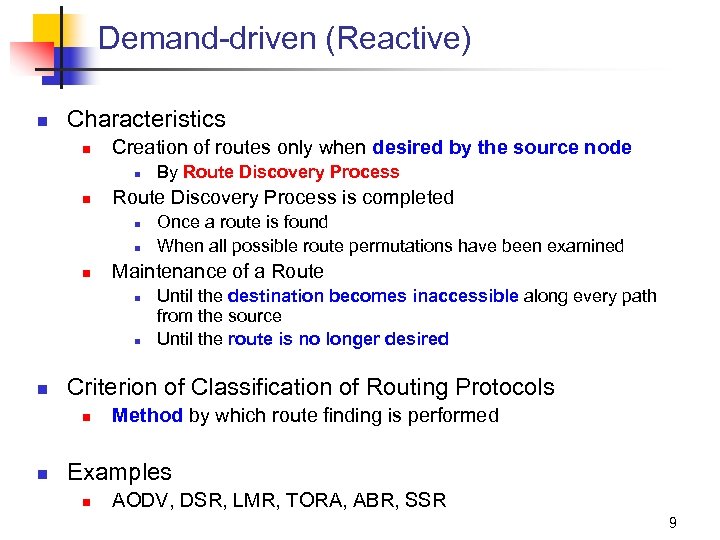
Demand-driven (Reactive) n Characteristics n Creation of routes only when desired by the source node n n Route Discovery Process is completed n n Until the destination becomes inaccessible along every path from the source Until the route is no longer desired Criterion of Classification of Routing Protocols n n Once a route is found When all possible route permutations have been examined Maintenance of a Route n n By Route Discovery Process Method by which route finding is performed Examples n AODV, DSR, LMR, TORA, ABR, SSR 9
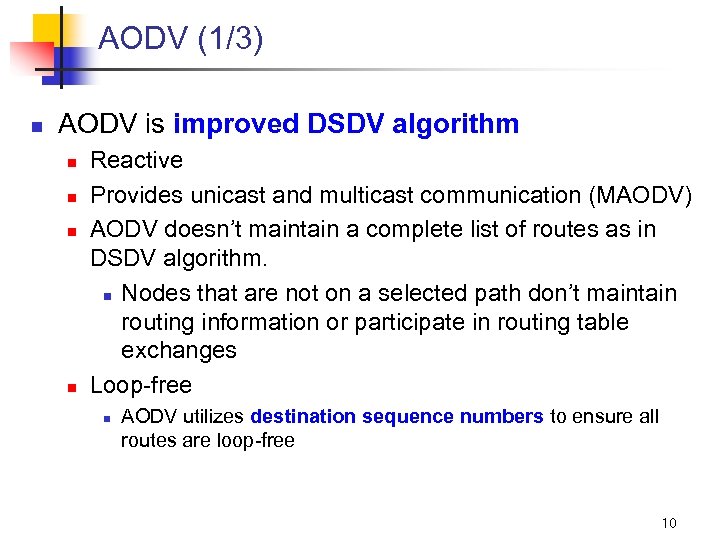
AODV (1/3) n AODV is improved DSDV algorithm n n Reactive Provides unicast and multicast communication (MAODV) AODV doesn’t maintain a complete list of routes as in DSDV algorithm. n Nodes that are not on a selected path don’t maintain routing information or participate in routing table exchanges Loop-free n AODV utilizes destination sequence numbers to ensure all routes are loop-free 10
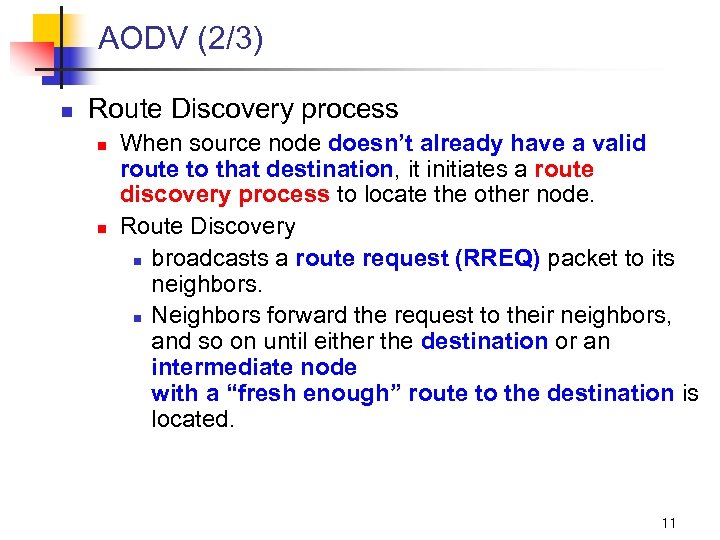
AODV (2/3) n Route Discovery process n n When source node doesn’t already have a valid route to that destination, it initiates a route discovery process to locate the other node. Route Discovery n broadcasts a route request (RREQ) packet to its neighbors. n Neighbors forward the request to their neighbors, and so on until either the destination or an intermediate node with a “fresh enough” route to the destination is located. 11
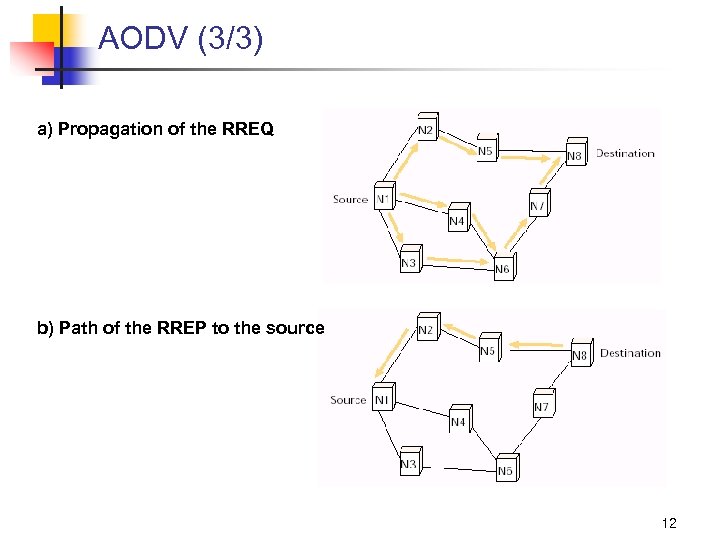
AODV (3/3) a) Propagation of the RREQ b) Path of the RREP to the source 12
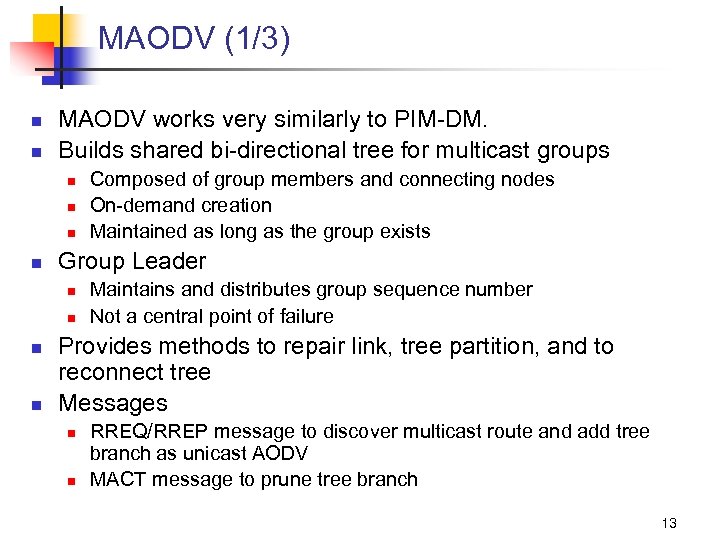
MAODV (1/3) n n MAODV works very similarly to PIM-DM. Builds shared bi-directional tree for multicast groups n n Group Leader n n Composed of group members and connecting nodes On-demand creation Maintained as long as the group exists Maintains and distributes group sequence number Not a central point of failure Provides methods to repair link, tree partition, and to reconnect tree Messages n n RREQ/RREP message to discover multicast route and add tree branch as unicast AODV MACT message to prune tree branch 13
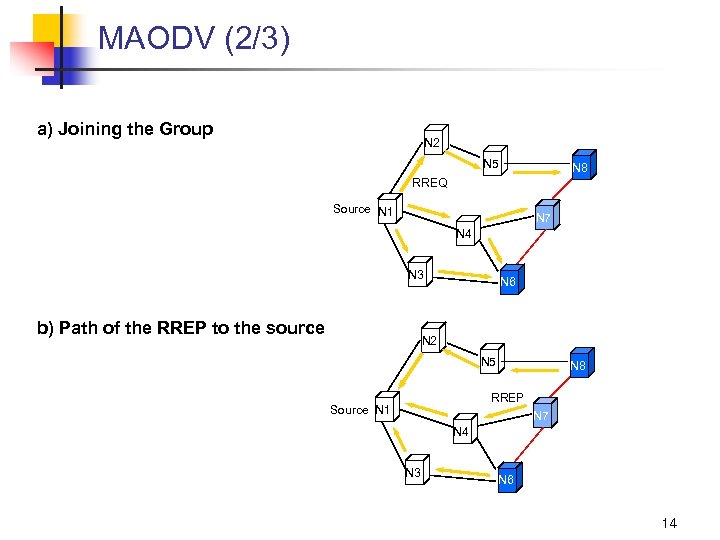
MAODV (2/3) a) Joining the Group N 2 N 5 N 8 RREQ Source N 1 N 7 N 4 N 3 b) Path of the RREP to the source N 6 N 2 N 5 N 8 RREP Source N 1 N 7 N 4 N 3 N 6 14
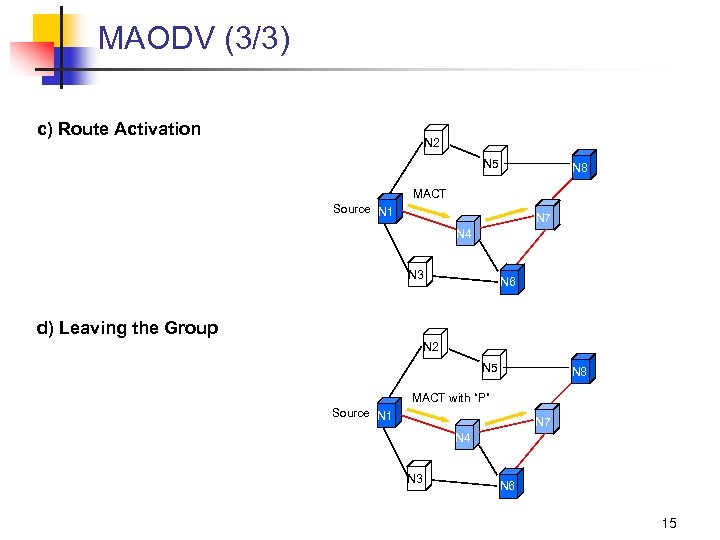
MAODV (3/3) c) Route Activation N 2 N 5 N 8 MACT Source N 1 N 7 N 4 N 3 N 6 d) Leaving the Group N 2 N 5 N 8 MACT with “P” Source N 1 N 7 N 4 N 3 N 6 15
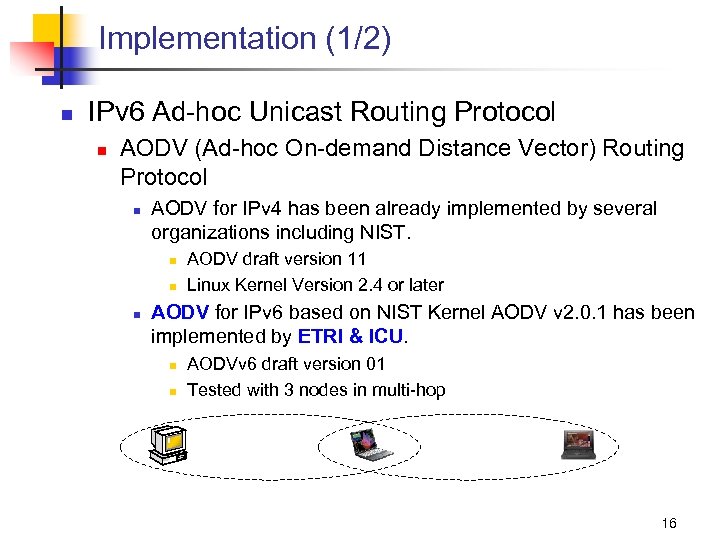
Implementation (1/2) n IPv 6 Ad-hoc Unicast Routing Protocol n AODV (Ad-hoc On-demand Distance Vector) Routing Protocol n AODV for IPv 4 has been already implemented by several organizations including NIST. n n n AODV draft version 11 Linux Kernel Version 2. 4 or later AODV for IPv 6 based on NIST Kernel AODV v 2. 0. 1 has been implemented by ETRI & ICU. n n AODVv 6 draft version 01 Tested with 3 nodes in multi-hop 16
Implementation (2/2) n IPv 6 Ad-hoc Multicast Routing Protocol n MAODV (Multicast AODV) Routing Protocol n MAODV for IPv 4 and IPv 6 have been being implemented by ETRI & ICU. n n MAODV draft version 00 Homepage http: //cnlab. icu. ac. kr/project/Adhoc. Project. html 17
Autoconfiguration Technology for IPv 6 MANET Autoconfiguration Technology? § Autoconfiguration Technology for IPv 6 MANET § Unicast Address Autoconfiguration § Multicast Name Resolution § Service Discovery § 18
Autoconfiguration Technology? n What is Autoconfiguration? n n Why is Autoconfiguration needed? n n The technology that let IP-enabled devices be able to communicate one another in infrastructureless environment. To provide hosts with the automatic configuration related to networking. To let it possible for hosts communicate when either dynamic or static configuration is impossible. To provide the quick and easy configuration related to the network facility in MANET environment. | Issues of IETF Zeroconf Working Group n n Unicast Address Autoconfiguration Multicast Address Allocation Name Resolution (DNS) Service Discovery 19
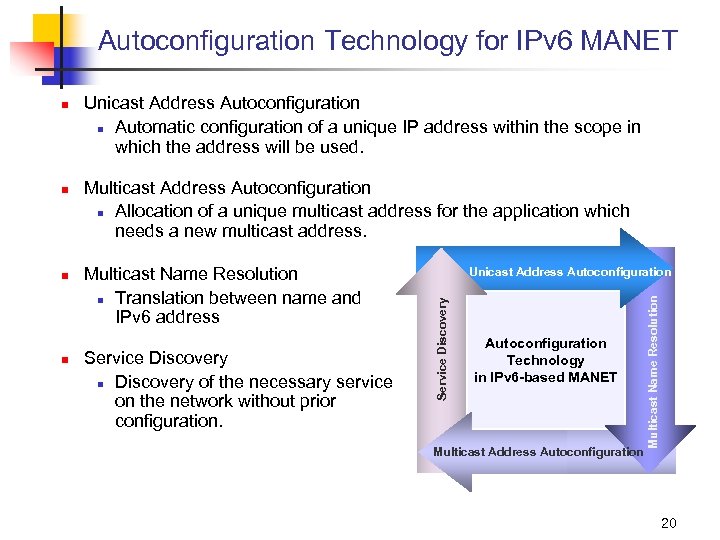
Autoconfiguration Technology for IPv 6 MANET n n Multicast Address Autoconfiguration n Allocation of a unique multicast address for the application which needs a new multicast address. Multicast Name Resolution n Translation between name and IPv 6 address Service Discovery n Discovery of the necessary service on the network without prior configuration. Unicast Address Autoconfiguration Technology in IPv 6 -based MANET Multicast Address Autoconfiguration Multicast Name Resolution n Unicast Address Autoconfiguration n Automatic configuration of a unique IP address within the scope in which the address will be used. Service Discovery n 20
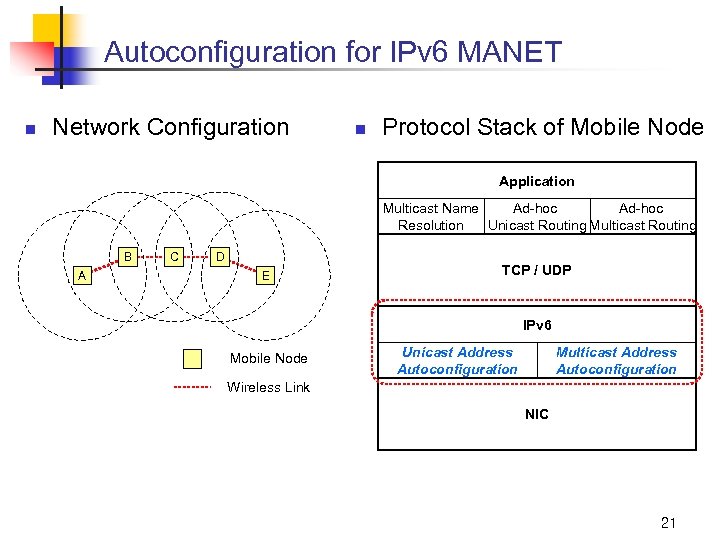
Autoconfiguration for IPv 6 MANET n Network Configuration n Protocol Stack of Mobile Node Application Multicast Name Ad-hoc Resolution Unicast Routing Multicast Routing B A C D E TCP / UDP IPv 6 Mobile Node Unicast Address Autoconfiguration Multicast Address Autoconfiguration Wireless Link NIC 21
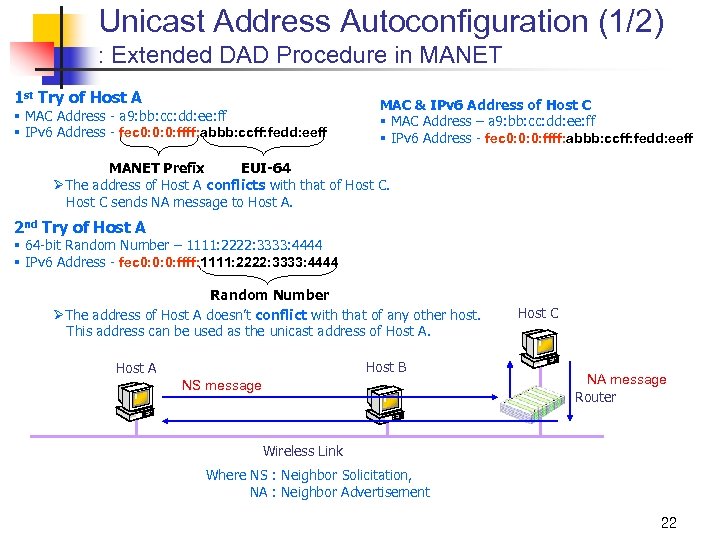
Unicast Address Autoconfiguration (1/2) : Extended DAD Procedure in MANET 1 st Try of Host A § MAC Address - a 9: bb: cc: dd: ee: ff § IPv 6 Address - fec 0: 0: 0: ffff: abbb: ccff: fedd: eeff MAC & IPv 6 Address of Host C § MAC Address – a 9: bb: cc: dd: ee: ff § IPv 6 Address - fec 0: 0: 0: ffff: abbb: ccff: fedd: eeff MANET Prefix EUI-64 ØThe address of Host A conflicts with that of Host C sends NA message to Host A. 2 nd Try of Host A § 64 -bit Random Number – 1111: 2222: 3333: 4444 § IPv 6 Address - fec 0: 0: 0: ffff: 1111: 2222: 3333: 4444 Random Number ØThe address of Host A doesn’t conflict with that of any other host. This address can be used as the unicast address of Host A. Host B Host A NS message Host C NA message Router Wireless Link Where NS : Neighbor Solicitation, NA : Neighbor Advertisement 22
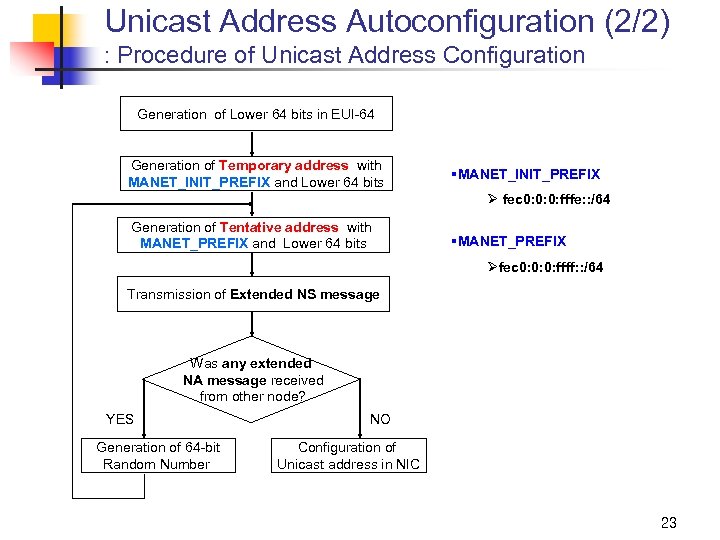
Unicast Address Autoconfiguration (2/2) : Procedure of Unicast Address Configuration Generation of Lower 64 bits in EUI-64 Generation of Temporary address with MANET_INIT_PREFIX and Lower 64 bits §MANET_INIT_PREFIX Ø fec 0: 0: 0: fffe: : /64 Generation of Tentative address with MANET_PREFIX and Lower 64 bits §MANET_PREFIX Øfec 0: 0: 0: ffff: : /64 Transmission of Extended NS message Was any extended NA message received from other node? YES Generation of 64 -bit Random Number NO Configuration of Unicast address in NIC 23
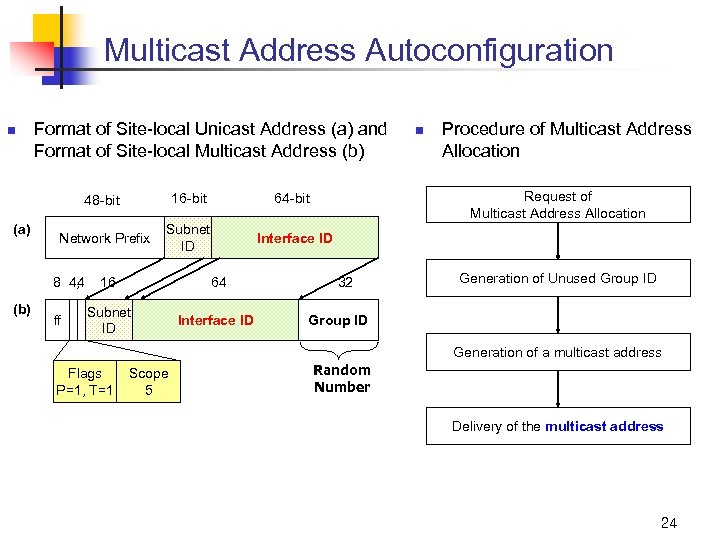
Multicast Address Autoconfiguration n Format of Site-local Unicast Address (a) and Format of Site-local Multicast Address (b) 16 -bit 64 -bit Network Prefix Subnet ID Interface ID 8 4, 4 (b) Procedure of Multicast Address Allocation Request of Multicast Address Allocation 48 -bit (a) n ff 16 64 Subnet ID Interface ID 32 Generation of Unused Group ID Generation of a multicast address Flags P=1, T=1 Scope 5 Random Number Delivery of the multicast address 24
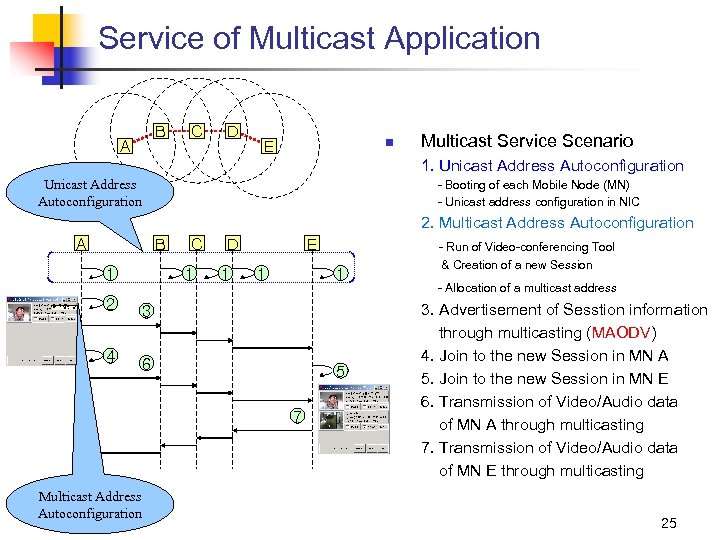
Service of Multicast Application B A C D n E Multicast Service Scenario 1. Unicast Address Autoconfiguration - Booting of each Mobile Node (MN) - Unicast address configuration in NIC 2. Multicast Address Autoconfiguration A B 1 C 1 2 1 E 1 - Run of Video-conferencing Tool 1 3 4 D 6 5 7 Multicast Address Autoconfiguration & Creation of a new Session - Allocation of a multicast address 3. Advertisement of Sesstion information through multicasting (MAODV) 4. Join to the new Session in MN A 5. Join to the new Session in MN E 6. Transmission of Video/Audio data of MN A through multicasting 7. Transmission of Video/Audio data of MN E through multicasting 25
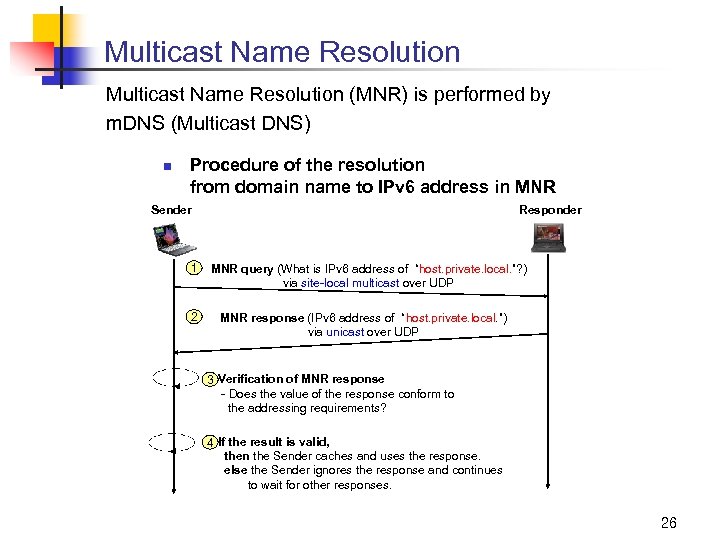
Multicast Name Resolution (MNR) is performed by m. DNS (Multicast DNS) n Procedure of the resolution from domain name to IPv 6 address in MNR Sender 1 2 Responder MNR query (What is IPv 6 address of “host. private. local. ”? ) via site-local multicast over UDP MNR response (IPv 6 address of “host. private. local. ”) via unicast over UDP 3 Verification of MNR response - Does the value of the response conform to the addressing requirements? 4 If the result is valid, then the Sender caches and uses the response. else the Sender ignores the response and continues to wait for other responses. 26
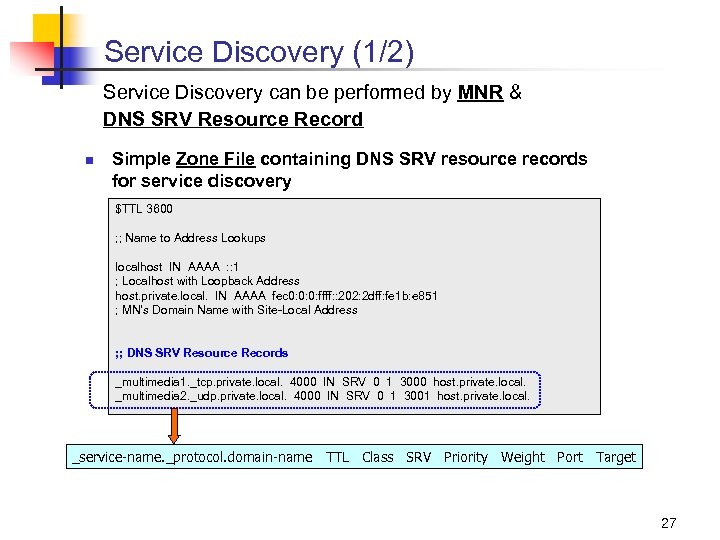
Service Discovery (1/2) Service Discovery can be performed by MNR & DNS SRV Resource Record n Simple Zone File containing DNS SRV resource records for service discovery $TTL 3600 ; ; Name to Address Lookups localhost IN AAAA : : 1 ; Localhost with Loopback Address host. private. local. IN AAAA fec 0: 0: 0: ffff: : 202: 2 dff: fe 1 b: e 851 ; MN’s Domain Name with Site-Local Address ; ; DNS SRV Resource Records _multimedia 1. _tcp. private. local. 4000 IN SRV 0 1 3000 host. private. local. _multimedia 2. _udp. private. local. 4000 IN SRV 0 1 3001 host. private. local. _service-name. _protocol. domain-name TTL Class SRV Priority Weight Port Target 27
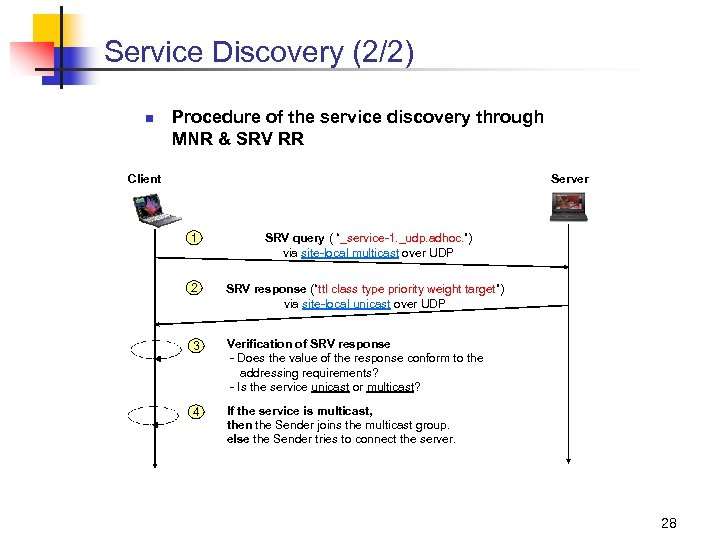
Service Discovery (2/2) n Procedure of the service discovery through MNR & SRV RR Client Server 1 SRV query ( “_service-1. _udp. adhoc. ”) via site-local multicast over UDP 2 SRV response (“ttl class type priority weight target”) via site-local unicast over UDP 3 Verification of SRV response - Does the value of the response conform to the addressing requirements? - Is the service unicast or multicast? 4 If the service is multicast, then the Sender joins the multicast group. else the Sender tries to connect the server. 28
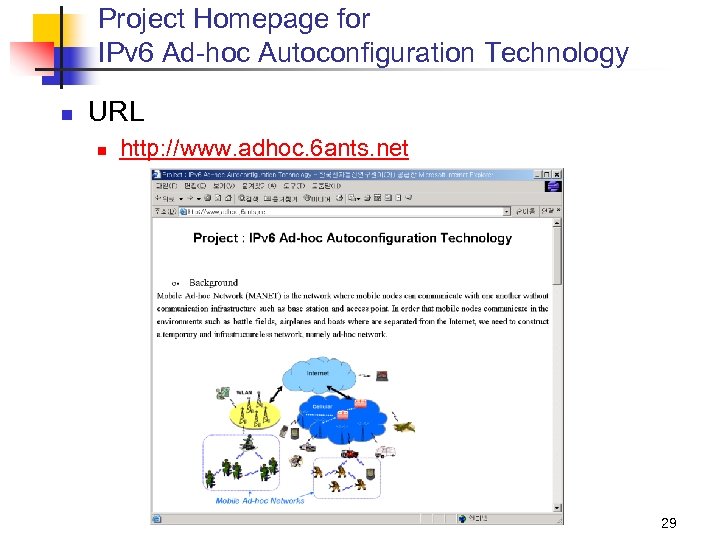
Project Homepage for IPv 6 Ad-hoc Autoconfiguration Technology n URL n http: //www. adhoc. 6 ants. net 29
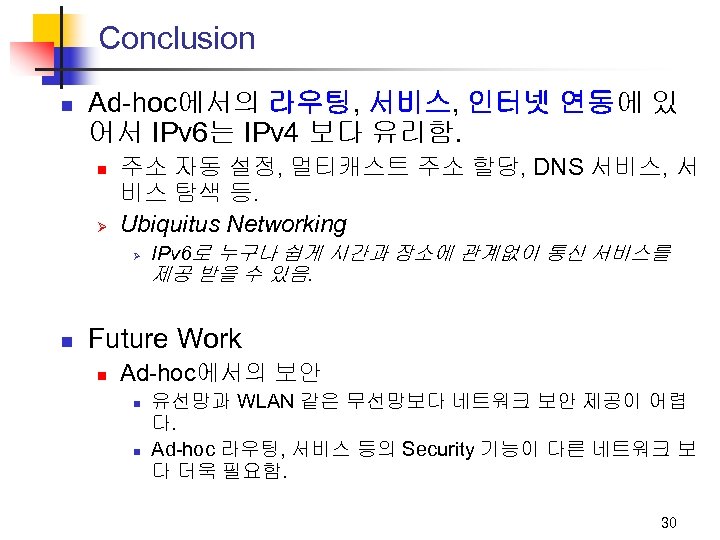
Conclusion n Ad-hoc에서의 라우팅, 서비스, 인터넷 연동에 있 어서 IPv 6는 IPv 4 보다 유리함. n Ø 주소 자동 설정, 멀티캐스트 주소 할당, DNS 서비스, 서 비스 탐색 등. Ubiquitus Networking Ø n IPv 6로 누구나 쉽게 시간과 장소에 관계없이 통신 서비스를 제공 받을 수 있음. Future Work n Ad-hoc에서의 보안 n n 유선망과 WLAN 같은 무선망보다 네트워크 보안 제공이 어렵 다. Ad-hoc 라우팅, 서비스 등의 Security 기능이 다른 네트워크 보 다 더욱 필요함. 30
![References [1] Elizabeth M. Royer and Chai-Keong Toh, “A Review of Current Routing Protocols](https://present5.com/presentation/de2b4d1540a0ccb68bc557d6f80cc911/image-31.jpg "References [1] Elizabeth M. Royer and Chai-Keong Toh, “A Review of Current Routing Protocols")
References [1] Elizabeth M. Royer and Chai-Keong Toh, “A Review of Current Routing Protocols for Ad Hoc Mobile Wireless Networks”, IEEE Personal Communications, April 1999. [2] Charles E. Perkins, Elizabeth M. Belding-Royer and Samir R. Das, “Ad hoc On-Demand Distance Vector (AODV) Routing”, (work in progress) draft-ietf-manet-aodv-10. txt, January 2002. [3] Elizabeth M. Royer and Charles E. Perkins, “Multicast Ad hoc On-Demand Distance Vector (MAODV) Routing”, draft-ietf-manet-maodv-00. txt, July 2000. [4] Erik Guttman, "Autoconfiguration for IP Networking: Enabling Local Communication", IEEE Internet Computing, May/June 2001. [5] Jaehoon Jeong and Jungsoo Park, “Autoconfiguration Technologies for IPv 6 Multicast Service in Mobile Adhoc Networks”, 10 th IEEE International Conference on Networks, Aug. 2002. [6] Jung-Soo Park and Myung-Ki Shin, “Link Scoped IPv 6 Multicast Addresses”, (work in progress) draft-ietfipv 6 -link-scoped-mcast-02. txt, July 2002. [7] Levon Esibov, Bernard Aboba and Dave Thaler, “Linklocal Multicast Name Resolution (LLMNR)”, draft-ietf -dnsext-mdns-11. txt, July 2002. [8] A. Gulbrandsen, P. Vixie and L. Esibov, “A DNS RR for specifying the location of services (DNS SRV)”, RFC 2782, Feb. 2000. [9] Ryuji Wakikawa, et al. , “Global connectivity for IPv 6 Mobile Ad Hoc Networks”, draft-wakikawa-manetglobalv 6 -01. txt, July 2002. [10] Thierry Ernst and Hong-Yon Lach, “Network Mobility Support Terminology”, draft-ernst-monetterminology-01. txt, July 2002. 31
Скачать презентацию Ad-hoc에서의 Autoconfiguration 기술 안소연 정재훈 ICU ETRI syahn icu
de2b4d1540a0ccb68bc557d6f80cc911.ppt