 Скачать презентацию Acute cholecystitis Орындаған Әлжанов Ш Тобы ҚДС 11
mika.pptx
- Количество слайдов: 16



Acute cholecystitis Орындаған: Әлжанов Ш. Тобы: ҚДС 11 -001 -02 к Қабылдаған:
Заголовок слайда Contents -Signs and symptoms -Causes -Diagnosis -Acute cholecystitis -Investigations -References
Acute cholecystitis is a sudden inflammation of the gallbladder that causes severe abdominal pain. • Cholecystitis is inflammation of the gallbladder, which occurs most commonly due to obstruction of the cystic duct with gallstones (cholelithiasis). Blockage of the cystic duct with gallstones causes accumulation of bile in the gallbladder and increased pressure within the gallbladder. Concentrated bile, pressure, and sometimes bacterial infection irritate and damage the gallbladder wall, causing inflammation and swelling of the gallbladder. Inflammation and swelling of the gallbladder can reduce normal blood flow to areas of the gallbladder, which can lead to cell death due to insufficient oxygen. Not everyone who has gallstones will go on to develop cholecystitis.
• Risk factors for cholelithiasis and cholecystitis are similar and include increasing age, female sex, pregnancy, certain medications, obesity, rapid weight loss, and Native American or Mexican American ethinicity. Females are twice as likely to develop cholecystitis as males. Uncomplicated cholecystitis has an excellent prognosis, however more than 25% of patients require surgery or develop complications. Delayed diagnosis of acute cholecystitis increases morbidity and mortality. Cholelithiasis and cholecystitis may present as a single episode or may recur on multiple occasions.
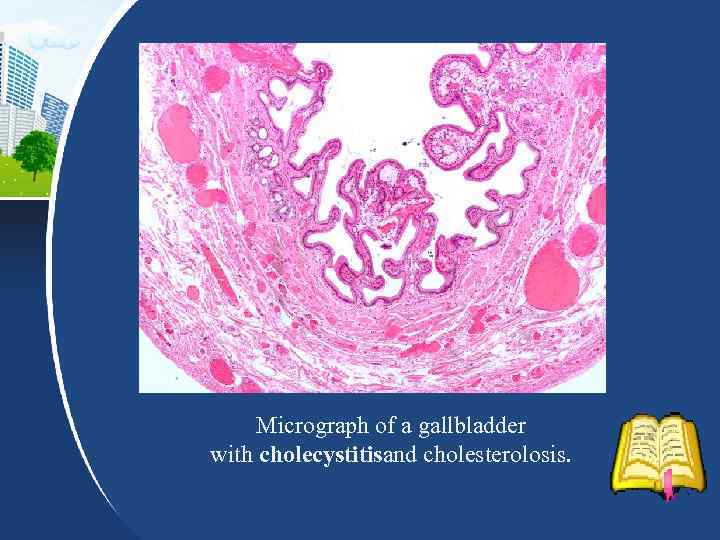
Micrograph of a gallbladder with cholecystitisand cholesterolosis.
Signs and symptoms • Cholecystitis usually presents as a pain in the right upper quadrant or epigastric region. The gallbladder may be tender and distended. Symptomatically it differs from biliary colic by the presence of an inflammatory component (fever, increased white cell count). Pain is initially intermittent, but later usually presents as constant and severe. The pain may be referred pain that is felt in the right scapula rather than the right upper quadrant or epigastric region (Boas' sign). It may also correlate with eating greasy, fatty, or fried foods. Diarrhea, vomiting, and nausea are common. The Murphy sign is specific, but not sensitive for cholecystitis. Elderly patients and those with diabetes may have vague symptoms that may not include fever or localized tenderness.
• More severe symptoms such as high fever, shock and jaundice indicate the development of complications such as abscess formation, perforation or ascending cholangitis. Another complication, gallstone ileus, occurs if the gallbladder perforates and forms a fistula with the nearby small bowel, leading to symptoms of intestinal obstruction. • Chronic cholecystitis manifests with non-specific symptoms such as nausea, vague abdominal pain, belching, and diarrhea.
Causes • Cholecystitis is often caused by cholelithiasis (the presence of choleliths, or gallstones, in the gallbladder), with choleliths most commonly blocking the cystic duct directly. This leads toinspissation (thickening) of bile, bile stasis, and secondary infection by gut organisms, predominantly E. coli and Bacteroides species. • The gallbladder's wall becomes inflamed. Extreme cases may result in necrosis and rupture. Inflammation often spreads to its outer covering, thus irritating surrounding structures such as the diaphragm and bowel. • Less commonly, in debilitated and trauma patients, the gallbladder may become inflamed and infected in the absence of cholelithiasis, and is known as acute acalculous cholecystitis. This can arise in patients with anorexia nervosa, as the lack of stimulation of the gallbladder leads to an infectious process. • Stones in the gallbladder may cause obstruction and the accompanying acute attack. The patient might develop a chronic, low-level inflammation which leads to a chronic cholecystitis, where the gallbladder is fibrotic and calcified.
Diagnosis • • Cholecystitis is usually diagnosed by a history of the above symptoms, as well as examination findings: Fever (usually low grade in uncomplicated cases) Tender right upper quadrant with or without Murphy's sign Ortner's sign — tenderness when hand taps the edge of right costal arch Georgievskiy — Myussi's sign (phrenic nerve sign) — pain when press between edges of sternocleidomastoid Boas' sign — Increased sensitivity below the right scapula (also due to phrenic nerve irritation) Subsequent laboratory and imaging tests are used to confirm the diagnosis and exclude other possible causes. Ultrasound is paramount in differential diagnosis. Ultrasound findings suggestive of acute cholecystitis include pericholecystic fluid, >4 mm gallbladder wall thickening, and Murphy's sign. Visualization of gallstones on ultrasound helps confirm the diagnosis of cholecystitis. Computed Tomography (CT) scan, Magnetic Resonance Imaging (MRI), and Hepatobiliary Scintigraphy (HBS) are also useful in the detection of cholecystitis. Endoscopic Retrograde Cholangiopancreatography (ERCP) may be useful to visualize the anatomy.
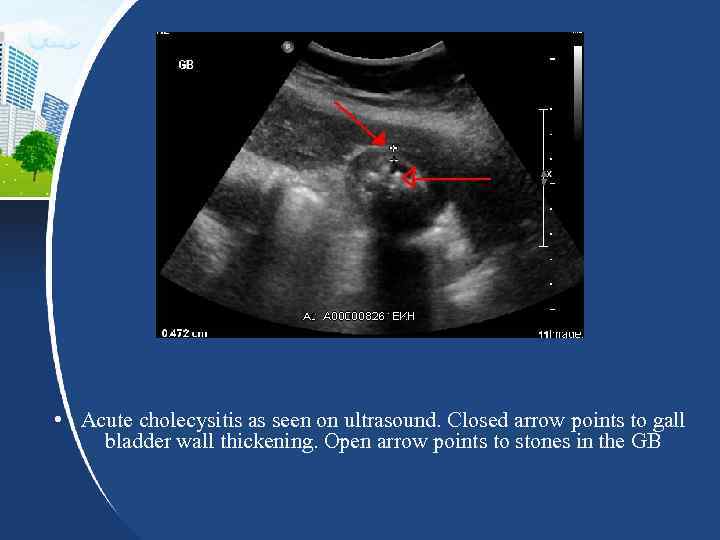
• Acute cholecysitis as seen on ultrasound. Closed arrow points to gall bladder wall thickening. Open arrow points to stones in the GB
Acute cholecystitis This should be suspected whenever there is acute right upper quadrant or epigastric pain, other possible causes include: • Perforated peptic ulcer • Acute peptic ulcer exacerbation • Amoebic liver abscess • Acute amoebic liver colitis • Acute pancreatitis • Acute intestinal obstruction • Renal colic • Acute retro-colic appendicitis
Investigations Blood • Laboratory values may be notable for an elevated alkaline phosphatase, possibly an elevated bilirubin (although this may indicate choledocholithiasis), and possibly an elevation of the WBC count. CRP (C-reactive protein) is often elevated. The degree of elevation of these laboratory values may depend on the degree of inflammation of the gallbladder. Patients with acute cholecystitis are much more likely to manifest abnormal laboratory values, while in chronic cholecystitis the laboratory values are frequently normal. Radiology • Sonography is a sensitive and specific modality for diagnosis of acute cholecystitis; adjusted sensitivity and specificity for diagnosis of acute cholecystitis are 88% and 80%, respectively. The diagnostic criteria are gallbladder wall thickening greater than 3 mm, pericholecystic fluid and sonographic Murphy's sign. Gallstones are not part of the diagnostic criteria as acute cholecystitis may occur with or without them.
Gall bladder perforation • Gall bladder perforation (GBP) is a rare but life-threatening complication of acute cholecystitis. The early diagnosis and treatment of GBP are crucial to decrease patient morbidity and mortality. • Approaches to this complication will vary based on the condition of an individual patient, the evaluation of the treating surgeon or physician, and the facilities' capability. Perforation can happen at the neck from pressure necrosis due to the impacted calculus, or at the fundus. If the bile is infected, diffuse peritonitis may occur readily and rapidly and may result in death A retrospective study looked at 332 patients who received medical and/or surgical treatment with the diagnosis of acute cholecystitis. Patients were treated with analgesics and antibiotics within the first 36 hours after admission (with a mean of 9 hours), and proceeded to surgery for a cholecystectomy. Two patients died and 6 patients had further complications. The authors of this study suggests that early diagnosis and emergency surgical treatment of gallbladder perforation are of crucial importance.
• About 90% of gallstones provoke no symptoms at all. If problems do develop, the chance of developing pain is about 2% per year for the first 10 years after stone formation. After this, the chance for developing symptoms declines. On average, symptoms take about 8 years to develop. The reason for the decline in incidence after 10 years is not known, although some doctors suggest that "younger, " smaller stones may be more likely to cause symptoms than larger, older ones.
References – Shea JA, Berlin JA, Escarce JJ, et al. (November 1994). "Revised estimates of diagnostic test sensitivity and specificity in suspected biliary tract disease" – Fink-Bennett D, Freitas JE, Ripley SD, Bree RL (August 1985). "The sensitivity of hepatobiliary imaging and real-time ultrasonography in the detection of acute cholecystitis" – Sung JY; Costerton JW; Shaffer EA (1992). "Defense system in the biliary tract against bacterial infection". – Makino I, Yamaguchi T, Sato N, Yasui T, Kita I (August 2009). "Xanthogranulomatous cholecystitis mimicking gallbladder carcinoma with a false-positive result on fluorodeoxyglucose PET" – Rao RV, Kumar A, Sikora SS, Saxena R, Kapoor VK (2005). "Xanthogranulomatous cholecystitis: differentiation from associated gall bladder carcinoma". – Mc. Coy JJ, Vila R, Petrossian G, Mc. Call RA, Reddy KS (March 1976). "Xanthogranulomatous cholecystitis. Report of two cases".

Thank you for attention!
Скачать презентацию Acute cholecystitis Орындаған Әлжанов Ш Тобы ҚДС 11
mika.pptx