 Скачать презентацию Actual Gender Differences There a number of
8162604f7b5113813eb601c450d3c9c6.ppt
- Количество слайдов: 34



Actual Gender Differences • There a number of documented gender differences – Exs: aggression, activity level, compliance, emotional expressivity
But: • Relatively few documented differences – Gender stereotypes suggest more differences than are actually documented by research • Even documented differences are relatively small in size – Average performance of males and females is not extremely different
Gender Typing • Process by which a child: – Becomes aware of his or her gender – Acquires information about the characteristics and behavior viewed as appropriate for males or females (gender stereotypes) – Acquires the characteristics and behaviors viewed as appropriate for either males or females (gender roles)
Developmental Trends in Gender Typing • By 2. 5 to 3 years, children label their own sex and that of other people • Do not yet understand that sex is a permanent characteristic
Development of Gender Stereotypes • By 2. 5 years, children have some knowledge of gender stereotypes • Over the preschool/early school years, learn more about toys, activities, and achievement domains considered appropriate for boys versus girls – Ex (achievement): boys are good at math; girls are good at English
• By late elementary school, children know gender stereotypes associated with psychological characteristics (personality traits) – Ex: males are assertive, aggressive, ambitious; females are emotional, nurturing, dependent
• Preschoolers’ gender stereotypes tend to be rigid – Don’t usually realize that characteristics associated with sex (e. g. , activities, clothing) don’t determine whether one is male or female • May be one reason they treat gender stereotypes as “rules” rather than as beliefs
• By elementary school, children’s gender stereotypes are more flexible – Understand that stereotypes are beliefs, not “rules” – But older children do not necessarily approve of “cross-gender” behavior
Development of Gender Role Behavior • Gender-stereotyped toy preferences are present by 14 months and continue to develop through the preschool years
• Gender segregation develops by ages 2 to 3 years – Tendency to associate with same-sex playmates • Typically lasts until around the onset of puberty
• Gender Intensification: A magnification of sex differences early in adolescence – Associated with increased pressure to conform to traditional gender roles (from parents, peers) – Gender intensification declines over the course of adolescence
Biological Influences on Gender Typing (Hormonal Influences) • Experimental animal studies indicate that exposure to androgens (male sex hormones): – Increases active play in male and female mammals – Promotes male-typical sexual behavior and aggression and suppresses maternal caregiving behavior in a wide variety of species

Humans: • Cannot do experimental research for ethical reasons – Correlational research
• In boys, naturally occurring variations in androgen levels are positively correlated with – Amount of rough-and-tumble play – Levels of physical aggression
• Congenital Adrenal Hyperplasia (CAH) – Disorder in which child is exposed to high levels of androgens from the prenatal period onward – Compared to girls without CAH, girls with CAH show • Higher activity levels • Greater interest in “male-typical” toys, activities, and occupations • Better spatial/mathematical abilities
Environmental Influences on Gender Typing • Social Learning Theory – Gender typing results from • Observational learning – By watching male and female “models”, children learn “appropriate” appearance, activities/occupations, and behavior for each sex • Rewards and punishments associated with gendertyped behavior – Rewards for conforming to appropriate gender role and lack of rewards and/or punishment for failure to conform
Parental Behavior • On average, data suggest that differences in parental treatment of boys and girls are not large • Does not mean that parental behavior is unimportant because: – Younger children receive more direct “training” from parents about gender roles than do older children – Parents vary in the extent to which they practice differential treatment
Evidence for Differential Treatment • Some data indicate that parents – Provide gender-stereotyped toys (e. g. , vehicles, dolls) – Are more responsive when children engage in “gender-appropriate” play • But data are not always consistent across studies – Parents also provide gender-neutral toys for children
• Gender-stereotyped toys may encourage different behaviors, characteristics, or abilities in males and females – Parents give toys that encourage action and competition to boys (e. g. , toy weapons, toy vehicles, construction toys and tools, sports equipment) – Parents give toys that encourage nurturance, cooperation, and physical attractiveness to girls (e. g. , dolls/stuffed animals, toy dishes, jewelry, jump ropes)
• Other evidence indicates that parents encourage different behaviors in boys and girls – More likely to encourage independence in boys • Respond more positively when boys demand attention, are highly active, or try to take toys from others • More likely to – Refuse or ignore a son’s request for help – Challenge boys in teaching situations (e. g. , offer scientific explanations, ask high-level questions) – Assign household chores that are outside the house (e. g. , yard work, taking out the trash)
– More likely to encourage closeness and dependence in girls • More likely to: – Direct play activities – Provide help – Engage in conversations – Talk about emotions – Assign chores inside the house
• Differential treatment of boys and girls may be relatively subtle – Data indicate gender differences in parentchild communication
– Parents more likely to offer scientific explanations to sons than to daughters (at a museum) • Ex: “When you turn that fast, it makes more electricity” versus “Turn that handle” – Mothers more likely to give boys greater freedom (autonomy) to make decisions • Ex: “When do you think would be a good time for you to do your music practice? ” versus “Do your practicing right after dinner”
Parental Beliefs • Parental beliefs are likely to influence parental behavior toward children – Ex: On average, parents rate sons as more competent in math/science than daughters even when there is no difference in performance
• Parents’ beliefs about their children’s abilities in specific areas/subjects are related to children’s – Self-perceptions of their abilities in those subjects – Effort in those subjects – Later performance in those subjects
Cognitive Developmental Theory (Kohlberg) • Three Stages: – Basic Gender Identity: • Recognition that one is a boy or a girl – Emerges between 2. 5 and 3 years

– Gender Stability • Understanding that gender is stable over time – Emerges between 3 and 5 years
– Gender Constancy/Consistency • Understanding that gender is constant/consistent across situations regardless of appearance or activities – Emerges between 5 and 7 years
• Kohlberg: Gender constancy leads to gender typing – Why is this incorrect? • Gender typing begins before children have achieved gender constancy
Gender Schema Theory: • Children construct gender schemas – Organized mental representations incorporating information about gender • Include children’s own experiences and information conveyed by others, including gender stereotypes • Schemas are dynamic—change as children acquire additional information
• Once children achieve basic gender identity, they are motivated to acquire gender-typed behavior and characteristics – Young children start with a simple “ingroup/out-group” gender schema • Motivated to prefer, pay attention to, and remember more about others of their own sex – Form an “own-sex” schema—detailed knowledge about their own gender
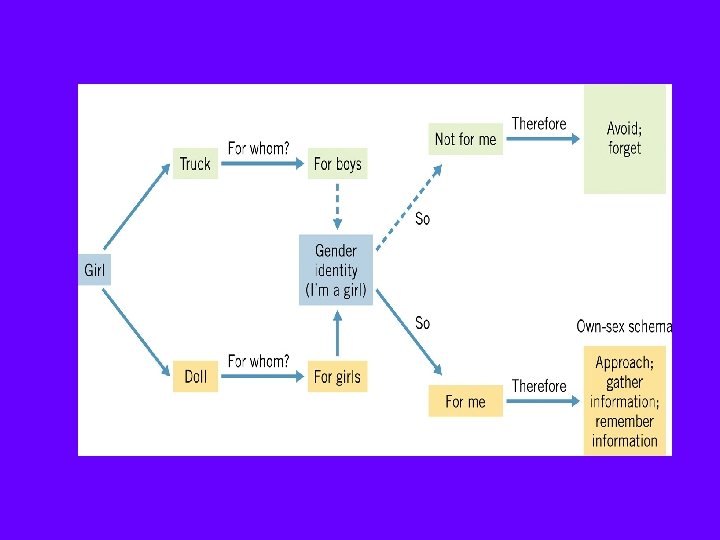
Evidence: Gender Schema Theory • Children used gender labels given to toys to guide their behavior – Gender-neutral, unfamiliar toys/objects labelled as “for girls” or “for boys” • Children prefer the toys/objects consistent with their gender
• Children show biases in their memory for information about gender – More likely to accurately remember information that is consistent with gender stereotypes – More likely to forget or distort information that is inconsistent with gender stereotypes
Скачать презентацию Actual Gender Differences There a number of
8162604f7b5113813eb601c450d3c9c6.ppt