


 Скачать презентацию Acts Chapter 21 Expository Thoughts and Considerations
94c88bcbfbf84b9ae2448693856cf320.ppt
- Количество слайдов: 49
 Acts Chapter 21 Expository Thoughts and Considerations
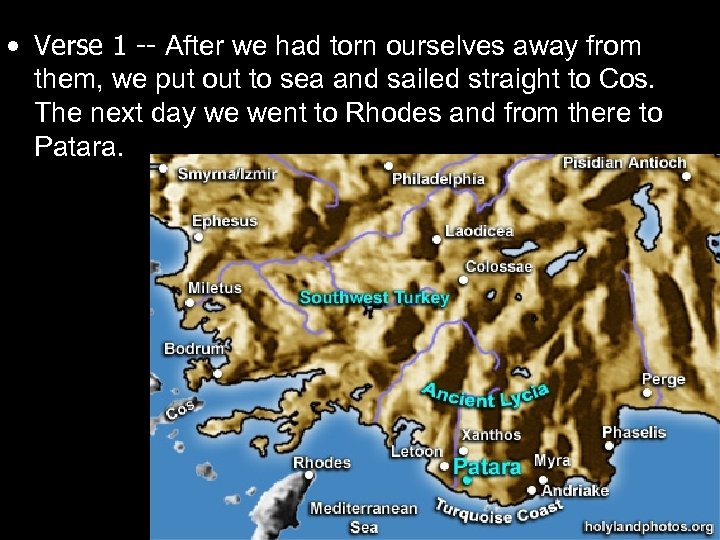 • Verse 1 -- After we had torn ourselves away from them, we put out to sea and sailed straight to Cos. The next day we went to Rhodes and from there to Patara.
 • At Rhodes had once stood the Colossus of Helios, an idol for the worship of the sun. The colossus stood 105 feet high. It stood for 56 years until an earthquake collapsed it in 224 B. C. • When Paul sailed there, the remains of the colossus were still there. The brass from the colossus was sold to a Jewish merchant in 600 B. C. by the conquering Seracens (Arabs). It took 900 camels to carry away the brass.
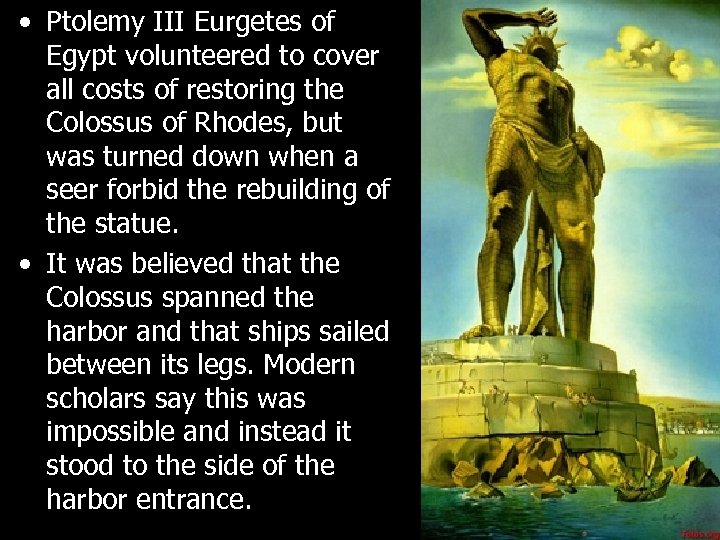 • Ptolemy III Eurgetes of Egypt volunteered to cover all costs of restoring the Colossus of Rhodes, but was turned down when a seer forbid the rebuilding of the statue. • It was believed that the Colossus spanned the harbor and that ships sailed between its legs. Modern scholars say this was impossible and instead it stood to the side of the harbor entrance.
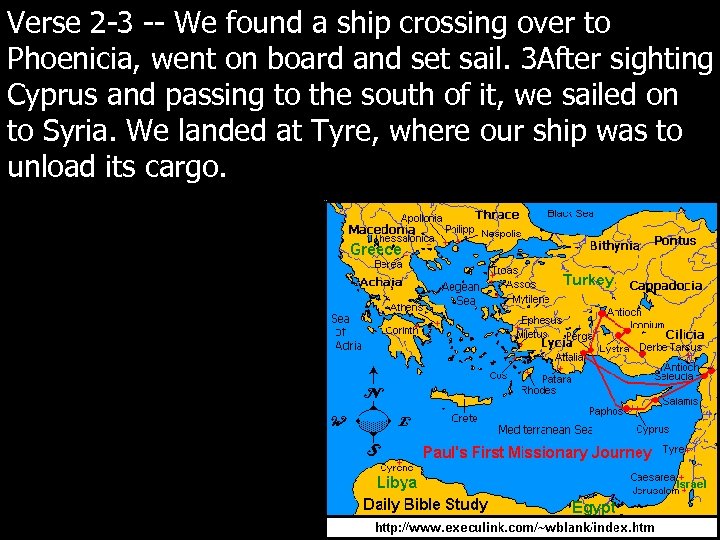 Verse 2 -3 -- We found a ship crossing over to Phoenicia, went on board and set sail. 3 After sighting Cyprus and passing to the south of it, we sailed on to Syria. We landed at Tyre, where our ship was to unload its cargo.
 • Verse 4 -- Finding the disciples there, we stayed with them seven days. Through the Spirit they urged Paul not to go on to Jerusalem. • They had to search for the Christians there. After finding them, they stayed 7 days. • Tyre is a city in Phoenecia. This is the first we learn of a church there. In Acts 11: 19 we learned that evangelism was done there. • The delay is likely the unloading and reloading of the ship.
 • Verse 5 -6 -- But when our time was up, we left and continued on our way. All the disciples and their wives and children accompanied us out of the city, and there on the beach we knelt to pray. 6 After saying good-by to each other, we went aboard the ship, and they returned home. • They board the ship again and continue toward Jerusalem. • They exchange, very likely, a tearful farewell and spend time in prayer. Then they depart.
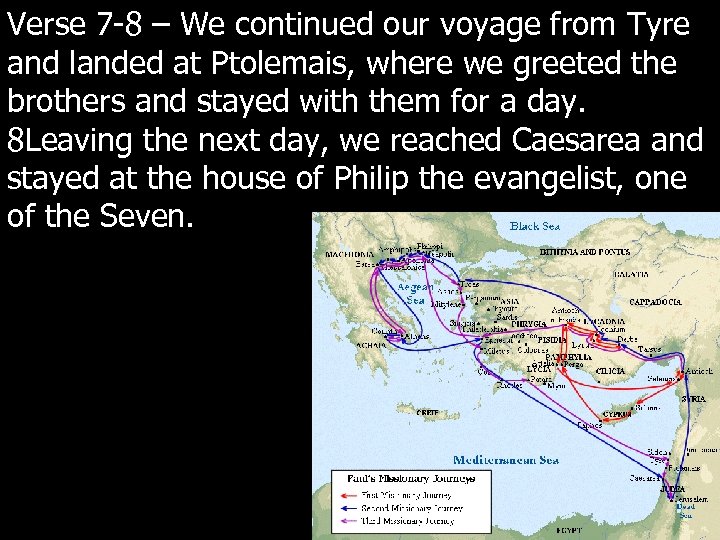 Verse 7 -8 – We continued our voyage from Tyre and landed at Ptolemais, where we greeted the brothers and stayed with them for a day. 8 Leaving the next day, we reached Caesarea and stayed at the house of Philip the evangelist, one of the Seven.
 • This is Paul’s third recorded visit to Caesarea. • Philip has lived there for upwards of 20 years. • He is one of the seven chosen to serve the Grecian widows in the early days of the church in Jerusalem. • He is known here as an “evangelist” from EUANGELION – a messenger.
 Verse 9 -- He had four unmarried daughters who prophesied. • They were “virgin” daughters – meaning unmarried, but also possibly that they had dedicated themselves to remaining single to fully devote themselves to the cause of Christ. • They “prophesied” – the present participle in the Greek indicates they practiced this gift over a long period of time. • It is highly possible that Luke gained some or much of his information for Luke/Acts from Philip and his daughters.
 Verse 10 -- After we had been there a number of days, a prophet named Agabus came down from Judea. • It is possible they stayed as much as a week with Philip. It was long enough for word of their visit to reach Judea, and for Agabus to travel there and deliver a prophecy. • Some believe this is a different Agabus from the one in Acts 11, because Luke introduces him again (without an article “the”). Likely it was the same prophet.
 Verse 11 – Coming over to us, he took Paul's belt, tied his own hands and feet with it and said, "The Holy Spirit says, 'In this way the Jews of Jerusalem will bind the owner of this belt and will hand him over to the Gentiles. ' " • Speaking through the Holy Spirit, Agabus removes any doubt there might have been about the fate that awaits Paul in Jerusalem. • The Jews themselves will bind him in just such a way.
 Verse 12 – When we heard this, we and the people there pleaded with Paul not to go up to Jerusalem. • Luke is involved in the pleading with Paul not to go to Jerusalem. • The are concerned for his life – but should realize that they are challenging the will of the Holy Spirit. • This matter is already decided.
 Verse 13 – Then Paul answered, "Why are you weeping and breaking my heart? I am ready not only to be bound, but also to die in Jerusalem for the name of the Lord Jesus. " • Paul has often insisted that nothing on earth was more important to him than serving Christ. • Now he insists that even his own life is nothing compared to the opportunity to serve Christ.
 Verse 14 – When he would not be dissuaded, we gave up and said, "The Lord's will be done. “ • They mean by this that they are wishing Paul the guidance and deliverance of the Lord. • They don’t know all of God’s plans for Paul, only part of them.
 Verse 15 -16 – After this, we got ready and went up to Jerusalem. Some of the disciples from Caesarea accompanied us and brought us to the home of Mnason, where we were to stay. He was a man from Cyprus and one of the early disciples. • They literally go “up” to Jerusalem, since it is a higher elevation. • Some of the brethren from Caesarea join the company, probably to attend the feast. • Mnason is from Cyprus (as was Barnabas) and opens his home to the company.
 Verse 17 – When we arrived at Jerusalem, the brothers received us warmly. • So ends the third missionary journey of Paul. • So begins the final segment of the book of Acts – which chronicles the last years of Paul’s life. • They meet with the church in Jerusalem and receive a warm welcome.
 Verse 18 -19 – The next day Paul and the rest of us went to see James, and all the elders were present. Paul greeted them and reported in detail what God had done among the Gentiles through his ministry. • James, the brother of Jesus (same James mentioned in Acts 15) is named separately from the rest of the Jerusalem leaders. • Many have speculated that James had a different office or title than the elders and held the position of “bishop” of Jerusalem. • This is nowhere recognized in the Bible.
 Verse 18 -19 – cont. • That he has a position of great authority, however, cannot be denied. • Galatians 1: 19 refers to the “other apostles” and then names James, suggesting that he was an apostle. He does not qualify to be an apostle in the same way as the twelve, but like Barnabas is an apostle in the broader sense of the word. • That he was greatly respected and central to the church in Jerusalem is undeniable. He was known by the people of Jerusalem as “James the Just. ”
 Verse 20 -- When they heard this, they praised God. Then they said to Paul: "You see, brother, how many thousands of Jews have believed, and all of them are zealous for the law. • It is conceivable that at this time Paul has also presented them with the gift from the Gentile churches. • James proceeds to warn Paul of the general opinion of the populace of Jerusalem concerning his work and teaching. • A rift continues between Jews and Gentiles and Christianity has not completely removed that rift.
 Verse 20 -- … thousands of Jews have believed, and all of them are zealous for the law. • While the council of Acts 15 decided matters concerning the Law for Gentiles, it did nothing to address observance of the Law by Jews. • Jews have continued to keep observances of the Law, including the feasts, and are upset that Paul is urging all (Jews and Gentiles alike) to recognize that the Law is coming to an end. • The Jews, zealous for the Law, see this as an attack against their national tradition and even against God.
 Verse 21 -- They have been informed that you teach all the Jews who live among the Gentiles to turn away from Moses, telling them not to circumcise their children or live according to our customs. • “Turn away” comes from the Greek APOSTIAN, from which we get “apostatize”. • While Paul has taught that observance of the Law is not necessary for salvation, he has not taught “against” observing the Law as a matter of tradition. The Law is not evil.
 Verse 22 -24 -- What shall we do? They will certainly hear that you have come, so do what we tell you. There are four men with us who have made a vow. Take these men, join in their purification rites and pay their expenses, so that they can have their heads shaved. Then everybody will know there is no truth in these reports about you, but that yourself are living in obedience to the law. • James seeks to find a way to have peace between Paul and Jewish believers who have been lied to.
 Verse 22 -24 -- … There are four men with us who have made a vow. Take these men, join in their purification rites and pay their expenses, so that they can have their heads shaved. Then everybody will know there is no truth in these reports about you, but that yourself are living in obedience to the law. • By participating in these purification rites, Paul would prove to the Jews that he still keeps the Law and approves of others doing so. They are trying to quash these false rumors.
 Verse 25 -- As for the Gentile believers, we have written to them our decision that they should abstain from food sacrificed to idols, from blood, from the meat of strangled animals and from sexual immorality. " • James wants Paul to understand, though, that the Jerusalem church leaders still stand by their understanding that the Law is not binding for salvation. • The Greeks are still free to live as they have lived under Paul’s teaching and direction.
 Verse 26 – The next day Paul took the men and purified himself along with them. Then he went to the temple to give notice of the date when the days of purification would end and the offering would be made for each of them. • This is most assuredly the keeping of temporary Nazirite vows. For full information on the Nazirite vow see Numbers 6: 1 -21. • The “days of purification” are the seven days at the end of the vow. Paul is not actually participating in the vow, but is accompanying these men in the completion of their vows.
 Verse 26 – The next day Paul took the men and purified himself along with them. Then he went to the temple to give notice of the date when the days of purification would end and the offering would be made for each of them. • This is most assuredly the keeping of temporary Nazirite vows. For full information on the Nazirite vow see Numbers 6: 1 -21. • The “days of purification” are the seven days at the end of the vow. Paul is not actually participating in the vow, but is accompanying these men in the completion of their vows.
 Verse 26 – … the offering would be made for each of them. • The offering at the end of the Nazirite vow was as follows: • A yearling male lamb without defect for a burnt offering • A yearling ewe lamb without defect for a sin offering • A ram without defect for a fellowship offering • Grain and drink offerings for fellowship • Unleavened bread
 Verse 26 – … the offering would be made for each of them. • The presentation of the offering was as follows: • The sin offering forgiveness and covering of sins. • The burnt offering as a soothing aroma to God. • The meal offerings for fellowship and covenant. • The burning of the hair in the fellowship offering.
 Verse 26 – … the offering would be made for each of them. • The wave offering: • The final act of the Nazirite vow is the presentation of the WAVE offering before the Lord. • The wave offering represents the priest’s portion of the offering. Everything else was burned up in fire as a pleasant aroma to God. • The priest then waved his portion before God to show that it was His, but was going to be shared by God’s priest.
 Verse 27 – When the seven days were nearly over, some Jews form the province of Asia saw Paul at the temple. They stirred up the whole crowd and seized him… • Unfortunately, Paul’s attempt to placate the Jews failed. Yet, he did not compromise his stand for the gospel by trying: (to those under the law I became as one under the law… (1 Cor. 9: 20). • These Jews know more of Paul’s work than the Jerusalem Jews, and so inflame the minds of the locals against Paul. • Paul is seized on the spot.
 Verse 28 – shouting, “Men of Israel, help us! This is the man who teaches all men everywhere against our people and our law and this place…. • These charges are, of course, completely unfounded. • The finer points of the argument are likely lost on these men. They only see that Paul does not defend the Old Covenant in quite the same way that they themselves do. • Paul has never spoken against the Jewish people, except inasmuch as they crucified Christ and abused Christians.
 Verse 28 – …And besides, he has brought Greeks into the temple area and defiled this holy place. ” • Again, this charge is completely unfounded and based on supposition rather than proof. • Verse 29, a parenthetical statement of explanation from Paul, states that they had seen Trophimus (an Ephesian) in the city with Paul and assumed that he had also accompanied Paul into the inner court of the temple. • A Gentile in the inner court would have been seen as a great defiling of the temple.
 Verse 29 – They had previously seen Trophimus the Ephesian in the city with Paul and assumed that Paul had brought him into the temple area. • The Romans accepted the Jewish sense of scruples to the point that they upheld the Jew’s right to put to death any Gentile they found in their inner court. Even if that person was a Roman. • Signs in Greek and Latin were posted at the base of the steps leading into the inner courts to warn any Gentile that the death penalty would be enacted if they went beyond that point.
 Verse 30 – The whole city was aroused, and the people came running from all directions. Seizing Paul, they dragged him from the temple and immediately the gates were shut. • A riot results from the accusations of the Asian Jews. • Paul is dragged out of the inner courts and into the Gentile court beyond. • Then the temple guards shut the gates between the outer and inner courts to seal out the violence that is happening in the outer court and keep it from defiling the inner courts.
 Verse 31 – While they were trying to kill him, news reached the commander of the Roman troops that the whole city of Jerusalem was in an uproar. • We are probably to see here that the crowd is disorganized to the point that Paul is not immediately put to death. • However, he is doubtless severely mauled and beaten and would have been soon dead had it not been for the intervention of the Roman garrison.
 Verse 32 – He at once took some officers and soldiers and ran down to the crowd. • Northwest of the temple area was the fortress of Antonia, built by Herod the Great. It housed a cohort of Roman troops under the command of a military tribune. • The fortress was connected with the outer court of the temple by two flights of steps. It is obvious that the Romans considered the temple to be the most likely place for a gathering and therefore a riot. • It takes only moments for the Romans to arrive.
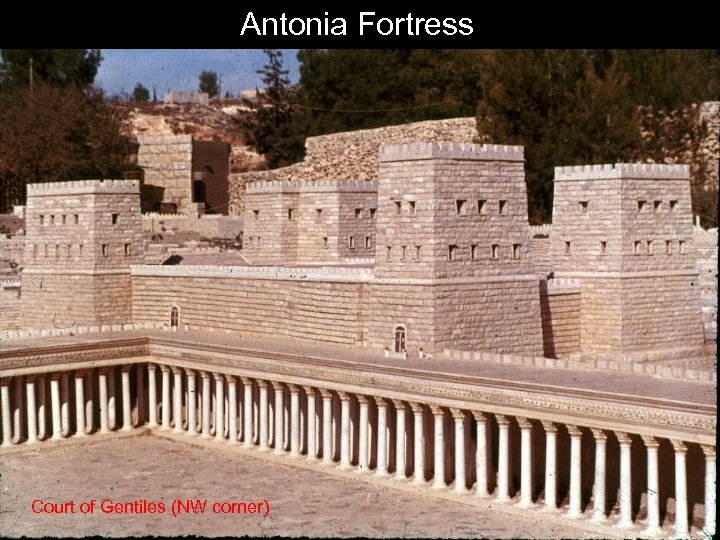 Antonia Fortress Court of Gentiles (NW corner)
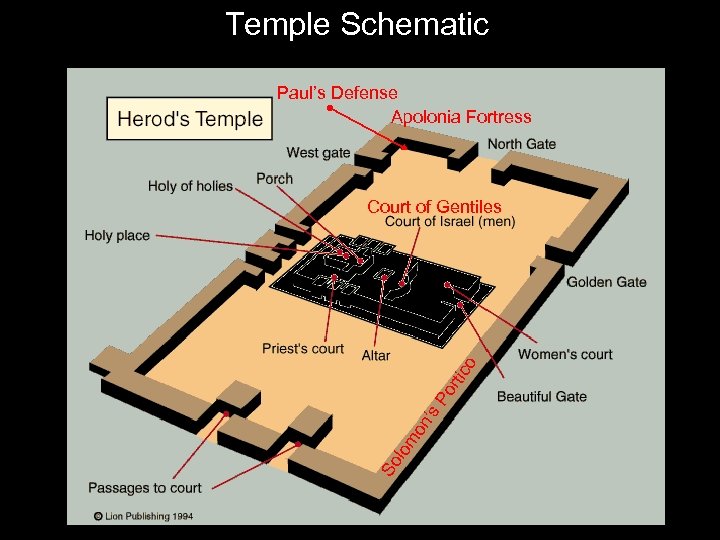 Temple Schematic Paul’s Defense Apolonia Fortress So lom on ’s P or tic o Court of Gentiles
 Verse 33 – The commander came up and arrested him and ordered him to be bound by two chains. • The Roman tribune doesn’t waste time trying to understand. He simply grabs Paul from the hands of the mob and binds him for questioning later. • He is mostly concerned that whatever Paul has done be handled properly through the legal system and not by a riotous mob. • So Agabus’ prophecy sees its fulfillment. Paul is chained, most likely to two soldiers.
 Verse 33, cont. -- …Then he asked who he was and what he had done. • Only after Paul is secured does the Roman try to determine what is happening. • He is interested in who Paul is, and in what formal charges could be made against him. • Vigilante justice is not going to be an issue as long as the Roman guard is protecting Paul. • Even here we see the intervention of the Lord to protect Paul from lasting harm.
 Verse 34– Some in the crowd shouted one thing and some another, and since the commander could not get at the truth because of the uproar, he ordered that Paul be taken into the barracks. • This is not accomplished easily. Verse 35 tells us that the violence of the crowd is so great that Paul has to be bodily lifted and carried by the crowd. • They are disappointed that Paul has just been rescued from their hands. The confusion is so great that nothing sure can be learned about the situation.
 Verse 36– The crowd that followed kept shouting, “Away with him!” • They are not, by this cry, suggesting that Paul be taken away and fairly tried. • They want him to be put to death immediately.
 Verse 37– As the soldiers were about to take Paul into the barracks, he asked the commander, “May I say something to you? ” “Do you speak Greek? ” he replied. • Paul obviously asks this question in Greek. • The Roman commander is doubtless impressed by this. • It is possible that he is impressed by the obvious education Paul has achieved. • It is also possible that Paul’s Greek confused him because he has already decide Paul is an Egyptian.
 Verse 38– “Aren’t you the Egyptian who started a revolt and led four thousand terrorists out into the desert some time ago? ” • Paul is arrested in 58 A. D. Some three years prior there had been an uprising caused by an Egyptian who came to Jerusalem claiming to be a prophet. • He led a group of some 4, 000 people to the Mount of Olives. He told them to wait until, at his command, the walls of Jerusalem would fall flat and they could overthrow the Romans.
 Verse 38– cont. • Josephus records the uprising and relates that Felix the procurator sent a body of troops against them, killing many in the process. The Egyptian disappeared from the area, never to be seen again. • The commander assumes that Paul is this Egyptian, returning to cause more trouble. • The word translated “terrorists” is the Greek SIKARIOI, from the Latin SICARII or “daggermen”. They were assassins.
 • The Sicarii arose in Judea during Felix’s procuratorship. • They were bitter enemies of the Romans and Roman supporters. • They would mingle with crowds at festivals and large gatherings with daggers hidden in their cloaks. They would wait for an opportune moment and stab and kill their opponents by stealth. • One of their victims was Jonathan, the son of Annas the high priest, who was himself high priest.
 Verse 39 – Paul answered, “I am a Jew, from Tarsus in Cilicia, a citizen of no ordinary city. Please let me speak to the people. ” • Paul assures him that he is no Egyptian. • Furthermore, he is from the well-known city of Tarsus. • He requests permission to speak to the crowd in his own defense.
 Verse 40 – Having received the commander’s permission, Paul stood on the steps and motioned to the crowd. (The remainder of the verse will be put with verse 1 of Chapter 22) • The commander does not prevent Paul from making a defense. • Paul is set down, but there is no mention of his being unchained. He remains standing on the steps leading up to the Antonia. • He begins the first of several defenses for his ministry and behavior.