


 Скачать презентацию Activity of Fulvestrant 500 mg Versus Anastrozole 1
3a28820f3f27fa9bc5179f8e6c9c531d.ppt
- Количество слайдов: 15
 Activity of Fulvestrant 500 mg Versus Anastrozole 1 mg As First. Line Treatment for Advanced Breast Cancer: Results From the FIRST Study Robertson JFR et al. J Clin Oncol 2009; 27(27): 4530 -35.
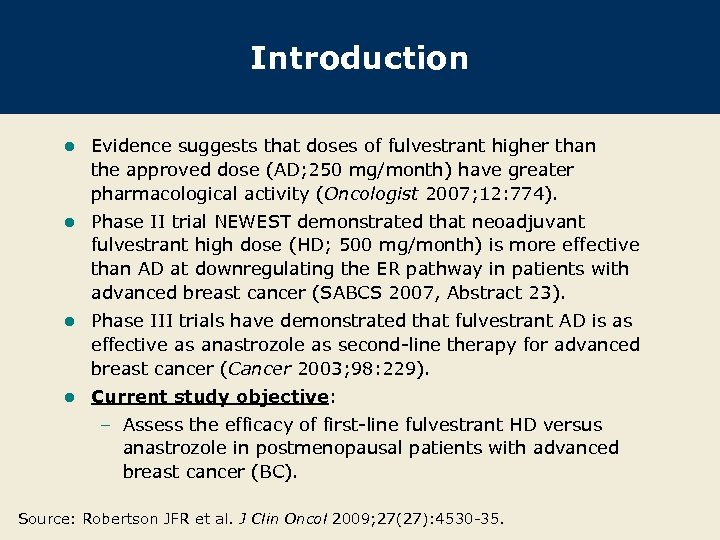 Introduction l Evidence suggests that doses of fulvestrant higher than the approved dose (AD; 250 mg/month) have greater pharmacological activity (Oncologist 2007; 12: 774). l Phase II trial NEWEST demonstrated that neoadjuvant fulvestrant high dose (HD; 500 mg/month) is more effective than AD at downregulating the ER pathway in patients with advanced breast cancer (SABCS 2007, Abstract 23). l Phase III trials have demonstrated that fulvestrant AD is as effective as anastrozole as second-line therapy for advanced breast cancer (Cancer 2003; 98: 229). l Current study objective: – Assess the efficacy of first-line fulvestrant HD versus anastrozole in postmenopausal patients with advanced breast cancer (BC). Source: Robertson JFR et al. J Clin Oncol 2009; 27(27): 4530 -35.
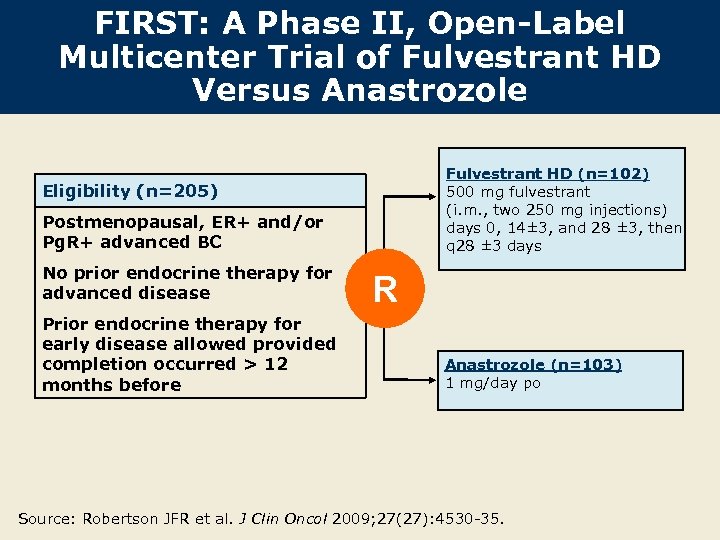 FIRST: A Phase II, Open-Label Multicenter Trial of Fulvestrant HD Versus Anastrozole Fulvestrant HD (n=102) 500 mg fulvestrant (i. m. , two 250 mg injections) days 0, 14± 3, and 28 ± 3, then q 28 ± 3 days Eligibility (n=205) Postmenopausal, ER+ and/or Pg. R+ advanced BC No prior endocrine therapy for advanced disease Prior endocrine therapy for early disease allowed provided completion occurred > 12 months before R Anastrozole (n=103) 1 mg/day po Source: Robertson JFR et al. J Clin Oncol 2009; 27(27): 4530 -35.
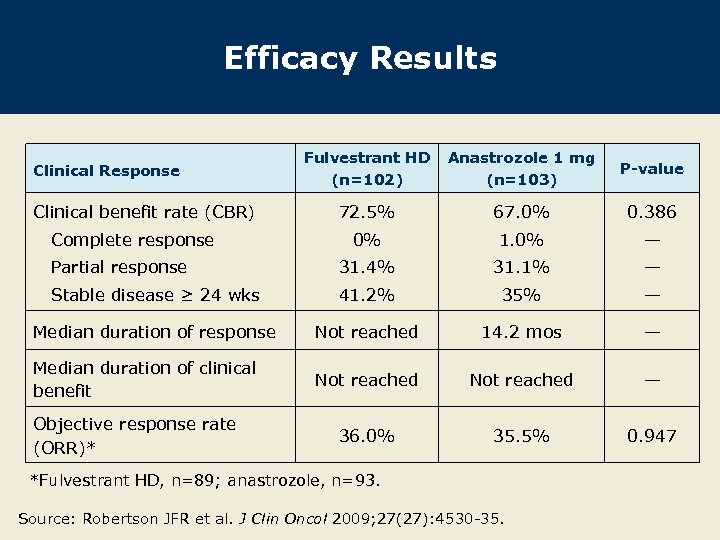 Efficacy Results Fulvestrant HD (n=102) Anastrozole 1 mg (n=103) P-value 72. 5% 67. 0% 0. 386 0% 1. 0% — Partial response 31. 4% 31. 1% — Stable disease ≥ 24 wks 41. 2% 35% — Median duration of response Not reached 14. 2 mos — Median duration of clinical benefit Not reached — 36. 0% 35. 5% 0. 947 Clinical Response Clinical benefit rate (CBR) Complete response Objective response rate (ORR)* *Fulvestrant HD, n=89; anastrozole, n=93. Source: Robertson JFR et al. J Clin Oncol 2009; 27(27): 4530 -35.
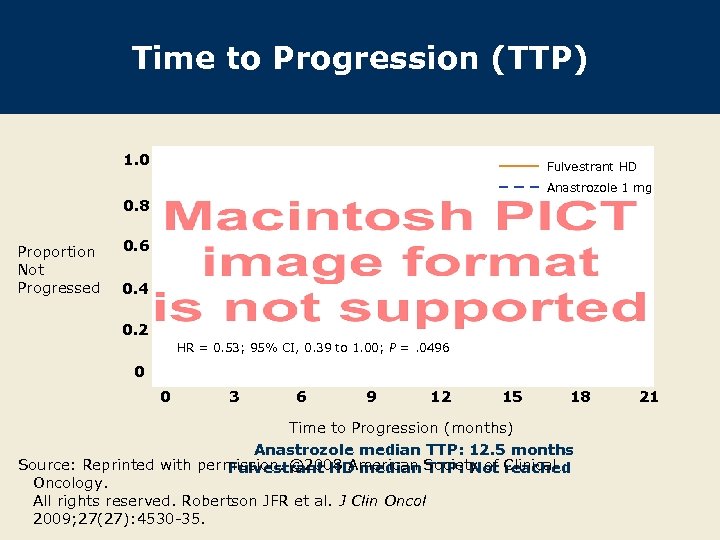 Time to Progression (TTP) 1. 0 Fulvestrant HD Anastrozole 1 mg 0. 8 Proportion Not Progressed 0. 6 0. 4 0. 2 HR = 0. 53; 95% CI, 0. 39 to 1. 00; P =. 0496 0 0 3 6 9 12 15 18 Time to Progression (months) Anastrozole median TTP: 12. 5 months Source: Reprinted with permission. © 2008 American Society of Clinical Fulvestrant HD median TTP: Not reached Oncology. All rights reserved. Robertson JFR et al. J Clin Oncol 2009; 27(27): 4530 -35. 21
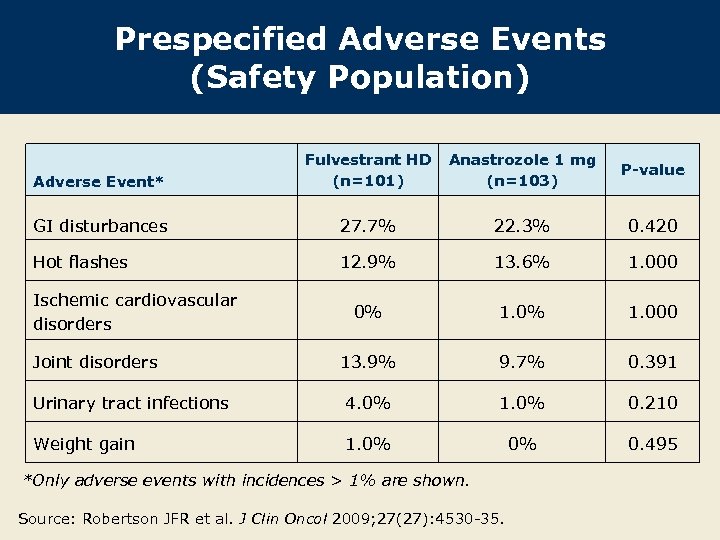 Prespecified Adverse Events (Safety Population) Adverse Event* Fulvestrant HD (n=101) Anastrozole 1 mg (n=103) P-value GI disturbances 27. 7% 22. 3% 0. 420 Hot flashes 12. 9% 13. 6% 1. 000 0% 1. 000 13. 9% 9. 7% 0. 391 Urinary tract infections 4. 0% 1. 0% 0. 210 Weight gain 1. 0% 0% 0. 495 Ischemic cardiovascular disorders Joint disorders *Only adverse events with incidences > 1% are shown. Source: Robertson JFR et al. J Clin Oncol 2009; 27(27): 4530 -35.
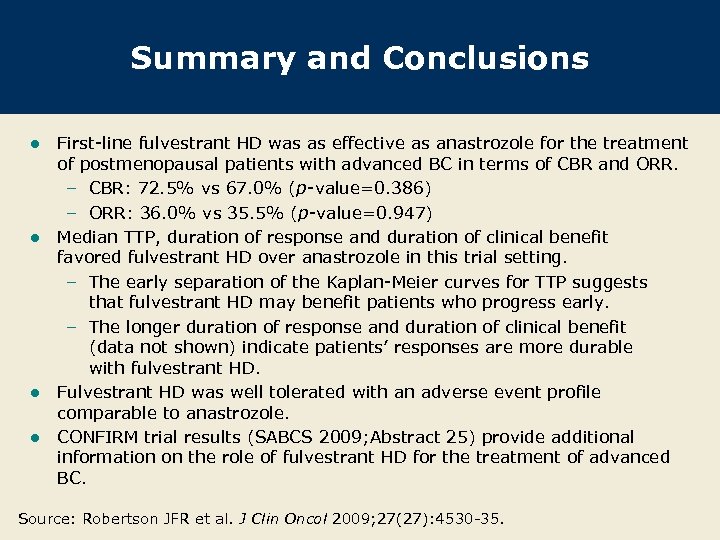 Summary and Conclusions First-line fulvestrant HD was as effective as anastrozole for the treatment of postmenopausal patients with advanced BC in terms of CBR and ORR. – CBR: 72. 5% vs 67. 0% (p-value=0. 386) – ORR: 36. 0% vs 35. 5% (p-value=0. 947) l Median TTP, duration of response and duration of clinical benefit favored fulvestrant HD over anastrozole in this trial setting. – The early separation of the Kaplan-Meier curves for TTP suggests that fulvestrant HD may benefit patients who progress early. – The longer duration of response and duration of clinical benefit (data not shown) indicate patients’ responses are more durable with fulvestrant HD. l Fulvestrant HD was well tolerated with an adverse event profile comparable to anastrozole. l CONFIRM trial results (SABCS 2009; Abstract 25) provide additional information on the role of fulvestrant HD for the treatment of advanced BC. l Source: Robertson JFR et al. J Clin Oncol 2009; 27(27): 4530 -35.
 CONFIRM: A Phase III, Randomized, Parallel-Group Trial Comparing Fulvestrant 250 mg vs Fulvestrant 500 mg in Postmenopausal Women with Estrogen Receptor-Positive Advanced Breast Cancer Di Leo A et al. SABCS 2009; Abstract 25.
 Introduction Fulvestrant is approved for the treatment of postmenopausal women with advanced breast cancer (BC) that have progressed or relapsed following endocrine therapy. l The efficacy of fulvestrant is well established at the approved dose of 250 mg/month (F 250). l Phase II trials NEWEST 1 and FIRST 2 have demonstrated that a 500 mg dose of fulvestrant (F 500) has improved biological and clinical activities (1 SABCS 2007; Abstract 23, 2 JCO 2009; 27: 4530). l Current study objectives: – Compare the biological activity of F 250 versus F 500 in postmenopausal patients with estrogen receptor (ER)positive advanced BC. l Source: Di Leo A et al. SABCS 2009; Abstract 25.
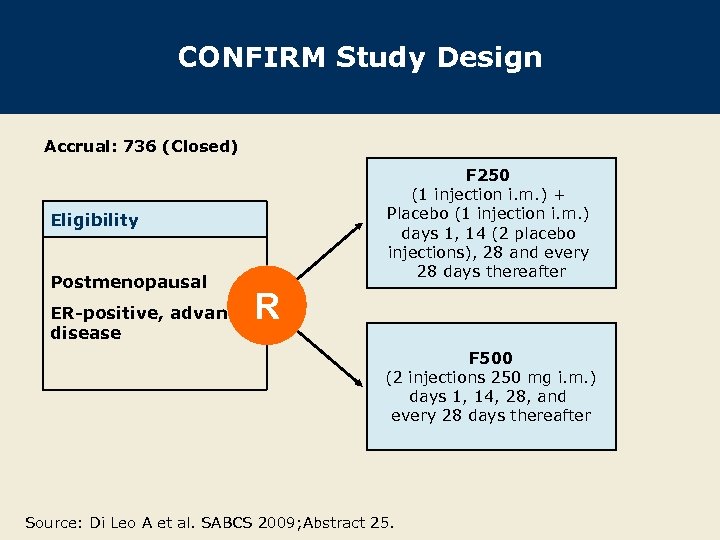 CONFIRM Study Design Accrual: 736 (Closed) F 250 (1 injection i. m. ) + Placebo (1 injection i. m. ) days 1, 14 (2 placebo injections), 28 and every 28 days thereafter Eligibility Postmenopausal R ER-positive, advanced disease F 500 (2 injections 250 mg i. m. ) days 1, 14, 28, and every 28 days thereafter Source: Di Leo A et al. SABCS 2009; Abstract 25.
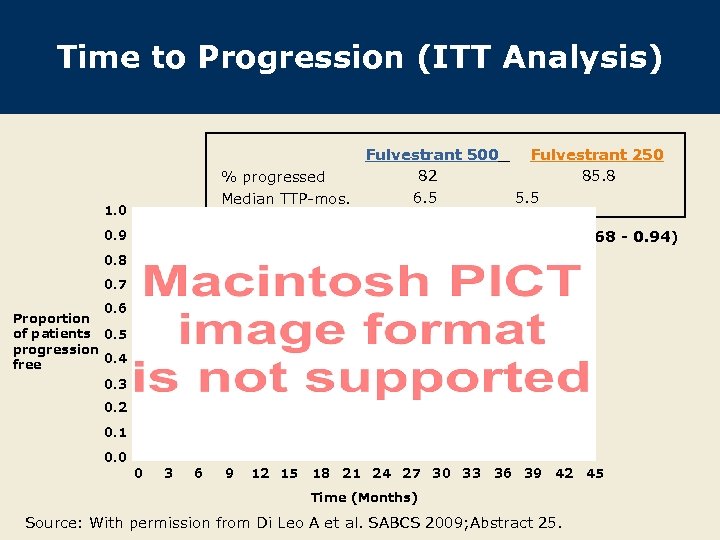 Time to Progression (ITT Analysis) Fulvestrant 500 82 % progressed 6. 5 Median TTP-mos. 1. 0 0. 9 Fulvestrant 250 85. 8 5. 5 Hazard Ratio (95% CI) = 0. 80 (0. 68 - 0. 94) p-value = 0. 006 0. 8 0. 7 0. 6 Proportion of patients 0. 5 progression 0. 4 free 0. 3 0. 2 0. 1 0. 0 0 3 6 9 12 15 18 21 24 27 30 33 36 39 42 45 Time (Months) Source: With permission from Di Leo A et al. SABCS 2009; Abstract 25.
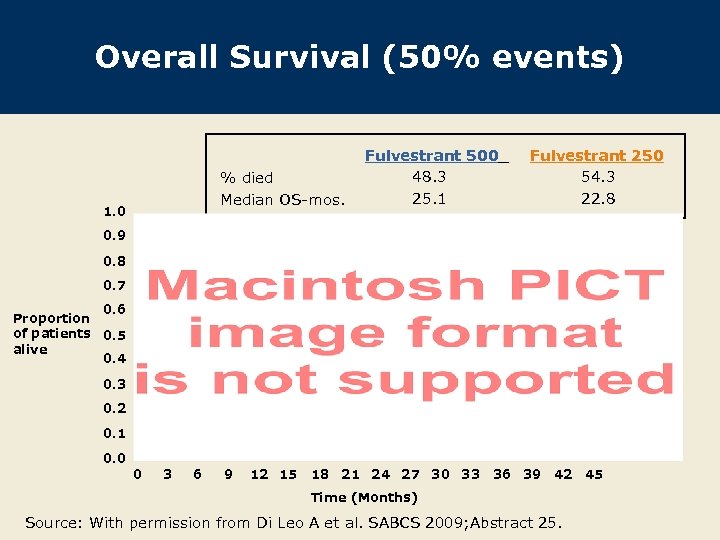 Overall Survival (50% events) % died Median OS-mos. 1. 0 Fulvestrant 500 48. 3 25. 1 Fulvestrant 250 54. 3 22. 8 Hazard Ratio (95% CI) = 0. 84 (0. 69 - 1. 03) p-value = 0. 091 0. 9 0. 8 0. 7 0. 6 Proportion of patients 0. 5 alive 0. 4 0. 3 0. 2 0. 1 0. 0 0 3 6 9 12 15 18 21 24 27 30 33 36 39 42 45 Time (Months) Source: With permission from Di Leo A et al. SABCS 2009; Abstract 25.
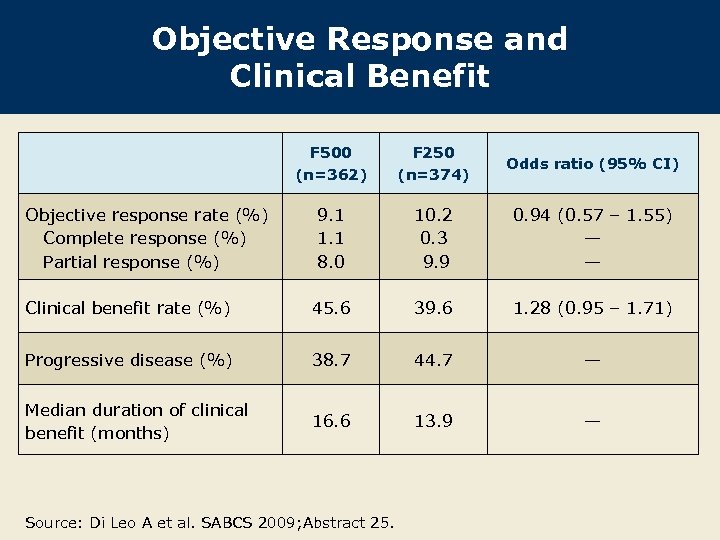 Objective Response and Clinical Benefit F 500 (n=362) F 250 (n=374) Odds ratio (95% CI) 9. 1 1. 1 8. 0 10. 2 0. 3 9. 9 0. 94 (0. 57 – 1. 55) — — Clinical benefit rate (%) 45. 6 39. 6 1. 28 (0. 95 – 1. 71) Progressive disease (%) 38. 7 44. 7 — Median duration of clinical benefit (months) 16. 6 13. 9 — Objective response rate (%) Complete response (%) Partial response (%) Source: Di Leo A et al. SABCS 2009; Abstract 25.
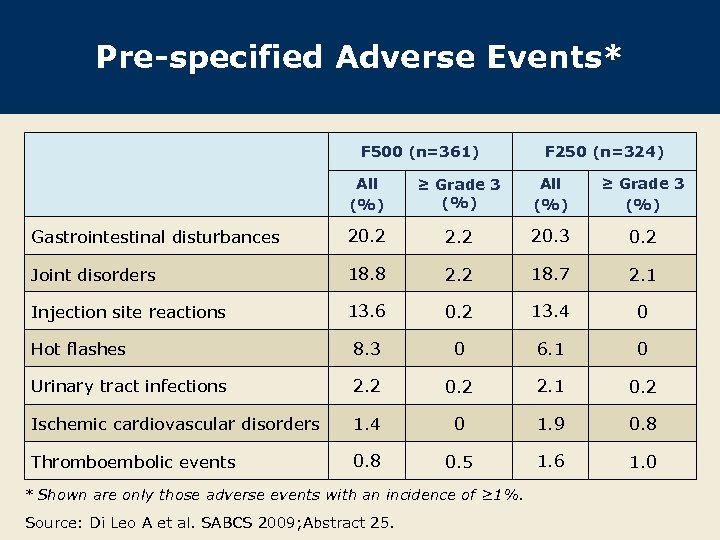 Pre-specified Adverse Events* F 500 (n=361) F 250 (n=324) All (%) ≥ Grade 3 (%) Gastrointestinal disturbances 20. 2 20. 3 0. 2 Joint disorders 18. 8 2. 2 18. 7 2. 1 Injection site reactions 13. 6 0. 2 13. 4 0 Hot flashes 8. 3 0 6. 1 0 Urinary tract infections 2. 2 0. 2 2. 1 0. 2 Ischemic cardiovascular disorders 1. 4 0 1. 9 0. 8 Thromboembolic events 0. 8 0. 5 1. 6 1. 0 * Shown are only those adverse events with an incidence of ≥ 1%. Source: Di Leo A et al. SABCS 2009; Abstract 25.
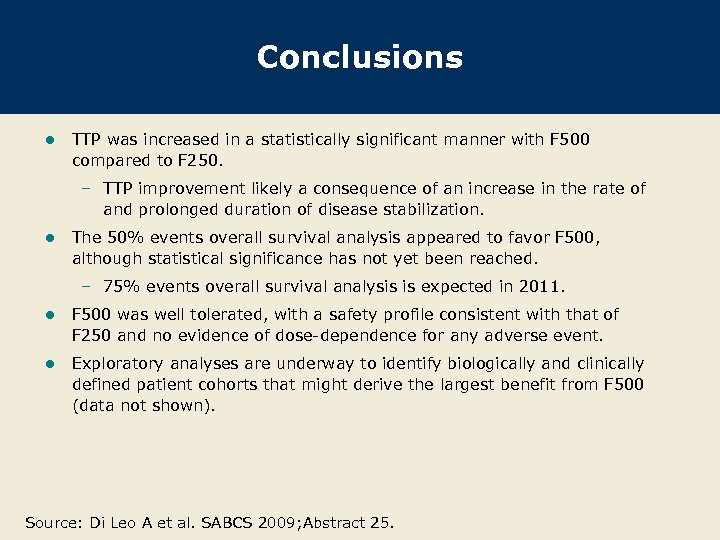 Conclusions l TTP was increased in a statistically significant manner with F 500 compared to F 250. – TTP improvement likely a consequence of an increase in the rate of and prolonged duration of disease stabilization. l The 50% events overall survival analysis appeared to favor F 500, although statistical significance has not yet been reached. – 75% events overall survival analysis is expected in 2011. l F 500 was well tolerated, with a safety profile consistent with that of F 250 and no evidence of dose-dependence for any adverse event. l Exploratory analyses are underway to identify biologically and clinically defined patient cohorts that might derive the largest benefit from F 500 (data not shown). Source: Di Leo A et al. SABCS 2009; Abstract 25.