


 Скачать презентацию Active vs Passive Strategies Using ETFs C Michael
72f8344c29f01d3196d2b4fe0d4f9b32.ppt
- Количество слайдов: 22
 Active vs. Passive Strategies Using ETFs C. Michael Carty Principal & CIO New Millennium Advisors, LLC July 20, 2010 QWAFAFEW/NYC Presentation Patrick Conway’s New York, NY
 Our Purpose n To review the pros and cons of using active vs. passive strategies using ETFs and their tax consequences. New Millennium Advisors
 Is Buy and Hold Dead? n Indexing works for investors as a group Individuals have unique characteristics Examples of characteristics changing Identify the instruments of change Passively active or actively passive? Are indexes purely passive? n n n New Millennium Advisors
 As a Group Investors Can Buy & Hold n n Individual stocks, bonds and cash Actively managed portfolios (stocks, bonds & cash) Mutual funds (stocks, bonds & cash) Passive funds (ETFs, ETNs, & ETCs) New Millennium Advisors
 Individuals Have Unique Characteristics n n n Risk preferences Financial goals Personal circumstances Asset endowments Time horizons New Millennium Advisors
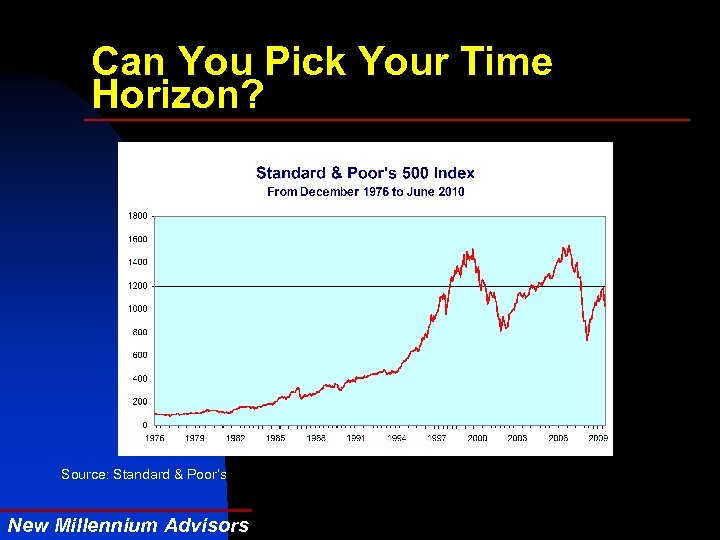 Can You Pick Your Time Horizon? Source: Standard & Poor’s New Millennium Advisors
 Characteristics Change with Time n n n Sell at the bottom & buy at the top Beat the market & absolute returns Marriage/divorce and disabilities Lotto, housing bubble/bust, & jobs Life, retirement & death New Millennium Advisors
 Instruments of Change n n n Economic cycles Inflation Government polices Fed monetary policy Regulatory environment Environmental factors New Millennium Advisors
 Passively Active or Actively Passive? n n Passive until change requires action (changes in strategic allocations) Actively using passive funds (tactical changes in strategic allocations) New Millennium Advisors
 Are Passive Indexes Truly Passive? n n Changing market definitions Percent of market capitalization Market cap or float-weighted Market segmentation vs. diversification New Millennium Advisors
 Global Industry Classification Standard n n n n n Energy Materials Industrials Consumer Discretionary Consumer Staples Health Care Financials Information Technology Telecom Services Utilities New Millennium Advisors
 Some Actively Passive ETP Pairs Possibilities n n n Large cap growth (IWF) vs. value (IWD) ETFs Large cap (IWB) vs. small cap (IWM) ETFs Domestic (IVV) vs. Foreign (EAF) ETFs Developed (EAF) vs. emerging markets (EEM) Two Chinas: FTSE (FXI) vs. Halter (PGJ) Gold (GLD) vs. Silver (SLV) New Millennium Advisors
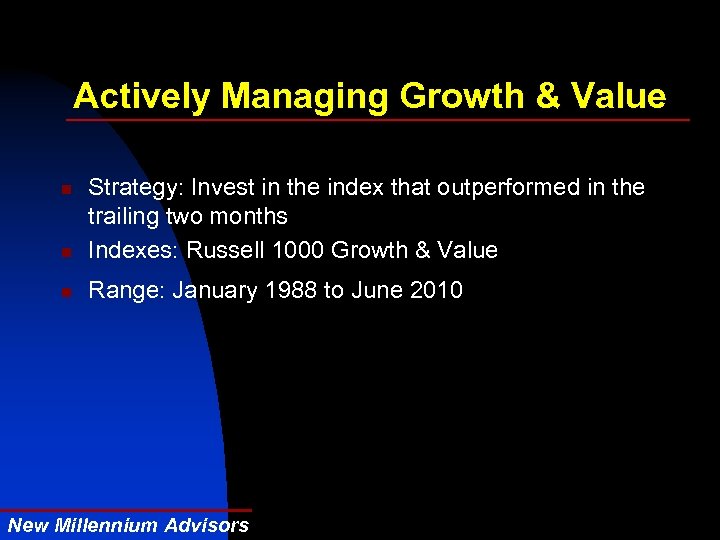 Actively Managing Growth & Value n Strategy: Invest in the index that outperformed in the trailing two months Indexes: Russell 1000 Growth & Value n Range: January 1988 to June 2010 n New Millennium Advisors
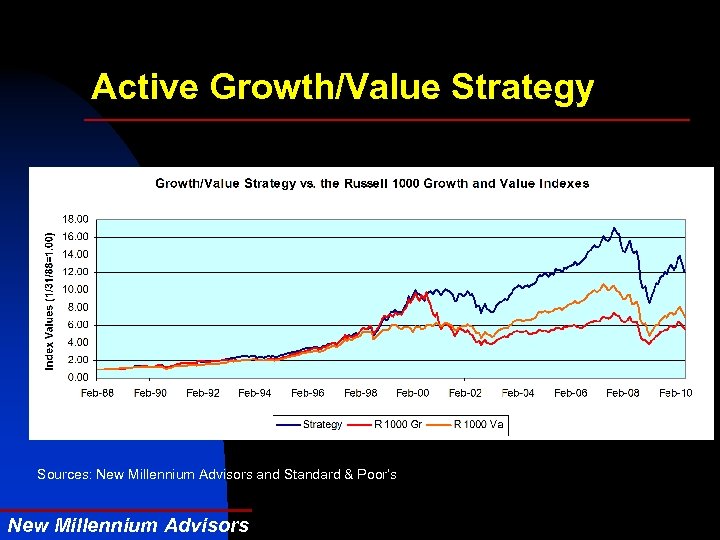 Active Growth/Value Strategy Sources: New Millennium Advisors and Standard & Poor’s New Millennium Advisors
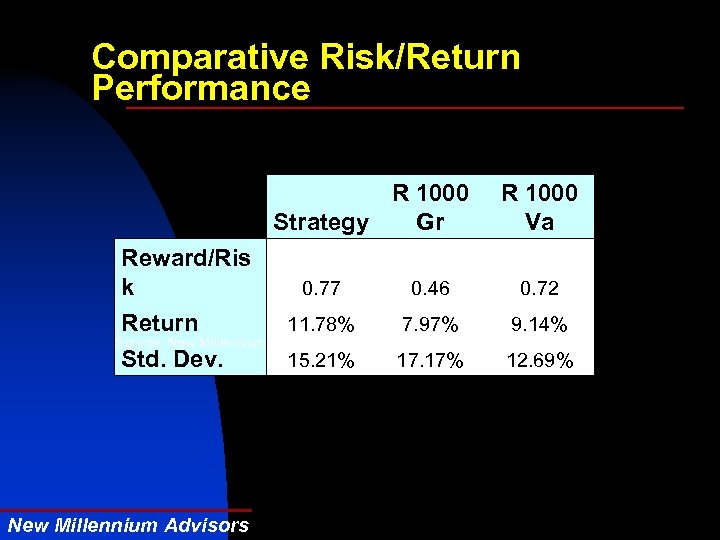 Comparative Risk/Return Performance R 1000 Strategy Gr Reward/Ris k 0. 77 Return 11. 78% Source: New Millennium Advisors Std. Dev. 15. 21% New Millennium Advisors R 1000 Va 0. 46 0. 72 7. 97% 9. 14% 17. 17% 12. 69%
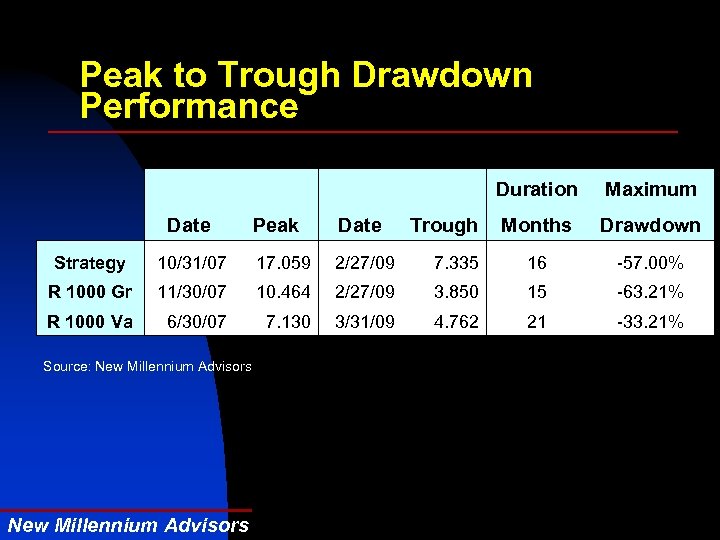 Peak to Trough Drawdown Performance Date Peak Date Duration Maximum Trough Months Drawdown Strategy 10/31/07 17. 059 2/27/09 7. 335 16 -57. 00% R 1000 Gr 11/30/07 10. 464 2/27/09 3. 850 15 -63. 21% R 1000 Va 6/30/07 7. 130 3/31/09 4. 762 21 -33. 21% Source: New Millennium Advisors
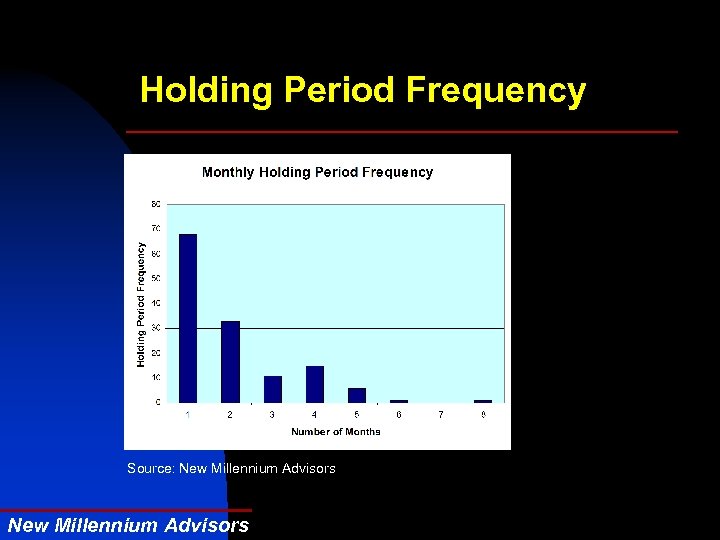 Holding Period Frequency Source: New Millennium Advisors
 How Should Tax Issues Be Managed? n n Distinguish between qualified and non-qualified accounts Consider the tax implications for long- and short-term investors, and equity and fixed income holdings New Millennium Advisors
 Qualified and Non-Qualified Accounts n n Non-qualified accounts can defer long-term capital gains indefinitely and withdraw funds at long-term capital gains rates Retirement accounts defer taxes but are taxed at the ordinary income rate when funds are withdrawn New Millennium Advisors
 Long-Term Investors Who Rarely Trade n n Equity ETFs should be held in non-qualified accounts to get a favorable tax treatment Fixed income investments should be held in taxdeferred accounts so income can compound tax free New Millennium Advisors
 Summary and Conclusions n n n Buy & hold strategies relates to the entire market and only investors in the aggregate can hold it indefinitely. An individual’s buy & hold choices are limited by their risk preferences, financial goals, personal circumstances, assets and their forms, and time horizons. These characteristics change over time, so their strategic allocation must be actively managed. As events cause changes, it is prudent and reasonable to adapt to them rather than be victimized by them. Managing tax consequences is simplified using tax efficient ETPs in non-qualified accounts as surrogates for qualified accounts. New Millennium Advisors
 Thank you! C. Michael Carty New Millennium Advisors, LLC Two Rector Street, 15 th Floor New York, NY 10006 Tel. (917) 697 -9464 Fax (212) 386 -7590 mcarty@qwafafew. org New Millennium Advisors