 Скачать презентацию Active Solar Air Heating By Mitchell French
231acd60ef2b1fba3fcd71433be0b803.ppt
- Количество слайдов: 16



Active Solar Air Heating By: Mitchell French
Objective • Give the class enough knowledge to make intelligent decisions regarding this heating system
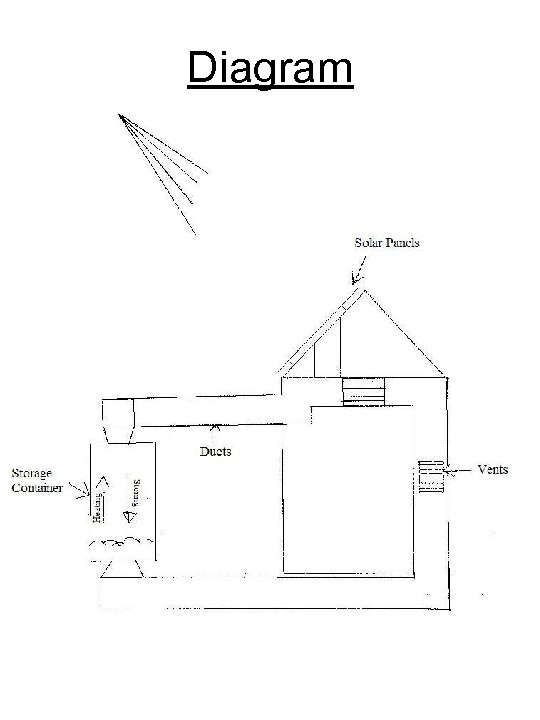
Collection • Solar Collectors Gather heat • Air is the absorbing fluid • Air moves directly into house or stores in rock storage bin • Air circulated through house using ducts • If excess heated air, stored in container • If not enough heat, backup heating system activates (traditional system)
Panels • Must be pointed towards true south – Point where sun is at its highest • This usually equates to your latitude +15° • Leniency of about 20° • Should not be placed in shaded area • Do not have to be placed on roof
Distribution • Fans move air through ducts in house • Large ducts allow the air to move slower and therefore feel warmer • An “Air Handler” decides where the air will go – From collectors to house – From collectors to storage container – From storage container to house
Ducts • Large due to lower temperature of air • Must move more air to make up for lower temperature • Must maximize the efficiency of fans • Requires insulation so no heat is lost (R-16) • Average system moves air at a speed of 1. 5 to 3 m/s
Storage Container Build • Lined with rocks on the bottom to absorb heat • Quartz most common type of stone • Larger than required for fluid system • Can be stored inside, basement, or underground outside
Storage Container System • Heated air enters through plenum at top • Rocks absorb heat from air • Air enters through bottom, heats as it rises and gets distributed to house • If air going to house: – Enters through bottom plenum – Absorbs heat as it rises – Fans circulate air through house
Properties of Container • Materials: Cinderblock, Concrete, Wood • Must be sealed to preserve efficiency • Usually installed in crawlspaces or basements • Should have ½ to 1 ft 3 for every ft 2 of collector • Should be 5 to 7 feet deep • Temperature: top-140°F (60 °C) bottom-70°F (21. 1°C)
Advantages / Disadvantages • Advantages: – If there is a leak in the system, it is less important than if one occurs in a liquid system – More effective during the day than the liquid system – Can heat air earlier and later in the day – Air systems do not freeze like is possibly with liquid systems • Disadvantages – Much more space required
Maintenance • Check ducts for leaks that could reduce performance • Make sure collectors are clear • Clean air filters for more efficient flow of air • Lubricate pumps and fans • Empty Storage Bin in summer
Installation • Depends on Container location • Hard to upgrade existing house • Must plan to use air solar heating from beginning
Partial Systems • No storage container • Collector panels not as large • Collector Panels placed directly on wall • Same principle as full system, but no storage • Collectors are relatively small • Simpler to install – fits in existing window
Conclusion • Size makes it cumbersome • Requires precise installation
References • http: //www. healthgoods. com/Education/Energy_In formation/Renewable_Energy/heating_with_active _solar. htm • http: //www. newenergy. org/sesci/publications/pam phlets/active. html • http: //www. solarenergysociety. ca/2003/active. asp • http: //www. canren. gc. ca/programs/index. asp? Ca. I D=60&Pg. ID=141 • http: //bathrooms. bobvila. com/Article/743. html
Diagram
Скачать презентацию Active Solar Air Heating By Mitchell French
231acd60ef2b1fba3fcd71433be0b803.ppt