


 Скачать презентацию Active Safety Features and Active Safety Human Factors
146008e1d0fc11c2c5a3e75dfd770f51.ppt
- Количество слайдов: 22
 Active Safety Features and Active Safety Human Factors Issues Mike Shulman Ford Motor Company
 Presentation Overview Ø Active Safety Opportunities Ø Defining the Active Safety Benefit Equation Ø The Role of Human Factors in Implementing Active Safety Ø The Information to Control Continuum Ø Research Opportunities
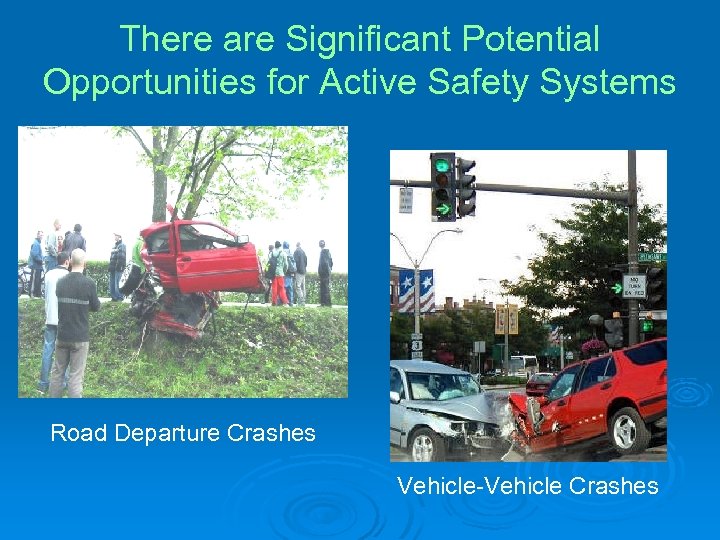 There are Significant Potential Opportunities for Active Safety Systems Road Departure Crashes Vehicle-Vehicle Crashes
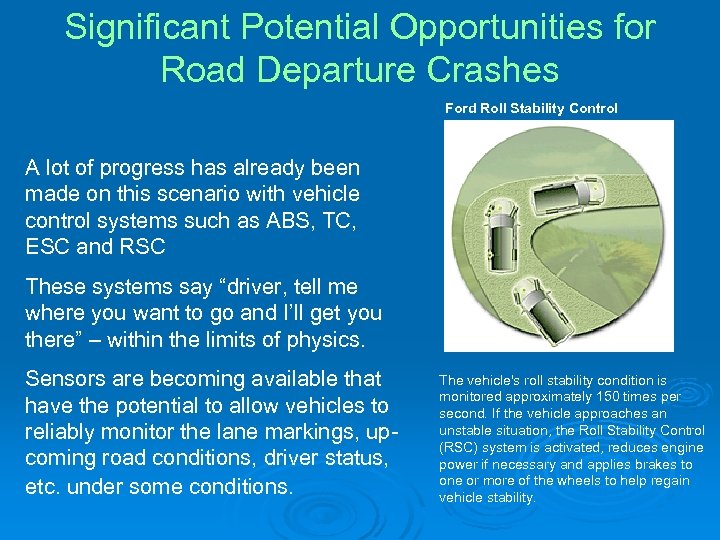 Significant Potential Opportunities for Road Departure Crashes Ford Roll Stability Control A lot of progress has already been made on this scenario with vehicle control systems such as ABS, TC, ESC and RSC These systems say “driver, tell me where you want to go and I’ll get you there” – within the limits of physics. Sensors are becoming available that have the potential to allow vehicles to reliably monitor the lane markings, upcoming road conditions, driver status, etc. under some conditions. The vehicle's roll stability condition is monitored approximately 150 times per second. If the vehicle approaches an unstable situation, the Roll Stability Control (RSC) system is activated, reduces engine power if necessary and applies brakes to one or more of the wheels to help regain vehicle stability.
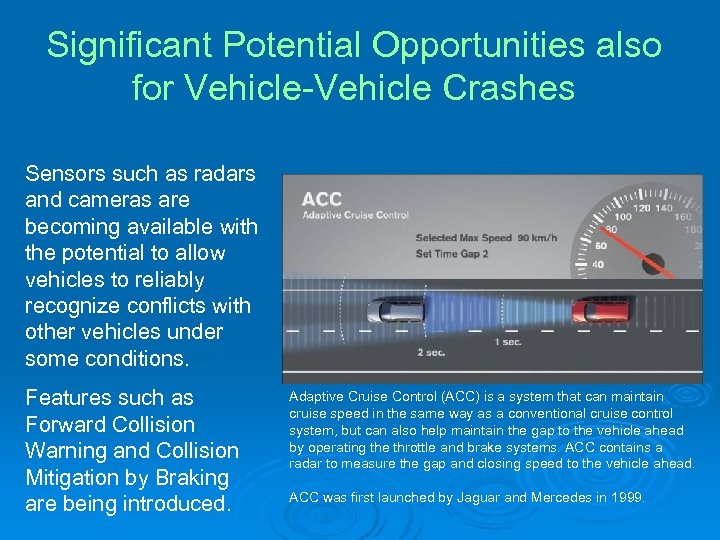 Significant Potential Opportunities also for Vehicle-Vehicle Crashes Sensors such as radars and cameras are becoming available with the potential to allow vehicles to reliably recognize conflicts with other vehicles under some conditions. Features such as Forward Collision Warning and Collision Mitigation by Braking are being introduced. Adaptive Cruise Control (ACC) is a system that can maintain cruise speed in the same way as a conventional cruise control system, but can also help maintain the gap to the vehicle ahead by operating the throttle and brake systems. ACC contains a radar to measure the gap and closing speed to the vehicle ahead. ACC was first launched by Jaguar and Mercedes in 1999.
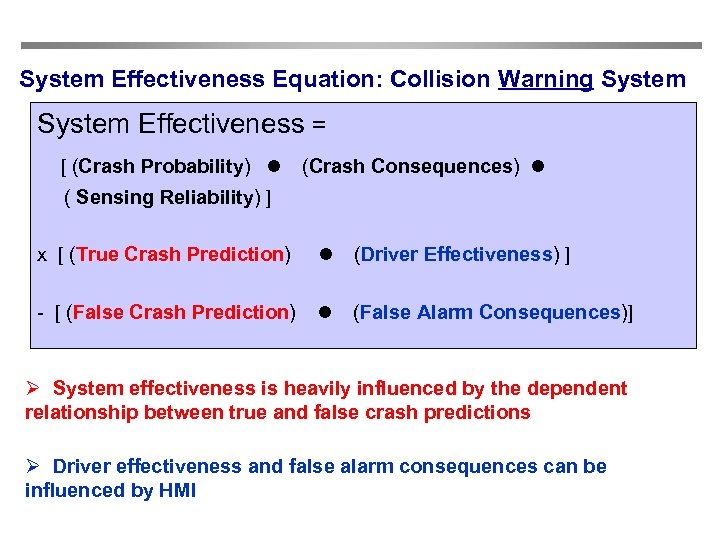 System Effectiveness Equation: Collision Warning System Effectiveness = [ (Crash Probability) l (Crash Consequences) l ( Sensing Reliability) ] x [ (True Crash Prediction) l (Driver Effectiveness) ] - [ (False Crash Prediction) l (False Alarm Consequences)] Ø System effectiveness is heavily influenced by the dependent relationship between true and false crash predictions Ø Driver effectiveness and false alarm consequences can be influenced by HMI
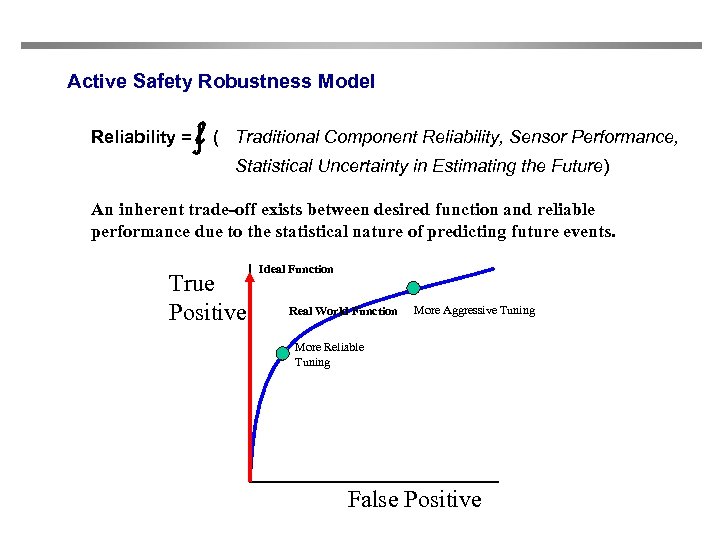 Active Safety Robustness Model Reliability = f( Traditional Component Reliability, Sensor Performance, Statistical Uncertainty in Estimating the Future) An inherent trade-off exists between desired function and reliable performance due to the statistical nature of predicting future events. True Positive Ideal Function Real World Function More Aggressive Tuning More Reliable Tuning False Positive
 From the ACAS FOT Final Program Report “With respect to FCW, results clearly suggest that further reductions in false alarms (resulting in a higher proportion of “credible” FCW alerts) are needed to ensure widespread FCW system acceptance. Only one-third of the imminent alerts were issued in response to vehicles that remained in the same lane as the driver during the approach. The remaining imminent alerts were issued primarily to roadside stationary objects (such as signs and mailboxes), when the lead vehicle was turning (which can be anticipated by the driver), or during driver-initiated lane changes. The overall impression is that a formidable technical challenge lies ahead in fielding a widely accepted FCW system. ”
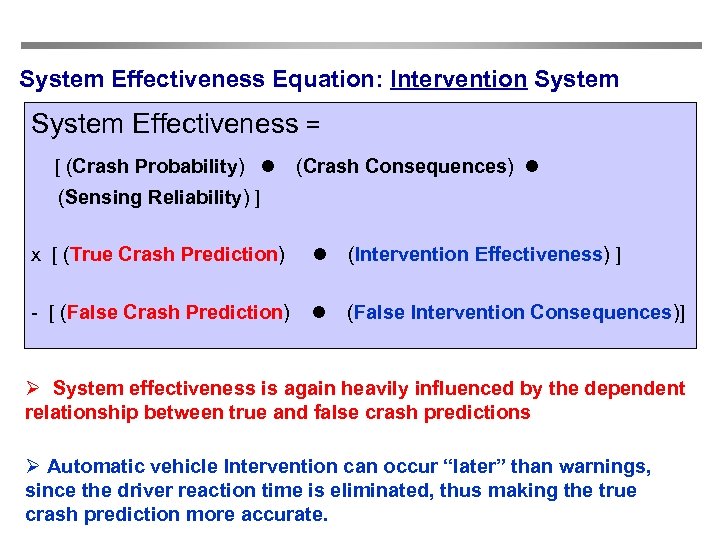 System Effectiveness Equation: Intervention System Effectiveness = [ (Crash Probability) l (Crash Consequences) l (Sensing Reliability) ] x [ (True Crash Prediction) l (Intervention Effectiveness) ] - [ (False Crash Prediction) l (False Intervention Consequences)] Ø System effectiveness is again heavily influenced by the dependent relationship between true and false crash predictions Ø Automatic vehicle Intervention can occur “later” than warnings, since the driver reaction time is eliminated, thus making the true crash prediction more accurate.
 To Increase Our Understanding of True/False Crash Prediction Ø Besides radar, vision, GPS/maps etc. , we are now exploring vehicle communications to aid in our understanding of the vehicle environment. Ø The CAMP VSC 2 Consortium (DCX, Ford, GM, Honda and Toyota) is working with the NHTSA and FHWA on: l l CICAS-V (Cooperative Intersection Collision Avoidance System for Violations). VSC-A (Vehicle Safety Communications Applications).
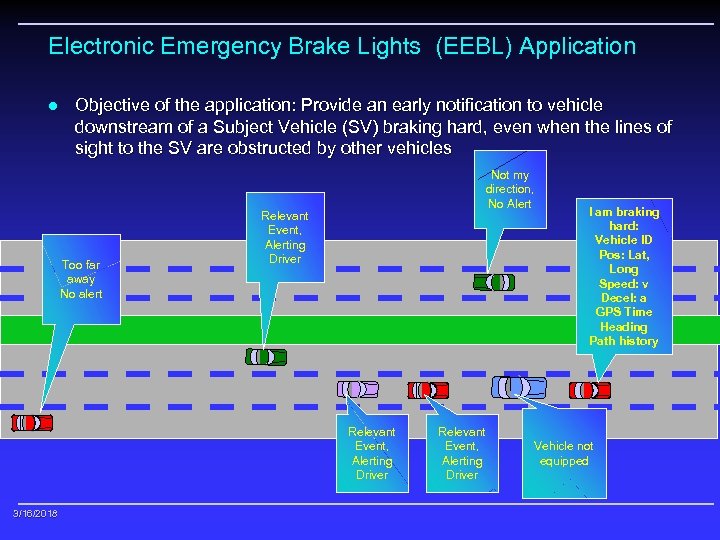 Electronic Emergency Brake Lights (EEBL) Application l Objective of the application: Provide an early notification to vehicle downstream of a Subject Vehicle (SV) braking hard, even when the lines of sight to the SV are obstructed by other vehicles Too far away No alert Not my direction, No Alert Relevant Event, Alerting Driver 3/16/2018 Relevant Event, Alerting Driver I am braking hard: Vehicle ID Pos: Lat, Long Speed: v Decel: a GPS Time Heading Path history Vehicle not equipped
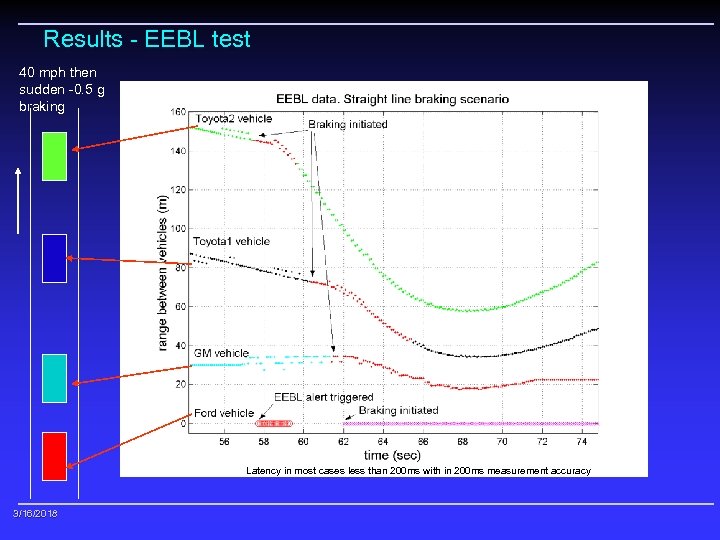 Results - EEBL test 40 mph then sudden -0. 5 g braking Latency in most cases less than 200 ms with in 200 ms measurement accuracy 3/16/2018
 Information to Control Continuum Ø Driver Acceptance is a crucial consideration in the implementation of Active Safety Systems Ø Current Implementation Strategies use a progression: l l Information Warning Limited Intervention Full Control
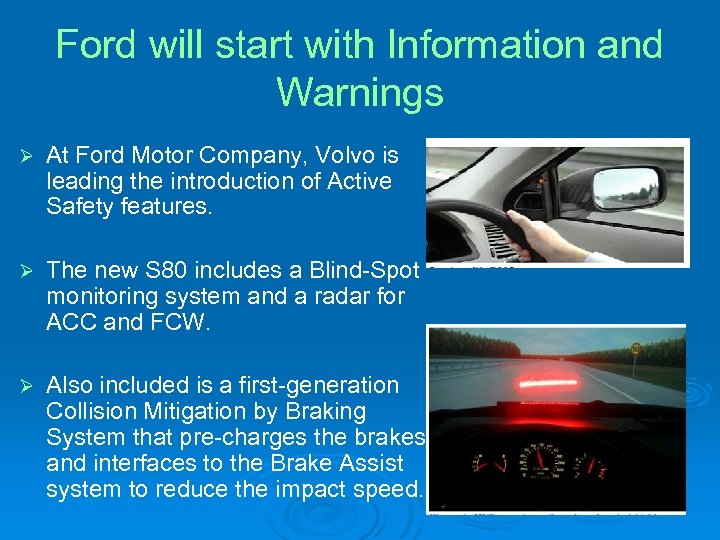 Ford will start with Information and Warnings Ø At Ford Motor Company, Volvo is leading the introduction of Active Safety features. Ø The new S 80 includes a Blind-Spot monitoring system and a radar for ACC and FCW. Ø Also included is a first-generation Collision Mitigation by Braking System that pre-charges the brakes and interfaces to the Brake Assist system to reduce the impact speed.
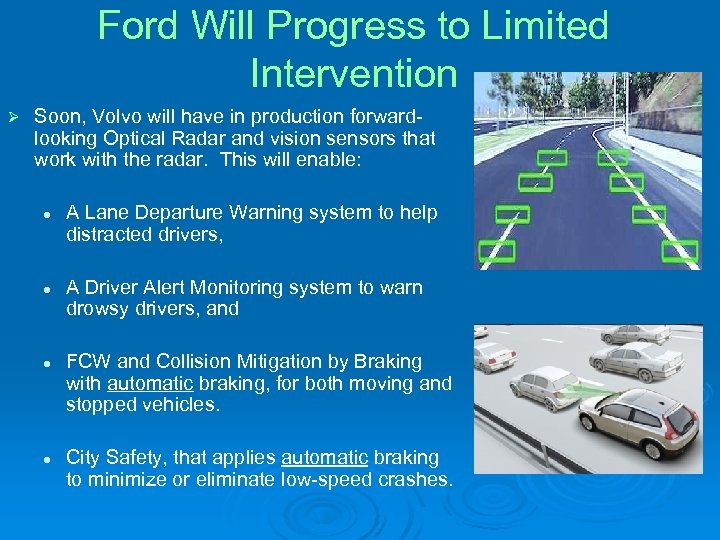 Ford Will Progress to Limited Intervention Ø Soon, Volvo will have in production forwardlooking Optical Radar and vision sensors that work with the radar. This will enable: l l A Lane Departure Warning system to help distracted drivers, A Driver Alert Monitoring system to warn drowsy drivers, and FCW and Collision Mitigation by Braking with automatic braking, for both moving and stopped vehicles. City Safety, that applies automatic braking to minimize or eliminate low-speed crashes.
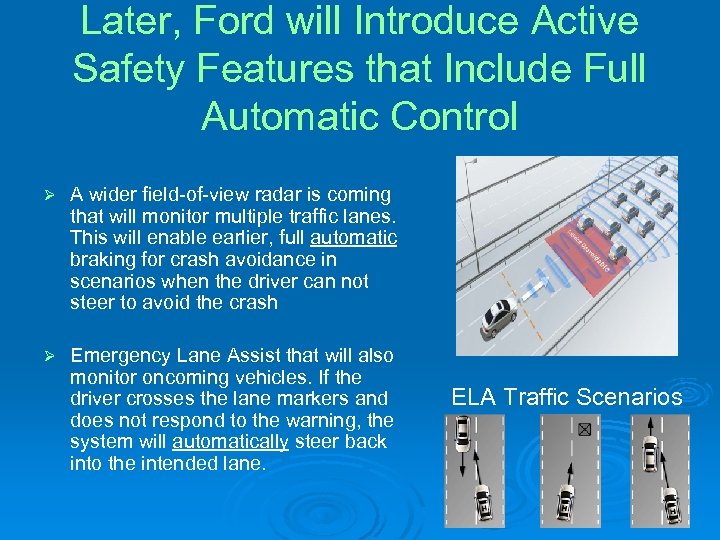 Later, Ford will Introduce Active Safety Features that Include Full Automatic Control Ø A wider field-of-view radar is coming that will monitor multiple traffic lanes. This will enable earlier, full automatic braking for crash avoidance in scenarios when the driver can not steer to avoid the crash Ø Emergency Lane Assist that will also monitor oncoming vehicles. If the driver crosses the lane markers and does not respond to the warning, the system will automatically steer back into the intended lane. ELA Traffic Scenarios
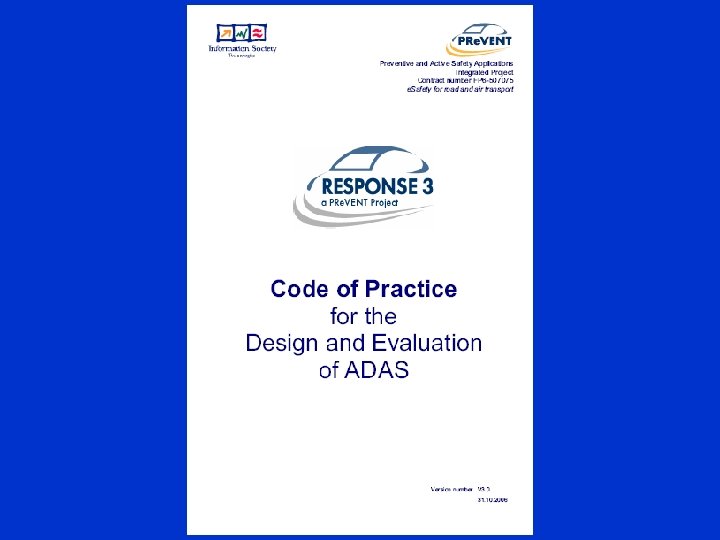
 ADAS Code of Practice Ø Europe has developed a Code of Practice for Advanced Driver Assistance Systems. Ø HMI Concept Simulation & Criteria for HMI Concept Selection are identified in sections A 59 & A 74 respectively. Ø These may be useful as a framework for the development of common design guidelines/standards in the US.
 Warnings Integration Ø ISO SC 13/WG 8 & SAE S&HF committee are working on an early draft standard regarding principles and guidelines for the integration of time-sensitive and safetycritical warning signals in road vehicles Ø Two proposed methods for evaluating the integration of active safety warnings are being considered l l Timely comprehension – measures comprehension of warnings Verification of no unwanted responses – measures participants responses to warnings in context, e. g. simulator or instrumented vehicle
 What are some major Active Safety Human Factors Issues? How do we successfully warn drivers in situations where the vehicle can sense things that the driver can not? 1. l l We have seen this issue in Emergency Electronic Brake Lights GM and VTTI have seen this issue in backing warning studies
 What are some major Active Safety Human Factors Issues? 2. How do we decide to take control of the vehicle away from the driver? What should we do in situations where it is unsafe to proceed? For example, gap acceptance at rural intersections. l We could tell drivers when we think it is unsafe, and/or l We could prevent the vehicle from proceeding until the threat has diminished.
 Research Opportunities Ø Identify the common activities (industry, government, suppliers, etc. ) needed for successful Active Safety deployment Ø Analyze current Active Safety deployments for lessons learned Ø Investigate the aspects of HMI that need standardization to avoid driver confusion and reduced system effectiveness