


 Скачать презентацию Active Reading and Thinking Strategies Chapter 1
15ad10f883caf05447ab512aad369ad0.ppt
- Количество слайдов: 17
 Active Reading and Thinking Strategies Chapter 1
 Self-Evaluation o o o Does your mind go blank when you take a test? Have you ever done poorly on a test even though you read the chapter two or three times? When reading, is it hard to remember what you read a few pages ago? Feel like you know what you read but you can’t explain it? Do you feel like you should be getting more from your textbooks?
 Active Reading o o Reading textbooks is not like reading novels. Efficient and effective reading allows you to read many more pages of text in less time. Active reading improves your recall and understanding. Active reading allows you to better grasp complicated reading material.
 Get Acquainted o Buy your textbooks as early as you can. n o If you’re certain of the books you need, buy them before classes start. Get familiar with each book n n Read the introduction Look at the table of contents Does it have a glossary? What’s the vocabulary like?
 Take your time o When beginning a reading assignment, make sure you have an idea of how long it will take n n Break the reading into manageable chunks Find the right speed for you o o n Too fast, and you miss important information Too slow, you’re probably paying too much attention to unimportant detail Don’t fall behind!
 Do’s of Active Reading o Read in an environment that works for you n Well-lit, free of distractions o o o Take breaks n o o o What’s your concentration limit? Read every day (even weekends) Be creative and thoughtful n o You may need to move around If you fall asleep while reading, sit up – don’t lie down Mark your books (but don’t mark every word) Read while you’re alert Read out loud if the material is complicated
 Don’ts of Active Reading o o o Don’t study in bed. Don’t have the TV on while you study Don’t play music while you read n o o Some people need background noise, though Don’t plan to read for hours at a time Don’t read when you’re sleepy Don’t fall behind Don’t wait till the last minute
 Mark your book! o o Forget selling your books back to the bookstore. Make notes in the margin n o Don’t highlight while reading If you don’t understand something, put a question mark by it.
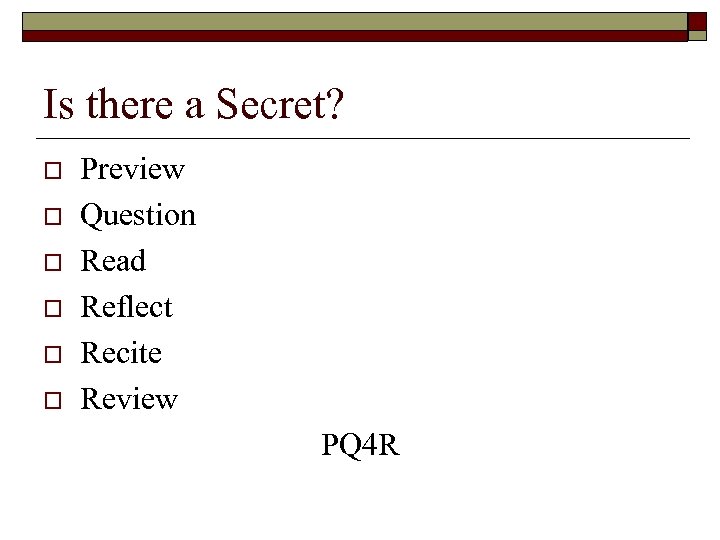 Is there a Secret? o o o Preview Question Read Reflect Recite Review PQ 4 R
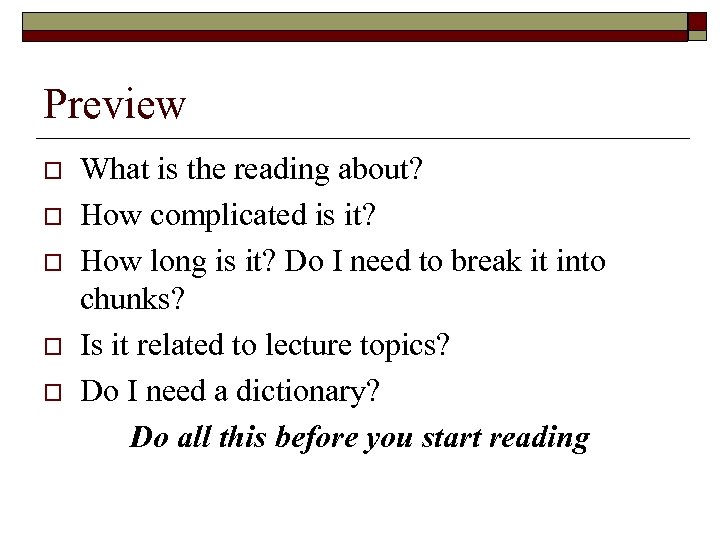 Preview o o o What is the reading about? How complicated is it? How long is it? Do I need to break it into chunks? Is it related to lecture topics? Do I need a dictionary? Do all this before you start reading
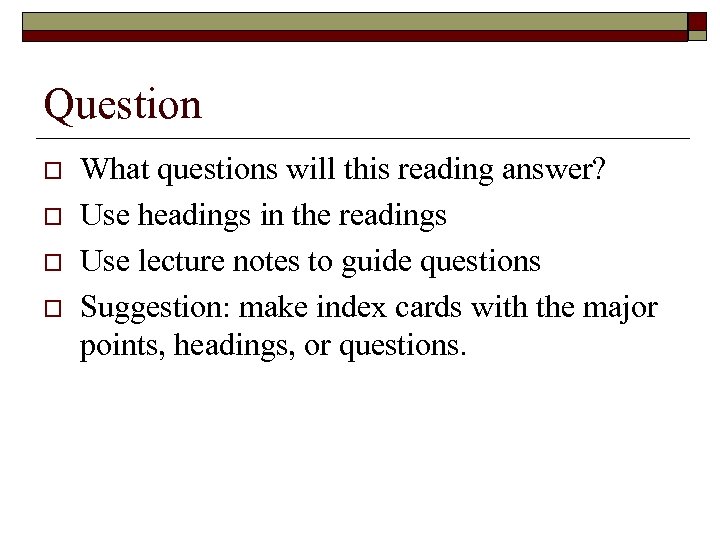 Question o o What questions will this reading answer? Use headings in the readings Use lecture notes to guide questions Suggestion: make index cards with the major points, headings, or questions.
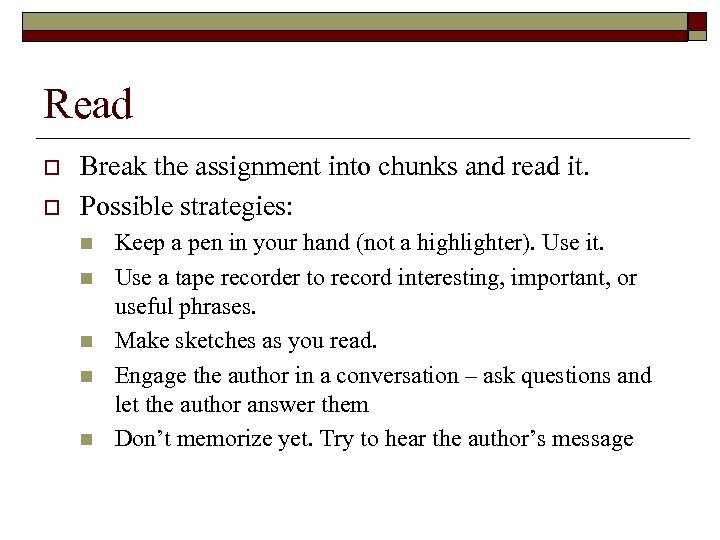 Read o o Break the assignment into chunks and read it. Possible strategies: n n n Keep a pen in your hand (not a highlighter). Use it. Use a tape recorder to record interesting, important, or useful phrases. Make sketches as you read. Engage the author in a conversation – ask questions and let the author answer them Don’t memorize yet. Try to hear the author’s message
 Reflect o Just what it sounds like – think about the reading. n n n o How does the reading relate to lecture topics? How does it fit with or challenge what you already know? What are the answers to the questions that you asked After you reflect, go back and highlight important points.
 Recite o o Explain what you read Strategies – n n n o Write a one-sentence summary of each main segment. Explain the reading out loud to yourself or someone else. Draw a flowchart that shows connections between ideas in the reading. This is where you learn what you understand what you don’t understand.
 Review o Go back over the reading n o o o Wait a day or two. See whether you remember the main concepts, even without looking at the book. Ask a question in class or after class about something you didn’t quite get. Focus on the hardest material
 Did you know? o When most professors read books, they use this strategy. We almost never read something just once from start to finish.
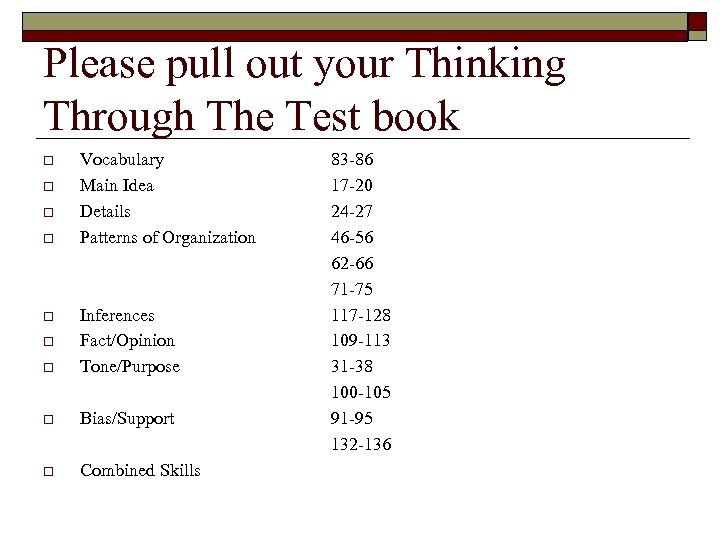 Please pull out your Thinking Through The Test book o o Vocabulary Main Idea Details Patterns of Organization o Inferences Fact/Opinion Tone/Purpose o Bias/Support o Combined Skills o o 83 -86 17 -20 24 -27 46 -56 62 -66 71 -75 117 -128 109 -113 31 -38 100 -105 91 -95 132 -136