


 Скачать презентацию Active Queue Management Rong Pan Cisco System EE
bd759bda03aa1ed86da51c121e6cd9f8.ppt
- Количество слайдов: 54
 Active Queue Management Rong Pan Cisco System EE 384 y Spring Quarter 2006
 Outline • Queue Management – Drop as a way to feedback to TCP sources – Part of a closed-loop • Traditional Queue Management – Drop Tail – Problems • Active Queue Management – RED – CHOKe – AFD 2
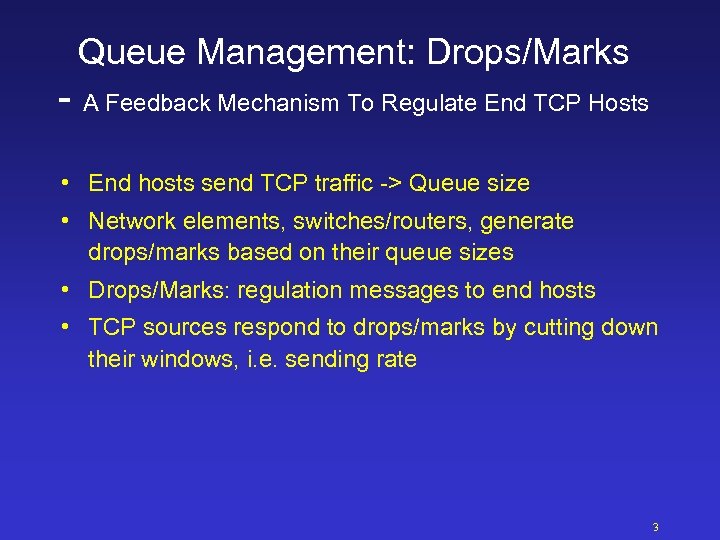 Queue Management: Drops/Marks - A Feedback Mechanism To Regulate End TCP Hosts • End hosts send TCP traffic -> Queue size • Network elements, switches/routers, generate drops/marks based on their queue sizes • Drops/Marks: regulation messages to end hosts • TCP sources respond to drops/marks by cutting down their windows, i. e. sending rate 3
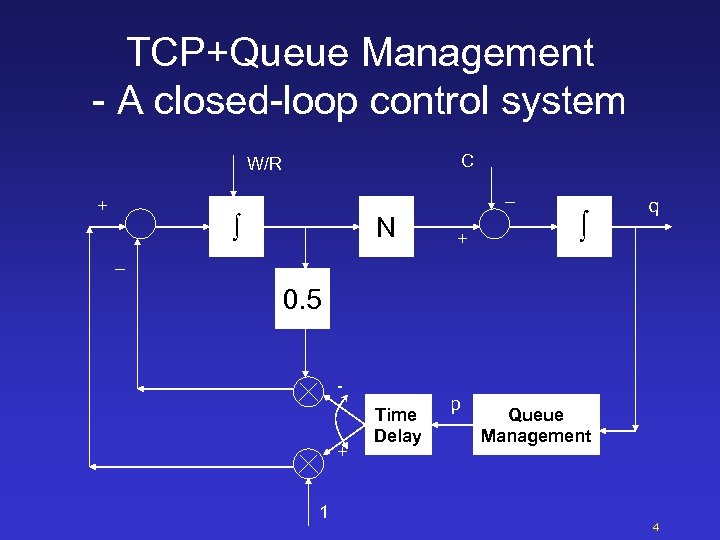 TCP+Queue Management - A closed-loop control system C W/R _ + N + q _ 0. 5 - + 1 Time Delay p Queue Management 4
 Drop Tail - problems • Lock out • Full queue • Bias against bursty traffic • Global synchronization 5
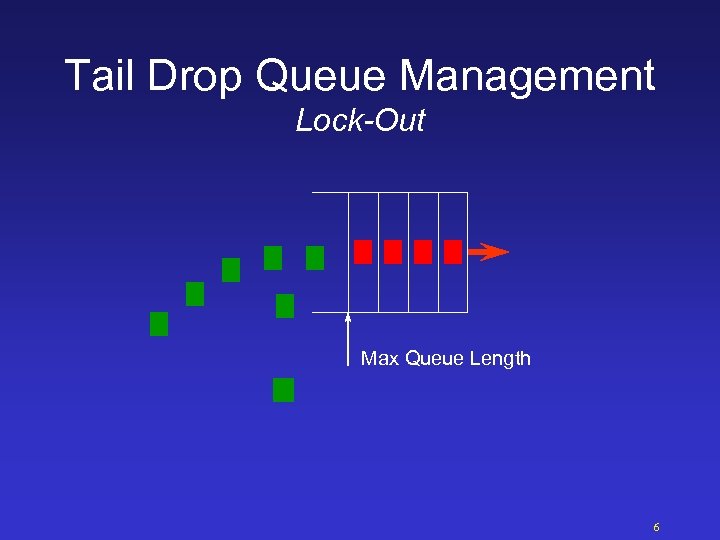 Tail Drop Queue Management Lock-Out Max Queue Length 6
 Tail Drop Queue Management Full-Queue • Only drop packets when queue is full – long steady-state delay 7
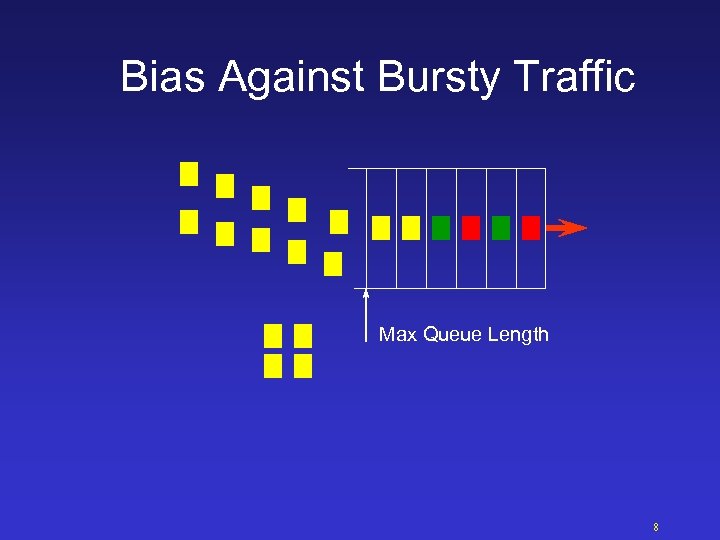 Bias Against Bursty Traffic Max Queue Length 8
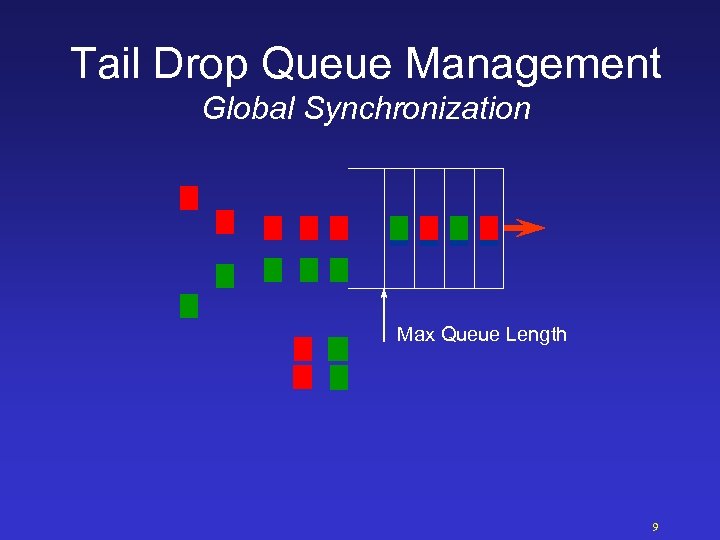 Tail Drop Queue Management Global Synchronization Max Queue Length 9
 Alternative Queue Management Schemes • Drop from front on full queue • Drop at random on full queue F both solve the lock-out problem F both have the full-queues problem 10
 Active Queue Management Goals • Solve tail-drop problems – no lock-out behavior – no global synchronization – no bias against bursty flow • Provide better Qo. S at a router – low steady-state delay – lower packet dropping 11
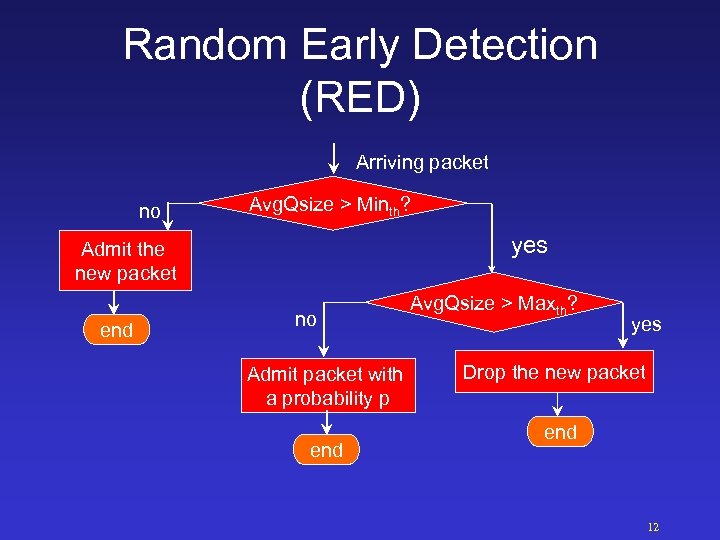 Random Early Detection (RED) Arriving packet no Avg. Qsize > Minth? yes Admit the new packet end no Admit packet with a probability p end Avg. Qsize > Maxth? yes Drop the new packet end 12
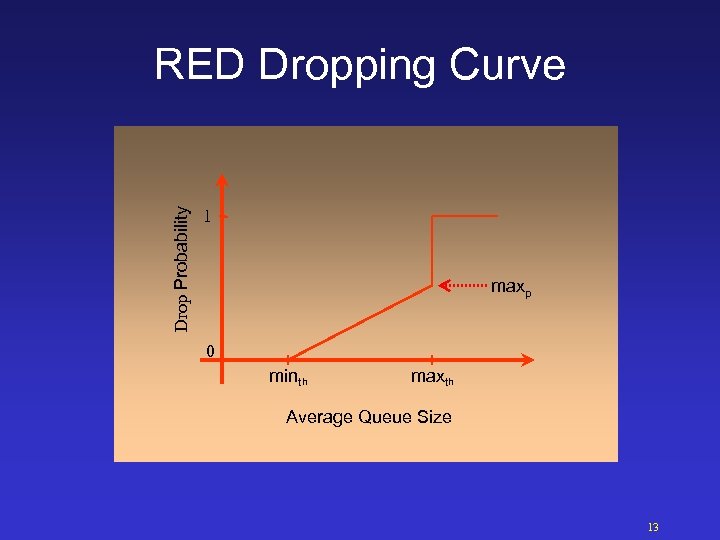 Drop Probability RED Dropping Curve 1 maxp 0 minth maxth Average Queue Size 13
 Effectiveness of RED - Lock-Out & Global Synchronization • Packets are randomly dropped • Each flow has the same probability of being discarded 14
 Effectiveness of RED - Full-Queue & Bias against bursty traffic • Drop packets probabilistically in anticipation of congestion – not when queue is full • Use qavg to decide packet dropping probability: allow instantaneous bursts 15
 What Qo. S does RED Provide? • Lower buffer delay: good interactive service – qavg is controlled to be small • Given responsive flows: packet dropping is reduced – early congestion indication allows traffic to throttle back before congestion • Given responsive flows: fair bandwidth allocation 16
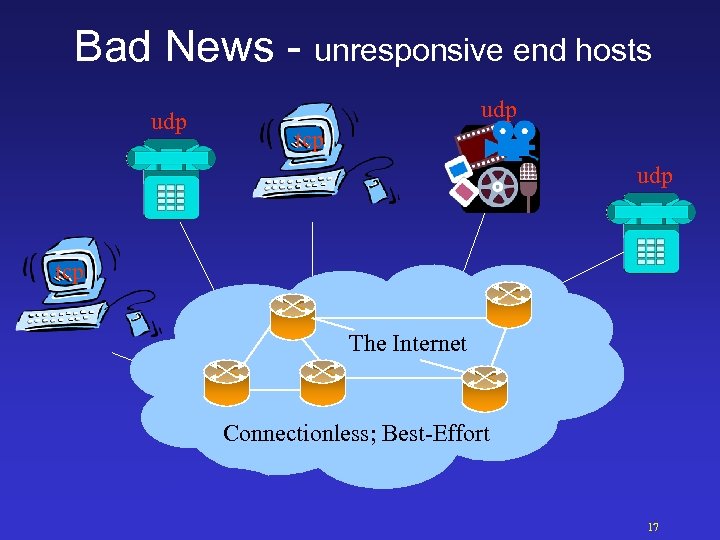 Bad News - unresponsive end hosts udp tcp The Internet Connectionless; Best-Effort 17
 Scheduling & Queue Management • What routers want to do? – isolate unresponsive flows (e. g. UDP) – provide Quality of Service to all users • Two ways to do it – scheduling algorithms: e. g. FQ, CSFQ, SFQ – queue management algorithms: e. g. RED, FRED, SRED 18
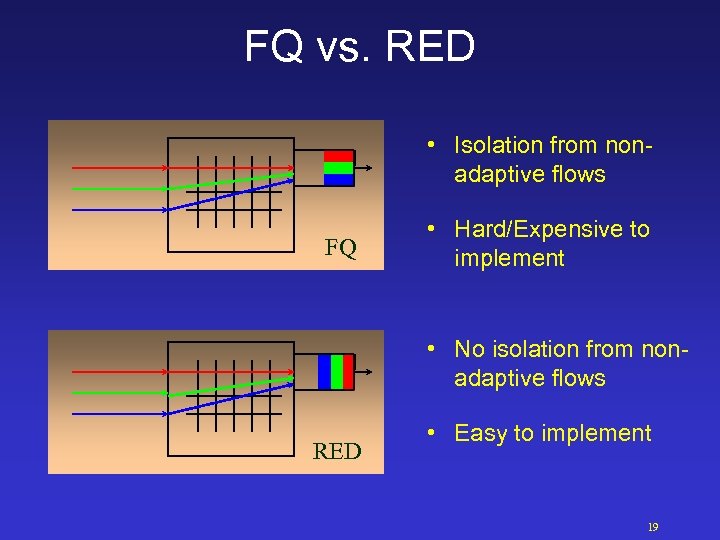 FQ vs. RED • Isolation from nonadaptive flows FQ • Hard/Expensive to implement • No isolation from nonadaptive flows RED • Easy to implement 19
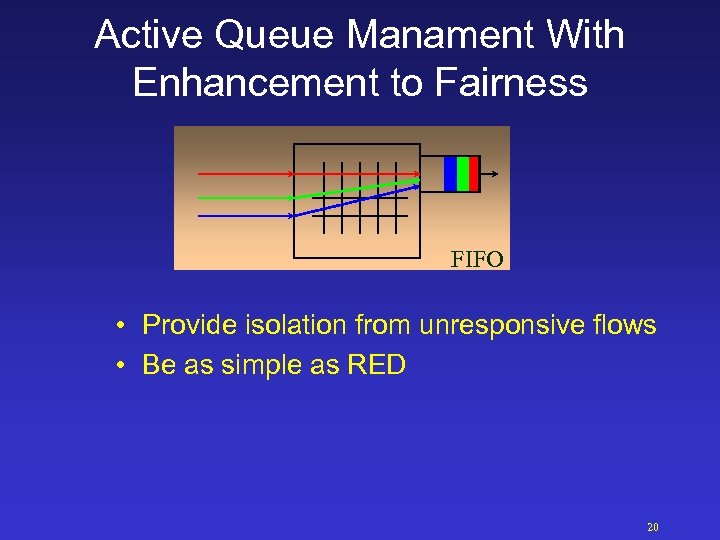 Active Queue Manament With Enhancement to Fairness FIFO • Provide isolation from unresponsive flows • Be as simple as RED 20
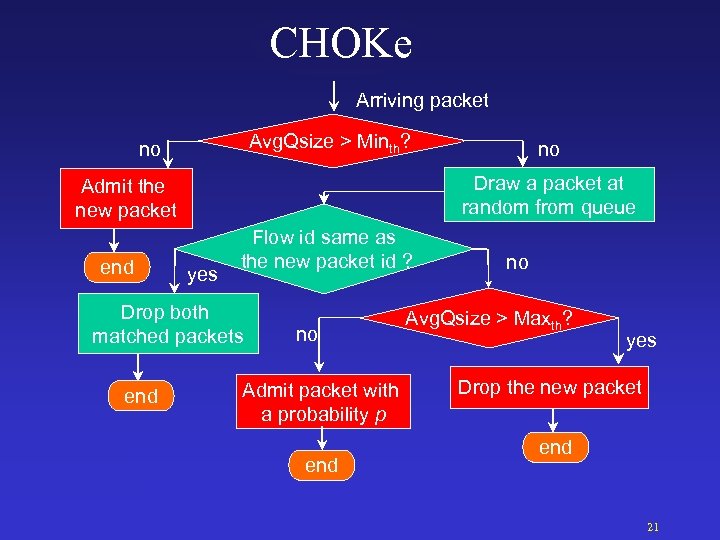 CHOKe RED Arriving packet Avg. Qsize > Minth? no Draw a packet at yes random from queue Admit the new packet end no yes Flow id same as Avg. Qsize > Maxth? no the new packet id ? no yes Drop Max ? Admit packet with Avg. Qsize > the new packet Drop both th no matched packets a probability p yes end Admit packet with a probability p end Drop the new packet end 21
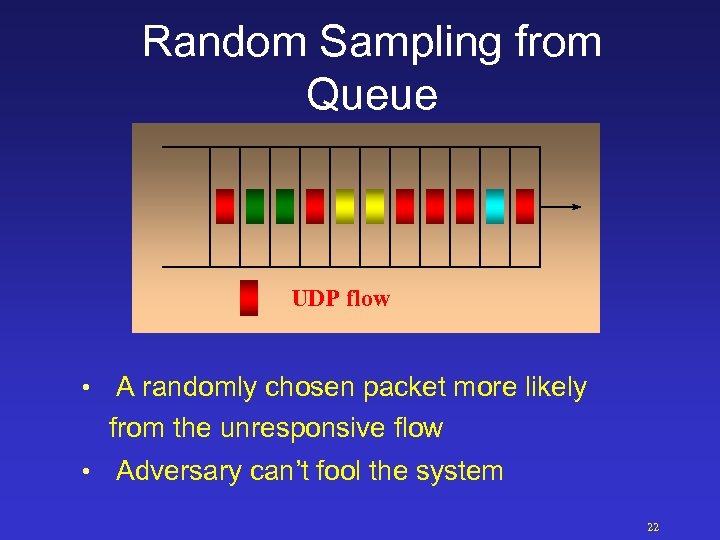 Random Sampling from Queue UDP flow • A randomly chosen packet more likely from the unresponsive flow • Adversary can’t fool the system 22
 Comparison of Flow ID • Compare the flow id with the incoming packet – more acurate – Reduce the chance of dropping packets from a TCPfriendly flows. 23
 Dropping Mechanism • Drop packets (both incoming and matching samples ) – More arrival -> More Drop – Give users a disincentive to send more 24
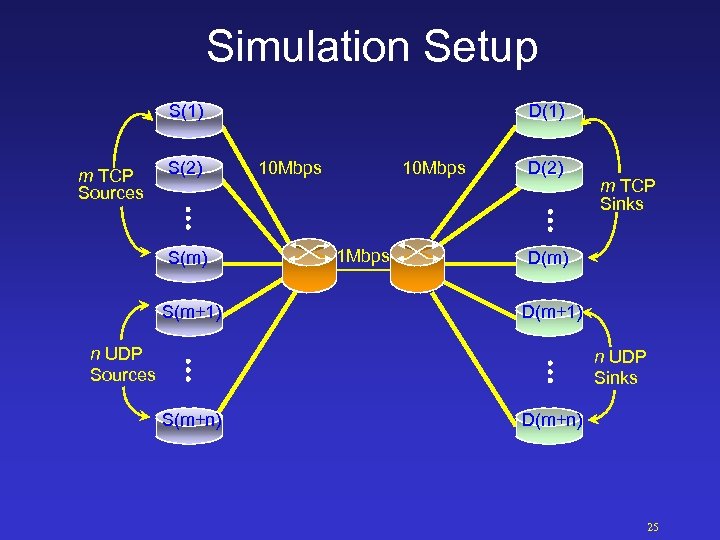 Simulation Setup S(1) m TCP Sources S(2) S(m+1) D(1) 10 Mbps 1 Mbps D(2) m TCP Sinks D(m) D(m+1) n UDP Sources n UDP Sinks S(m+n) D(m+n) 25
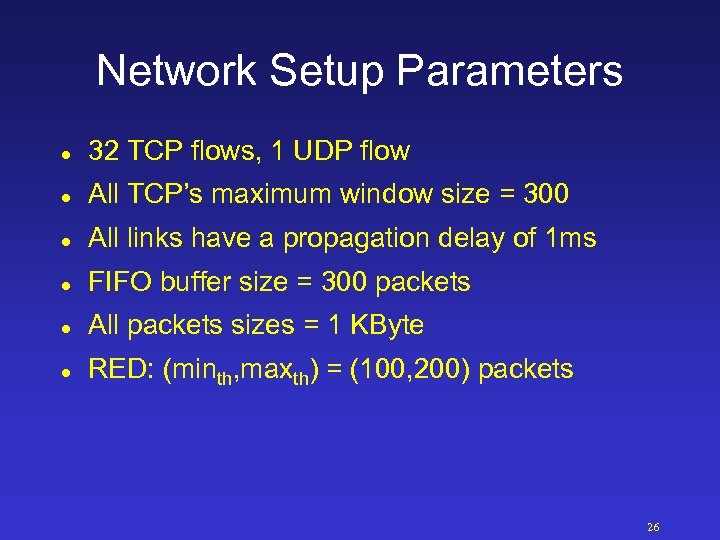 Network Setup Parameters l 32 TCP flows, 1 UDP flow l All TCP’s maximum window size = 300 l All links have a propagation delay of 1 ms l FIFO buffer size = 300 packets l All packets sizes = 1 KByte l RED: (minth, maxth) = (100, 200) packets 26
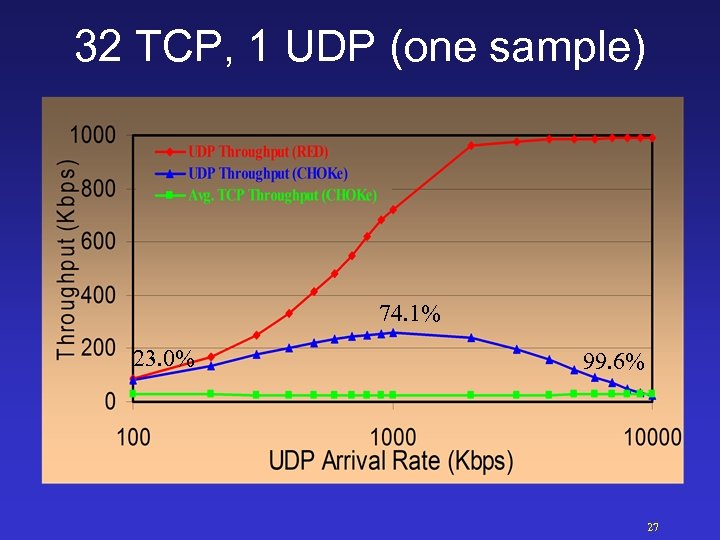 32 TCP, 1 UDP (one sample) 74. 1% 23. 0% 99. 6% 27
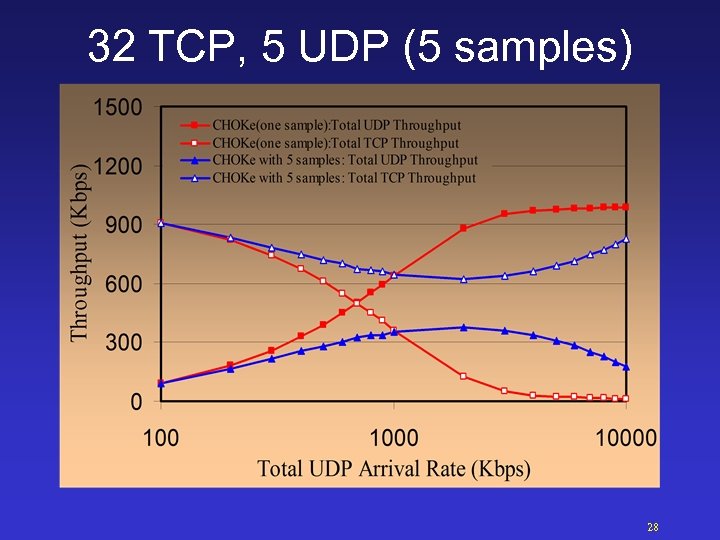 32 TCP, 5 UDP (5 samples) 28
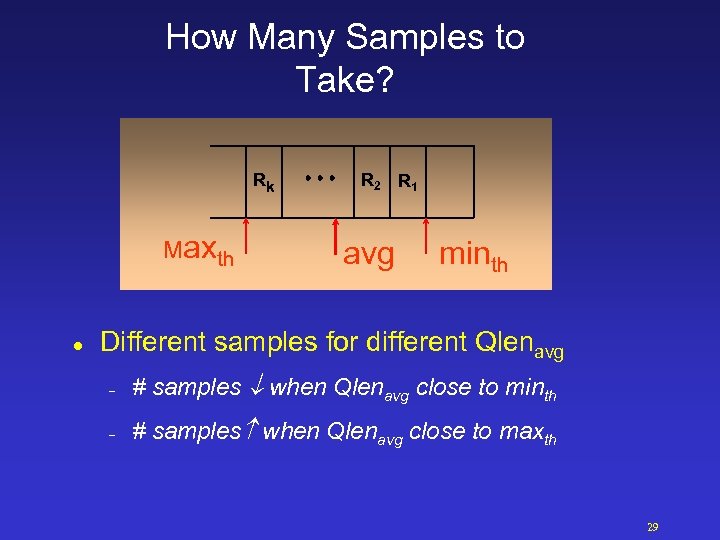 How Many Samples to Take? Rk Maxth l R 2 R 1 avg minth Different samples for different Qlenavg – # samples when Qlenavg close to minth – # samples when Qlenavg close to maxth 29
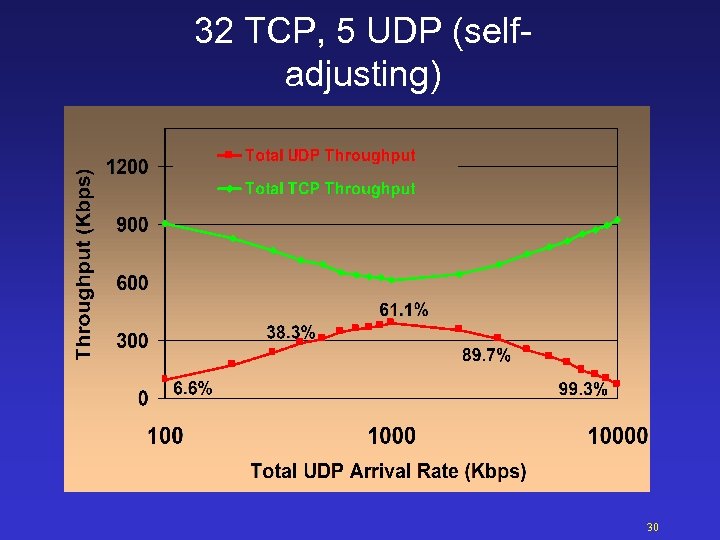 32 TCP, 5 UDP (selfadjusting) 30
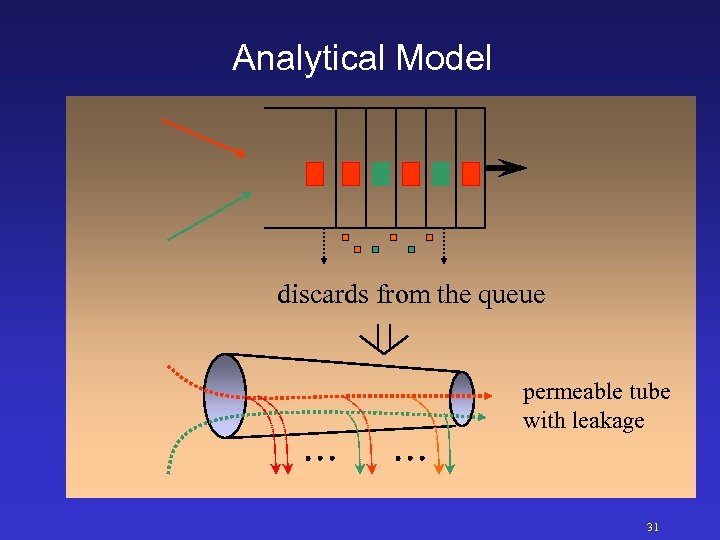 Analytical Model discards from the queue permeable tube with leakage 31
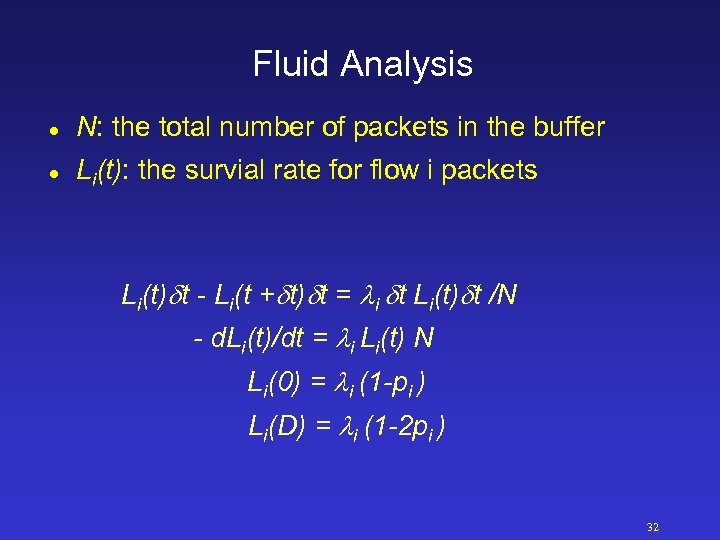 Fluid Analysis l N: the total number of packets in the buffer l Li(t): the survial rate for flow i packets Li(t) t - Li(t + t) t = i t Li(t) t /N - d. Li(t)/dt = i Li(t) N Li(0) = i (1 -pi ) Li(D) = i (1 -2 pi ) 32
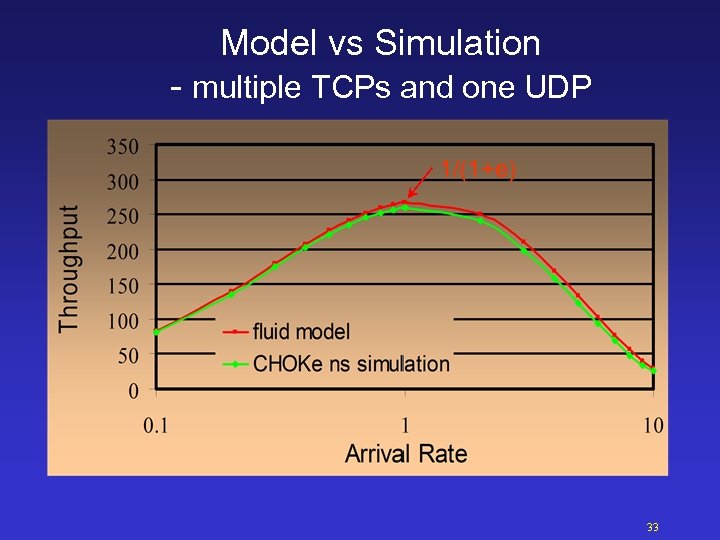 Model vs Simulation - multiple TCPs and one UDP 1/(1+e) 33
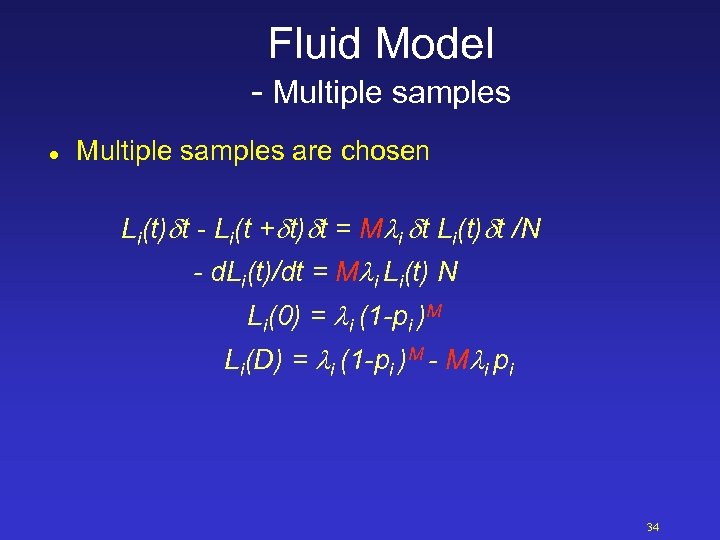 Fluid Model - Multiple samples l Multiple samples are chosen Li(t) t - Li(t + t) t = M i t Li(t) t /N - d. Li(t)/dt = M i Li(t) N Li(0) = i (1 -pi )M Li(D) = i (1 -pi )M - M i pi 34
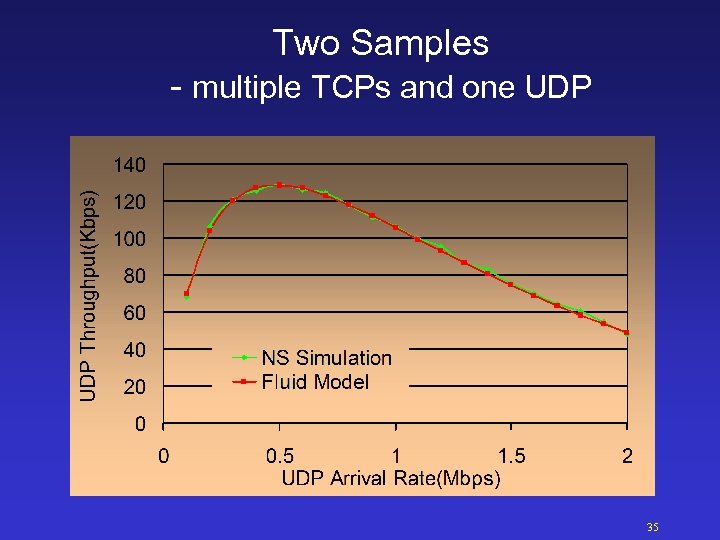 Two Samples - multiple TCPs and one UDP 35
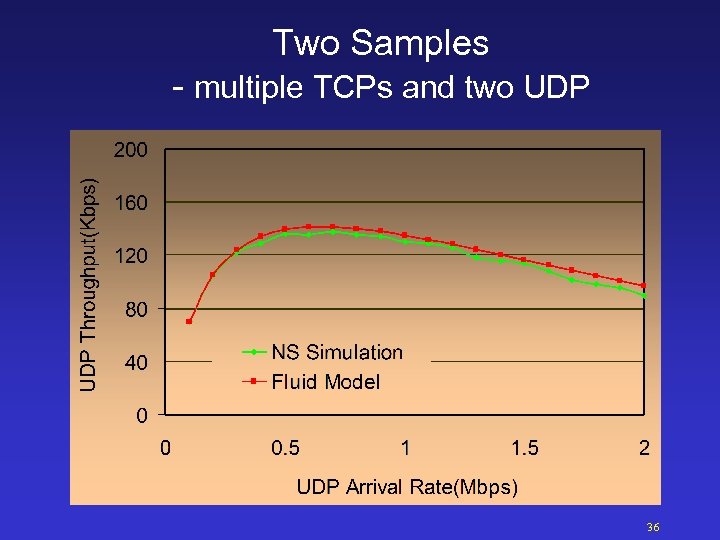 Two Samples - multiple TCPs and two UDP 36
 What If We Use a Small Amount of State? 37
 AFD: Goal • Approximate equal bandwidth allocation – Not only AQM, approximate DRR scheduling – Provide soft queues in addition to physical queues • Keep the state requirement small • Be simple to implement 38
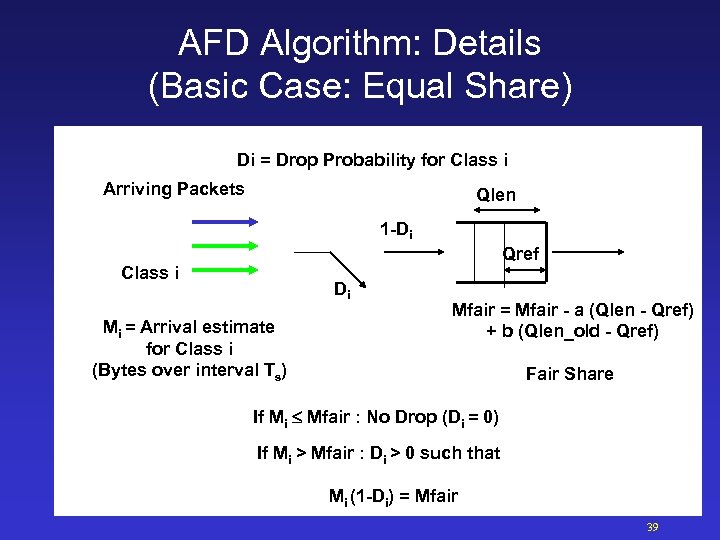 AFD Algorithm: Details (Basic Case: Equal Share) Di = Drop Probability for Class i Arriving Packets Qlen 1 -Di Qref Class i Di Mi = Arrival estimate for Class i (Bytes over interval Ts) Mfair = Mfair - a (Qlen - Qref) + b (Qlen_old - Qref) Fair Share If Mi Mfair : No Drop (Di = 0) If Mi > Mfair : Di > 0 such that Mi (1 -Di) = Mfair 39
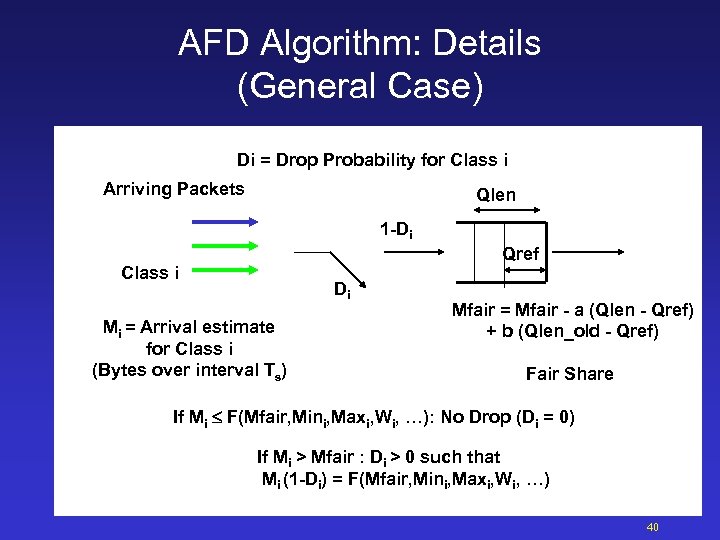 AFD Algorithm: Details (General Case) Di = Drop Probability for Class i Arriving Packets Qlen 1 -Di Qref Class i Di Mi = Arrival estimate for Class i (Bytes over interval Ts) Mfair = Mfair - a (Qlen - Qref) + b (Qlen_old - Qref) Fair Share If Mi F(Mfair, Mini, Maxi, Wi, …): No Drop (Di = 0) If Mi > Mfair : Di > 0 such that Mi (1 -Di) = F(Mfair, Mini, Maxi, Wi, …) 40
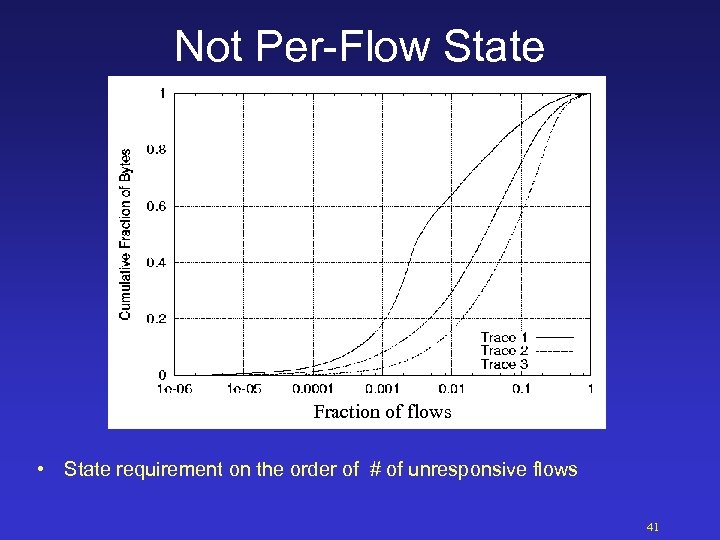 Not Per-Flow State Fraction of flows • State requirement on the order of # of unresponsive flows 41
 AFD Solution: Details • Based on 3 simple mechanisms – estimate per “class” arrival rate • counting per “class” bytes over fixed intervals ( Ts ) • potential averaging over multiple intervals – estimate deserved departure rate (so as to achieve the proper bandwidth allocation for the class) • Observation and averaging of queue length as measure of congestion • Functional definition of “fair share” based on fairness criterion – perform probabilistic dropping (pre-enqueue) to drive arrival rate to equal desired departure rate 42
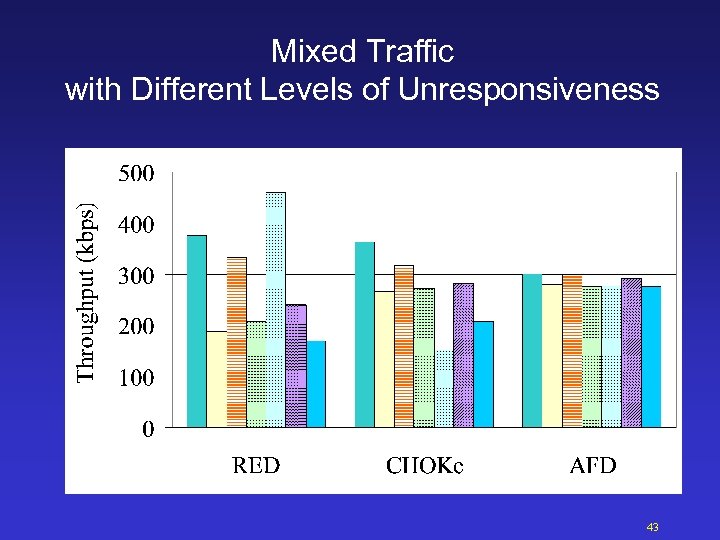 Mixed Traffic with Different Levels of Unresponsiveness 43
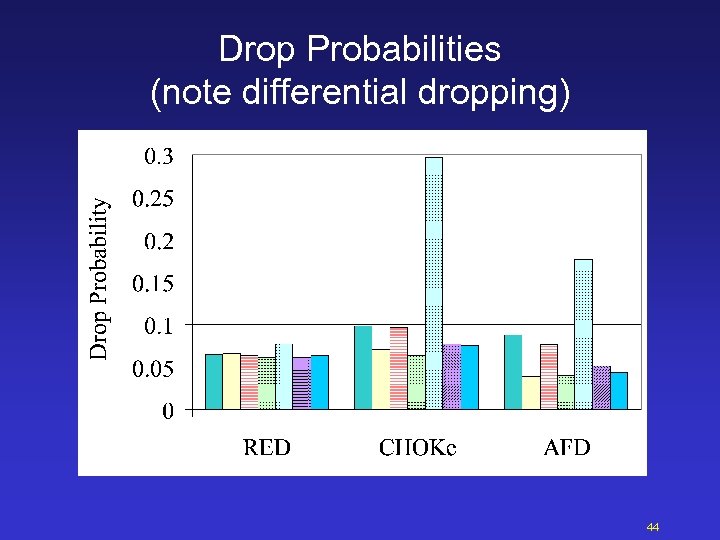 Drop Probabilities (note differential dropping) 44
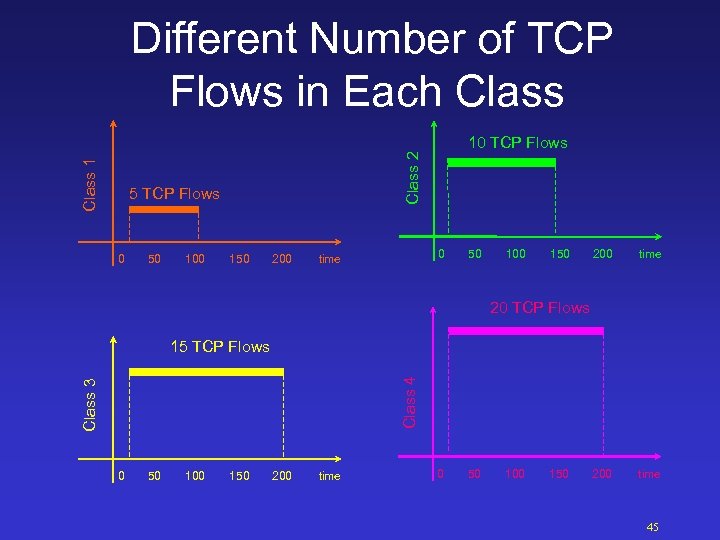 Different Number of TCP Flows in Each Class 2 Class 1 10 TCP Flows 5 TCP Flows 0 50 100 150 200 0 time 50 100 150 200 time 20 TCP Flows Class 3 Class 4 15 TCP Flows 0 50 100 150 200 time 0 50 100 150 45
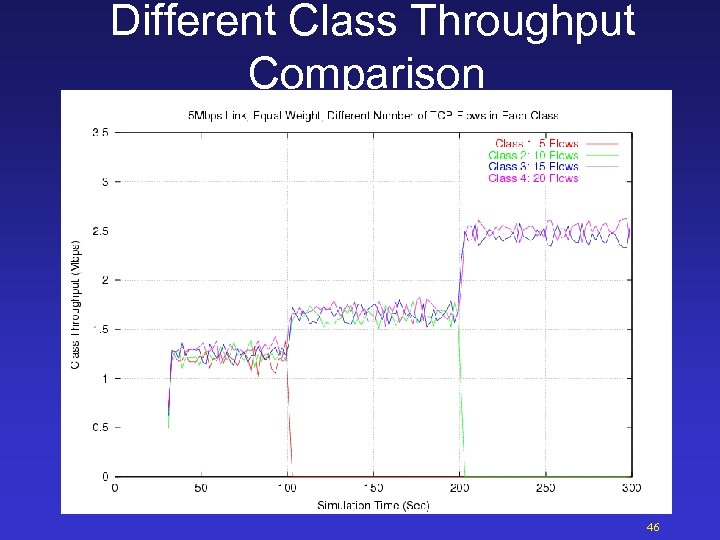 Different Class Throughput Comparison 46
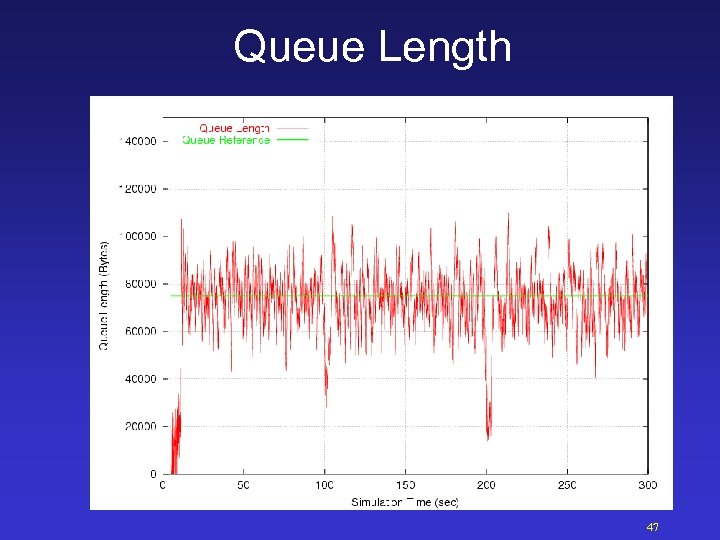 Queue Length 47
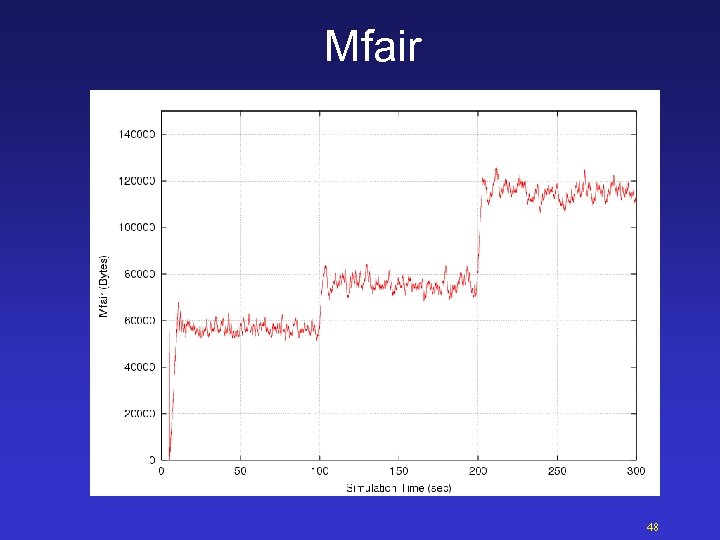 Mfair 48
 AFD Implementation Issues • Monitor Arrival Rate • Determine Drop Probability • Maximize Link Utilization 49
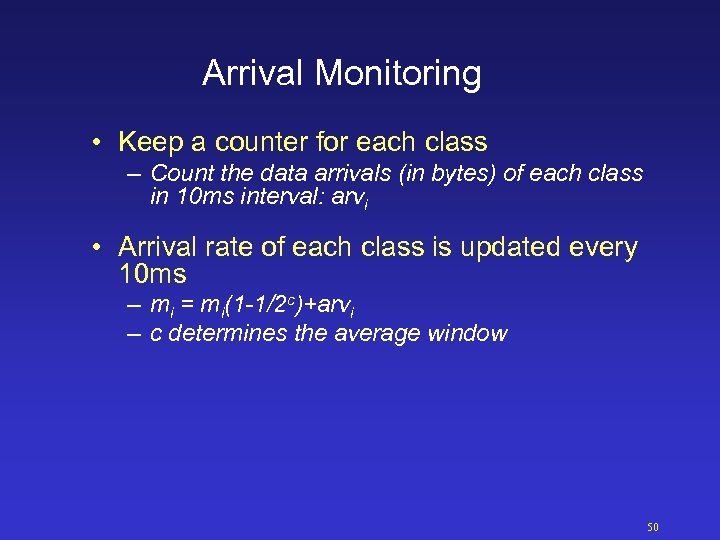 Arrival Monitoring • Keep a counter for each class – Count the data arrivals (in bytes) of each class in 10 ms interval: arvi • Arrival rate of each class is updated every 10 ms – mi = mi(1 -1/2 c)+arvi – c determines the average window 50
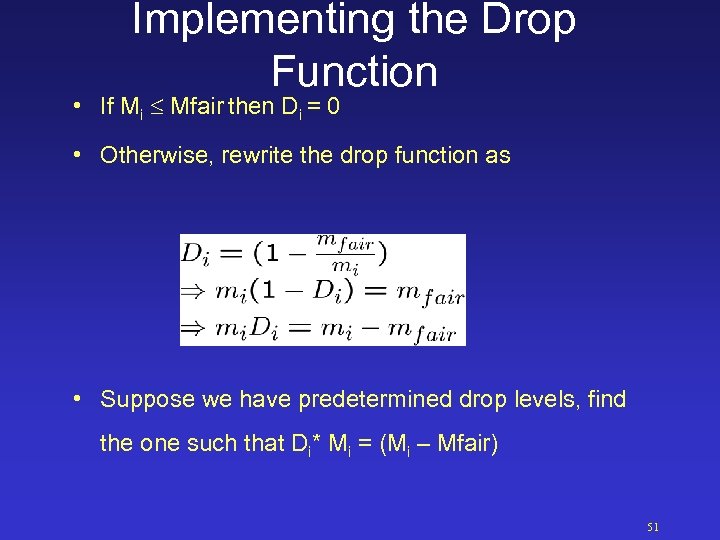 Implementing the Drop Function • If Mi Mfair then Di = 0 • Otherwise, rewrite the drop function as • Suppose we have predetermined drop levels, find the one such that Di* Mi = (Mi – Mfair) 51
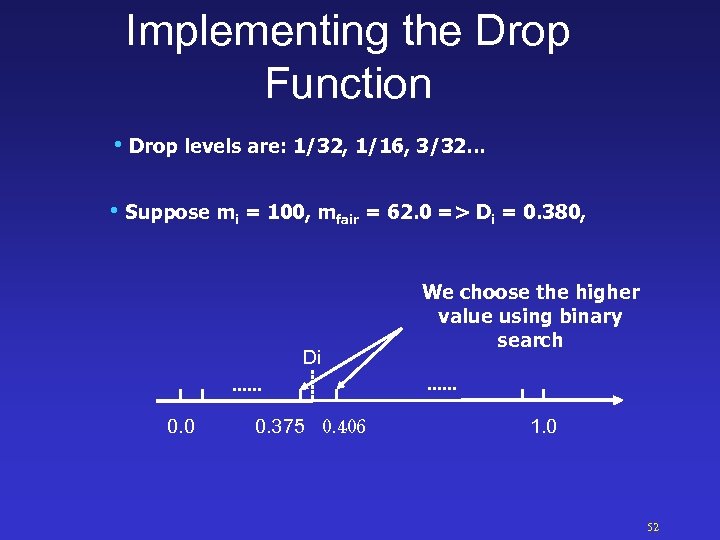 Implementing the Drop Function • Drop levels are: 1/32, 1/16, 3/32… • Suppose mi = 100, mfair = 62. 0 => Di = 0. 380, Di 0. 0 0. 375 0. 406 We choose the higher value using binary search 1. 0 52
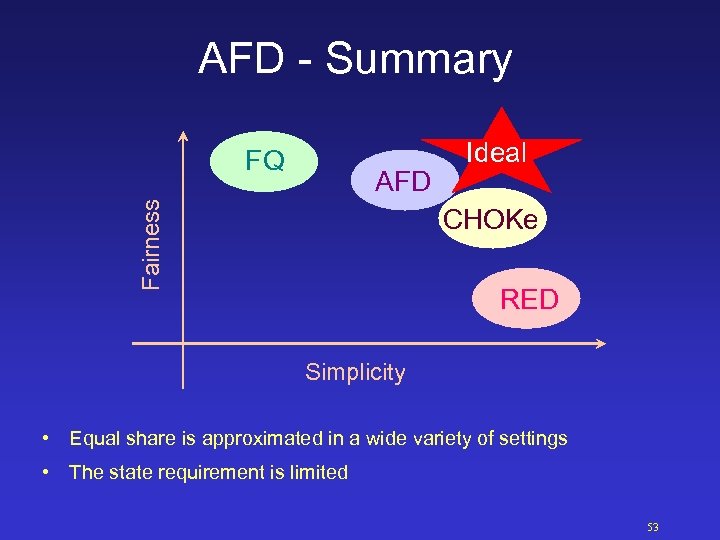 AFD - Summary FQ Fairness AFD Ideal CHOKe RED Simplicity • Equal share is approximated in a wide variety of settings • The state requirement is limited 53
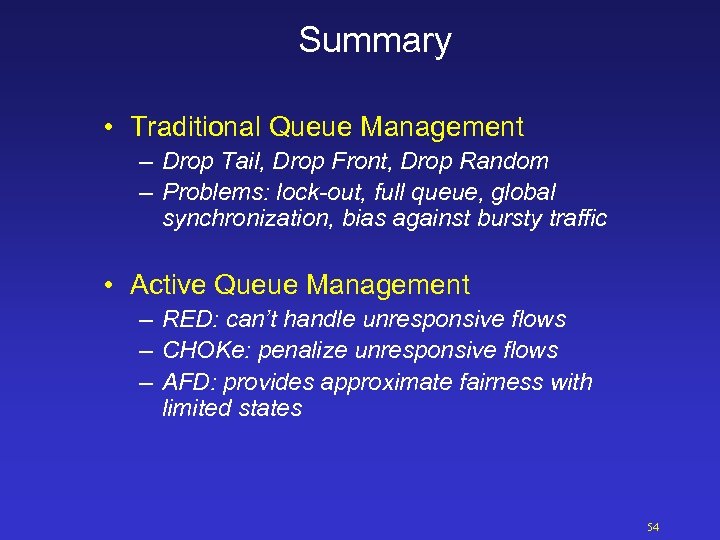 Summary • Traditional Queue Management – Drop Tail, Drop Front, Drop Random – Problems: lock-out, full queue, global synchronization, bias against bursty traffic • Active Queue Management – RED: can’t handle unresponsive flows – CHOKe: penalize unresponsive flows – AFD: provides approximate fairness with limited states 54