 Скачать презентацию Action Planning Where logic-based representation of knowledge makes
l4-Planirovanie_Deystvy.ppt
- Количество слайдов: 68



Action Planning (Where logic-based representation of knowledge makes search problems more interesting) R&N: Chap. 11, Sect. 11. 1– 4 1
§ The goal of action planning is to choose actions and ordering relations among these actions to achieve specified goals § Search-based problem solving applied to 8 -puzzle was one example of planning, but our description of this problem used specific data structures and functions § Here, we will develop a non-specific, logic-based language to represent knowledge about actions, states, and goals, and we will study how search algorithms can exploit this representation 2
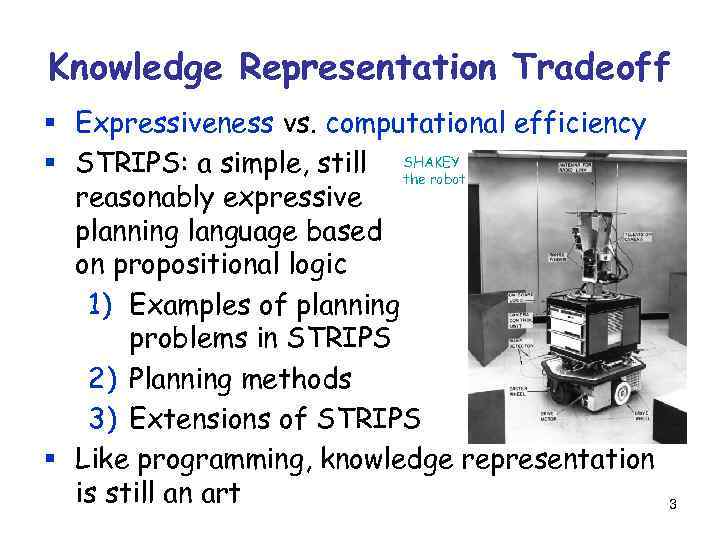
Knowledge Representation Tradeoff § Expressiveness vs. computational efficiency § STRIPS: a simple, still SHAKEY the robot reasonably expressive planning language based on propositional logic 1) Examples of planning problems in STRIPS 2) Planning methods 3) Extensions of STRIPS § Like programming, knowledge representation is still an art 3
STRIPS Language through Examples 4
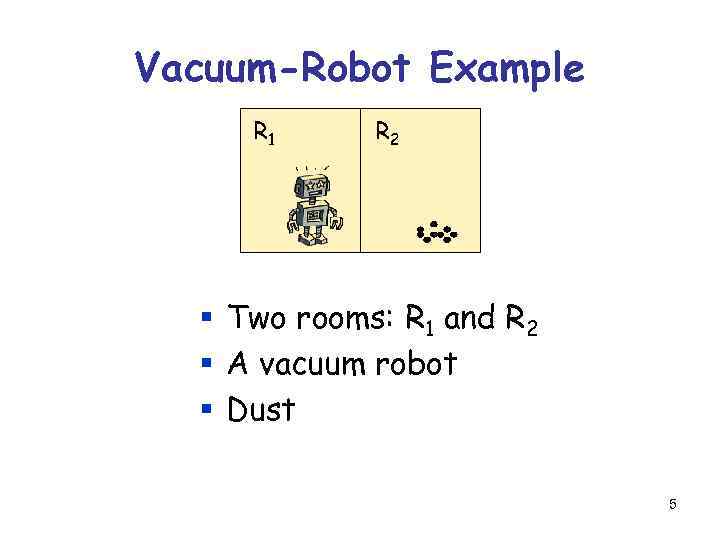
Vacuum-Robot Example R 1 R 2 § Two rooms: R 1 and R 2 § A vacuum robot § Dust 5
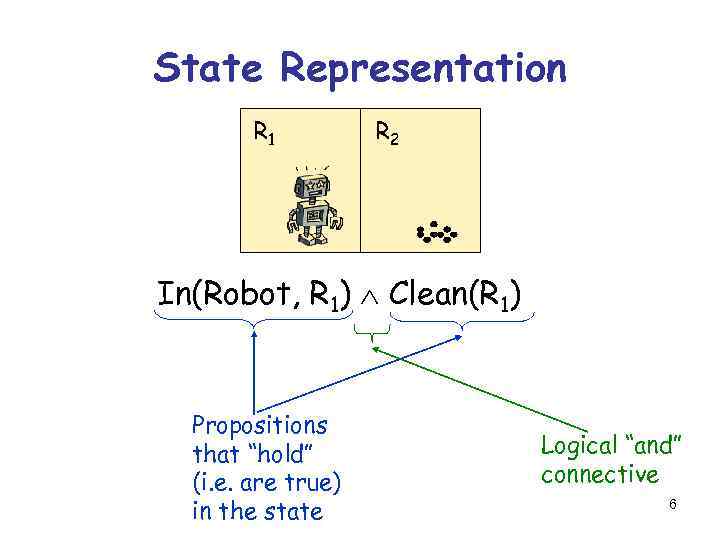
State Representation R 1 R 2 In(Robot, R 1) Clean(R 1) Propositions that “hold” (i. e. are true) in the state Logical “and” connective 6
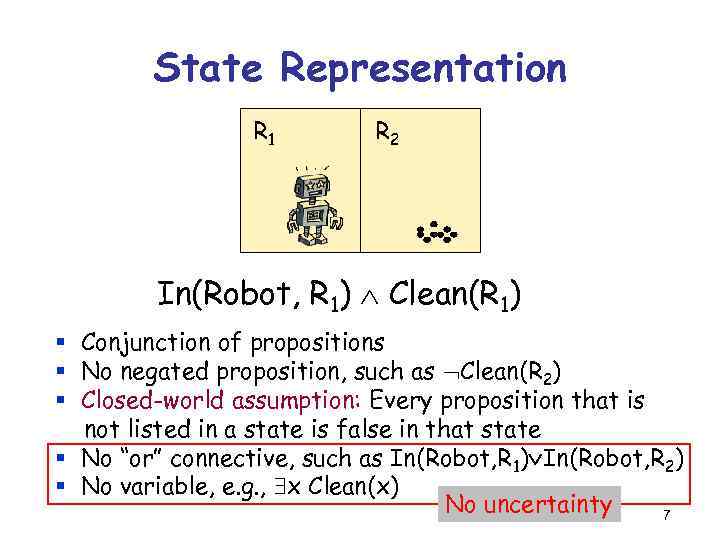
State Representation R 1 R 2 In(Robot, R 1) Clean(R 1) § Conjunction of propositions § No negated proposition, such as Clean(R 2) § Closed-world assumption: Every proposition that is not listed in a state is false in that state § No “or” connective, such as In(Robot, R 1) In(Robot, R 2) § No variable, e. g. , x Clean(x) No uncertainty 7
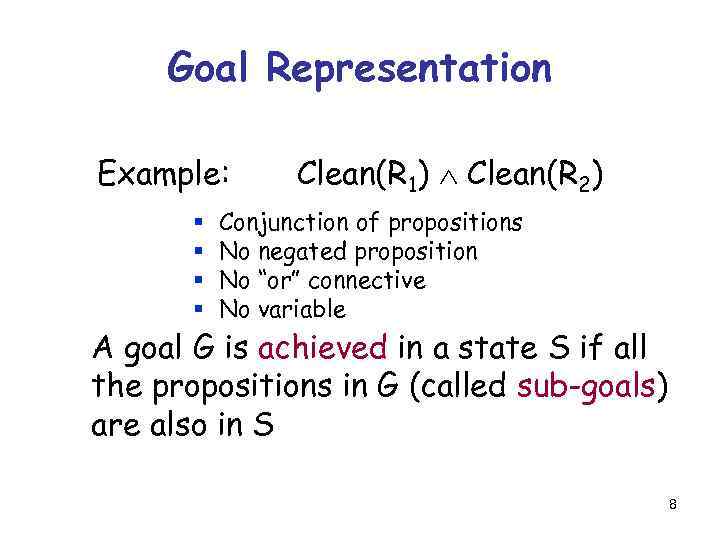
Goal Representation Example: § § Clean(R 1) Clean(R 2) Conjunction of propositions No negated proposition No “or” connective No variable A goal G is achieved in a state S if all the propositions in G (called sub-goals) are also in S 8
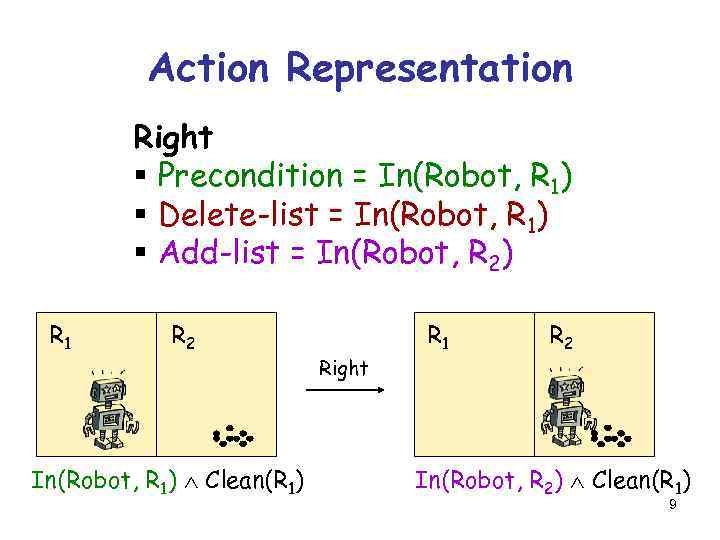
Action Representation Right § Precondition = In(Robot, R 1) § Delete-list = In(Robot, R 1) § Add-list = In(Robot, R 2) R 1 R 2 In(Robot, R 1) Clean(R 1) Right R 1 R 2 In(Robot, R 2) Clean(R 1) 9
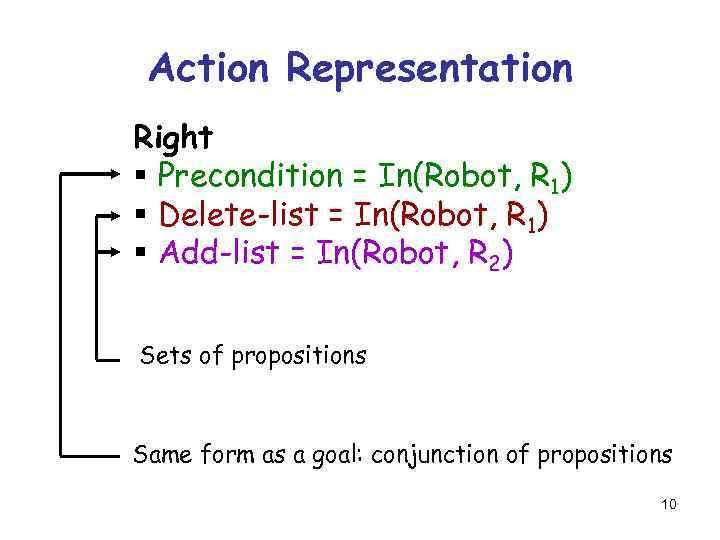
Action Representation Right § Precondition = In(Robot, R 1) § Delete-list = In(Robot, R 1) § Add-list = In(Robot, R 2) Sets of propositions Same form as a goal: conjunction of propositions 10
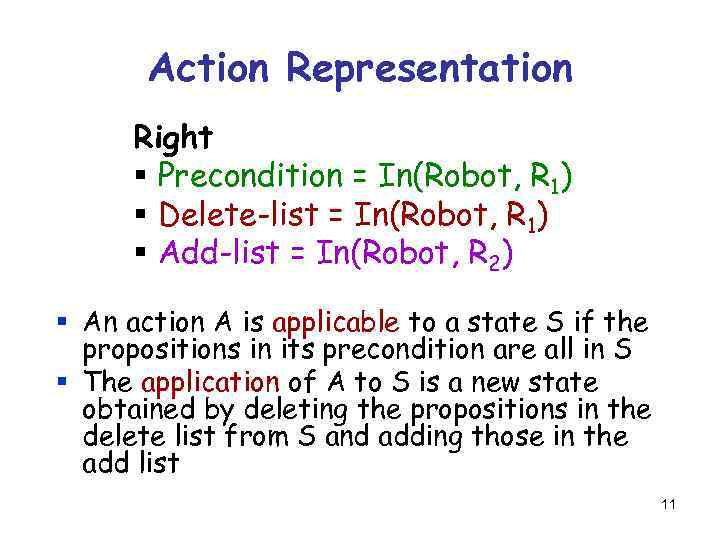
Action Representation Right § Precondition = In(Robot, R 1) § Delete-list = In(Robot, R 1) § Add-list = In(Robot, R 2) § An action A is applicable to a state S if the propositions in its precondition are all in S § The application of A to S is a new state obtained by deleting the propositions in the delete list from S and adding those in the add list 11
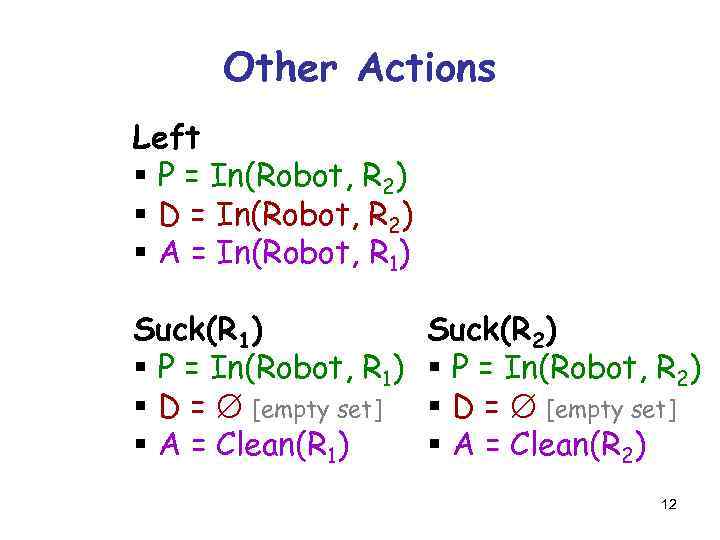
Other Actions Left § P = In(Robot, R 2) § D = In(Robot, R 2) § A = In(Robot, R 1) Suck(R 1) § P = In(Robot, R 1) § D = [empty set] § A = Clean(R 1) Suck(R 2) § P = In(Robot, R 2) § D = [empty set] § A = Clean(R 2) 12
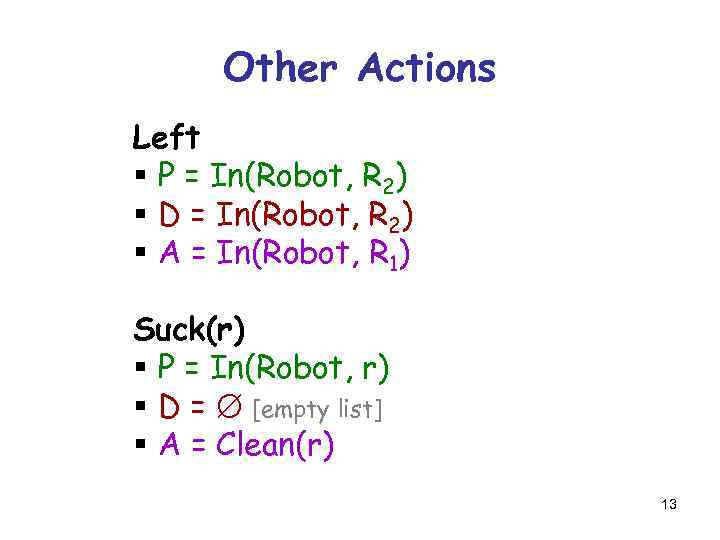
Other Actions Left § P = In(Robot, R 2) § D = In(Robot, R 2) § A = In(Robot, R 1) Suck(r) § P = In(Robot, r) § D = [empty list] § A = Clean(r) 13
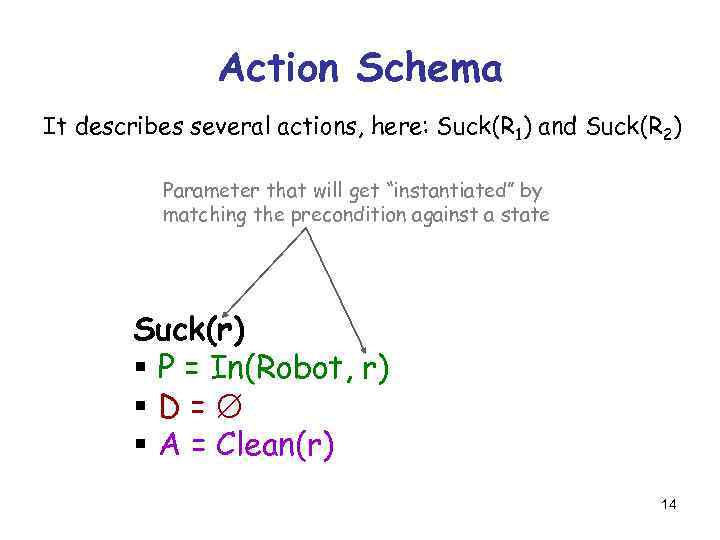
Action Schema It describes several actions, here: Suck(R 1) and Suck(R 2) Left § P = In(Robot, get 2) R “instantiated” by Parameter that will matching the precondition § D = In(Robot, R 2)against a state § A = In(Robot, R 1) Suck(r) § P = In(Robot, r) §D= § A = Clean(r) 14
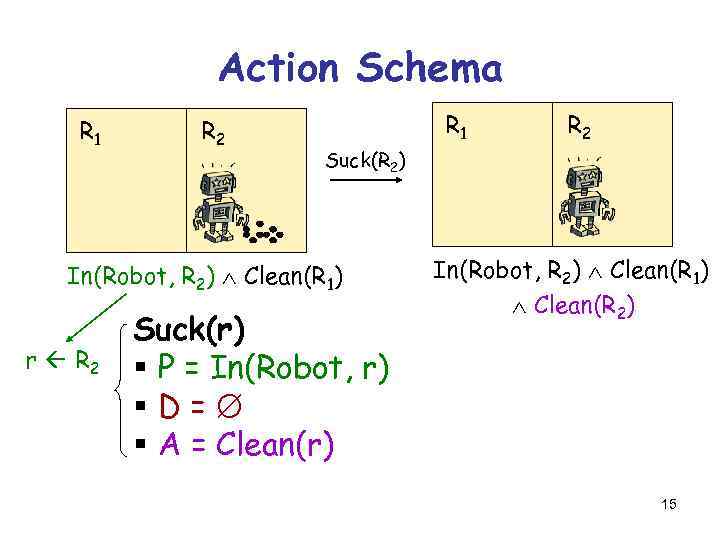
Action Schema R 1 Left R 2 Suck(R 2) § P = In(Robot, R 2) § D = In(Robot, R 2) § A = In(Robot, R 1) In(Robot, R 2) Clean(R 1) r R 2 Suck(r) § P = In(Robot, r) §D= § A = Clean(r) R 1 R 2 In(Robot, R 2) Clean(R 1) Clean(R 2) 15
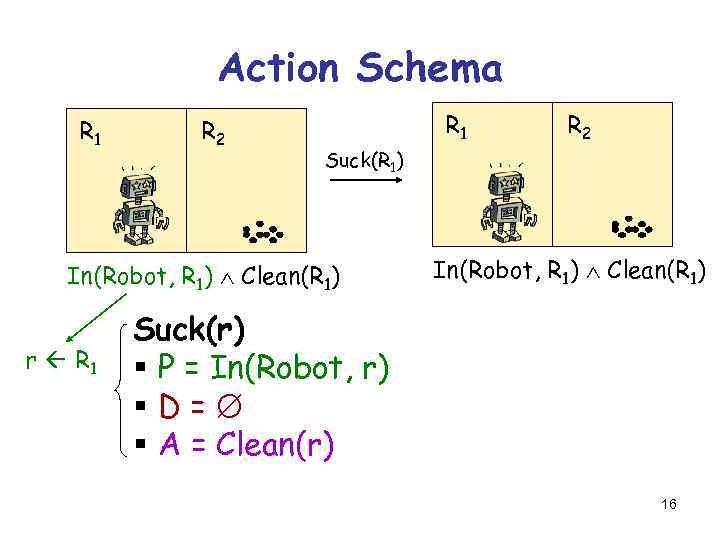
Action Schema R 1 Left R 2 Suck(R 1) § P = In(Robot, R 2) § D = In(Robot, R 2) § A = In(Robot, R 1) Clean(R 1) r R 1 R 2 In(Robot, R 1) Clean(R 1) Suck(r) § P = In(Robot, r) §D= § A = Clean(r) 16
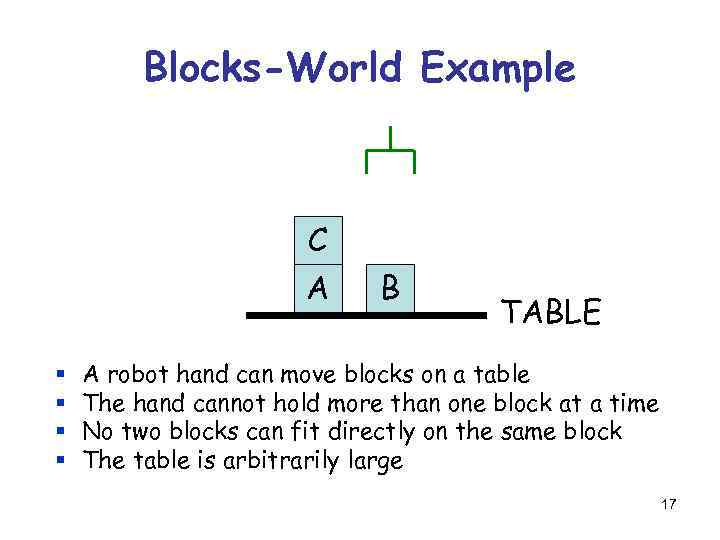
Blocks-World Example C A § § B TABLE A robot hand can move blocks on a table The hand cannot hold more than one block at a time No two blocks can fit directly on the same block The table is arbitrarily large 17
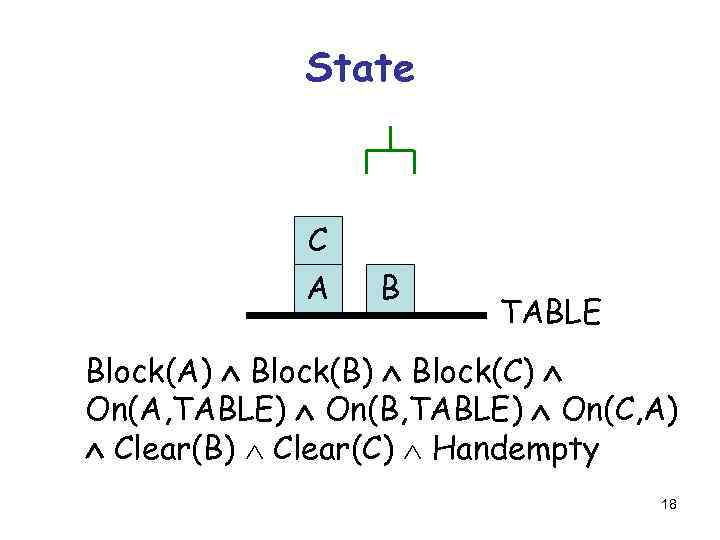
State C A B TABLE Block(A) Block(B) Block(C) On(A, TABLE) On(B, TABLE) On(C, A) Clear(B) Clear(C) Handempty 18
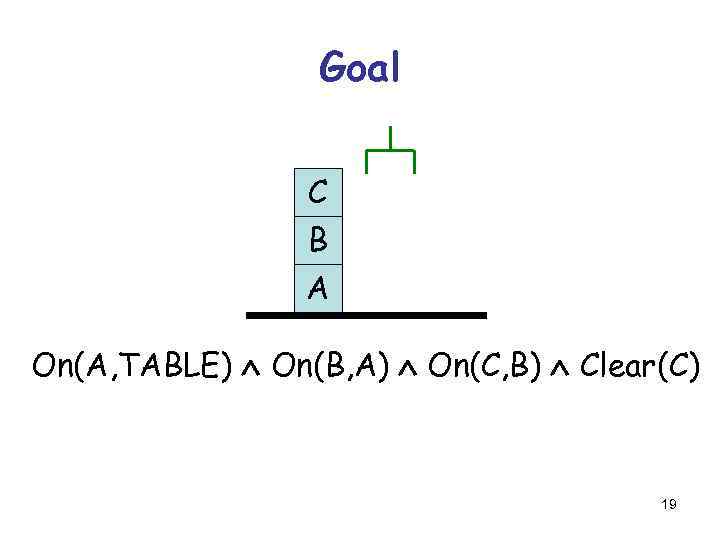
Goal C B A On(A, TABLE) On(B, A) On(C, B) Clear(C) 19
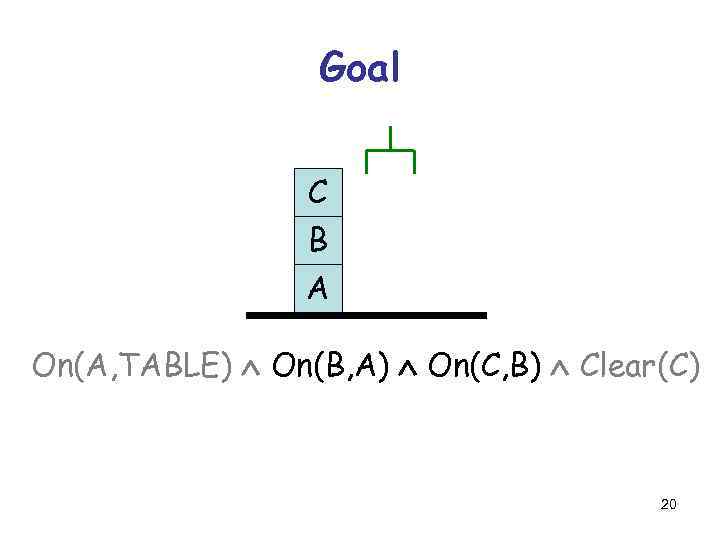
Goal C B A On(A, TABLE) On(B, A) On(C, B) Clear(C) 20
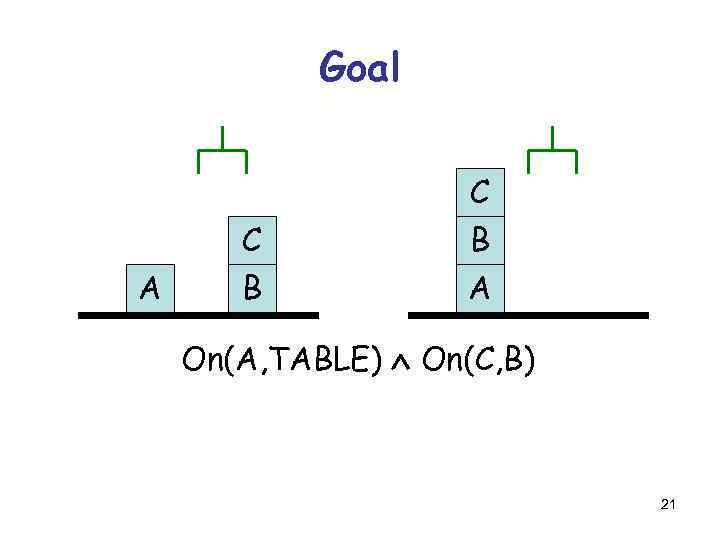
Goal C A C B B A On(A, TABLE) On(C, B) 21
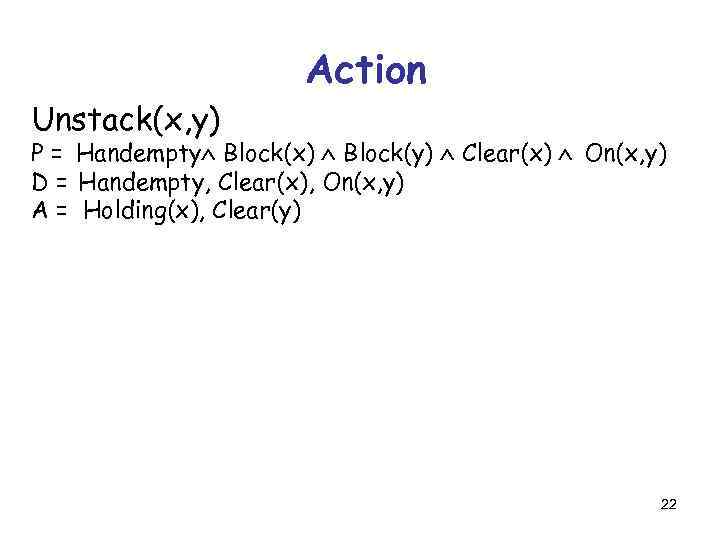
Action Unstack(x, y) P = Handempty Block(x) Block(y) Clear(x) On(x, y) D = Handempty, Clear(x), On(x, y) A = Holding(x), Clear(y) 22
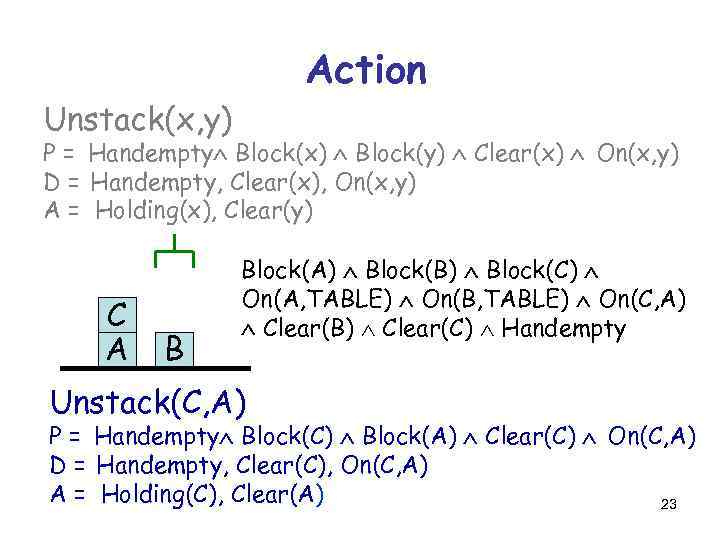
Action Unstack(x, y) P = Handempty Block(x) Block(y) Clear(x) On(x, y) D = Handempty, Clear(x), On(x, y) A = Holding(x), Clear(y) C A B Block(A) Block(B) Block(C) On(A, TABLE) On(B, TABLE) On(C, A) Clear(B) Clear(C) Handempty Unstack(C, A) P = Handempty Block(C) Block(A) Clear(C) On(C, A) D = Handempty, Clear(C), On(C, A) A = Holding(C), Clear(A) 23
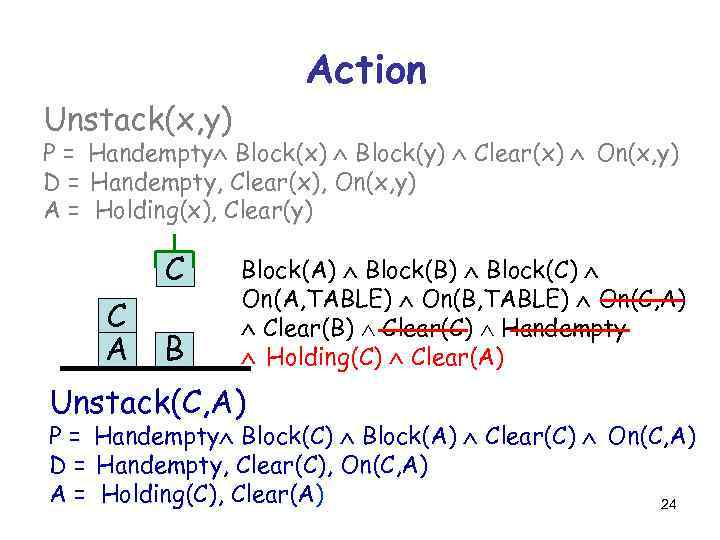
Action Unstack(x, y) P = Handempty Block(x) Block(y) Clear(x) On(x, y) D = Handempty, Clear(x), On(x, y) A = Holding(x), Clear(y) C C A B Block(A) Block(B) Block(C) On(A, TABLE) On(B, TABLE) On(C, A) Clear(B) Clear(C) Handempty Holding(C) Clear(A) Unstack(C, A) P = Handempty Block(C) Block(A) Clear(C) On(C, A) D = Handempty, Clear(C), On(C, A) A = Holding(C), Clear(A) 24
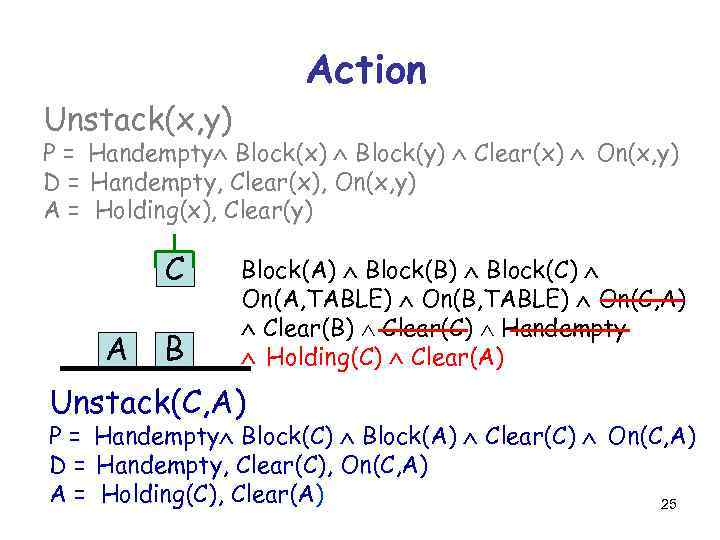
Action Unstack(x, y) P = Handempty Block(x) Block(y) Clear(x) On(x, y) D = Handempty, Clear(x), On(x, y) A = Holding(x), Clear(y) C A B Block(A) Block(B) Block(C) On(A, TABLE) On(B, TABLE) On(C, A) Clear(B) Clear(C) Handempty Holding(C) Clear(A) Unstack(C, A) P = Handempty Block(C) Block(A) Clear(C) On(C, A) D = Handempty, Clear(C), On(C, A) A = Holding(C), Clear(A) 25
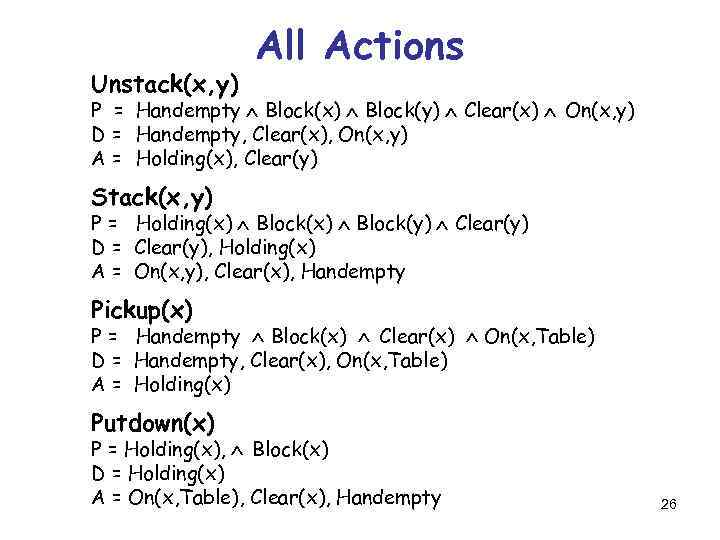
Unstack(x, y) All Actions P = Handempty Block(x) Block(y) Clear(x) On(x, y) D = Handempty, Clear(x), On(x, y) A = Holding(x), Clear(y) Stack(x, y) P = Holding(x) Block(y) Clear(y) D = Clear(y), Holding(x) A = On(x, y), Clear(x), Handempty Pickup(x) P = Handempty Block(x) Clear(x) On(x, Table) D = Handempty, Clear(x), On(x, Table) A = Holding(x) Putdown(x) P = Holding(x), Block(x) D = Holding(x) A = On(x, Table), Clear(x), Handempty 26
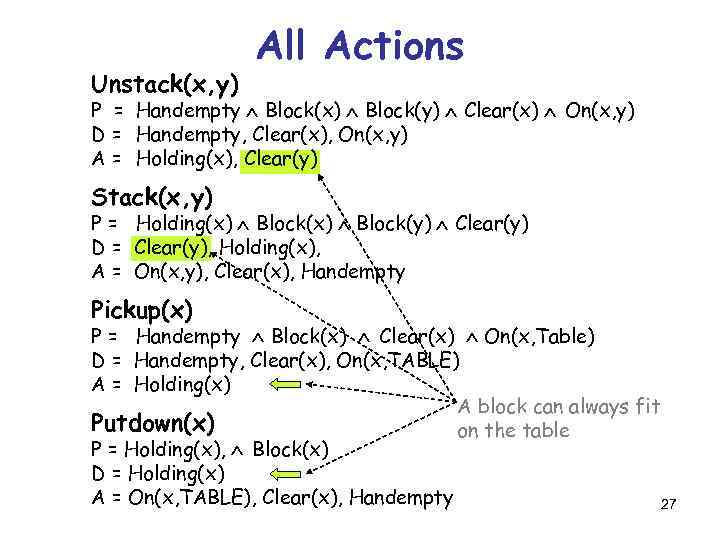
Unstack(x, y) All Actions P = Handempty Block(x) Block(y) Clear(x) On(x, y) D = Handempty, Clear(x), On(x, y) A = Holding(x), Clear(y) Stack(x, y) P = Holding(x) Block(y) Clear(y) D = Clear(y), Holding(x), A = On(x, y), Clear(x), Handempty Pickup(x) P = Handempty Block(x) Clear(x) On(x, Table) D = Handempty, Clear(x), On(x, TABLE) A = Holding(x) A block can always fit Putdown(x) on the table P = Holding(x), Block(x) D = Holding(x) A = On(x, TABLE), Clear(x), Handempty 27
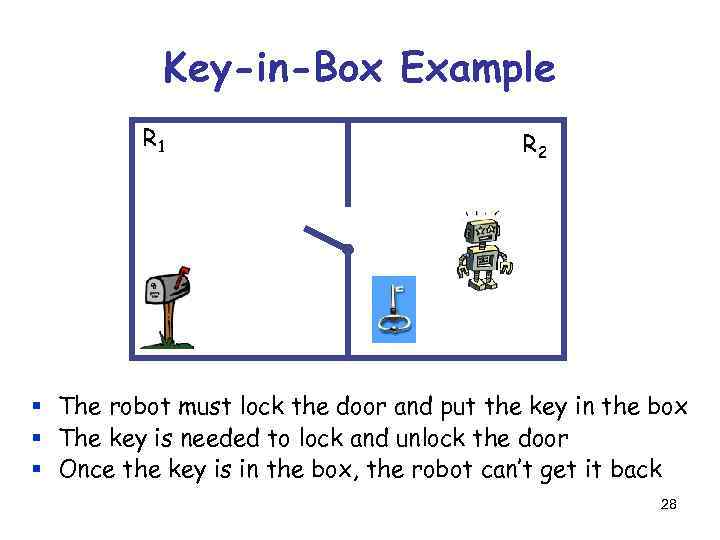
Key-in-Box Example R 1 R 2 § The robot must lock the door and put the key in the box § The key is needed to lock and unlock the door § Once the key is in the box, the robot can’t get it back 28
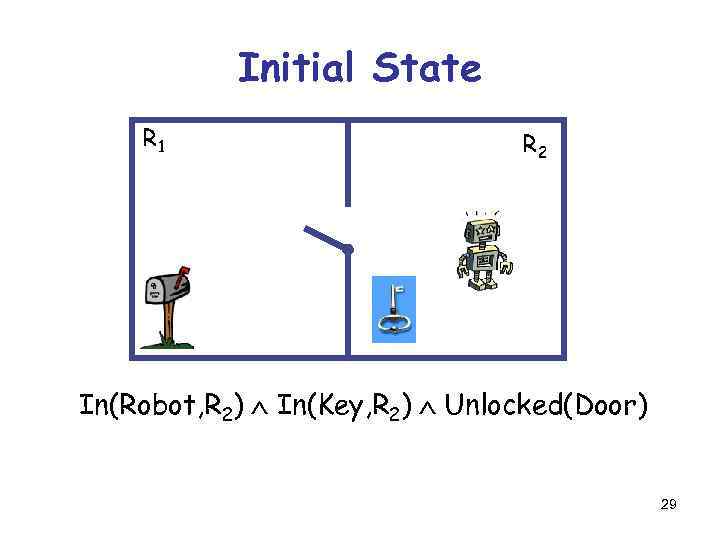
Initial State R 1 R 2 In(Robot, R 2) In(Key, R 2) Unlocked(Door) 29
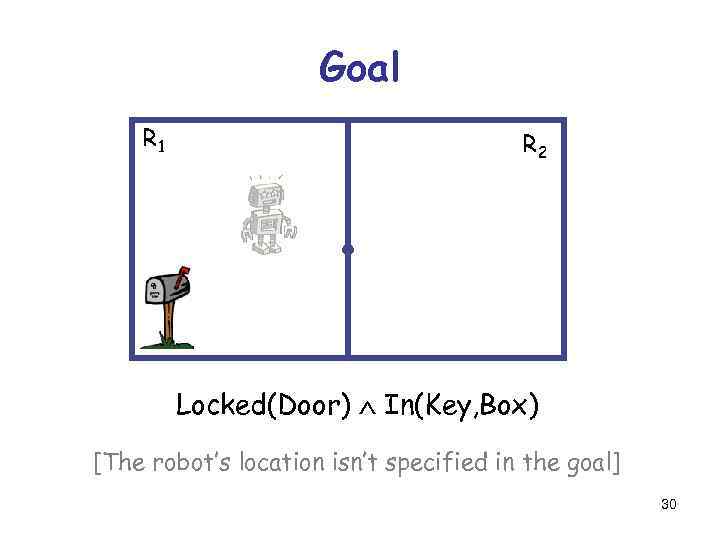
Goal R 1 R 2 Locked(Door) In(Key, Box) [The robot’s location isn’t specified in the goal] 30
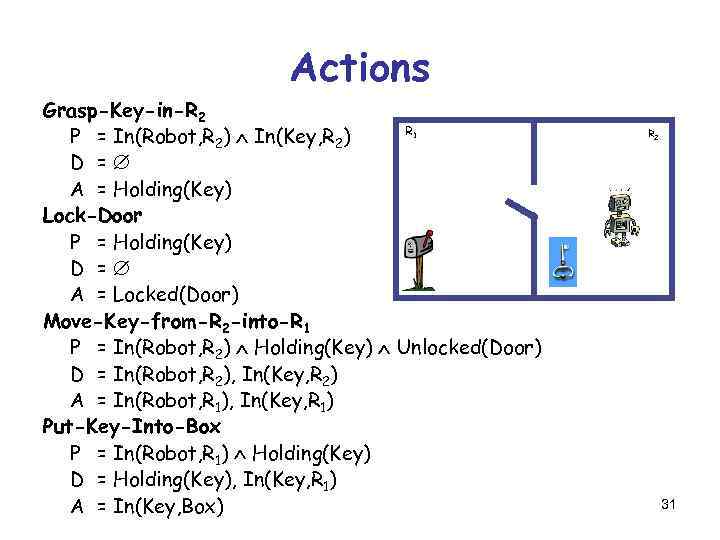
Actions Grasp-Key-in-R 2 R P = In(Robot, R 2) In(Key, R 2) D = A = Holding(Key) Lock-Door P = Holding(Key) D = A = Locked(Door) Move-Key-from-R 2 -into-R 1 P = In(Robot, R 2) Holding(Key) Unlocked(Door) D = In(Robot, R 2), In(Key, R 2) A = In(Robot, R 1), In(Key, R 1) Put-Key-Into-Box P = In(Robot, R 1) Holding(Key) D = Holding(Key), In(Key, R 1) A = In(Key, Box) 1 R 2 31
Planning Methods 32
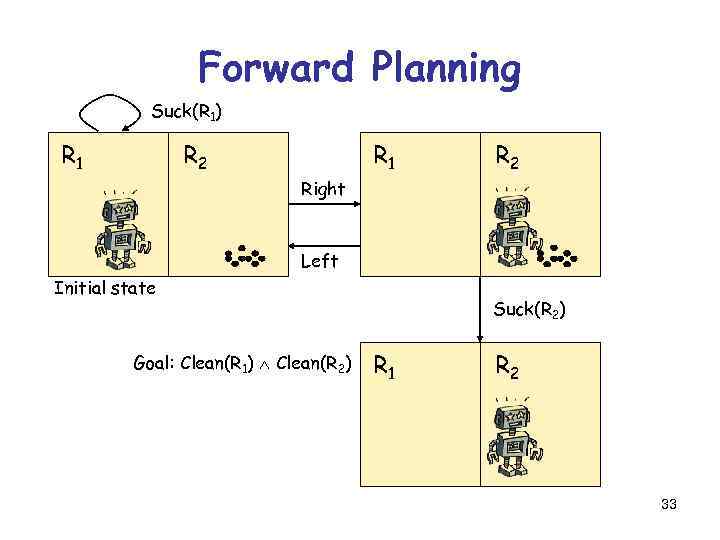
Forward Planning Suck(R 1) R 1 R 2 Right Left Initial state Goal: Clean(R 1) Clean(R 2) Suck(R 2) R 1 R 2 33
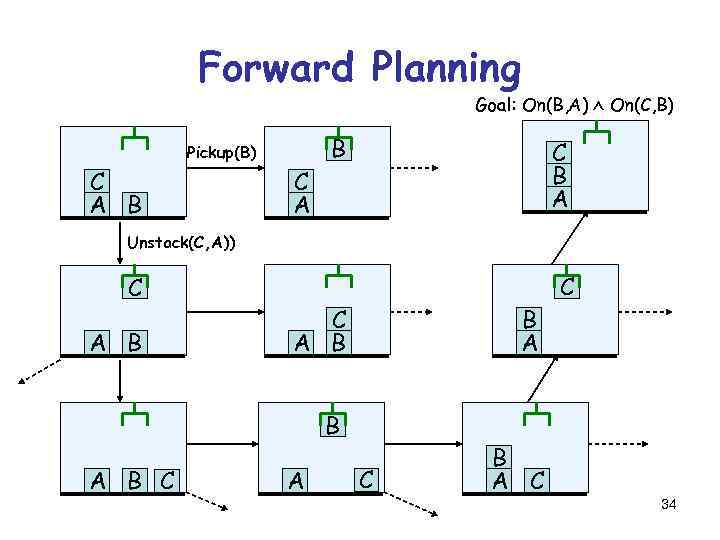
Forward Planning Goal: On(B, A) On(C, B) Pickup(B) C A B C B A Unstack(C, A)) C A B B A B C A C C B A C 34
Need for an Accurate Heuristic § Forward planning simply searches the space of world states from the initial to the goal state § Imagine an agent with a large library of actions, whose goal is G, e. g. , G = Have(Milk) § In general, many actions are applicable to any given state, so the branching factor is huge § In any given state, most applicable actions are irrelevant to reaching the goal Have(Milk) § Fortunately, an accurate consistent heuristic can be computed using planning graphs 35
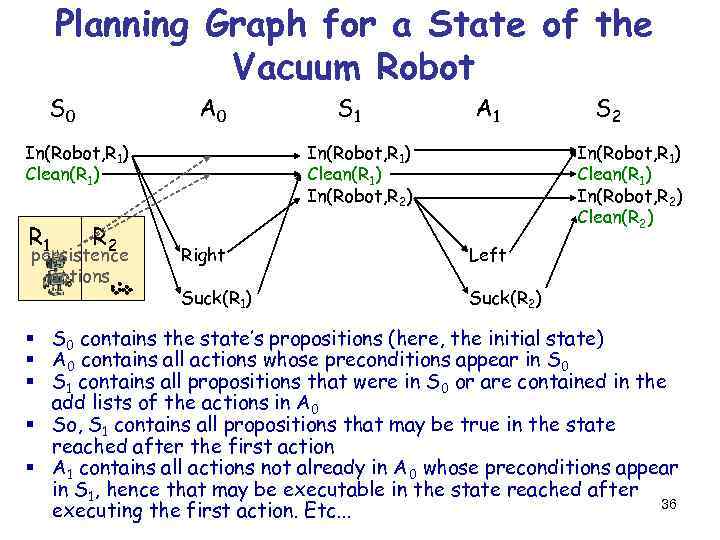
Planning Graph for a State of the Vacuum Robot S 0 A 0 In(Robot, R 1) Clean(R 1) R 1 R 2 persistence actions S 1 A 1 In(Robot, R 1) Clean(R 1) In(Robot, R 2) S 2 In(Robot, R 1) Clean(R 1) In(Robot, R 2) Clean(R 2) Right Left Suck(R 1) Suck(R 2) § S 0 contains the state’s propositions (here, the initial state) § A 0 contains all actions whose preconditions appear in S 0 § S 1 contains all propositions that were in S 0 or are contained in the add lists of the actions in A 0 § So, S 1 contains all propositions that may be true in the state reached after the first action § A 1 contains all actions not already in A 0 whose preconditions appear in S 1, hence that may be executable in the state reached after 36 executing the first action. Etc. . .
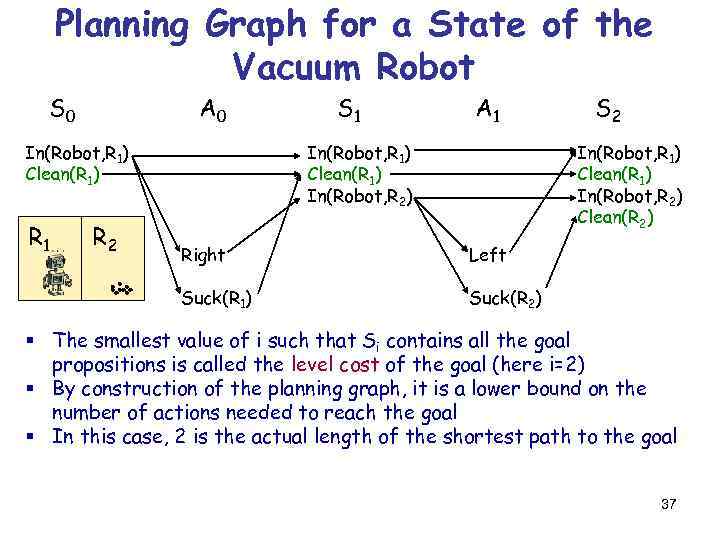
Planning Graph for a State of the Vacuum Robot S 0 A 0 In(Robot, R 1) Clean(R 1) R 1 R 2 S 1 A 1 In(Robot, R 1) Clean(R 1) In(Robot, R 2) S 2 In(Robot, R 1) Clean(R 1) In(Robot, R 2) Clean(R 2) Right Left Suck(R 1) Suck(R 2) § The smallest value of i such that Si contains all the goal propositions is called the level cost of the goal (here i=2) § By construction of the planning graph, it is a lower bound on the number of actions needed to reach the goal § In this case, 2 is the actual length of the shortest path to the goal 37
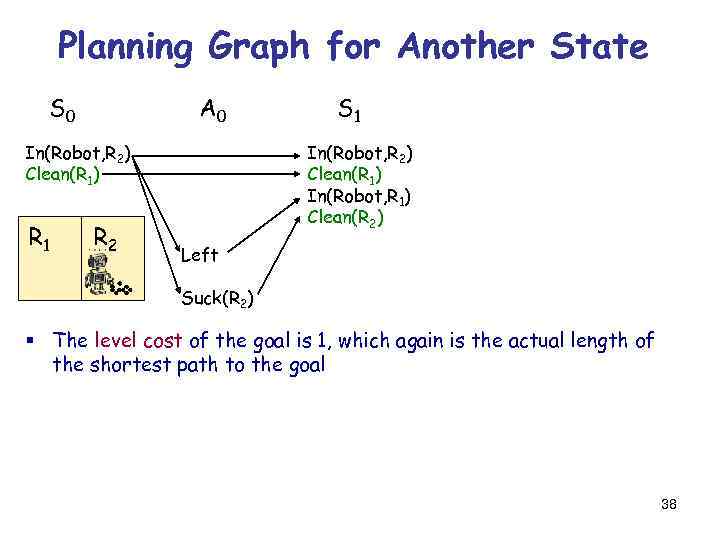
Planning Graph for Another State S 0 A 0 In(Robot, R 2) Clean(R 1) R 1 R 2 S 1 In(Robot, R 2) Clean(R 1) In(Robot, R 1) Clean(R 2) Left Suck(R 2) § The level cost of the goal is 1, which again is the actual length of the shortest path to the goal 38
Application of Planning Graphs to Forward Planning § Whenever a new node is generated, compute the planning graph of its state [update the planning graph at the parent node] § Stop computing the planning graph when: • • Either the goal propositions are in a set Si [then i is the level cost of the goal] Or when Si+1 = Si (the planning graph has leveled off) [then the generated node is not on a solution path] § Set the heuristic h(N) of a node N to the level cost of the goal for the state of N § h is a consistent heuristic for unit-cost actions § Hence, A* using h yields a solution with minimum number of actions 39
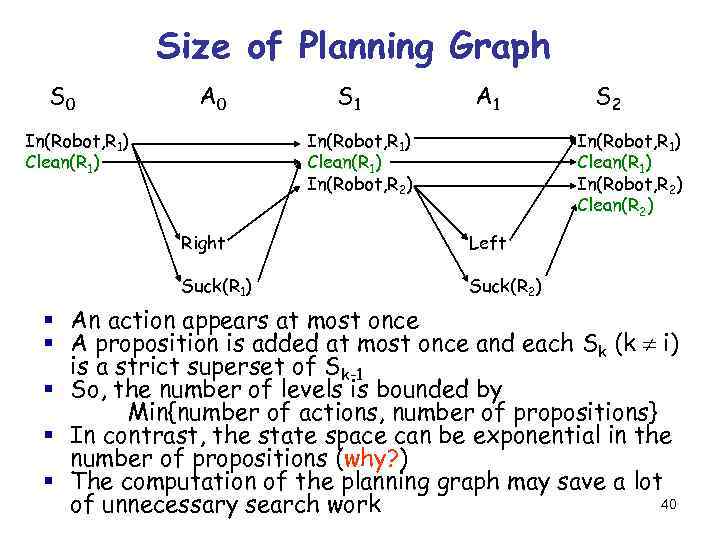
Size of Planning Graph S 0 A 0 In(Robot, R 1) Clean(R 1) S 1 A 1 In(Robot, R 1) Clean(R 1) In(Robot, R 2) S 2 In(Robot, R 1) Clean(R 1) In(Robot, R 2) Clean(R 2) Right Left Suck(R 1) Suck(R 2) § An action appears at most once § A proposition is added at most once and each Sk (k i) is a strict superset of Sk-1 § So, the number of levels is bounded by Min{number of actions, number of propositions} § In contrast, the state space can be exponential in the number of propositions (why? ) § The computation of the planning graph may save a lot 40 of unnecessary search work
Improvement of Planning Graph: Mutual Exclusions § Goal: Refine the level cost of the goal to be a more accurate estimate of the number of actions needed to reach it § Method: Detect obvious exclusions among propositions at the same level (see R&N) § It usually leads to more accurate heuristics, but the planning graphs can be bigger and more expensive to compute 41
§ Forward planning still suffers from an excessive branching factor § In general, there are much fewer actions that are relevant to achieving a goal than actions that are applicable to a state § How to determine which actions are relevant? How to use them? § Backward planning 42
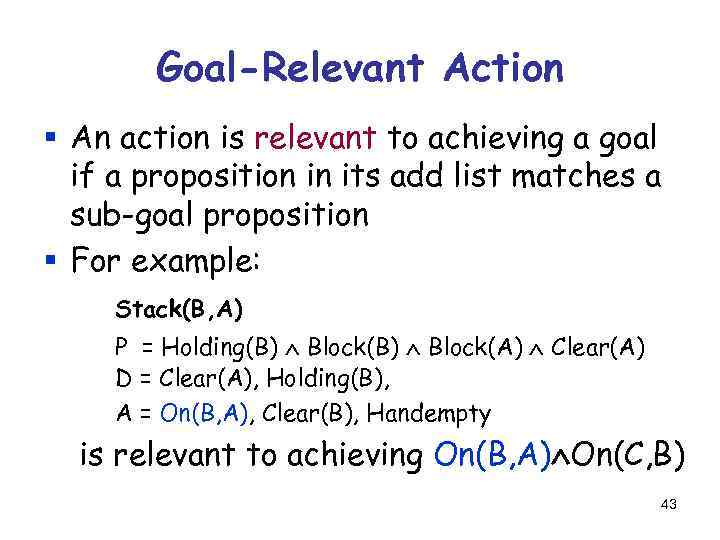
Goal-Relevant Action § An action is relevant to achieving a goal if a proposition in its add list matches a sub-goal proposition § For example: Stack(B, A) P = Holding(B) Block(A) Clear(A) D = Clear(A), Holding(B), A = On(B, A), Clear(B), Handempty is relevant to achieving On(B, A) On(C, B) 43
Regression of a Goal The regression of a goal G through an action A is the least constraining precondition R[G, A] such that: If a state S satisfies R[G, A] then: 1. The precondition of A is satisfied in S 2. Applying A to S yields a state that satisfies G 44
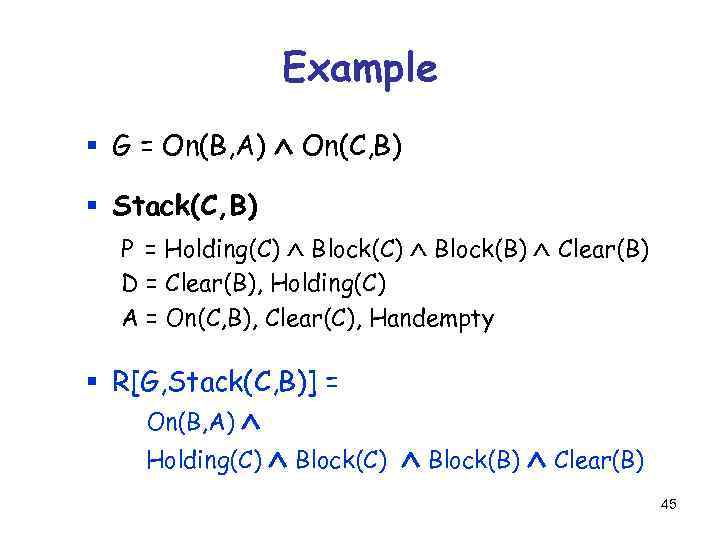
Example § G = On(B, A) On(C, B) § Stack(C, B) P = Holding(C) Block(B) Clear(B) D = Clear(B), Holding(C) A = On(C, B), Clear(C), Handempty § R[G, Stack(C, B)] = On(B, A) Holding(C) Block(B) Clear(B) 45
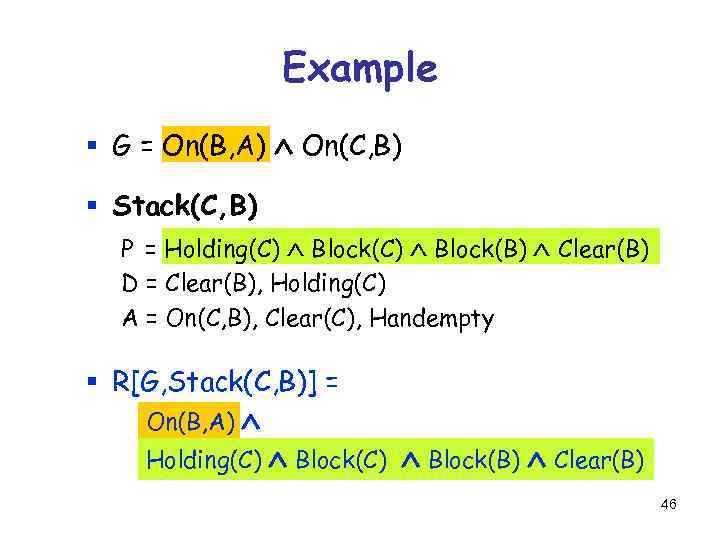
Example § G = On(B, A) On(C, B) § Stack(C, B) P = Holding(C) Block(B) Clear(B) D = Clear(B), Holding(C) A = On(C, B), Clear(C), Handempty § R[G, Stack(C, B)] = On(B, A) Holding(C) Block(B) Clear(B) 46
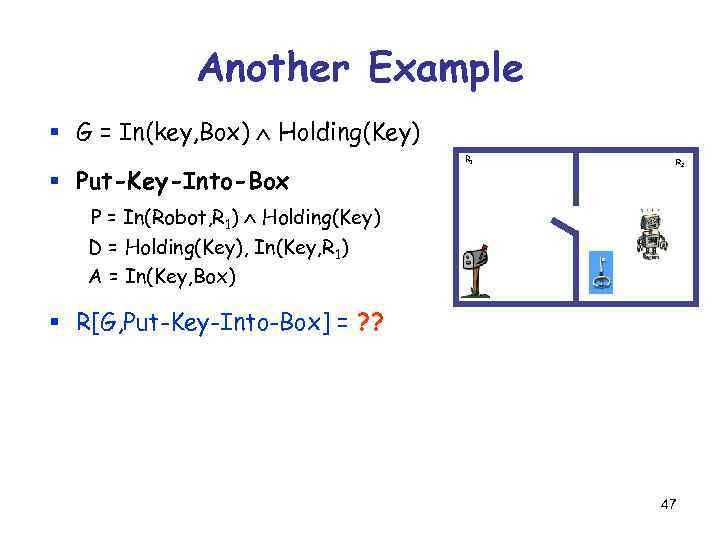
Another Example § G = In(key, Box) Holding(Key) § Put-Key-Into-Box R 1 R 2 P = In(Robot, R 1) Holding(Key) D = Holding(Key), In(Key, R 1) A = In(Key, Box) § R[G, Put-Key-Into-Box] = ? ? 47
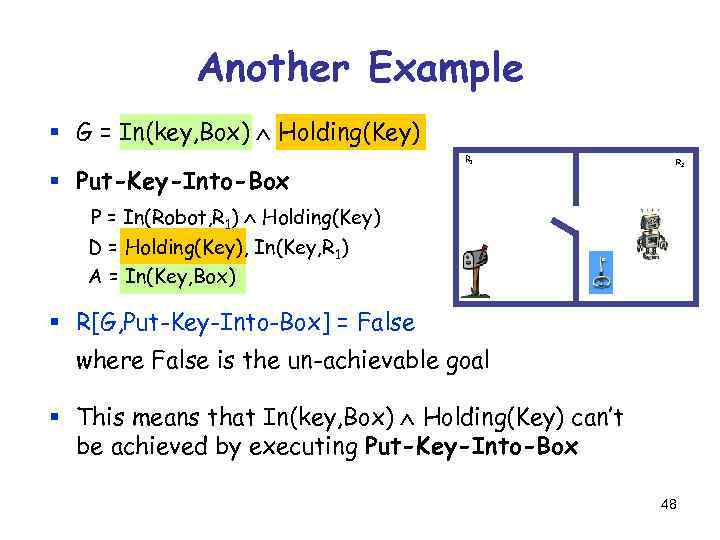
Another Example § G = In(key, Box) Holding(Key) § Put-Key-Into-Box R 1 R 2 P = In(Robot, R 1) Holding(Key) D = Holding(Key), In(Key, R 1) A = In(Key, Box) § R[G, Put-Key-Into-Box] = False where False is the un-achievable goal § This means that In(key, Box) Holding(Key) can’t be achieved by executing Put-Key-Into-Box 48
![Computation of R[G, A] 1. If any sub-goal of G is in A’s delete](https://present5.com/presentation/4168232_158147072/image-49.jpg "Computation of R[G, A] 1. If any sub-goal of G is in A’s delete")
Computation of R[G, A] 1. If any sub-goal of G is in A’s delete list then return False 2. Else a. G’ Precondition of A b. For every sub-goal SG of G do If SG is not in A’s add list then add SG to G’ 3. Return G’ 49
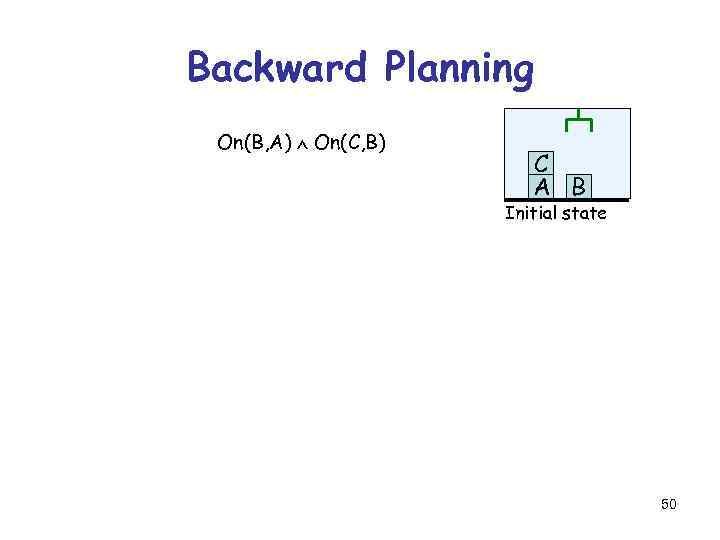
Backward Planning On(B, A) On(C, B) C A B Initial state 50
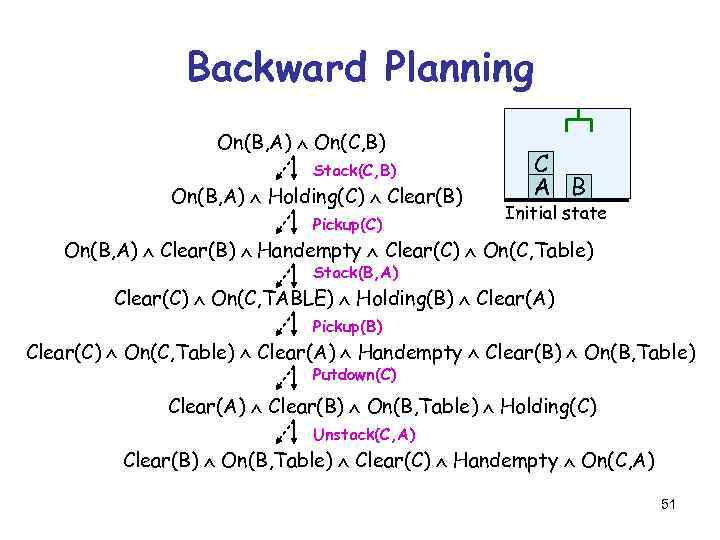
Backward Planning On(B, A) On(C, B) Stack(C, B) On(B, A) Holding(C) Clear(B) Pickup(C) C A B Initial state On(B, A) Clear(B) Handempty Clear(C) On(C, Table) Stack(B, A) Clear(C) On(C, TABLE) Holding(B) Clear(A) Pickup(B) Clear(C) On(C, Table) Clear(A) Handempty Clear(B) On(B, Table) Putdown(C) Clear(A) Clear(B) On(B, Table) Holding(C) Unstack(C, A) Clear(B) On(B, Table) Clear(C) Handempty On(C, A) 51
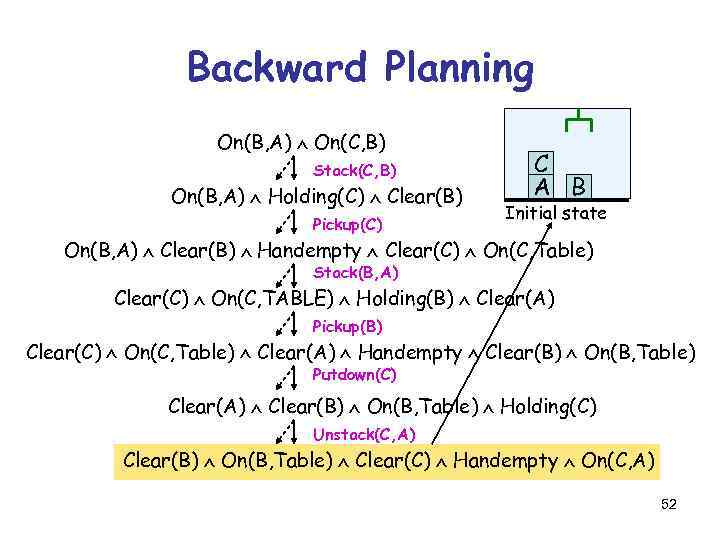
Backward Planning On(B, A) On(C, B) Stack(C, B) On(B, A) Holding(C) Clear(B) Pickup(C) C A B Initial state On(B, A) Clear(B) Handempty Clear(C) On(C, Table) Stack(B, A) Clear(C) On(C, TABLE) Holding(B) Clear(A) Pickup(B) Clear(C) On(C, Table) Clear(A) Handempty Clear(B) On(B, Table) Putdown(C) Clear(A) Clear(B) On(B, Table) Holding(C) Unstack(C, A) Clear(B) On(B, Table) Clear(C) Handempty On(C, A) 52
Search Tree § Backward planning searches a space of goals from the original goal of the problem to a goal that is satisfied in the initial state § There are often much fewer actions relevant to a goal than there actions applicable to a state smaller branching factor than in forward planning § The lengths of the solution paths are the same 53
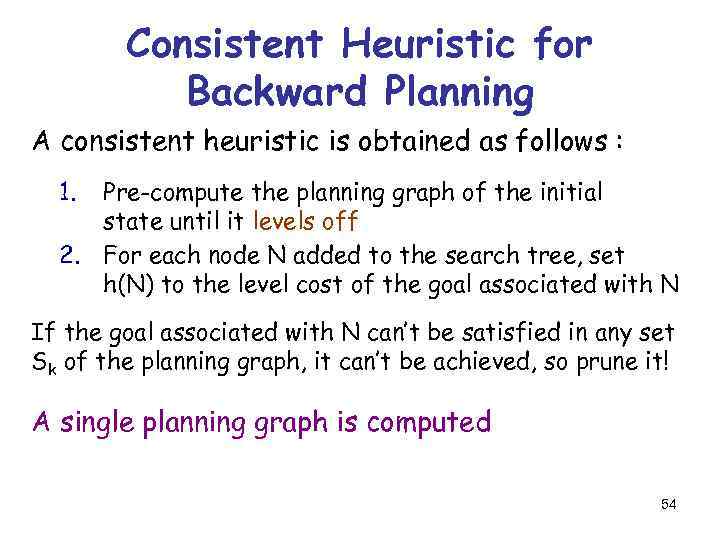
Consistent Heuristic for Backward Planning A consistent heuristic is obtained as follows : 1. Pre-compute the planning graph of the initial state until it levels off 2. For each node N added to the search tree, set h(N) to the level cost of the goal associated with N If the goal associated with N can’t be satisfied in any set Sk of the planning graph, it can’t be achieved, so prune it! A single planning graph is computed 54
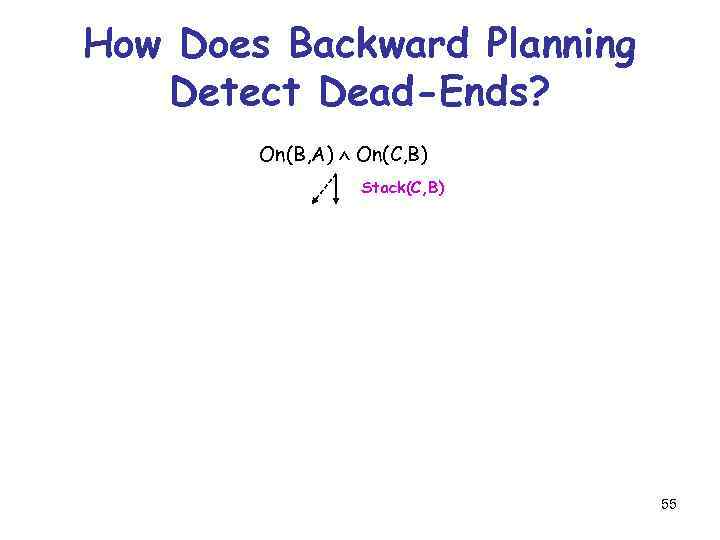
How Does Backward Planning Detect Dead-Ends? On(B, A) On(C, B) Stack(C, B) 55
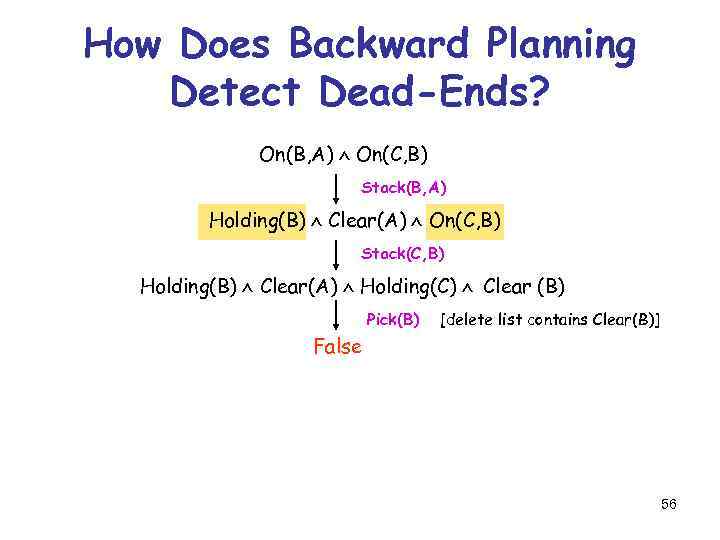
How Does Backward Planning Detect Dead-Ends? On(B, A) On(C, B) Stack(B, A) Holding(B) Clear(A) On(C, B) Stack(C, B) Holding(B) Clear(A) Holding(C) Clear (B) Pick(B) [delete list contains Clear(B)] False 56
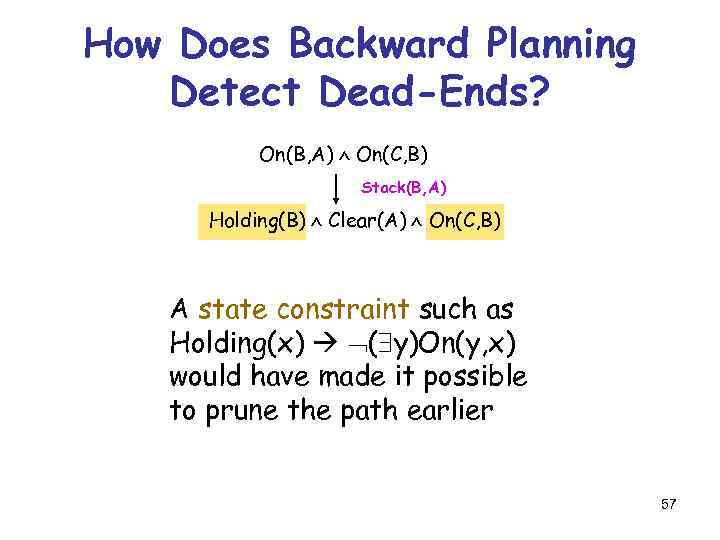
How Does Backward Planning Detect Dead-Ends? On(B, A) On(C, B) Stack(B, A) Holding(B) Clear(A) On(C, B) A state constraint such as Holding(x) ( y)On(y, x) would have made it possible to prune the path earlier 57
Some Extensions of STRIPS Language 58
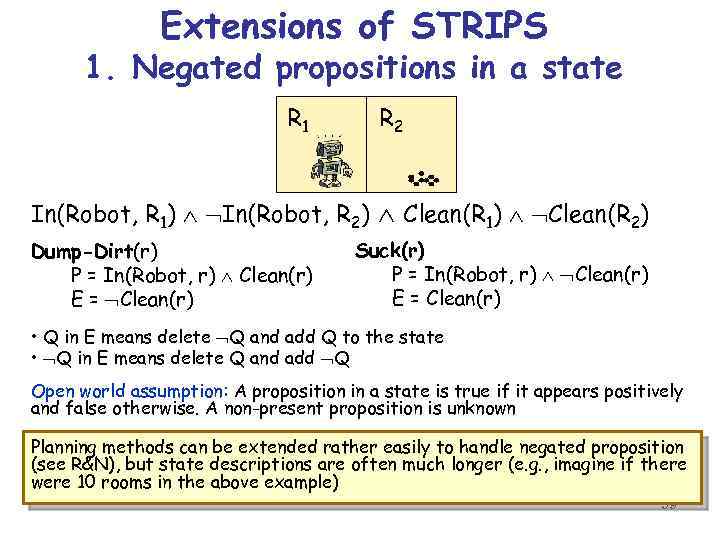
Extensions of STRIPS 1. Negated propositions in a state R 1 R 2 In(Robot, R 1) In(Robot, R 2) Clean(R 1) Clean(R 2) Dump-Dirt(r) P = In(Robot, r) Clean(r) E = Clean(r) Suck(r) P = In(Robot, r) Clean(r) E = Clean(r) • Q in E means delete Q and add Q to the state • Q in E means delete Q and add Q Open world assumption: A proposition in a state is true if it appears positively and false otherwise. A non-present proposition is unknown Planning methods can be extended rather easily to handle negated proposition (see R&N), but state descriptions are often much longer (e. g. , imagine if there were 10 rooms in the above example) 59
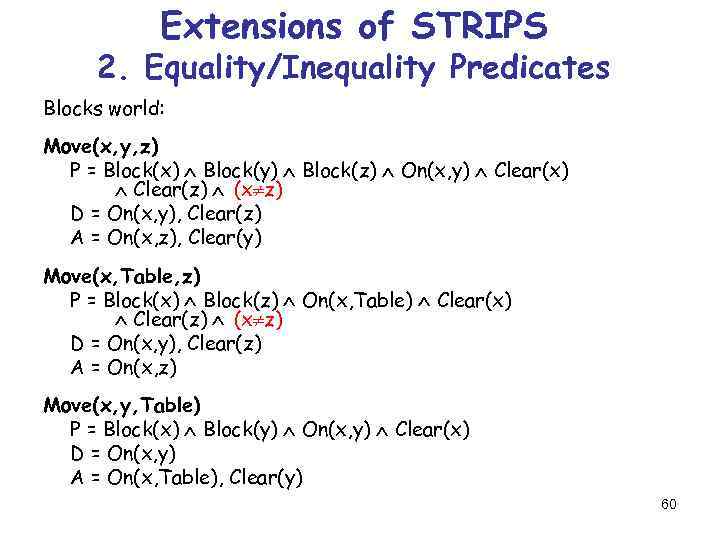
Extensions of STRIPS 2. Equality/Inequality Predicates Blocks world: Move(x, y, z) P = Block(x) Block(y) Block(z) On(x, y) Clear(x) Clear(z) (x z) D = On(x, y), Clear(z) A = On(x, z), Clear(y) Move(x, Table, z) P = Block(x) Block(z) On(x, Table) Clear(x) Clear(z) (x z) D = On(x, y), Clear(z) A = On(x, z) Move(x, y, Table) P = Block(x) Block(y) On(x, y) Clear(x) D = On(x, y) A = On(x, Table), Clear(y) 60
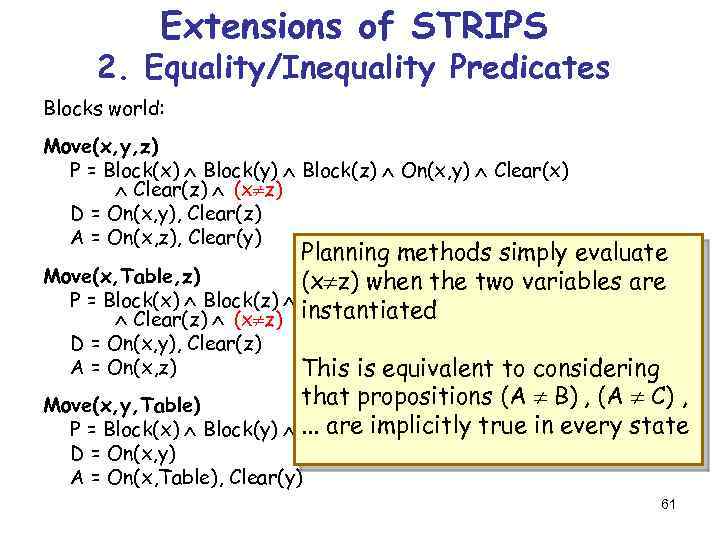
Extensions of STRIPS 2. Equality/Inequality Predicates Blocks world: Move(x, y, z) P = Block(x) Block(y) Block(z) On(x, y) Clear(x) Clear(z) (x z) D = On(x, y), Clear(z) A = On(x, z), Clear(y) Planning methods simply evaluate Move(x, Table, z) (x z) when the two variables are P = Block(x) Block(z) On(x, Table) Clear(x) Clear(z) (x z) instantiated D = On(x, y), Clear(z) A = On(x, z) This is equivalent to considering that propositions (A B) , (A C) , Move(x, y, Table) P = Block(x) Block(y) . . . are implicitly true in every state On(x, y) Clear(x) D = On(x, y) A = On(x, Table), Clear(y) 61
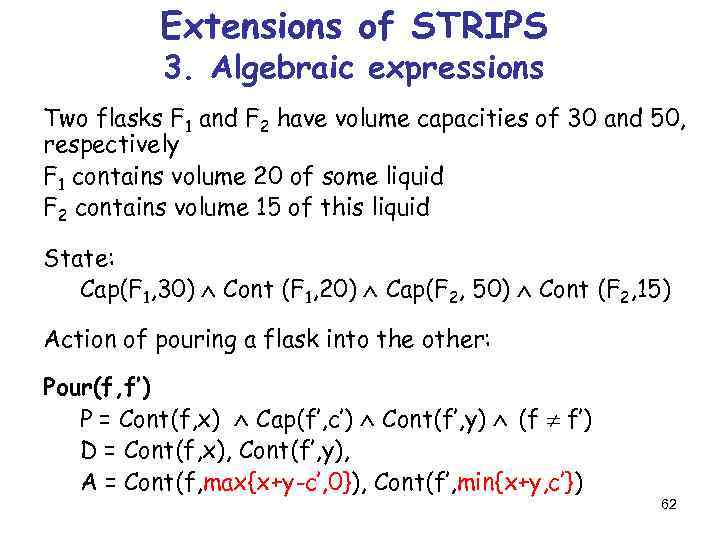
Extensions of STRIPS 3. Algebraic expressions Two flasks F 1 and F 2 have volume capacities of 30 and 50, respectively F 1 contains volume 20 of some liquid F 2 contains volume 15 of this liquid State: Cap(F 1, 30) Cont (F 1, 20) Cap(F 2, 50) Cont (F 2, 15) Action of pouring a flask into the other: Pour(f, f’) P = Cont(f, x) Cap(f’, c’) Cont(f’, y) (f f’) D = Cont(f, x), Cont(f’, y), A = Cont(f, max{x+y-c’, 0}), Cont(f’, min{x+y, c’}) 62
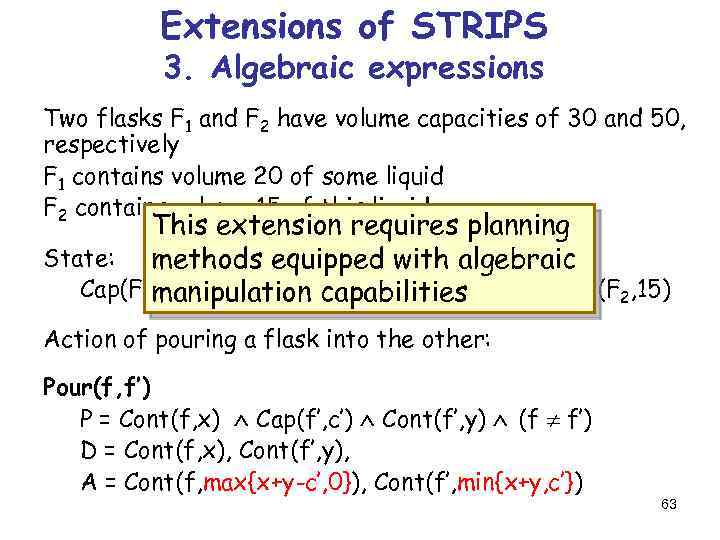
Extensions of STRIPS 3. Algebraic expressions Two flasks F 1 and F 2 have volume capacities of 30 and 50, respectively F 1 contains volume 20 of some liquid F 2 contains volume 15 of this liquid This extension requires planning State: methods equipped with algebraic Cap(F 1, 30) Cont (F 1, 20) Cap(F 2, 50) Cont (F 2, 15) manipulation capabilities Action of pouring a flask into the other: Pour(f, f’) P = Cont(f, x) Cap(f’, c’) Cont(f’, y) (f f’) D = Cont(f, x), Cont(f’, y), A = Cont(f, max{x+y-c’, 0}), Cont(f’, min{x+y, c’}) 63
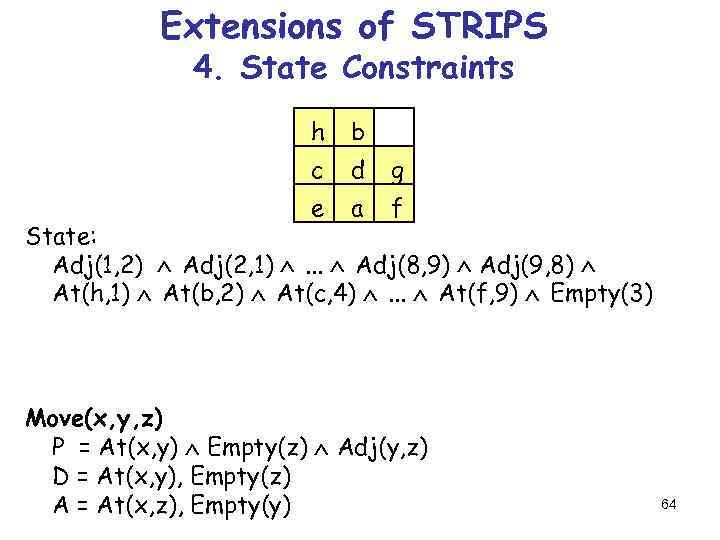
Extensions of STRIPS 4. State Constraints h b c d g e a f State: Adj(1, 2) Adj(2, 1) . . . Adj(8, 9) Adj(9, 8) At(h, 1) At(b, 2) At(c, 4) . . . At(f, 9) Empty(3) Move(x, y, z) P = At(x, y) Empty(z) Adj(y, z) D = At(x, y), Empty(z) A = At(x, z), Empty(y) 64
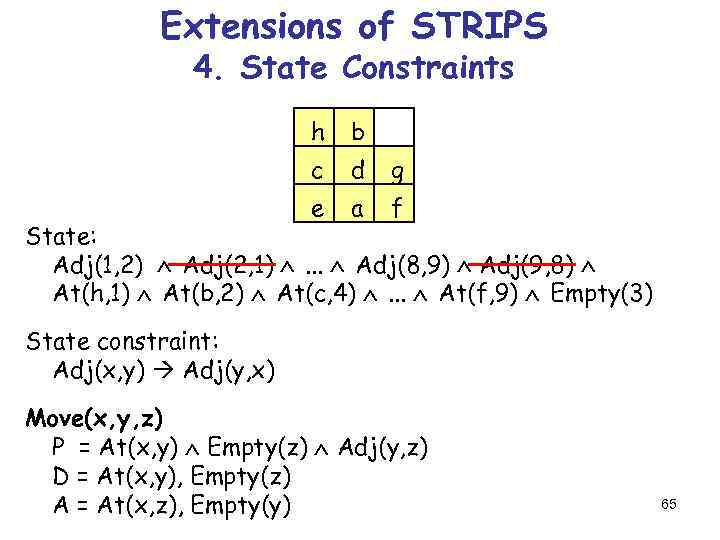
Extensions of STRIPS 4. State Constraints h b c d g e a f State: Adj(1, 2) Adj(2, 1) . . . Adj(8, 9) Adj(9, 8) At(h, 1) At(b, 2) At(c, 4) . . . At(f, 9) Empty(3) State constraint: Adj(x, y) Adj(y, x) Move(x, y, z) P = At(x, y) Empty(z) Adj(y, z) D = At(x, y), Empty(z) A = At(x, z), Empty(y) 65
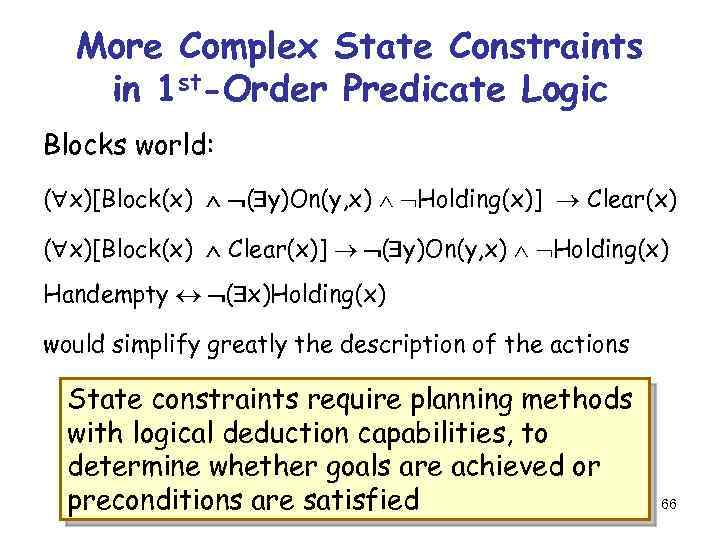
More Complex State Constraints in 1 st-Order Predicate Logic Blocks world: ( x)[Block(x) ( y)On(y, x) Holding(x)] Clear(x) ( x)[Block(x) Clear(x)] ( y)On(y, x) Holding(x) Handempty ( x)Holding(x) would simplify greatly the description of the actions State constraints require planning methods with logical deduction capabilities, to determine whether goals are achieved or preconditions are satisfied 66
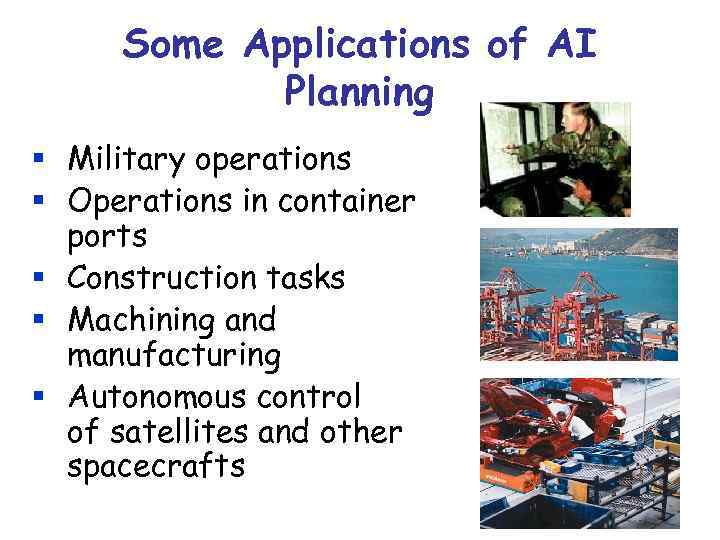
Some Applications of AI Planning § Military operations § Operations in container ports § Construction tasks § Machining and manufacturing § Autonomous control of satellites and other spacecrafts 67
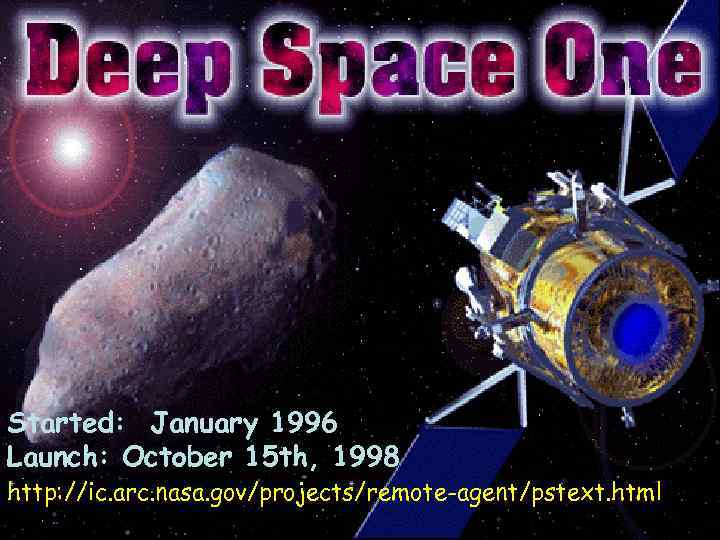
Started: January 1996 Launch: October 15 th, 1998 http: //ic. arc. nasa. gov/projects/remote-agent/pstext. html 68
Скачать презентацию Action Planning Where logic-based representation of knowledge makes
l4-Planirovanie_Deystvy.ppt