


 Скачать презентацию ACTING AND CONVERSING 26 04 2015 Speech
1e45bb8e42d07e7fe3fe01e162e6f27b.ppt
- Количество слайдов: 16
 ACTING AND CONVERSING 26. 04. 2015
 Speech Acts: Austin and Searle • Utterances make propositions: ‘I had a busy day’; Have you called your mother? ’ T/F (constative utterances) >> connected with events and happenings in the world (experienced or imagined) • Ethical propositions: ‘Thou shalt not kill’ >> serve as guides to behaviour in some world or other • ‘Phatic’ utterances: ‘Nice day’; ‘How do you do? ’ >> affective value J. L. Austin (1962): performative utterance – speakers are not just saying but doing something e. g. ‘I do’ – you marry, ‘I sentence you to 5 years in jail’ – put someone in prison Ø all performatives must meet felicity conditions to be successful 1. a conventional procedure must exist for doing whatever is to be done (who must say what and in what circumstances) 2. all participants must properly execute this procedure and carry it through to completion 3. the necessary thoughts, feelings and intentions must be present in all parties >>> Speech act – first person subject + verb in the present e. g. ‘I hereby name’
 Discussion question Austin specified certain felicity conditions if performatives are to succeed. He says that if either of the first conditions is not met we have a misfire, but if the third is not met we have an abuse. Why do you think he chose terms? Can you give some examples from your own experience of misfires and abuses?
 • Searle (1969) : people perform different kinds of acts when they speak • The utterances we use are locutions • express intent that a speaker has – have an illocutionary force (one form can have several functions (e. g. ‘y’want a piece of candy? ’/ question, request, offer), and one function can be expressed with different forms (e. g. ask someone to close the door) • Illocutions often cause listeners to do things - perlocutions At least six ways in which we can make requests or give indirect orders: 1. Focus on the ability to do something: “Can you pass the salt? ” 2. Focus on the speaker’s wish or desire that the hearer do sth. : “I would like you to go now” 3. Focus on the hearer actually doing something: “Officers will henceforth wear ties at dinner” 4. Focus on the hearer’s willingness or desire to do sth. : “Would you be willing to write this letter for me? ” 5. Focus on the reasons for doing sth. : “You’re standing on my foot” 6. Those that embed one of the above types inside another: “I would appreciate it if you could make less noise § Austin focuses on how speakers realize their intentions in speaking § Searle focuses on how listeners respond to utterances i. e. how one person tries to figure out how another is using a particular utterance
 Discussion questions 1. Standing by the side of the swimming pool, you say to a small girl ‘Can you swim? ’ expecting either ‘Yes’ or ‘No’ as an answer. However, she jumps into the water instead. Explain how she interpreted your words. Does the same explanation hold for the reply ‘I’ll bring you one in a minute’ rather than ‘Yes, we don’t need any’ to the question, ‘Is there any beer in the fridge? ’ 2. What observations can you make about the relationship of grammatical form and speaker’s intent from data such as the following? a. Have you tidied up your room yet? b. When do you plan to tidy up your room? c. Don’t you think your room is a mess? d. Are you planning to do anything about your room? e. Can you go upstairs and tidy your room? f. Would you mind tidying up your room? g. Wouldn’t it be a good idea to tidy up your room? h. Go and tidy up your room. i. Your room needs tidying up. j. Kids who can’t keep their rooms tidy don’t get ice cream.
 Cooperation and face: Grice and Goffman Grice (1975), we are able to converse with one another because we recognize common goals in conversation and specific ways of achieving these goals – Cooperative principle: ‘Make your conversational contribution such as is required, at the stage at which it occurs, by the accepted purpose or direction of the talk exchange in which you are engaged. ’ v 4 maxims that follow from the cooperative principle: 1. The maxim of quantity: Be as informative as required 2. The maxim of quality: Don’t say what you believe to be false or that for which you lack adequate evidence 3. The maxim of relation: Be relevant 4. The maxim of manner: Avoid obscurity of expression and ambiguity, and be brief and orderly.
 >>> speakers might violate, exploit or opt out of some maxims. e. g. 1 A. I am out of petrol. B. There is a garage round the corner. e. g. 2* A. Smith doesn’t seem to have a girlfriend these days. B. He has been paying a lot of visits to New York lately. >>> Sometimes the aim is irony, metaphor, hyperbole e. g. ‘You are a fine friend’ – to someone who has just let you down ‘You are the cream in my coffee’ – why is X telling me this in this way?
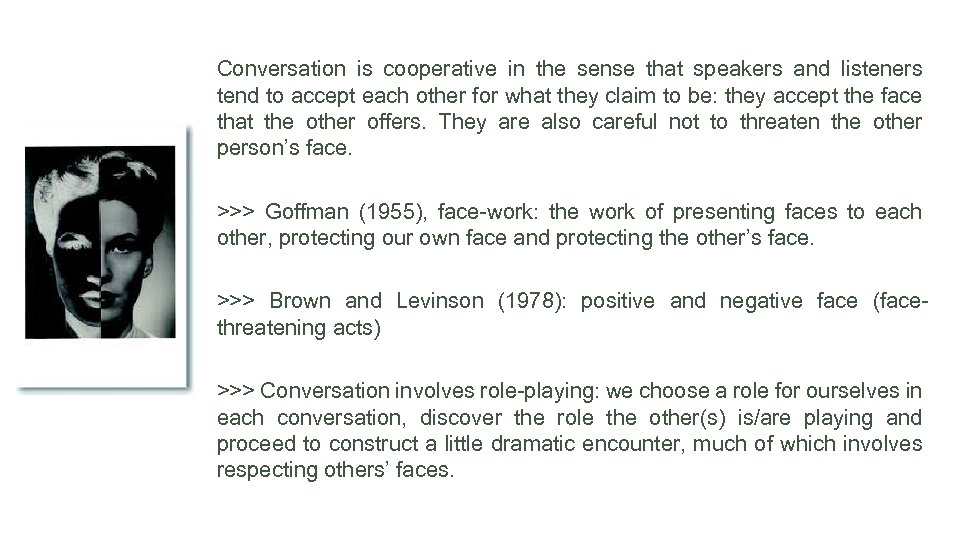 Conversation is cooperative in the sense that speakers and listeners tend to accept each other for what they claim to be: they accept the face that the other offers. They are also careful not to threaten the other person’s face. >>> Goffman (1955), face-work: the work of presenting faces to each other, protecting our own face and protecting the other’s face. >>> Brown and Levinson (1978): positive and negative face (facethreatening acts) >>> Conversation involves role-playing: we choose a role for ourselves in each conversation, discover the role the other(s) is/are playing and proceed to construct a little dramatic encounter, much of which involves respecting others’ faces.
 Discussion questions 1. What might a friend think if you said ‘completely out of the blue’ each of the following: a. Your husband/wife is still faithful. b. The sun did rise this morning. c. Your shoes are clean today. d. Tomorrow’s Friday. In which circumstances would you actually say these? What do you imply with them? 2. Here are several ways of offering someone some coffee. When and with whom, might you prefer one way of offering rather than another? Why? a. Should I make (us) some coffee? / b. Would you like (me to make) some coffee? / c. Can I make you some coffee? / d. Let’s have some coffee. / e. How about a nice cup of coffee? / f. I could make you a cup of coffee. / Do you drink coffee? 3. For each of the following, explain a set of circumstances that might exist to bring about your using the why question-form. Explain the various functions of this question-form. a. Why are you crying? / b. Why cry about it? / c. Why paint it? / d. Why don’t you paint it? / e. Why are you painting the room blue? / Why don’t you paint the room?
 Some features of conversation q Ochs (1979) – speech can be planned and unplanned Unplanned: repetitions, simple active sentences, speaker and listener combining to construct propositions, stringing of clauses together with and but, juxtaposition of clauses with no overt links, deletion of subjects and referents, use of deictics. q Important principles used in conversation: adjacency pairs e. g. greeting-return of greeting; question-answer; request-acceptance or refusal etc. Violations – to disrupt conversations or require explanations q A basic exchange has three parts: initiation, response and feedback Principles of turn-taking (overlapping, interruptions: indicators of turn-taking: pitch, gestures): varying by cultural group; Tannen (1987): New Yorkers e. g. telephone conversations: Japan – the caller speaks first by identifying himself/ herself; Netherlands and Sweden – people answer the phone by identifying themselves; France – a telephone call is an intrusion so the caller verifies the number and identifies him/herself; America – not taken seriously >> establish a topic
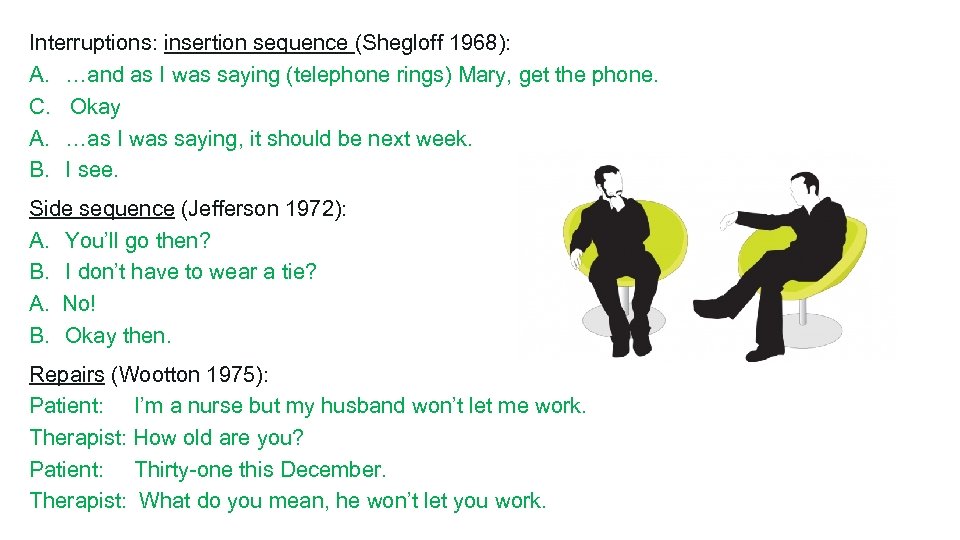 Interruptions: insertion sequence (Shegloff 1968): A. …and as I was saying (telephone rings) Mary, get the phone. C. Okay A. …as I was saying, it should be next week. B. I see. Side sequence (Jefferson 1972): A. You’ll go then? B. I don’t have to wear a tie? A. No! B. Okay then. Repairs (Wootton 1975): Patient: I’m a nurse but my husband won’t let me work. Therapist: How old are you? Patient: Thirty-one this December. Therapist: What do you mean, he won’t let you work.
 • Closing might involve several steps: A. So, that’s agreed? (the closing down of a topic) B. Yep, agreed. (repeated by the other party) A. Good, I knew you would. B. Yes, no problem really. A. Thanks for the help. (thanking) B. Don’t mention it. A. Okay, I’ll be back soon. (pre-closing exchange) B. Okay, then, Bye. Take care. (exchange of farewells) A. Bye. Awareness of conventions is what makes a conversation successful Verbal exchanges which involve people from different cultural backgrounds can more easily go wrong than those that involve people who share the same cultural background (Gumperz and Cook. Gumperz 1982)
 Discussion questions E. g. 1 Gumperz (1982) cites the following conversation recorded in a small office: A. Are you gonna be here for ten minutes? B. Go ahead and take your break. Take longer if you want to. A. I’ll just be outside on the porch. Call me if you need me. B. OK, don’t worry. What can you say about the people, the situation, and their relationship from this brief exchange? E. g. 2 Try to explain how each remark in the conversation relates to what has gone before and what follows. The setting is a neighbourhood convenience store and the time 11 pm. Speaker A is a woman in one of the two lines to the cash registers. These lines are quite closely packed because there is not much space in the area in front of the registers. Speaker B, a man, is directly behind A in the same line. He is looking around at shelves and others in the store but is paying no particular attention to the woman in front of him – she is just one of those ‘others’. A. (looks directly at B) Would you like to get in front of me? B. (Surprised) No! A. You know I can feel your tension. B. (Edges back) I’m sorry but I’m not aware of it. (Turns away, raises his eyebrows and shrugs his shoulders)
 E. g. 3 This conversation involves an encounter between complete strangers. The setting is a park adjacent to a university, one frequented by students and by the general public. The time is fine autumn afternoon and the park is well populated. Speaker B is sitting on the bench, reading a book (dressed in a style favoured by students). Speaker A approaches her (dressed in jeans and a black leather jacket – style not favoured by students). He approaches A and says: A. B. You look a little lonely. Not at all. You smoke hash? I don’t want to buy any, and I don’t have any to sell. How about coke? Look! I’m not bothering anyone and I was quite content until… Two’s a company. You’re a crowd! Don’t get fresh with me. (urban: tries to get physical action without permission) (Stands up, picks up book and leaves)
 E. g. 4 Here are some conversational openers. When might each be suitable? Which would be improved by an introductory ‘Excuse me’? a. b. c. d. e. f. g. h. What time is it please? Gotta match? Do you have the time? The bus is sure late! What a mess! Sorry! You seem lonely. Are you looking for Mr. Jones? E. g. 5 Account for ‘Oh!’ in the following conversation: A. Hello John, how are you today? B. Awful. I’ve got a terrible cold, my dog’s sick and work is just piling up all around me. A. Oh!
 E. g. 6 You are at a party and you approach a group of strangers, one of whom says: “Hello, we are just talking about the news from the Middle East. ’ What do you consider to be the purpose of such a remark? E. g. 7 What is the function of ‘Yes’ in the following two exchanges: A. Teacher: So which is the dependent variable? Student: Age. Teacher: Yes. B. Physician: How often do you get this itching? Patient: Often, just about every night. Physician: Yes. Would you expect the two utterances of ‘Yes’ to be alike in loudness and pitch? Who would speak next? What might be said? E. g. 8 Try to formulate what you consider to be the characteristics of a ‘good’ conversationalist and of a ‘poor’ conversationalist. Be as specific as you can in trying to assess such matters as fluency, style of speech adopted, special mannerisms, types of expressions used and so on.