


 Скачать презентацию ACPS Meeting 8 May 2002 The Process Analytical
2f6440959eb7abef45ee3c7ff12c3b8d.ppt
- Количество слайдов: 16
 ACPS Meeting, 8 May 2002 The Process Analytical Technology (PAT) Initiative: Progress Report and Next Steps Ajaz S. Hussain, Ph. D. Deputy Director Office of Pharmaceutical Sciences CDER, FDA
 Motivation • Significant potential and need exists for improving the efficiencies of pharmaceutical manufacturing and associated regulatory processes • Technological opportunities (e. g. , PAT) available for realizing this potential – Industry reluctant to take advantage of such opportunities due to “regulatory uncertainties, ” prefers to adopt a “Don’t Use” or “Don’t Tell” approach • An undesirable situation for both industry and public health
 Why PAT? • PAT provides an opportunity to move from the current “testing to document quality” paradigm to a “Continuous Quality Assurance” paradigm that can improve our ability to ensure quality was “built-in” or was “by design” - ultimate realization of the true spirit of c. GMP! – – At/On/In-line measurement of “performance” attributes Real-time or rapid feedback controls (focus on prevention) Greater insight and understating of processes Potential for significant reduction in production (and development) cycle time – Reduce (regulatory) concerns and potential for remote inspection strategies
 Goals and Objectives • Using PAT as a model technological opportunity, develop a regulatory framework to facilitate introduction of new manufacturing technologies that enhance process efficiencies and understanding – Identify and eliminate perceived/real “regulatory hurdles” – Develop a dynamic, team-based, scientific approach for regulatory assessment (review & inspection) of new technologies – International harmonization
 Strategy • A “win-win” approach with input from the ACPS and the FDA Science Board – Internal Collaboration: CDER & ORA • FDA PAT Steering Committee – External Collaboration: Industry & Academia • FDA/ACPS Subcommittee on PAT • PQRI • Two parallel tracks – Guidance for industry on PAT • Step 1: General principles (not focused on any one technology) – Encourage submission • Team approach for review & inspection during development phase
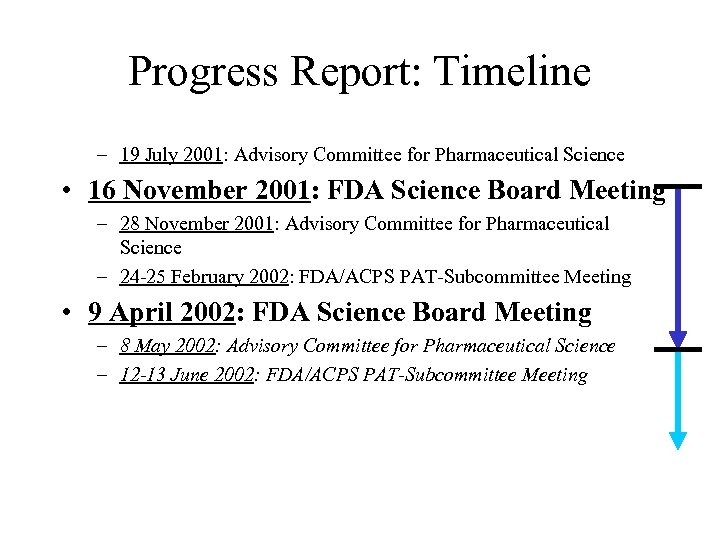 Progress Report: Timeline – 19 July 2001: Advisory Committee for Pharmaceutical Science • 16 November 2001: FDA Science Board Meeting – 28 November 2001: Advisory Committee for Pharmaceutical Science – 24 -25 February 2002: FDA/ACPS PAT-Subcommittee Meeting • 9 April 2002: FDA Science Board Meeting – 8 May 2002: Advisory Committee for Pharmaceutical Science – 12 -13 June 2002: FDA/ACPS PAT-Subcommittee Meeting
 Collaboration: Internal • FDA’s PAT Steering Committee • • Doug Ellsworth (NJDO, ORA) Mike Olson (DFS, ORA) Diane Obrien (DFS, ORA) Joseph Famulare (OC, CDER) Moheb Nasr (OTR/OPS, CDER) Frank Holcomb (OGD/OPS, CDER) Yuan-yuan Chiu (ONDC/OPS, CDER) Ajaz Hussain (OPS, CDER) [Chair] • Consensus building and awareness – CDER Science Rounds, Seminars, Visiting Lecture Series, ….
 Collaboration: External • FDA/ACPS Subcommittee on PAT – Federal Register Notice (10/25/01) requesting nominations from industry, academia, . . . • Product Quality Research Institute (PQRI) – Research program (Blending/NIR) • Academia (Pharmacy, Chemistry and Engineering) – Currently three NSF “Process” Centers • Development of training and certification program • Continuing education program
 General (principles) Guidance on PAT • Proposed Goals and Objectives – General principles and terminology • Bring the community on the “same page” – Address issues related to “regulatory uncertainties” – Clarify the regulatory process • Review and inspection – Other tangible benefits • Serve as a tool for building within-company consensus • Promote research and development activities in the pharmaceutical PAT area
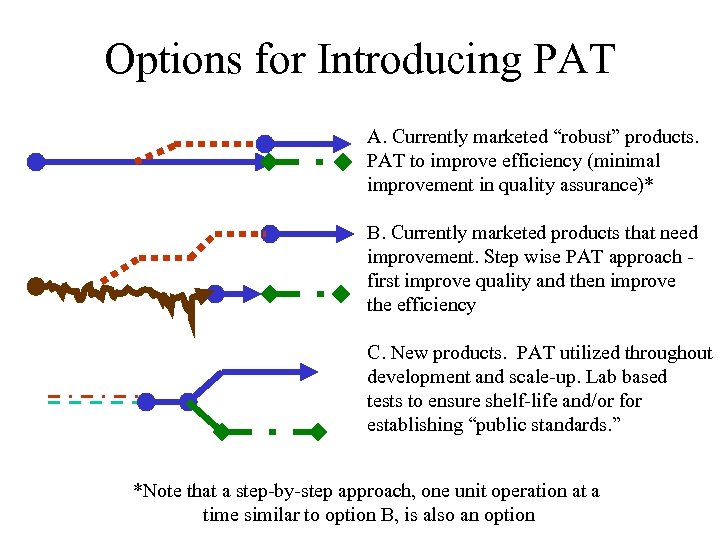 Options for Introducing PAT A. Currently marketed “robust” products. PAT to improve efficiency (minimal improvement in quality assurance)* B. Currently marketed products that need improvement. Step wise PAT approach first improve quality and then improve the efficiency C. New products. PAT utilized throughout development and scale-up. Lab based tests to ensure shelf-life and/or for establishing “public standards. ” *Note that a step-by-step approach, one unit operation at a time similar to option B, is also an option
 Track #2: Encourage Submissions (now) • Companies can propose PAT submissions – Contact the OPS/CDER/FDA to discuss their proposed PAT applications or submissions – Review-Inspection teams for these submissions • Concurrent development -review/inspection – To date we have received two formal requests (major US companies) for a meeting to discuss proposed submissions
 Track #2 a: Encourage Established PAT Technologies • Encourage application of selected on/in/at line measurement tools for unit operations and/or as alternate tests – Unit operations: blending, drying – Technologies: NIR, Raman, Chemical imaging • Incorporate regulatory recommendations within current projects (e. g. , draft Blend Uniformity Guidance document)
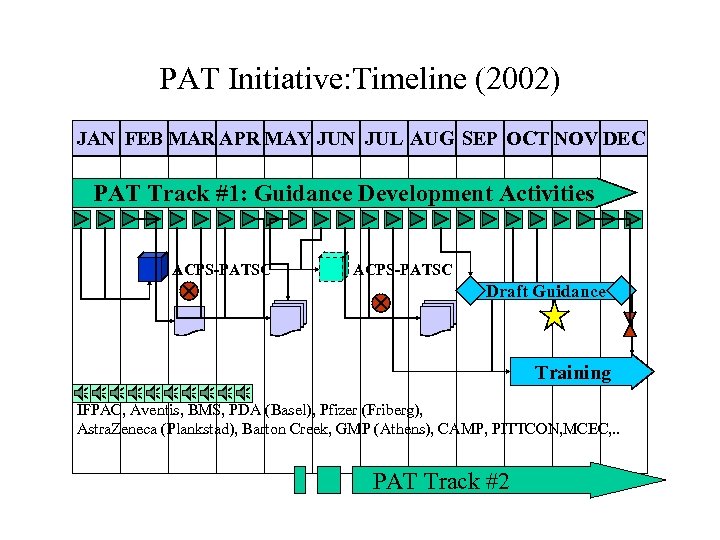 PAT Initiative: Timeline (2002) JAN FEB MAR APR MAY JUN JUL AUG SEP OCT NOV DEC PAT Track #1: Guidance Development Activities ACPS-PATSC Draft Guidance Training IFPAC, Aventis, BMS, PDA (Basel), Pfizer (Friberg), Astra. Zeneca (Plankstad), Barton Creek, GMP (Athens), CAMP, PITTCON, MCEC, . . PAT Track #2
 Next Steps • Establish a CDER-ORA PAT team for joint review/inspection of PAT based submissions. – Team review-inspection process and procedures – Select four reviewers and four inspectors to be part of this first team – Recruit expert consultants: Process/Chemical Engineer (PD-drafted), Process Analytical Chemist, Chemometrician, Industrial Pharmacist.
 Next Steps • Develop a training (and certification) program PAT Review-Inspection Team – Proposal (curriculum) to be discussed at the 06/02 meeting of the PAT-Subcommittee • Expand FDA research efforts to understand issues related to PAT based applications – NIR, Chemical imaging, Prediction of product performance (dissolution) • Publish the proposed general guidance (draft)
 Next Steps • Public workshops on PAT – Program developed for the Arden House Conference (AAPS PT Section) • USA 01/03; UK 03/03 (AAPS-RPS; FDA-MCA) – FDA/AAPS PAT Workshop under development (target 04/03) • Formalize efforts towards International Harmonization – Currently informal communications with a few European regulators