


 Скачать презентацию ACPA QCAST PLANT CERTIFICATION MADE EASY www concrete-pipe
3bb66b1bf44914411d1df3dd8603258e.ppt
- Количество слайдов: 73
 ACPA QCAST PLANT CERTIFICATION MADE EASY www. concrete-pipe. org
 2 Learning Objectives Recognize the benefit of obtaining the ACPA QCast Certification. Recall the product options for QCast Certification. Recall the components of the certification program. Recall the qualification requirements for the QC person on-site according to the QCast program. State the scoring requirements for passing for overall and for critical items, respectively. Recall the minimum documentation requirements for initial certification of first time plants.
 3 Objectives 1. Understand how to become QCAST certified. 2. Introduction to plant certification requirements. 3. Provide suggestions to organize paperwork. 4. How to avoid common deficiencies.
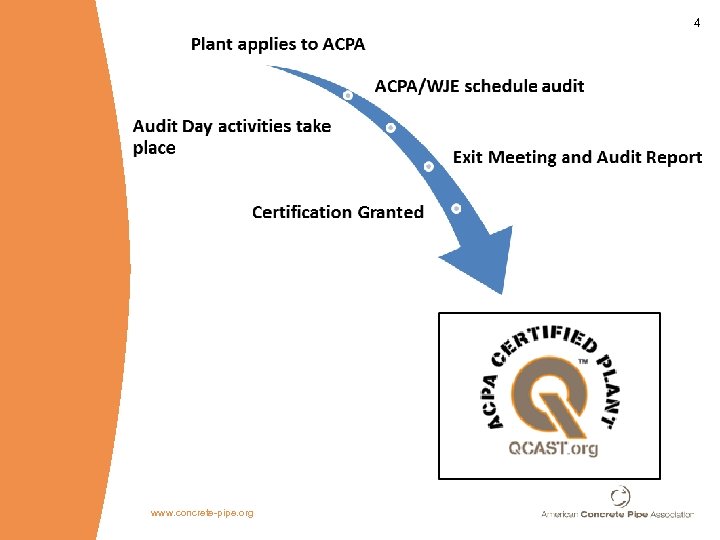 4 www. concrete-pipe. org
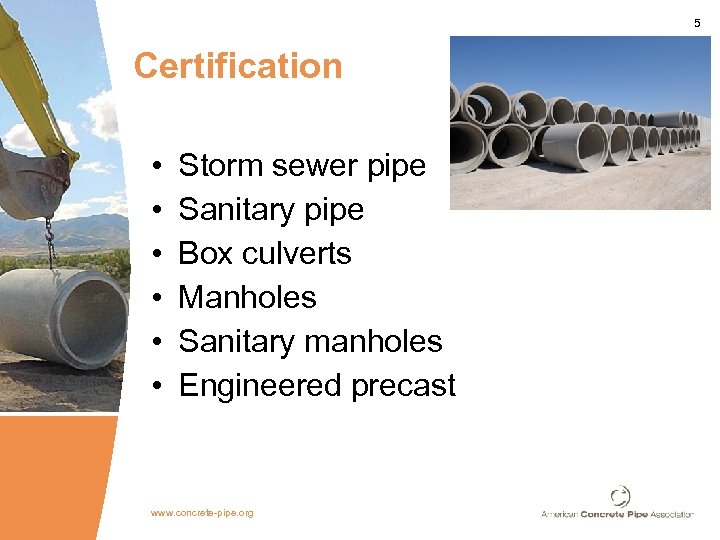 5 Certification • • • Storm sewer pipe Sanitary pipe Box culverts Manholes Sanitary manholes Engineered precast www. concrete-pipe. org
 6 QCAST Plant Certification Process - Submit Application Submit Copy of Plant Quality Control Manual Have All Elements Available for Inspection Receipt of a Satisfactory Audit (announced) ACPA QCAST Concrete Pipe, Manhole, Precast Products, Box Culvert And Threesided Precast Structures Plant Certification Manual - Application Process (voluntary) - Provides All Requirements - Re-certification Process (annually) - Appeal Process
 7 Scoring Requirements In order to be awarded certificate plants must: • Receive a minimum overall score of 80 out of 100. • Receive a score greater than 75 on identified critical audit elements (reinforcing inspection, concrete testing and TEB) • Plants that fail a Combined Storm and Sanitary Sewer Pipe may still gain Storm Sewer Certification or conditional certification if the plant passes all Storm items with an 80, and a score greater than 75 on critical items. www. concrete-pipe. org
 8 Certification process can seem overwhelming. Break the program down into man smaller parts.
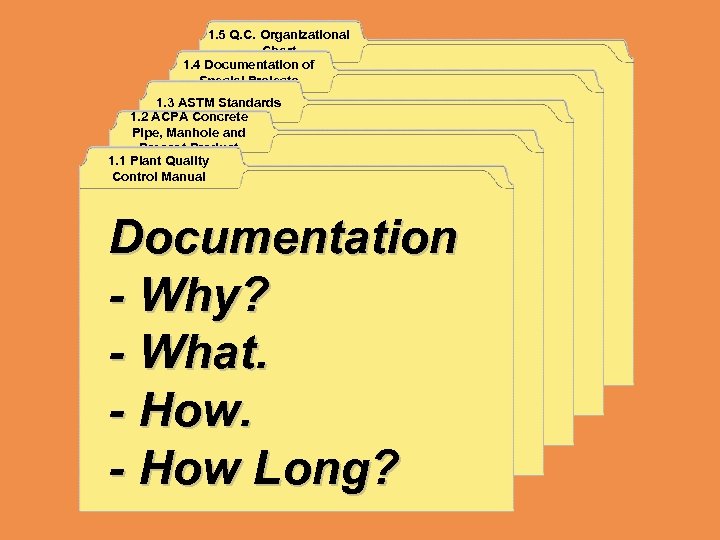 1. 5 Q. C. Organizational Chart 1. 4 Documentation of Special Projects 1. 3 ASTM Standards 1. 2 ACPA Concrete Pipe, Manhole and Precast Product 1. 1 Plant Quality Control Manual Documentation - Why? - What. - How Long?
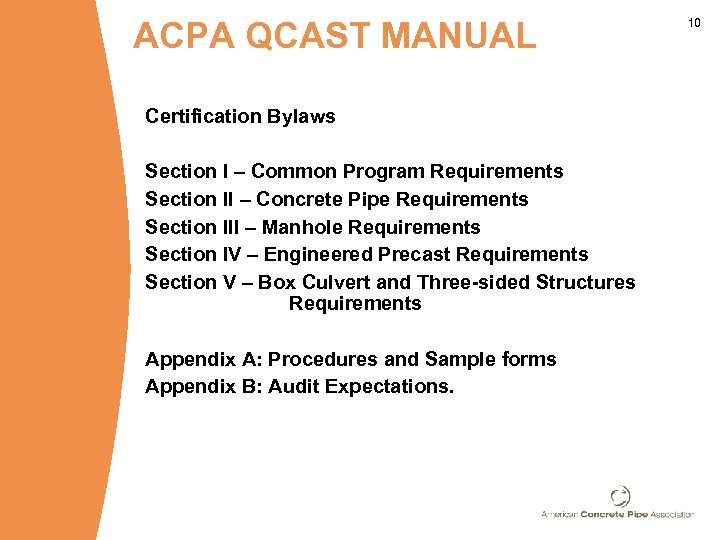 ACPA QCAST MANUAL Certification Bylaws Section I – Common Program Requirements Section II – Concrete Pipe Requirements Section III – Manhole Requirements Section IV – Engineered Precast Requirements Section V – Box Culvert and Three-sided Structures Requirements Appendix A: Procedures and Sample forms Appendix B: Audit Expectations. 10
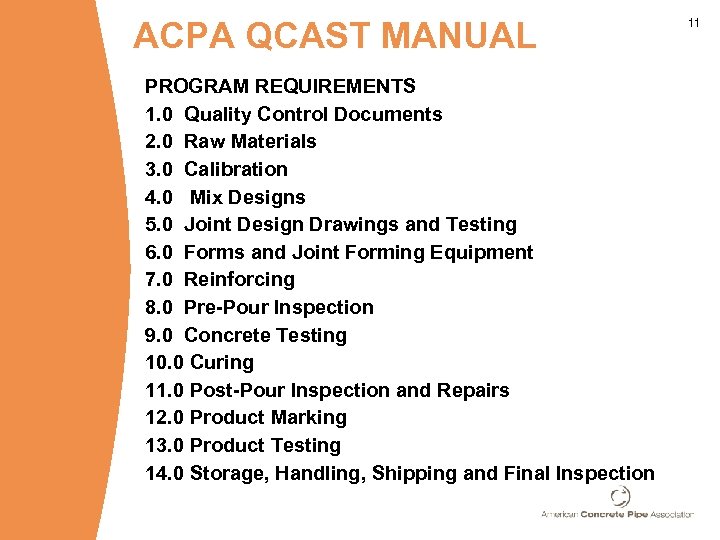 ACPA QCAST MANUAL PROGRAM REQUIREMENTS 1. 0 Quality Control Documents 2. 0 Raw Materials 3. 0 Calibration 4. 0 Mix Designs 5. 0 Joint Design Drawings and Testing 6. 0 Forms and Joint Forming Equipment 7. 0 Reinforcing 8. 0 Pre-Pour Inspection 9. 0 Concrete Testing 10. 0 Curing 11. 0 Post-Pour Inspection and Repairs 12. 0 Product Marking 13. 0 Product Testing 14. 0 Storage, Handling, Shipping and Final Inspection 11
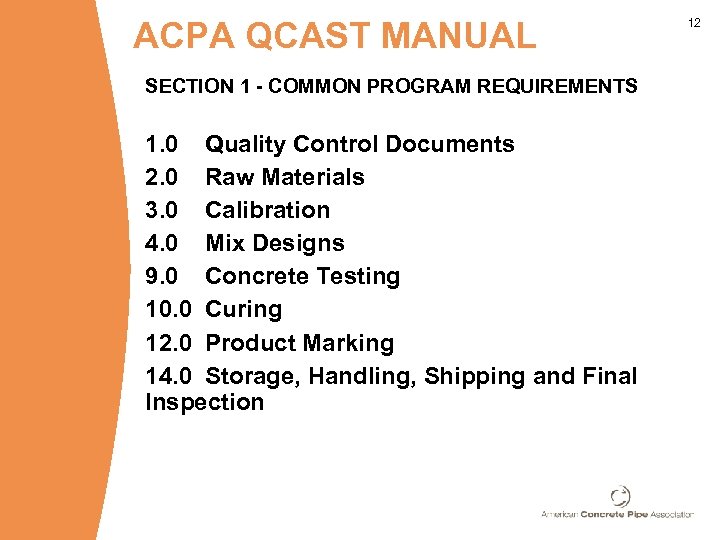 ACPA QCAST MANUAL SECTION 1 - COMMON PROGRAM REQUIREMENTS 1. 0 Quality Control Documents 2. 0 Raw Materials 3. 0 Calibration 4. 0 Mix Designs 9. 0 Concrete Testing 10. 0 Curing 12. 0 Product Marking 14. 0 Storage, Handling, Shipping and Final Inspection 12
 13 All documentation files should contain information for the previous 3 years plus year-to-date. For new applicants, files should contain all documentation generated since you adopted the Certification Program plus any previously accumulated information. A minimum of two months of documentation is required, plus any previously accumulated information.
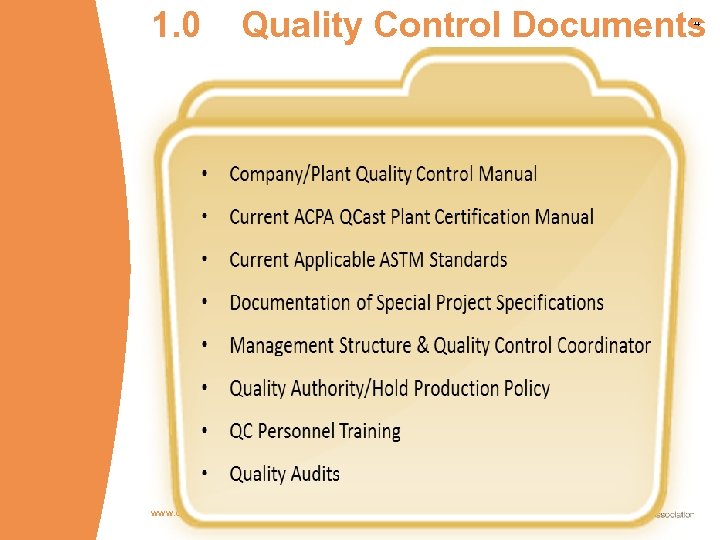 1. 0 Quality Control Documents www. concrete-pipe. org 14
 15 1. 1 PLANT QUALITY MANUAL • A description or reference to standard industry procedures which constitute the plant’s working quality system. • All necessary technical information for carrying out the plants quality systems or must make clear where the relevant information is to be found. • A document control system.
 1. 2 ACPA QCAST CERTIFICATION MANUAL What goes in here? Current version of ACPA Concrete Pipe, Manhole and Precast Products Plant Certification Manual Where do I get it? American Concrete Pipe Association Phone: (972) 506 -7216 or Web: www. concrete-pipe. org 16
 1. 3 CURRENT APPLICABLE ASTM STANDARDS What goes in here? ASTM Standards. A list of required standards can be found in ACPA QCAST manual. Where do I get them? A book containing all required ASTM Standards on concrete pipe may be purchased from the ACPA. All other recommended ASTM Standards may be purchased from ASTM. (www. astm. org) 17
 18 1. 4 DOCUMENTATION OF SPECIAL PROJECTS What goes in here? Any special projects specifications that exceed minimum ACPA requirements or have different test methods or criteria. Note: if no special projects exist, it may be of value to insert a sheet of paper dated to the current year that says “No special project specifications for the 20 XX year-todate”. Where do I get it? From your Project Specifications.
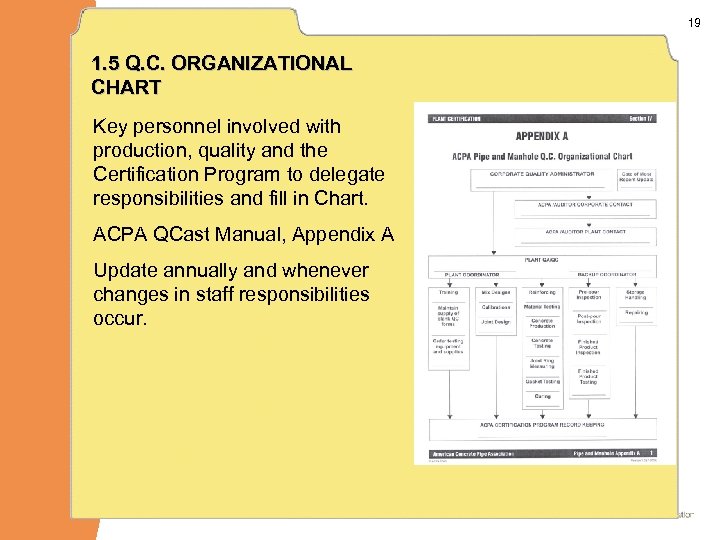 19 1. 5 Q. C. ORGANIZATIONAL CHART Key personnel involved with production, quality and the Certification Program to delegate responsibilities and fill in Chart. ACPA QCast Manual, Appendix A Update annually and whenever changes in staff responsibilities occur.
 1. 6 QUALITY AUTHORITY/HOLD PRODUCTION POLICY A statement describing the authority of personnel to correct and/stop production when quality issues arise and to reject products not meeting requirements. Policy should be written by plant/company quality director and approved by the company president. Once policy is written it should be shared with the entire plant. 20
 1. 7 Q. C. MEETING AND PERSONNEL TRAINING RECORDS What goes in here? ACI, DOT, QCast or other Quality Training certifications. In-house Quality Meeting Minutes. Annual Internal Quality Audit Results. 21
 2. 0 MATERIALS Files should be kept containing the following materials certifications: Cement – Cement mill certs received from the cement company once/mo. for each type of cement being used. Aggregate – A Certificate of Compliance (ASTM C 33) should be received once/yr. for each material from your aggregate supplier. Aggregate Gradations – Need gradations for each aggregate quarterly as per Pipe, Manhole and Precast Products and monthly for Box Certification. Fly Ash & Other Cementitious Materials – A test report should be supplied by the supplier once per month. 22
 2. 0 MATERIALS (Cont) Additives – Cert. by the additive supplier once/yr. for each material. Reinforcing – Mill certs should be supplied by the supplier once/mo. for each type of product. Gasket Material – Certification should be supplied by the manufacturer once per year for each type of gasket. Joint Sealant – Certification should be supplied by the manufacturer once per year for each type of sealant. Pipe to Manhole Seals – Cert. should be supplied by the manufacturer once per year for each type of gasket. 23
 3. 0 CALIBRATIONS Documents showing the following calibrations at specified frequency. Concrete Batching Equipment 1/yr Must be calibrated and certified by independent agency Water Meter 1/yr. In-house calibration using volumetrically calibrated 55 gallon barrel or water weight works well. Additive Dispensing Equipment 1/yr. In-house volumetric calibration using graduated cylinders works well. Get graduated cylinder from supply house such as Mc. Master-Carr. Concrete Compression Tester 1/yr. Must be calibrated and certified by independent agency. 24
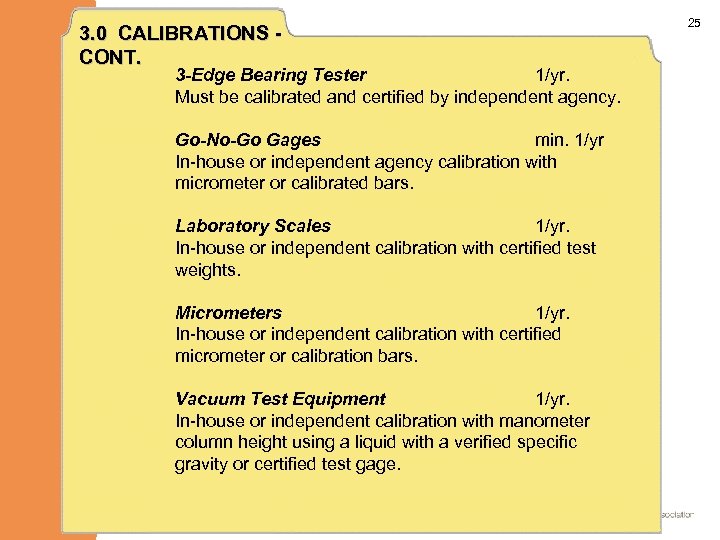 3. 0 CALIBRATIONS CONT. 3 -Edge Bearing Tester 1/yr. Must be calibrated and certified by independent agency. Go-No-Go Gages min. 1/yr In-house or independent agency calibration with micrometer or calibrated bars. Laboratory Scales 1/yr. In-house or independent calibration with certified test weights. Micrometers 1/yr. In-house or independent calibration with certified micrometer or calibration bars. Vacuum Test Equipment 1/yr. In-house or independent calibration with manometer column height using a liquid with a verified specific gravity or certified test gage. 25
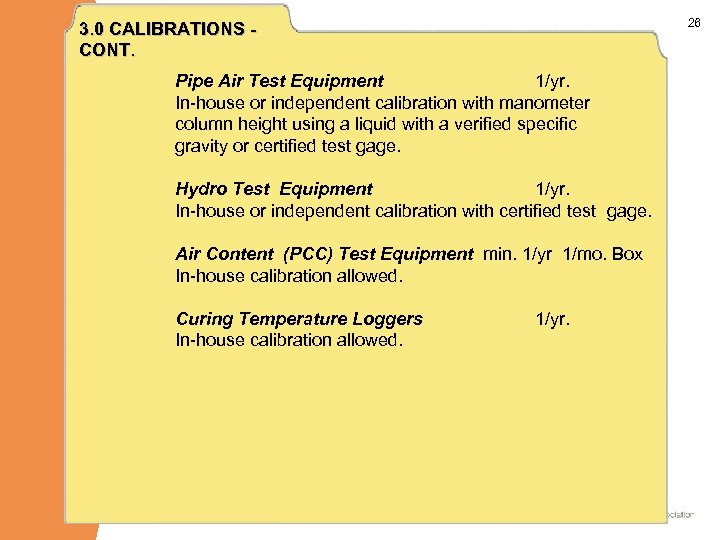 26 3. 0 CALIBRATIONS CONT. Pipe Air Test Equipment 1/yr. In-house or independent calibration with manometer column height using a liquid with a verified specific gravity or certified test gage. Hydro Test Equipment 1/yr. In-house or independent calibration with certified test gage. Air Content (PCC) Test Equipment min. 1/yr 1/mo. Box In-house calibration allowed. Curing Temperature Loggers In-house calibration allowed. 1/yr.
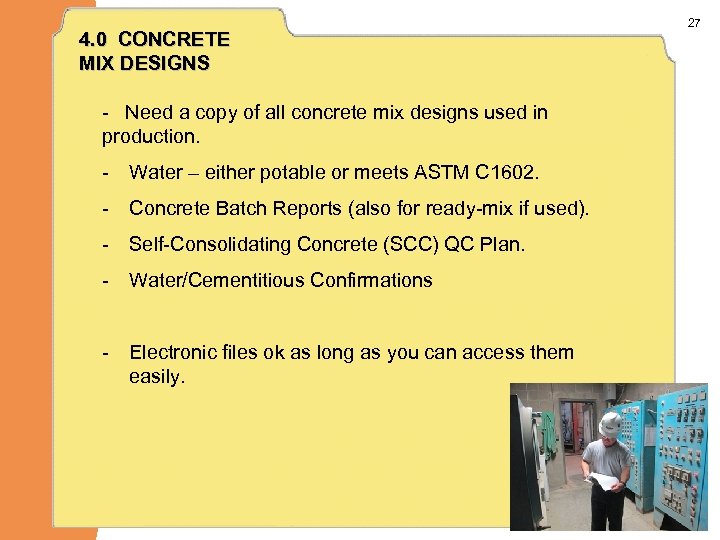 4. 0 CONCRETE MIX DESIGNS - Need a copy of all concrete mix designs used in production. - Water – either potable or meets ASTM C 1602. - Concrete Batch Reports (also for ready-mix if used). - Self-Consolidating Concrete (SCC) QC Plan. - Water/Cementitious Confirmations - Electronic files ok as long as you can access them easily. 27
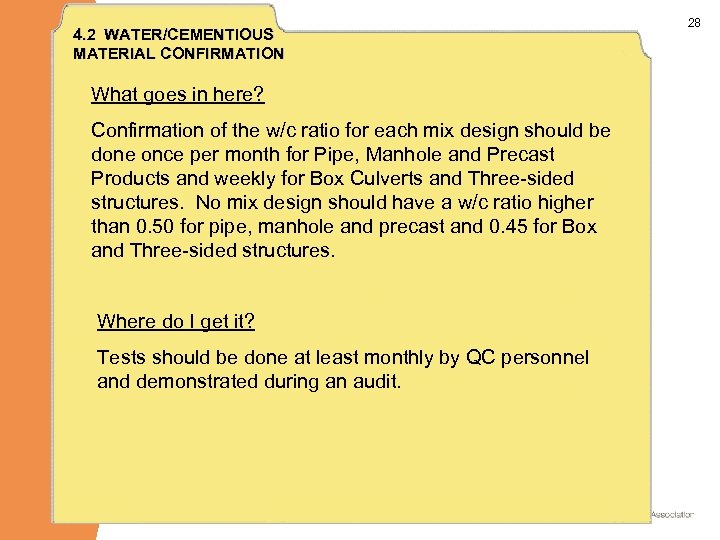 4. 2 WATER/CEMENTIOUS MATERIAL CONFIRMATION What goes in here? Confirmation of the w/c ratio for each mix design should be done once per month for Pipe, Manhole and Precast Products and weekly for Box Culverts and Three-sided structures. No mix design should have a w/c ratio higher than 0. 50 for pipe, manhole and precast and 0. 45 for Box and Three-sided structures. Where do I get it? Tests should be done at least monthly by QC personnel and demonstrated during an audit. 28
 9. 0 CONCRETE TESTING What goes in here? Reports documenting slump/flow, temperature, air content, unit weight, and absorption shall be kept on file. Need to demonstrate concrete testing procedures during audit. 29
 9. 7 COMPRESSIVE STRENGTH TESTING What goes in here? Reports documenting compressive strength tests for all mixes used in production. Min. of 5 cylinders per week for pipe tested in TEB otherwise 5 cylinders per day. Box culverts min. of 2 additional cylinders per week for stripping strength. For tests done in-house will need to demonstrate cylinder fabrication and concrete strength testing procedures during audit. Monitor strengths and ensure strength is adequate at shipping ages per shipping policy. 30
 10. 0 CURING RECORDS What goes in here? Reports showing temperature cycle of products, minimum one kiln per day/cycle. Keep maximum temperatures below 160 F (71 C) with max. rise 40 F/hr (25 C/hr). Plants should have calibrated instruments to measure the cure cycle of products, daily. 31
 12. 0 PRODUCT MARKING No files needed but must understand the minimum requirements of ASTM or local standards for marking your products. Periodically check your products to make sure that they are properly marked. Auditor will inspect your products to ensure that they are properly and legibly marked. 32
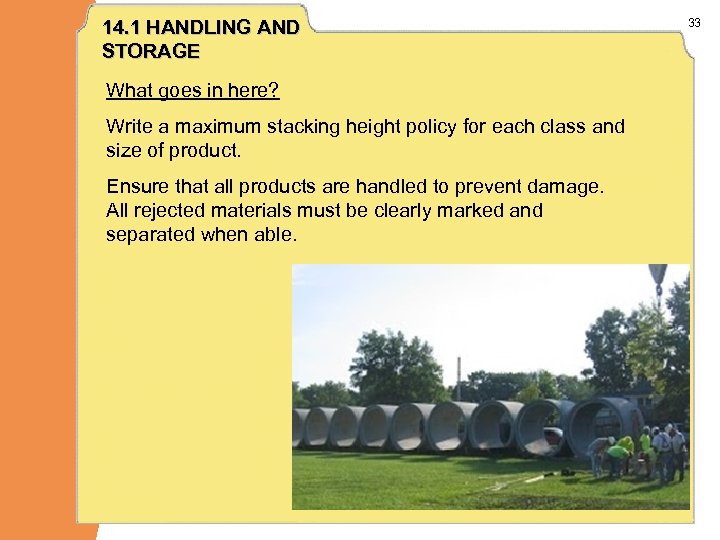 14. 1 HANDLING AND STORAGE What goes in here? Write a maximum stacking height policy for each class and size of product. Ensure that all products are handled to prevent damage. All rejected materials must be clearly marked and separated when able. 33
 14. 2 SHIPPING POLICY What goes in here? Write a Shipping Policy that corresponds with your current shipping practices and how they relate to three-edge bearing and concrete compression test results and inspection criteria. Correlate with strength testing or TEB test results. 34
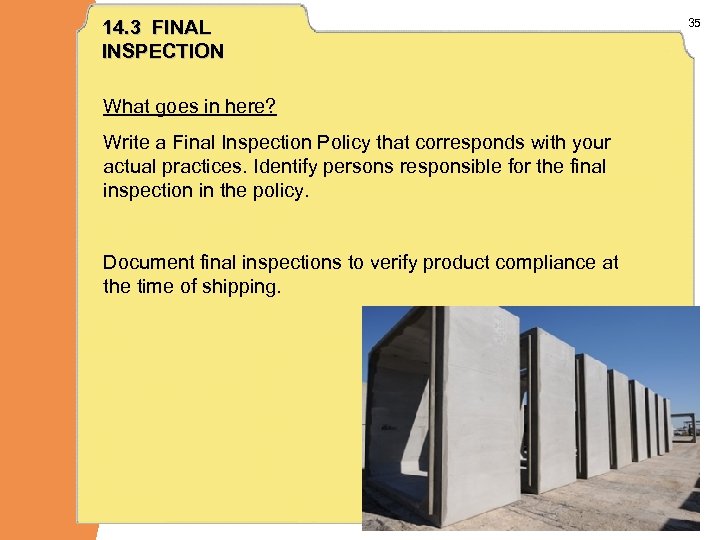 14. 3 FINAL INSPECTION What goes in here? Write a Final Inspection Policy that corresponds with your actual practices. Identify persons responsible for the final inspection in the policy. Document final inspections to verify product compliance at the time of shipping. 35
 ACPA QCAST PRODUCT REQUIREMENTS Section II – Concrete Pipe Requirements Section III – Manhole Requirements Section IV – Engineered Precast Products Requirements Section V – Box Culvert and Three-sided Structures Requirements 36
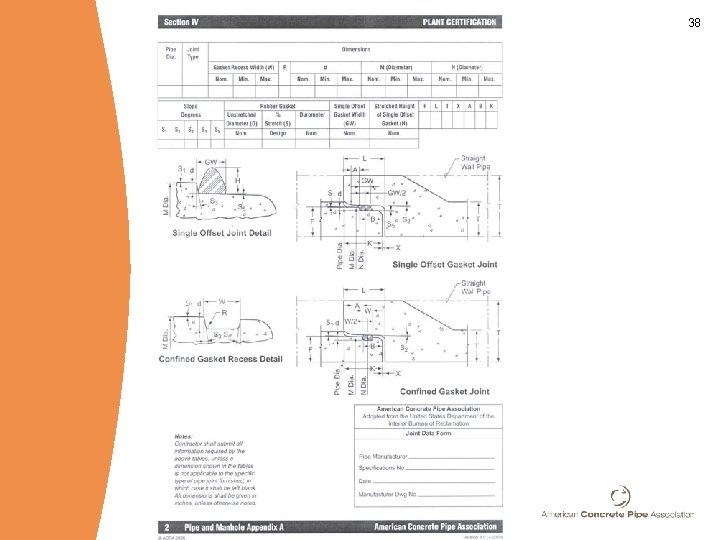
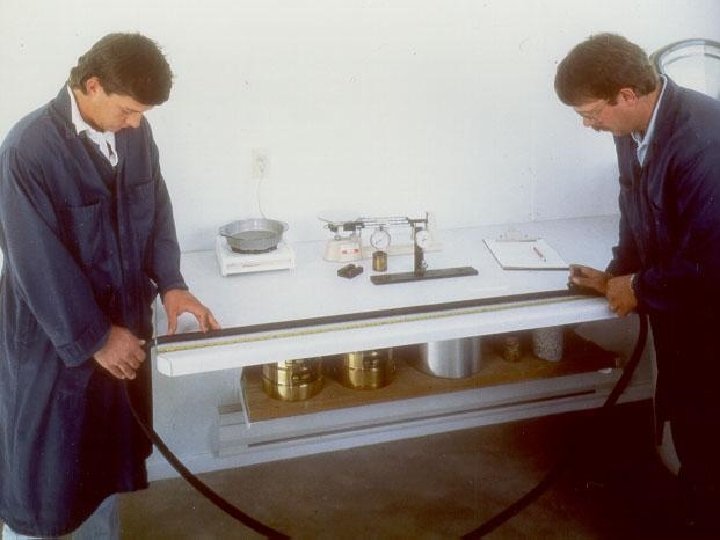
 5. 1, 5. 2, 5. 3 JOINT DESIGN DRAWINGS What goes in here? Detailed drawings of joints used for gasketed and non-gasketed pipe, manholes, precast and boxes. Include tolerances. (See sample form in Appendix) Sanitary Pipe – include design calculations and Go/No Go gaging system including gasket compression figures. Where do I get it? Check with both equipment and gasket suppliers. What do I do with it? Retain in file. Sanitary - Demonstrate proper use of Go/No Go gaging during audit. 37
 38
38
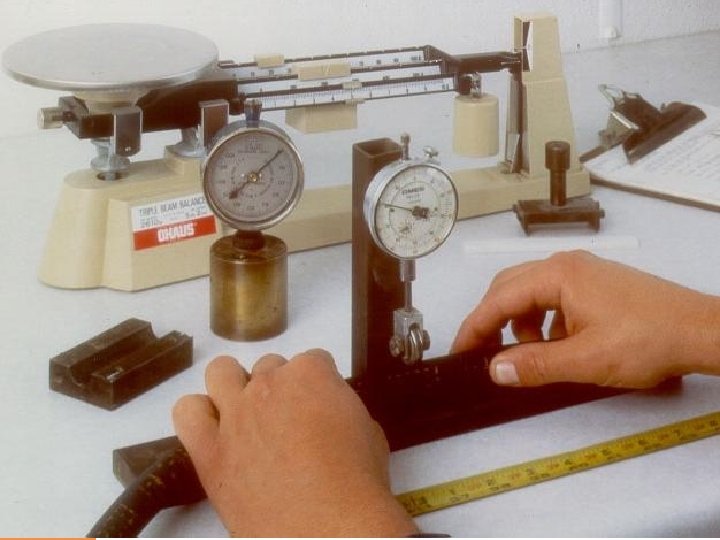
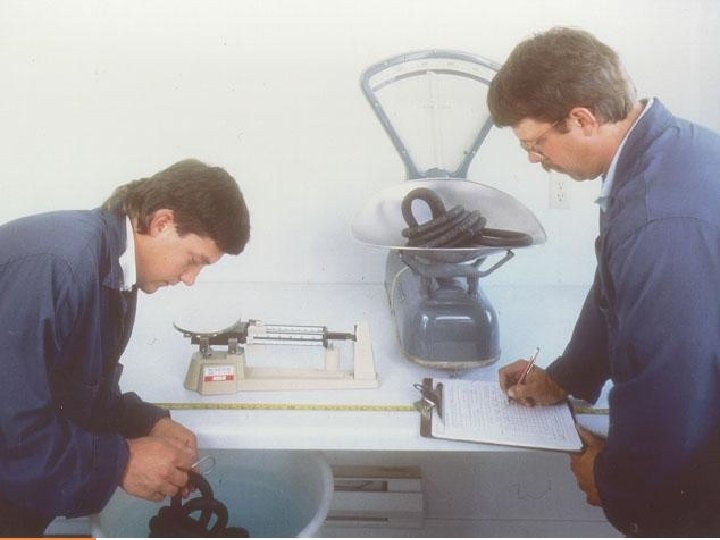
 39 5. 4 GASKET QUALITY What goes in here? Critical dimensions of gaskets (pipe, MH, box, others). Reports of gasket tests per frequency in QCAST manual - less 36” 1/300 - 36” and larger 1/100 Where do I get it? Check with equipment and gasket suppliers Test methods in QCast Manual. What do I do with it? Demonstrate gasket QC tests during audit and compare results with acceptable dimensions.
 40
40
 41
41
 42
42
 6. 0 EQUIPMENT & FORMS What goes in here? Inspection reports for all new and repaired equipment to check dimensions and function. Where do I get it? Reports can be done in-house or by equipment supplier. Plants should always verify critical measurements. 43
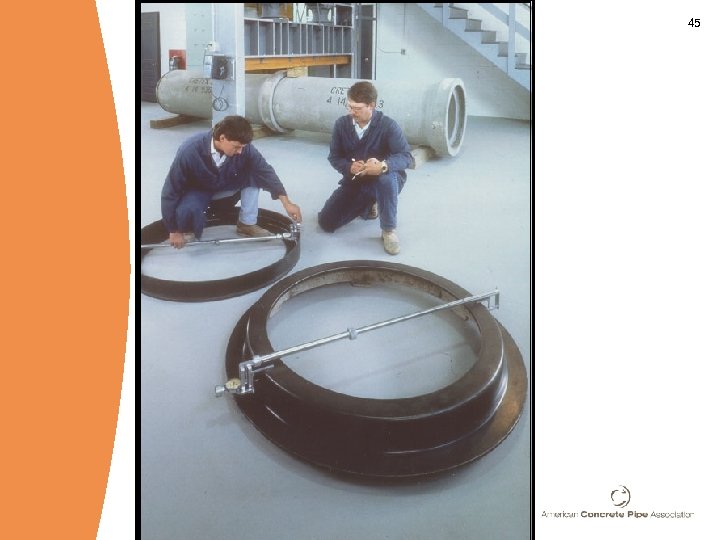
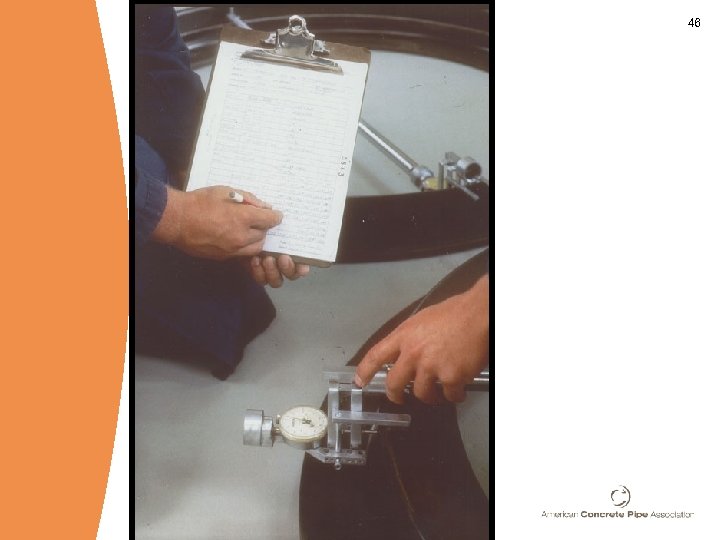
 6. 2 PIPE AND MANHOLE HEADER/PALLET/RING INSPECTION What goes in here? Incoming Inspection Reports for all Headers/Pallets/Truing Rings for gasketed pipe and manholes. Annual inspection of gasket sealing surfaces for sanitary products. Sample forms in Appendix A of the Certification Manual. What do I do with it? Verify compliance with established tolerance to insure joint integrity. File for future reference. NOTE: Good idea store your original, detailed Incoming Inspection Reports separately from annual QC data but with easy access. Sanitary Audit: demonstrate procedures for measuring joint formers. 44
 45
45
 46
46
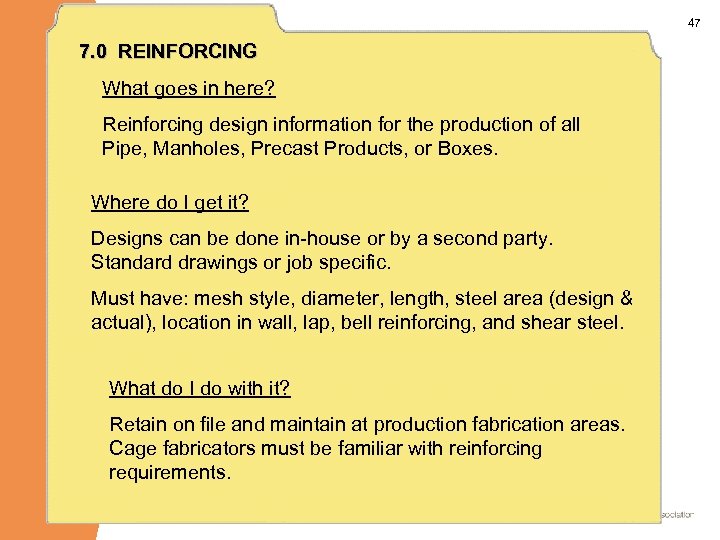 47 7. 0 REINFORCING What goes in here? Reinforcing design information for the production of all Pipe, Manholes, Precast Products, or Boxes. Where do I get it? Designs can be done in-house or by a second party. Standard drawings or job specific. Must have: mesh style, diameter, length, steel area (design & actual), location in wall, lap, bell reinforcing, and shear steel. What do I do with it? Retain on file and maintain at production fabrication areas. Cage fabricators must be familiar with reinforcing requirements.
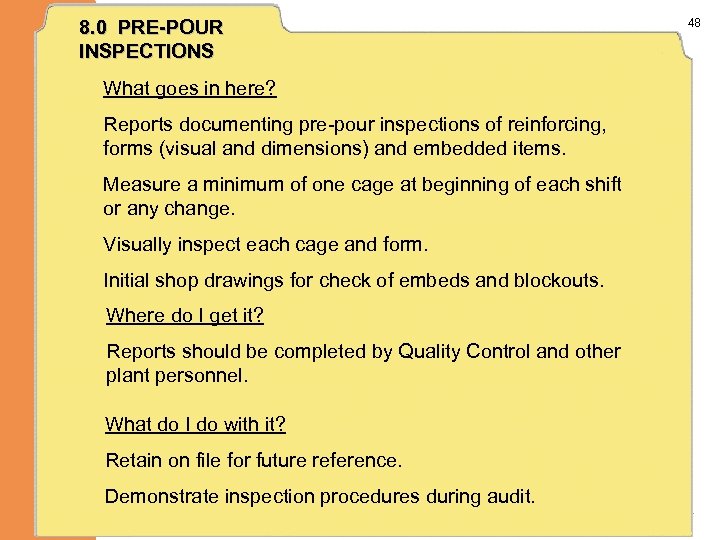 8. 0 PRE-POUR INSPECTIONS What goes in here? Reports documenting pre-pour inspections of reinforcing, forms (visual and dimensions) and embedded items. Measure a minimum of one cage at beginning of each shift or any change. Visually inspect each cage and form. Initial shop drawings for check of embeds and blockouts. Where do I get it? Reports should be completed by Quality Control and other plant personnel. What do I do with it? Retain on file for future reference. Demonstrate inspection procedures during audit. 48
 11. 0 POST-POUR INSPECTION What goes in here? Check a portion of each day’s production before and after finishing/patching. Maintain a written repair procedure and list acceptable repair materials. Perform visual and dimensional checks on both barrel and joints. Document 1 piece/size/shift. Sanitary: Go/No Go gaging. Where do I get it? Sample forms can be found in the QCAST Appendix. Demonstrate during audit. 49
 13. 0 PRODUCT TESTING (PIPE AND MANHOLES) What goes in here? Proof of design and ongoing tests of pipe and manhole showing that products are meeting standards for Water Tightness, Three. Edge Bearing, and Joint Tests. Monitor testing frequency with production. Manhole Step Tests – every 3 years. Where do I get it? Most tests are ASTM Standards. What do I do with it? Use them to make sure your products are meeting all applicable standards. Retain on file for future reference. Demonstrate tests during audit. 50
 13. 2 3 -EDGE BEARING TEST What goes in here? Test results at the frequency described in Section 13. 2 of the Certification Manual to minimum of 0. 01 inch crack. Annually, test a minimum of one pipe per size and class (60” or smaller) to Ultimate Load. Where do I get it? ASTM C 497 and QCAST manual. What do I do with it? Retain on file for future reference. NOTE: Production records should be used to verify test frequencies. Pipe tested only to the formation of the 0. 01 in. crack meeting test requirements should be accepted for use. 51
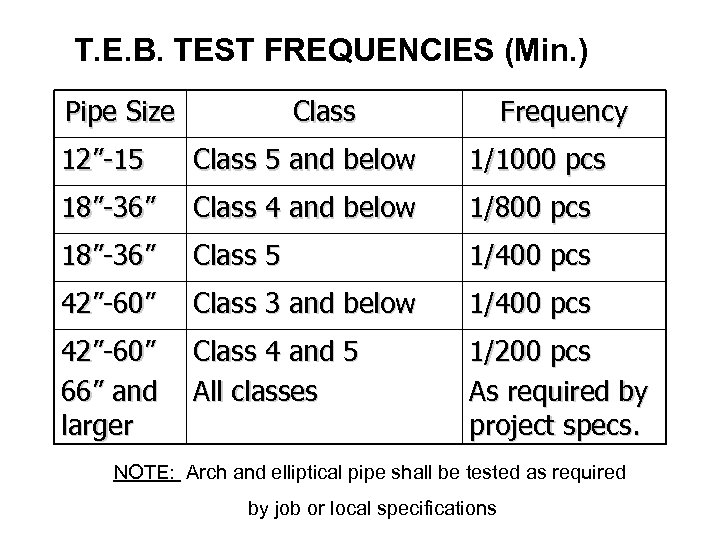 T. E. B. TEST FREQUENCIES (Min. ) Pipe Size Class Frequency 12”-15 Class 5 and below 1/1000 pcs 18”-36” Class 4 and below 1/800 pcs 18”-36” Class 5 1/400 pcs 42”-60” Class 3 and below 1/400 pcs 42”-60” 66” and larger Class 4 and 5 All classes 1/200 pcs As required by project specs. NOTE: Arch and elliptical pipe shall be tested as required by job or local specifications
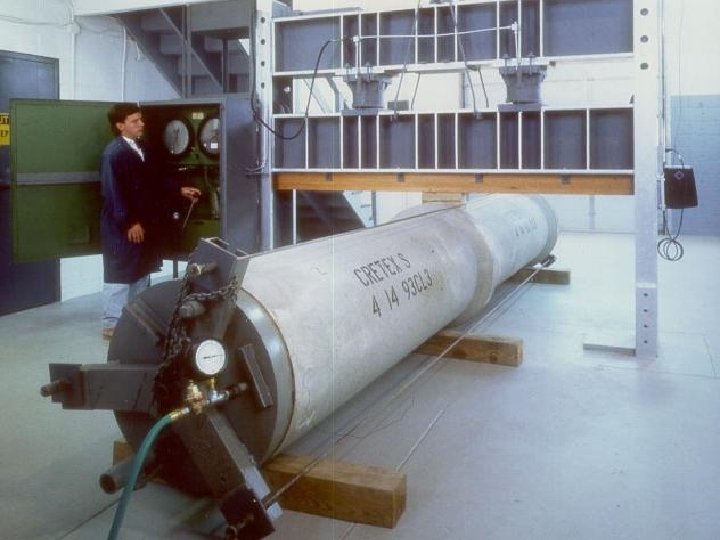
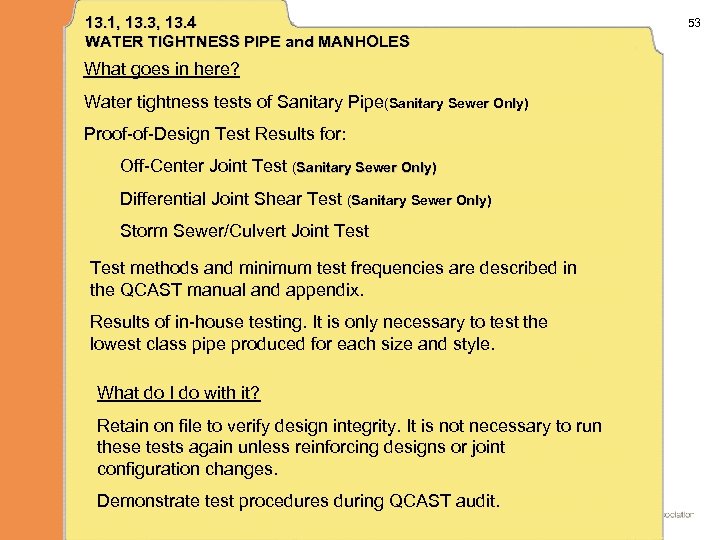 13. 1, 13. 3, 13. 4 WATER TIGHTNESS PIPE and MANHOLES What goes in here? Water tightness tests of Sanitary Pipe(Sanitary Sewer Only) Proof-of-Design Test Results for: Off-Center Joint Test (Sanitary Sewer Only) Differential Joint Shear Test (Sanitary Sewer Only) Storm Sewer/Culvert Joint Test methods and minimum test frequencies are described in the QCAST manual and appendix. Results of in-house testing. It is only necessary to test the lowest class pipe produced for each size and style. What do I do with it? Retain on file to verify design integrity. It is not necessary to run these tests again unless reinforcing designs or joint configuration changes. Demonstrate test procedures during QCAST audit. 53
 54
54
 ACPA QCAST MANUAL Appendix A: Procedures and Sample forms Appendix B: Audit Expectations.
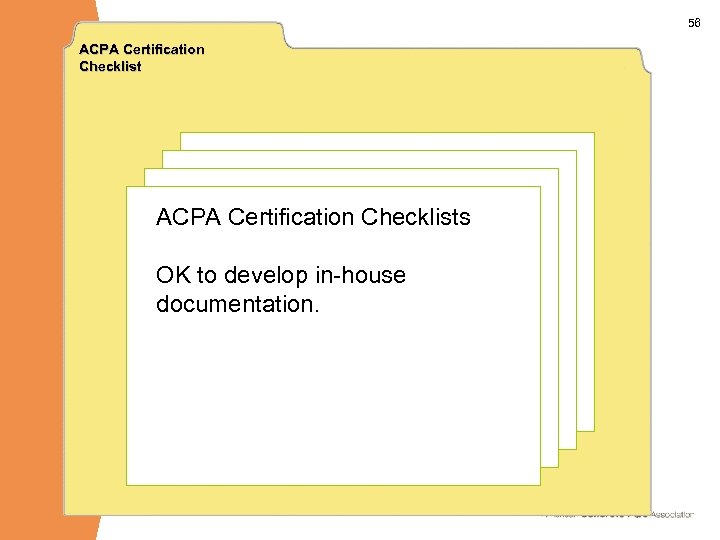 56 ACPA Certification Checklist Documentation Checklist ACPA Certification (On going) Testing and Inspection ACPA Certification Checklists Misc. Materials (On going) Review monthly / required OK to develop in-house frequently documentation.
 What happens on Audit Day?
 59 The Audit “A periodic onsite-verification by a certification authority to ascertain whether or not a documented quality system is being effectively implemented. ” The auditor will check your documentation files for completeness and content.
 60 • • • • Quality documentation files Materials documents/specifications Calibration documents Copies of all mix designs Joints Equipment Reinforcing Pre-pour and Post-pour inspections Concrete and product testing documentation Written curing procedures Handling and storage maximum stack heights Written shipping policy Final inspection procedure www. concrete-pipe. org
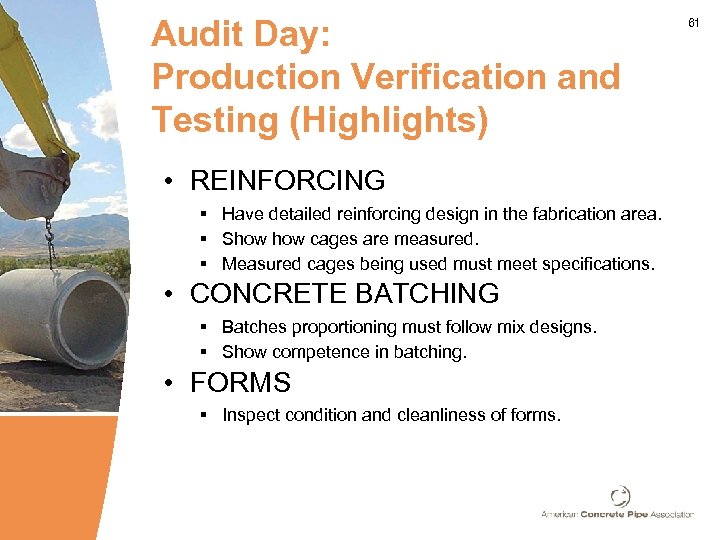 Audit Day: Production Verification and Testing (Highlights) • REINFORCING § Have detailed reinforcing design in the fabrication area. § Show cages are measured. § Measured cages being used must meet specifications. • CONCRETE BATCHING § Batches proportioning must follow mix designs. § Show competence in batching. • FORMS § Inspect condition and cleanliness of forms. 61
 Production Verification and Testing (Highlights) 64 Plant personnel shall show competency when performing the following tests: • Compressive strength: cylinder preparation, handling, curing and testing. • Slump, Flow, Temp, Air content testing. • Concrete absorption testing. (If done in house) • Aggregate gradation testing. (If done in house)
 Production Verification and Testing (Highlights) 65 Plant personnel shall show competency when performing the following inspections: • Gasket Testing (If done in house) • Sanitary (if done in-house): § Pallet Inspection § Header Inspection § Truing Ring Inspection
 Production Verification and Testing (Highlights) CURING Plant personnel shall demonstrate curing methods and retrieve results. 66
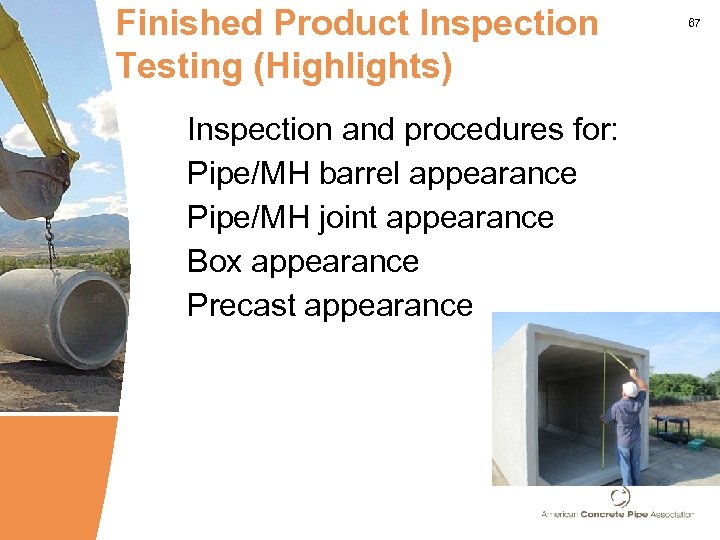 Finished Product Inspection Testing (Highlights) Inspection and procedures for: Pipe/MH barrel appearance Pipe/MH joint appearance Box appearance Precast appearance 67
 Finished Product Inspection & Testing (Highlights) 68 The auditor shall witness the following inspections and tests for procedure, equipment and results. • • Barrel/Box dimensions Pipe/MH/Box joint inspection Water tightness tests (sanitary) Three-edge bearing tests Off center hydrostatic joint test (sanitary) Differential joint shear test (sanitary) Storm sewer and culvert joint test Compressive strength test
 Audit Day Finally, the auditor shall verify plant procedures for: • • • Product marking Handling and storage Repairs Segregating of reject pieces Final inspection 69
 70 Manholes • ASTM C 478 • Pre-pour each piece (wet-cast) • Sanitary manholes § § § Joint design calcs/drawings Gasket tests Joint forming equipment Dimensional checks of spigots Water-tightness Vacuum/Hydro • ASTM C 1244 www. concrete-pipe. org
 71 Precast • • • Standard and non-standard products ASTM or local specs control Reinforcing drawings and tolerances Pre-pour min. one cage/shift/type Post-pour critical dimensions/blockouts www. concrete-pipe. org
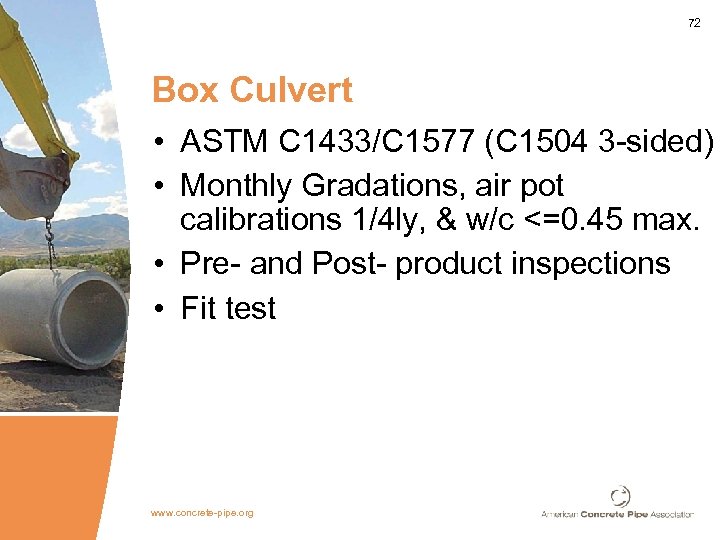 72 Box Culvert • ASTM C 1433/C 1577 (C 1504 3 -sided) • Monthly Gradations, air pot calibrations 1/4 ly, & w/c <=0. 45 max. • Pre- and Post- product inspections • Fit test www. concrete-pipe. org
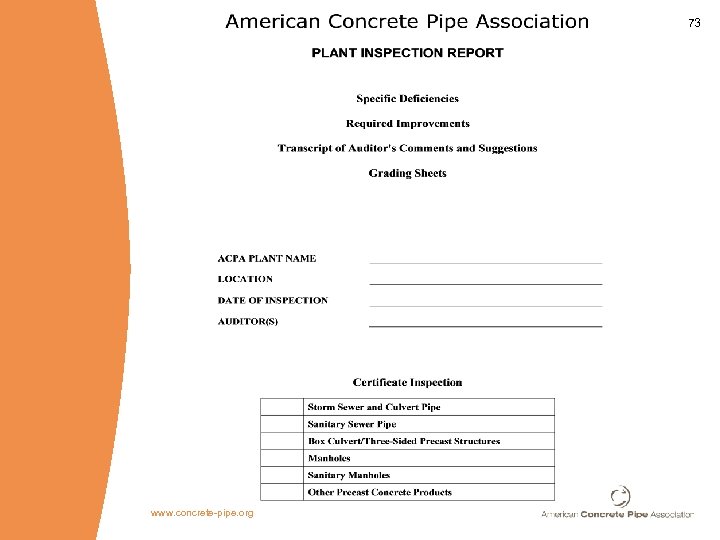 73 www. concrete-pipe. org
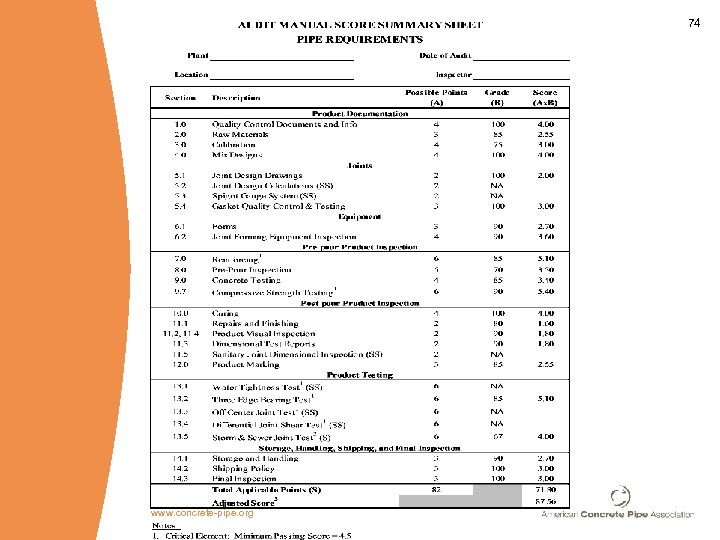 74 www. concrete-pipe. org
 75 ACPA QCast Certification 1. Break the Program down into smaller parts. 2. Document well. 3. Ask for help if you need it. 4. Show the auditor what you know.
 QUESTIONS? www. concrete-pipe. org