 Скачать презентацию ACM CCS Conference Tutorial Nov 2009 Cyber Security
41612e4b9dd28225e19bfb6808eb205a.ppt
- Количество слайдов: 74



ACM CCS Conference Tutorial Nov. 2009 Cyber Security for the Power Grid: Cyber Security Issues & Securing Control Systems Andrew Wright Cyber Security Solutions For <Client Name> CTO, N-Dimension andrew. wright@n-dimension. com
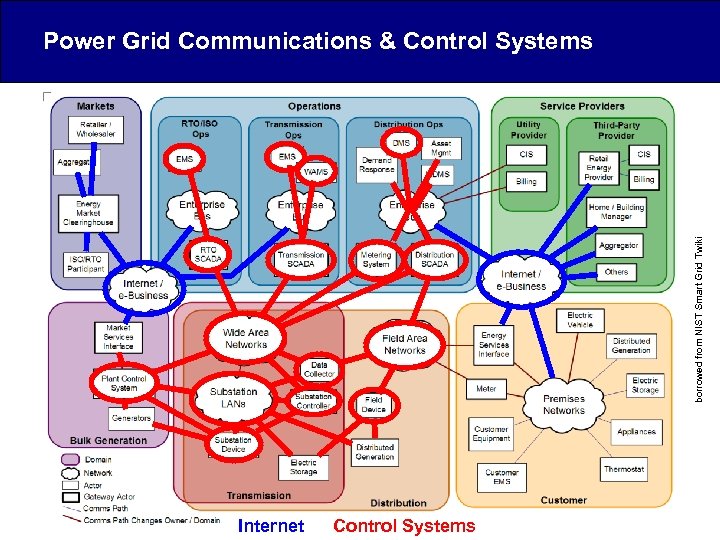
borrowed from NIST Smart Grid Twiki Power Grid Communications & Control Systems Internet Control Systems
Agenda • High-Level – Industrial Control Systems and Cyber Security Issues – Securing Control Systems • Detailed – Security Issues in Industrial Control Systems – Today’s Threats – Securing Control Systems
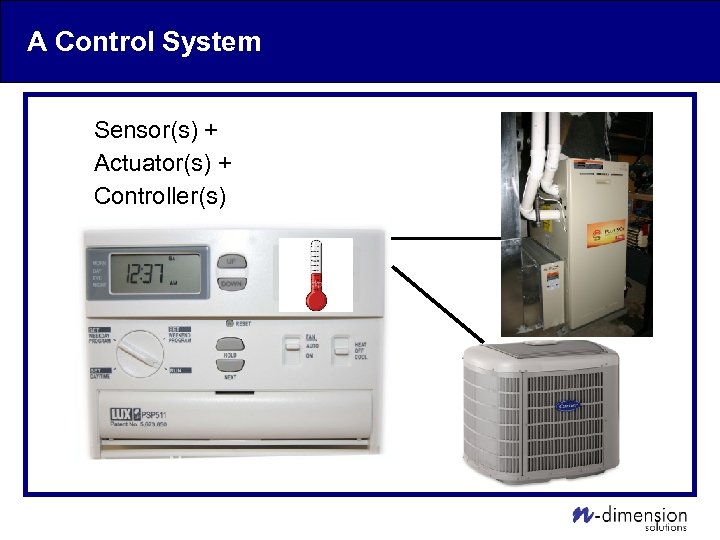
A Control System Sensor(s) + Actuator(s) + Controller(s)
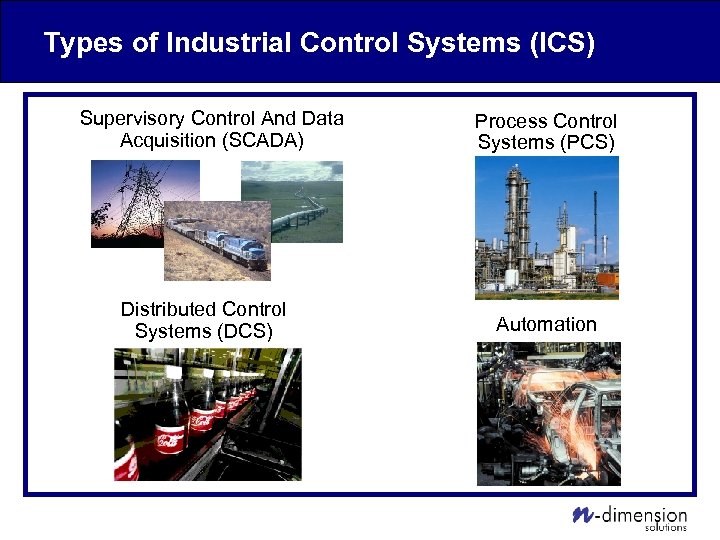
Types of Industrial Control Systems (ICS) Supervisory Control And Data Acquisition (SCADA) Distributed Control Systems (DCS) Process Control Systems (PCS) Automation
Historical ICS • • Proprietary Complete vertical solutions Customized Specialized communications – Wired, fiber, microwave, dialup, serial, etc. – 100 s of different protocols – Slow; e. g. 1200 baud • Long service lifetimes: 15– 20 years • Not designed with security in mind
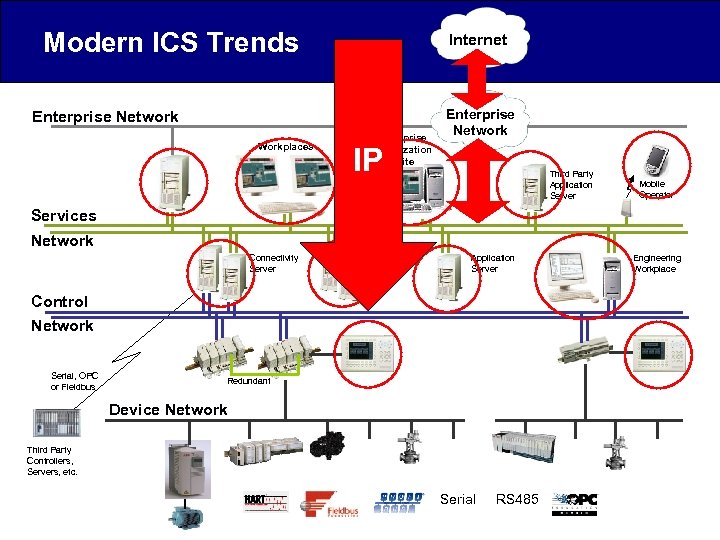
Modern ICS Trends Internet Enterprise Network Workplaces Firewall Enterprise Optimization Suite Enterprise Network IP Third Party Application Server Mobile Operator Services Network Connectivity Server Historian Server Application Server Control Network Serial, OPC or Fieldbus Redundant Device Network Third Party Controllers, Servers, etc. Serial RS 485 Engineering Workplace
Technology Trends in ICS • COTS (Commercial-Off-The-Shelf) technologies – – Operating systems—Windows, Win. CE, embedded RTOSes Applications—Databases, web servers, web browsers, etc. IT protocols—HTTP, SMTP, FTP, DCOM, XML, SNMP, etc. Networking equipment—switches, routers, firewalls, etc. • Connectivity of ICS to enterprise LAN – Improved business visibility, business process efficiency – Remote access to control center and field devices • IP Networking – – Common in higher level networks, gaining in lower levels Many legacy protocols wrapped in TCP or UDP Most new industrial devices have Ethernet ports Most new ICS architectures are IP-based
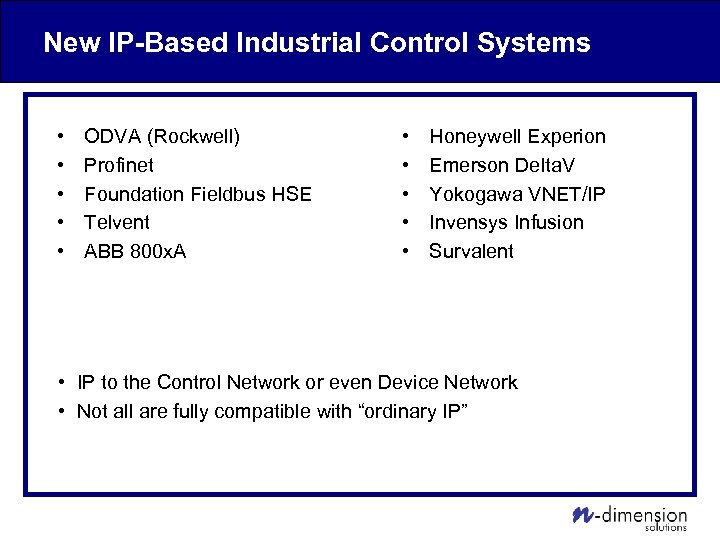
New IP-Based Industrial Control Systems • • • ODVA (Rockwell) Profinet Foundation Fieldbus HSE Telvent ABB 800 x. A • • • Honeywell Experion Emerson Delta. V Yokogawa VNET/IP Invensys Infusion Survalent • IP to the Control Network or even Device Network • Not all are fully compatible with “ordinary IP”
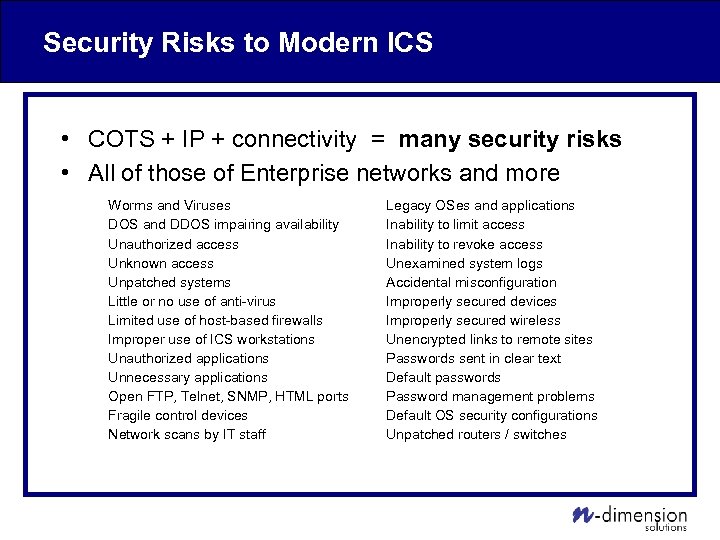
Security Risks to Modern ICS • COTS + IP + connectivity = many security risks • All of those of Enterprise networks and more Worms and Viruses DOS and DDOS impairing availability Unauthorized access Unknown access Unpatched systems Little or no use of anti-virus Limited use of host-based firewalls Improper use of ICS workstations Unauthorized applications Unnecessary applications Open FTP, Telnet, SNMP, HTML ports Fragile control devices Network scans by IT staff Legacy OSes and applications Inability to limit access Inability to revoke access Unexamined system logs Accidental misconfiguration Improperly secured devices Improperly secured wireless Unencrypted links to remote sites Passwords sent in clear text Default passwords Password management problems Default OS security configurations Unpatched routers / switches
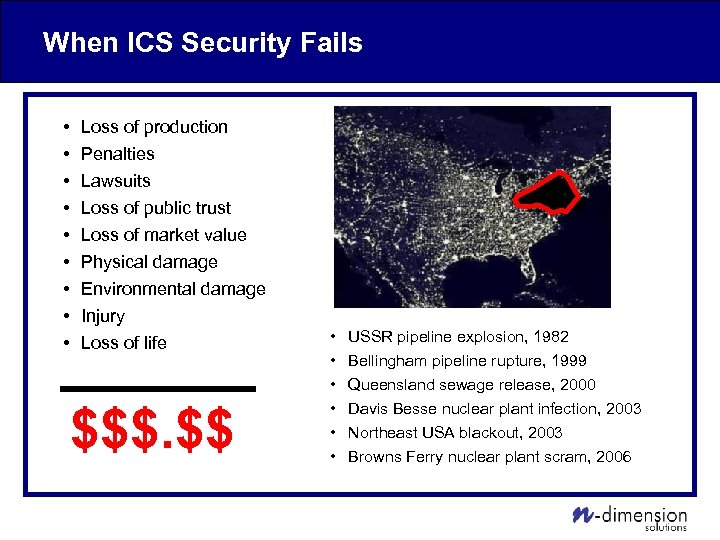
When ICS Security Fails • • • Loss of production Penalties Lawsuits Loss of public trust Loss of market value Physical damage Environmental damage Injury Loss of life $$$. $$ • • • USSR pipeline explosion, 1982 Bellingham pipeline rupture, 1999 Queensland sewage release, 2000 Davis Besse nuclear plant infection, 2003 Northeast USA blackout, 2003 Browns Ferry nuclear plant scram, 2006
So How Do We Secure Industrial Control Systems? ACM CCS Tutorial Nov. 2009
There is No Silver Bullet!
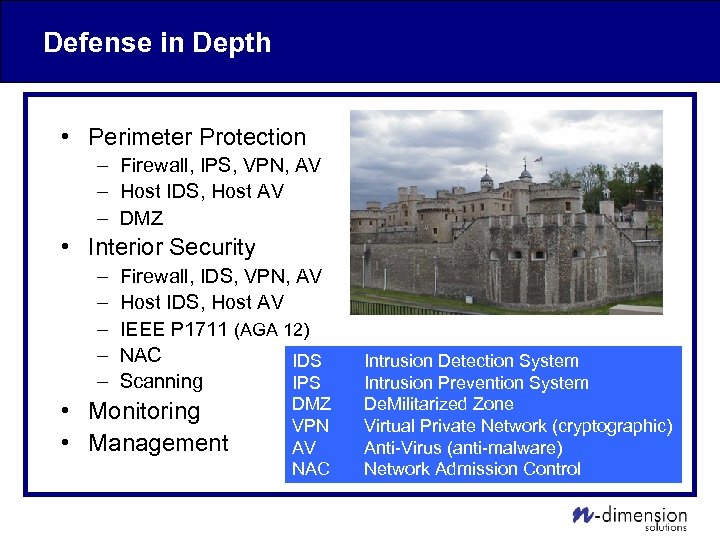
Defense in Depth • Perimeter Protection – Firewall, IPS, VPN, AV – Host IDS, Host AV – DMZ • Interior Security – – – Firewall, IDS, VPN, AV Host IDS, Host AV IEEE P 1711 (AGA 12) NAC IDS Scanning IPS • Monitoring • Management DMZ VPN AV NAC Intrusion Detection System Intrusion Prevention System De. Militarized Zone Virtual Private Network (cryptographic) Anti-Virus (anti-malware) Network Admission Control
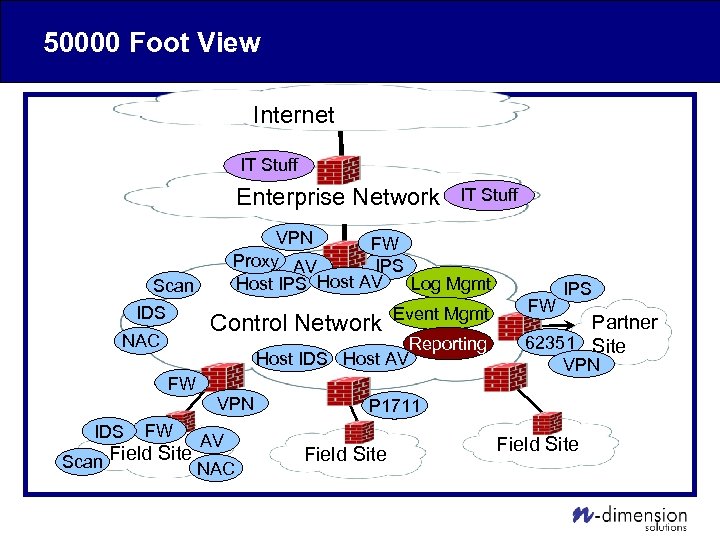
50000 Foot View Internet IT Stuff Enterprise Network VPN FW Proxy AV IPS Host AV Log Mgmt Host IPS Scan IDS Control Network NAC IDS Event Mgmt Host IDS Host AV FW FW IT Stuff VPN AV Scan Field Site NAC Reporting FW IPS Partner 62351 Site VPN P 1711 Field Site
Security Issues in Industrial Control Systems ACM CCS Tutorial Nov. 2009
Availability, Integrity and Confidentiality • Enterprise networks require C-I-A – Confidentiality of intellectual property matters most • ICS requires A-I-C – Availability and integrity of control matters most – control data has low entropy—little need for confidentiality – Many ICS vendors provide six 9’s of availability • Ensuring availability is hard – Cryptography does not help (directly) – DOS protection, rate limiting, resource management, Qo. S, redundancy, robust hardware with high MTBF • Security must not reduce availability!
Do. S and DDo. S Attacks • Denial of Service (Do. S) attack overwhelms a system with too many packets/requests – Exhausts TCP stack or application resources – Defenses include connection limits in firewall • Distributed Denial of Service (DDo. S) attack coordinates a botnet to overwhelm a target system – No single point of attack – Requires sophisticated, coordinated defenses – Weapon of choice for hackers, hacktivists, cyber-extortionists • Do. S, DDo. S particularly effective when Availability is critical, i. e. against ICS
Fragile ICS Devices • Many IP stack implementations are fragile – Some devices lockup on ping sweep or NMAP scan – Numerous incidents of ICS shut down by uninformed IT staff running a well-intentioned vulnerability scan • Modern ICS devices are much more complex – Some IEDs include web server for configuration and status – More lines of code leads to more bugs – Modern IEDs require patching just like servers
Unpatched Systems • Many ICS systems are not patched current – Particularly Windows servers – No patches available for older versions of windows • OS and application patches can break ICS – OS patches are tested for enterprise apps • Uncertified patches can invalidate warranty • Patching often requires system reboot • Before installation of a patch: – – Vendor certification—typically one week Lab testing by operator Staged deployment on less critical systems first Avoid interrupting any critical process phases
Limited use of Host Anti-Virus • AV operations can cause significant system disruption at inopportune times – 3 am is no better than any other time for a full disk scan on a system that operates 24 x 7 x 365 • ICS vendors only beginning to support anti-virus – Anti-virus is only as good as the signature set – Signatures may require testing just like patches • AV may be losing ground in enterprise deployments – impact on hosts, endpoint security not getting better – virus writers have learned to test against dominant AV • application whitelisting can be a good alternative – enumerate goodness rather than badness
Poor Authentication and Authorization • Machine-to-machine comms involve no “user” • Many ICS have poor authentication mechanisms and very limited authorization mechanisms • Many protocols use cleartext passwords • Many ICS devices lack crypto support • Sometimes passwords left at vendor default • Device passwords are hard to manage appropriately – Often one password is shared amongst all devices and all users and seldom if ever changed – This is happening AGAIN in Smart Meter deployments!
Poor Audit and Logging • Many ICS have poor or non-existent support for logging security-related actions – Attempted or successful intrusions may go unnoticed • Where IDS logs are kept, they are often not reviewed • Various regulatory requirements are driving some change in this area – NERC—North American Electric Reliability Corporation – FERC—Federal Energy Regulatory Commission – Sarbanes Oxley and PCAOB (Public Company Accounting Oversight Board) – FISMA—Federal Information Security Management Act
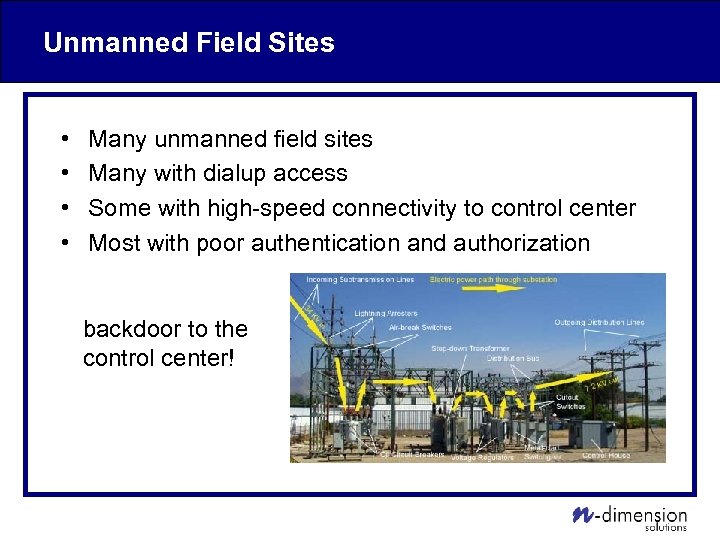
Unmanned Field Sites • • Many unmanned field sites Many with dialup access Some with high-speed connectivity to control center Most with poor authentication and authorization backdoor to the control center!
Legacy Equipment • Much legacy equipment • Usually impossible to update to add security features • Difficult to protect legacy communications – but see IEEE P 1711 for serial encryption • Password protection is weak • Little or no audit and logging
Unauthorized Applications • Unauthorized apps installed on ICS systems can interfere with ICS operation • Many types of unauthorized apps have been found during security audits – – – Instant messaging P 2 P file sharing DVD and MPEG video players Games, including Internet-based Web browsers
Inappropriate Use of ICS Desktops • Web browsing from HMI can infect ICS – – Browser vulnerabilities Downloads Cross-site scripting Spyware • Email to/from control servers can infect ICS – Sendmail and outlook vulnerabilities • Disk storage exhaustion can crash OS – Storage of music, videos
Little or No Cyber Security Monitoring • internal monitoring is essential to detect low profile compromises – – IDS port scanning vulnerability scanning system audit • without internal monitoring don’t know whether systems have been compromised
Requirement for 3 rd Party Access • Firmware updates and PLC, IED programming are sometimes done by vendor – Many ICS have open maintenance ports – Infected vendor laptops can bring down ICS • Partners may require continuous status information – Partner access is often poorly secured – Partner channels can serve as backdoors • 3 rd parties may include: – ISO, transmission provider or grid neighbor, equipment vendor, emissions monitoring service or agency, water level monitoring agency, vibration monitoring service, etc.
People Issues • ICS network often managed by “Control Systems Department”, distinct from “IT Department” running enterprise network – ICS personnel are not IT or networking experts – IT personnel are not ICS experts • Majority of control systems workforce is older and nearing retirement – Few young people entering this field – Few academic programs
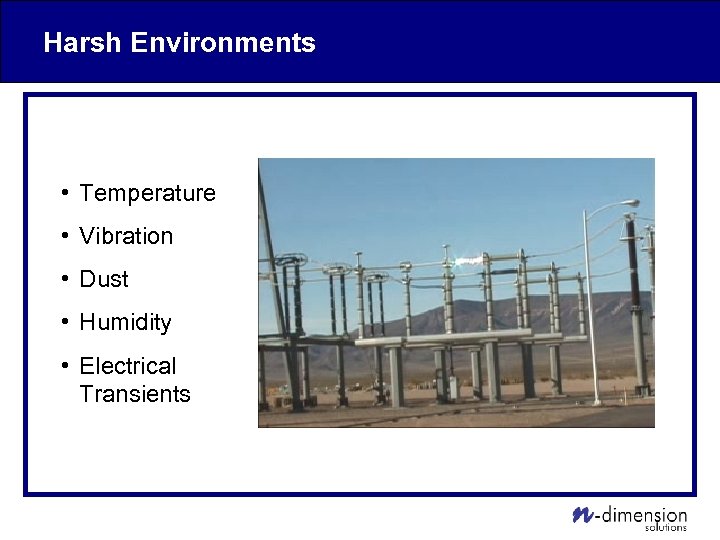
Harsh Environments • Temperature • Vibration • Dust • Humidity • Electrical Transients
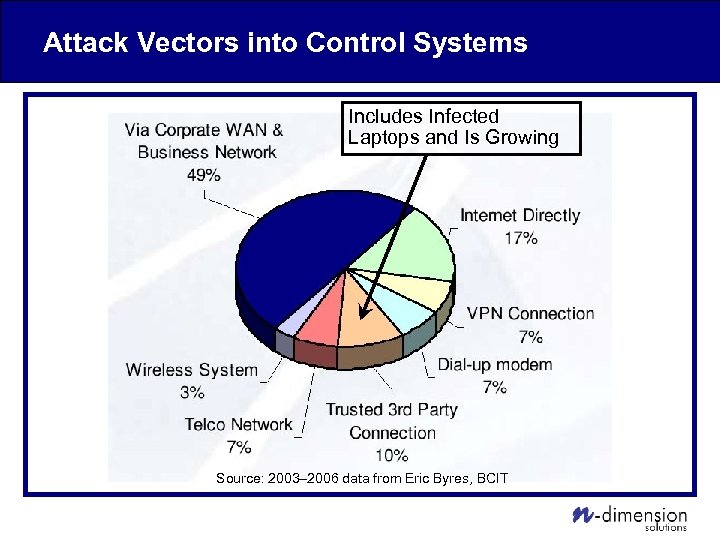
Attack Vectors into Control Systems Includes Infected Laptops and Is Growing Source: 2003– 2006 data from Eric Byres, BCIT
Security Assessments on ICS • Various groups perform security assessments and penetration tests on ICS (generally under NDA) – – Idaho National Labs Sandia National Labs N-Dimension Solutions Other private organizations • Vulnerability assessments always uncover problems • For penetration tests, we always get in – Not a question of “if”, but “how long”
Other Issues • • • Unusual physical topologies Many special purpose, limited function devices Static network configurations Multicast Long service lifetimes
For More Information. . . • See Smart Grid Cyber Security Strategy and Requirements, NISTIR 7628, www. nist. gov/smartgrid – particularly Appendices C and D
Today’s Threats ACM CCS Tutorial Nov. 2009
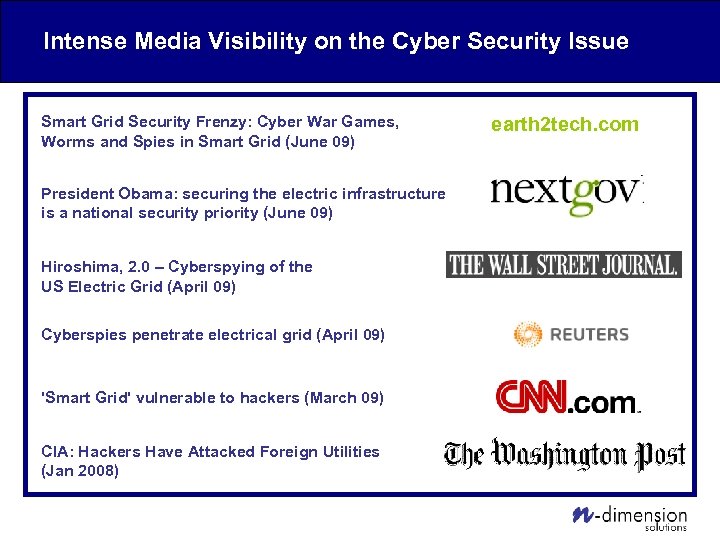
Intense Media Visibility on the Cyber Security Issue Smart Grid Security Frenzy: Cyber War Games, Worms and Spies in Smart Grid (June 09) President Obama: securing the electric infrastructure is a national security priority (June 09) Hiroshima, 2. 0 – Cyberspying of the US Electric Grid (April 09) Cyberspies penetrate electrical grid (April 09) 'Smart Grid' vulnerable to hackers (March 09) CIA: Hackers Have Attacked Foreign Utilities (Jan 2008) earth 2 tech. com
Limited Information About Incidents • Little information sharing about actual attacks – BCIT incident database has about 30 incidents per year vs. 100 s of thousands of incidents per year in CERT database – Few cyber attacks on ICS for which details are public • Little information sharing about actual vulnerabilities – some are not easily or rapidly fixed – assessments are done under NDA • Difficult to estimate risk – Difficult to demonstrate ROI for security spending • But… lots of data about significant financial losses in enterprise and e-commerce – Why would control systems be immune?
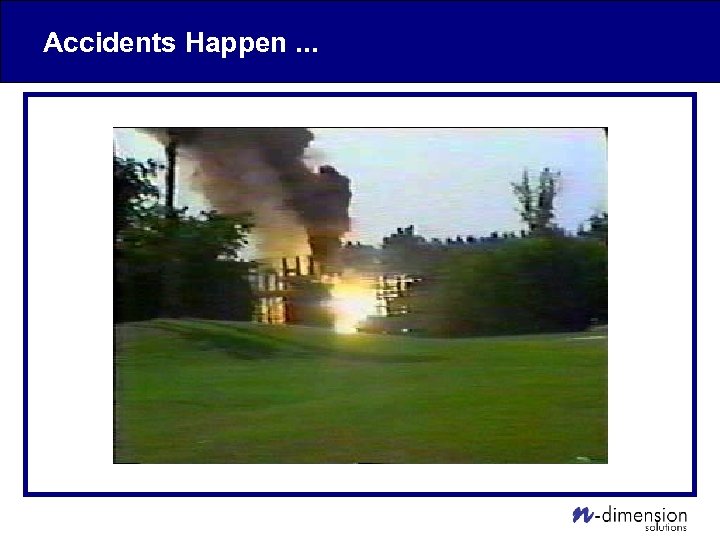
Accidents Happen. . .
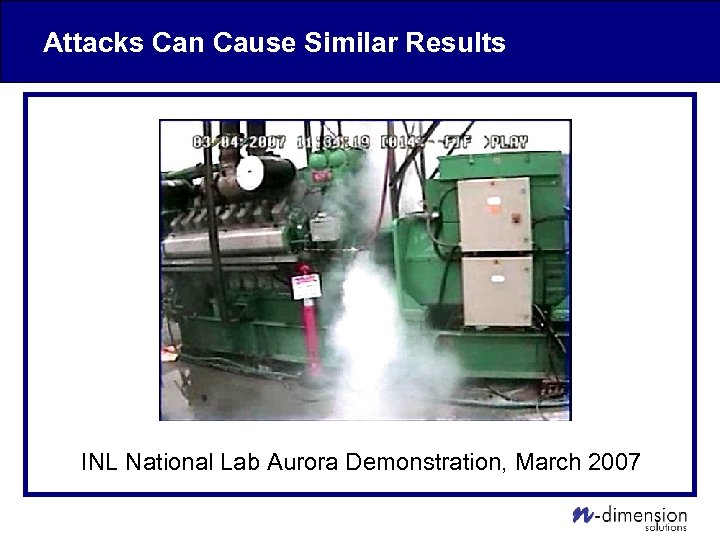
Attacks Can Cause Similar Results INL National Lab Aurora Demonstration, March 2007
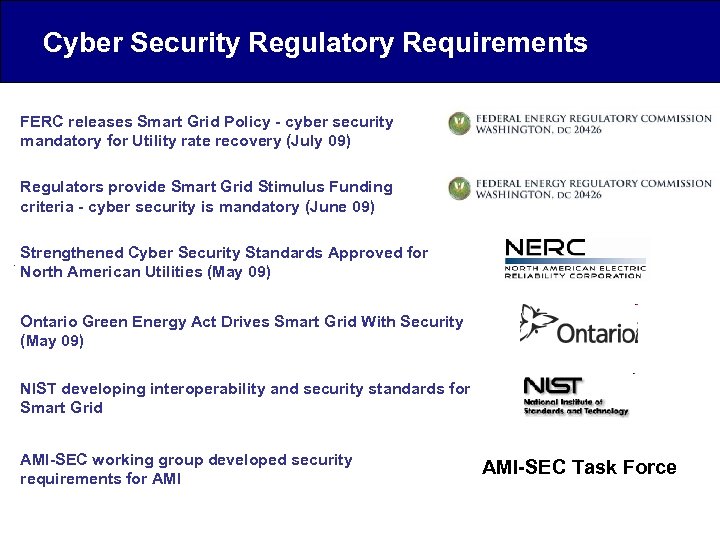
Cyber Security Regulatory Requirements FERC releases Smart Grid Policy - cyber security mandatory for Utility rate recovery (July 09) Regulators provide Smart Grid Stimulus Funding criteria - cyber security is mandatory (June 09) Strengthened Cyber Security Standards Approved for North American Utilities (May 09) Ontario Green Energy Act Drives Smart Grid With Security (May 09) NIST developing interoperability and security standards for Smart Grid AMI-SEC working group developed security requirements for AMI-SEC Task Force
Securing Control Systems ACM CCS Tutorial Nov. 2009
Adversaries • • • Script kiddies Hackers Organized crime Disgruntled insiders Competitors Terrorists Hactivists Eco-terrorists Nation states
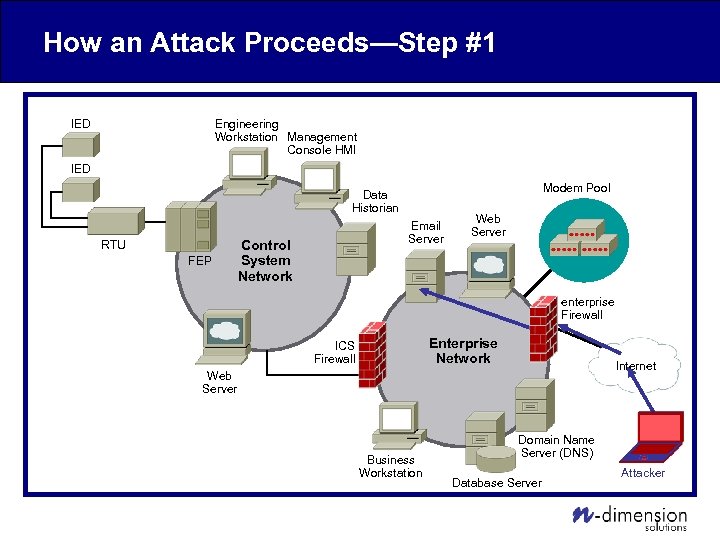
How an Attack Proceeds—Step #1 Engineering Workstation Management Console HMI IED Modem Pool Data Historian RTU FEP Email Server Control System Network Web Server enterprise Firewall Enterprise Network ICS Firewall Internet Web Server Business Workstation Domain Name Server (DNS) Database Server Attacker
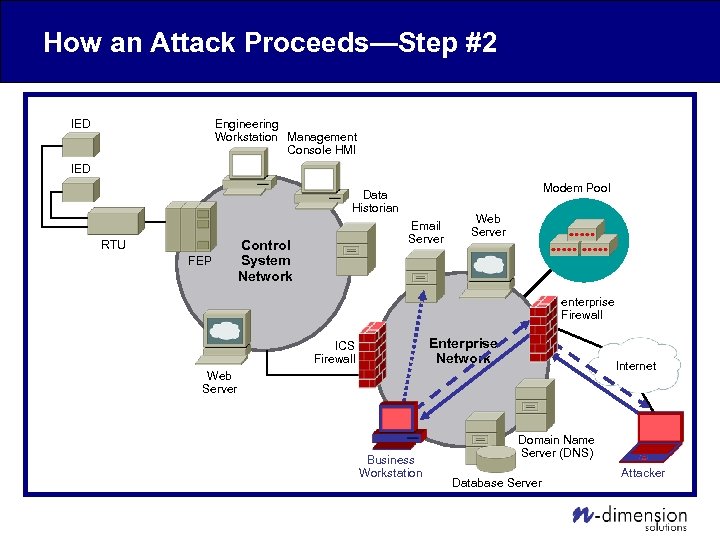
How an Attack Proceeds—Step #2 Engineering Workstation Management Console HMI IED Modem Pool Data Historian RTU FEP Email Server Control System Network Web Server enterprise Firewall Enterprise Network ICS Firewall Internet Web Server Business Workstation Domain Name Server (DNS) Database Server Attacker
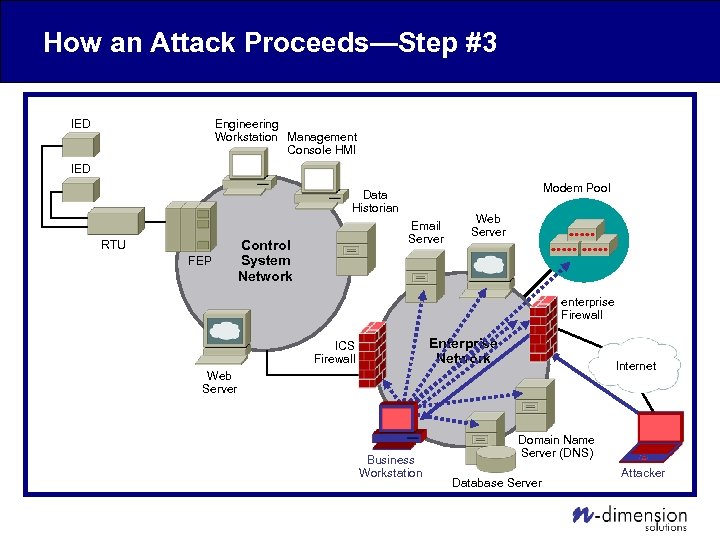
How an Attack Proceeds—Step #3 Engineering Workstation Management Console HMI IED Modem Pool Data Historian RTU FEP Email Server Control System Network Web Server enterprise Firewall Enterprise Network ICS Firewall Internet Web Server Business Workstation Domain Name Server (DNS) Database Server Attacker
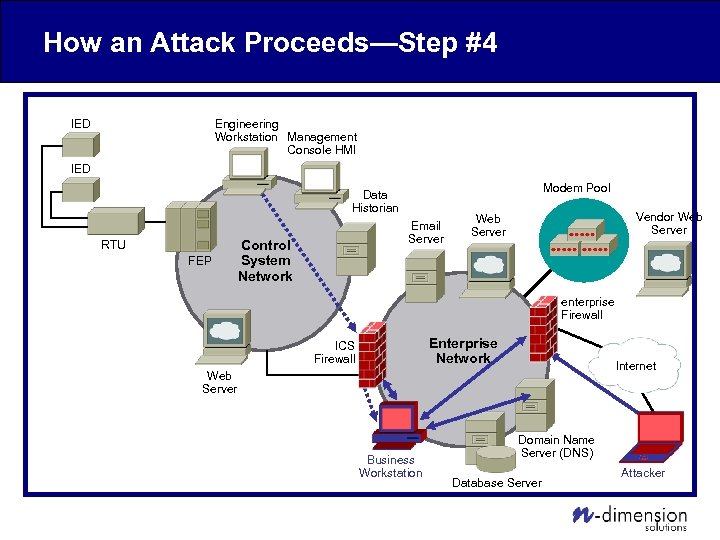
How an Attack Proceeds—Step #4 Engineering Workstation Management Console HMI IED Modem Pool Data Historian RTU FEP Email Server Control System Network Vendor Web Server enterprise Firewall Enterprise Network ICS Firewall Internet Web Server Business Workstation Domain Name Server (DNS) Database Server Attacker
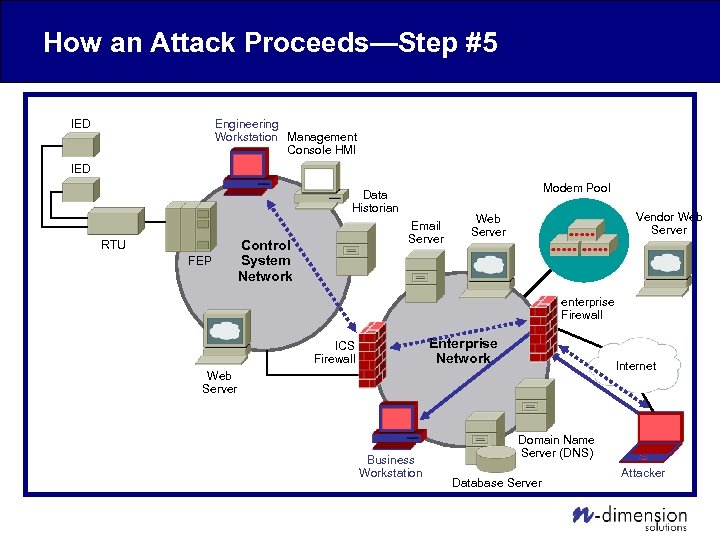
How an Attack Proceeds—Step #5 Engineering Workstation Management Console HMI IED Modem Pool Data Historian RTU FEP Email Server Control System Network Vendor Web Server enterprise Firewall Enterprise Network ICS Firewall Internet Web Server Business Workstation Domain Name Server (DNS) Database Server Attacker
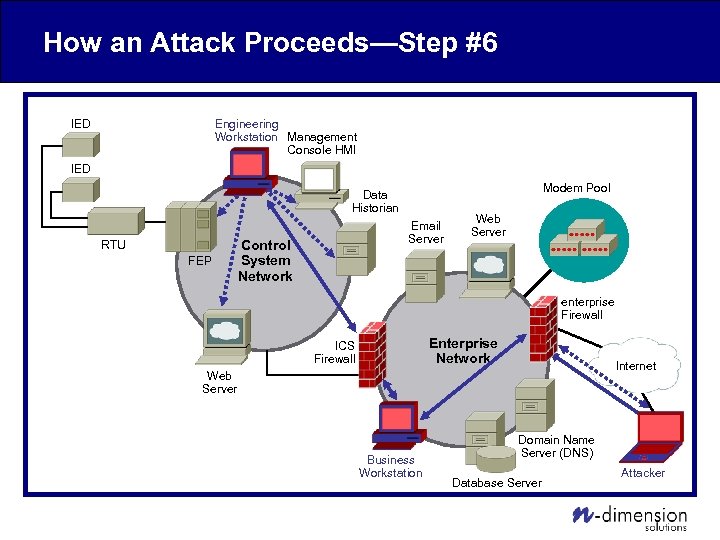
How an Attack Proceeds—Step #6 Engineering Workstation Management Console HMI IED Modem Pool Data Historian RTU FEP Email Server Control System Network Web Server enterprise Firewall Enterprise Network ICS Firewall Internet Web Server Business Workstation Domain Name Server (DNS) Database Server Attacker
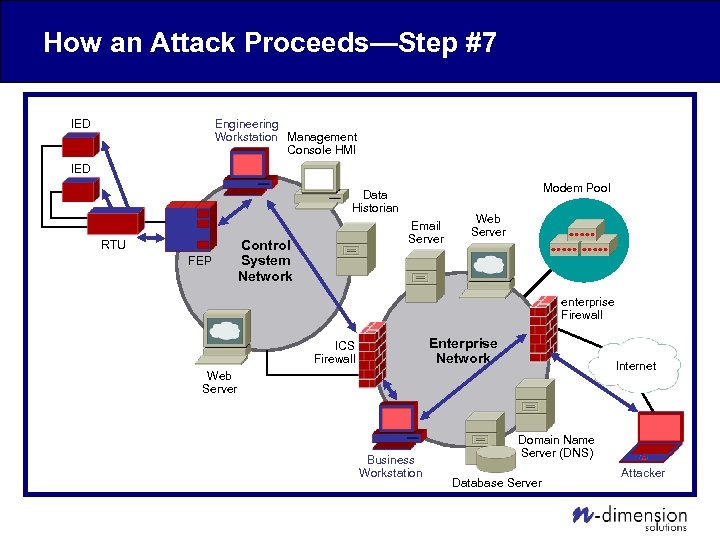
How an Attack Proceeds—Step #7 Engineering Workstation Management Console HMI IED Modem Pool Data Historian RTU FEP Email Server Control System Network Web Server enterprise Firewall Enterprise Network ICS Firewall Internet Web Server Business Workstation Domain Name Server (DNS) Database Server Attacker
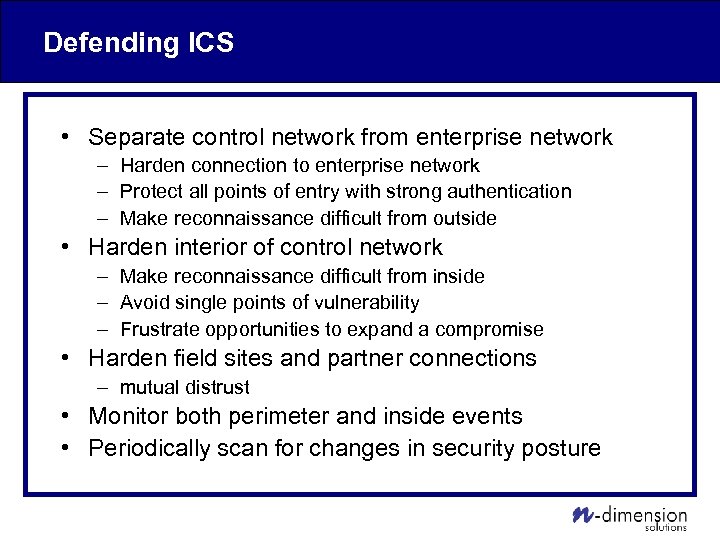
Defending ICS • Separate control network from enterprise network – Harden connection to enterprise network – Protect all points of entry with strong authentication – Make reconnaissance difficult from outside • Harden interior of control network – Make reconnaissance difficult from inside – Avoid single points of vulnerability – Frustrate opportunities to expand a compromise • Harden field sites and partner connections – mutual distrust • Monitor both perimeter and inside events • Periodically scan for changes in security posture
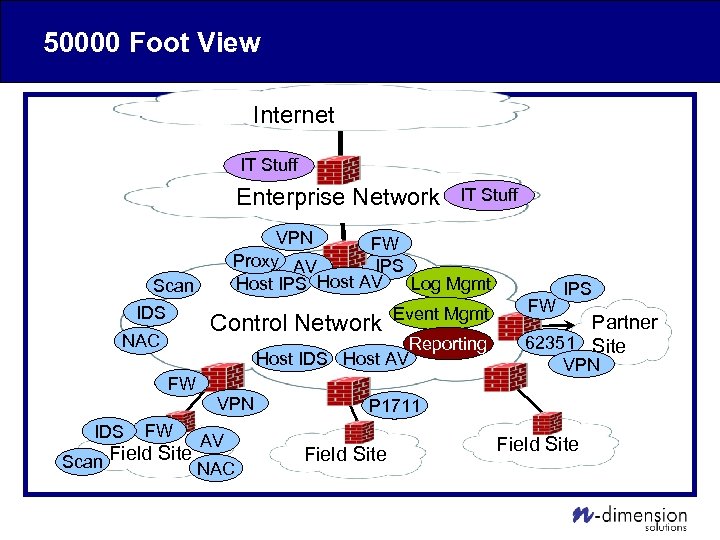
50000 Foot View Internet IT Stuff Enterprise Network VPN FW Proxy AV IPS Host AV Log Mgmt Host IPS Scan IDS Control Network NAC IDS Event Mgmt Host IDS Host AV FW FW IT Stuff VPN AV Scan Field Site NAC Reporting FW IPS Partner 62351 Site VPN P 1711 Field Site
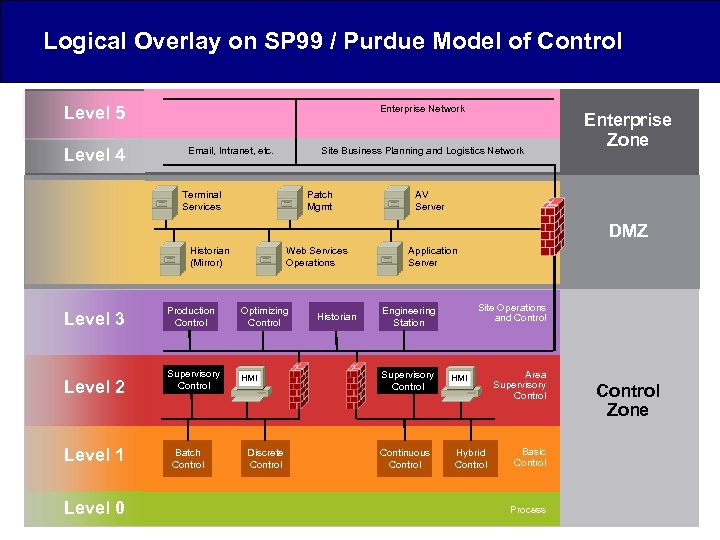
Logical Overlay on SP 99 / Purdue Model of Control Level 5 Level 4 Enterprise Network Email, Intranet, etc. Site Business Planning and Logistics Network Terminal Services Patch Mgmt Enterprise Zone AV Server DMZ Historian (Mirror) Level 3 Level 2 Level 1 Level 0 Web Services Operations Production Control Optimizing Control Supervisory Control HMI Batch Control Discrete Control Historian Application Server Site Operations and Control Engineering Station Supervisory Control Continuous Control HMI Hybrid Control Area Supervisory Control Basic Control Process Control Zone
Logical Architecture • Enterprise Zone contains typical business systems – Email, web, office apps, etc. • DMZ provides business connectivity – Contains only non-critical systems that need access to both Control and Enterprise Zones – Enforces separation between Enterprise and Control Zones – Consists of multiple functional sub-zones • Separated by Firewall, IPS, Anti-Virus, etc. • Control Zone demarcates critical control systems – Consists of multiple functional sub-zones • Internally protected by Firewall, IDS, Anti-Virus, etc.
How NOT to connect Control / Enterprise • • • Dual-homed server with Host IPS / AV Router with packet filter ACLs Two-port Firewall Router + Firewall combination • See NISCC Good Practice Guide on Firewall Deployment for SCADA and Process Control Networks, NISCC and BCIT, Feb 2005
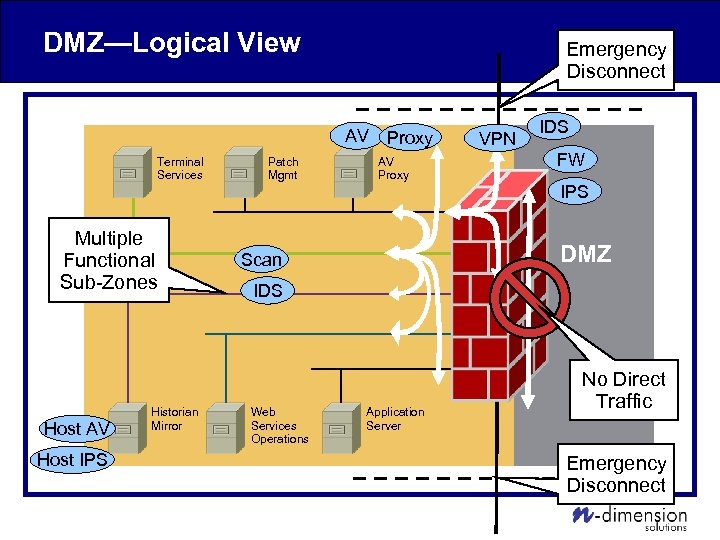
DMZ—Logical View Emergency Disconnect AV Terminal Services Multiple Functional Sub-Zones Host AV Host IPS Historian Mirror Patch Mgmt Proxy AV Proxy VPN IDS FW IPS DMZ Scan IDS Web Services Operations Application Server No Direct Traffic Emergency Disconnect
DMZ Design Principles • • • • DMZ contains non-critical systems Multiple functional security sub-zones Traffic between sub-zones undergoes firewall (& IPS or IDS) DMZ is only path in/out of Control Zone Default deny for all firewall interfaces No direct traffic across DMZ No control traffic to outside Limited outbound traffic from Control Zone Very limited inbound traffic to Control Zone No common ports between outside & inside Emergency disconnect at inside or outside No network management from outside Cryptographic VPN and Firewall to all 3 rd party connections
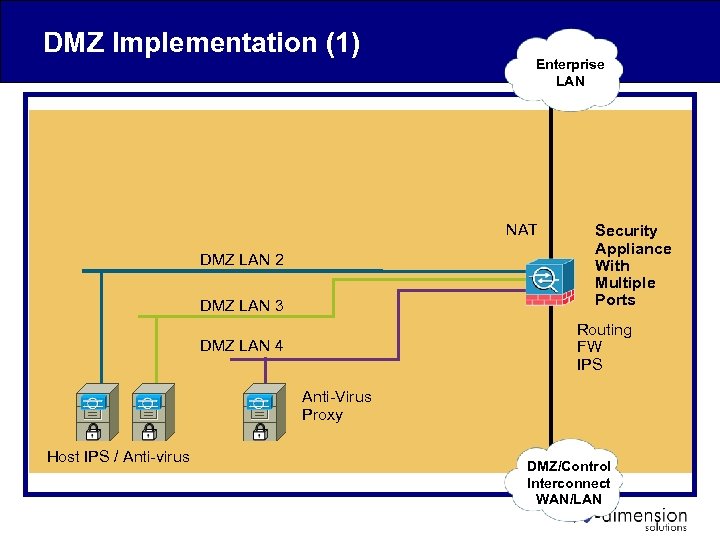
DMZ Implementation (1) Enterprise LAN NAT DMZ LAN 2 DMZ LAN 3 Security Appliance With Multiple Ports Routing FW IPS DMZ LAN 4 Anti-Virus Proxy Host IPS / Anti-virus DMZ/Control Interconnect WAN/LAN
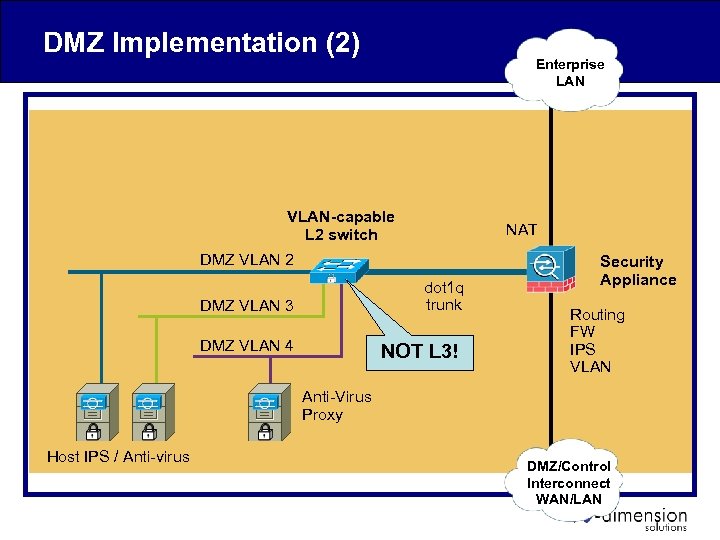
DMZ Implementation (2) Enterprise LAN VLAN-capable L 2 switch NAT DMZ VLAN 2 dot 1 q trunk DMZ VLAN 3 DMZ VLAN 4 NOT L 3! Security Appliance Routing FW IPS VLAN Anti-Virus Proxy Host IPS / Anti-virus DMZ/Control Interconnect WAN/LAN
DMZ Implementation • Sub-zones implemented by physical LANs or VLANs – Physical LANs require multi-port Security Appliance – VLANs require: • VLAN-capable Security Appliance and Switch • anti-VLAN hopping protections on switch and FW • NO L 3 (routing) on switch • FW implements policy between – DMZ LANs, Enterprise Zone, Control Zone • Anti-virus proxy controls outbound HTTP and/or FTP access to enterprise or Internet resources • Host IPS and/or Host Anti-virus protects DMZ servers
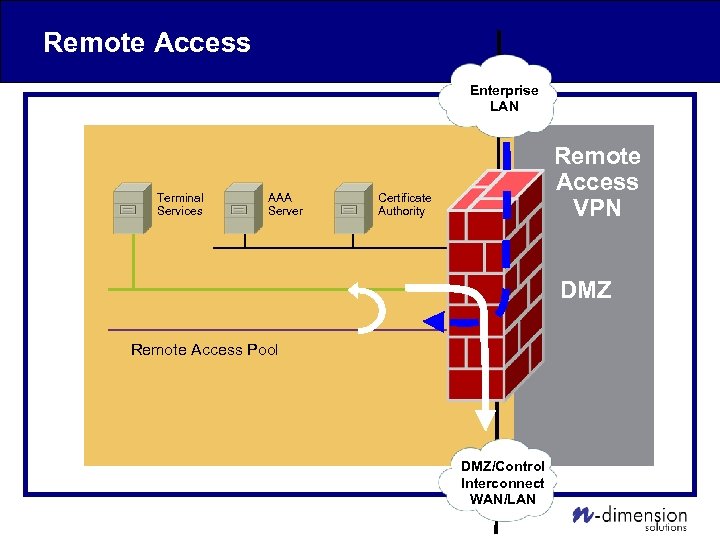
Remote Access Enterprise LAN Terminal Services AAA Server Remote Access VPN Certificate Authority DMZ Remote Access Pool DMZ/Control Interconnect WAN/LAN
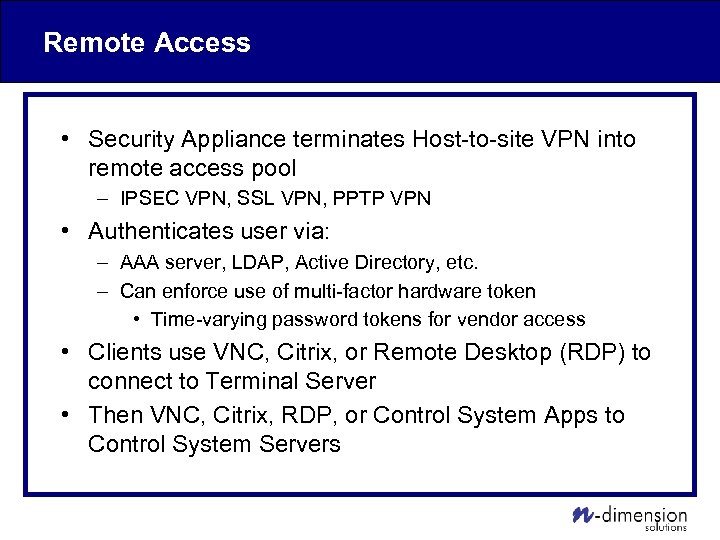
Remote Access • Security Appliance terminates Host-to-site VPN into remote access pool – IPSEC VPN, SSL VPN, PPTP VPN • Authenticates user via: – AAA server, LDAP, Active Directory, etc. – Can enforce use of multi-factor hardware token • Time-varying password tokens for vendor access • Clients use VNC, Citrix, or Remote Desktop (RDP) to connect to Terminal Server • Then VNC, Citrix, RDP, or Control System Apps to Control System Servers
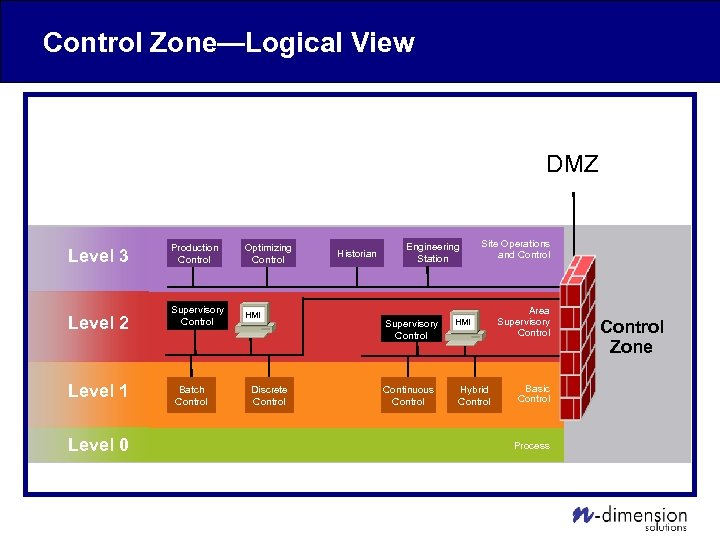
Control Zone—Logical View DMZ Level 3 Level 2 Level 1 Level 0 Production Control Optimizing Control Supervisory Control HMI Batch Control Discrete Control Historian Engineering Station Supervisory Control Continuous Control Site Operations and Control HMI Hybrid Control Area Supervisory Control Basic Control Process Control Zone
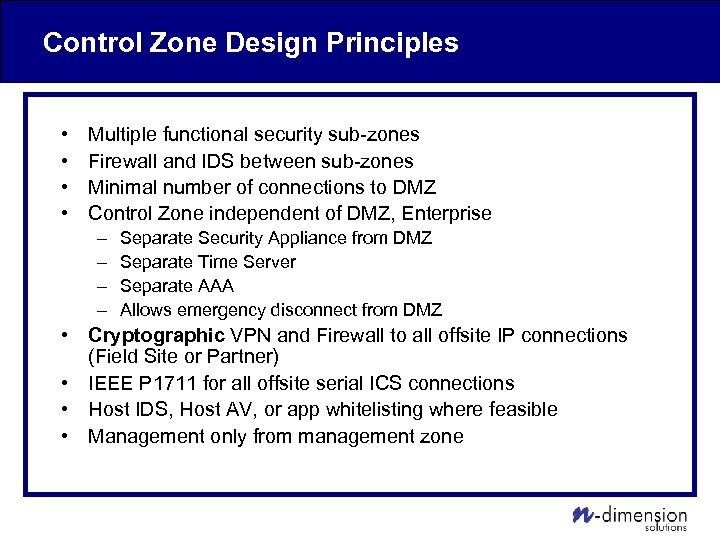
Control Zone Design Principles • • Multiple functional security sub-zones Firewall and IDS between sub-zones Minimal number of connections to DMZ Control Zone independent of DMZ, Enterprise – – Separate Security Appliance from DMZ Separate Time Server Separate AAA Allows emergency disconnect from DMZ • Cryptographic VPN and Firewall to all offsite IP connections (Field Site or Partner) • IEEE P 1711 for all offsite serial ICS connections • Host IDS, Host AV, or app whitelisting where feasible • Management only from management zone
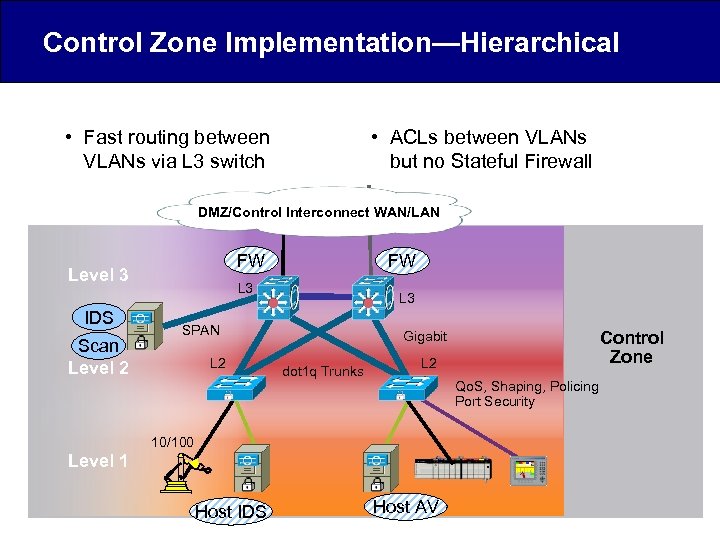
Control Zone Implementation—Hierarchical • Fast routing between VLANs via L 3 switch • ACLs between VLANs but no Stateful Firewall DMZ/Control Interconnect WAN/LAN FW Level 3 IDS Scan Level 2 FW L 3 SPAN L 2 dot 1 q Trunks L 2 Qo. S, Shaping, Policing Port Security 10/100 Level 1 Host IDS Control Zone Gigabit Host AV
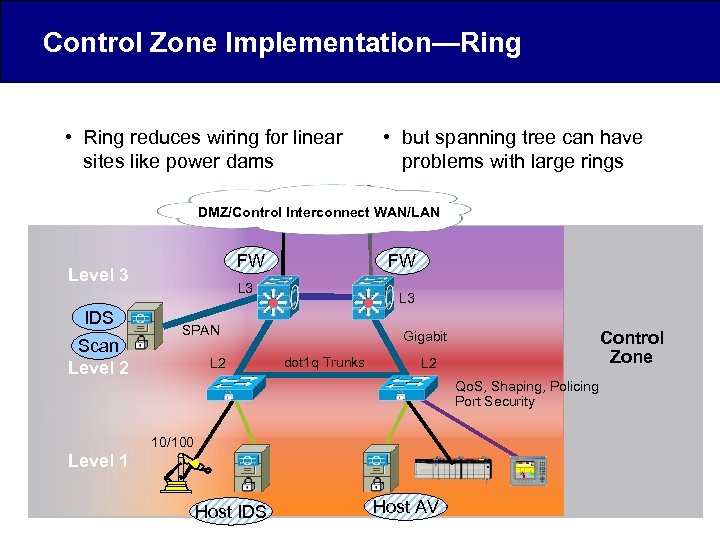
Control Zone Implementation—Ring • Ring reduces wiring for linear sites like power dams • but spanning tree can have problems with large rings DMZ/Control Interconnect WAN/LAN FW Level 3 IDS Scan Level 2 FW L 3 SPAN L 2 Control Zone Gigabit dot 1 q Trunks L 2 Qo. S, Shaping, Policing Port Security 10/100 Level 1 Host IDS Host AV
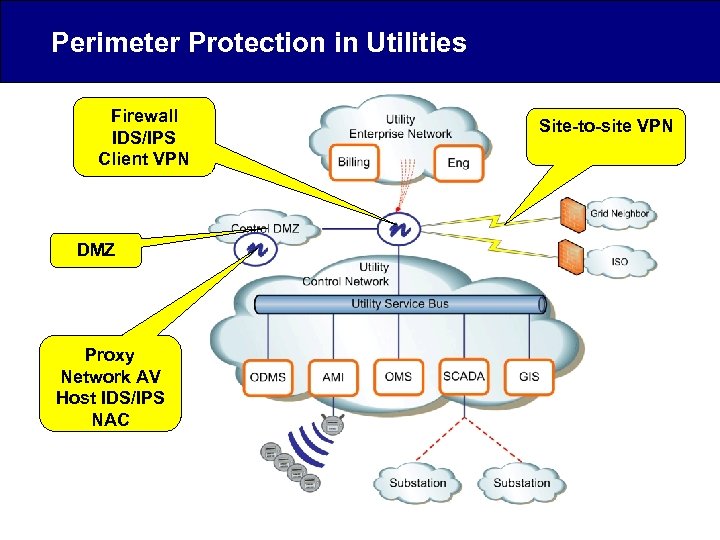
Perimeter Protection in Utilities Firewall IDS/IPS Client VPN DMZ Proxy Network AV Host IDS/IPS NAC Site-to-site VPN
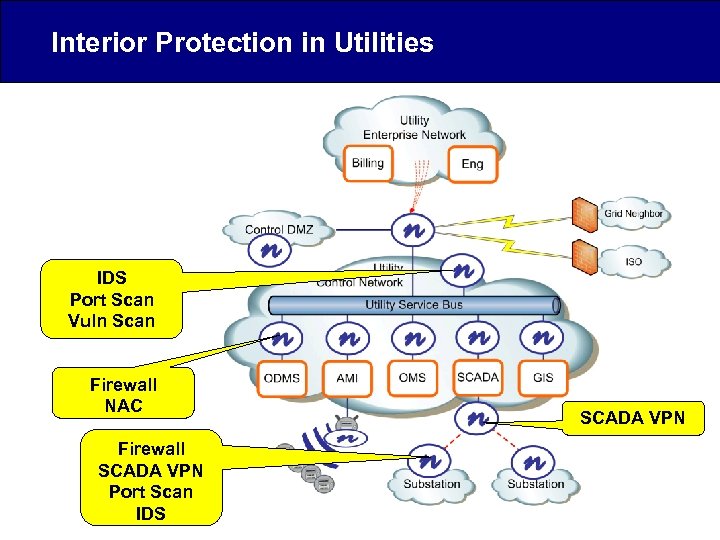
Interior Protection in Utilities IDS Port Scan Vuln Scan Firewall NAC Firewall SCADA VPN Port Scan IDS SCADA VPN
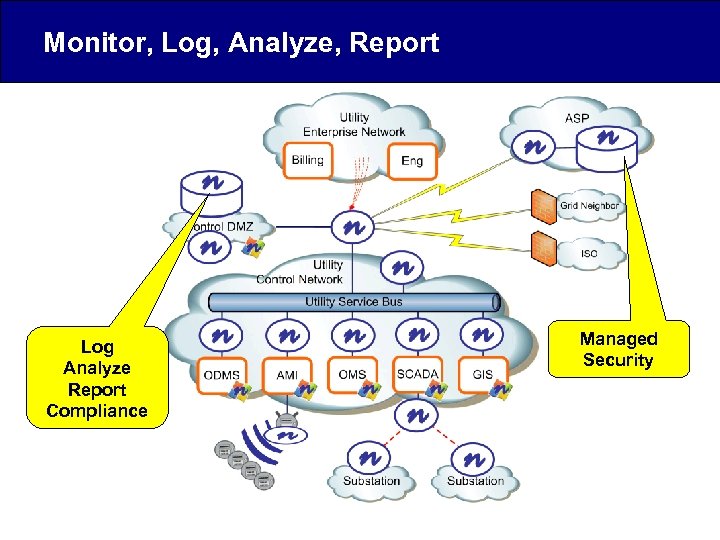
Monitor, Log, Analyze, Report Log Analyze Report Compliance Managed Security
Beyond Network Security • Planning, processes, procedures, physical security, etc. are also important • NERC CIP Regulatory Requirements provide reasonably good guidance in this area: • • • CIP-001: Sabotage Reporting CIP-002: Critical Cyber Asset Identification CIP-003: Security Management Controls CIP-004: Personnel & Training CIP-005: Electronic Security Perimeters CIP-006: Physical Security CIP-007: Systems Security Management CIP-008: Incident Reporting & Response Planning CIP-009: Recovery Plans for Critical Cyber Assets See www. nerc. com -> Standards -> Reliability Standards -> CIP
Summary • Today’s ICS are mix of modern and legacy – vulnerabilities due to both lack of security design in legacy and security issues in newer equipment • Defense in depth is essential – both perimeter (DMZ) and interior security are crucial • Regulation and government action is driving change • Smart Grid must be designed with strong security
Thanks! andrew. wright@n-dimension. com ACM CCS Tutorial Nov. 2009
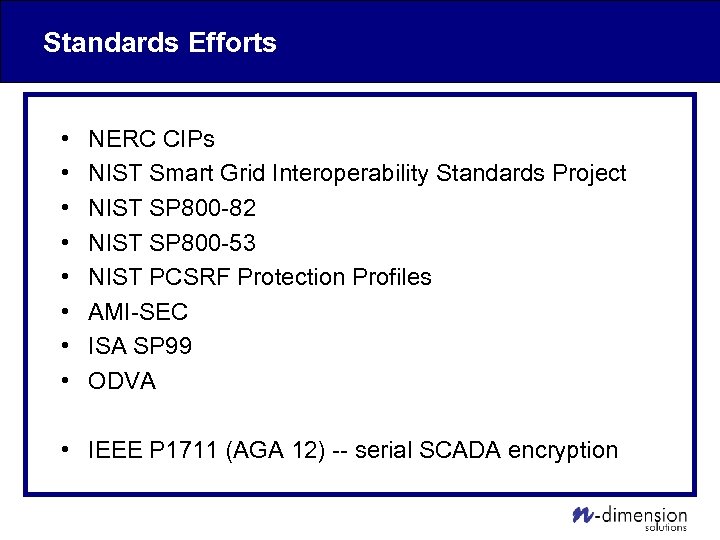
Standards Efforts • • NERC CIPs NIST Smart Grid Interoperability Standards Project NIST SP 800 -82 NIST SP 800 -53 NIST PCSRF Protection Profiles AMI-SEC ISA SP 99 ODVA • IEEE P 1711 (AGA 12) -- serial SCADA encryption

A Few References • www. nist. gov/smartgrid • Securing Your SCADA and Industrial Control Systems, Version 1. 0, DHS, ISBN 0 -16 -075115 -8 • Guide to SCADA and Industrial Control System Security, NIST SP 800 -82 • ISA 99 Industrial Automation and Control Systems Security, www. isa. org/MSTemplate. cfm? Microsite. ID=988&Co mmittee. ID=6821 • AGA 12/IEEE P 1689 SCADA Encryption Standard, scadasafe. sf. net
Скачать презентацию ACM CCS Conference Tutorial Nov 2009 Cyber Security
41612e4b9dd28225e19bfb6808eb205a.ppt