 Скачать презентацию Acknowledgement Study subjects n EPA Northwest Research Center
0e7cce3d31335f8f6e04e97c2c488ea7.ppt
- Количество слайдов: 43



Acknowledgement § Study subjects n EPA/Northwest Research Center for Particulate Air Pollution and Health Effects n WA Department of Ecology n U. S. EPA Region 10 1
Exposure and Health Assessment of Agricultural Burning Smoke Lee-Jane Sally Liu, Chang-Fu Wu, Tim Larson Lianne Sheppard, Kristin Shepherd Jeff Sullivan, Carol Trenga, Joel Kaufman Tim Gould, Sara Jarvis, Collen Marquist EPA NW Research Center for Particulate Air Pollution and Health, University of Washington Candis Claiborn, Ranil Dhammapala, Jorge Jimenez Washington State University For Pullman and Spokane town meetings (June 7, 2004) 2
Objectives n n n Characterize the air quality impacts from agricultural field burning in Eastern WA Characterize community exposure to Ag burning smoke Determine the relationship(s), if any, between particulate air pollution from Ag burning and acute adverse health outcomes in asthmatic adults 3
General Scientific Questions Are episodes of increased particulate matter air pollution from agricultural burning associated with health effects in adults with asthma, as measured by: o o Increased pulmonary inflammation? Decrements in lung function? Is pulmonary response modified by use of antiinflammatory medication? 4
Study Location and Population n Washington State University community, Pullman, WA. 33 adults, in the WSU community, with physician-diagnosed mild or moderate asthma Sample size was determined based on power simulations 5
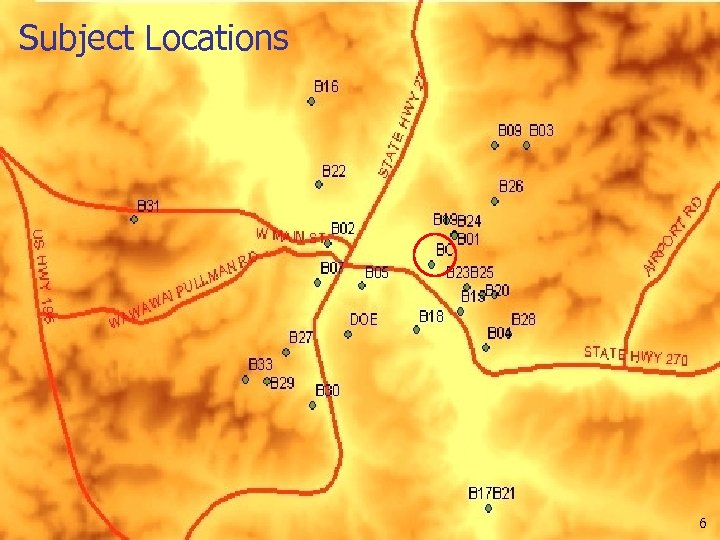
Subject Locations 6
Study Period n n n ~60 -day period (Sept 3 -Nov 1, 2002) 2 monitoring sessions, each session consisting of 33 subjects and 30 days of monitoring period. 33 subjects: 16 Active and 17 on-call n Those subjects who are active in session 1 become on-call in session 2 7
Health Measures n n Exhaled nitric oxide (e. NO) Lung function tests n n Forced expiratory volume in 1 second (FEV 1) Mid-expiratory flow (MEF) 8
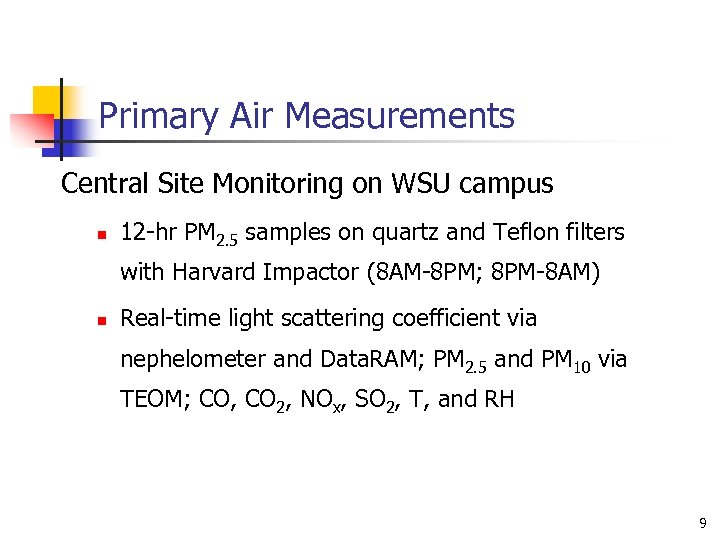
Primary Air Measurements Central Site Monitoring on WSU campus n 12 -hr PM 2. 5 samples on quartz and Teflon filters with Harvard Impactor (8 AM-8 PM; 8 PM-8 AM) n Real-time light scattering coefficient via nephelometer and Data. RAM; PM 2. 5 and PM 10 via TEOM; CO, CO 2, NOx, SO 2, T, and RH 9
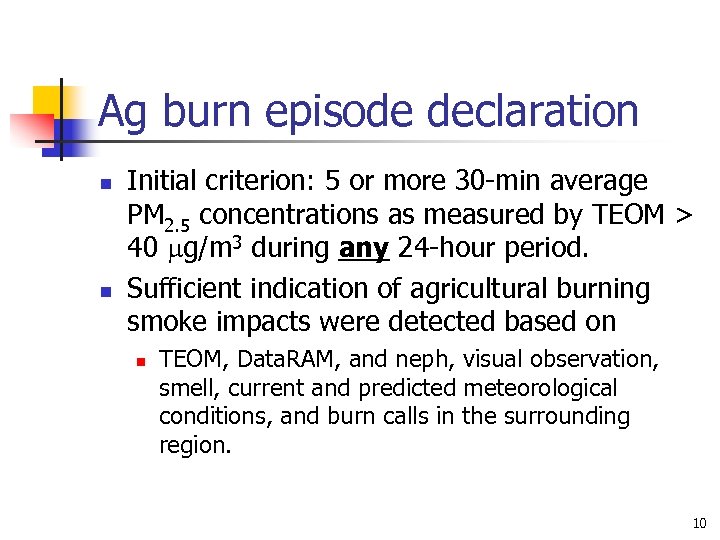
Ag burn episode declaration n n Initial criterion: 5 or more 30 -min average PM 2. 5 concentrations as measured by TEOM > 40 g/m 3 during any 24 -hour period. Sufficient indication of agricultural burning smoke impacts were detected based on n TEOM, Data. RAM, and neph, visual observation, smell, current and predicted meteorological conditions, and burn calls in the surrounding region. 10
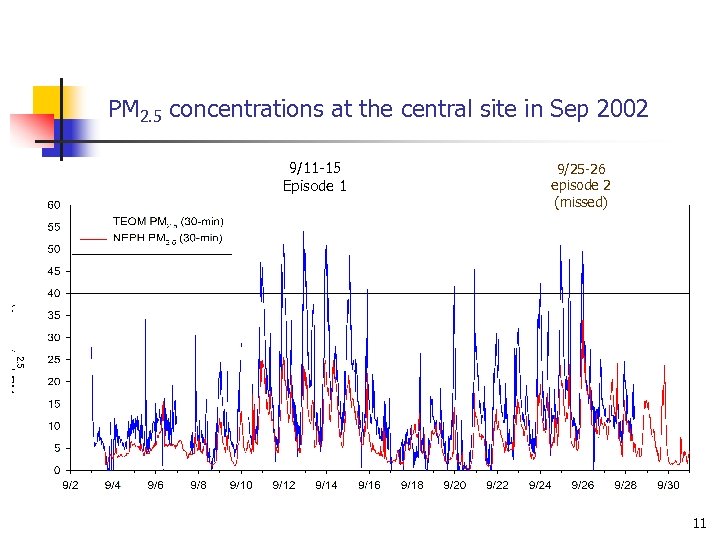
PM 2. 5 concentrations at the central site in Sep 2002 9/11 -15 Episode 1 9/25 -26 episode 2 (missed) 11
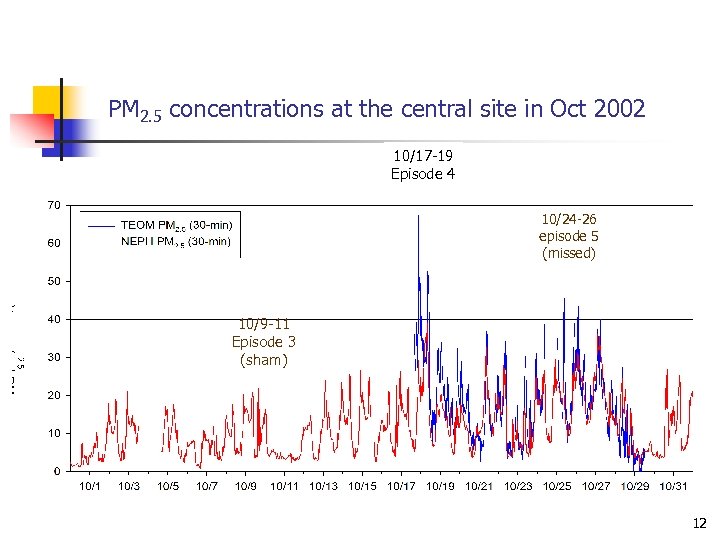
PM 2. 5 concentrations at the central site in Oct 2002 10/17 -19 Episode 4 10/24 -26 episode 5 (missed) 10/9 -11 Episode 3 (sham) 12
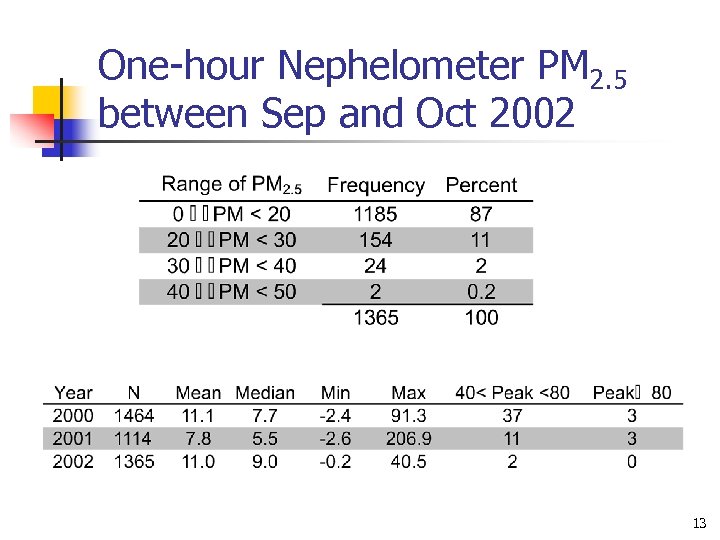
One-hour Nephelometer PM 2. 5 between Sep and Oct 2002 13
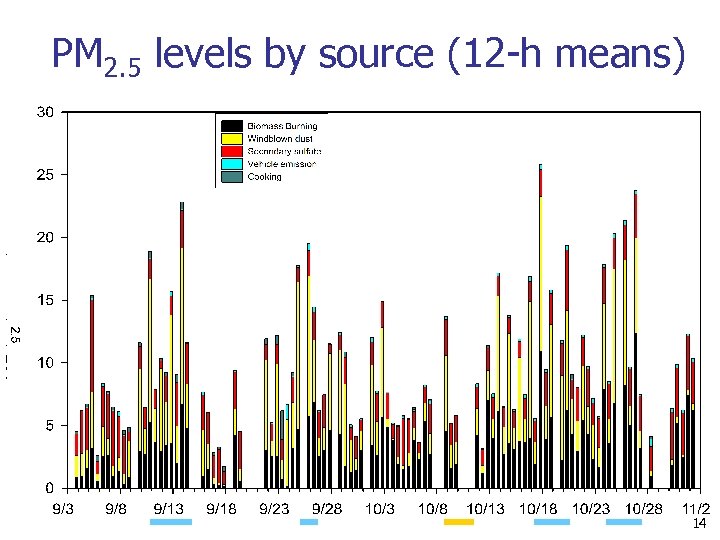
PM 2. 5 levels by source (12 -h means) 14
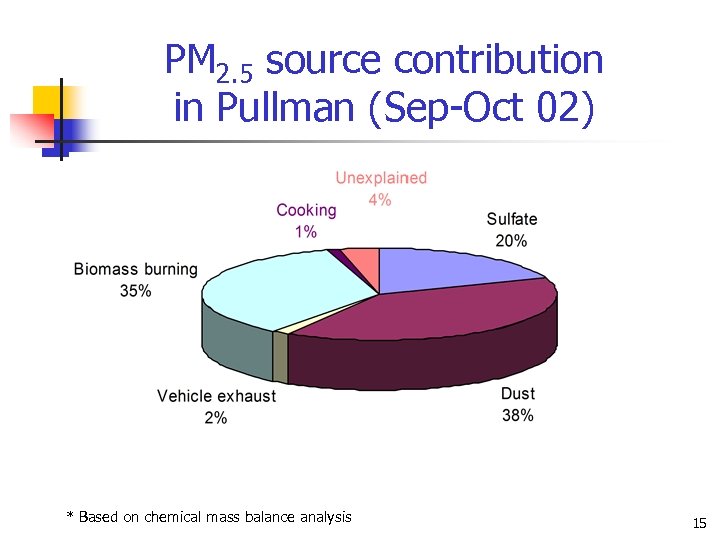
PM 2. 5 source contribution in Pullman (Sep-Oct 02) * Based on chemical mass balance analysis 15
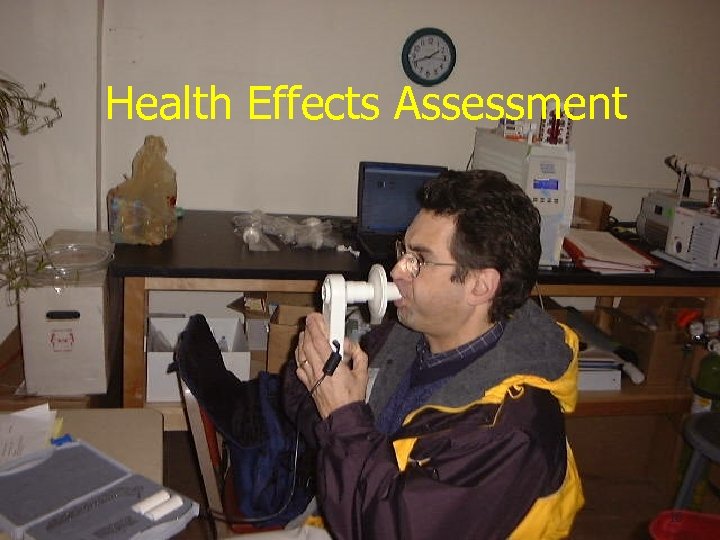
Health Effects Assessment 16
Primary Hypothesis Adults with mild to moderate asthma who are not using anti-inflammatory medication will show an increase in exhaled nitric oxide (e. NO) associated with the peak 1 -hr average of central site PM 2. 5 during the previous 24 hours. 17
Secondary Hypotheses These adults with asthma not using anti-inflammatory medication: n Will show an increase in e. NO associated with the peak 1 -hr average of central site PM 2. 5 during 24 hour period one day prior (1 day lag) to measurement. n Will show a decrease in lung function as measured by MEF and FEV 1 associated with prior 24 -hr and 1 -day lagged peak 1 -hr average of central site PM 2. 5. n Will show higher e. NO and lower lung function (MEF, FEV 1) on ag-burn episode days compared to nonepisodic days. 18
Health Measures n n Exhaled nitric oxide (e. NO), a sensitive marker for inflammation in the lungs Lung function tests n n FEV 1: forced expiratory volume in 1 second, an estimate of airflow obstruction MEF: mid-expiratory flow, a measure of airflow from the small airways 19
Health Effects Assessment Active subjects – 3 lab visits/week n n n Breath samples for e. NO Coached pulmonary function tests (Micro DL) Symptom/medication and time-activity diaries On-call subjects – 3 lab visits/episode n n 3 consecutive-day lab visits (e. NO, PFT, urine samples) during an “episode” Symptoms 20
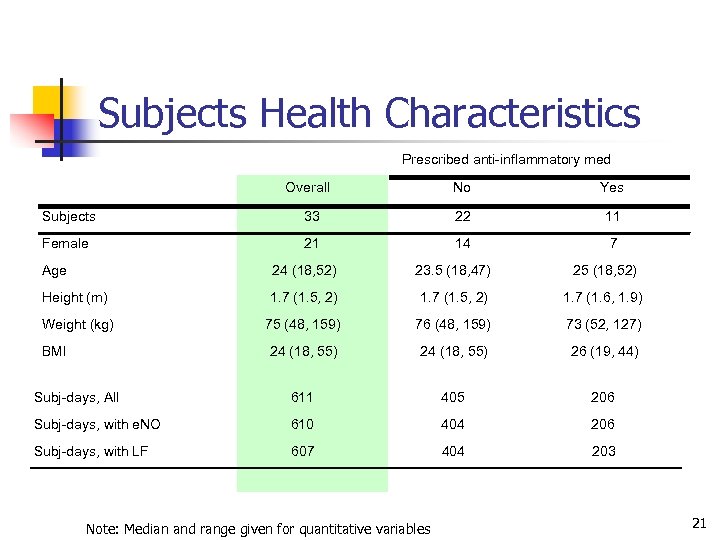
Subjects Health Characteristics Prescribed anti-inflammatory med Overall No Yes Subjects 33 22 11 Female 21 14 7 Age 24 (18, 52) 23. 5 (18, 47) 25 (18, 52) Height (m) 1. 7 (1. 5, 2) 1. 7 (1. 6, 1. 9) Weight (kg) 75 (48, 159) 76 (48, 159) 73 (52, 127) 24 (18, 55) 26 (19, 44) Subj-days, All 611 405 206 Subj-days, with e. NO 610 404 206 Subj-days, with LF 607 404 203 BMI Note: Median and range given for quantitative variables 21
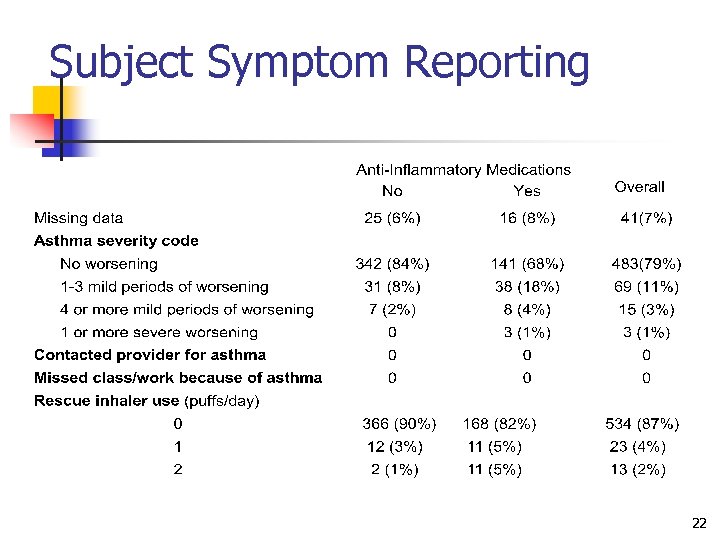
Subject Symptom Reporting 22
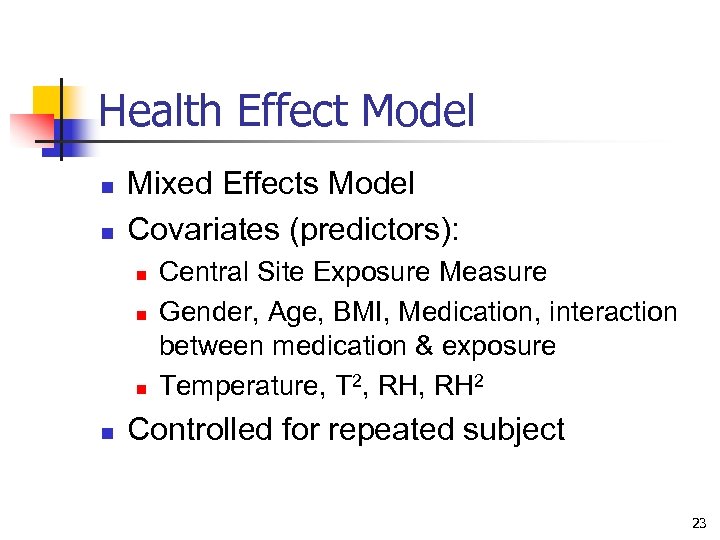
Health Effect Model n n Mixed Effects Model Covariates (predictors): n n Central Site Exposure Measure Gender, Age, BMI, Medication, interaction between medication & exposure Temperature, T 2, RH 2 Controlled for repeated subject 23
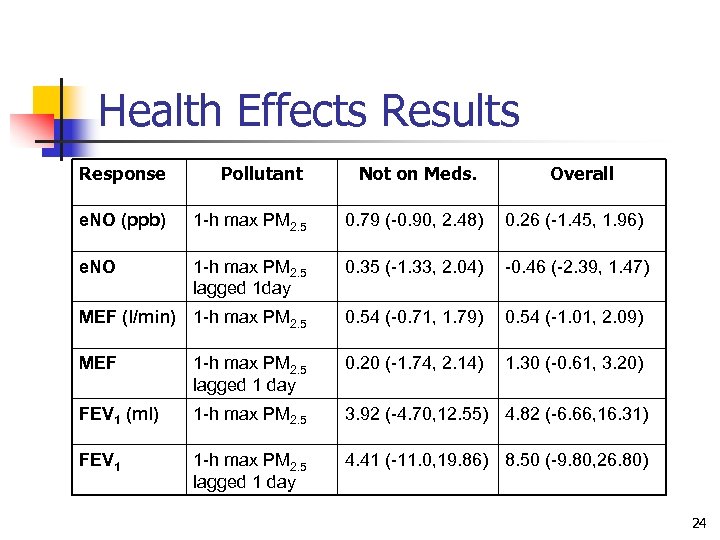
Health Effects Results Response Pollutant Not on Meds. Overall e. NO (ppb) 1 -h max PM 2. 5 0. 79 (-0. 90, 2. 48) 0. 26 (-1. 45, 1. 96) e. NO 1 -h max PM 2. 5 lagged 1 day 0. 35 (-1. 33, 2. 04) -0. 46 (-2. 39, 1. 47) MEF (l/min) 1 -h max PM 2. 5 0. 54 (-0. 71, 1. 79) 0. 54 (-1. 01, 2. 09) MEF 1 -h max PM 2. 5 lagged 1 day 0. 20 (-1. 74, 2. 14) 1. 30 (-0. 61, 3. 20) FEV 1 (ml) 1 -h max PM 2. 5 3. 92 (-4. 70, 12. 55) 4. 82 (-6. 66, 16. 31) FEV 1 1 -h max PM 2. 5 lagged 1 day 4. 41 (-11. 0, 19. 86) 8. 50 (-9. 80, 26. 80) 24
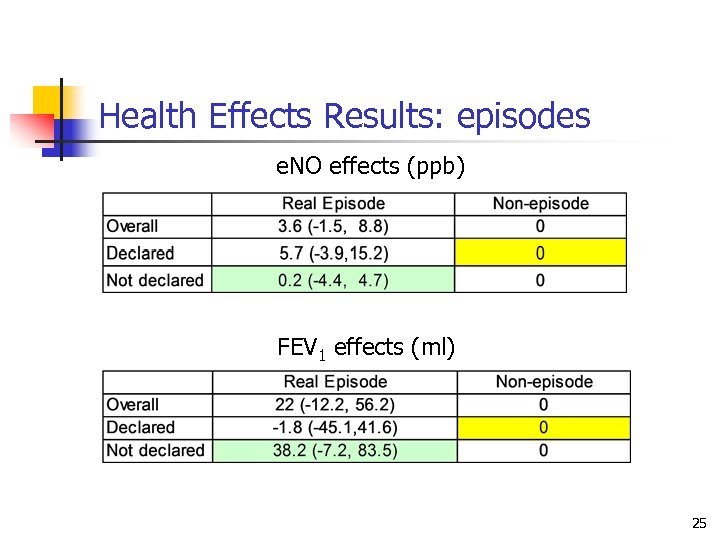
Health Effects Results: episodes e. NO effects (ppb) FEV 1 effects (ml) 25
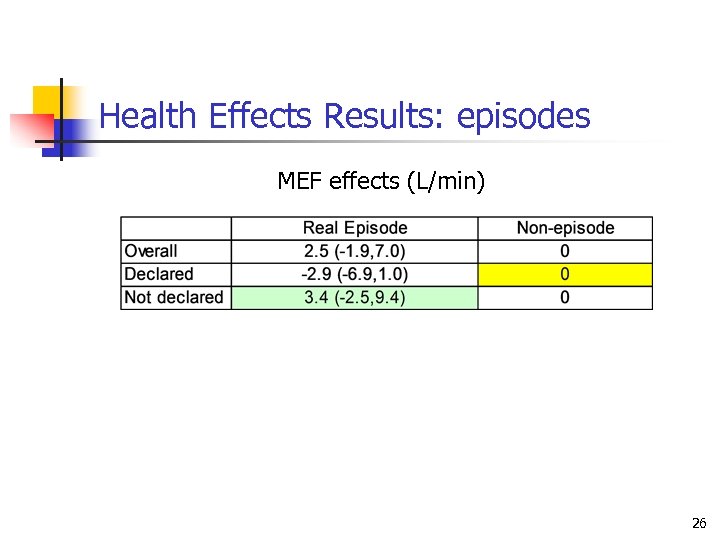
Health Effects Results: episodes MEF effects (L/min) 26
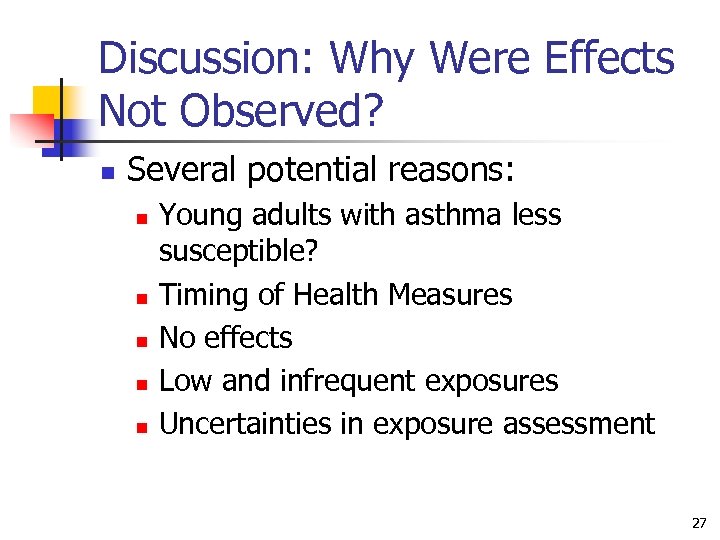
Discussion: Why Were Effects Not Observed? n Several potential reasons: n n n Young adults with asthma less susceptible? Timing of Health Measures No effects Low and infrequent exposures Uncertainties in exposure assessment 27
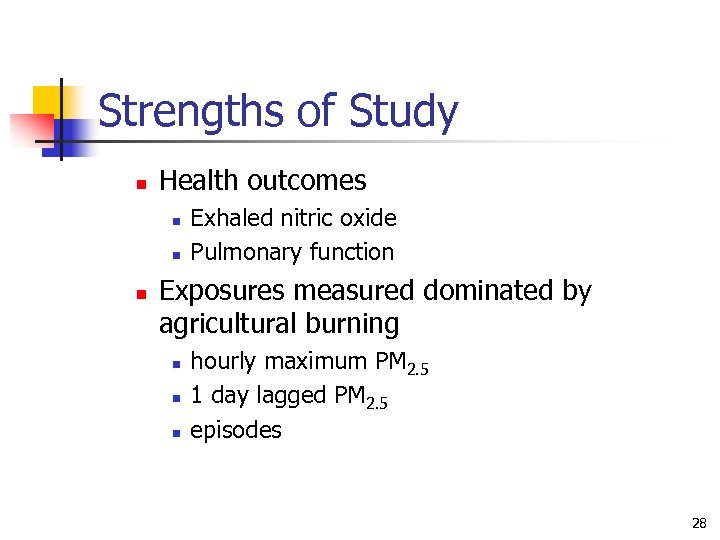
Strengths of Study n Health outcomes n n n Exhaled nitric oxide Pulmonary function Exposures measured dominated by agricultural burning n n n hourly maximum PM 2. 5 1 day lagged PM 2. 5 episodes 28
Study Limitations n n Adults with asthma were chosen based on feasibility, population base, residential and monitoring locations Difficult to precisely define agricultural burning component Low peak exposure levels Diurnal and spatial exposure variation 29
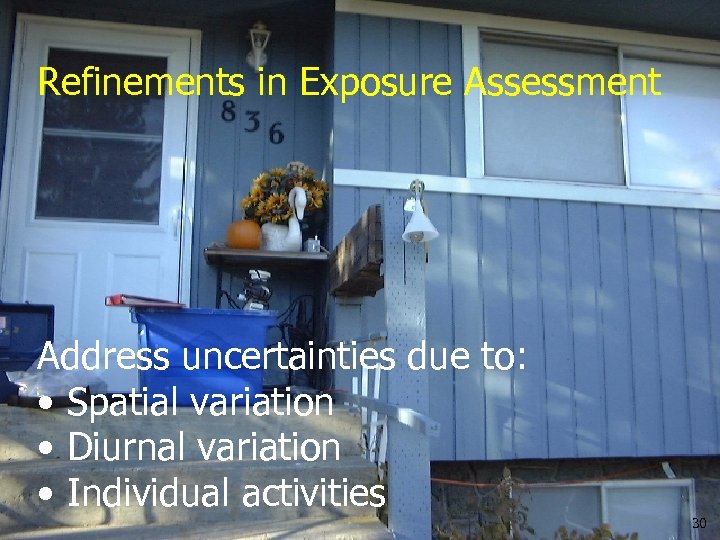
Refinements in Exposure Assessment Address uncertainties due to: • Spatial variation • Diurnal variation • Individual activities 30
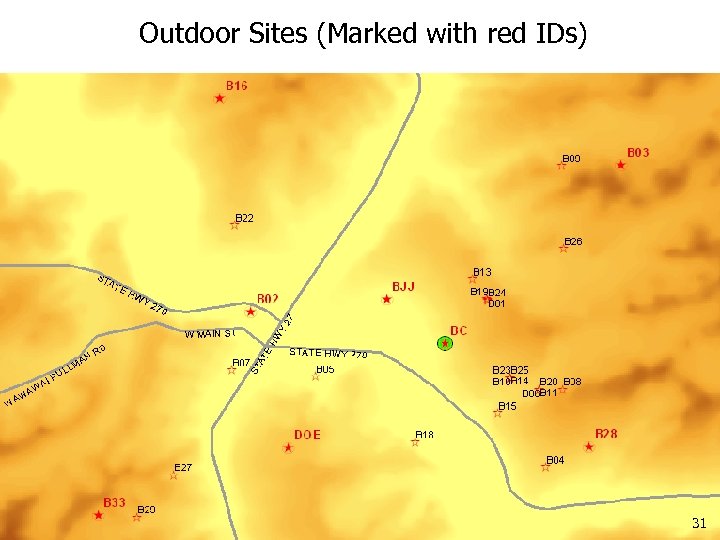
Outdoor Sites (Marked with red IDs) 31
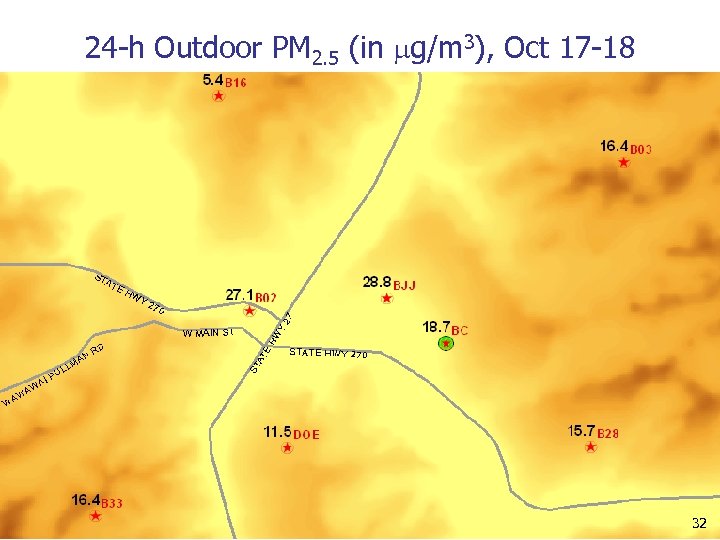
24 -h Outdoor PM 2. 5 (in g/m 3), Oct 17 -18 32
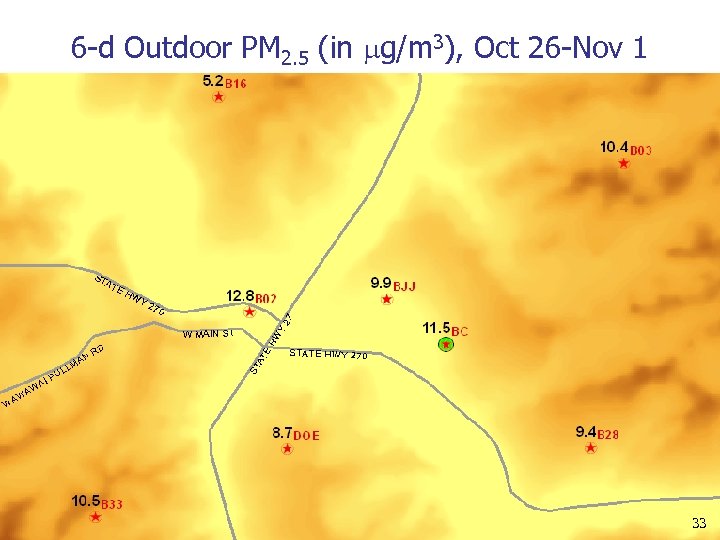
6 -d Outdoor PM 2. 5 (in g/m 3), Oct 26 -Nov 1 33
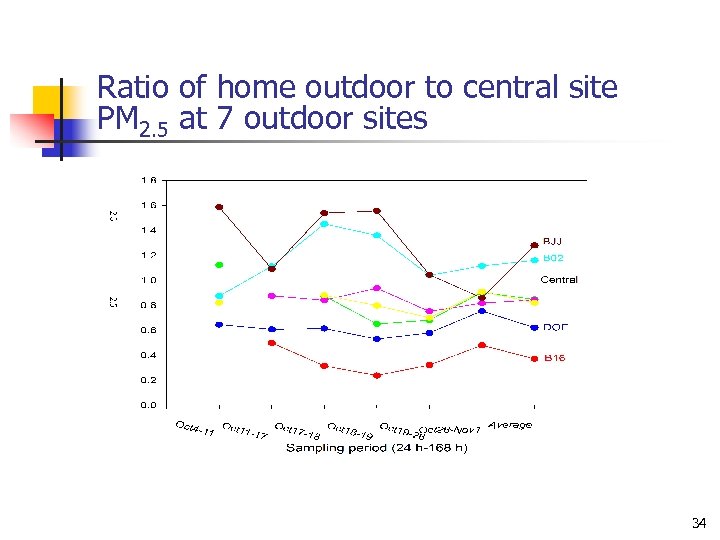
Ratio of home outdoor to central site PM 2. 5 at 7 outdoor sites 34
Personal Exposure Assessment n Time-activity diary n n Personal sampling: n n 2/d, 2 HPEMs/subject (Teflon for XRF, quartz for EC/OC) Urine Sample Collection and smoked food diary n n From every subject everyday, 10 -min resolution Daily urine samples from the 2 intensive monitoring subjects; 2 urine samples/day from all subjects during episodes House ventilation logs (intensive subjects only) 35
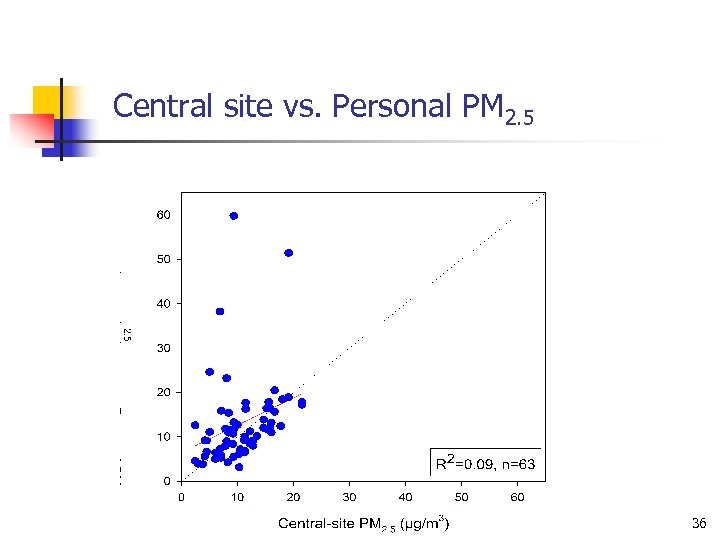
Central site vs. Personal PM 2. 5 36
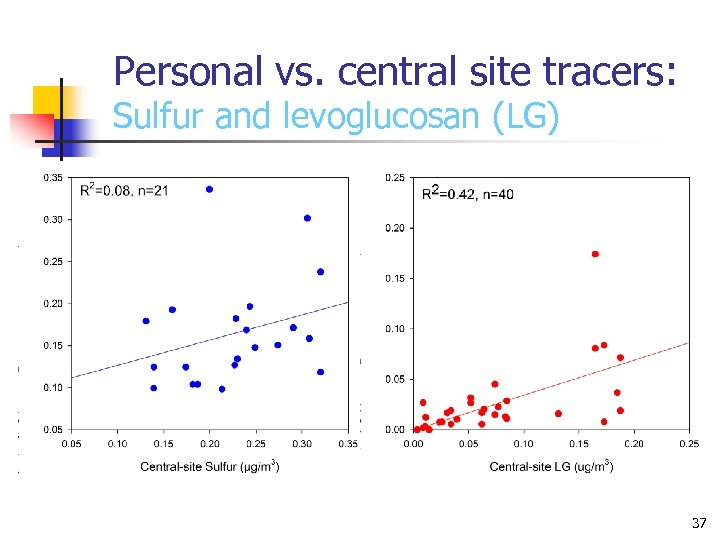
Personal vs. central site tracers: Sulfur and levoglucosan (LG) 37
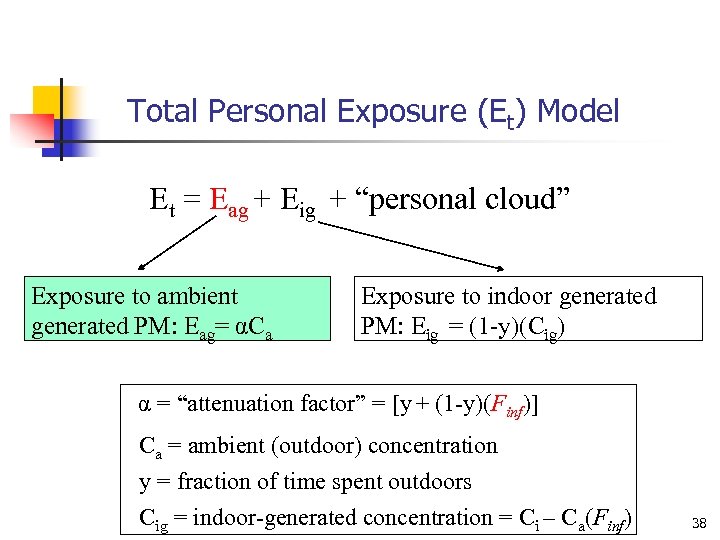
Total Personal Exposure (Et) Model Et = Eag + Eig + “personal cloud” Exposure to ambient generated PM: Eag= αCa Exposure to indoor generated PM: Eig = (1 -y)(Cig) α = “attenuation factor” = [y + (1 -y)(Finf)] Ca = ambient (outdoor) concentration y = fraction of time spent outdoors Cig = indoor-generated concentration = Ci – Ca(Finf) 38
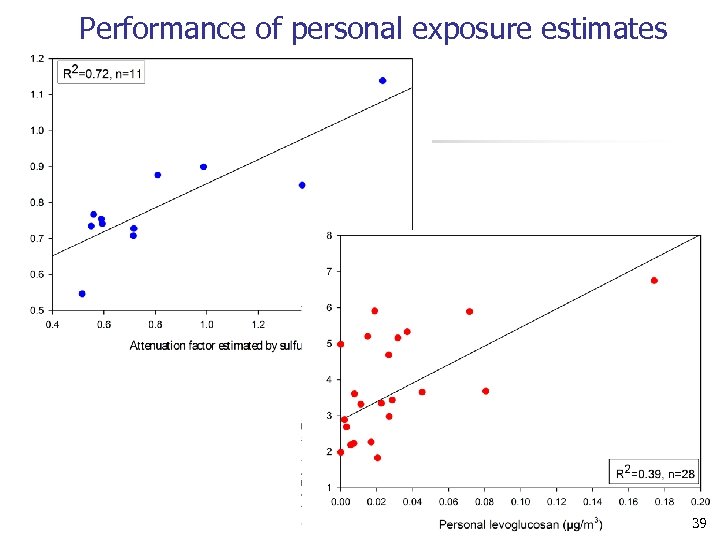
Performance of personal exposure estimates 39
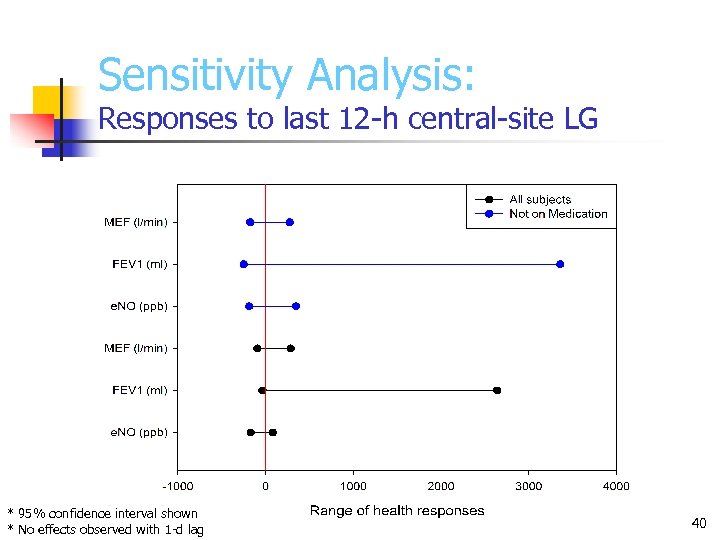
Sensitivity Analysis: Responses to last 12 -h central-site LG * 95% confidence interval shown * No effects observed with 1 -d lag 40
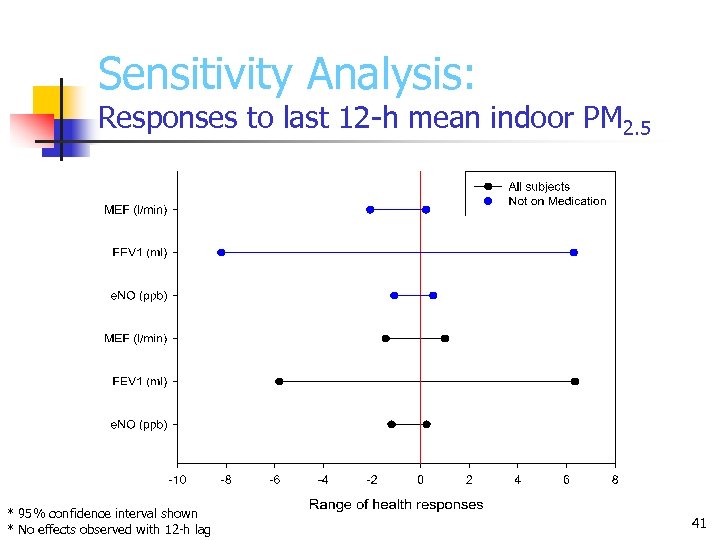
Sensitivity Analysis: Responses to last 12 -h mean indoor PM 2. 5 * 95% confidence interval shown * No effects observed with 12 -h lag 41
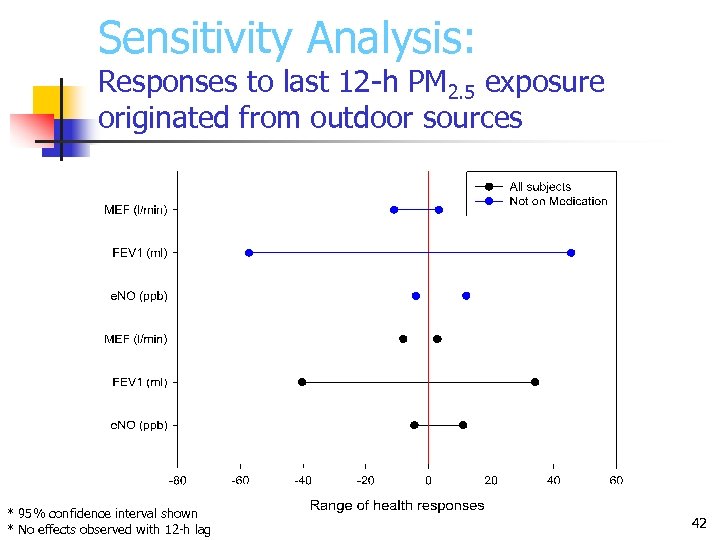
Sensitivity Analysis: Responses to last 12 -h PM 2. 5 exposure originated from outdoor sources * 95% confidence interval shown * No effects observed with 12 -h lag 42
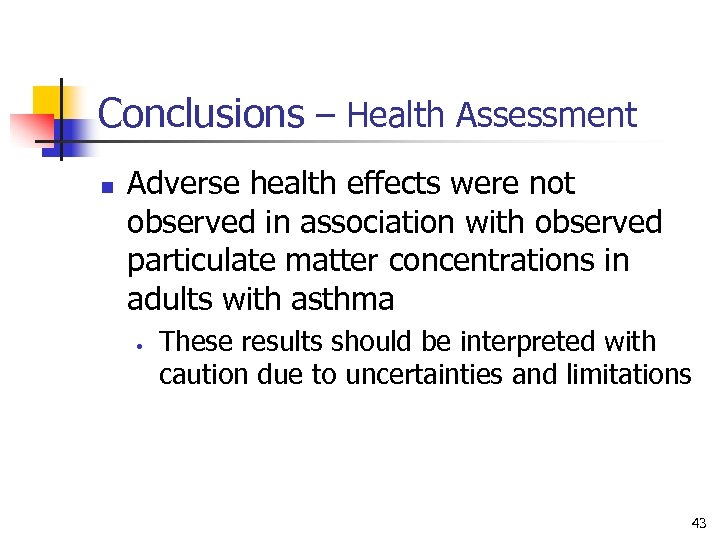
Conclusions – Health Assessment n Adverse health effects were not observed in association with observed particulate matter concentrations in adults with asthma • These results should be interpreted with caution due to uncertainties and limitations 43
Скачать презентацию Acknowledgement Study subjects n EPA Northwest Research Center
0e7cce3d31335f8f6e04e97c2c488ea7.ppt