 Скачать презентацию ACID and Modularity in the Cloud Liuba Shrira
5d4219b42d37d54fcbe15749ddf87c3f.ppt
- Количество слайдов: 63



ACID and Modularity in the Cloud Liuba Shrira Brandeis University
Trends Applications are moving to the Cloud - new (FB, Zymba…) and established (MSFT Office. . ) Users want applications to run everywhere - Mac. Book, i. Phone, i. Pad
Cloud: Democracy for Developers Resources: Amazon, Google, Microsoft… (Ia. S) Platforms: Android, App Store (Pa. S)
Challenges Remain - Consistency in the presence of failures - Predictable performance in the presence of varying load Developers want to use tried and true tools - how to adapt? Developers need new tools - how to build?
Transactions: true and tried tool Invented by Gray, Lomet make developers life easier. . The proverbial transaction : Begin … Transfer money from account x to y … Commit (or Abort)
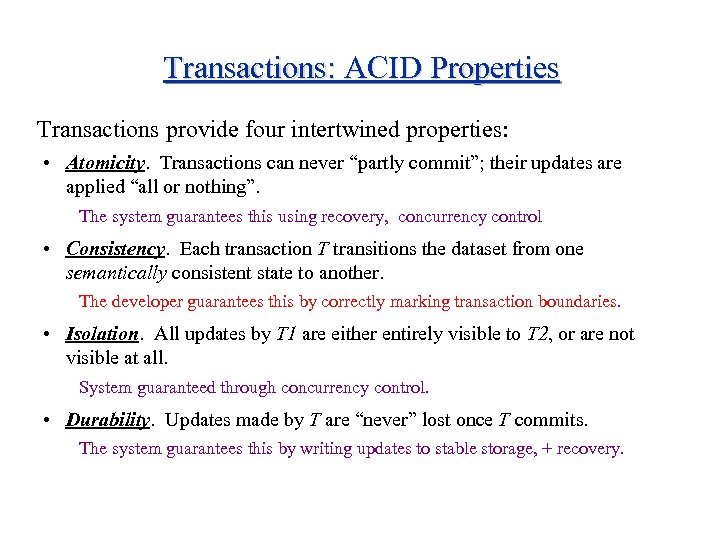
Transactions: ACID Properties Transactions provide four intertwined properties: • Atomicity. Transactions can never “partly commit”; their updates are applied “all or nothing”. The system guarantees this using recovery, concurrency control • Consistency. Each transaction T transitions the dataset from one semantically consistent state to another. The developer guarantees this by correctly marking transaction boundaries. • Isolation. All updates by T 1 are either entirely visible to T 2, or are not visible at all. System guaranteed through concurrency control. • Durability. Updates made by T are “never” lost once T commits. The system guarantees this by writing updates to stable storage, + recovery.
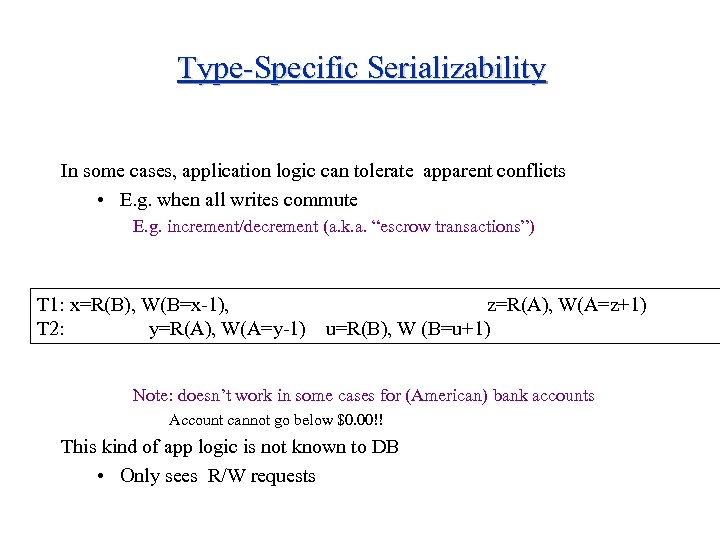
Type-Specific Serializability In some cases, application logic can tolerate apparent conflicts • E. g. when all writes commute E. g. increment/decrement (a. k. a. “escrow transactions”) T 1: x=R(B), W(B=x-1), T 2: y=R(A), W(A=y-1) z=R(A), W(A=z+1) u=R(B), W (B=u+1) Note: doesn’t work in some cases for (American) bank accounts Account cannot go below $0. 00!! This kind of app logic is not known to DB • Only sees R/W requests
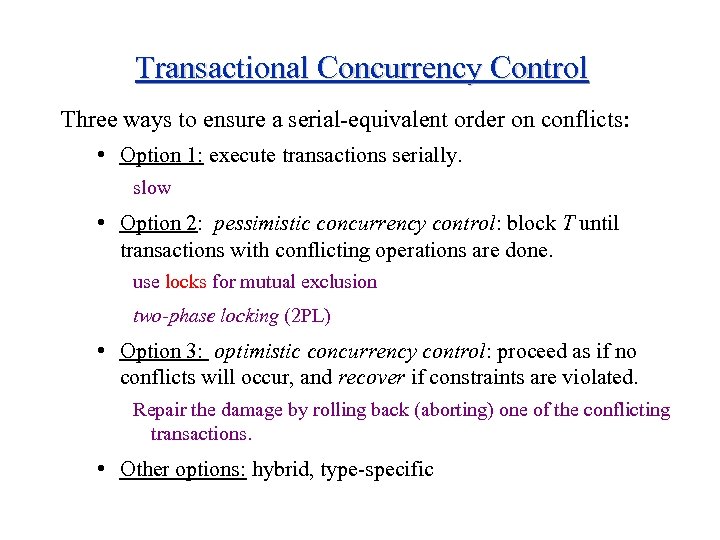
Transactional Concurrency Control Three ways to ensure a serial-equivalent order on conflicts: • Option 1: execute transactions serially. slow • Option 2: pessimistic concurrency control: block T until transactions with conflicting operations are done. use locks for mutual exclusion two-phase locking (2 PL) • Option 3: optimistic concurrency control: proceed as if no conflicts will occur, and recover if constraints are violated. Repair the damage by rolling back (aborting) one of the conflicting transactions. • Other options: hybrid, type-specific
Recovery Protocol Model: Persistent data lives on disk or flash Transactions compute in memory (volatile) ACID - need way to ensure A & D in the presence of crashes, aborts Approach: recovery protocol
Idea: Write-Ahead Logging (WAL) The Write-Ahead Logging Protocol: Must write the log record for an update before the corresponding data gets to disk. Must force all log records for a Xact before commit. (so transaction is not committed until all of its log records including its “commit” record are on the stable log. ) #1 helps guarantee Atomicity. #2 helps guarantee Durability. # ( 1+2) + lazy disk update helps guarantee good Performance.
Got ACID!
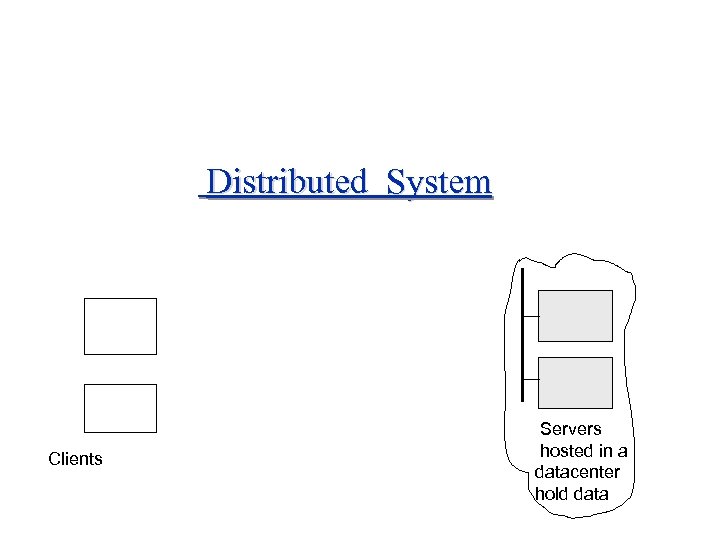
Distributed System Clients Servers hosted in a datacenter hold data
Disadvantages of Locking Pessimistic concurrency control has a number of key disadvantages in distributed systems: • Overhead. Locks cost to acquire, pay even if no conflict occurs. • Low concurrency. If locks are too coarse, they reduce concurrency unnecessarily. Need for strict 2 PL makes it even worse. • Low availability. A client cannot make progress if the server or lock holder is temporarily unreachable.
Optimistic Concurrency Control OCC skips the locking and takes action only when a conflict actually occurs. “ better to apologize than ask for permission”
Simple Validation for OCC validation is simple with a few assumptions: • Transactions update a private “tentative” copy of data. Updates from T are not visible to S until T validates/commits. • Transactions validate and commit serially at a central point. Transaction manager keeps track for each transaction T: Maintain a read set R(T) and a write set W(T) of items/objects read and written by T. T cannot affect S if S commits before T, so we only need to worry about whether or not T observed writes by S.
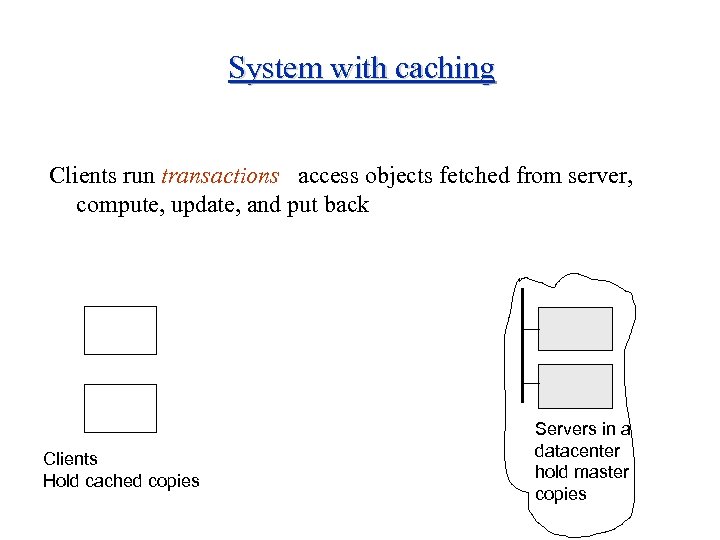
System with caching Clients run transactions access objects fetched from server, compute, update, and put back Clients Hold cached copies Servers in a datacenter hold master copies
Caching System Problem 1 (client/server): If the client caches data and updates locally, the cache must be consistent at start of each transaction. Otherwise, there is no guarantee that T observes writes by an S that committed before T started. Validation queue may grow without bound. Problem 2 (multiple servers): validation/commit is no longer serial.
Client/Server OCC with caching Key idea: use cache invalidations) to simplify validation checks, allowing clients to cache objects across transactions. • Each server keeps a conservative cached set of objects cached by each client C. • If a validated S has modified an object x in C’s cached set: 1. Callback client to invalidate its cached copy of x. 2. Client aborts/restarts any local action T with x in R(T). 3. x is in C’s invalid set until C acks the invalidate. • A transaction T from client C fails validation if there is any object x in R(T) that is also in C’s invalid set. .
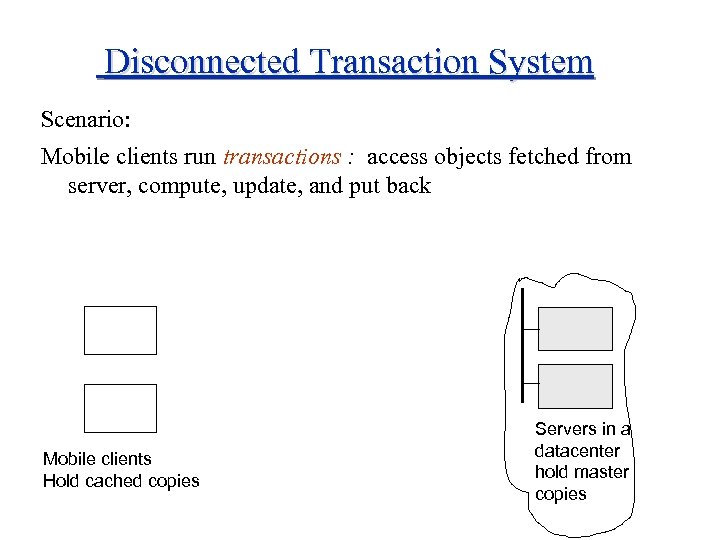
Disconnected Transaction System Scenario: Mobile clients run transactions : access objects fetched from server, compute, update, and put back Mobile clients Hold cached copies Servers in a datacenter hold master copies
Disconnected Client/Server Key idea: disconnected client runs tentative transactions, a tentative commit of T adds a record R(T), W(T) to a tentative transaction log. • Server accumulates invalid set for each client C • A client reconnects and validates log using invalid set. 1. Client aborts any tentative transaction T with x in R(T) and either x in invalid set or x in W(D), where D is a tentative transaction that already aborted. 2. Client commits at the server remaining tentative transactions • Client obtains new values from the server and retries or “reconciles” aborted transactions. .
A Problem with Optimistic Concurrency • Validate read/write conflicts at reconnection (easy) • If no conflicts, can commit Effects become permanent • If conflicts, transactions abort Roll effects back (hate it…) • or reconcile Ask client for help (complex. . )
Problems with Pessimistic and Optimistic Pessimistic - slow and no good for disconnection Optimistic – complex to reconcile, clients hate rollback
A “hybrid” approach: Reservations • Optimistic for private data • Avoid conflicts using reservations for shared data Special locks with timeouts • Exploit object type to gain concurrency e. g. commutative updates
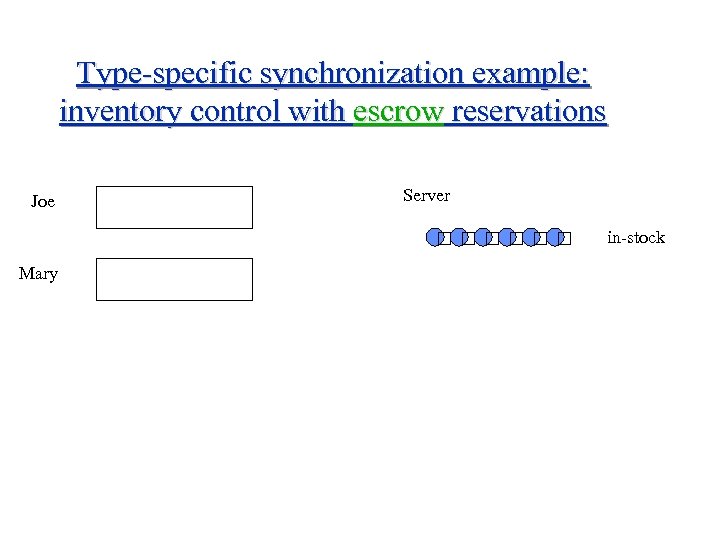
Type-specific synchronization example: inventory control with escrow reservations Joe Server Mary in-stock
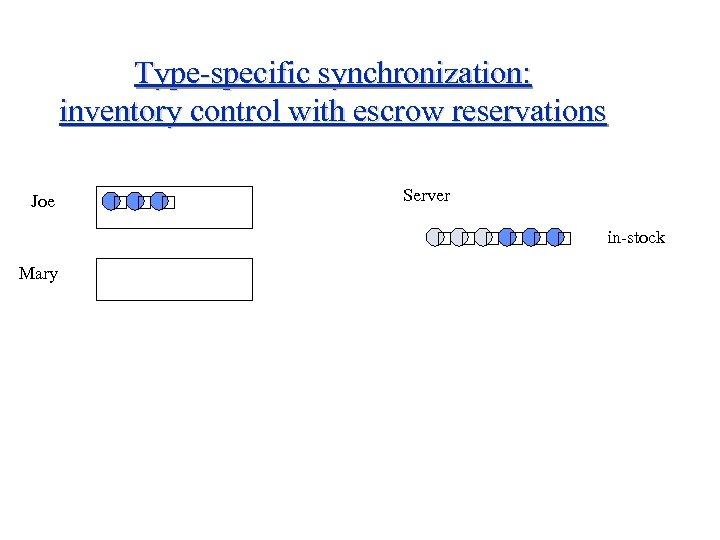
Type-specific synchronization: inventory control with escrow reservations Joe Server Mary in-stock
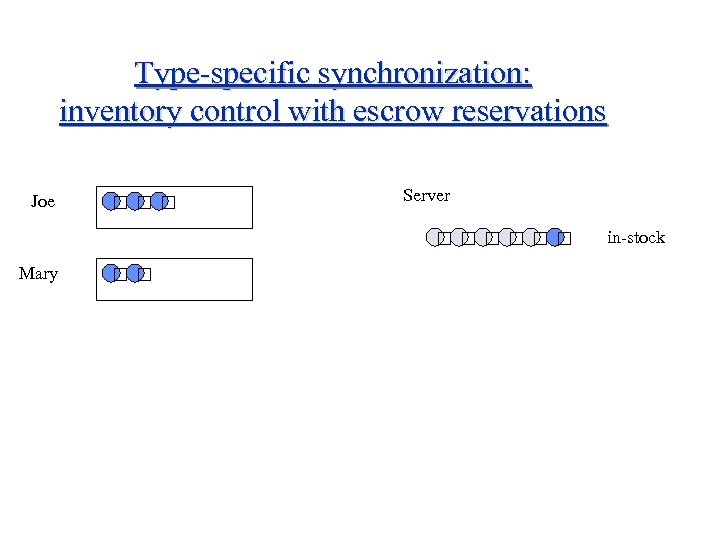
Type-specific synchronization: inventory control with escrow reservations Joe Server Mary in-stock
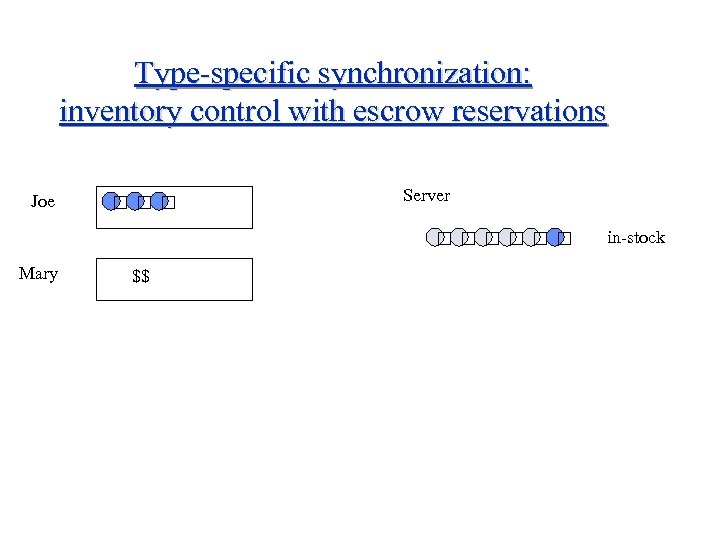
Type-specific synchronization: inventory control with escrow reservations Joe Server Mary $$ in-stock
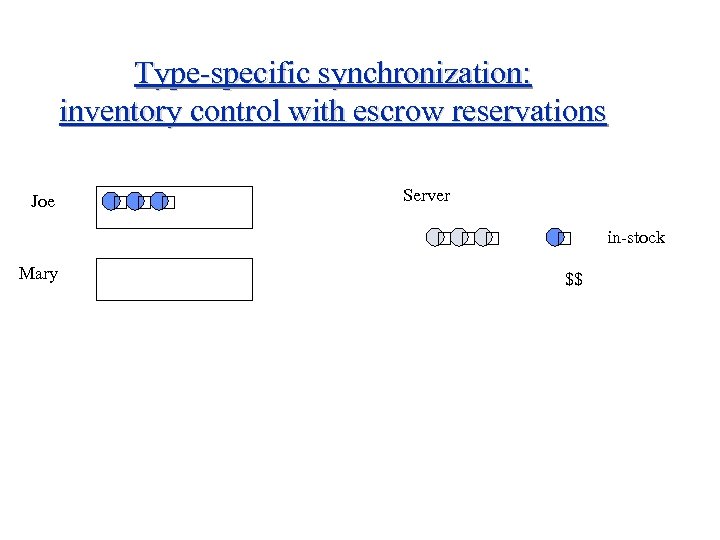
Type-specific synchronization: inventory control with escrow reservations Joe Server Mary $$ in-stock
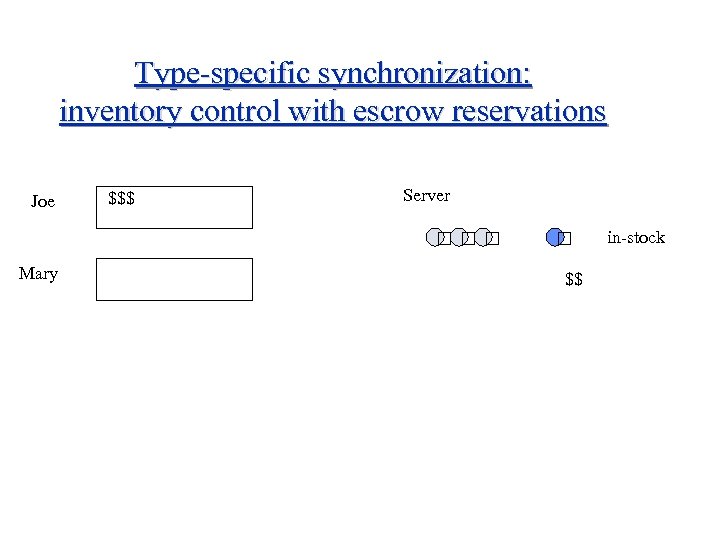
Type-specific synchronization: inventory control with escrow reservations Joe $$$ Server Mary $$ in-stock
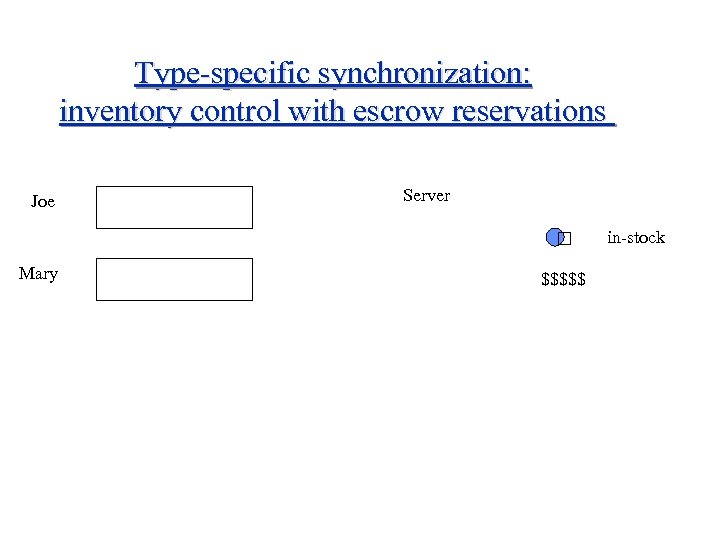
Type-specific synchronization: inventory control with escrow reservations Joe Server Mary $$$$$ in-stock
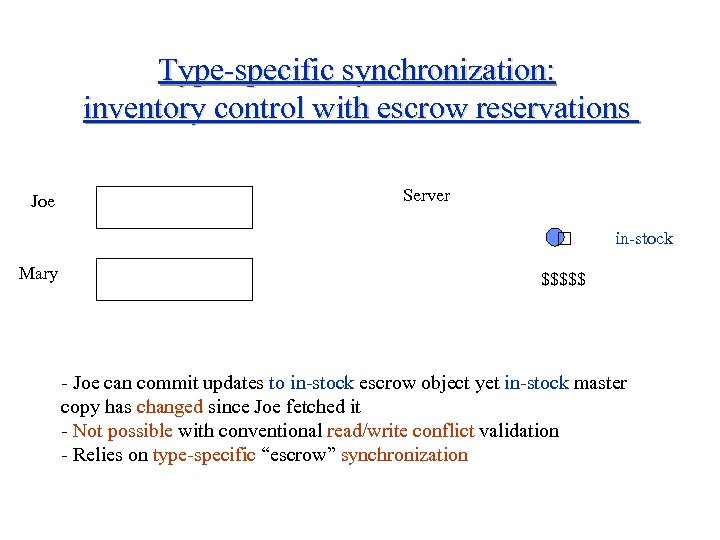
Type-specific synchronization: inventory control with escrow reservations Joe Server Mary in-stock $$$$$ - Joe can commit updates to in-stock escrow object yet in-stock master copy has changed since Joe fetched it - Not possible with conventional read/write conflict validation - Relies on type-specific “escrow” synchronization
In the 80’s and 90’s. . . Many clever type-specific CC protocols
Deal-Breaker Where does type-specific code live? • Server’s concurrency & recovery engine IT manager says - “you want what? ” • Install customized (unstable, buggy? ) code in my highperformance enterprise-critical box engine?
Upshot: IT managers want commodity servers! • Reliability • Performance • Stability
New modular approach: Exo-leasing Can get the benefits of type-specific synchronization without modifying the servers Can run on top of commodity servers • attractive for cloud systems Plus extra benefits. . .
We want Mobile Inventory Example: • Ability to acquire sales reservations so disconnected transactions can commit without conflicts • Proper outcome in the absence of failures: only finalized sales commit - abort recovery • Proper outcome in the case of failures: if sale not finalized, reservation is released - crash recovery without modification to server concurrency and recovery code
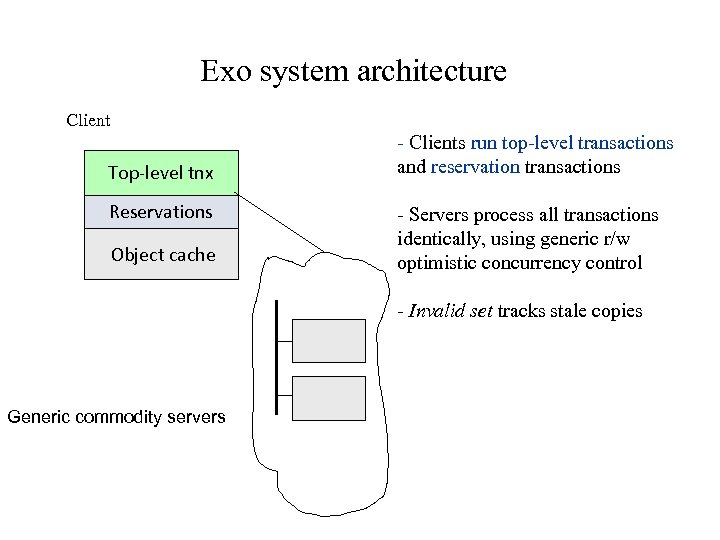
Exo system architecture Client Top-level tnx Reservations Object cache - Clients run top-level transactions and reservation transactions - Servers process all transactions identically, using generic r/w optimistic concurrency control - Invalid set tracks stale copies Generic commodity servers
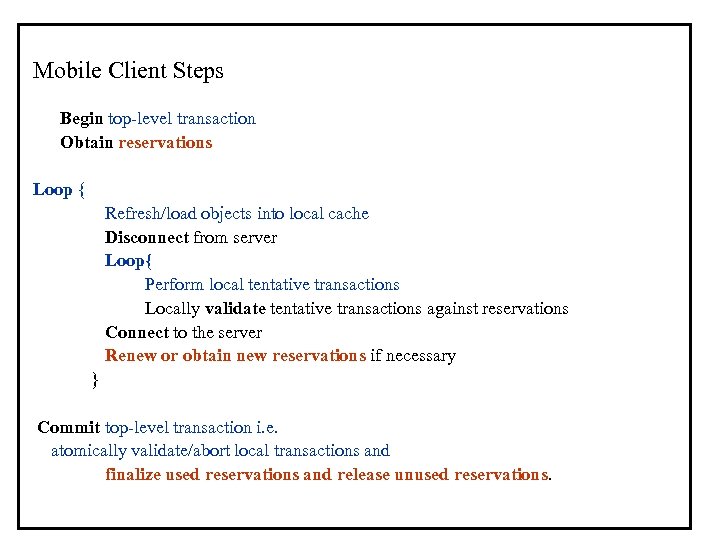
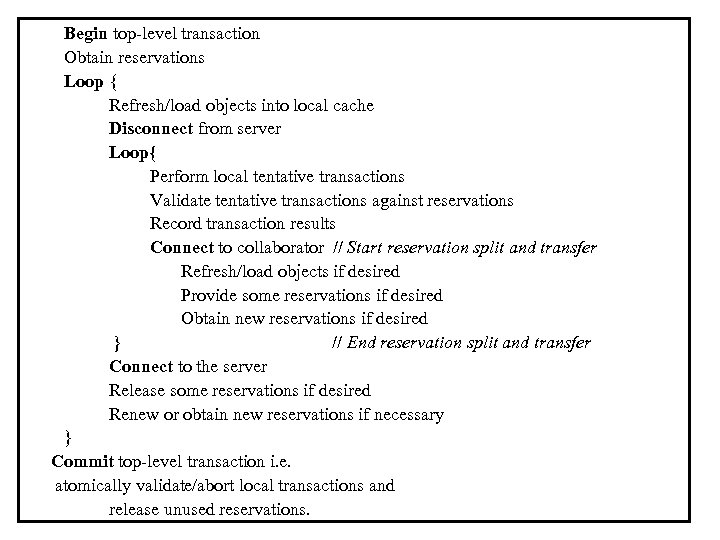
Mobile Client Steps Begin top-level transaction Obtain reservations Loop { Refresh/load objects into local cache Disconnect from server Loop{ Perform local tentative transactions Locally validate tentative transactions against reservations Connect to the server Renew or obtain new reservations if necessary } Commit top-level transaction i. e. atomically validate/abort local transactions and finalize used reservations and release unused reservations.
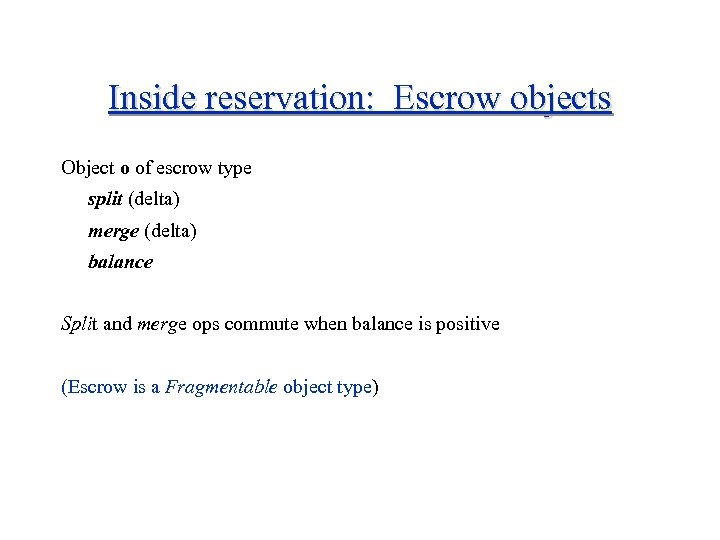
Inside reservation: Escrow objects Object o of escrow type split (delta) merge (delta) balance Split and merge ops commute when balance is positive (Escrow is a Fragmentable object type)
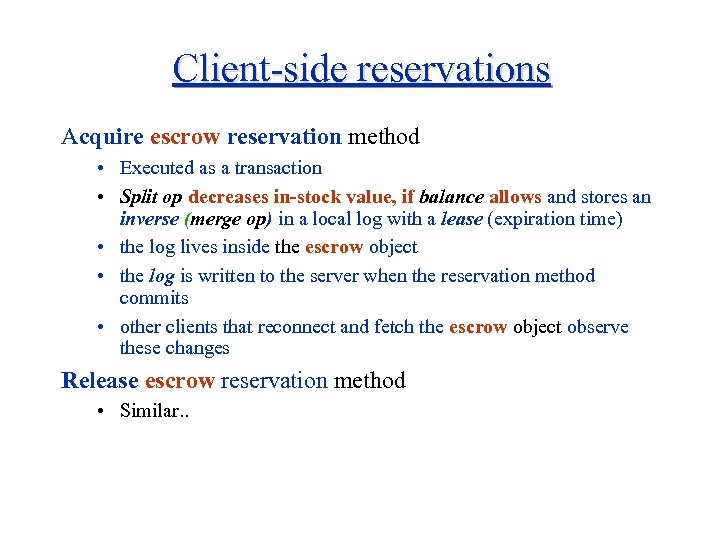
Client-side reservations Acquire escrow reservation method • Executed as a transaction • Split op decreases in-stock value, if balance allows and stores an inverse (merge op) in a local log with a lease (expiration time) • the log lives inside the escrow object • the log is written to the server when the reservation method commits • other clients that reconnect and fetch the escrow object observe these changes Release escrow reservation method • Similar. .
Client reconnects to server to commit top-level transaction Client invokes object-specific commit confirmation actions to make changes covered by leases permanent When top-level transaction commits confirmation actions take effect
Synchronization conflicts What if Mary committed a reservation on the same object? My stale object copy detected My client applies inverse, re-fetches a fresh copy and retries
Failures What if my client crashes, or fails to reconnect in time? Reservation lease expires Other client notices an expired lease, cleans up (applies inverse). That is lazy recovery
So: client reconnects to server to commit top-level transaction Client invokes object-specific commit confirmation actions to make changes covered by leases permanent Client also invokes object-specific confirmation actions to clean-up changes covered by observed expired leases When top-level transaction commits confirmation actions take effect
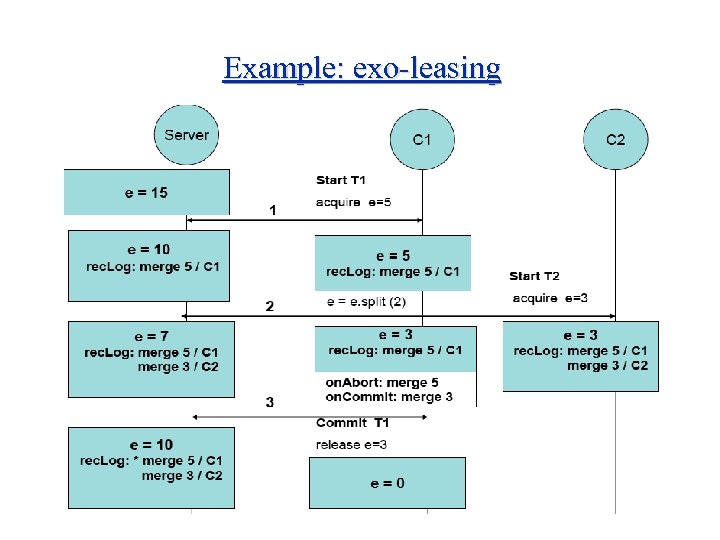
Example: exo-leasing
Considerations No one notices expiration • not needed? Many notice • First cleanup makes other copies stale Performance • Retry OK for moderate contention Clock skew • Use server clock Security • OK in appliance (plus recent security techniques)
Exo-leasing : 2 -level transaction system Low-level: generic server runs base transactions r/w OCC High-level: application transactions run on clients synchronize using escrow objects
ACID for high-level transactions Durability - from base transactions I&C - semantic Atomicity reservations like locks, but unlike locks must release reservations at commit can be lazy on aborts
Server-side 80 -90’s protocol implementations Typically look like a monitor • Monitor procedures manage reservations • A mutex protects the shared state Advantage of exo approach • Can convert server-side to client-side • Can exploit existing clever 80 -90’s algorithms on commodity servers
Transformation: Server-side Escrow to Client-side Service object exports a collection of methods (acquire, release, expire) Object implementation consists of procedures implementing the methods (split and merge) plus shared state they are manipulating: - log of outstanding reservations with leases and inverses - internal state ( in-stock balance object) Code resembles a monitor: a type specific lock manager and a mutex protecting shared state Exo Transformation: Client caches the escrow object, runs methods on cached copy, updates server copy at commit. Cache coherence protocol (invalid sets) replaces mutex Plus two-level transaction system Application level transactions are ACID with semantic I Reservations (semantic locks + timeouts) run as regular ACID
Promised extra benefit “I have extra, want my reservation? “ In today transaction systems must reconnect Exo-leasing enables transfer without reconnecting
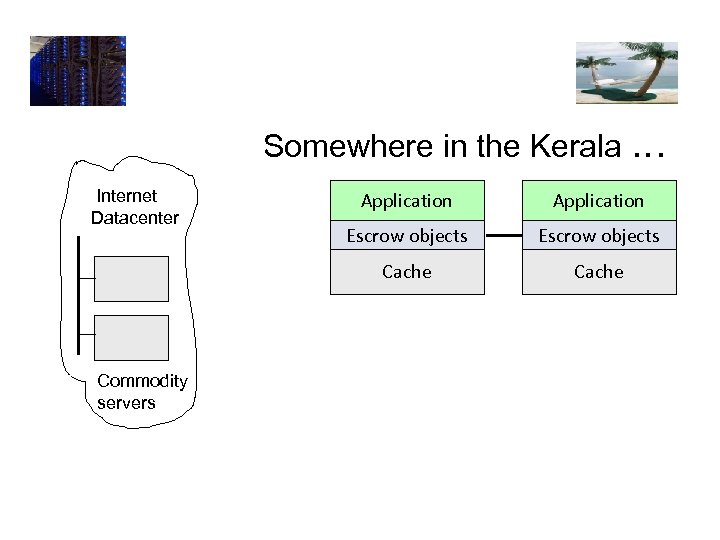
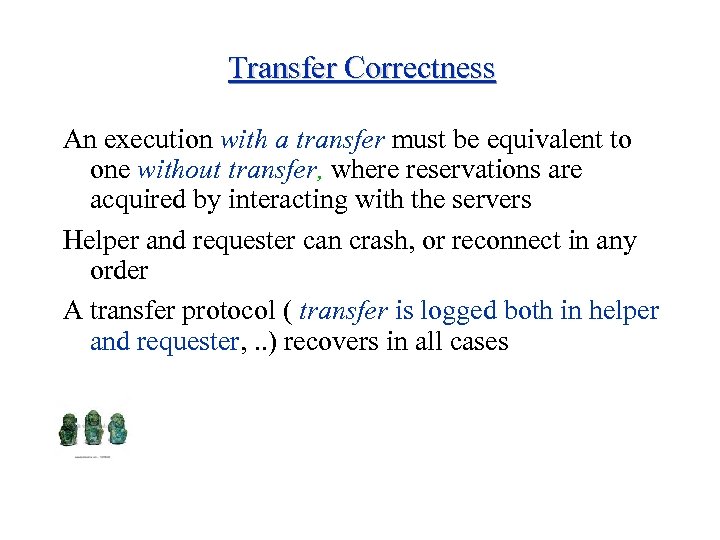
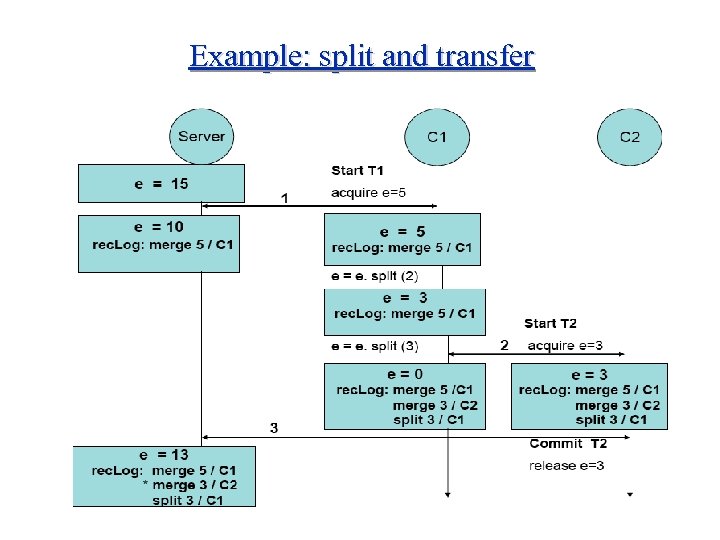
Reservation Transfer Insight: • The client side in exo-leasing carries the complete typespecific synchronization logic • A helper client can “give-up” some of his reservations and transfer it to a requester client, to allow requester to avoid conflicts
Somewhere in the Kerala. . . Internet Datacenter Application Escrow objects Cache Commodity servers Application Cache
Begin top-level transaction Obtain reservations Loop { Refresh/load objects into local cache Disconnect from server Loop{ Perform local tentative transactions Validate tentative transactions against reservations Record transaction results Connect to collaborator // Start reservation split and transfer Refresh/load objects if desired Provide some reservations if desired Obtain new reservations if desired } // End reservation split and transfer Connect to the server Release some reservations if desired Renew or obtain new reservations if necessary } Commit top-level transaction i. e. atomically validate/abort local transactions and release unused reservations.
Transfer Correctness An execution with a transfer must be equivalent to one without transfer, where reservations are acquired by interacting with the servers Helper and requester can crash, or reconnect in any order A transfer protocol ( transfer is logged both in helper and requester, . . ) recovers in all cases
Example: split and transfer
Summary: classic transactions ACID Transactions: a basic abstraction simplifies how programmers deal with concurrency and failures CC: locking Recovery In distributed systems optimistic CC works better, but need conflict reconciliation Type-specific CC: can avoid conflicts but prior approaches face a barrier
Summary: exo-leasing Makes it possible to run type-specific synchronization on generic commodity servers (good for cloud. . ) Enables a new features: reservation transfer between mobile clients We examined escrow, but approach is general – can recycle clever schemes from 80’s and 90’s
Any Questions? Builds on: Thor system (SIGMOD 95, MIT project) MX system (ECOOP 06, Brandeis project) Exo-leasing system (Middleware 08, Brandeis + Doug Terry) Future work: client side merge for CRDT server side PSI (builds on snapshot system called Retro)
Glossing over: Experimental evaluation • Prior studies show performance benefit of type-specific reservations (Prequica, 80’s-90’s) mobile C 2 C transfer (Tian, Flynn, Issarny. . . ) • Do not repeat, focus on the cost of doing business with exo-leasing the overhead of disconnected validation • The upshot: cost is moderate
Skipping: System design and implementation details for client side • 2 -level transaction system + open nested transactions for reservations (server side: Lomet/Weikum ) • mobile cooperative caching system (Tian 06, Blue 07)
Extension 1: long running transactions Exo-leasing • Helps long-running update transactions Snapshot Isolation • Help long-running queries (read-only transactions) How about both ? See our Exo. Snap paper proposal.
Extension 2: Exo-leasing • Helps fragmentable types CRDTS • Help commutative types How about both? in progress. . client side
Скачать презентацию ACID and Modularity in the Cloud Liuba Shrira
5d4219b42d37d54fcbe15749ddf87c3f.ppt