 Скачать презентацию Achieving Sustainable Growth Through Engagement with the Private
3a236a23a86a3e6d6d2dd680d53d1644.ppt
- Количество слайдов: 15



Achieving Sustainable Growth Through Engagement with the Private Sector: Symposium on Environment and Engagement of the Private Sector Tokyo, March 26, 2008 Motoko Aizawa Environment and Social Development Department
Under a Business as Usual Scenario § Economic development as a pressing global priority – Emerging markets’ “right to grow” – North to south/west to east flows Trade, investments and projects externalizing environmental and socioeconomic costs § One-off investments with typically shorter time horizons and limited geographic scope § Technology risk as a constraint § 2
From Business as Usual to a New Business Model Private sector as driver of sustainable development through trade, investments, projects § Demonstrating corporate responsibility and realizing business benefits by responding to voluntary codes and principles § Partnership with the public sector / emerging markets players to minimize risks, maximize Private Sector as part of the solution for impacts Global Sustainable Development Challenges § 3
IFC – A Decade of Experience in Managing E&S Risks & Creating Opportunities § Built its environmental and social sustainability policy framework over a decade – Sustainability Policy & Disclosure Policy – 8 Performance Standards – 62 sector-specific Environmental, Health and Safety Guidelines Internal technical expertise § Mainstreaming E&S issues in core operations § Together these provide a framework to: § – Manage project risks – Improve IFC performance 4
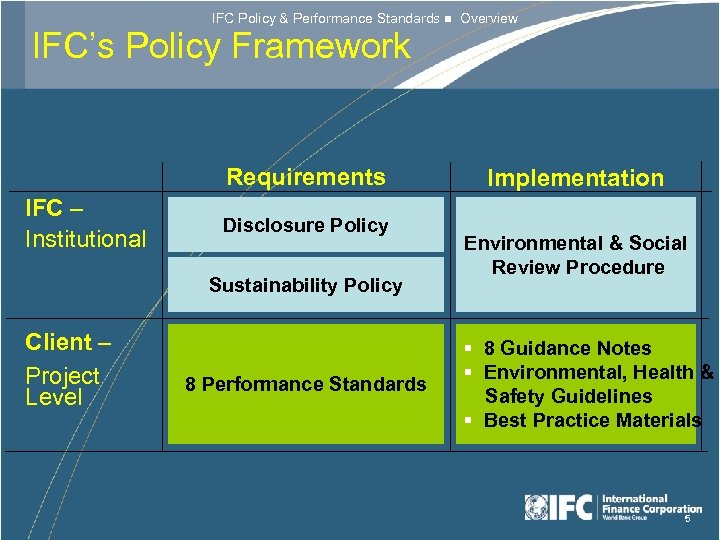
IFC Policy & Performance Standards n Overview IFC’s Policy Framework Requirements IFC – Institutional Disclosure Policy Sustainability Policy Client – Project Level 8 Performance Standards Implementation Environmental & Social Review Procedure § 8 Guidance Notes § Environmental, Health & Safety Guidelines § Best Practice Materials 5
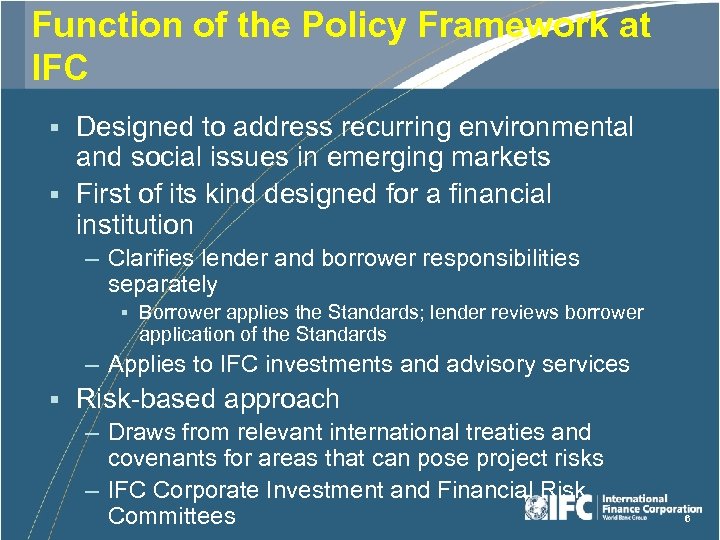
Function of the Policy Framework at IFC Designed to address recurring environmental and social issues in emerging markets § First of its kind designed for a financial institution § – Clarifies lender and borrower responsibilities separately § Borrower applies the Standards; lender reviews borrower application of the Standards – Applies to IFC investments and advisory services § Risk-based approach – Draws from relevant international treaties and covenants for areas that can pose project risks – IFC Corporate Investment and Financial Risk Committees 6
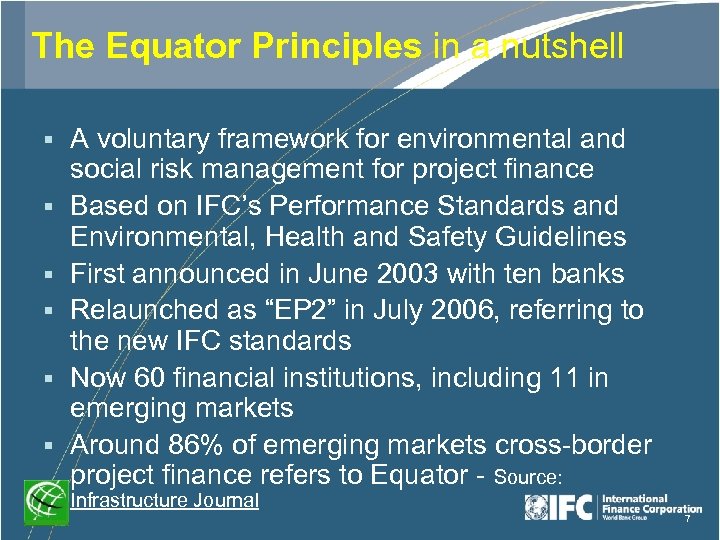
The Equator Principles in a nutshell § § § A voluntary framework for environmental and social risk management for project finance Based on IFC’s Performance Standards and Environmental, Health and Safety Guidelines First announced in June 2003 with ten banks Relaunched as “EP 2” in July 2006, referring to the new IFC standards Now 60 financial institutions, including 11 in emerging markets Around 86% of emerging markets cross-border project finance refers to Equator - Source: Infrastructure Journal 7
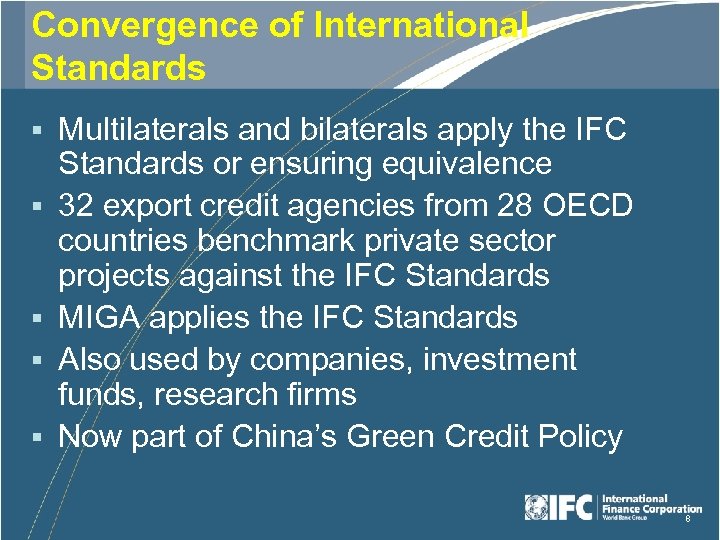
Convergence of International Standards § § § Multilaterals and bilaterals apply the IFC Standards or ensuring equivalence 32 export credit agencies from 28 OECD countries benchmark private sector projects against the IFC Standards MIGA applies the IFC Standards Also used by companies, investment funds, research firms Now part of China’s Green Credit Policy 8
Application of International Standards Protect the environment, benefit local communities, and meet expectations of civil society § Business benefits § – Manage risks, protect reputation – Level the playing field – Improve predictability and create efficiencies in large projects and syndications – Gain access to global network of knowledge, institutions § Helps guide sustainable private sector projects and investments in emerging markets 9
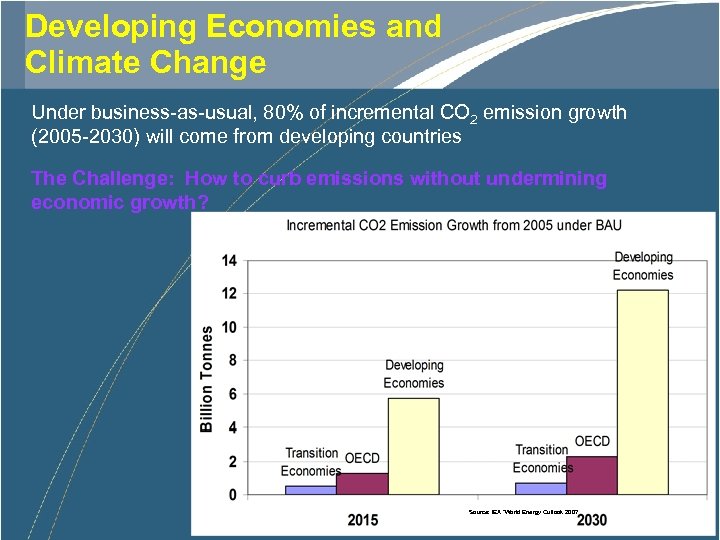
Developing Economies and Climate Change Under business-as-usual, 80% of incremental CO 2 emission growth (2005 -2030) will come from developing countries The Challenge: How to curb emissions without undermining economic growth? Source: IEA “World Energy Outlook 2007 10
IFC’s Overall Approach to Climate Change § Private sector critical in addressing climate change Potential IFC Role: –Scope to crowd in substantial private investments –A role in accelerating technology transfer –Climate Investment Fund –Encourage south-south investments –Leverage Equator banks § A Balanced Approach –IFC primary goal of sustainable development - to be balanced with climate change concerns § IFC collaboration with World Bank, public sector key 11
IFC’s Climate Change Strategy: Near Term Priorities § Mainstreaming climate across IFC – Double / triple “win-win” investments in renewable energy (RE) and energy efficiency (EE) across all sectors – Pursue mitigation opportunities in cleaner fuels, sustainable forestry, agriculture § Transforming economic activity towards low carbon and climate resilient growth – E. g. , Through CIF: Several dedicated funds with focus on clean technology investment, adaptation and forestry, etc. – Concessional loans, guarantees, insurance, grants and riskmanagement tools § Scaling up carbon finance – Carbon market is now € 40 billion/year (2007) and growing – IFC is offering an innovative Carbon Delivery Guarantee 12
IFC’s Climate Change Strategy: New Initiatives § IFC’s role in adaptation to climate change – Most urgent for vulnerable emerging markets – Relevant for risk professionals in FIs – Piloting projects in Asia, Africa to analyze physical, financial and human risks & risk reduction opportunities § Measuring GHGs in IFC’s portfolio – IFC to begin reporting portfolio GHG emissions in FY 08 – Developing tools consistent with WRI/WBCSD GHG protocol, tailored to FIs – Possible upgrading of IFC’s Performance Standard 3 / Equator Principles § The pilot use of carbon shadow prices in project appraisal – Considering the inclusion of a range of “shadow prices” for GHGs in financial analysis 13
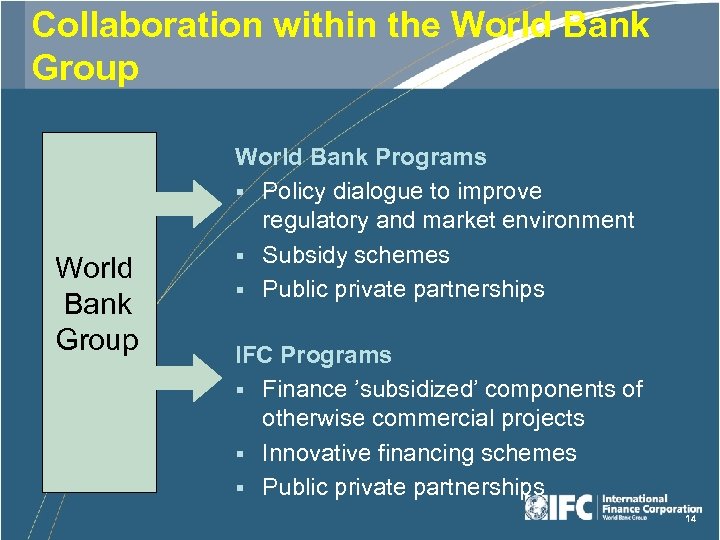
Collaboration within the World Bank Group World Bank Programs § Policy dialogue to improve regulatory and market environment § Subsidy schemes § Public private partnerships IFC Programs § Finance ’subsidized’ components of otherwise commercial projects § Innovative financing schemes § Public private partnerships 14
Private Sector: Part of Solution to Climate Change “The Bali Action Plan calls for the road to Copenhagen to be an open process – open to the private sector, international organisations and civil society. This offers opportunities for the business community to contribute. With private sector constituting 86 percent of investment financial flows related to climate change, businesses are vital to the solution. Business could, for example, explain its views on technology transfer, contribute to the design of sectoral approaches, and help to write financial language into the final deal. ” Yvo de Boer, Executive Secretary 15
Скачать презентацию Achieving Sustainable Growth Through Engagement with the Private
3a236a23a86a3e6d6d2dd680d53d1644.ppt