 Скачать презентацию Achieving Profitable and Sustainable Growth İstanbul 06 April
04be76b86f3db9ec29fc2b1e89a369cc.ppt
- Количество слайдов: 59



Achieving Profitable and Sustainable Growth İstanbul 06, April, 2009 This report is confidential and is intended solely for the use and information of Tunçsan. No third parties may rely on this report. . 0
Table Of Contents I. Executive Summary II. Turkish Fresh Tomato and Tomato Paste Market III. Overview of Tunçsan and Its Business IV. Overview of Tunçsan’s Current Operations V. Future Prospects: New Business Opportunities 1
I. Executive Summary 2
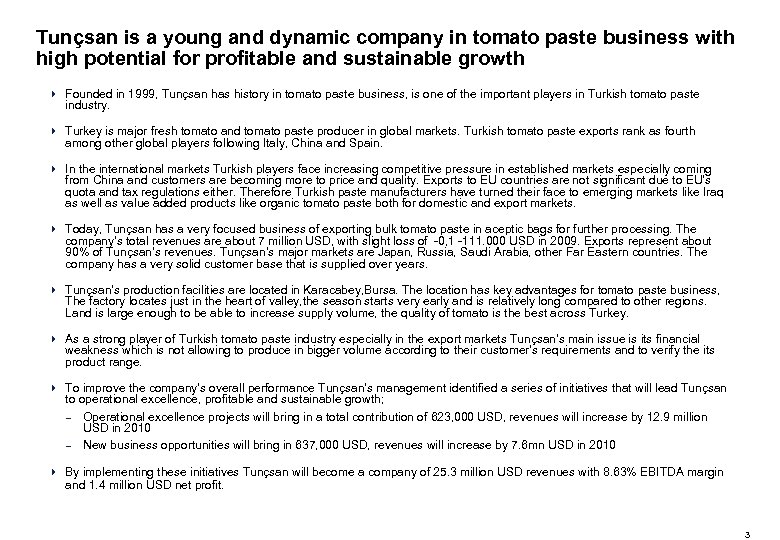
Tunçsan is a young and dynamic company in tomato paste business with high potential for profitable and sustainable growth 4 Founded in 1999, Tunçsan has history in tomato paste business, is one of the important players in Turkish tomato paste industry. 4 Turkey is major fresh tomato and tomato paste producer in global markets. Turkish tomato paste exports rank as fourth among other global players following Italy, China and Spain. 4 In the international markets Turkish players face increasing competitive pressure in established markets especially coming from China and customers are becoming more to price and quality. Exports to EU countries are not significant due to EU’s quota and tax regulations either. Therefore Turkish paste manufacturers have turned their face to emerging markets like Iraq as well as value added products like organic tomato paste both for domestic and export markets. 4 Today, Tunçsan has a very focused business of exporting bulk tomato paste in aceptic bags for further processing. The company’s total revenues are about 7 million USD, with slight loss of -0, 1 -111. 000 USD in 2009. Exports represent about 90% of Tunçsan’s revenues. Tunçsan’s major markets are Japan, Russia, Saudi Arabia, other Far Eastern countries. The company has a very solid customer base that is supplied over years. 4 Tunçsan’s production facilities are located in Karacabey, Bursa. The location has key advantages for tomato paste business, The factory locates just in the heart of valley, the season starts very early and is relatively long compared to other regions. Land is large enough to be able to increase supply volume, the quality of tomato is the best across Turkey. 4 As a strong player of Turkish tomato paste industry especially in the export markets Tunçsan’s main issue is its financial weakness which is not allowing to produce in bigger volume according to their customer’s requirements and to verify the its product range. 4 To improve the company’s overall performance Tunçsan’s management identified a series of initiatives that will lead Tunçsan to operational excellence, profitable and sustainable growth; – Operational excellence projects will bring in a total contribution of 623, 000 USD, revenues will increase by 12. 9 million USD in 2010 – New business opportunities will bring in 637, 000 USD, revenues will increase by 7. 6 mn USD in 2010 4 By implementing these initiatives Tunçsan will become a company of 25. 3 million USD revenues with 8. 63% EBITDA margin and 1. 4 million USD net profit. 3
II. Turkish Fresh Tomato and Tomato Paste Market 4
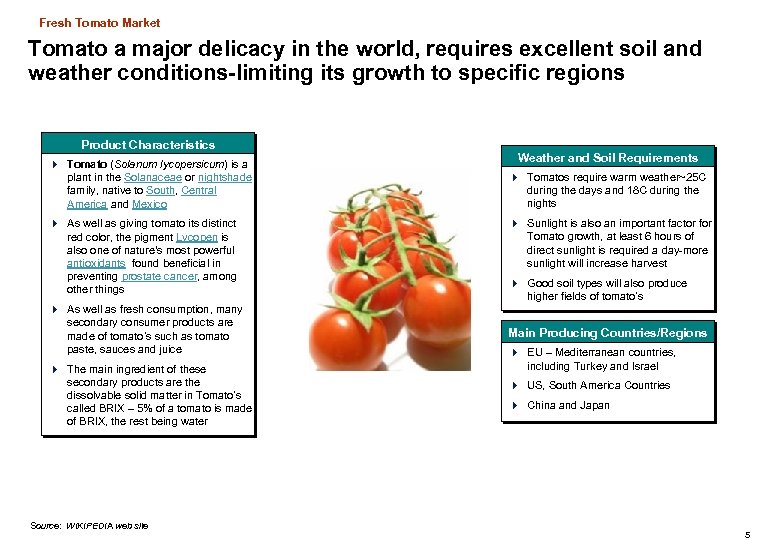
Fresh Tomato Market Tomato a major delicacy in the world, requires excellent soil and weather conditions-limiting its growth to specific regions Product Characteristics 4 Tomato (Solanum lycopersicum) is a plant in the Solanaceae or nightshade family, native to South, Central America and Mexico 4 As well as giving tomato its distinct red color, the pigment Lycopen is also one of nature's most powerful antioxidants found beneficial in preventing prostate cancer, among other things 4 As well as fresh consumption, many secondary consumer products are made of tomato’s such as tomato paste, sauces and juice 4 The main ingredient of these secondary products are the dissolvable solid matter in Tomato’s called BRIX – 5% of a tomato is made of BRIX, the rest being water Source: WIKIPEDIA web site Weather and Soil Requirements 4 Tomatos require warm weather~25 C during the days and 18 C during the nights 4 Sunlight is also an important factor for Tomato growth, at least 6 hours of direct sunlight is required a day-more sunlight will increase harvest 4 Good soil types will also produce higher fields of tomato’s Main Producing Countries/Regions 4 EU – Mediterranean countries, including Turkey and Israel 4 US, South America Countries 4 China and Japan 5
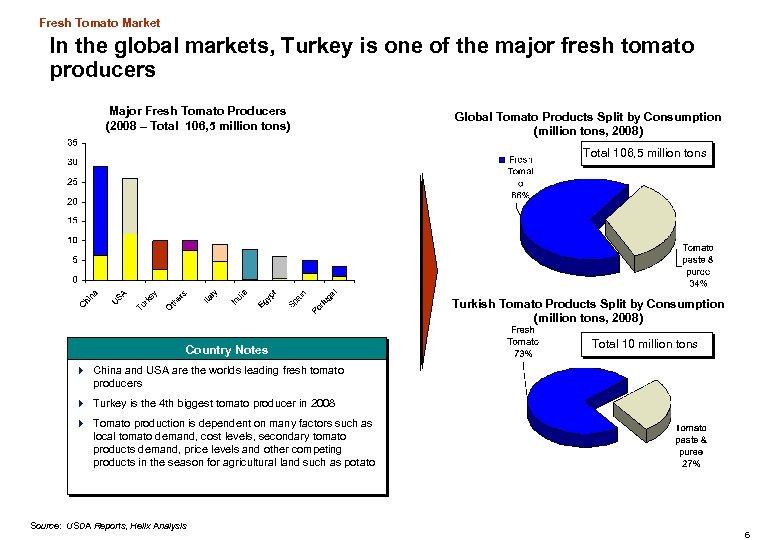
Fresh Tomato Market In the global markets, Turkey is one of the major fresh tomato producers Major Fresh Tomato Producers (2008 – Total 106, 5 million tons) Global Tomato Products Split by Consumption (million tons, 2008) Total 106, 5 million tons Turkish Tomato Products Split by Consumption (million tons, 2008) Country Notes Total 10 million tons 4 China and USA are the worlds leading fresh tomato producers 4 Turkey is the 4 th biggest tomato producer in 2008 4 Tomato production is dependent on many factors such as local tomato demand, cost levels, secondary tomato products demand, price levels and other competing products in the season for agricultural land such as potato Source: USDA Reports, Helix Analysis 6
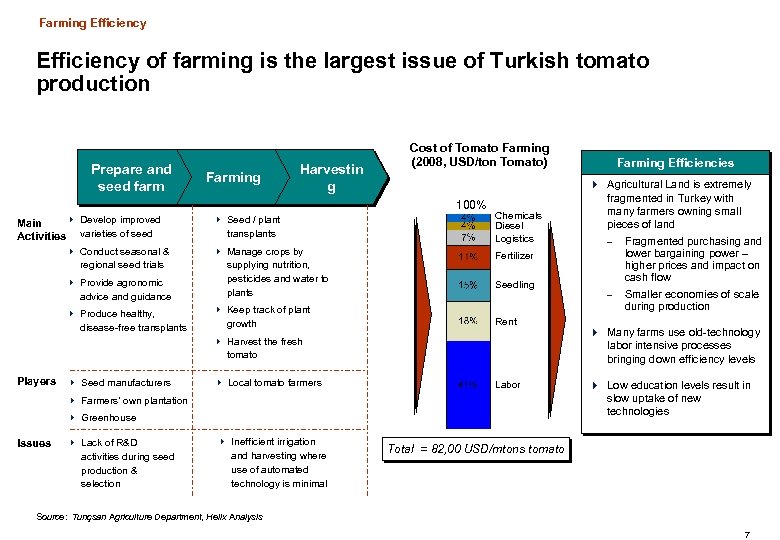
Farming Efficiency of farming is the largest issue of Turkish tomato production Prepare and seed farm Farming Harvestin g Cost of Tomato Farming (2008, USD/ton Tomato) 100% 4 Seed / plant transplants Chemicals Diesel Logistics 4 Produce healthy, disease-free transplants 4 Keep track of plant growth 4 Develop improved Main Activities varieties of seed 4 Conduct seasonal & regional seed trials Players 4 Seed manufacturers 4 Local tomato farmers Rent Labor 4 Greenhouse 4 Inefficient irrigation and harvesting where use of automated technology is minimal Fragmented purchasing and lower bargaining power – higher prices and impact on cash flow – 4 Farmers’ own plantation 4 Lack of R&D activities during seed production & selection – Smaller economies of scale during production Seedling 4 Harvest the fresh tomato Issues 4 Agricultural Land is extremely fragmented in Turkey with many farmers owning small pieces of land Fertilizer 4 Provide agronomic advice and guidance 4 Manage crops by supplying nutrition, pesticides and water to plants Farming Efficiencies 4 Many farms use old-technology labor intensive processes bringing down efficiency levels 4 Low education levels result in slow uptake of new technologies Total = 82, 00 USD/mtons tomato Source: Tunçsan Agriculture Department, Helix Analysis 7
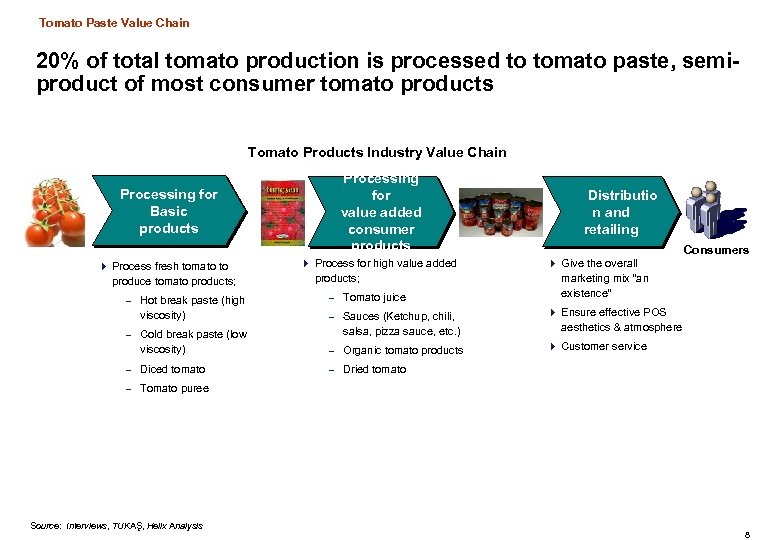
Tomato Paste Value Chain 20% of total tomato production is processed to tomato paste, semiproduct of most consumer tomato products Tomato Products Industry Value Chain Processing for Basic products Processing for value added consumer products 4 Process fresh tomato to produce tomato products; 4 Process for high value added products; Distributio n and retailing Consumers – Tomato juice 4 Give the overall marketing mix “an existence” – Cold break paste (low viscosity) Sauces (Ketchup, chili, salsa, pizza sauce, etc. ) 4 Ensure effective POS aesthetics & atmosphere – Organic tomato products 4 Customer service – Diced tomato – Dried tomato – Tomato puree – – Hot break paste (high viscosity) Source: Interviews, TUKAŞ, Helix Analysis 8
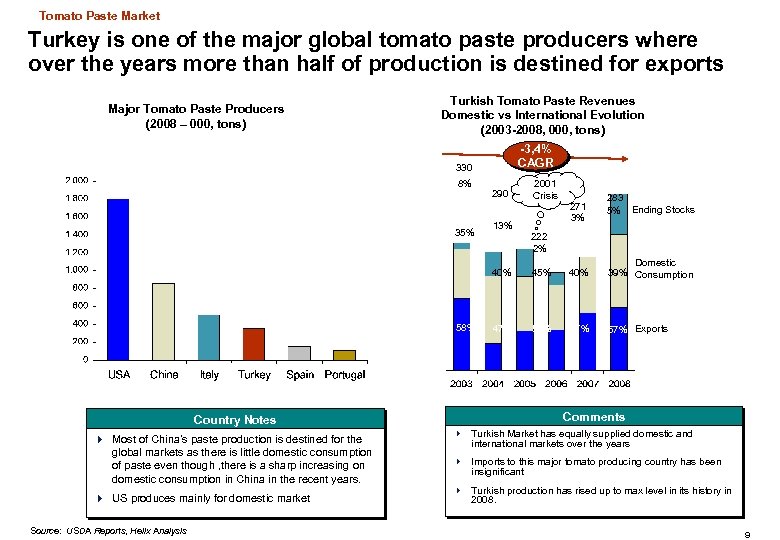
Tomato Paste Market Turkey is one of the major global tomato paste producers where over the years more than half of production is destined for exports Major Tomato Paste Producers (2008 – 000, tons) Turkish Tomato Paste Revenues Domestic vs International Evolution (2003 -2008, 000, tons) -3, 4% CAGR 330 8% 35% 290 13% 2001 Crisis 271 3% 283 5% Ending Stocks 222 2% 40% 58% Country Notes 4 Most of China’s paste production is destined for the global markets as there is little domestic consumption of paste even though , there is a sharp increasing on domestic consumption in China in the recent years. 4 US produces mainly for domestic market Source: USDA Reports, Helix Analysis 45% 40% Domestic 39% Consumption 47% 53% 57% Exports Comments 4 Turkish Market has equally supplied domestic and international markets over the years 4 Imports to this major tomato producing country has been insignificant 4 Turkish production has rised up to max level in its history in 2008. 9
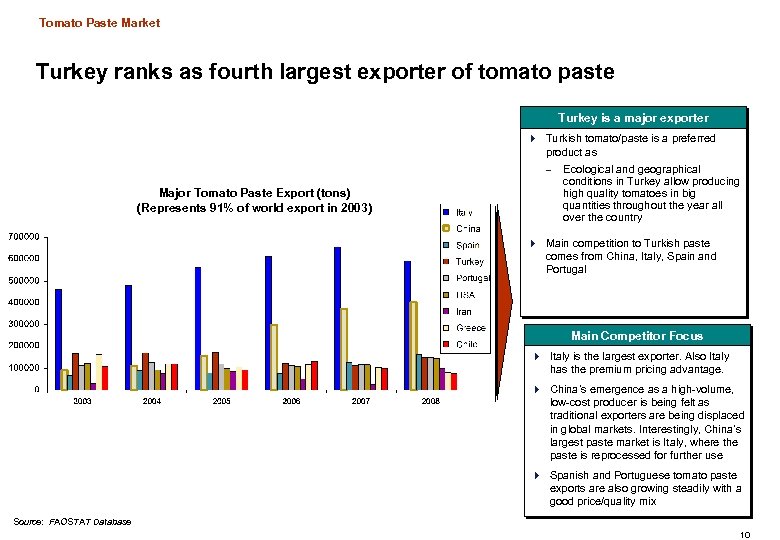
Tomato Paste Market Turkey ranks as fourth largest exporter of tomato paste Turkey is a major exporter 4 Turkish tomato/paste is a preferred product as – Major Tomato Paste Export (tons) (Represents 91% of world export in 2003) Ecological and geographical conditions in Turkey allow producing high quality tomatoes in big quantities throughout the year all over the country 4 Main competition to Turkish paste comes from China, Italy, Spain and Portugal Main Competitor Focus 4 Italy is the largest exporter. Also Italy has the premium pricing advantage. 4 China’s emergence as a high-volume, low-cost producer is being felt as traditional exporters are being displaced in global markets. Interestingly, China’s largest paste market is Italy, where the paste is reprocessed for further use 4 Spanish and Portuguese tomato paste exports are also growing steadily with a good price/quality mix Source: FAOSTAT Database 10
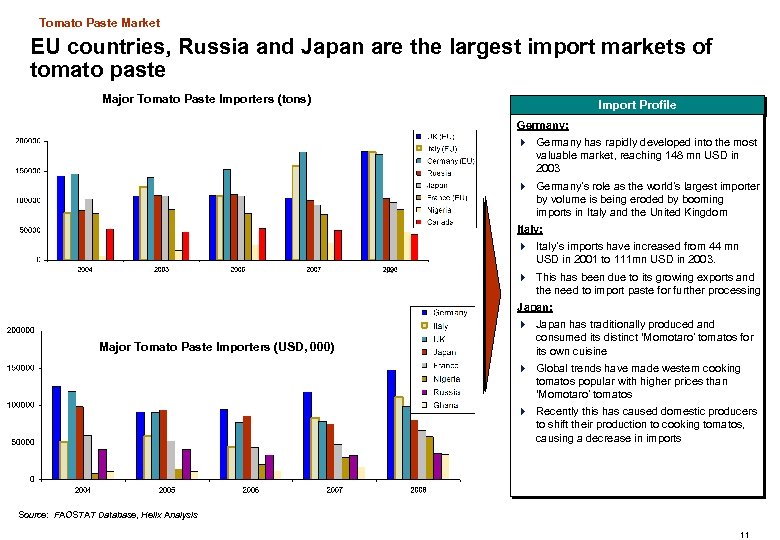
Tomato Paste Market EU countries, Russia and Japan are the largest import markets of tomato paste Major Tomato Paste Importers (tons) Import Profile Germany: Major Tomato Paste Importers (USD, 000) 4 Germany has rapidly developed into the most valuable market, reaching 148 mn USD in 2003 4 Germany’s role as the world’s largest importer by volume is being eroded by booming imports in Italy and the United Kingdom Italy: 4 Italy’s imports have increased from 44 mn USD in 2001 to 111 mn USD in 2003. 4 This has been due to its growing exports and the need to import paste for further processing Japan: 4 Japan has traditionally produced and consumed its distinct ‘Momotaro’ tomatos for its own cuisine 4 Global trends have made western cooking tomatos popular with higher prices than ‘Momotaro’ tomatos 4 Recently this has caused domestic producers to shift their production to cooking tomatos, causing a decrease in imports Source: FAOSTAT Database, Helix Analysis 11
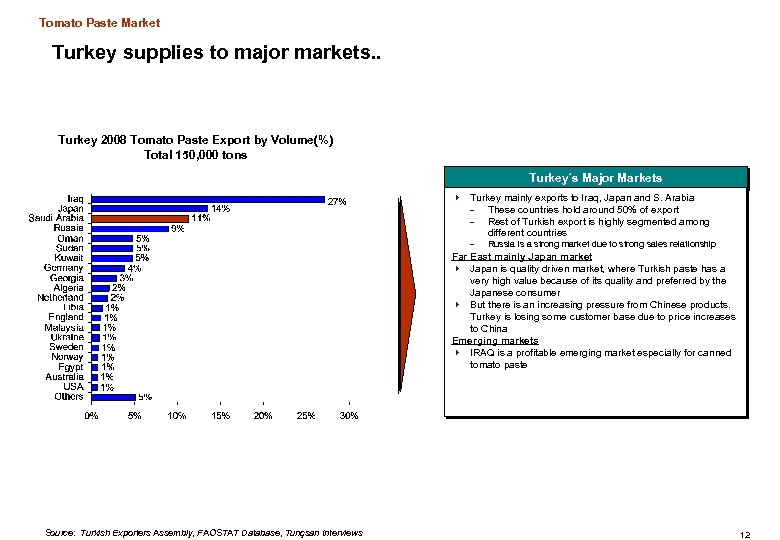
Tomato Paste Market Turkey supplies to major markets. . Turkey 2008 Tomato Paste Export by Volume(%) Total 150, 000 tons Turkey´s Major Markets 4 Turkey mainly exports to Iraq, Japan and S. Arabia – These countries hold around 50% of export – Rest of Turkish export is highly segmented among different countries – Russia is a strong market due to strong sales relationship Far East mainly Japan market 4 Japan is quality driven market, where Turkish paste has a very high value because of its quality and preferred by the Japanese consumer 4 But there is an increasing pressure from Chinese products. Turkey is losing some customer base due to price increases to China Emerging markets 4 IRAQ is a profitable emerging market especially for canned tomato paste Source: Turkish Exporters Assembly, FAOSTAT Database, Tunçsan Interviews 12
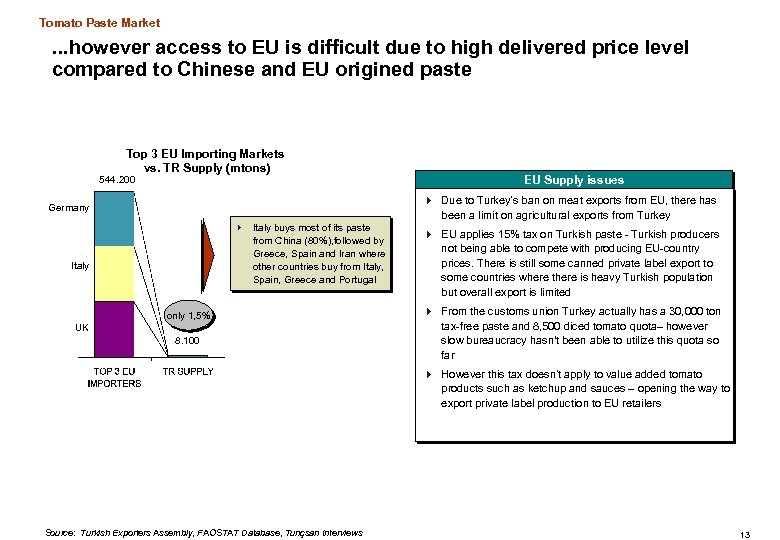
Tomato Paste Market . . . however access to EU is difficult due to high delivered price level compared to Chinese and EU origined paste Top 3 EU Importing Markets vs. TR Supply (mtons) 544. 200 EU Supply issues 4 Due to Turkey’s ban on meat exports from EU, there has been a limit on agricultural exports from Turkey Germany 4 Italy buys most of its paste from China (80%), followed by Greece, Spain and Iran where other countries buy from Italy, Spain, Greece and Portugal Italy only 1, 5% UK 8. 100 4 EU applies 15% tax on Turkish paste - Turkish producers not being able to compete with producing EU-country prices. There is still some canned private label export to some countries where there is heavy Turkish population but overall export is limited 4 From the customs union Turkey actually has a 30, 000 ton tax-free paste and 8, 500 diced tomato quota– however slow bureaucracy hasn't been able to utilize this quota so far 4 However this tax doesn’t apply to value added tomato products such as ketchup and sauces – opening the way to export private label production to EU retailers Source: Turkish Exporters Assembly, FAOSTAT Database, Tunçsan Interviews 13
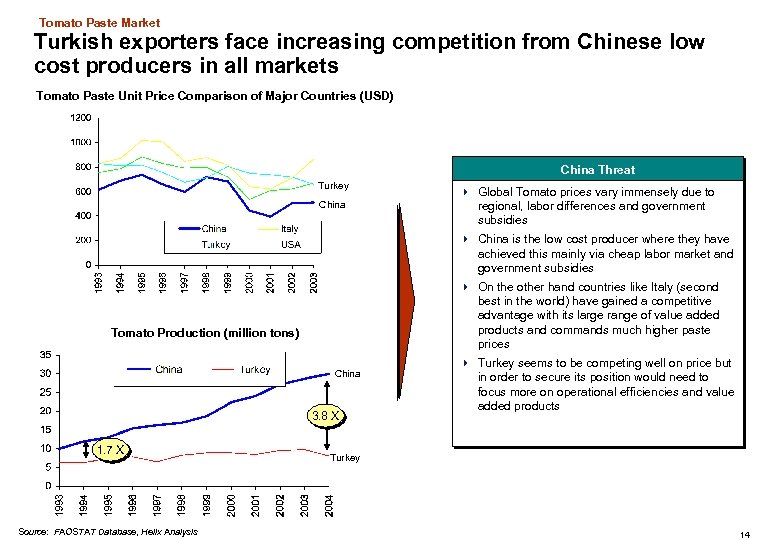
Tomato Paste Market Turkish exporters face increasing competition from Chinese low cost producers in all markets Tomato Paste Unit Price Comparison of Major Countries (USD) China Threat Turkey China Tomato Production (million tons) China 3. 8 X 1. 7 X Source: FAOSTAT Database, Helix Analysis 4 Global Tomato prices vary immensely due to regional, labor differences and government subsidies 4 China is the low cost producer where they have achieved this mainly via cheap labor market and government subsidies 4 On the other hand countries like Italy (second best in the world) have gained a competitive advantage with its large range of value added products and commands much higher paste prices 4 Turkey seems to be competing well on price but in order to secure its position would need to focus more on operational efficiencies and value added products Turkey 14
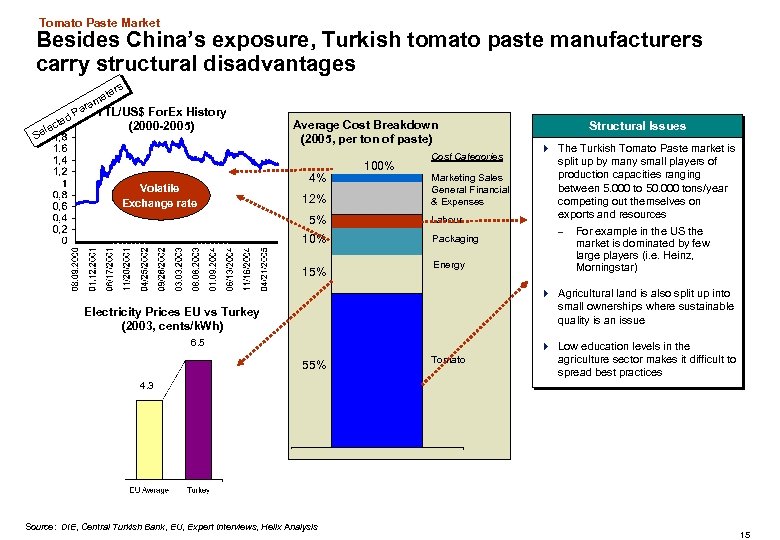
Tomato Paste Market Besides China’s exposure, Turkish tomato paste manufacturers carry structural disadvantages rs ete ram Pa YTL/US$ For. Ex History ted c (2000 -2005) ele S Volatile Exchange rate Average Cost Breakdown (2005, per ton of paste) 4% 12% 5% 10% 15% 100% Cost Categories Marketing Sales General Financial & Expenses Labour Packaging Energy Structural Issues 4 The Turkish Tomato Paste market is split up by many small players of production capacities ranging between 5. 000 to 50. 000 tons/year competing out themselves on exports and resources – For example in the US the market is dominated by few large players (i. e. Heinz, Morningstar) 4 Agricultural land is also split up into small ownerships where sustainable quality is an issue Electricity Prices EU vs Turkey (2003, cents/k. Wh) 6. 5 55% Tomato 4 Low education levels in the agriculture sector makes it difficult to spread best practices 4. 3 Source: DIE, Central Turkish Bank, EU, Expert Interviews, Helix Analysis 15
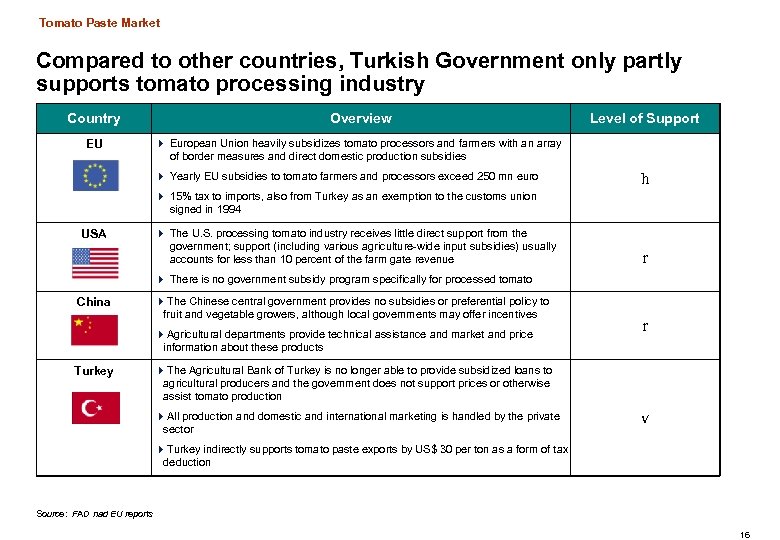
Tomato Paste Market Compared to other countries, Turkish Government only partly supports tomato processing industry Country Overview EU 4 European Union heavily subsidizes tomato processors and farmers with an array of border measures and direct domestic production subsidies 4 Yearly EU subsidies to tomato farmers and processors exceed 250 mn euro Level of Support h 4 15% tax to imports, also from Turkey as an exemption to the customs union signed in 1994 USA 4 The U. S. processing tomato industry receives little direct support from the government; support (including various agriculture-wide input subsidies) usually accounts for less than 10 percent of the farm gate revenue r 4 There is no government subsidy program specifically for processed tomato China 4 The Chinese central government provides no subsidies or preferential policy to fruit and vegetable growers, although local governments may offer incentives 4 Agricultural departments provide technical assistance and market and price information about these products Turkey r 4 The Agricultural Bank of Turkey is no longer able to provide subsidized loans to agricultural producers and the government does not support prices or otherwise assist tomato production 4 All production and domestic and international marketing is handled by the private sector v 4 Turkey indirectly supports tomato paste exports by US$ 30 per ton as a form of tax deduction Source: FAD nad EU reports 16
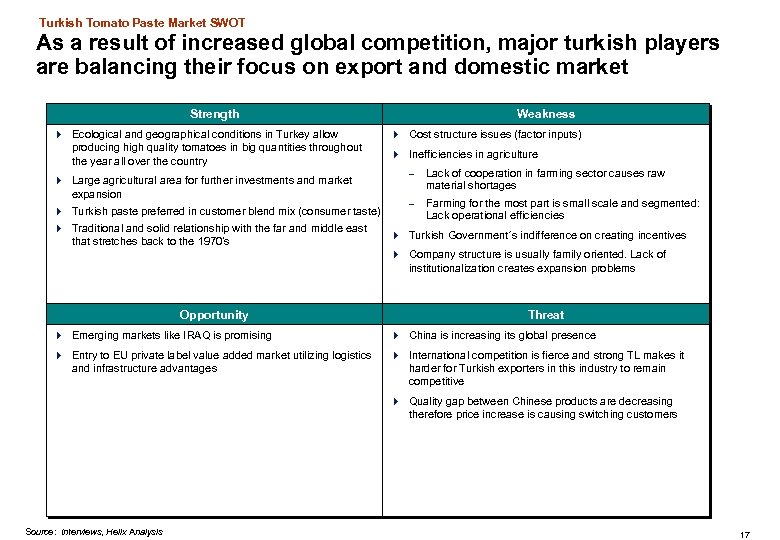
Turkish Tomato Paste Market SWOT As a result of increased global competition, major turkish players are balancing their focus on export and domestic market Strength 4 Ecological and geographical conditions in Turkey allow producing high quality tomatoes in big quantities throughout the year all over the country Weakness 4 Cost structure issues (factor inputs) 4 Inefficiencies in agriculture – Lack of cooperation in farming sector causes raw 4 Large agricultural area for further investments and market material shortages expansion – Farming for the most part is small scale and segmented: 4 Turkish paste preferred in customer blend mix (consumer taste) Lack operational efficiencies 4 Traditional and solid relationship with the far and middle east 4 Turkish Government´s indifference on creating incentives that stretches back to the 1970’s 4 Company structure is usually family oriented. Lack of institutionalization creates expansion problems Opportunity Threat 4 Emerging markets like IRAQ is promising 4 China is increasing its global presence 4 Entry to EU private label value added market utilizing logistics and infrastructure advantages 4 International competition is fierce and strong TL makes it harder for Turkish exporters in this industry to remain competitive 4 Quality gap between Chinese products are decreasing therefore price increase is causing switching customers Source: Interviews, Helix Analysis 17
III. Overview of Tunçsan and its Business 18
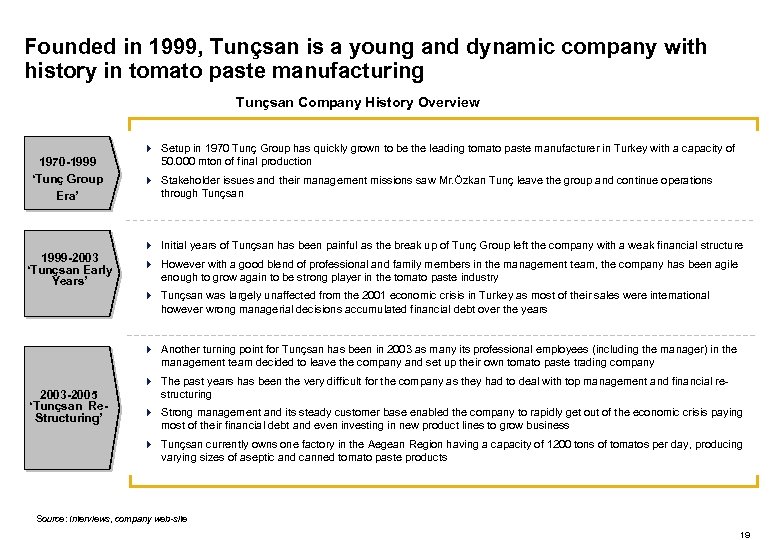
Founded in 1999, Tunçsan is a young and dynamic company with history in tomato paste manufacturing Tunçsan Company History Overview 1970 -1999 ‘Tunç Group Era’ 1999 -2003 ‘Tunçsan Early Years’ 4 Setup in 1970 Tunç Group has quickly grown to be the leading tomato paste manufacturer in Turkey with a capacity of 50. 000 mton of final production 4 Stakeholder issues and their management missions saw Mr. Özkan Tunç leave the group and continue operations through Tunçsan 4 Initial years of Tunçsan has been painful as the break up of Tunç Group left the company with a weak financial structure 4 However with a good blend of professional and family members in the management team, the company has been agile enough to grow again to be strong player in the tomato paste industry 4 Tunçsan was largely unaffected from the 2001 economic crisis in Turkey as most of their sales were international however wrong managerial decisions accumulated financial debt over the years 4 Another turning point for Tunçsan has been in 2003 as many its professional employees (including the manager) in the management team decided to leave the company and set up their own tomato paste trading company 2003 -2005 ‘Tunçsan Re. Structuring’ 4 The past years has been the very difficult for the company as they had to deal with top management and financial restructuring 4 Strong management and its steady customer base enabled the company to rapidly get out of the economic crisis paying most of their financial debt and even investing in new product lines to grow business 4 Tunçsan currently owns one factory in the Aegean Region having a capacity of 1200 tons of tomatos per day, producing varying sizes of aseptic and canned tomato paste products Source: Interviews, company web-site 19
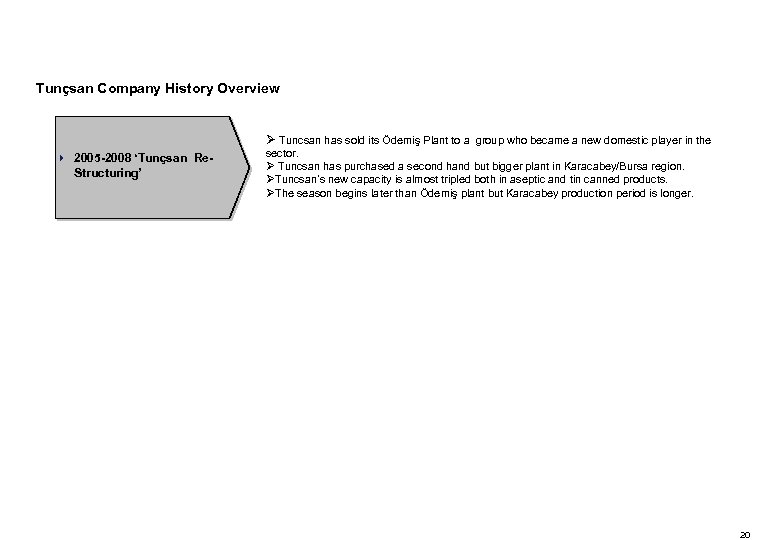
Tunçsan Company History Overview Ø Tuncsan has sold its Ödemiş Plant to a group who became a new domestic player in the 4 2005 -2008 ‘Tunçsan Re. Structuring’ sector. Ø Tuncsan has purchased a second hand but bigger plant in Karacabey/Bursa region. ØTuncsan’s new capacity is almost tripled both in aseptic and tin canned products. ØThe season begins later than Ödemiş plant but Karacabey production period is longer. 20
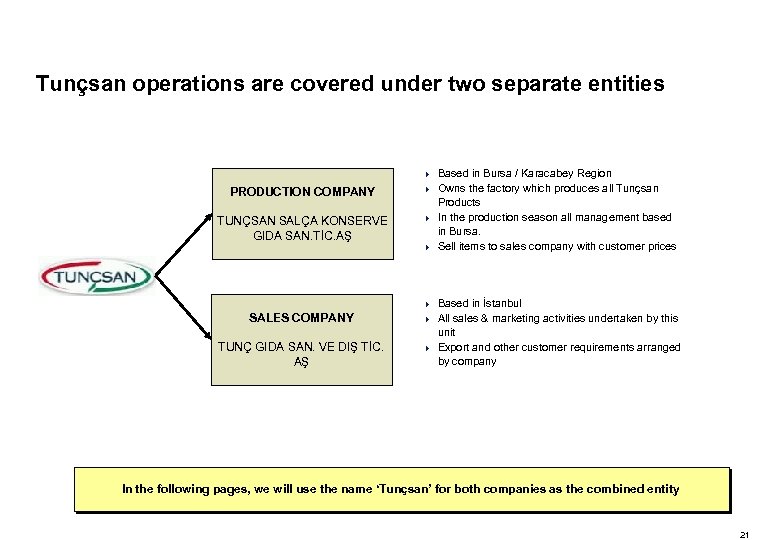
Tunçsan operations are covered under two separate entities 4 PRODUCTION COMPANY 4 TUNÇSAN SALÇA KONSERVE GIDA SAN. TİC. AŞ 4 4 4 SALES COMPANY TUNÇ GIDA SAN. VE DIŞ TİC. AŞ 4 4 Based in Bursa / Karacabey Region Owns the factory which produces all Tunçsan Products In the production season all management based in Bursa. Sell items to sales company with customer prices Based in İstanbul All sales & marketing activities undertaken by this unit Export and other customer requirements arranged by company In the following pages, we will use the name ‘Tunçsan’ for both companies as the combined entity 21
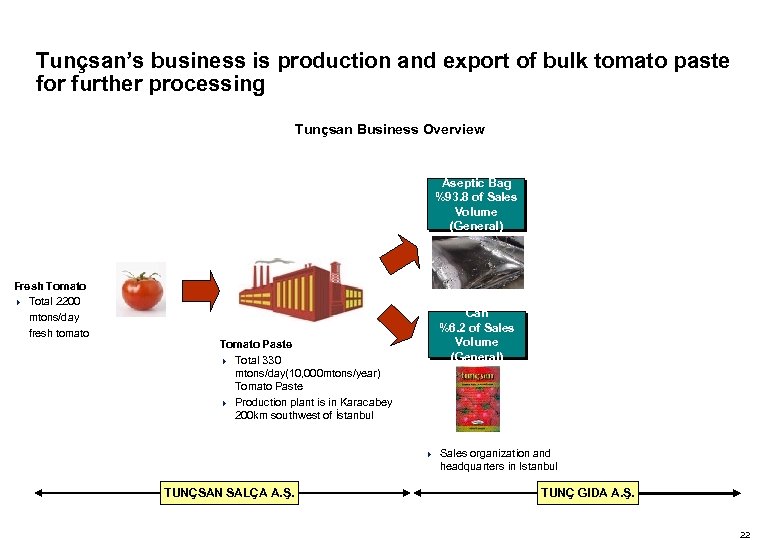
Tunçsan’s business is production and export of bulk tomato paste for further processing Tunçsan Business Overview Aseptic Bag %93. 8 of Sales Volume (General) Fresh Tomato 4 Total 2200 mtons/day fresh tomato Can %6. 2 of Sales Volume (General) Tomato Paste 4 Total 330 mtons/day(10, 000 mtons/year) Tomato Paste 4 Production plant is in Karacabey 200 km southwest of İstanbul 4 TUNÇSAN SALÇA A. Ş. Sales organization and headquarters in Istanbul TUNÇ GIDA A. Ş. 22
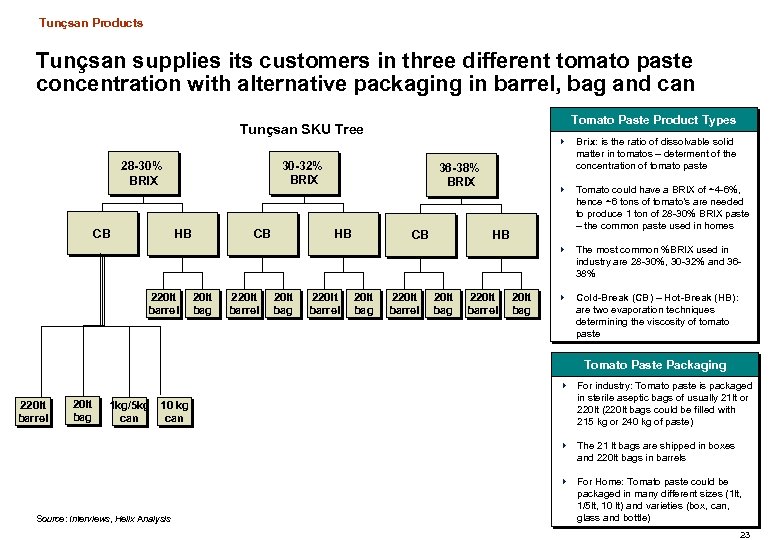
Tunçsan Products Tunçsan supplies its customers in three different tomato paste concentration with alternative packaging in barrel, bag and can Tomato Paste Product Types Tunçsan SKU Tree 30 -32% BRIX 28 -30% BRIX CB HB CB 4 Brix: is the ratio of dissolvable solid matter in tomatos – determent of the concentration of tomato paste 36 -38% BRIX HB CB 4 Tomato could have a BRIX of ~4 -6%, hence ~6 tons of tomato’s are needed to produce 1 ton of 28 -30% BRIX paste – the common paste used in homes HB 4 The most common %BRIX used in industry are 28 -30%, 30 -32% and 3638% 220 lt barrel 20 lt bag 220 lt barrel 20 lt bag 4 Cold-Break (CB) – Hot-Break (HB): are two evaporation techniques determining the viscosity of tomato paste Tomato Paste Packaging 220 lt barrel 20 lt bag 1 kg/5 kg 10 kg can 4 For industry: Tomato paste is packaged in sterile aseptic bags of usually 21 lt or 220 lt (220 lt bags could be filled with 215 kg or 240 kg of paste) 4 The 21 lt bags are shipped in boxes and 220 lt bags in barrels Source: Interviews, Helix Analysis 4 For Home: Tomato paste could be packaged in many different sizes (1 lt, 1/5 lt, 10 lt) and varieties (box, can, glass and bottle) 23
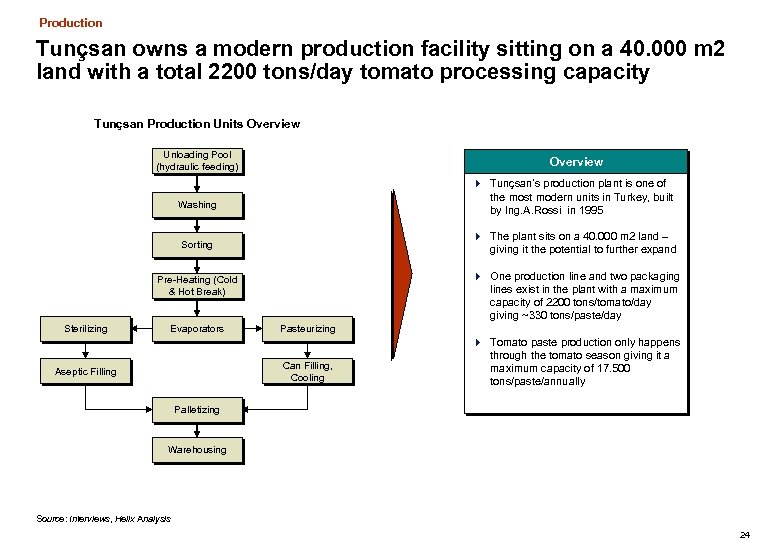
Production Tunçsan owns a modern production facility sitting on a 40. 000 m 2 land with a total 2200 tons/day tomato processing capacity Tunçsan Production Units Overview Unloading Pool (hydraulic feeding) Overview 4 Tunçsan’s production plant is one of the most modern units in Turkey, built by Ing. A. Rossi in 1995 Washing 4 The plant sits on a 40. 000 m 2 land – giving it the potential to further expand Sorting 4 One production line and two packaging lines exist in the plant with a maximum capacity of 2200 tons/tomato/day giving ~330 tons/paste/day Pre-Heating (Cold & Hot Break) Sterilizing Evaporators Pasteurizing Can Filling, Cooling Aseptic Filling 4 Tomato paste production only happens through the tomato season giving it a maximum capacity of 17. 500 tons/paste/annually Palletizing Warehousing Source: Interviews, Helix Analysis 24
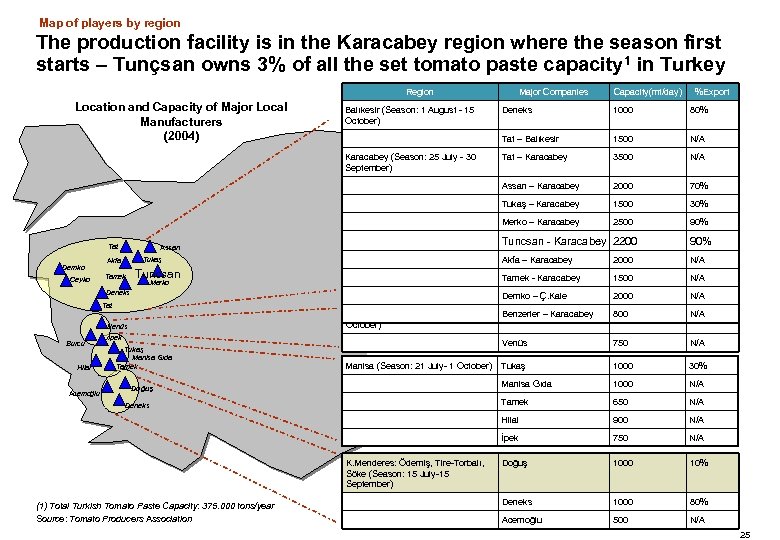
Map of players by region The production facility is in the Karacabey region where the season first starts – Tunçsan owns 3% of all the set tomato paste capacity 1 in Turkey Region Location and Capacity of Major Local Manufacturers (2004) Balıkesir (Season: 1 August - 15 October) Major Companies Capacity(mt/day) %Export 1000 80% Tat – Balıkesir 1500 N/A Tat – Karacabey 3500 N/A Assan – Karacabey 2000 70% Tukaş – Karacabey 1500 30% Merko – Karacabey (Season: 25 July - 30 September) Deneks 2500 90% Tamek Tat Burcu Hilal Acemoğlu İpek Tukaş Manisa Gıda Tamek Manisa (Season: 21 July- 1 October) Doğuş Deneks K. Menderes: Ödemiş, Tire-Torbalı, Söke (Season: 15 July-15 September) (1) Total Turkish Tomato Paste Capacity: 375. 000 tons/year Source: Tomato Producers Association 2000 N/A Benzerler – Karacabey Burcu 800 1000 N/A 750 N/A Tukaş 1000 30% 1000 N/A Tamek Bergama (Season: 21 July- 1 October) Venüs N/A Manisa Gıda Merko Deneks 1500 Venüs Tuncsan N/A Tamek - Karacabey Tukaş Akfa 2000 650 N/A 900 N/A İpek Ceyko Akfa – Karacabey Assan 90% Hilal Demko Tuncsan - Karacabey 2200 Demko – Ç. Kale Tat 750 N/A Doğuş 1000 10% Deneks 1000 80% Acemoğlu 500 N/A 25
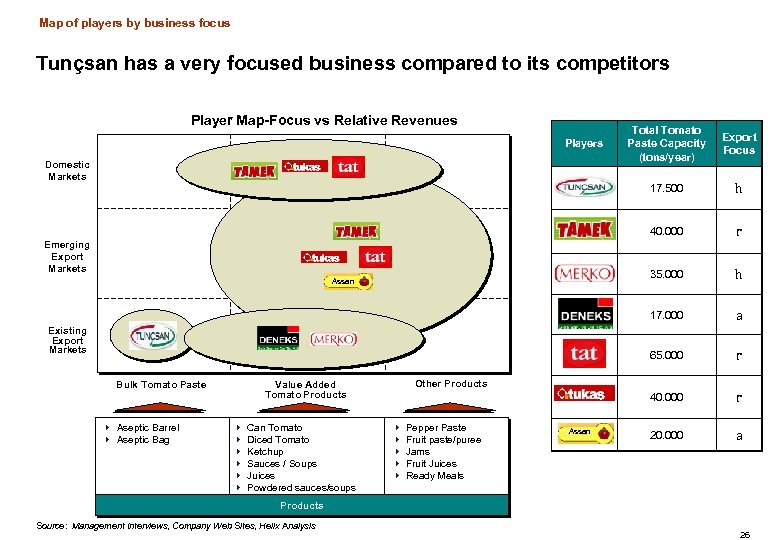
Map of players by business focus Tunçsan has a very focused business compared to its competitors Player Map-Focus vs Relative Revenues Bulk Tomato Paste 4 Aseptic Barrel 4 Aseptic Bag Can Tomato Diced Tomato Ketchup Sauces / Soups Juices Powdered sauces/soups a r 40. 000 r 20. 000 a Other Products Value Added Tomato Products 4 4 4 h 65. 000 Existing Export Markets r 17. 000 Assan h 35. 000 Emerging Export Markets Export Focus 40. 000 Domestic Markets Total Tomato Paste Capacity (tons/year) 17. 500 Players 4 4 4 Pepper Paste Fruit paste/puree Jams Fruit Juices Ready Meals Assan Products Source: Management Interviews, Company Web Sites, Helix Analysis 26
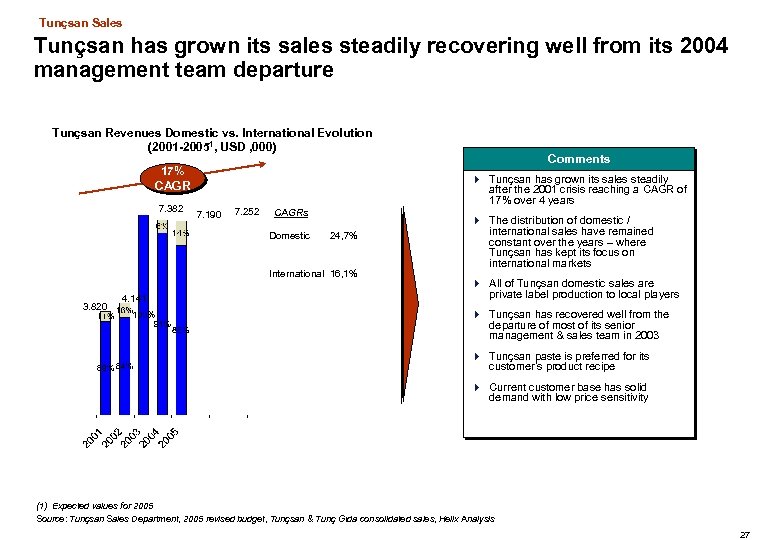
Tunçsan Sales Tunçsan has grown its sales steadily recovering well from its 2004 management team departure Tunçsan Revenues Domestic vs. International Evolution (2001 -20051, USD , 000) 17% CAGR 7. 382 4 Tunçsan has grown its sales steadily after the 2001 crisis reaching a CAGR of 17% over 4 years 7. 190 7. 252 CAGRs Domestic 24, 7% International 16, 1% 3. 820 4. 141 Comments 4 The distribution of domestic / international sales have remained constant over the years – where Tunçsan has kept its focus on international markets 4 All of Tunçsan domestic sales are private label production to local players 4 Tunçsan has recovered well from the departure of most of its senior management & sales team in 2003 4 Tunçsan paste is preferred for its customer’s product recipe 4 Current customer base has solid demand with low price sensitivity (1) Expected values for 2005 Source: Tunçsan Sales Department, 2005 revised budget, Tunçsan & Tunç Gıda consolidated sales, Helix Analysis 27
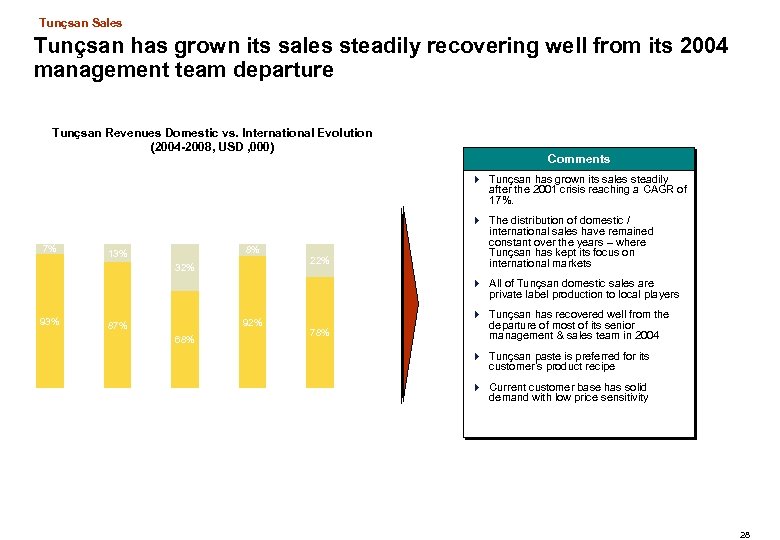
Tunçsan Sales Tunçsan has grown its sales steadily recovering well from its 2004 management team departure Tunçsan Revenues Domestic vs. International Evolution (2004 -2008, USD , 000) Comments 4 Tunçsan has grown its sales steadily after the 2001 crisis reaching a CAGR of 17%. 7% 8% 13% 32% 22% 4 The distribution of domestic / international sales have remained constant over the years – where Tunçsan has kept its focus on international markets 4 All of Tunçsan domestic sales are private label production to local players 93% 92% 87% 68% 78% 4 Tunçsan has recovered well from the departure of most of its senior management & sales team in 2004 4 Tunçsan paste is preferred for its customer’s product recipe 2004 2005 2006 2007 2008 4 Current customer base has solid demand with low price sensitivity 28
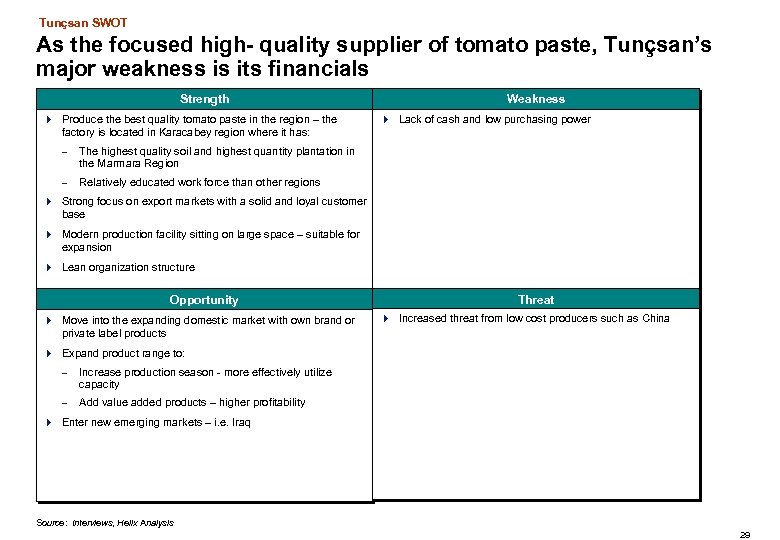
Tunçsan SWOT As the focused high- quality supplier of tomato paste, Tunçsan’s major weakness is its financials Strength 4 Produce the best quality tomato paste in the region – the factory is located in Karacabey region where it has: – 4 Lack of cash and low purchasing power The highest quality soil and highest quantity plantation in the Marmara Region – Weakness Relatively educated work force than other regions 4 Strong focus on export markets with a solid and loyal customer base 4 Modern production facility sitting on large space – suitable for expansion 4 Lean organization structure Opportunity 4 Move into the expanding domestic market with own brand or private label products Threat 4 Increased threat from low cost producers such as China 4 Expand product range to: – Increase production season - more effectively utilize capacity – Add value added products – higher profitability 4 Enter new emerging markets – i. e. Iraq Source: Interviews, Helix Analysis 29
IV. Overview of Tunçsan’s Current Operations 30
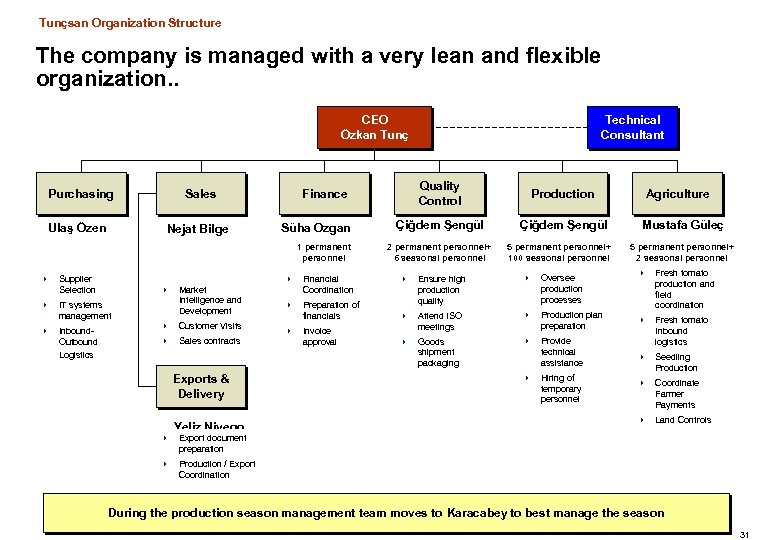
Tunçsan Organization Structure The company is managed with a very lean and flexible organization. . CEO Özkan Tunç Purchasing Ulaş Özen Sales Nejat Bilge Finance Süha Ozgan 1 permanent personnel 4 Financial 4 Supplier 4 Market Selection 4 IT systems management 4 Inbound. Outbound Intelligence and Development 4 Customer Visits 4 Sales contracts Coordination 4 Preparation of financials 4 Invoice approval Technical Consultant Quality Control Production Çiğdem Şengül 2 permanent personnel+ 6 seasonal personnel 4 Ensure high production quality 4 Attend ISO meetings 4 Goods shipment packaging Logistics Exports & Delivery Yeliz Niyego 5 permanent personnel+ 100 seasonal personnel 4 Oversee production processes 4 Production plan preparation 4 Provide technical assistance 4 Hiring of temporary personnel Agriculture Mustafa Güleç 5 permanent personnel+ 2 seasonal personnel 4 Fresh tomato production and field coordination 4 Fresh tomato Inbound logistics 4 Seedling Production 4 Coordinate Farmer Payments 4 Land Controls 4 Export document preparation 4 Production / Export Coordination During the production season management team moves to Karacabey to best manage the season 31
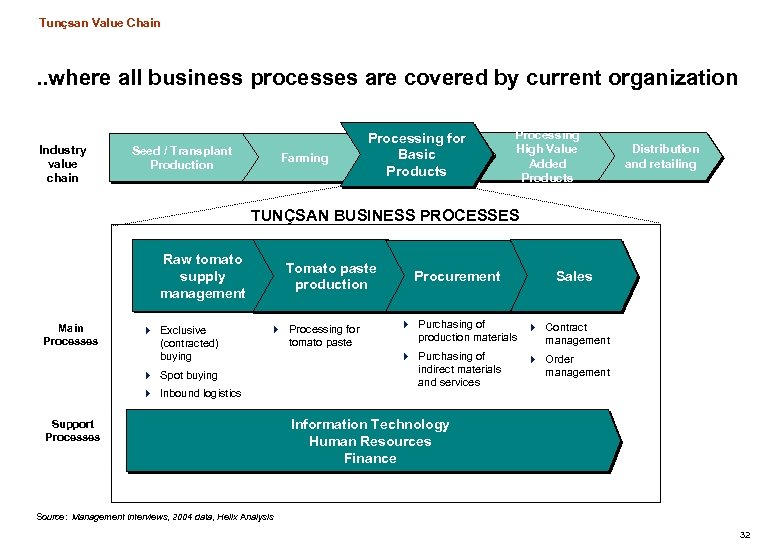
Tunçsan Value Chain . . where all business processes are covered by current organization Industry value chain Seed / Transplant Production Farming Processing for Basic Products Processing High Value Added Products Distribution and retailing TUNÇSAN BUSINESS PROCESSES Raw tomato supply management Main Processes 4 Exclusive (contracted) buying Tomato paste production 4 Processing for tomato paste 4 Spot buying 4 Inbound logistics Support Processes Procurement Sales 4 Purchasing of 4 Contract production materials management 4 Purchasing of 4 Order indirect materials management and services Information Technology Human Resources Finance Source: Management Interviews, 2004 data, Helix Analysis 32
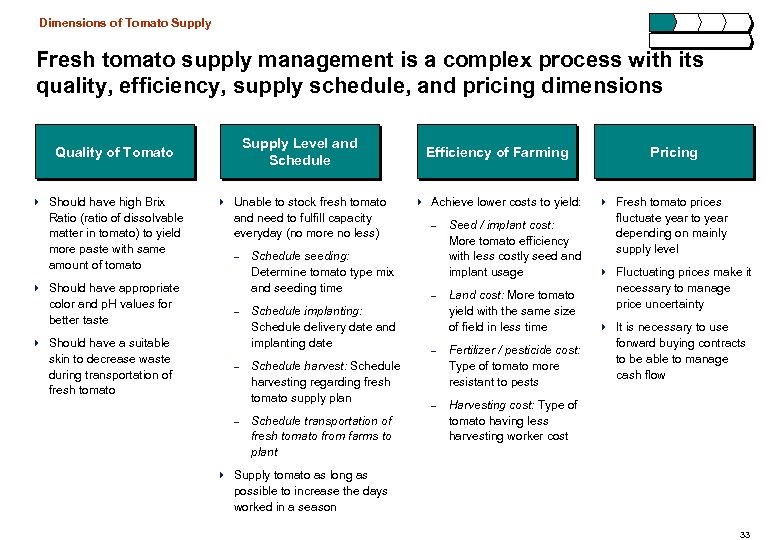
Dimensions of Tomato Supply Fresh tomato supply management is a complex process with its quality, efficiency, supply schedule, and pricing dimensions Supply Level and Schedule Quality of Tomato 4 Should have high Brix Ratio (ratio of dissolvable matter in tomato) to yield more paste with same amount of tomato 4 Should have appropriate color and p. H values for better taste 4 Should have a suitable skin to decrease waste during transportation of fresh tomato 4 Unable to stock fresh tomato and need to fulfill capacity everyday (no more no less) – – Schedule seeding: Determine tomato type mix and seeding time Schedule implanting: Schedule delivery date and implanting date Schedule harvest: Schedule harvesting regarding fresh tomato supply plan Schedule transportation of fresh tomato from farms to plant Efficiency of Farming 4 Achieve lower costs to yield: – – Seed / implant cost: More tomato efficiency with less costly seed and implant usage Land cost: More tomato yield with the same size of field in less time – Fertilizer / pesticide cost: Type of tomato more resistant to pests – Pricing 4 Fresh tomato prices fluctuate year to year depending on mainly supply level 4 Fluctuating prices make it necessary to manage price uncertainty 4 It is necessary to use forward buying contracts to be able to manage cash flow Harvesting cost: Type of tomato having less harvesting worker cost 4 Supply tomato as long as possible to increase the days worked in a season 33
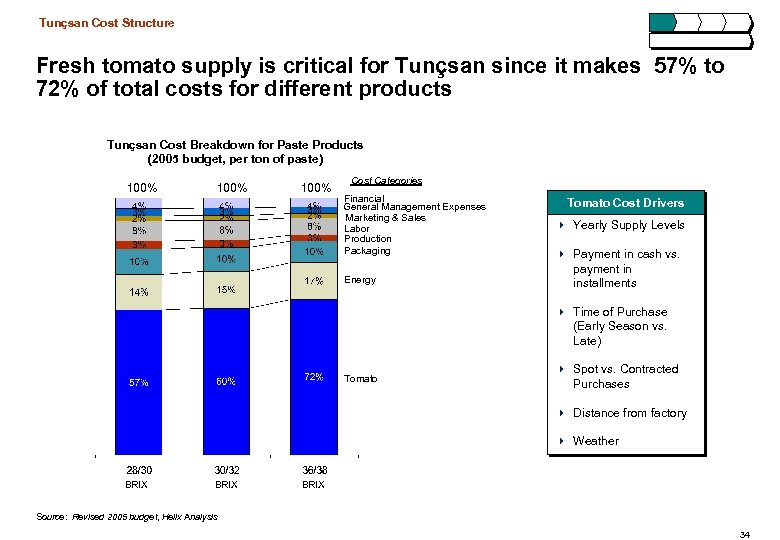
Tunçsan Cost Structure Fresh tomato supply is critical for Tunçsan since it makes 57% to 72% of total costs for different products Tunçsan Cost Breakdown for Paste Products (2005 budget, per ton of paste) 100% Cost Categories Financial General Management Expenses Marketing & Sales Labor Production Packaging Energy Tomato Cost Drivers 4 Yearly Supply Levels 4 Payment in cash vs. payment in installments 4 Time of Purchase (Early Season vs. Late) Tomato 4 Spot vs. Contracted Purchases 4 Distance from factory 4 Weather BRIX Source: Revised 2005 budget, Helix Analysis 34
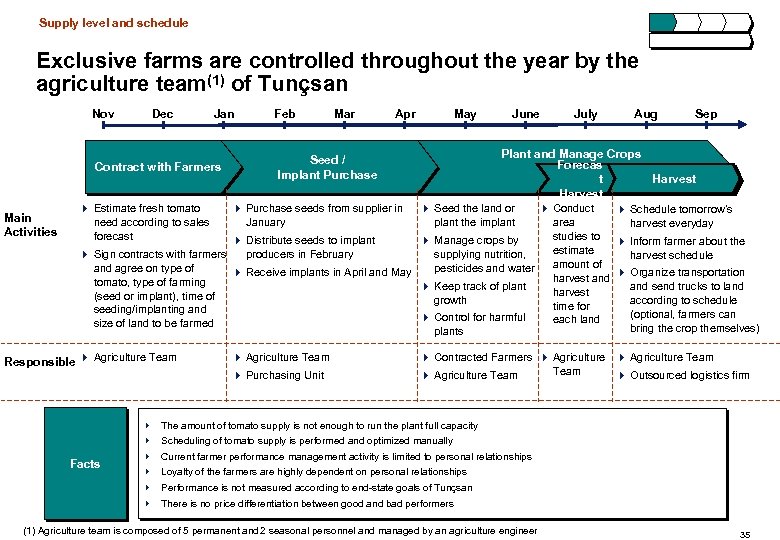
Supply level and schedule Exclusive farms are controlled throughout the year by the agriculture team(1) of Tunçsan Nov Dec Jan Contract with Farmers Main Activities 4 Estimate fresh tomato need according to sales forecast Feb Mar Apr Seed / Implant Purchase 4 Purchase seeds from supplier in January May June 4 Agriculture Team 4 Purchasing Unit Facts 4 4 4 Aug Sep Plant and Manage Crops Forecas Harvest t Harvest 4 Seed the land or 4 Conduct 4 Schedule tomorrow’s plant the implant 4 Distribute seeds to implant 4 Manage crops by 4 Sign contracts with farmers producers in February supplying nutrition, and agree on type of pesticides and water 4 Receive implants in April and May tomato, type of farming 4 Keep track of plant (seed or implant), time of growth seeding/implanting and 4 Control for harmful size of land to be farmed plants Responsible 4 Agriculture Team July area harvest everyday studies to 4 Inform farmer about the estimate harvest schedule amount of harvest and 4 Organize transportation and send trucks to land harvest according to schedule time for (optional, farmers can each land bring the crop themselves) 4 Contracted Farmers 4 Agriculture Team 4 Outsourced logistics firm The amount of tomato supply is not enough to run the plant full capacity Scheduling of tomato supply is performed and optimized manually Current farmer performance management activity is limited to personal relationships Loyalty of the farmers are highly dependent on personal relationships Performance is not measured according to end-state goals of Tunçsan There is no price differentiation between good and bad performers (1) Agriculture team is composed of 5 permanent and 2 seasonal personnel and managed by an agriculture engineer 35
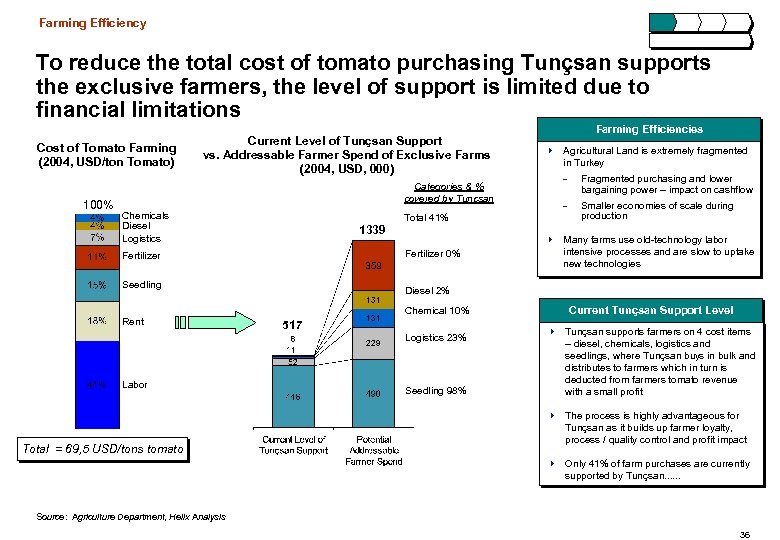
Farming Efficiency To reduce the total cost of tomato purchasing Tunçsan supports the exclusive farmers, the level of support is limited due to financial limitations Cost of Tomato Farming (2004, USD/ton Tomato) 100% Current Level of Tunçsan Support vs. Addressable Farmer Spend of Exclusive Farms (2004, USD, 000) Categories & % covered by Tunçsan Chemicals Diesel Logistics Total 41% 1339 Fertilizer 0% Fertilizer Seedling 517 Logistics 23% Labor Total = 69, 5 USD/tons tomato 4 Agricultural Land is extremely fragmented in Turkey – Fragmented purchasing and lower bargaining power – impact on cashflow – Smaller economies of scale during production 4 Many farms use old-technology labor intensive processes and are slow to uptake new technologies Diesel 2% Chemical 10% Rent Farming Efficiencies Seedling 98% Current Tunçsan Support Level 4 Tunçsan supports farmers on 4 cost items – diesel, chemicals, logistics and seedlings, where Tunçsan buys in bulk and distributes to farmers which in turn is deducted from farmers tomato revenue with a small profit 4 The process is highly advantageous for Tunçsan as it builds up farmer loyalty, process / quality control and profit impact 4 Only 41% of farm purchases are currently supported by Tunçsan. . . Source: Agriculture Department, Helix Analysis 36
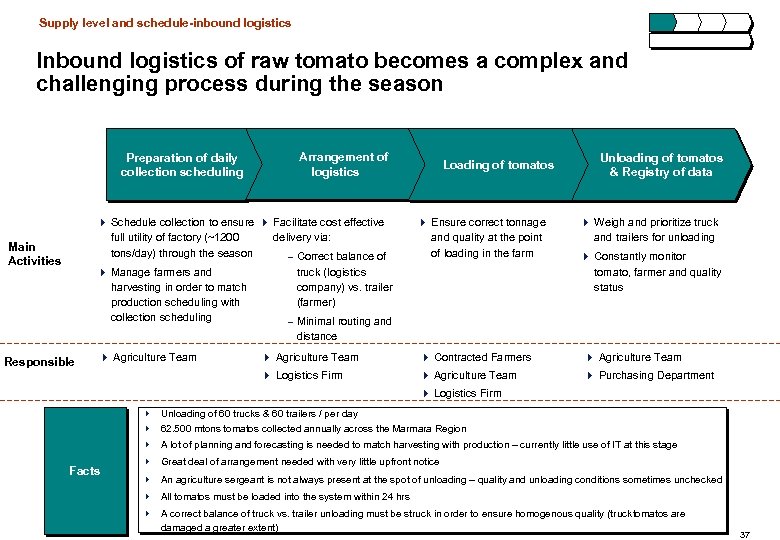
Supply level and schedule-inbound logistics Inbound logistics of raw tomato becomes a complex and challenging process during the season Preparation of daily collection scheduling Arrangement of logistics 4 Schedule collection to ensure 4 Facilitate cost effective full utility of factory (~1200 delivery via: tons/day) through the season – Correct balance of 4 Manage farmers and truck (logistics harvesting in order to match company) vs. trailer production scheduling with (farmer) collection scheduling – Minimal routing and Main Activities Loading of tomatos 4 Ensure correct tonnage and quality at the point of loading in the farm Unloading of tomatos & Registry of data 4 Weigh and prioritize truck and trailers for unloading 4 Constantly monitor tomato, farmer and quality status distance 4 Agriculture Team 4 Contracted Farmers 4 Agriculture Team 4 Logistics Firm Responsible 4 Agriculture Team 4 Purchasing Department 4 Logistics Firm 4 Unloading of 60 trucks & 60 trailers / per day 4 62. 500 mtons tomatos collected annually across the Marmara Region 4 A lot of planning and forecasting is needed to match harvesting with production – currently little use of IT at this stage Facts 4 Great deal of arrangement needed with very little upfront notice 4 An agriculture sergeant is not always present at the spot of unloading – quality and unloading conditions sometimes unchecked 4 All tomatos must be loaded into the system within 24 hrs 4 A correct balance of truck vs. trailer unloading must be struck in order to ensure homogenous quality (truck tomatos are damaged a greater extent) 37
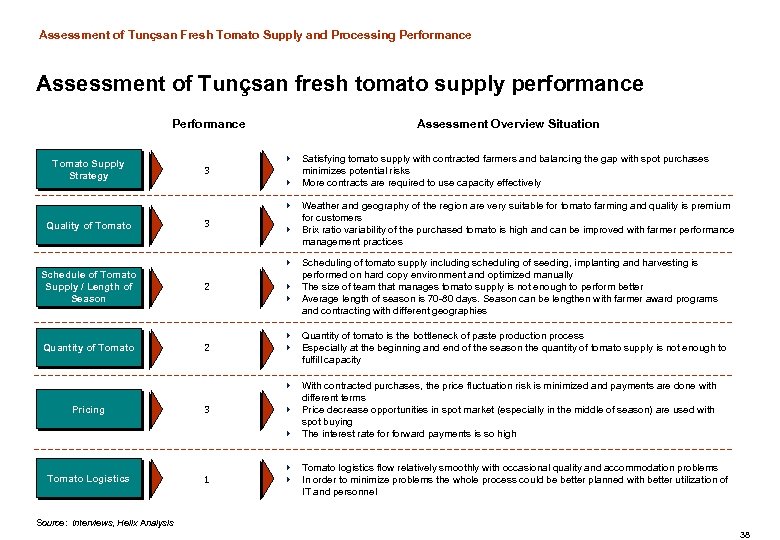
Assessment of Tunçsan Fresh Tomato Supply and Processing Performance Assessment of Tunçsan fresh tomato supply performance Performance Assessment Overview Situation 3 4 Satisfying tomato supply with contracted farmers and balancing the gap with spot purchases minimizes potential risks 4 More contracts are required to use capacity effectively 3 4 Weather and geography of the region are very suitable for tomato farming and quality is premium for customers 4 Brix ratio variability of the purchased tomato is high and can be improved with farmer performance management practices Schedule of Tomato Supply / Length of Season 2 4 Scheduling of tomato supply including scheduling of seeding, implanting and harvesting is performed on hard copy environment and optimized manually 4 The size of team that manages tomato supply is not enough to perform better 4 Average length of season is 70 -80 days. Season can be lengthen with farmer award programs and contracting with different geographies Quantity of Tomato 2 4 Quantity of tomato is the bottleneck of paste production process 4 Especially at the beginning and end of the season the quantity of tomato supply is not enough to fulfill capacity Pricing 3 4 With contracted purchases, the price fluctuation risk is minimized and payments are done with different terms 4 Price decrease opportunities in spot market (especially in the middle of season) are used with spot buying 4 The interest rate forward payments is so high Tomato Logistics 1 4 Tomato logistics flow relatively smoothly with occasional quality and accommodation problems 4 In order to minimize problems the whole process could be better planned with better utilization of IT and personnel Tomato Supply Strategy Quality of Tomato Source: Interviews, Helix Analysis 38
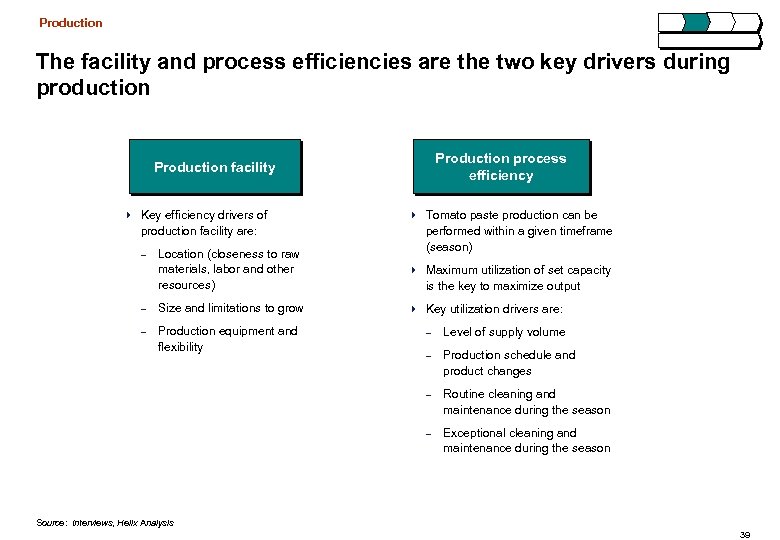
Production The facility and process efficiencies are the two key drivers during production Production process efficiency Production facility 4 Key efficiency drivers of production facility are: – Location (closeness to raw materials, labor and other resources) – Size and limitations to grow – Production equipment and flexibility 4 Tomato paste production can be performed within a given timeframe (season) 4 Maximum utilization of set capacity is the key to maximize output 4 Key utilization drivers are: – Level of supply volume – Production schedule and product changes – Routine cleaning and maintenance during the season – Exceptional cleaning and maintenance during the season Source: Interviews, Helix Analysis 39
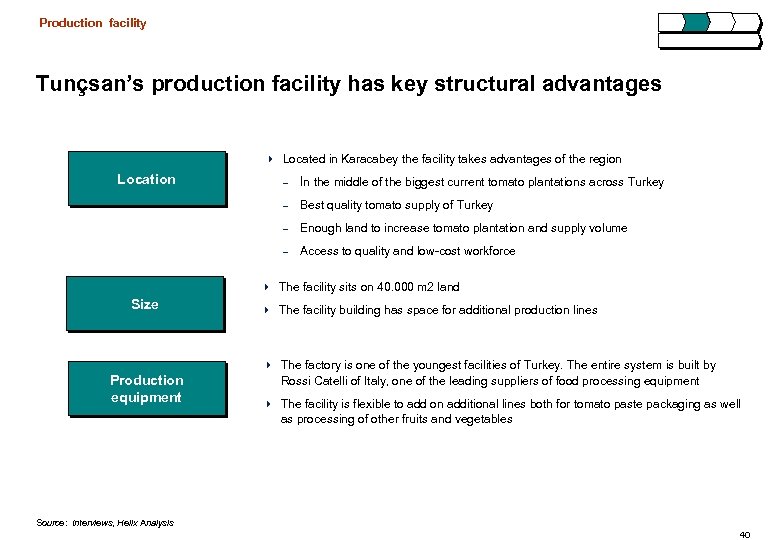
Production facility Tunçsan’s production facility has key structural advantages 4 Located in Karacabey the facility takes advantages of the region Location – İn the middle of the biggest current tomato plantations across Turkey – Best quality tomato supply of Turkey – Enough land to increase tomato plantation and supply volume – Access to quality and low-cost workforce 4 The facility sits on 40. 000 m 2 land Size Production equipment 4 The facility building has space for additional production lines 4 The factory is one of the youngest facilities of Turkey. The entire system is built by Rossi Catelli of Italy, one of the leading suppliers of food processing equipment 4 The facility is flexible to add on additional lines both for tomato paste packaging as well as processing of other fruits and vegetables Source: Interviews, Helix Analysis 40
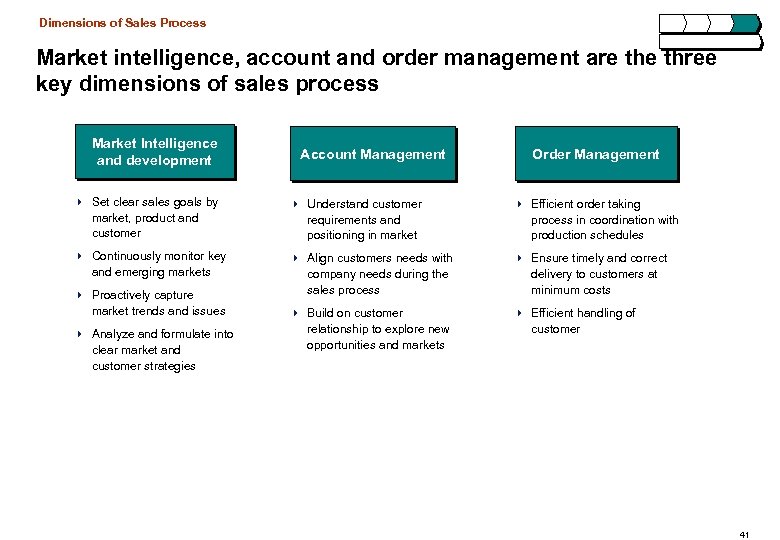
Dimensions of Sales Process Market intelligence, account and order management are three key dimensions of sales process Market Intelligence and development Account Management Order Management 4 Set clear sales goals by market, product and customer 4 Understand customer requirements and positioning in market 4 Efficient order taking process in coordination with production schedules 4 Continuously monitor key and emerging markets 4 Align customers needs with company needs during the sales process 4 Ensure timely and correct delivery to customers at minimum costs 4 Build on customer relationship to explore new opportunities and markets 4 Efficient handling of customer 4 Proactively capture market trends and issues 4 Analyze and formulate into clear market and customer strategies 41
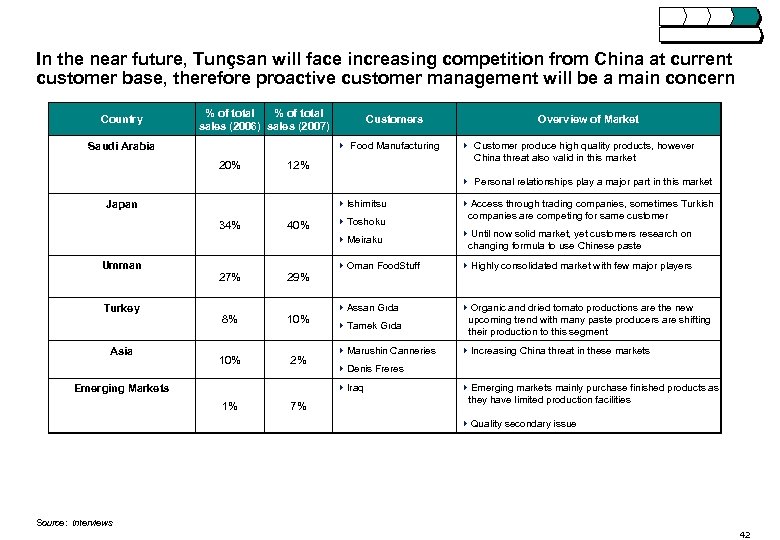
In the near future, Tunçsan will face increasing competition from China at current customer base, therefore proactive customer management will be a main concern Country % of total sales (2006) sales (2007) Customers 4 Food Manufacturing Saudi Arabia 20% 12% Overview of Market 4 Customer produce high quality products, however China threat also valid in this market 4 Personal relationships play a major part in this market 4 Ishimitsu Japan 34% 40% 4 Toshoku 4 Access through trading companies, sometimes Turkish companies are competing for same customer 4 Meiraku Umman Turkey Asia 29% 8% 10% 2% 4 Oman Food. Stuff 4 Highly consolidated market with few major players 4 Assan Gıda 27% 4 Until now solid market, yet customers research on changing formula to use Chinese paste 4 Organic and dried tomato productions are the new upcoming trend with many paste producers are shifting their production to this segment 4 Tamek Gıda 4 Marushin Canneries 4 Denis Freres 4 Iraq Emerging Markets 1% 7% 4 Increasing China threat in these markets 4 Emerging markets mainly purchase finished products as they have limited production facilities 4 Quality secondary issue Source: Interviews 42
V. Future Prospects: New business opportunities 43
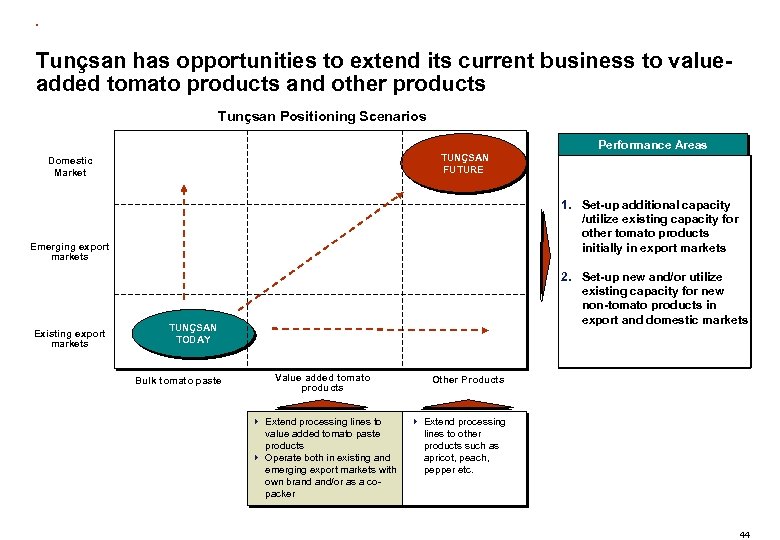
. Tunçsan has opportunities to extend its current business to valueadded tomato products and other products Tunçsan Positioning Scenarios Performance Areas TUNÇSAN FUTURE Domestic Market 1. Set-up additional capacity /utilize existing capacity for other tomato products initially in export markets Emerging export markets Existing export markets 2. Set-up new and/or utilize existing capacity for new non-tomato products in export and domestic markets TUNÇSAN TODAY Bulk tomato paste Value added tomato products 4 Extend processing lines to value added tomato paste products 4 Operate both in existing and emerging export markets with own brand and/or as a copacker Other Products 4 Extend processing lines to other products such as apricot, peach, pepper etc. 44
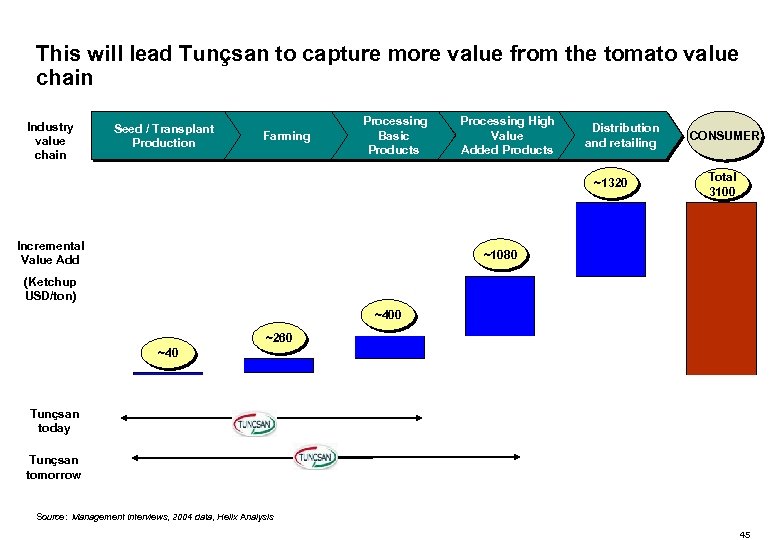
This will lead Tunçsan to capture more value from the tomato value chain Industry value chain Seed / Transplant Production Farming Processing Basic Products Processing High Value Added Products Distribution and retailing ~1320 Incremental Value Add CONSUMER Total 3100 ~1080 (Ketchup USD/ton) ~400 ~260 ~40 Tunçsan today Tunçsan tomorrow Source: Management Interviews, 2004 data, Helix Analysis 45
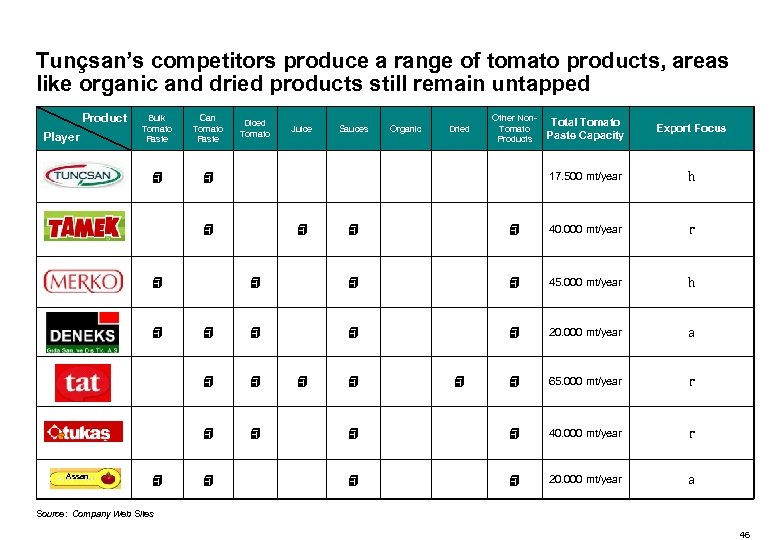
Tunçsan’s competitors produce a range of tomato products, areas like organic and dried products still remain untapped Product Can Tomato Paste Player Bulk Tomato Paste Other Non. Tomato Products Juice Sauces Organic Dried Total Tomato Paste Capacity Export Focus 17. 500 mt/year Diced Tomato h 40. 000 mt/year r 45. 000 mt/year h 20. 000 mt/year a 65. 000 mt/year r 40. 000 mt/year r 20. 000 mt/year a Assan Source: Company Web Sites 46
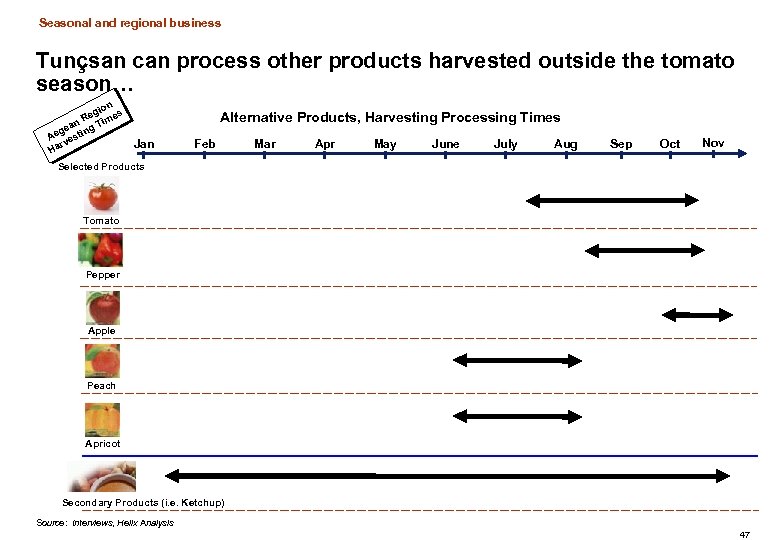
Seasonal and regional business Tunçsan can process other products harvested outside the tomato season… n gio s Re ime n T ea eg sting A e rv Ha Alternative Products, Harvesting Processing Times Jan Feb Mar Apr May June July Aug Sep Oct Nov Selected Products Tomato Pepper Apple Peach Apricot Secondary Products (i. e. Ketchup) Source: Interviews, Helix Analysis 47
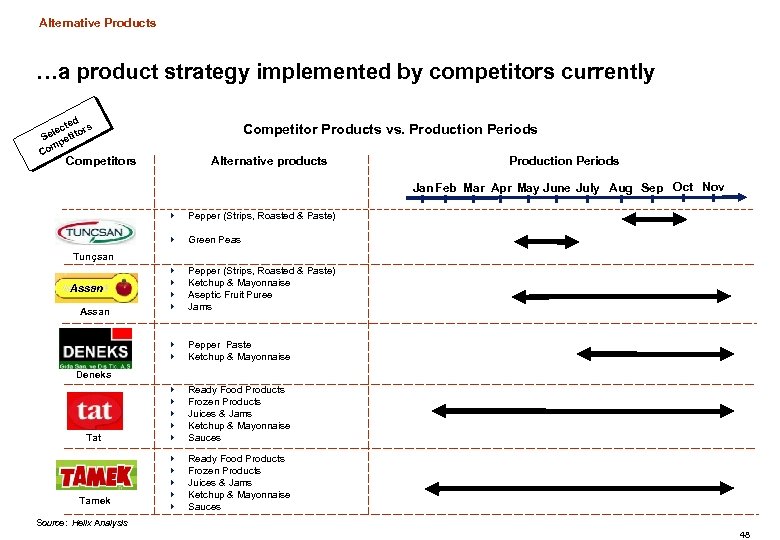
Alternative Products …a product strategy implemented by competitors currently d cte rs ele etito S p m Co Competitor Products vs. Production Periods Competitors Alternative products Production Periods Jan Feb Mar Apr May June July Aug Sep Oct Nov 4 Pepper (Strips, Roasted & Paste) 4 Green Peas 4 4 Pepper (Strips, Roasted & Paste) Ketchup & Mayonnaise Aseptic Fruit Puree Jams 4 4 Pepper Paste Ketchup & Mayonnaise 4 4 4 4 4 Ready Food Products Frozen Products Juices & Jams Ketchup & Mayonnaise Sauces Tunçsan Assan Deneks Tat Tamek Source: Helix Analysis 48
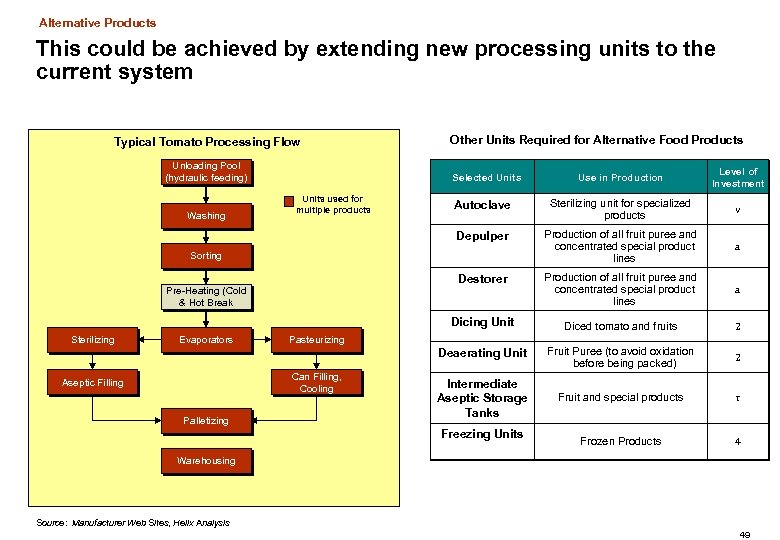
Alternative Products This could be achieved by extending new processing units to the current system Typical Tomato Processing Flow Unloading Pool (hydraulic feeding) Other Units Required for Alternative Food Products Level of Investment Autoclave Sterilizing unit for specialized products v Depulper Production of all fruit puree and concentrated special product lines a Destorer Production of all fruit puree and concentrated special product lines a Dicing Unit Diced tomato and fruits 2 Deaerating Unit Washing Use in Production Fruit Puree (to avoid oxidation before being packed) 2 Intermediate Aseptic Storage Tanks Fruit and special products r Frozen Products 4 Selected Units used for multiple products Sorting Pre-Heating (Cold & Hot Break Sterilizing Evaporators Pasteurizing Can Filling, Cooling Aseptic Filling Palletizing Freezing Units Warehousing Source: Manufacturer Web Sites, Helix Analysis 49
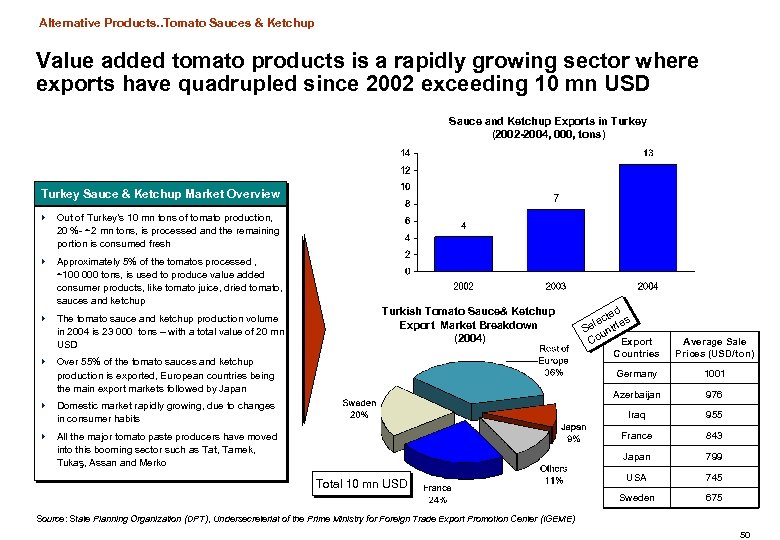
Alternative Products. . Tomato Sauces & Ketchup Value added tomato products is a rapidly growing sector where exports have quadrupled since 2002 exceeding 10 mn USD Sauce and Ketchup Exports in Turkey (2002 -2004, 000, tons) Turkey Sauce & Ketchup Market Overview 4 Out of Turkey’s 10 mn tons of tomato production, 20 %- ~2 mn tons, is processed and the remaining portion is consumed fresh 4 Approximately 5% of the tomatos processed , ~100 000 tons, is used to produce value added consumer products, like tomato juice, dried tomato, sauces and ketchup 4 The tomato sauce and ketchup production volume in 2004 is 23 000 tons – with a total value of 20 mn USD Turkish Tomato Sauce& Ketchup Export Market Breakdown (2004) ted lec tries Se un Export Co Countries Germany 843 Japan 799 USA 745 Sweden Total 10 mn USD 955 France 4 All the major tomato paste producers have moved into this booming sector such as Tat, Tamek, Tukaş, Assan and Merko 976 Iraq 4 Domestic market rapidly growing, due to changes in consumer habits 1001 Azerbaijan 4 Over 55% of the tomato sauces and ketchup production is exported, European countries being the main export markets followed by Japan Average Sale Prices (USD/ton) 675 Source: State Planning Organization (DPT), Undersecreteriat of the Prime Ministry for Foreign Trade Export Promotion Center (IGEME) 50
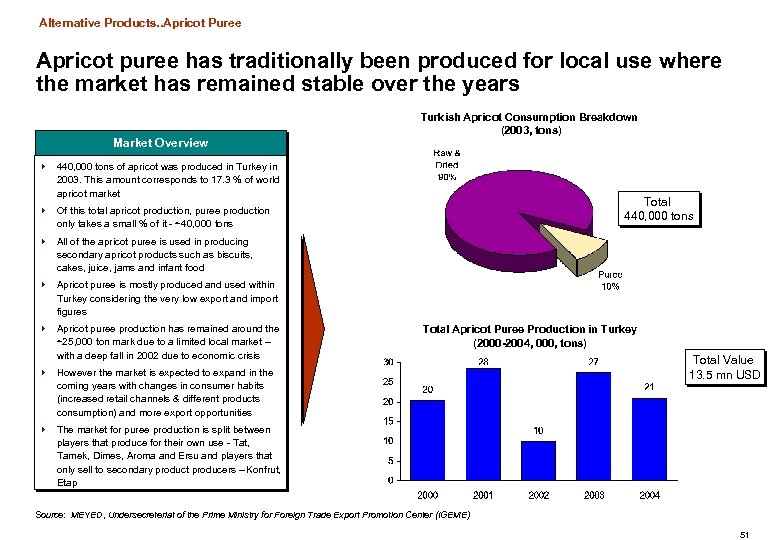
Alternative Products. . Apricot Puree Apricot puree has traditionally been produced for local use where the market has remained stable over the years Market Overview Turkish Apricot Consumption Breakdown (2003, tons) 4 440, 000 tons of apricot was produced in Turkey in 2003. This amount corresponds to 17. 3 % of world apricot market Total 440, 000 tons 4 Of this total apricot production, puree production only takes a small % of it - ~40, 000 tons 4 All of the apricot puree is used in producing secondary apricot products such as biscuits, cakes, juice, jams and infant food 4 Apricot puree is mostly produced and used within Turkey considering the very low export and import figures 4 Apricot puree production has remained around the ~25, 000 ton mark due to a limited local market – with a deep fall in 2002 due to economic crisis Total Apricot Puree Production in Turkey (2000 -2004, 000, tons) 4 However the market is expected to expand in the coming years with changes in consumer habits (increased retail channels & different products consumption) and more export opportunities Total Value 13. 5 mn USD 4 The market for puree production is split between players that produce for their own use - Tat, Tamek, Dimes, Aroma and Ersu and players that only sell to secondary product producers – Konfrut, Etap Source: MEYED, Undersecreteriat of the Prime Ministry for Foreign Trade Export Promotion Center (IGEME) 51
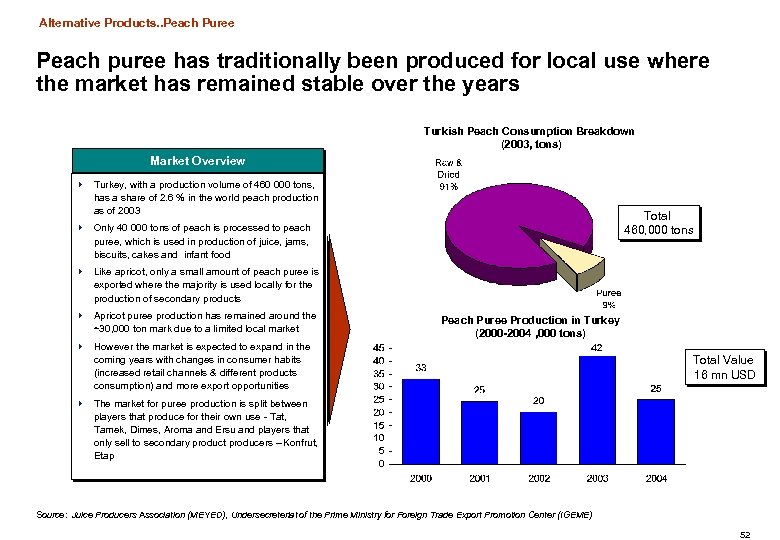
Alternative Products. . Peach Puree Peach puree has traditionally been produced for local use where the market has remained stable over the years Turkish Peach Consumption Breakdown (2003, tons) Market Overview 4 Turkey, with a production volume of 460 000 tons, has a share of 2. 6 % in the world peach production as of 2003 Total 460, 000 tons 4 Only 40 000 tons of peach is processed to peach puree, which is used in production of juice, jams, biscuits, cakes and infant food 4 Like apricot, only a small amount of peach puree is exported where the majority is used locally for the production of secondary products 4 Apricot puree production has remained around the ~30, 000 ton mark due to a limited local market Peach Puree Production in Turkey (2000 -2004 , 000 tons) 4 However the market is expected to expand in the coming years with changes in consumer habits (increased retail channels & different products consumption) and more export opportunities Total Value 16 mn USD 4 The market for puree production is split between players that produce for their own use - Tat, Tamek, Dimes, Aroma and Ersu and players that only sell to secondary product producers – Konfrut, Etap Source: Juice Producers Association (MEYED), Undersecreteriat of the Prime Ministry for Foreign Trade Export Promotion Center (IGEME) 52
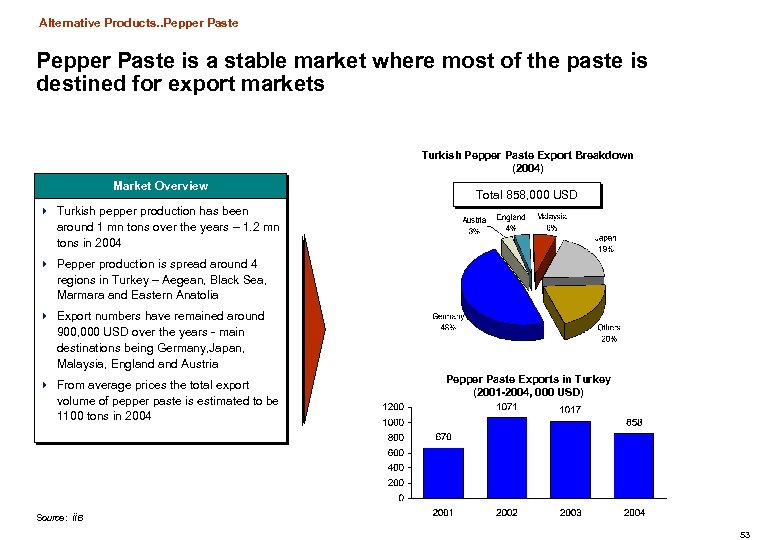
Alternative Products. . Pepper Paste is a stable market where most of the paste is destined for export markets Turkish Pepper Paste Export Breakdown (2004) Market Overview Total 858, 000 USD 4 Turkish pepper production has been around 1 mn tons over the years – 1. 2 mn tons in 2004 4 Pepper production is spread around 4 regions in Turkey – Aegean, Black Sea, Marmara and Eastern Anatolia 4 Export numbers have remained around 900, 000 USD over the years - main destinations being Germany, Japan, Malaysia, England Austria 4 From average prices the total export volume of pepper paste is estimated to be 1100 tons in 2004 Pepper Paste Exports in Turkey (2001 -2004, 000 USD) Source: İİB 53
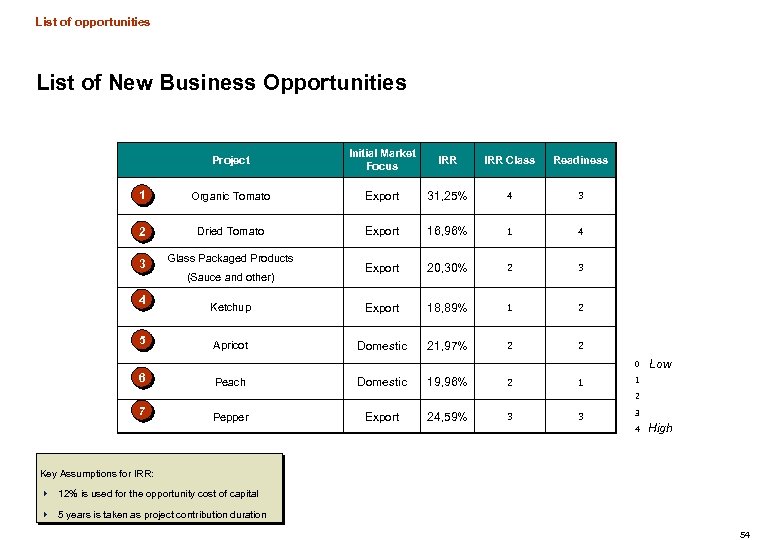
List of opportunities List of New Business Opportunities Project Initial Market Focus IRR Class Readiness 1 Organic Tomato Export 31, 25% 4 3 2 Dried Tomato Export 16, 96% 1 4 3 Glass Packaged Products Export 20, 30% 2 3 Ketchup Export 18, 89% 1 2 Apricot Domestic 21, 97% 2 2 (Sauce and other) 4 5 0 6 Peach Domestic 19, 96% 2 1 Low 1 2 7 Pepper Export 24, 59% 3 3 3 4 High Key Assumptions for IRR: 4 12% is used for the opportunity cost of capital 4 5 years is taken as project contribution duration 54
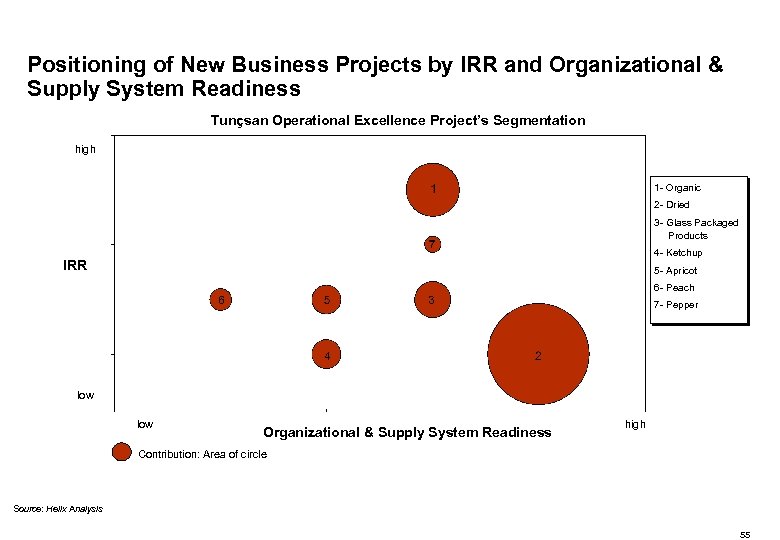
Positioning of New Business Projects by IRR and Organizational & Supply System Readiness Tunçsan Operational Excellence Project’s Segmentation high 1 - Organic 2 - Dried 3 - Glass Packaged Products 4 - Ketchup IRR 5 - Apricot 6 - Peach 7 - Pepper low Organizational & Supply System Readiness high Contribution: Area of circle Source: Helix Analysis 55
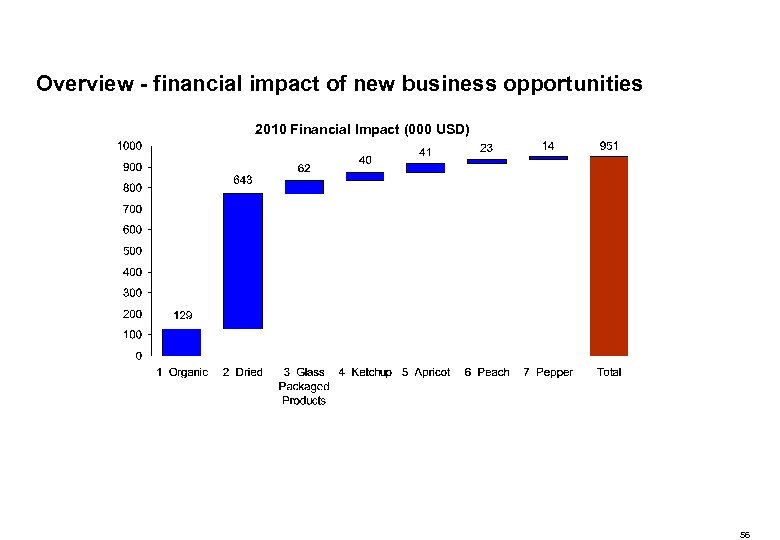
Overview - financial impact of new business opportunities 2010 Financial Impact (000 USD) 56
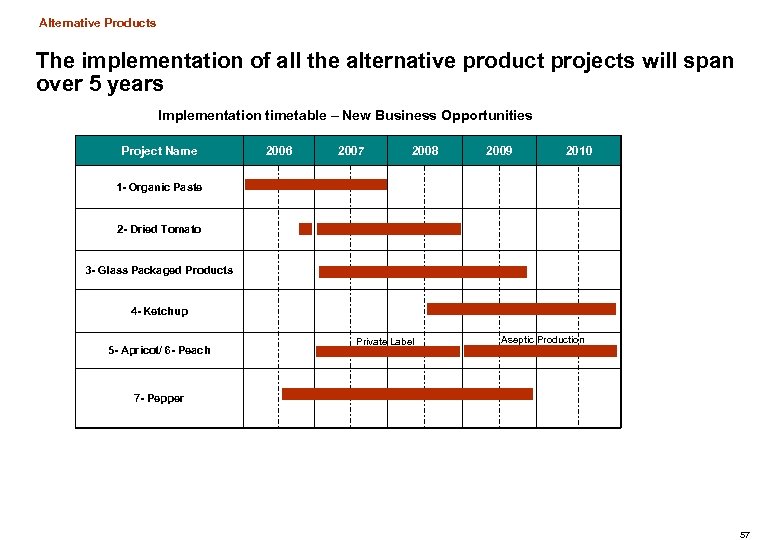
Alternative Products The implementation of all the alternative product projects will span over 5 years Implementation timetable – New Business Opportunities Project Name 2006 2007 2008 2009 2010 1 - Organic Paste 2 - Dried Tomato 3 - Glass Packaged Products 4 - Ketchup 5 - Apricot/ 6 - Peach Private Label Aseptic Production 7 - Pepper 57
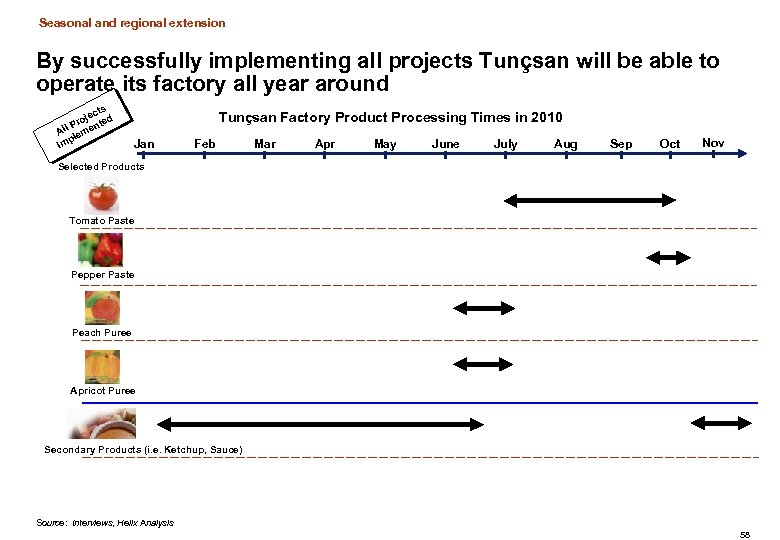
Seasonal and regional extension By successfully implementing all projects Tunçsan will be able to operate its factory all year around ts ec roj nted P All leme p Im Tunçsan Factory Product Processing Times in 2010 Jan Feb Mar Apr May June July Aug Sep Oct Nov Selected Products Tomato Paste Pepper Paste Peach Puree Apricot Puree Secondary Products (i. e. Ketchup, Sauce) Source: Interviews, Helix Analysis 58
Скачать презентацию Achieving Profitable and Sustainable Growth İstanbul 06 April
04be76b86f3db9ec29fc2b1e89a369cc.ppt