 Скачать презентацию ACE Program Communication Curriculum Objectives Participants will
f08cdf234009350c480a6a6e514a5c73.ppt
- Количество слайдов: 74



ACE Program Communication Curriculum
Objectives: Participants will be able to: • document ability to communicate effectively in writing with students, parents, colleagues, administrators, and community resource personnel. • demonstrate effective teacher-student communications skills in the classroom. • analyze the effect of teacher communication on student performance.
Reflect: Why is Communication Important? • Think about all the people you communicated with during the past school year. • Think about all the different types of communication that you used. • Think about all of the different purposes for communication during the school year.
Communication is Important • The Telephone Game: – 2 teams – one message. • What will be message be according to the last person?
Communication is Important • Scenario: Harry, Julia, Bob and Alice all signed up for dance lessons. While Julia and Bob liked learning the tango best, Tom and Alice were keen on the waltz. Until one lesson when the dance instructor realized that Tom had two left feet. Immediately he went to the hospital and had a right foot transplant. Now Tom and Alice are back on the dance floor cutting up a rug.

The Final Word • By the time the message reached the last person, was it quite jumbled and different from the initial scenario? • Can you see how a jumbled message can often be the result of gossip and by the time it gets to the last person it can be very distorted?
Task 2. 1. 2: Written Communication Portfolio • • • This task will take time to collect. This task involves communication with students, parents, colleagues, administrators, and community resource personnel. Create a folder in which you can keep copies of important written communications that should include a combination of: – – – – written instructions or directions to students for task completion written directions on tests scripted directions used to begin group work letters, e-mails Newsletters and any other forms of written documentation you choose.
Task 2. 1. 2: Written Communication Portfolio • Throughout the semester, add materials to your file, making sure that you provide evidence that you can do the following: a. Communicate high expectations, b. Provide opportunities for students to learn from each other, c. Convey ideas and information clearly, d. Use appropriate communication techniques with colleagues, community specialists, administrators, and families, e. Use strategies that support individual and group inquiry.
Task 2. 1. 2: Written Communication Portfolio • Be sure to annotate each entry in your folder with the skill you think it demonstrates. – – • • One way of doing the annotation would be to write the letter corresponding to the skill on the top of each entry e. g. code a document that shows you can "communicate high expectations" with the letter "a. " Be sure to include at least three examples of each skill. There should be 15 examples. Be sure to watch your grammar, spelling and mechanics.
Communication Skill Level Review • Use this review to help you reflect on your own communication skill levels. (Handout) • Please check the correct response(s) for each question or statement for three time frames: A. for your skill level on the first day that you taught school B. for your present skill level C. for the level that you intend to reach as you grow as a teacher
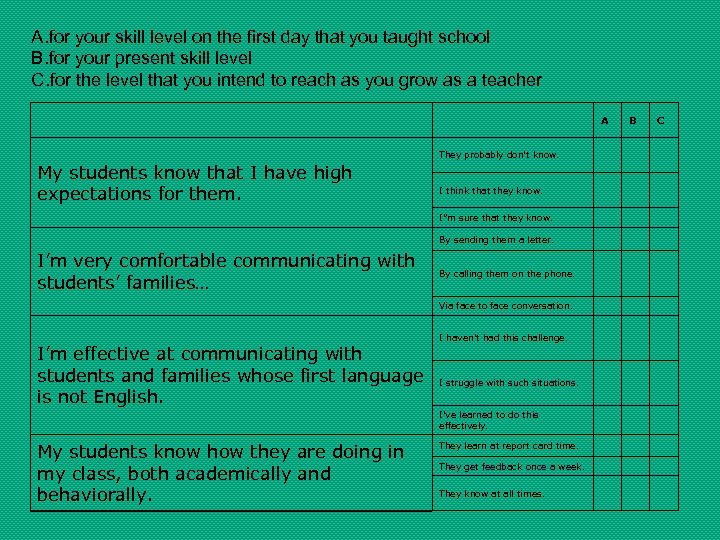
A. for your skill level on the first day that you taught school B. for your present skill level C. for the level that you intend to reach as you grow as a teacher A They probably don’t know. My students know that I have high expectations for them. I think that they know. I”m sure that they know. By sending them a letter. I’m very comfortable communicating with students’ families… By calling them on the phone. Via face to face conversation. I’m effective at communicating with students and families whose first language is not English. I haven’t had this challenge. I struggle with such situations. I’ve learned to do this effectively. My students know how they are doing in my class, both academically and behaviorally. They learn at report card time. They get feedback once a week. They know at all times. B C
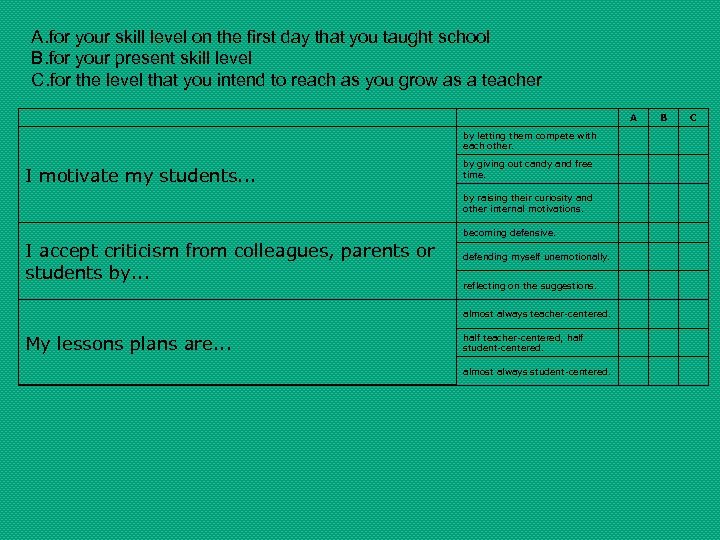
A. for your skill level on the first day that you taught school B. for your present skill level C. for the level that you intend to reach as you grow as a teacher by letting them compete with each other. I motivate my students. . . by giving out candy and free time. by raising their curiosity and other internal motivations. becoming defensive. I accept criticism from colleagues, parents or students by. . . defending myself unemotionally. reflecting on the suggestions. almost always teacher-centered. My lessons plans are. . . half teacher-centered, half student-centered. almost always student-centered. A B C
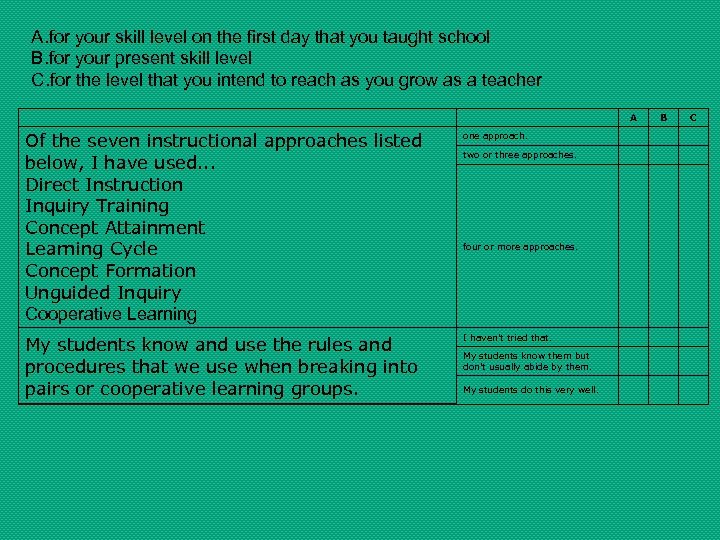
A. for your skill level on the first day that you taught school B. for your present skill level C. for the level that you intend to reach as you grow as a teacher Of the seven instructional approaches listed below, I have used. . . Direct Instruction Inquiry Training Concept Attainment Learning Cycle Concept Formation Unguided Inquiry Cooperative Learning one approach. My students know and use the rules and procedures that we use when breaking into pairs or cooperative learning groups. I haven't tried that. two or three approaches. four or more approaches. My students know them but don't usually abide by them. My students do this very well. A B C

Time to Break
Families Matter • Research on parent participation in the education of their students: – Parents of all races and economic levels do care deeply about their students. – Parents do value education. What it means to be “well educated” can vary based on culture and other factors, but parents do want their students to succeed.
Successful Parent Involvement Programs • An awareness and respect for one another’s culture and values. • View both parties as having valuable knowledge and perspectives. • Learn about students’ communities and culture by home visits, translator-mediated conferences, notes home, and research. • Clear, frequent, and multifaceted attempts to communicate.
Successful Parent Involvement Programs • A need to expand traditional options for family involvement beyond infrequent nighttime events and classroom volunteering (legal aaproval). • A need to grow over time and expanding as trust builds.
Carousel Communication Challenge • What are some suggestions you would make for successful communication with parents? • Think about all of the different means of communication and their advantages and disadvantages as well as reasons for communication.
Tips for Communicating with Parents • Set a warm and supportive tone: – Establish yourself as an authority figure: • Express genuine concern as a professional. • Reflect your care for students through words and actions. – Use nonverbal communication: • Meet parents in collegial location. • Express enthusiasm through handshake, posture, and facial expressions.
Tips for Communicating with Parents • Set a warm and supportive tone: – Celebrate and suffer: • Appreciate, don’t evaluate successes and struggles. – Actively listen: Andrea M. Guillaume , • Convey body language of full attention. K-12 Classroom Teaching: A Primer for • Paraphrase your understanding. New Professionals, second edition, . Upper – Keep things positive. Use laughter. Saddle River, New Jersey: Merrill Prentice • Use appropriate humor to keep perspective. Hall, 2004.
Student Motivation • Extrinsic Motivation: – Motivation that is promoted by factors outside the individual and unrelated to the task being performed. Example: Carol is motivated to earn an A in Math because her father promised her a trip to San Diego to visit her cousin if she brought her C up to an A. • Intrinsic Motivation: – Motivation that is promoted by internal desires to perform a particular task. Example: Mary is motivated to earn an A in Biology because she wants to understand more about plants and animals since she wants to become a veterinarian.
How do you promote intrinsic motivation? • Student Motivation Through Self-Efficacy (Sense of Self-Competency): – Provide competence-promoting feedback: tell students how to improve their performance. – Promote mastery on challenging tasks, but designed for the student’s success. – Promote self-comparison rather than comparison with others to avoid undermining self-confidence. – Be sure that errors occur within an overall context of success: everyone must deal with failure as a temporary setback and use it to continue toward improvement.
Task 2. 1. 2 Possible Correlations to Other Tasks • There are other tasks that require good communication and may correlate with task 2. 1. 2 • Please use the handout to help you consider how communications of this task may be utilized to meet requirements of other related tasks in: – – – – assessment, continuous improvement, critical thinking, knowledge of the subject, llearning environments, planning, role of the teacher, and technology.
Objectives • To explore the impact of different types of communication on children’s behaviour and attendance • To explore common barriers to effective communication • To explore choice of language likely to promote positive behaviour and regular attendance
Underlying principles • Communicating appreciation of appropriate behaviour is a key means of developing and influencing future positive behaviour • Children need communication that is clear, with no hidden messages • Positive relationships with children are key to positive behaviour and regular attendance • The language of belonging and the language of choice are particularly effective when we are talking with children about their behaviour and attendance • Behaviour is contextual and interactive • It is important to draw on previous experience • The session will adopt a solution-focussed approach
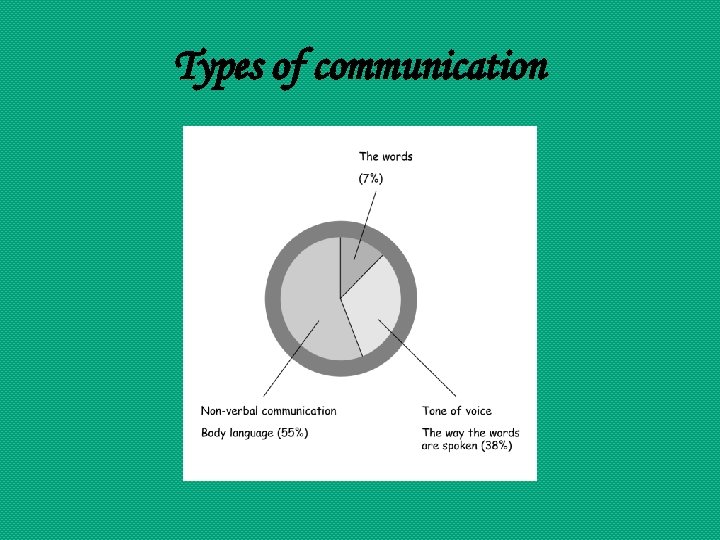
Types of communication
Barriers to effective communication about behavior • Emotional aspects • Threats to teacher self-esteem • Skills/experience
Roles which impede effective communication • • • Dictator Judge Victim Analyst Preacher Lecturer Consoler Joker Detective Busy bee Controlling/bossy Assessing Needing to be hurt Attributing underlying pathology Moraliser Know-all Soothes Fools around Questioner Doesn’t really listen
Communication that creates or reinforces negative behavior • Sarcasm • Anger • Belittling • Negative expectations • Insensitive physical contact • Overt use of physical size
Communication to promote positive behavior • Praise • Affirmations • Positively stated expectations • Language of belonging • Language of choice • Eye contact • Safe physical contact • Body language
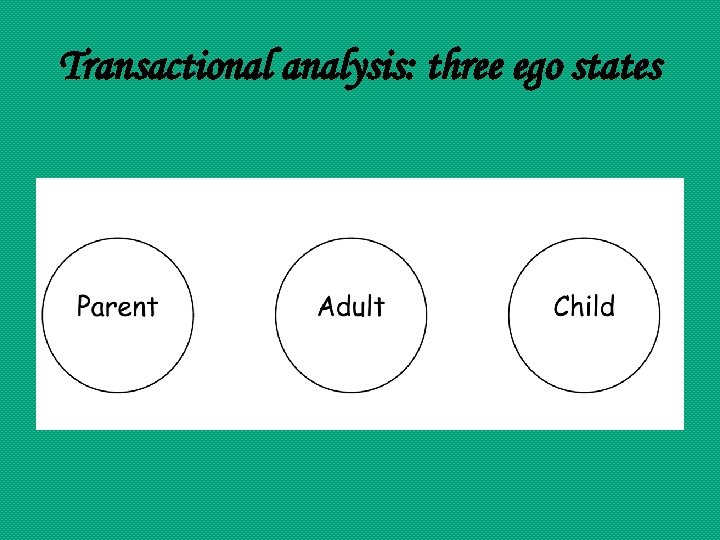
Transactional analysis: three ego states
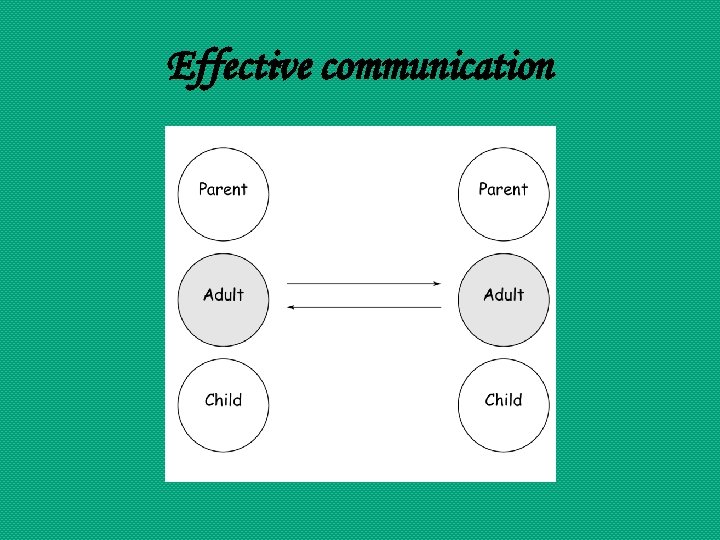
Effective communication
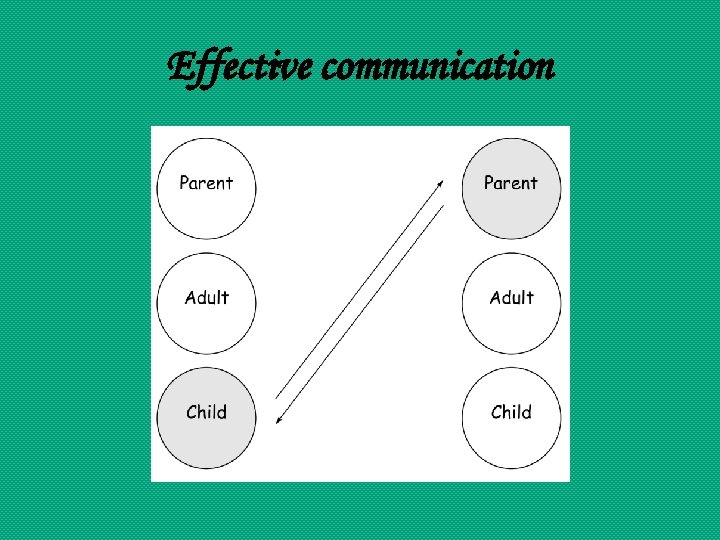
Effective communication
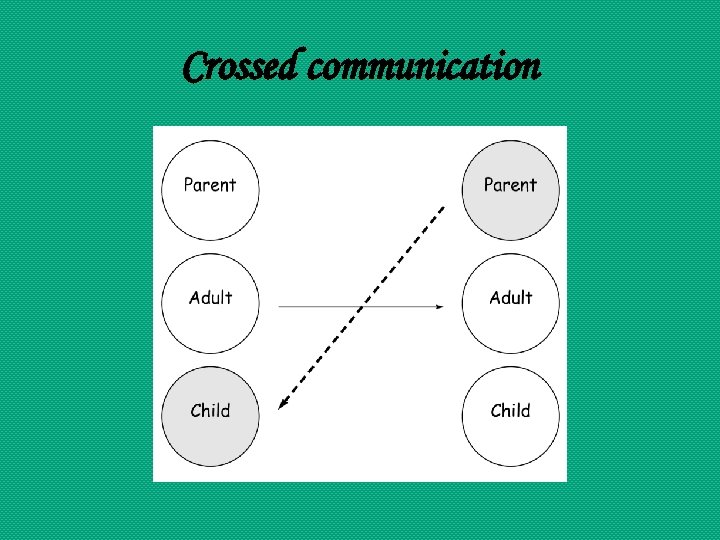
Crossed communication
‘I messages’ • The behaviour • The effect • The feelings • What could be done differently
Benefits of using ‘I messages’ • The adult can stay calm • The adult communicates genuine feelings • The likelihood of confrontation is minimised • Communication is opened up rather than closed down • The self-image of the child is protected
We have considered: • types of communication • barriers to effective communication • communication that can create or reinforce negative behavior • transparency in communication

Crown copyright statement The content of this presentation may be reproduced free of charge by schools, local education authorities and ITT providers, provided that the material is acknowledged as Crown copyright, the publication title is specified, it is reproduced accurately and not used in a misleading context. Anyone else wishing to reuse part or all of the content of this publication should apply to HMSO for a core licence. The permission to reproduce Crown copyright protected material does not extend to any material in this publication which is identified as being the copyright of a third party. Applications to reproduce the material from this publication should be addressed to: HMSO, The Licensing Division, St Clements House, 2– 16 Colegate, Norwich NR 3 1 BQ Fax: 01603 723000 e-mail: hmsolicensing@cabinet-office. x. gsi. gov. uk
Activity • Brainstorm good qualities of communication that teachers should use in the classroom.
Classroom Communication • • Teacher speaks clearly enough for every student to hear. Teacher maintains eye contact with students. Teacher uses variation in pace and pitch of voice. Teacher uses visual and/or hands on resources to emphasize objectives. • Teacher addresses students correctly and courteously. • Teacher responds appropriately to students' questions. • Teacher does not interrupt students or allow them to be interrupted by their peers.
Classroom Communication • • • Teacher avoids stereotyping and cultural discrimination. Teacher uses gender-neutral terminology when possible. Teacher treats students respectfully. Teacher treats students fairly and impartially. Teacher evenhandedly administers praise and correction to students. • Teacher encourages all students to participate in class discussions. • Teacher encourages students to consider various viewpoints, including those of their peers. • Teacher uses correct grammar.
Research Findings on Non-Verbal Communication • Birdwhistell (1970) - 65% of a message’s meaning is communicated through non-verbal clues. • Today, some researchers put the amount of information being transmitted non-verbally even higher. For example Fromkin and Rodman (1983) - up to 90% of the meaning of a message is transmitted non-verbally.
Non-Verbal Communication • Researchers have divided non-verbal communication into 4 categories: – Kinesics- communication by body movement (the opposite of being stiff) – Haptics- communication by touch – Proxemics- the space between people (think of proximity) – Oculesics- eye contact (very important to classroom management)
Body Language • Bodily orientation (the degree to which one interactant’s shoulders and legs are turned toward, rather than away from, the other interactant): – Standing individuals interact with more direct orientation with those of higher status than with those of lower status.
Body Language • Open and closed bodily positions (with open positions consisting of knees apart, legs stretched out, elbows away from body, hands not touching, legs uncrossed, etc. , and closed positions consisting of legs crossed at either knees or ankles, hands folded on lap, arms crossed, etc. ): – Individuals with open body positions are perceived more positively than those with closed body positions. – Individuals with open body positions are more persuasive than those with closed body positions.
Body Language • Trunk lean (the direction in which one interactant positions his or her trunk, forward / toward or backward / away from, in relation to the other interactant): – Individuals who engage in forward trunk leans increase the verbal output of their interactional partner more than those who do not. – Individuals tend to engage in more sideways-leans when interacting with lower-status than with higher-status individuals.
Body Language • Postural positions: – The adoption (or imitation) of common bodily postures (identified as posture matching) by interactants in pairs or groups tends to enhance rapport between/ among the interactants, because it signals that the interactants are open to and with one another. The adoption of noncongruent postures tends to indicate attitudinal and perceptual differences or relationship distance.
Body Language • Gestures (hand arm movements): – Speakers engage in more manipulative gestures (such as touching self or surroundings) when they are responding to intimate questions and when they are interacting at a close interpersonal distance. – Individuals’ hand movements – especially vertical one – can indicate a positive interpersonal relationship.
Body Language • Head movements: – Listeners who engage in head nodding increase the speech duration of speakers. – Listeners who engage in head nodding provide positive reinforcements for speakers.
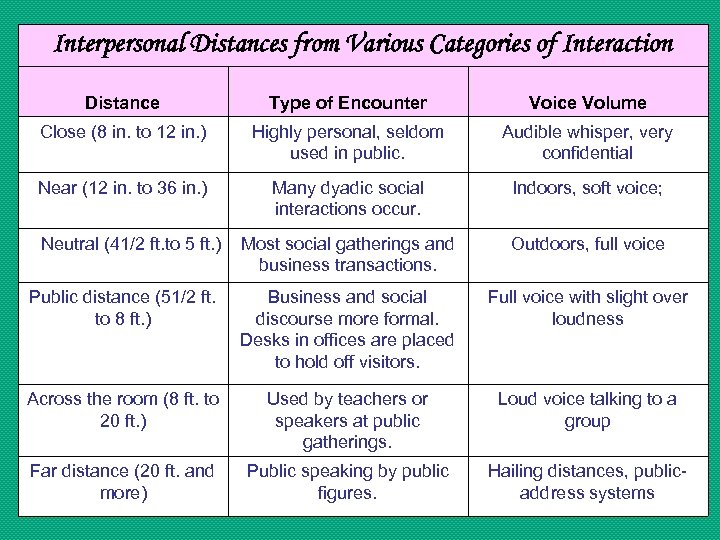
Interpersonal Distances from Various Categories of Interaction Distance Type of Encounter Voice Volume Close (8 in. to 12 in. ) Highly personal, seldom used in public. Audible whisper, very confidential Near (12 in. to 36 in. ) Many dyadic social interactions occur. Indoors, soft voice; Neutral (41/2 ft. to 5 ft. ) Most social gatherings and business transactions. Outdoors, full voice Public distance (51/2 ft. to 8 ft. ) Business and social discourse more formal. Desks in offices are placed to hold off visitors. Full voice with slight over loudness Across the room (8 ft. to 20 ft. ) Used by teachers or speakers at public gatherings. Loud voice talking to a group Far distance (20 ft. and more) Public speaking by public figures. Hailing distances, publicaddress systems
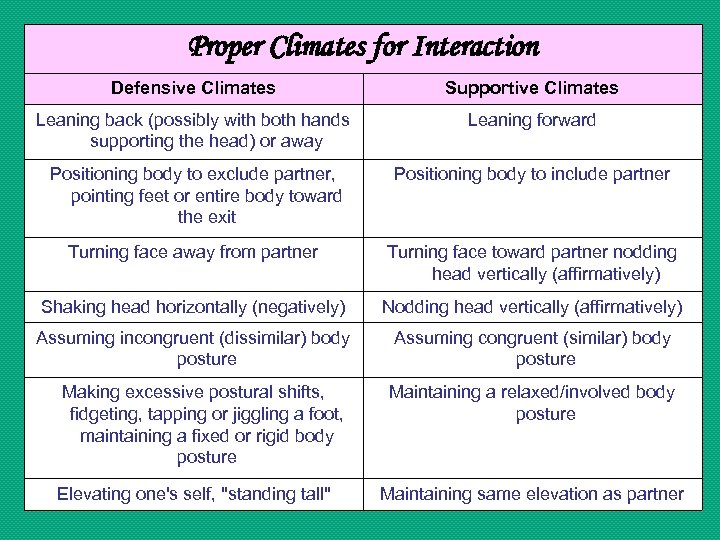
Proper Climates for Interaction Defensive Climates Supportive Climates Leaning back (possibly with both hands supporting the head) or away Leaning forward Positioning body to exclude partner, pointing feet or entire body toward the exit Positioning body to include partner Turning face away from partner Turning face toward partner nodding head vertically (affirmatively) Shaking head horizontally (negatively) Nodding head vertically (affirmatively) Assuming incongruent (dissimilar) body posture Assuming congruent (similar) body posture Making excessive postural shifts, fidgeting, tapping or jiggling a foot, maintaining a fixed or rigid body posture Elevating one's self, "standing tall" Maintaining a relaxed/involved body posture Maintaining same elevation as partner
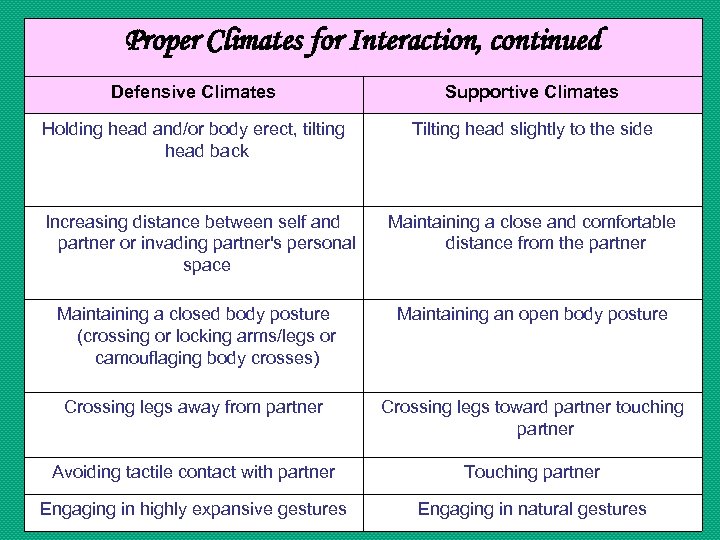
Proper Climates for Interaction, continued Defensive Climates Supportive Climates Holding head and/or body erect, tilting head back Tilting head slightly to the side Increasing distance between self and partner or invading partner's personal space Maintaining a close and comfortable distance from the partner Maintaining a closed body posture (crossing or locking arms/legs or camouflaging body crosses) Maintaining an open body posture Crossing legs away from partner Crossing legs toward partner touching partner Avoiding tactile contact with partner Touching partner Engaging in highly expansive gestures Engaging in natural gestures
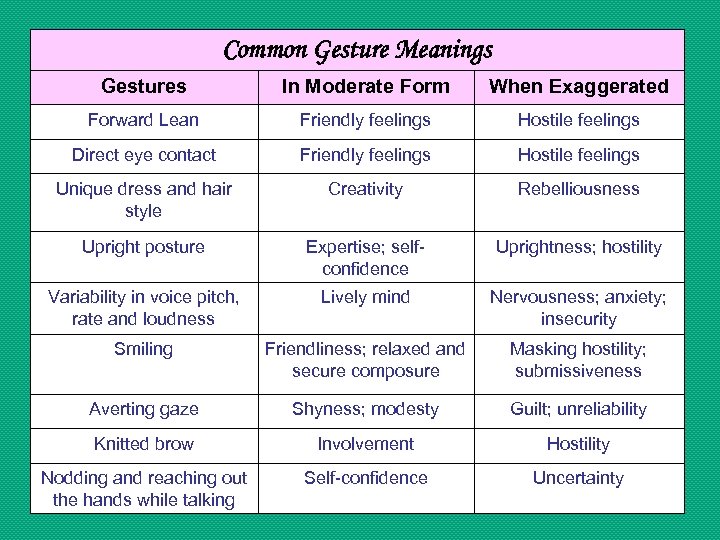
Common Gesture Meanings Gestures In Moderate Form When Exaggerated Forward Lean Friendly feelings Hostile feelings Direct eye contact Friendly feelings Hostile feelings Unique dress and hair style Creativity Rebelliousness Upright posture Expertise; selfconfidence Uprightness; hostility Variability in voice pitch, rate and loudness Lively mind Nervousness; anxiety; insecurity Smiling Friendliness; relaxed and secure composure Masking hostility; submissiveness Averting gaze Shyness; modesty Guilt; unreliability Knitted brow Involvement Hostility Nodding and reaching out the hands while talking Self-confidence Uncertainty
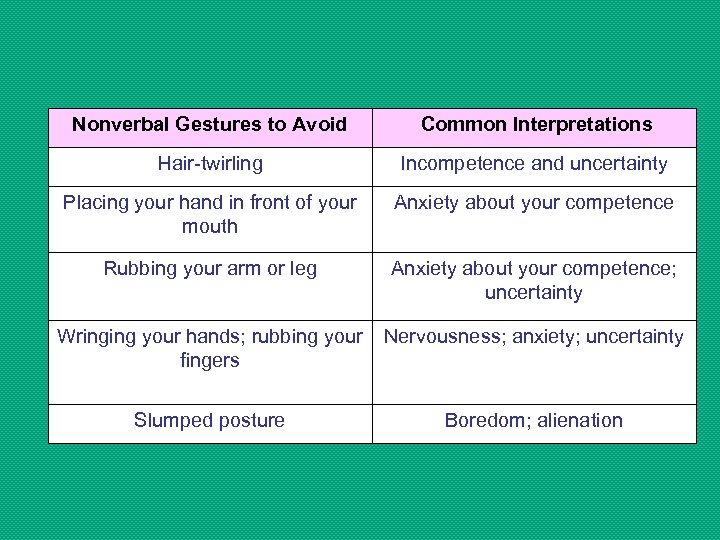
Nonverbal Gestures to Avoid Common Interpretations Hair-twirling Incompetence and uncertainty Placing your hand in front of your mouth Anxiety about your competence Rubbing your arm or leg Anxiety about your competence; uncertainty Wringing your hands; rubbing your Nervousness; anxiety; uncertainty fingers Slumped posture Boredom; alienation
Task 2. 2. 1: Videotaped Teaching • Videotape three 15 -30 minute lessons • Self-evaluate • Seek peer evaluation
Task 2. 2. 1: Videotaped Teaching • Select a lesson that will provide many opportunities to interact with your students. Limit lecture or presentation modes. • Plan to ask questions and stimulate discussion in different ways. Some effective communication strategies you can try include: – Restate ideas and draw conclusions – Use visual, aural, and kinesthetic cues – Probe for learner understanding – Be sensitive to nonverbal cues – Help students articulate their ideas and thinking processes – Promote risk-taking and problem-solving – Facilitate factual recall – Encourage convergent and divergent thinking – Stimulate curiosity – Help students to formulate questions
Task 2. 2. 1: Videotaped Teaching • Schedule someone to videotape the lesson. • Protect the confidentiality rights of your students. You can secure a written authorization from their parents to videotape, or have the person doing the taping stay in the back of the room, filming the backs of heads only. Check with your principal to make sure you follow school policy. • Watch your videotape and analyze your performance, using the selfassessment questions. Write an answer to each of the six questions. • Ask a peer or your mentor to review your analysis, agreeing or disagreeing with your assessment and adding his or her comments on your strengths and areas needing improvement. • Repeat the process two more times. NOTE: If performance is extremely strong the first or second time (all ratings of “acceptable”), and the assessor is extremely confident about the ratings, one or both repetitions may be omitted. • Summarize your learning about yourself and what you expect to do to improve. • Submit the results to your instructor.
Task 2. 2. 1: Questions for Self-Assessment and Peer Assessment Handout • How was your physical appearance? – Clothing (tasteful or too bright, too tight, too loose) – Hair (neat or dirty, hanging) • How was your voice? – Voice quality (pleasant, confident, convincing or squeaky, uncertain) – Volume (appropriately loud or too soft, too loud) – Pitch and inflection (varying up and down or monotonous) – Expression (convey respect or talking down) – Tone (conversational or lecturing)
Task 2. 2. 1: Questions for Self-Assessment and Peer Assessment • How was your facial expression? – Attentiveness (Interested or bored, pre-occupied, frowning, impatient) – Eye contact (looking directly at students or elsewhere) – Sincere (match what you are saying or contradictory - e. g. , serious or smiling/sneering while you're disciplining) • How were your physical movement and gestures? – Hand arm movement (appropriate movement or hands in pocket, behind back, arms folded) – Total body movement (walking or standing still, pacing back and forth)
Task 2. 2. 1: Questions for Self-Assessment and Peer Assessment • How is your content presentation? – Introduction (gets attention and builds on previous lesson) – Questions (higher order and include appropriate pause for response) – Examples (use examples and non-examples) – Guided practice (well-designed) – Pace (momentum) – Feedback (meaningful and corrective) – Summary (includes what should have been learned) – Instructions for homework (clear)
Task 2. 2. 1: Questions for Self-Assessment and Peer Assessment • How was your management of behavior? – Aware (of what's happening at all times) – Quick response (to misbehavior to prevent it from getting out of hand) – Demeanor (tension invisible)
Discussion Activity • Why is it important to use good grammar in the classroom? • Is there a difference for some subjects or grade levels in grammar expectations for teachers?
Importance of Teacher Grammar • Using correct grammar is an essential part of being a teacher regardless of the subject(s) you teach. • It provides a level of professionalism necessary to garner the respect of your peers and administrators. • Additionally, students will emulate the grammar you use in your classroom.
Grammar Links • Grammar Test 1 http: //www. meguffey. com/gram_mech_diag. html • Grammar Test 2 Quiz on Grammar, Punctuation, and Usage • You can find additional instruction and quizzes at the following links: http: //198. 85. 71. 81/english/grammarguide. html http: //www. me. vt. edu/writing/exercises/ http: //a 4 esl. org/q/h/grammar. html http: //grammar. ccc. commnet. edu/grammar/quiz_list. htm
Task 2. 3. 1: Observation • In this task, you will provide documentation of your communication skills as expressed in verbal and nonverbal interactions with students during a planned guided discussion as part of a lesson. – Plan a lesson or part of a lesson that incorporates interactive discussion and communication, involving all students or a group of students. – Determine and list the things you need to say or explain as a set of talking points. – Create the questions you expect to use to foster learning.
Task 2. 3. 1: Observation • Make a list of nonverbal behaviors you think will help the lesson, such as moving near the student you are talking to, looking at the student who is the focus, or pointing at a display. • If helpful, make a list of specific students you plan to involve or prompt. • Practice your statements and questions so you are familiar with them.
Task 2. 3. 1: Observation • Teach the lesson in front of an observer. Remember to: – Maintain the focus of the lesson. – Use both statements and questions intermittently. – Keep the conversation moving with gestures and movement. – Use non-verbal behavior to keep students on task. – Involve as many students as possible. • Have the observer score your interactive lesson using the prescribed forms.
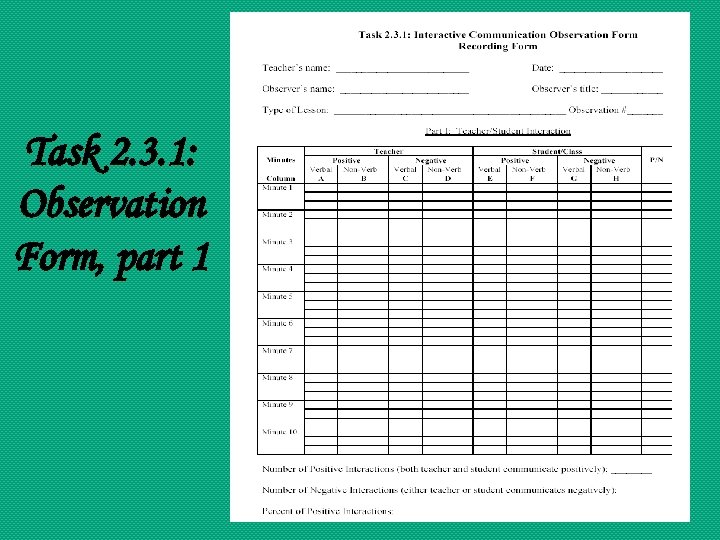
Task 2. 3. 1: Observation Form, part 1
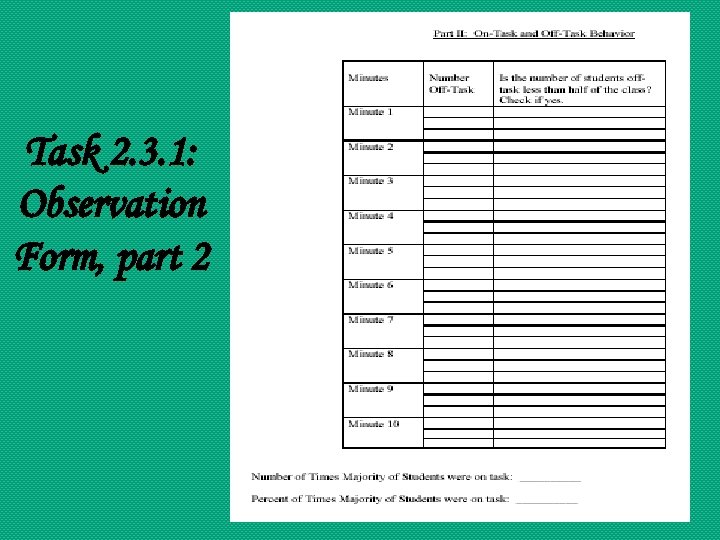
Task 2. 3. 1: Observation Form, part 2
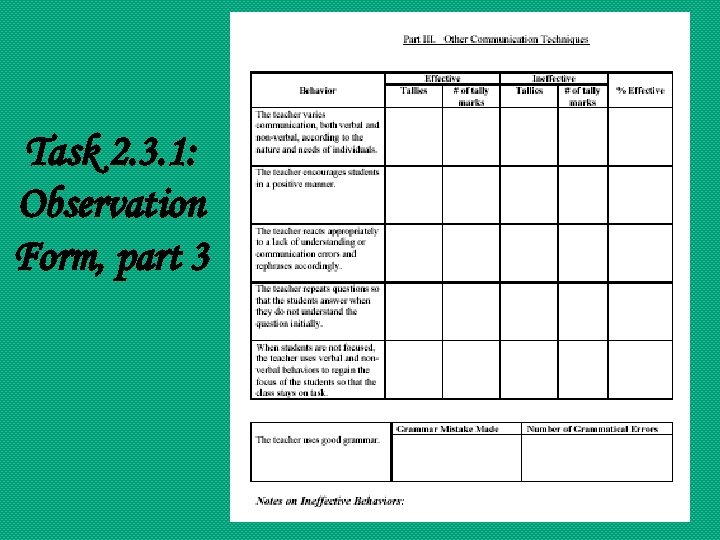
Task 2. 3. 1: Observation Form, part 3
Communication • Teaching effectively means using all kinds of communication skills - including listening, questioning, responding, demonstrating, body language, reading, and writing as well as talking. • Great communication skills on your part will help your students and their parents hear your high expectations for them -- and understand how students are progressing.
Communication • The more communication techniques you use, the better you'll come to understand your students' diverse needs, and how you can meet them. • Pass on communications skills by your example, and you'll find your students will start to practice them, too. Then interaction between students can become a powerful teaching tool.
Communication • “. . . teaching is more than telling. “ » Andrea M. Guillaume
Resources • • • • Arthur, D. (1995, June). The importance of body language. HR Focus, 72 (6), 22 -23. Baldry, C. (1999, August). Space – The final frontier. Sociology, 33 (3), 535. Bloomfield, C. L. , & Fairley, I. R. (1991) Business communication – A process approach. San Diego, CA: Harcourt Brace Jovanovich. Feldman, R. S. (1992). Applications of Nonverbal Behavioral Theories and Research. New Jersey: Lawrence Erlbaum Associates, Inc. Hogrefe, C. J. (1988). Cross-cultural perspectives in nonverbal communication. Lewiston, NY: C. J. Hogrefe Inc. Jones, S. L. (1997, June). A guide to using color effectively in business communication. Business Communication Quarterly, 60 (2), 76 -89. Judd, D. B. , & Wyszecki, G. (1975). Color in business, science, and industry. (3 rd ed. ). New York: John Wiley & Sons, Inc. Knapp, M. & Hall, J. (1992). Nonverbal communication in human interaction. Orlando, FL: Holt, Rinehart & Winsten, Inc. Malandro, L. A. (1983, 1989). Non-verbal Communication (2 nd ed. ). New York : Random House. Port, R. E. , & Samovar, L. A. (1993). Communication between cultures. (2 nd ed. ). Albany: Wadsworth Publishing Co. Rosier, B. (1999, March). Putting colour into PC sales. Marketing, 18. Segerstrale, U. & Molnar, P. (1997). Nonverbal communication where nature meets culture. Mahuan, NJ: Lawrence Erlbaum Associates. Vargas, M. F. (1986). Louder than words – An introduction to nonverbal communication. Ames, IA: The Iowa State University Press.
Скачать презентацию ACE Program Communication Curriculum Objectives Participants will
f08cdf234009350c480a6a6e514a5c73.ppt