 Скачать презентацию Accuracy of transcutaneous bilirubin measurement NEMC Evidence Report
a96f52e1347ac48725dc2aee5f9d90e5.ppt
- Количество слайдов: 42



Accuracy of transcutaneous bilirubin measurement NEMC Evidence Report Rebecca Flynn O’Brien, MD Division of General Pediatrics and Adolescent Medicine The Floating Hospital for Children Tufts-New England Medical Center
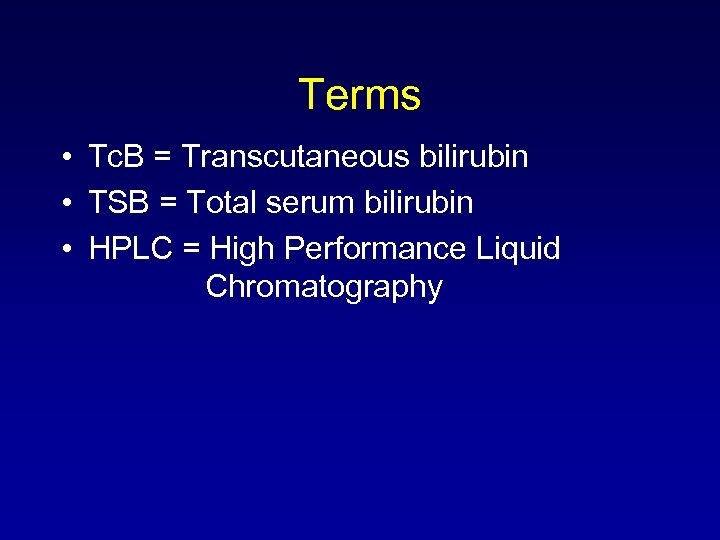
Terms • Tc. B = Transcutaneous bilirubin • TSB = Total serum bilirubin • HPLC = High Performance Liquid Chromatography
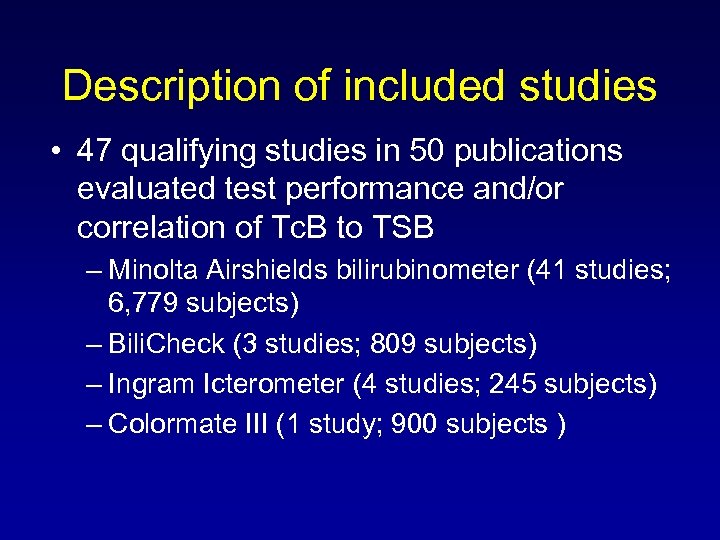
Description of included studies • 47 qualifying studies in 50 publications evaluated test performance and/or correlation of Tc. B to TSB – Minolta Airshields bilirubinometer (41 studies; 6, 779 subjects) – Bili. Check (3 studies; 809 subjects) – Ingram Icterometer (4 studies; 245 subjects) – Colormate III (1 study; 900 subjects )
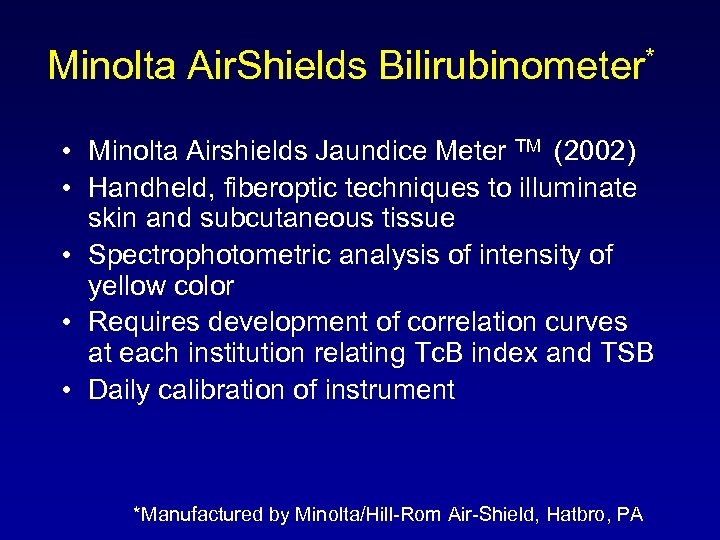
Minolta Air. Shields Bilirubinometer* • Minolta Airshields Jaundice Meter TM (2002) • Handheld, fiberoptic techniques to illuminate skin and subcutaneous tissue • Spectrophotometric analysis of intensity of yellow color • Requires development of correlation curves at each institution relating Tc. B index and TSB • Daily calibration of instrument *Manufactured by Minolta/Hill-Rom Air-Shield, Hatbro, PA
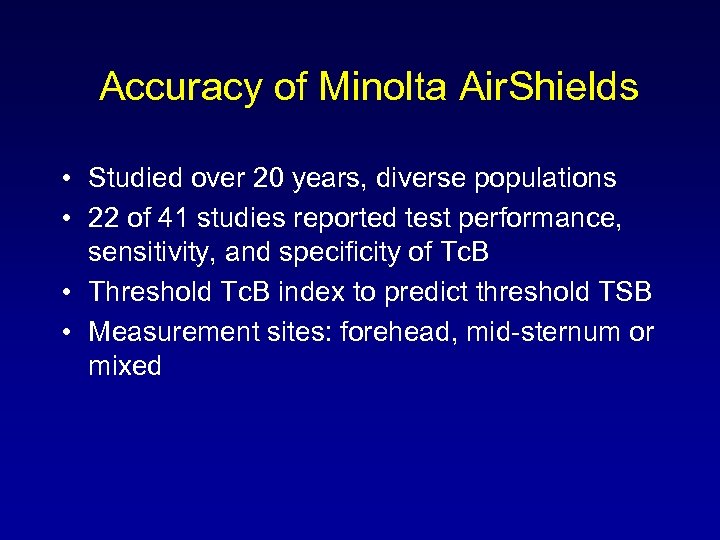
Accuracy of Minolta Air. Shields • Studied over 20 years, diverse populations • 22 of 41 studies reported test performance, sensitivity, and specificity of Tc. B • Threshold Tc. B index to predict threshold TSB • Measurement sites: forehead, mid-sternum or mixed
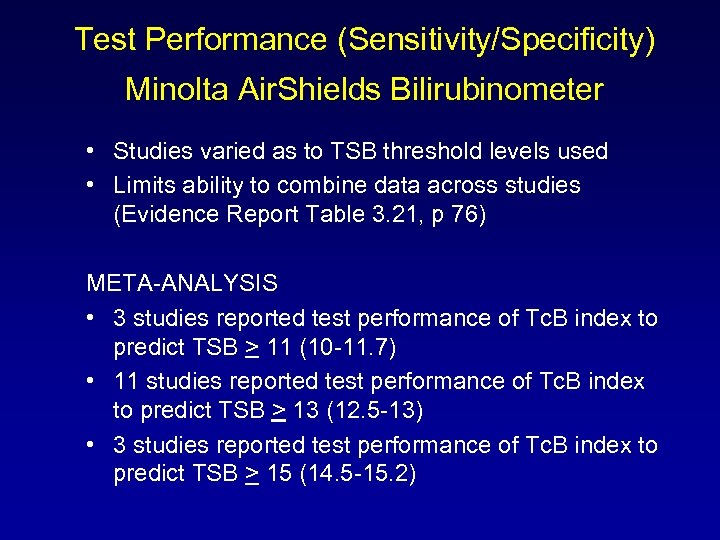
Test Performance (Sensitivity/Specificity) Minolta Air. Shields Bilirubinometer • Studies varied as to TSB threshold levels used • Limits ability to combine data across studies (Evidence Report Table 3. 21, p 76) META-ANALYSIS • 3 studies reported test performance of Tc. B index to predict TSB > 11 (10 -11. 7) • 11 studies reported test performance of Tc. B index to predict TSB > 13 (12. 5 -13) • 3 studies reported test performance of Tc. B index to predict TSB > 15 (14. 5 -15. 2)
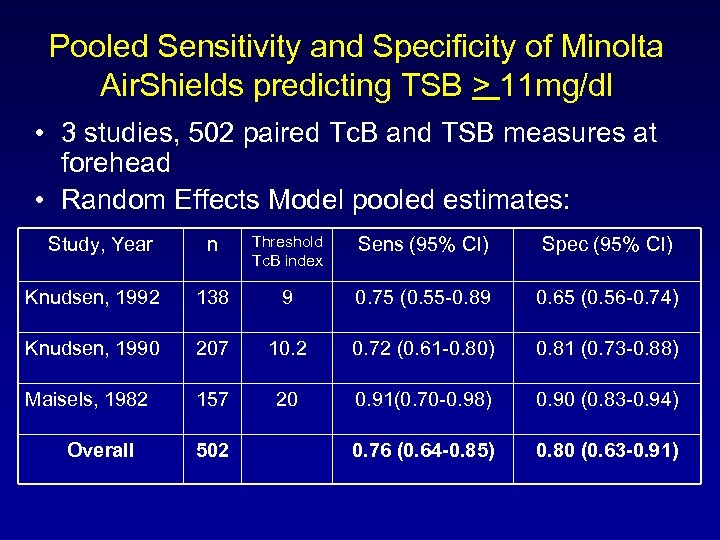
Pooled Sensitivity and Specificity of Minolta Air. Shields predicting TSB > 11 mg/dl • 3 studies, 502 paired Tc. B and TSB measures at forehead • Random Effects Model pooled estimates: n Threshold Tc. B index Sens (95% CI) Spec (95% CI) Knudsen, 1992 138 9 0. 75 (0. 55 -0. 89 0. 65 (0. 56 -0. 74) Knudsen, 1990 207 10. 2 0. 72 (0. 61 -0. 80) 0. 81 (0. 73 -0. 88) Maisels, 1982 157 20 0. 91(0. 70 -0. 98) 0. 90 (0. 83 -0. 94) 0. 76 (0. 64 -0. 85) 0. 80 (0. 63 -0. 91) Study, Year Overall 502
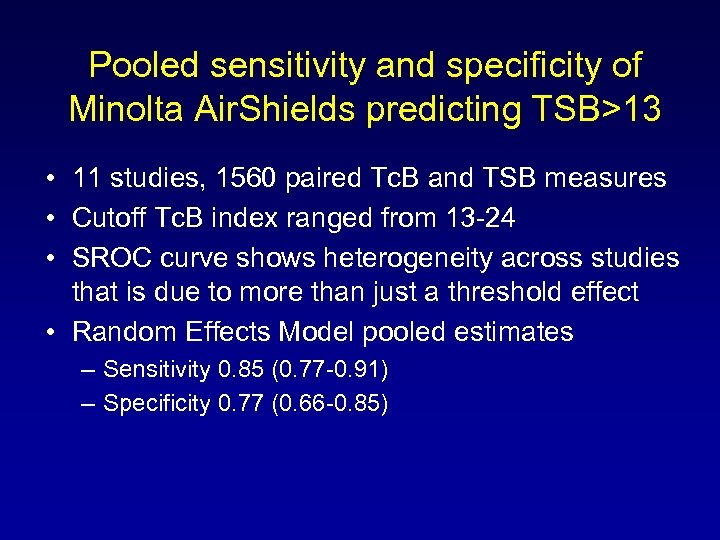
Pooled sensitivity and specificity of Minolta Air. Shields predicting TSB>13 • 11 studies, 1560 paired Tc. B and TSB measures • Cutoff Tc. B index ranged from 13 -24 • SROC curve shows heterogeneity across studies that is due to more than just a threshold effect • Random Effects Model pooled estimates – Sensitivity 0. 85 (0. 77 -0. 91) – Specificity 0. 77 (0. 66 -0. 85)
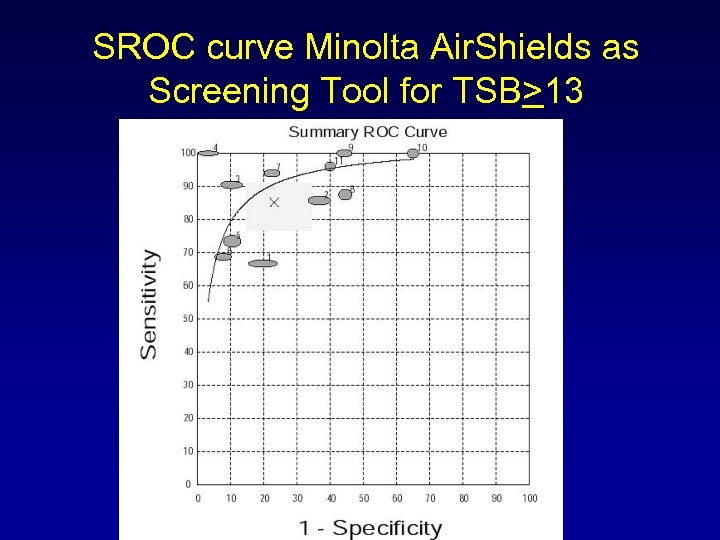
SROC curve Minolta Air. Shields as Screening Tool for TSB>13
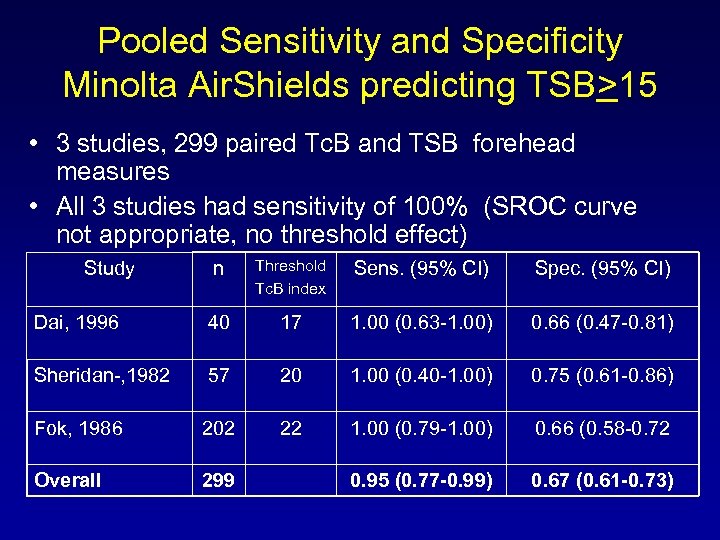
Pooled Sensitivity and Specificity Minolta Air. Shields predicting TSB>15 • 3 studies, 299 paired Tc. B and TSB forehead measures • All 3 studies had sensitivity of 100% (SROC curve not appropriate, no threshold effect) n Threshold Tc. B index Sens. (95% CI) Spec. (95% CI) Dai, 1996 40 17 1. 00 (0. 63 -1. 00) 0. 66 (0. 47 -0. 81) Sheridan-, 1982 57 20 1. 00 (0. 40 -1. 00) 0. 75 (0. 61 -0. 86) Fok, 1986 202 22 1. 00 (0. 79 -1. 00) 0. 66 (0. 58 -0. 72 Overall 299 0. 95 (0. 77 -0. 99) 0. 67 (0. 61 -0. 73) Study
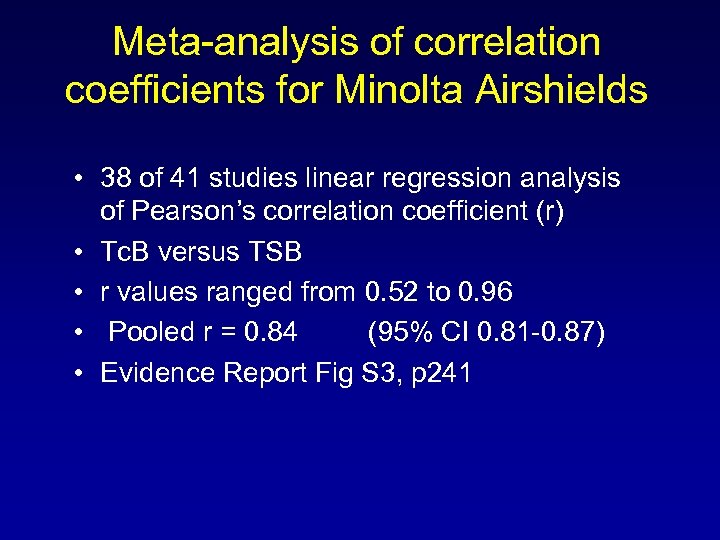
Meta-analysis of correlation coefficients for Minolta Airshields • 38 of 41 studies linear regression analysis of Pearson’s correlation coefficient (r) • Tc. B versus TSB • r values ranged from 0. 52 to 0. 96 • Pooled r = 0. 84 (95% CI 0. 81 -0. 87) • Evidence Report Fig S 3, p 241
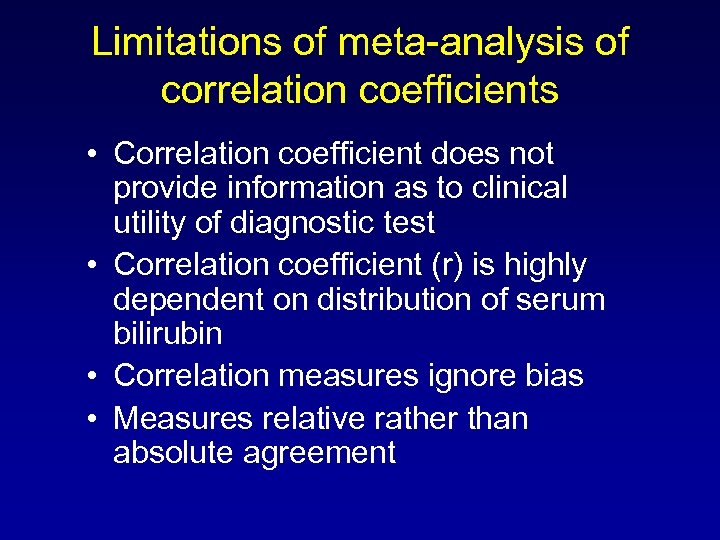
Limitations of meta-analysis of correlation coefficients • Correlation coefficient does not provide information as to clinical utility of diagnostic test • Correlation coefficient (r) is highly dependent on distribution of serum bilirubin • Correlation measures ignore bias • Measures relative rather than absolute agreement
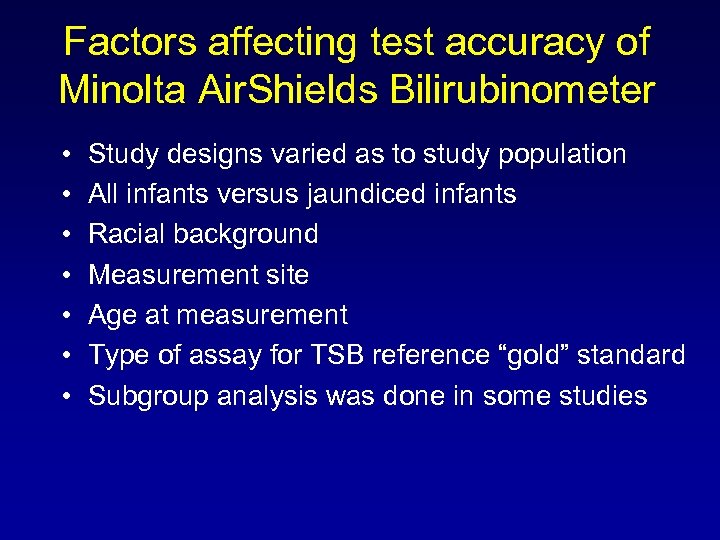
Factors affecting test accuracy of Minolta Air. Shields Bilirubinometer • • Study designs varied as to study population All infants versus jaundiced infants Racial background Measurement site Age at measurement Type of assay for TSB reference “gold” standard Subgroup analysis was done in some studies
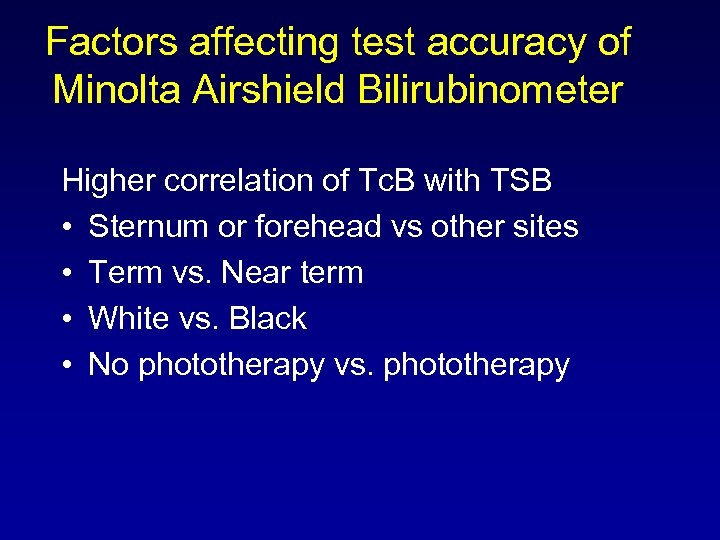
Factors affecting test accuracy of Minolta Airshield Bilirubinometer Higher correlation of Tc. B with TSB • Sternum or forehead vs other sites • Term vs. Near term • White vs. Black • No phototherapy vs. phototherapy
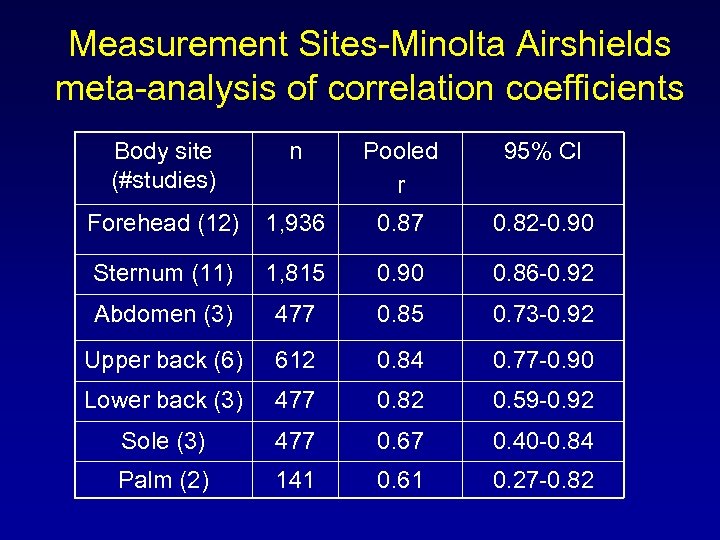
Measurement Sites-Minolta Airshields meta-analysis of correlation coefficients Body site (#studies) n Pooled r 95% CI Forehead (12) 1, 936 0. 87 0. 82 -0. 90 Sternum (11) 1, 815 0. 90 0. 86 -0. 92 Abdomen (3) 477 0. 85 0. 73 -0. 92 Upper back (6) 612 0. 84 0. 77 -0. 90 Lower back (3) 477 0. 82 0. 59 -0. 92 Sole (3) 477 0. 67 0. 40 -0. 84 Palm (2) 141 0. 61 0. 27 -0. 82
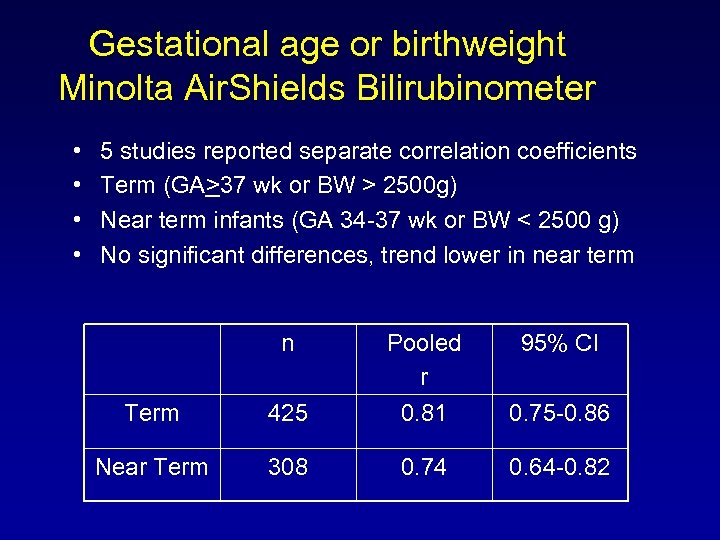
Gestational age or birthweight Minolta Air. Shields Bilirubinometer • • 5 studies reported separate correlation coefficients Term (GA>37 wk or BW > 2500 g) Near term infants (GA 34 -37 wk or BW < 2500 g) No significant differences, trend lower in near term n Term 425 Pooled r 0. 81 Near Term 308 0. 74 95% CI 0. 75 -0. 86 0. 64 -0. 82
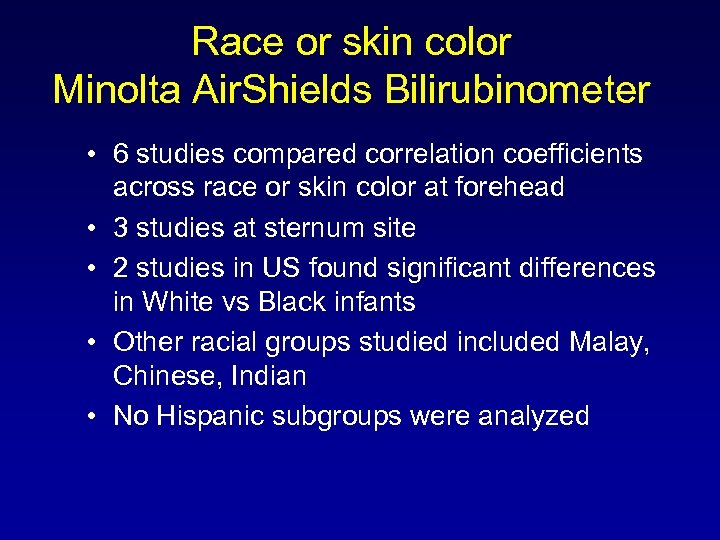
Race or skin color Minolta Air. Shields Bilirubinometer • 6 studies compared correlation coefficients across race or skin color at forehead • 3 studies at sternum site • 2 studies in US found significant differences in White vs Black infants • Other racial groups studied included Malay, Chinese, Indian • No Hispanic subgroups were analyzed
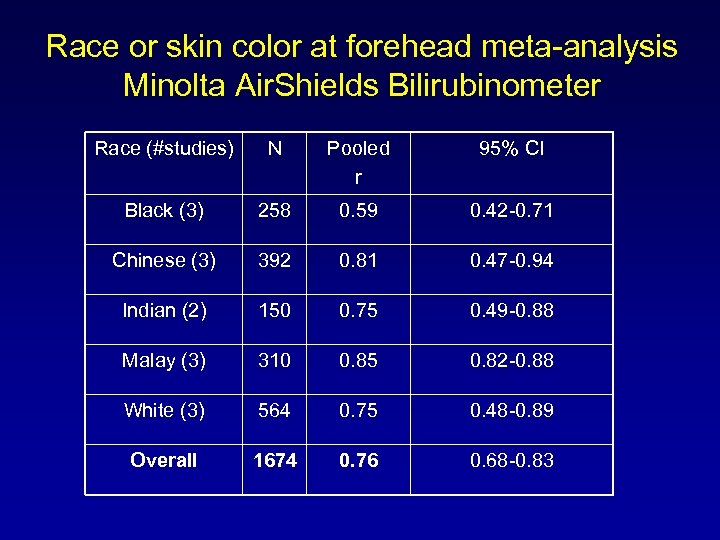
Race or skin color at forehead meta-analysis Minolta Air. Shields Bilirubinometer Race (#studies) N Pooled r 95% CI Black (3) 258 0. 59 0. 42 -0. 71 Chinese (3) 392 0. 81 0. 47 -0. 94 Indian (2) 150 0. 75 0. 49 -0. 88 Malay (3) 310 0. 85 0. 82 -0. 88 White (3) 564 0. 75 0. 48 -0. 89 Overall 1674 0. 76 0. 68 -0. 83
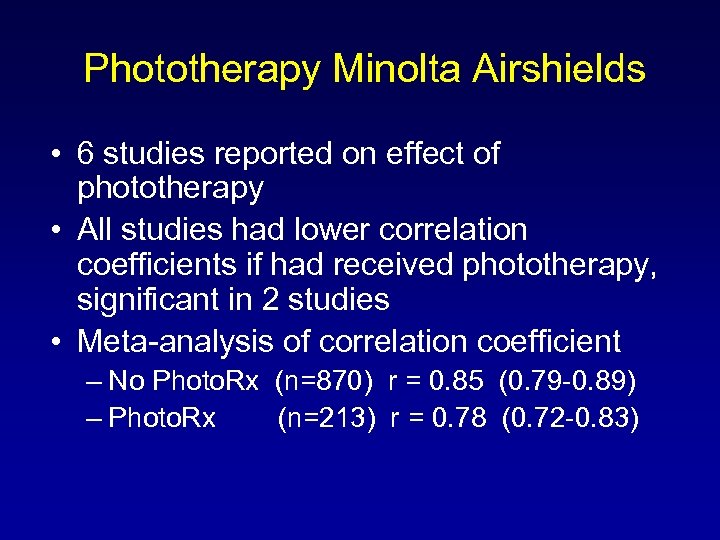
Phototherapy Minolta Airshields • 6 studies reported on effect of phototherapy • All studies had lower correlation coefficients if had received phototherapy, significant in 2 studies • Meta-analysis of correlation coefficient – No Photo. Rx (n=870) r = 0. 85 (0. 79 -0. 89) – Photo. Rx (n=213) r = 0. 78 (0. 72 -0. 83)
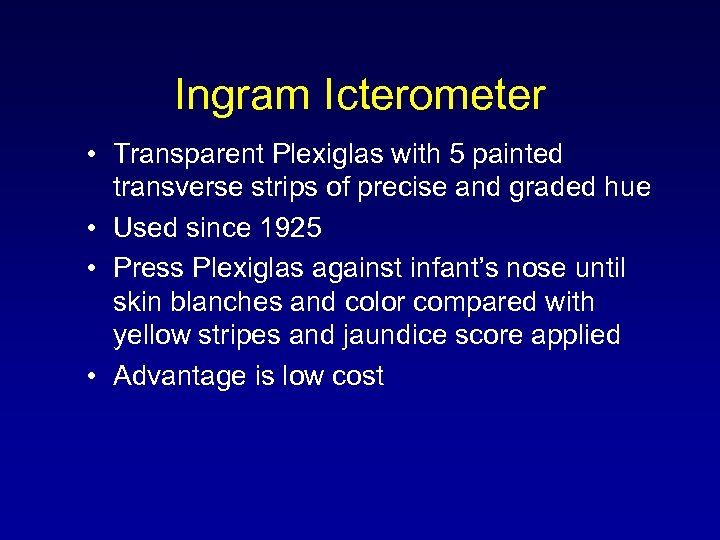
Ingram Icterometer • Transparent Plexiglas with 5 painted transverse strips of precise and graded hue • Used since 1925 • Press Plexiglas against infant’s nose until skin blanches and color compared with yellow stripes and jaundice score applied • Advantage is low cost
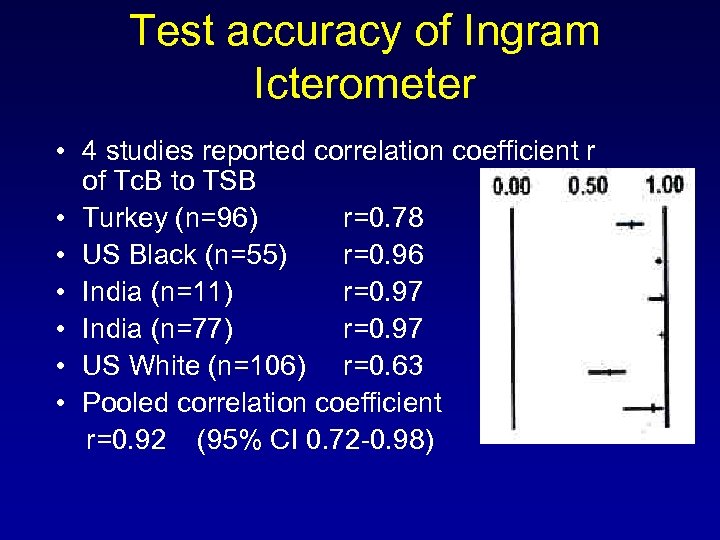
Test accuracy of Ingram Icterometer • 4 studies reported correlation coefficient r of Tc. B to TSB • Turkey (n=96) r=0. 78 • US Black (n=55) r=0. 96 • India (n=11) r=0. 97 • India (n=77) r=0. 97 • US White (n=106) r=0. 63 • Pooled correlation coefficient r=0. 92 (95% CI 0. 72 -0. 98)
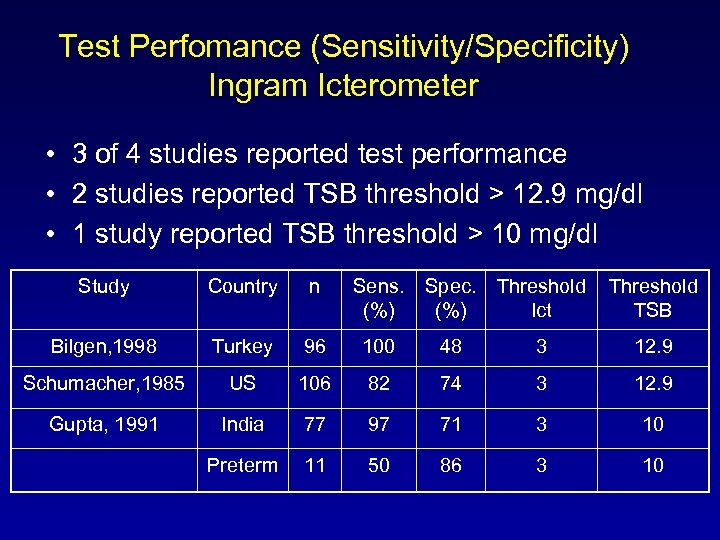
Test Perfomance (Sensitivity/Specificity) Ingram Icterometer • 3 of 4 studies reported test performance • 2 studies reported TSB threshold > 12. 9 mg/dl • 1 study reported TSB threshold > 10 mg/dl Study Country n Sens. (%) Spec. (%) Threshold Ict Threshold TSB Bilgen, 1998 Turkey 96 100 48 3 12. 9 Schumacher, 1985 US 106 82 74 3 12. 9 Gupta, 1991 India 77 97 71 3 10 Preterm 11 50 86 3 10
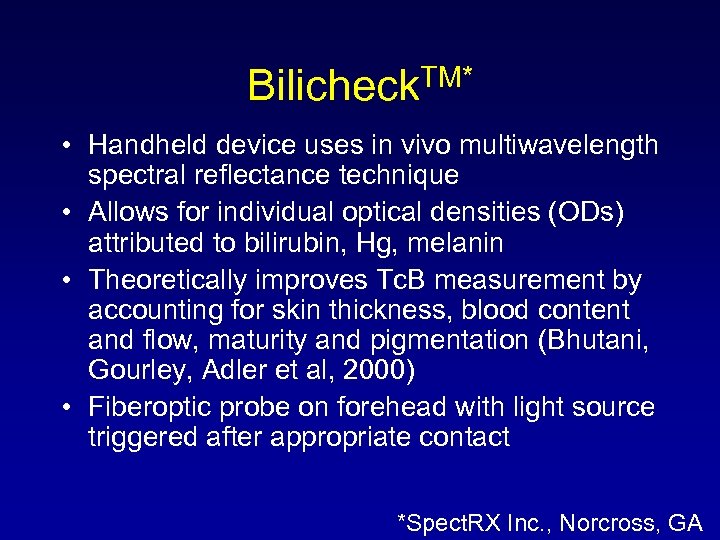
TM* Bilicheck • Handheld device uses in vivo multiwavelength spectral reflectance technique • Allows for individual optical densities (ODs) attributed to bilirubin, Hg, melanin • Theoretically improves Tc. B measurement by accounting for skin thickness, blood content and flow, maturity and pigmentation (Bhutani, Gourley, Adler et al, 2000) • Fiberoptic probe on forehead with light source triggered after appropriate contact *Spect. RX Inc. , Norcross, GA
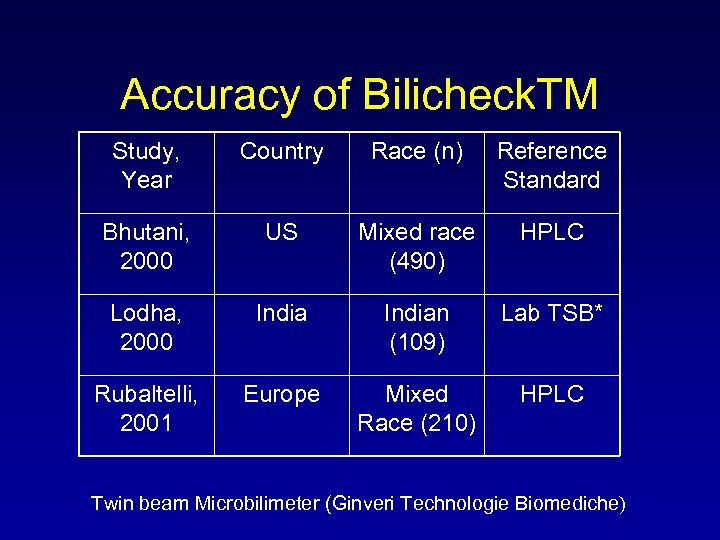
Accuracy of Bilicheck. TM Study, Year Country Race (n) Reference Standard Bhutani, 2000 US Mixed race (490) HPLC Lodha, 2000 Indian (109) Lab TSB* Rubaltelli, 2001 Europe Mixed Race (210) HPLC Twin beam Microbilimeter (Ginveri Technologie Biomediche)
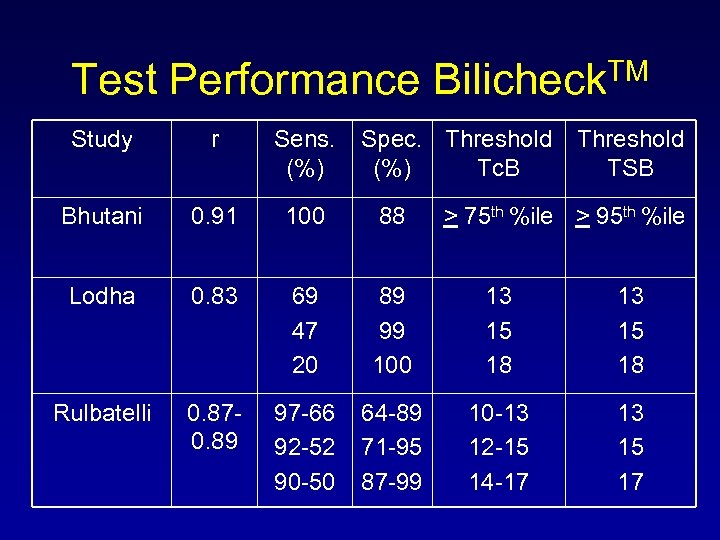
Test Performance Bilicheck. TM Study r Sens. (%) Spec. Threshold (%) Tc. B Threshold TSB Bhutani 0. 91 100 88 Lodha 0. 83 69 47 20 89 99 100 13 15 18 Rulbatelli 0. 870. 89 97 -66 92 -52 90 -50 64 -89 71 -95 87 -99 10 -13 12 -15 14 -17 13 15 17 > 75 th %ile > 95 th %ile
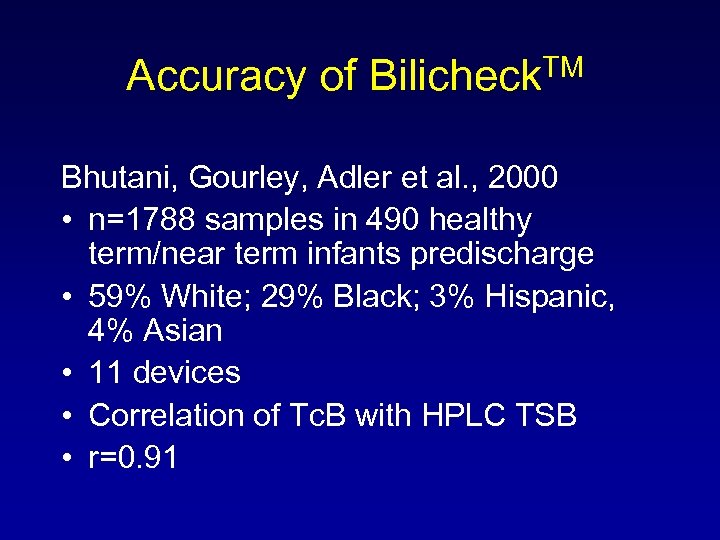
Accuracy of Bilicheck. TM Bhutani, Gourley, Adler et al. , 2000 • n=1788 samples in 490 healthy term/near term infants predischarge • 59% White; 29% Black; 3% Hispanic, 4% Asian • 11 devices • Correlation of Tc. B with HPLC TSB • r=0. 91
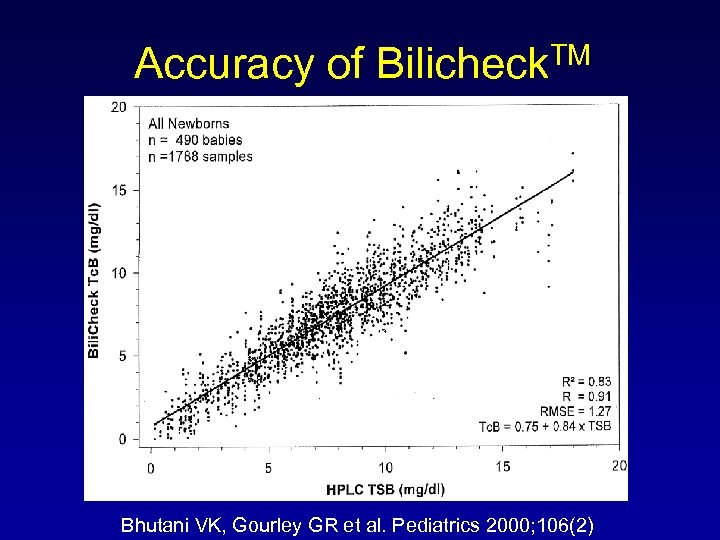
Accuracy of Bilicheck. TM Bhutani VK, Gourley GR et al. Pediatrics 2000; 106(2)
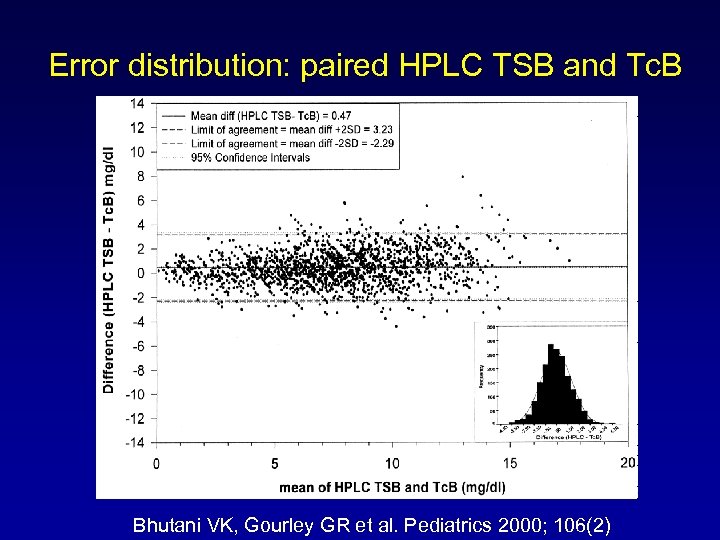
Error distribution: paired HPLC TSB and Tc. B Bhutani VK, Gourley GR et al. Pediatrics 2000; 106(2)
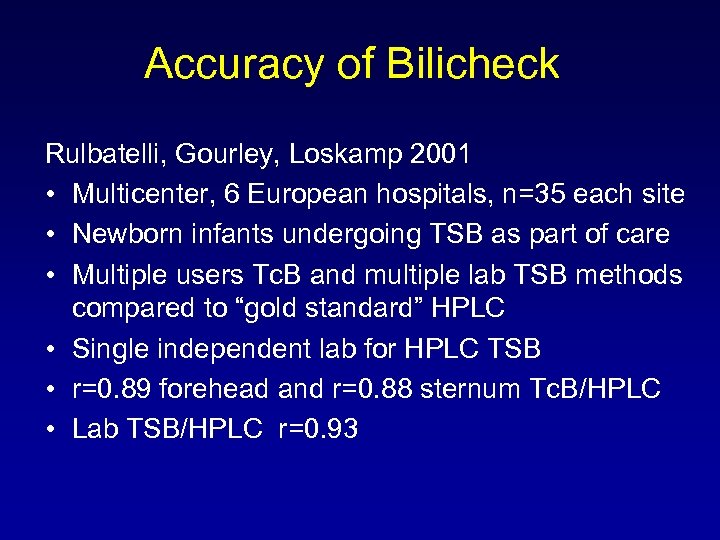
Accuracy of Bilicheck Rulbatelli, Gourley, Loskamp 2001 • Multicenter, 6 European hospitals, n=35 each site • Newborn infants undergoing TSB as part of care • Multiple users Tc. B and multiple lab TSB methods compared to “gold standard” HPLC • Single independent lab for HPLC TSB • r=0. 89 forehead and r=0. 88 sternum Tc. B/HPLC • Lab TSB/HPLC r=0. 93
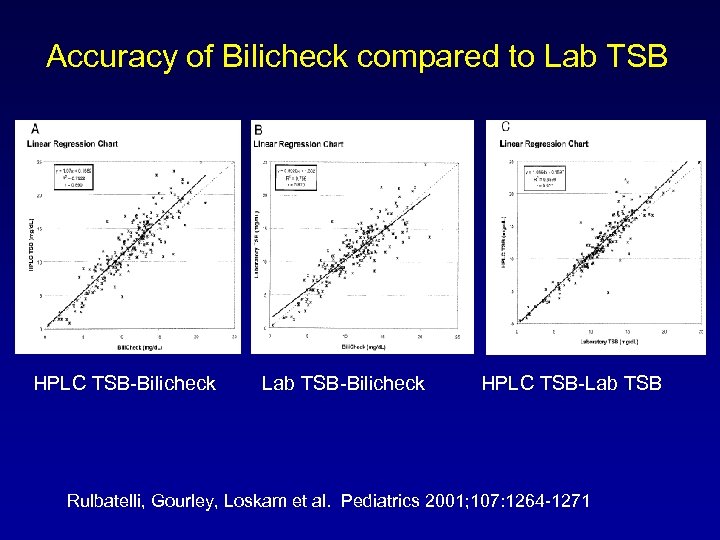
Accuracy of Bilicheck compared to Lab TSB HPLC TSB-Bilicheck Lab TSB-Bilicheck HPLC TSB-Lab TSB Rulbatelli, Gourley, Loskam et al. Pediatrics 2001; 107: 1264 -1271
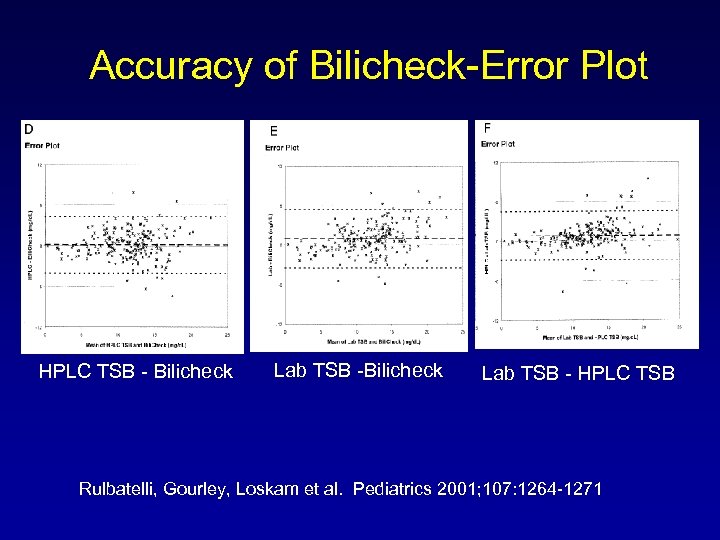
Accuracy of Bilicheck-Error Plot HPLC TSB - Bilicheck Lab TSB - HPLC TSB Rulbatelli, Gourley, Loskam et al. Pediatrics 2001; 107: 1264 -1271
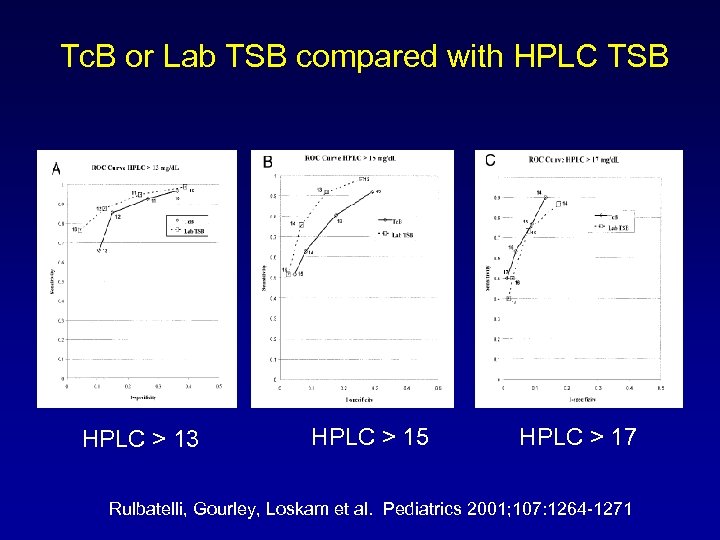
Tc. B or Lab TSB compared with HPLC TSB HPLC > 13 HPLC > 15 HPLC > 17 Rulbatelli, Gourley, Loskam et al. Pediatrics 2001; 107: 1264 -1271
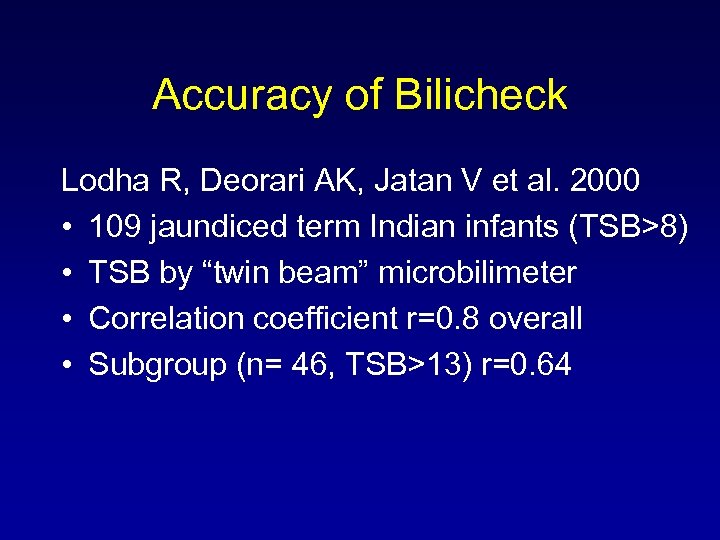
Accuracy of Bilicheck Lodha R, Deorari AK, Jatan V et al. 2000 • 109 jaundiced term Indian infants (TSB>8) • TSB by “twin beam” microbilimeter • Correlation coefficient r=0. 8 overall • Subgroup (n= 46, TSB>13) r=0. 64
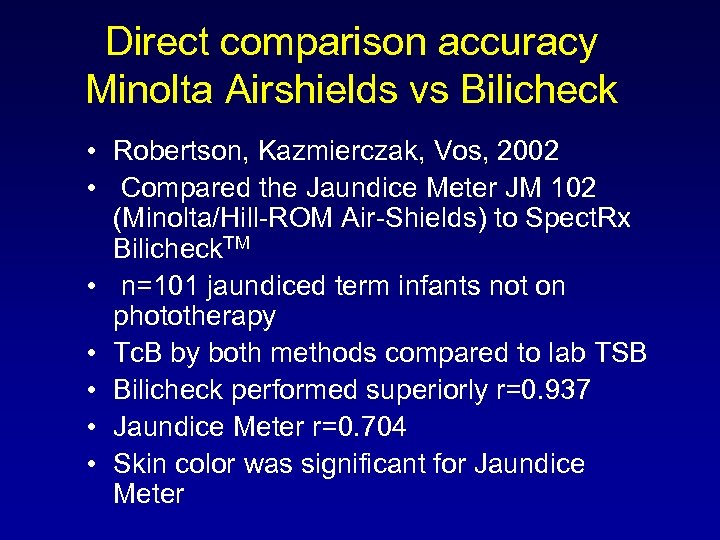
Direct comparison accuracy Minolta Airshields vs Bilicheck • Robertson, Kazmierczak, Vos, 2002 • Compared the Jaundice Meter JM 102 (Minolta/Hill-ROM Air-Shields) to Spect. Rx Bilicheck. TM • n=101 jaundiced term infants not on phototherapy • Tc. B by both methods compared to lab TSB • Bilicheck performed superiorly r=0. 937 • Jaundice Meter r=0. 704 • Skin color was significant for Jaundice Meter
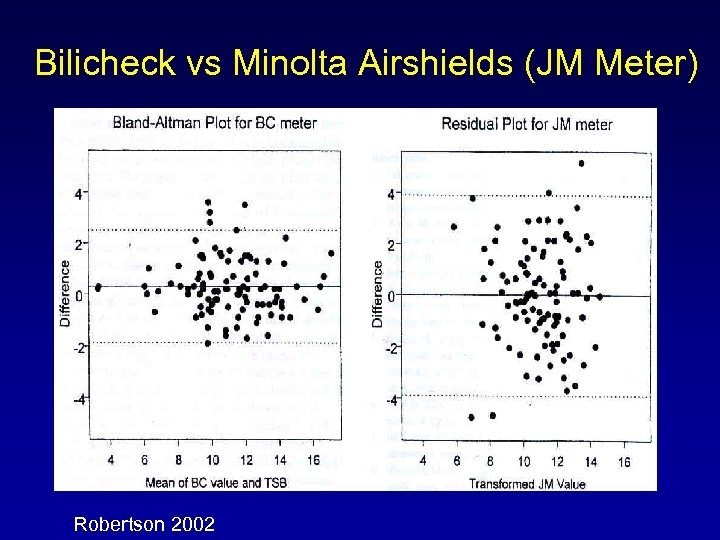
Bilicheck vs Minolta Airshields (JM Meter) Robertson 2002
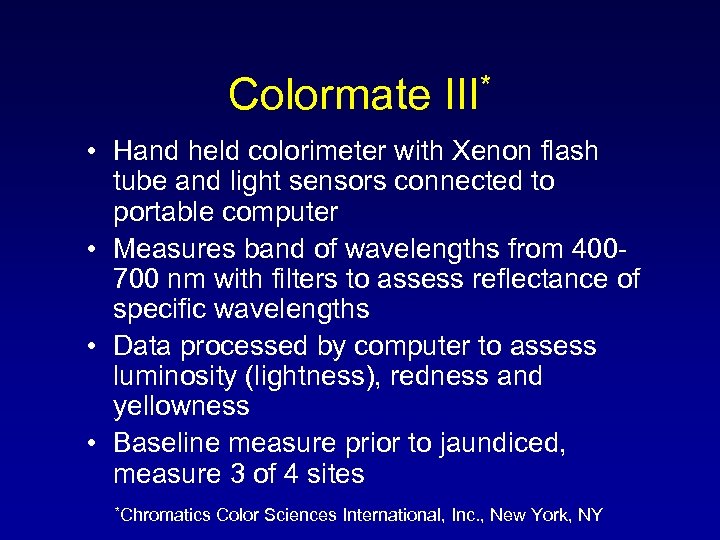
Colormate III* • Hand held colorimeter with Xenon flash tube and light sensors connected to portable computer • Measures band of wavelengths from 400700 nm with filters to assess reflectance of specific wavelengths • Data processed by computer to assess luminosity (lightness), redness and yellowness • Baseline measure prior to jaundiced, measure 3 of 4 sites *Chromatics Color Sciences International, Inc. , New York, NY
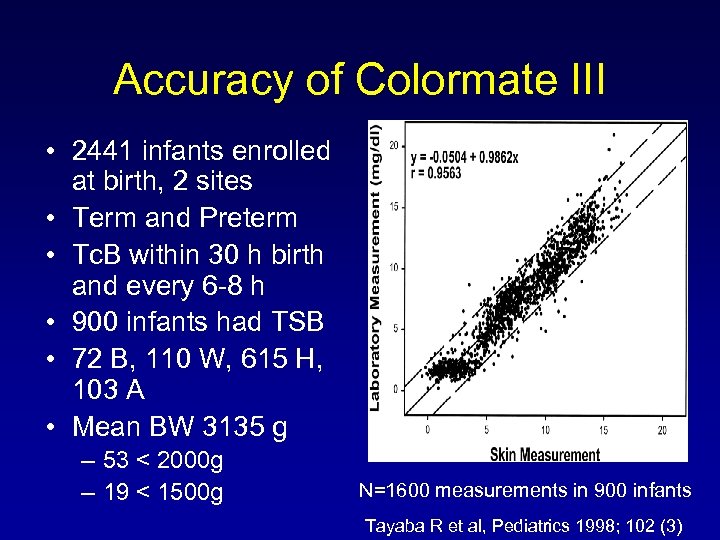
Accuracy of Colormate III • 2441 infants enrolled at birth, 2 sites • Term and Preterm • Tc. B within 30 h birth and every 6 -8 h • 900 infants had TSB • 72 B, 110 W, 615 H, 103 A • Mean BW 3135 g – 53 < 2000 g – 19 < 1500 g N=1600 measurements in 900 infants Tayaba R et al, Pediatrics 1998; 102 (3)
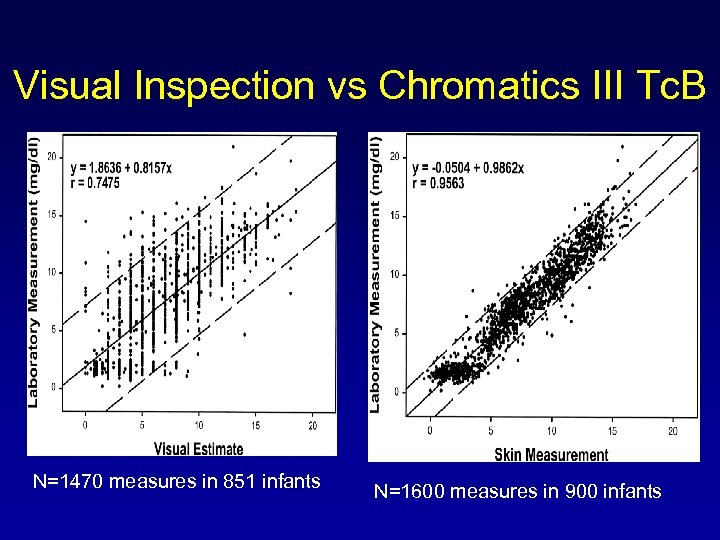
Visual Inspection vs Chromatics III Tc. B N=1470 measures in 851 infants N=1600 measures in 900 infants
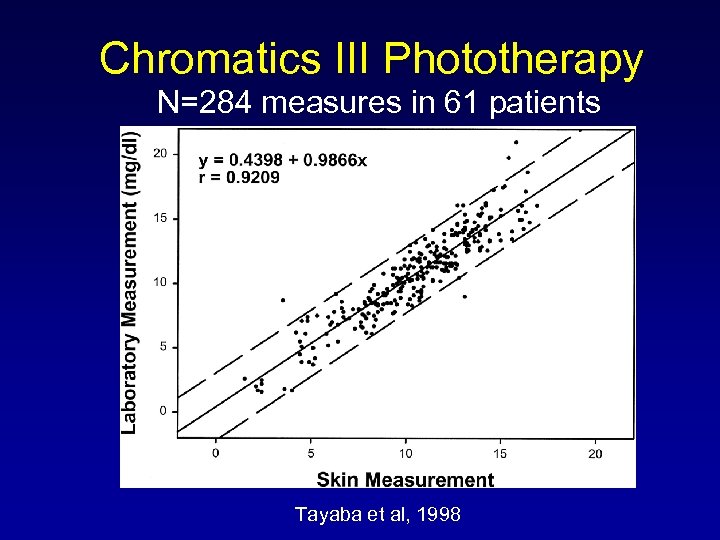
Chromatics III Phototherapy N=284 measures in 61 patients Tayaba et al, 1998
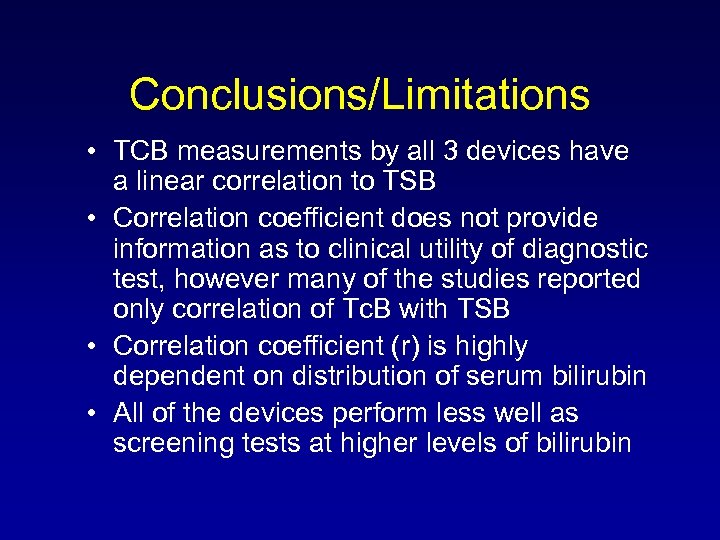
Conclusions/Limitations • TCB measurements by all 3 devices have a linear correlation to TSB • Correlation coefficient does not provide information as to clinical utility of diagnostic test, however many of the studies reported only correlation of Tc. B with TSB • Correlation coefficient (r) is highly dependent on distribution of serum bilirubin • All of the devices perform less well as screening tests at higher levels of bilirubin
Conclusions/Limitations • Minolta Airshields bilirubinometer – Performs best at sternum or forehead site – Performs less well in Black vs White infants – As a screening test, it does not perform consistently across studies as evidenced by SROC • Ingram icterometer – Small number of studies – Lacks objectivity of other methods as depends on observer visualization
Conclusions/Limitations • Newer Bilicheck. TM device that theoretically correct effects of melanin and hemoglobin appears to be an improvement over older devices • Future research should confirm these findings in larger sample sizes of diverse populations and include effects of phototherapy
Скачать презентацию Accuracy of transcutaneous bilirubin measurement NEMC Evidence Report
a96f52e1347ac48725dc2aee5f9d90e5.ppt