


 Скачать презентацию Accredited Gemologists Association Task Force on Lighting and
1e9f3eb11d1e3c4ab9cb4c714e607fa7.ppt
- Количество слайдов: 23
 Accredited Gemologists Association Task Force on Lighting and Color-Grading Part I: Lighting And Its Effect on Color-Grading Colorless Diamonds Recap, Standards, Solutions, New Info February 3, 2010
 Recap - Task Force Purpose ~ To develop lighting standards for color grading diamonds to improve reliability and consistency of color grading results, globally ~
 Recap - Task Force Scope of Work • Researched global historical teachings and practices • Researched established standards by GIA, IDC, CIBJO and PAS • Researched science of colorless diamonds including fluorescence • Performed scientific testwork of a sample of diamonds in lighting environments commonly used to color grade diamonds. • Based on results of testwork, developed standards for an artificial lighting environment which can be repeated globally. Today – Recap Highlights and Recommend Solutions
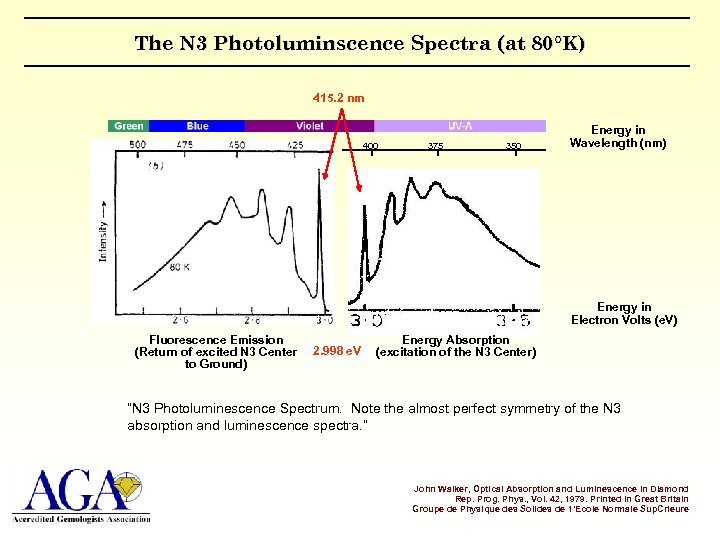 The N 3 Photoluminscence Spectra (at 80°K) 415. 2 nm 400 375 350 Energy in Wavelength (nm) Energy in Electron Volts (e. V) Fluorescence Emission (Return of excited N 3 Center to Ground) 2. 998 e. V Energy Absorption (excitation of the N 3 Center) “N 3 Photoluminescence Spectrum. Note the almost perfect symmetry of the N 3 absorption and luminescence spectra. ” John Walker, Optical Absorption and Luminescence in Diamond Rep. Prog. Phys. , Vol. 42, 1979. Printed in Great Britain Groupe de Physique des Solides de 1’Ecole Normale Sup. Crieure
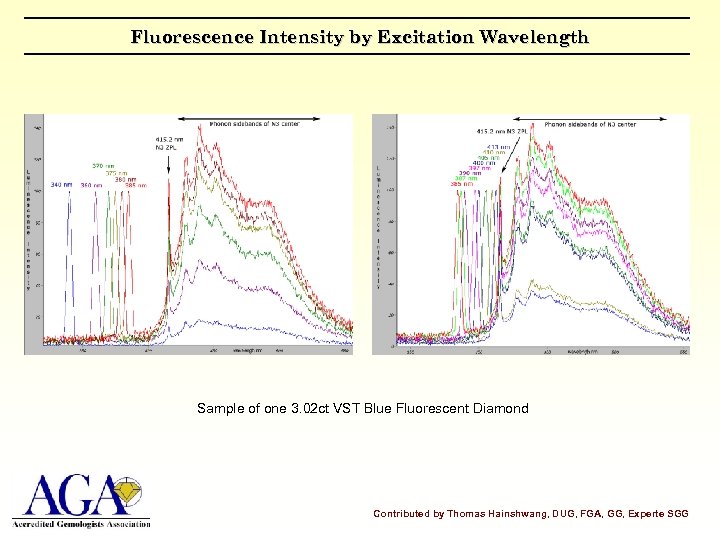 Fluorescence Intensity by Excitation Wavelength Sample of one 3. 02 ct VST Blue Fluorescent Diamond Contributed by Thomas Hainshwang, DUG, FGA, GG, Experte SGG
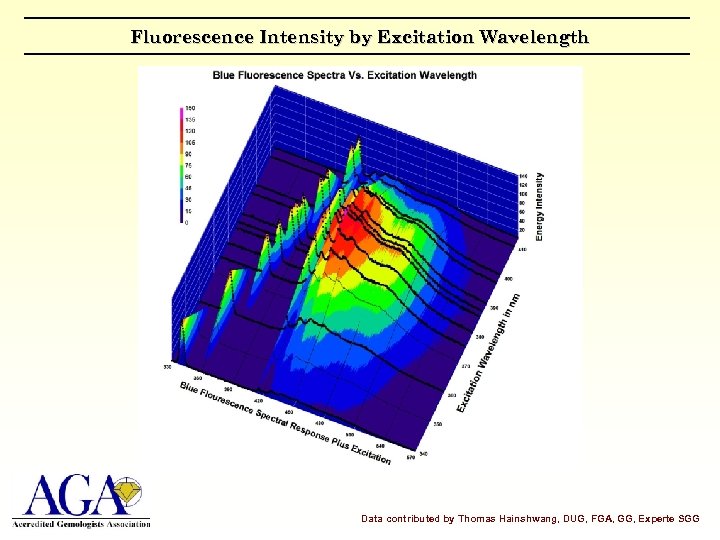 Fluorescence Intensity by Excitation Wavelength Sample of one 3. 02 ct VST Blue Fluorescent Diamond Data contributed by Thomas Hainshwang, DUG, FGA, GG, Experte SGG
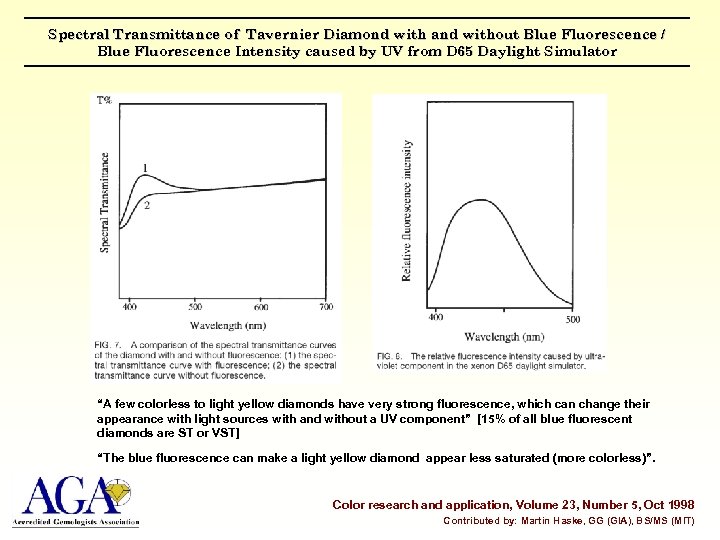 Spectral Transmittance of Tavernier Diamond with and without Blue Fluorescence / Blue Fluorescence Intensity caused by UV from D 65 Daylight Simulator “A few colorless to light yellow diamonds have very strong fluorescence, which can change their appearance with light sources with and without a UV component” [15% of all blue fluorescent diamonds are ST or VST] “The blue fluorescence can make a light yellow diamond appear less saturated (more colorless)”. Color research and application, Volume 23, Number 5, Oct 1998 Contributed by: Martin Haske, GG (GIA), BS/MS (MIT)
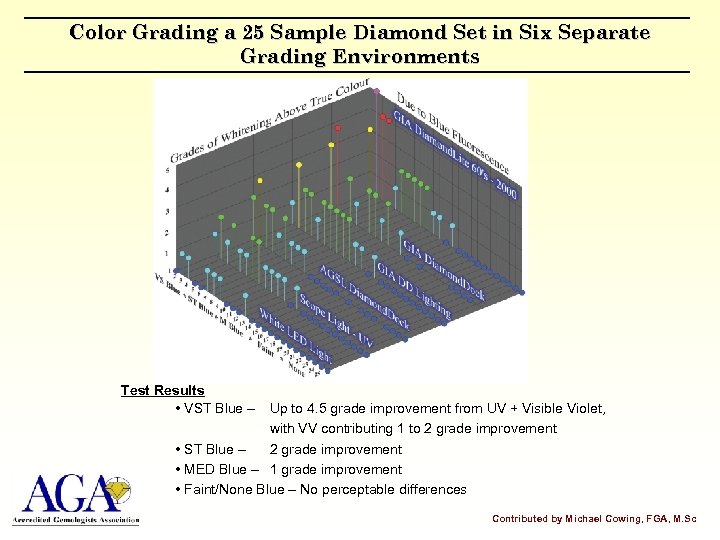 Color Grading a 25 Sample Diamond Set in Six Separate Grading Environments Test Results • VST Blue – Up to 4. 5 grade improvement from UV + Visible Violet, with VV contributing 1 to 2 grade improvement • ST Blue – 2 grade improvement • MED Blue – 1 grade improvement • Faint/None Blue – No perceptable differences Contributed by Michael Cowing, FGA, M. Sc
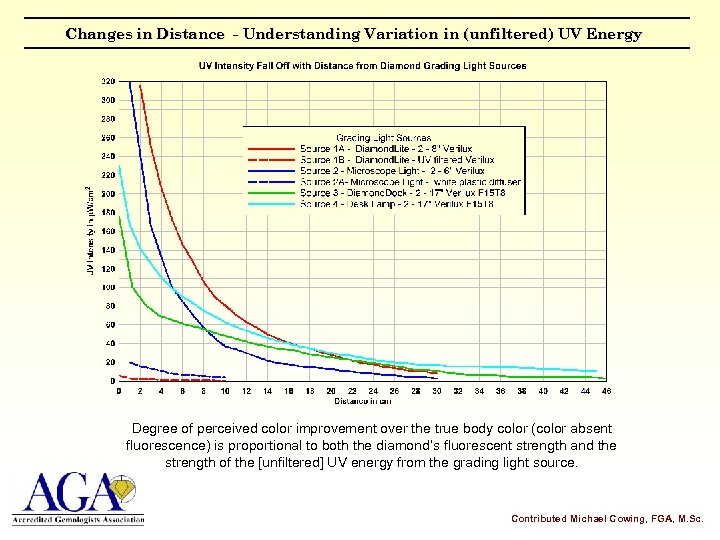 Changes in Distance - Understanding Variation in (unfiltered) UV Energy Degree of perceived color improvement over the true body color (color absent fluorescence) is proportional to both the diamond’s fluorescent strength and the strength of the [unfiltered] UV energy from the grading light source. Contributed Michael Cowing, FGA, M. Sc.
![Understanding CIE Indoor Daylight Illuminant D 65 • • • “Developed for industrial [textile]](https://present5.com/presentation/1e9f3eb11d1e3c4ab9cb4c714e607fa7/image-10.jpg "Understanding CIE Indoor Daylight Illuminant D 65 • • • “Developed for industrial [textile]") Understanding CIE Indoor Daylight Illuminant D 65 • • • “Developed for industrial [textile] applications needing indoor daylight spectra for average colormetric work” “Considers transmission of clear glass samples only” “In practice, glass coatings become more important and must be considered by CIE in future” “In future, CIE hopes to be able to recommend indoor daylight sources” Appendix A – “Special glazing systems are capable of reducing energy consumption for heating in winter and cooling in summer, reducing glare from outside and minimizing UV fading of furnishings. 300 -320 UV-B 0. 45% 321 -400 UV-A 9. 58% 401 -420 VIOLET 4. 45% 421 -450 INDIGO 7. 38% 451 -490 BLUE 11. 21% 491 -550 GREEN 15. 60% 551 -590 YELLOW 9. 39% 591 -620 ORANGE 6. 53% 621 -750 RED 23. 91% 751 -830 INFRARED 11. 49% Data from International Commission on Illumination (CIE); Indoor Daylight Illuminant D 65
Understanding CIE Indoor Daylight Illuminant D 65 • • • “Developed for industrial [textile] applications needing indoor daylight spectra for average colormetric work” “Considers transmission of clear glass samples only” “In practice, glass coatings become more important and must be considered by CIE in future” “In future, CIE hopes to be able to recommend indoor daylight sources” Appendix A – “Special glazing systems are capable of reducing energy consumption for heating in winter and cooling in summer, reducing glare from outside and minimizing UV fading of furnishings. 300 -320 UV-B 0. 45% 321 -400 UV-A 9. 58% 401 -420 VIOLET 4. 45% 421 -450 INDIGO 7. 38% 451 -490 BLUE 11. 21% 491 -550 GREEN 15. 60% 551 -590 YELLOW 9. 39% 591 -620 ORANGE 6. 53% 621 -750 RED 23. 91% 751 -830 INFRARED 11. 49% Data from International Commission on Illumination (CIE); Indoor Daylight Illuminant D 65
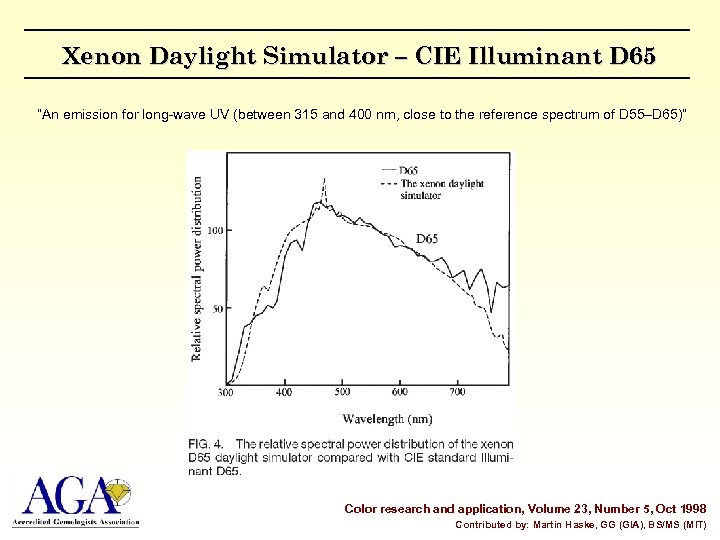 Xenon Daylight Simulator – CIE Illuminant D 65 “An emission for long-wave UV (between 315 and 400 nm, close to the reference spectrum of D 55–D 65)” Color research and application, Volume 23, Number 5, Oct 1998 Contributed by: Martin Haske, GG (GIA), BS/MS (MIT)
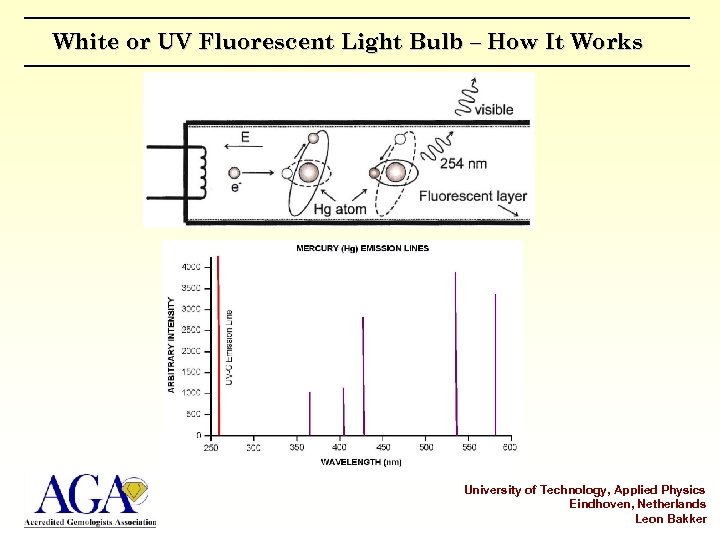 White or UV Fluorescent Light Bulb – How It Works University of Technology, Applied Physics Eindhoven, Netherlands Leon Bakker
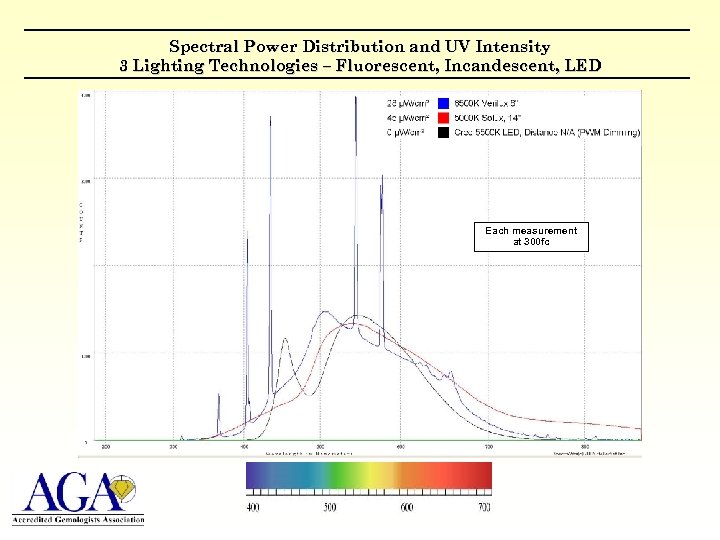 Spectral Power Distribution and UV Intensity 3 Lighting Technologies – Fluorescent, Incandescent, LED Each measurement at 300 fc
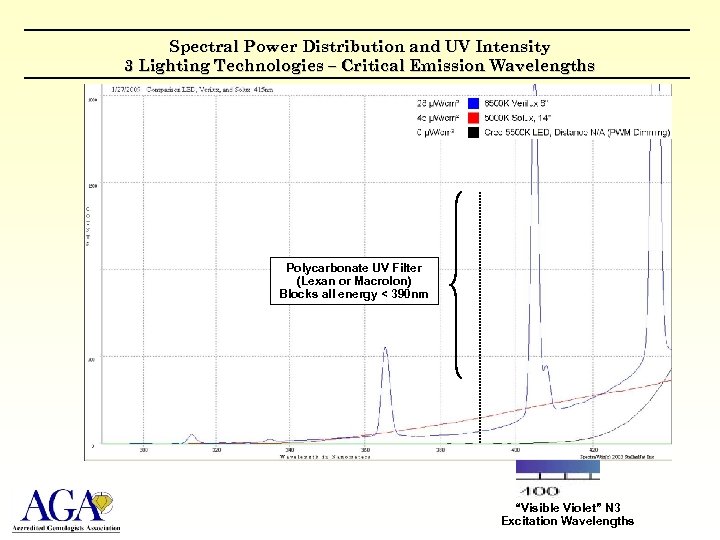 Spectral Power Distribution and UV Intensity 3 Lighting Technologies – Critical Emission Wavelengths Polycarbonate UV Filter (Lexan or Macrolon) Blocks all energy < 390 nm “Visible Violet” N 3 Excitation Wavelengths
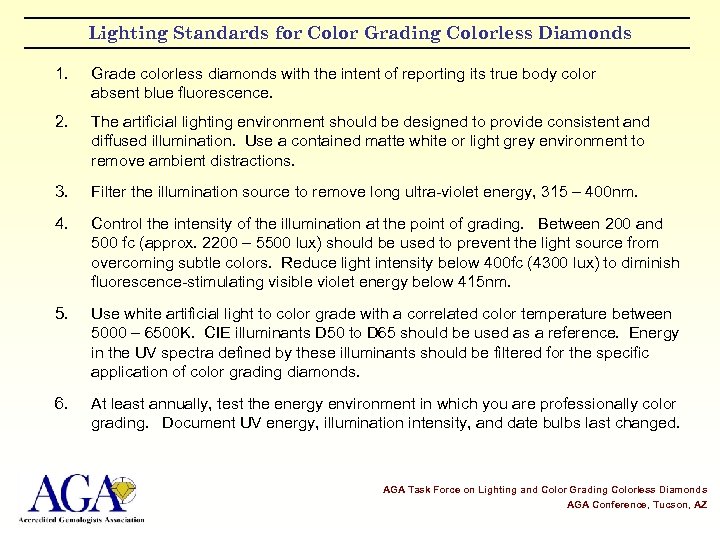 Lighting Standards for Color Grading Colorless Diamonds 1. Grade colorless diamonds with the intent of reporting its true body color absent blue fluorescence. 2. The artificial lighting environment should be designed to provide consistent and diffused illumination. Use a contained matte white or light grey environment to remove ambient distractions. 3. Filter the illumination source to remove long ultra-violet energy, 315 – 400 nm. 4. Control the intensity of the illumination at the point of grading. Between 200 and 500 fc (approx. 2200 – 5500 lux) should be used to prevent the light source from overcoming subtle colors. Reduce light intensity below 400 fc (4300 lux) to diminish fluorescence-stimulating visible violet energy below 415 nm. 5. Use white artificial light to color grade with a correlated color temperature between 5000 – 6500 K. CIE illuminants D 50 to D 65 should be used as a reference. Energy in the UV spectra defined by these illuminants should be filtered for the specific application of color grading diamonds. 6. At least annually, test the energy environment in which you are professionally color grading. Document UV energy, illumination intensity, and date bulbs last changed. AGA Task Force on Lighting and Color Grading Colorless Diamonds AGA Conference, Tucson, AZ
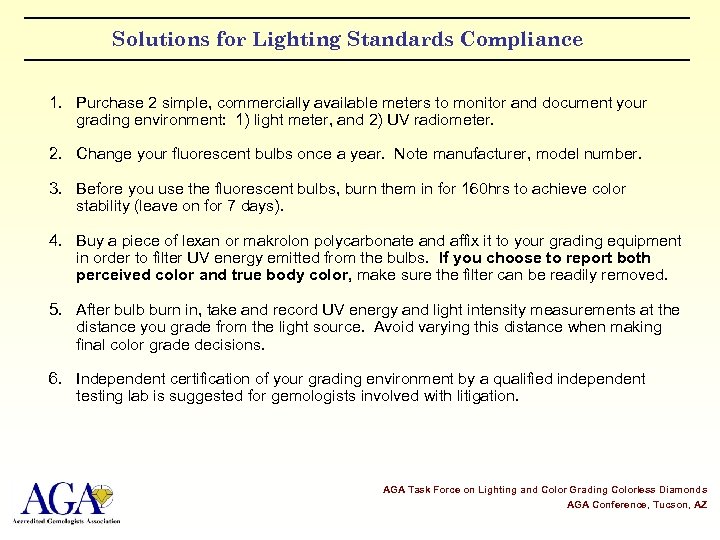 Solutions for Lighting Standards Compliance 1. Purchase 2 simple, commercially available meters to monitor and document your grading environment: 1) light meter, and 2) UV radiometer. 2. Change your fluorescent bulbs once a year. Note manufacturer, model number. 3. Before you use the fluorescent bulbs, burn them in for 160 hrs to achieve color stability (leave on for 7 days). 4. Buy a piece of lexan or makrolon polycarbonate and affix it to your grading equipment in order to filter UV energy emitted from the bulbs. If you choose to report both perceived color and true body color, make sure the filter can be readily removed. 5. After bulb burn in, take and record UV energy and light intensity measurements at the distance you grade from the light source. Avoid varying this distance when making final color grade decisions. 6. Independent certification of your grading environment by a qualified independent testing lab is suggested for gemologists involved with litigation. AGA Task Force on Lighting and Color Grading Colorless Diamonds AGA Conference, Tucson, AZ
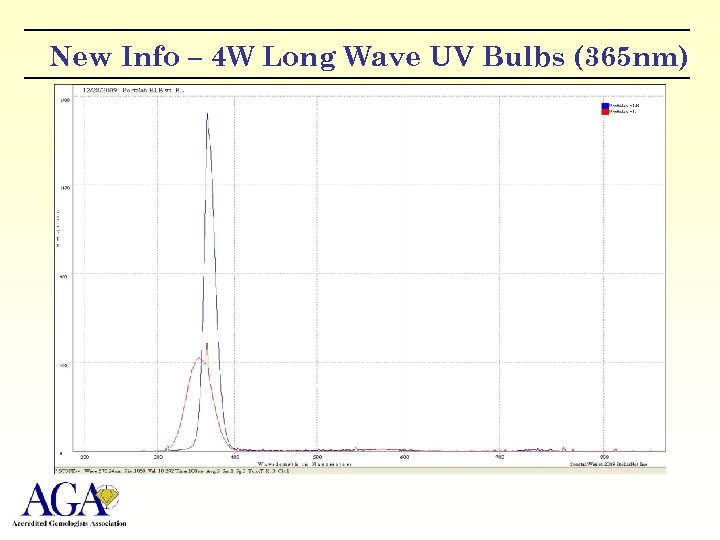
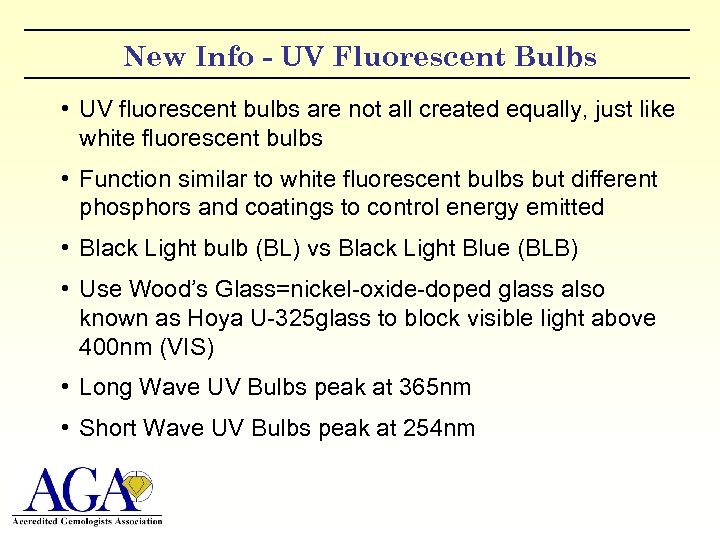 New Info - UV Fluorescent Bulbs • UV fluorescent bulbs are not all created equally, just like white fluorescent bulbs • Function similar to white fluorescent bulbs but different phosphors and coatings to control energy emitted • Black Light bulb (BL) vs Black Light Blue (BLB) • Use Wood’s Glass=nickel-oxide-doped glass also known as Hoya U-325 glass to block visible light above 400 nm (VIS) • Long Wave UV Bulbs peak at 365 nm • Short Wave UV Bulbs peak at 254 nm
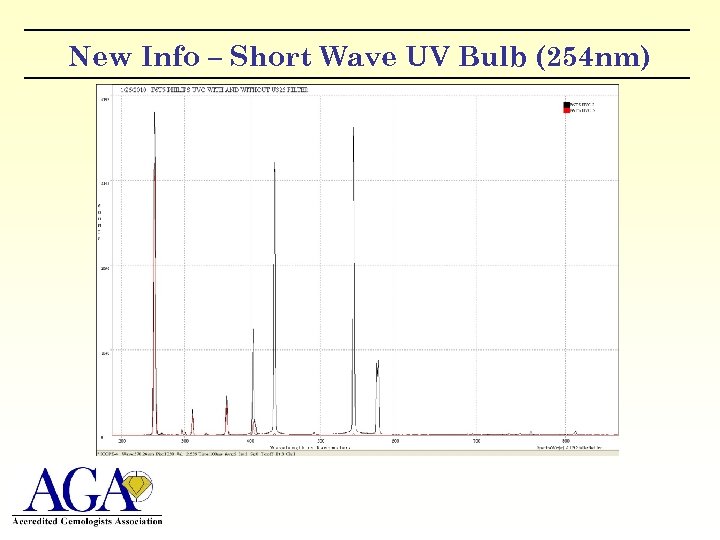 New Info – Short Wave UV Bulb (254 nm)
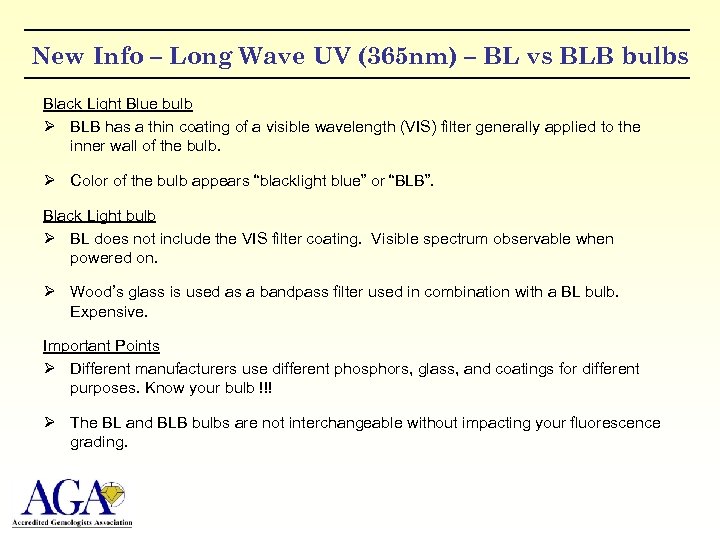 New Info – Long Wave UV (365 nm) – BL vs BLB bulbs Black Light Blue bulb Ø BLB has a thin coating of a visible wavelength (VIS) filter generally applied to the inner wall of the bulb. Ø Color of the bulb appears “blacklight blue” or “BLB”. Black Light bulb Ø BL does not include the VIS filter coating. Visible spectrum observable when powered on. Ø Wood’s glass is used as a bandpass filter used in combination with a BL bulb. Expensive. Important Points Ø Different manufacturers use different phosphors, glass, and coatings for different purposes. Know your bulb !!! Ø The BL and BLB bulbs are not interchangeable without impacting your fluorescence grading.
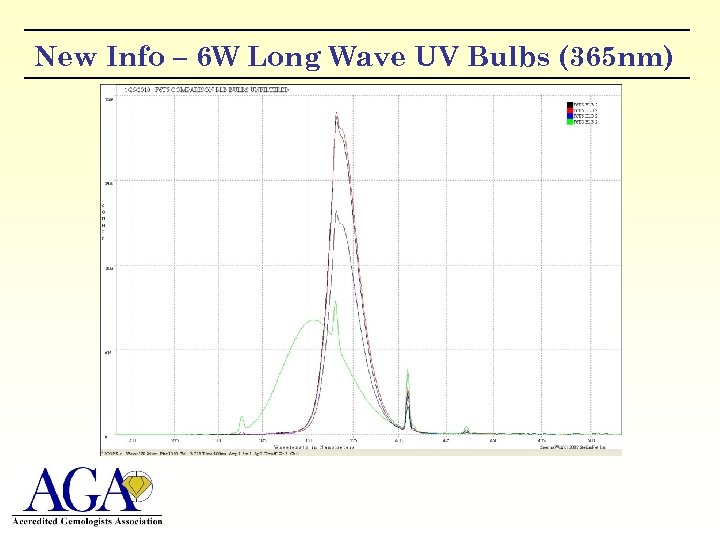 New Info – 6 W Long Wave UV Bulbs (365 nm)
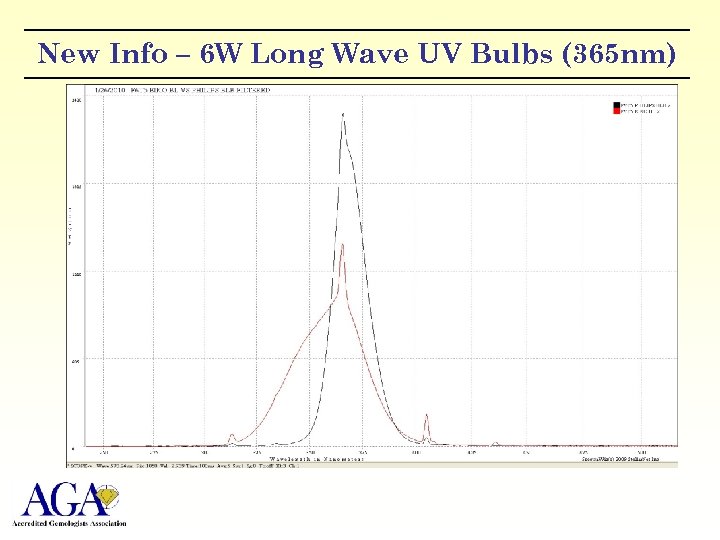 New Info – 6 W Long Wave UV Bulbs (365 nm)
 New Info – 4 W Long Wave UV Bulbs (365 nm)
 Don’t Stress !!! CERTIFY YOUR GRADING BOX!