 Скачать презентацию Accreditation for SCI Rehabilitation Quality Accountability and Transparency
ffee07d4906d36f8b3f60cf166d1ed58.ppt
- Количество слайдов: 37



Accreditation for SCI Rehabilitation: Quality, Accountability, and Transparency ESCIF Congress 18 -20 May 2011 De Rijp, The Netherlands
CARF International n First question what does CARF stand for? l Commission on Accreditation of Rehabilitation Facilities (CARF) 2
Second question…. n What is accreditation? l Systematic approach to review and address performance of organizations l Uses standards that are developed in a variety of ways l Should be third party and independent l Should be not-for-profit l Surveyors are from outside the organization but should have expertise in the area being surveyed 3
CARF International § An international accreditation and standardsetting organization • Develop and revise standards • Consultative accreditation process § 1966 § Private, not-for-profit, independent § Health and human services accreditation across the lifespan and continuum of care § Field driven – consumers, providers, payers, regulators § Moral owners – persons served § Person centered 4
CARF Values n Core values: l All people have the right to be treated with dignity and respect l All people should have access to needed services that achieve optimal outcomes l All people should be empowered to exercise informed choice 5
CARF International Areas of Accreditation § § § Aging Services Behavioral Health Service Children and Youth Services Employment/Community Services Medical Rehabilitation Services DMEPOS (US) § Durable Medical Equipment and Prosthetic/Orthotic Supplies § Opioid Treatment Programs § Quality Insurance Practices (Non-US) 6
Medical Rehabilitation Focus n Only accreditor focused on medical rehabilitation n Specialty programs to differentiate yourself in the market…for example l l l l l 7 Stroke Brain Injury Amputee Spinal Cord System of Care Interdisciplinary Pain Occupational Rehabilitation Pediatrics Health Enhancement Case Management Inpatient, Outpatient, Home and Community Services, Residential, Vocational
CARF International § International: US, Canada, Europe, Asia, Africa, South America, Middle East § 19 Countries § 8. 7 million people served in 2010 § 6, 700+ organizations § 48, 700+ programs § 20, 000+ locations § More than 2, 600 surveys annually § More than 1, 500 peer surveyors § 106 accredited Spinal Cord Systems of Care 8
Mission and Accountability § The mission of CARF: • Promote quality • Value • Optimal outcomes of services through a consultative accreditation process that centers on enhancing the lives of persons served. § Accountable to the CARF Board of Directors 9
Accreditation within a Care System § Supports: • • • 10 Innovation Empowerment Productivity Accountability Better ways to deal with competition through planning Provide a continuum of high quality care in an accessible, responsive and caring manner and at a reasonable cost
Accreditation as an Innovation § Learning new ways to get work done through: • Creative problem solving that utilizes continuous quality improvement tools • Critical to streamlining work processes and finding better ways to achieve success with fewer resources • Use of accurate, complete, reliable and valid data to make decisions 11
Accreditation as a Quality Strategy § Important principle: • • 12 Understanding that the organization will never again be “still” Won’t have a finish line – continuous improvement Will require organizations and people to look for ways to better serve their customers in a more cost effective manner Quality framework – ISO, Six Sigma, LEAN, etc.
Why Accreditation? § Quality strategy § Business strategy § Communication system § Management tool § Establishes baseline of quality for an industry § Refocuses business on person served/resident § Establishes and re-establishes relationships with stakeholders 13
Design/Framework n 14 Section One ASPIRE to Excellence l Leadership l Governance l Integrated Strategic Planning l Input from Persons Served l Legal and regulatory Requirements l Financial Planning and Management l Risk Management n Section One ASPIRE to Excellence l Human Resources l Health and Safety l Technology l Rights of Persons Served l Accessibility – Removal of Barriers l Information and Outcomes Management – both business and clinical l Performance Improvement
Design/Framework n Section 2: l 2. A Program/Service Structure l 2. B Rehabilitation and Service Process for the Person Served l 2. C Service Process for Persons Served in Home and Community Services l 2. D Health Enhancement l 2. E Case Management l 2. F Rehabilitation and Service process for Children and Adolescents 15
Design/Framework n Section 3 – Specific Programs l Spinal Cord System of Care meets — Comprehensive Integrated Inpatient Rehabilitation Program standards — Outpatient Medical Rehabilitation program standards — Spinal Cord System of Care standards l If the SCSC has Home and Community Services, Residential Rehabilitation Services, and/or Vocational Services in its continuum and they meet the program description they must seek accreditation in those areas 16
Persons Served Perspective n Moral Owners of CARF – l Who we can not fail to protect n Starts in leadership with the standard that says: l A person centred philosophy: — Is demonstrated by: – – Leadership Personnel — Guides the service delivery — Is communicated to stakeholders in an understandable manner 17
Person Served Perspective n Active listening in ongoing way n n 18 l What you do with the information Rights Removal of barriers Staff that are competent to assist with person served meeting their goals Answering the question : l What happens for a person like me in your program? (RESULTS)
Person Served Perspective n Access to services n Value or Satisfaction from person served perspective l u. SPEQ: The Voice of the Consumer n Member of the decision-making team n Active participant in their rehabilitation n Preferences 19
CARF Process § § § § 20 A consultative, peer review survey process versus “inspection” Performance improvement/quality framework A journey … no finish line Assistance throughout the process - not just about your survey Network and build connections Person-centered Surveyors are your peers from the field. Their consultation adds value and quality to the survey Standards revised every 3 -4 years – raises the bar for rehabilitation
Survey Process n n 2 -3 days with surveyors from all over Orientation Conference Physical Plant Tour 3 components of a survey: l Interview l Observation l Review of documents n Exit conference 21
Survey Process n Organization preparation l Assigned a resource specialist to work with you l No charge for consultation via emails, phone, use as often as you want l Trainings could be through CARF 101 s, webcasts, audiotapes l Quick to respond and people who answer questions are clinicians 22
Survey Process n How long does it take to prepare? l Depends upon how organized you are as a business l Have to have a minimum of 6 months track record of use of the standards l Start by thorough review of standards and identify which ones you are not doing at all (if there any like that) and begin there l Use CARF resource specialist to assist – do not hesitate to ask questions instead of wasting time trying to figure it out! 23
Survey Process n Accreditation Outcomes: l Three Year l One Year l Provisional (a second one year in a row; third time we visit if not a three year the organization is nonaccredited) l Non accreditation 24
CARF International § Peer review process § Process emphasizes the person served, performance improvement, business and service delivery aspects of human service, and good management process § Strong case managed approaches throughout process sets of standards as well as program standards § Framework that includes business and clinical guidance 25
Always a question about costs n $995 (USD) non-refundable Intent to Survey fee (like an application) n $1950 (USD) per day per survey includes l l l Travel Hotel/meals Survey report Certificate n Typical survey 2 -3 surveyors (depends upon how many programs you are getting accredited) for 2 -3 days ($7800 -11, 600) 26
Which organizations choose CARF? n Some don’t choose some are “mandated” l Government l Payer l Associations n Those wanting to differentiate themselves n Those wanting a performance improvement system that reflects their daily work l ISO l Six Sigma l Lean n n 27 The competitor is doing it so “I have to do it” New organizations The “bad apples” usually don’t Those that already have a reputation don’t see the need unless there are competitors in their geographic area that have it
European organizations that have chosen CARF n National Spinal Injuries Centre Stoke Mandeville Hospital – Aylesbury England n NRH - Dun Laoghaire, Ireland n Sunnaas – Oslo, Norway n University of Lund - Hoor, Sweden n Uppsala University Hospital, Uppsala, Sweden 28
Accreditation Not a Guarantee but … § A foundation § Identifies necessary components for excellence § Addresses stakeholder needs around accountability in efficiency, results or outcomes of services, satisfaction with services and the organization § Uses a quality framework that is embedded in all quality awards 29
Specific topics in CARF n Scope: l Medical/ physiological l Functional l Psychosocial l Research capability l Aging with a disability l Case management l Resource management l Transition planning l Life-long follow-up 30 n Scope: l Life-ling health promotion l Resources for independent living and community integration l Prevention related to potential risks and complications l Safety for persons served and environments in which they participate
Specific topics n Provide directly or link: l Behavioral health l Independent living centres l Clinical research centres l Consumer advocacy groups l Driver rehabilitation n Arranges for or provides diagnostics n Specialty physicians and staff n Ventilator persons served 31
Specific Topics n 32 Education program for person served and families/support systems based on needs: l Access to benefits and systems l Autonomic dysreflexia l Bladder and bowel management l Cardiovascular risk factors l Chemical use/abuse/dependen cy l Consumer advocacy organizations l Depression n Education: l Diabetes prevention l Edema management l Emergency preparedness l Follow-up medical care – — need for and access to l l l Independent living Life care planning Medical nutrition therapy Musculoskeletal issues Pain management
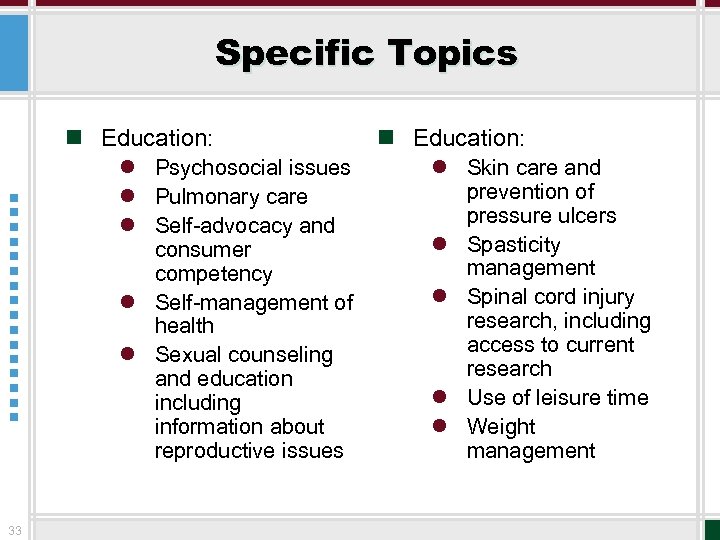
Specific Topics n Education: l Psychosocial issues l Pulmonary care l Self-advocacy and consumer competency l Self-management of health l Sexual counseling and education including information about reproductive issues 33 n Education: l Skin care and prevention of pressure ulcers l Spasticity management l Spinal cord injury research, including access to current research l Use of leisure time l Weight management
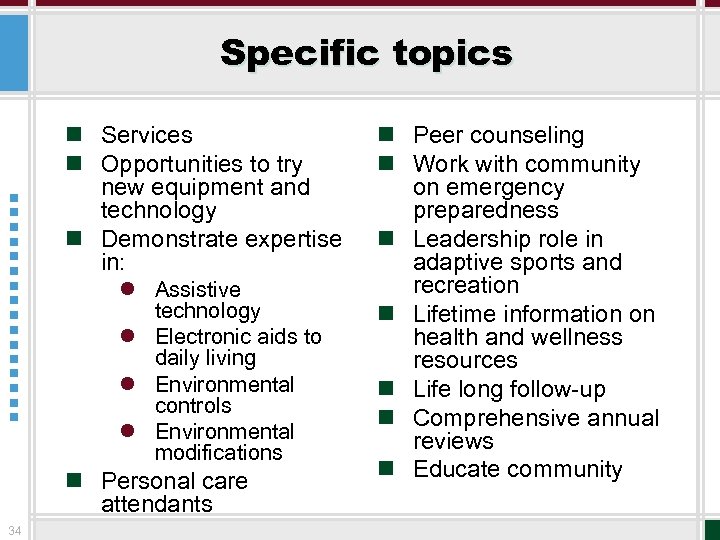
Specific topics n Services n Opportunities to try new equipment and technology n Demonstrate expertise in: l Assistive technology l Electronic aids to daily living l Environmental controls l Environmental modifications n Personal care attendants 34 n Peer counseling n Work with community on emergency preparedness n Leadership role in adaptive sports and recreation n Lifetime information on health and wellness resources n Life long follow-up n Comprehensive annual reviews n Educate community
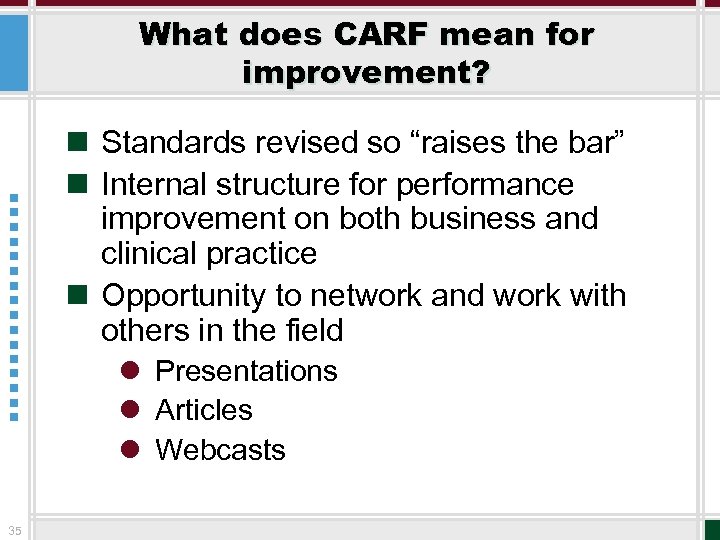
What does CARF mean for improvement? n Standards revised so “raises the bar” n Internal structure for performance improvement on both business and clinical practice n Opportunity to network and work with others in the field l Presentations l Articles l Webcasts 35
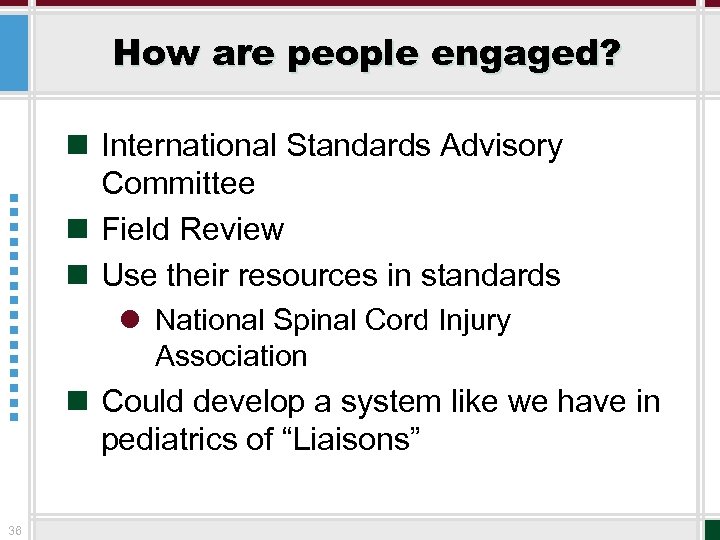
How are people engaged? n International Standards Advisory Committee n Field Review n Use their resources in standards l National Spinal Cord Injury Association n Could develop a system like we have in pediatrics of “Liaisons” 36
Contact us n Chris Mac. Donell – Managing Director l cmacdonell@carf. org l 202 -664 -3314 mobile l www. carf. org l www. uspeq. org n Cathy Rebella – Resource Specialist for Europe l crebella@carf. org 37
Скачать презентацию Accreditation for SCI Rehabilitation Quality Accountability and Transparency
ffee07d4906d36f8b3f60cf166d1ed58.ppt