


 Скачать презентацию Accounting Fundamentals Dr Yan Xiong Department of Accountancy
7c41f1a1e0f4a6290c444a93945f08cc.ppt
- Количество слайдов: 68
 Accounting Fundamentals Dr. Yan Xiong Department of Accountancy CSU Sacramento The lecture notes are primarily based on Reimers (2003).
 Chapter 10: Statement of Cash Flows Agenda t t t Overview of SCF Direct Method Indirect Method
 Agenda t Overview of SCF
 Purpose of the Statement of Cash Flows t To show the business acquired its cash during the current year t To show the business spent its cash during the current year This information is crucial for decision makers predict future cash flows of the business.
 What Is Considered “CASH” For The Statement Of Cash Flows? t t Cash includes cash and cash equivalents for purpose of the statement. Cash Equivalents are u. Short-term, highly liquid investments. u. Easily convertible into known amounts of cash.
 Categories of Cash Flows Categories are based on activities related to cash flows: 1. Operating the business. 2. Investing in productive assets. 3. Financing the business. These are the sections of the Statement of Cash Flows.
 Operating Activities t t t Cash inflows and outflows that are directly related to income from normal operations. Technically, FASB defines operating activities as those that are not investing or financing activities. There are two ways to compute net cash flow from operating activities: u. Direct method u. Indirect method
 Cash Flows from Operating Activities Cash inflows and outflows that are directly related to income from normal operations. Inflows include: u. Receipts from customers. u. Interest on receivables. u. Dividends received.
 Cash Flows from Operating Activities Cash inflows and outflows that are directly related to income from normal operations. Outflows include: u. Payments to vendors. u. Interest paid on liabilities. u. Income taxes paid. u. Salary and wages payments to employees. Pa o yt the er ord of
 Cash Flows from Investing Activities t t Cash inflows and outflows that are related to the purchase and sale of productive assets. Inflows include proceeds from: u. Sales of property, plant, and equipment. u. Sales of investments in securities. u. Collection of principal on loans made to others.
 Cash Flows from Investing Activities t t Cash inflows and outflows that are related to the purchase and sale of productive assets. Outflows include payments for: u. The purchase of property, plant and equipment. u. The purchase of long-term investments. u. Loans to others.
 Cash Flows from Financing Activities Cash inflows and outflows that are related to how cash was obtained to finance the enterprise. Inflows include: u. Proceeds from sale of stock. u. Proceeds from sale of bonds and from borrowings.
 Cash Flows from Financing Activities Cash inflows and outflows that are related to how cash was obtained to finance the enterprise. Outflows include: u. Payments to purchase treasury stock. u. Principal payments to retire bonds and loans.
 Cash Flows from Noncash Activities Investing and financing activities that do not involve cash, e. g. , u. Retirement of bonds by issuing stock. u. Settlement of debt by transferring assets. Noncash activities must be disclosed separately in the financial statements.
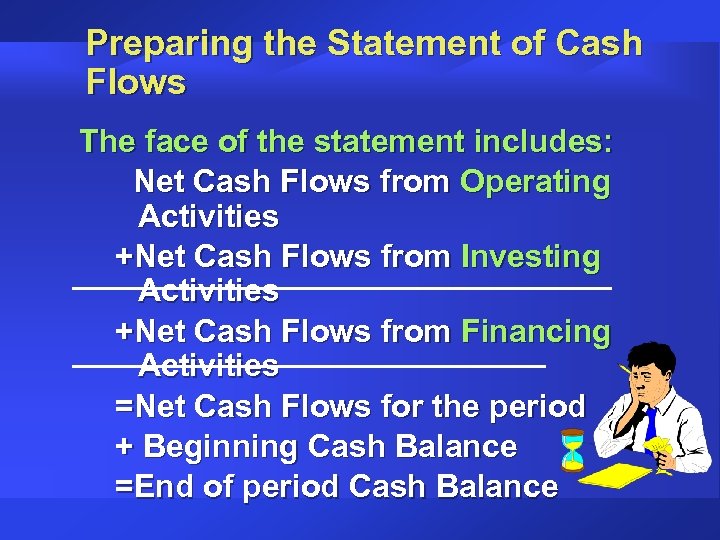 Preparing the Statement of Cash Flows The face of the statement includes: Net Cash Flows from Operating Activities +Net Cash Flows from Investing Activities +Net Cash Flows from Financing Activities =Net Cash Flows for the period + Beginning Cash Balance =End of period Cash Balance
 Two Alternative Approaches Indirect Method u. Shows net cash inflow (outflow) from operations as an adjustment of net income. u. Used by 97% of companies. Direct Method u. Reports the components of cash from operations as gross receipts and payments. u. Recommended by the FASB, but rarely used.
 Converting Accrual Data to Cash Data t t t Accounting records are kept on the accrual basis (GAAP). Cash data must be developed before the SCF can be prepared (especially for operating activities). The examples that follow demonstrate the direct method for converting accrual data to cash data.
 Three Information Sources Are Used 1. The income statement for the current period. 2. Comparative beginning of period and end of period balance sheets. 3. Additional transaction details not found in the financial statements.
 Agenda t Direct Method
 Direct Method t t Income statement approach Look at each item on the income statement to determine how to make it a “cash” number
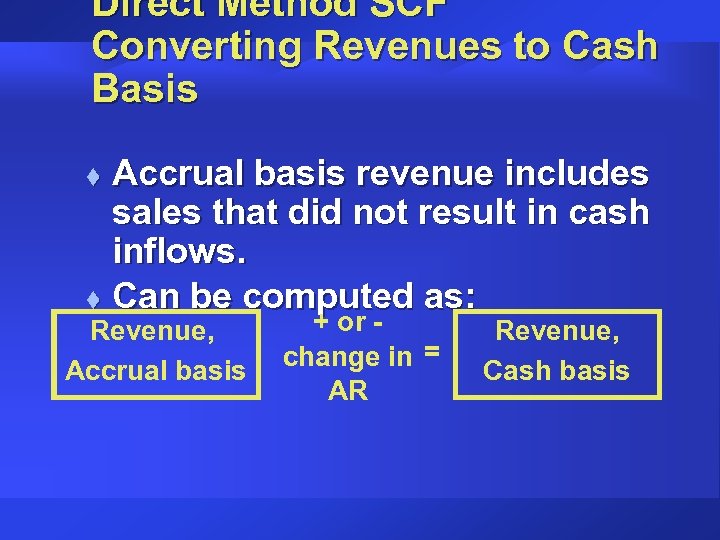 Direct Method SCF Converting Revenues to Cash Basis Accrual basis revenue includes sales that did not result in cash inflows. t Can be computed as: t Revenue, Accrual basis + or change in = AR Revenue, Cash basis
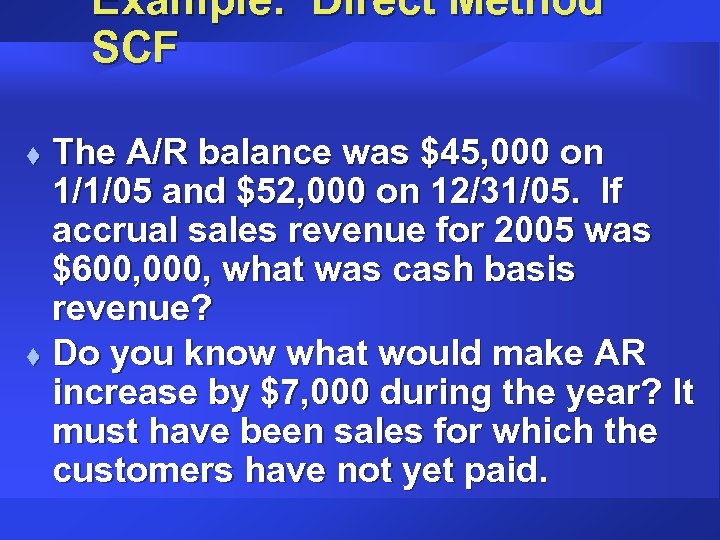 Example: Direct Method SCF The A/R balance was $45, 000 on 1/1/05 and $52, 000 on 12/31/05. If accrual sales revenue for 2005 was $600, 000, what was cash basis revenue? t Do you know what would make AR increase by $7, 000 during the year? It must have been sales for which the customers have not yet paid. t
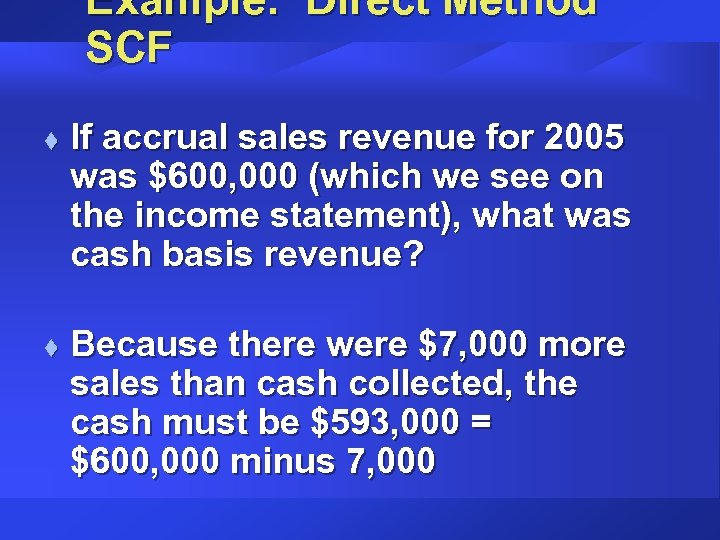 Example: Direct Method SCF t t If accrual sales revenue for 2005 was $600, 000 (which we see on the income statement), what was cash basis revenue? Because there were $7, 000 more sales than cash collected, the cash must be $593, 000 = $600, 000 minus 7, 000
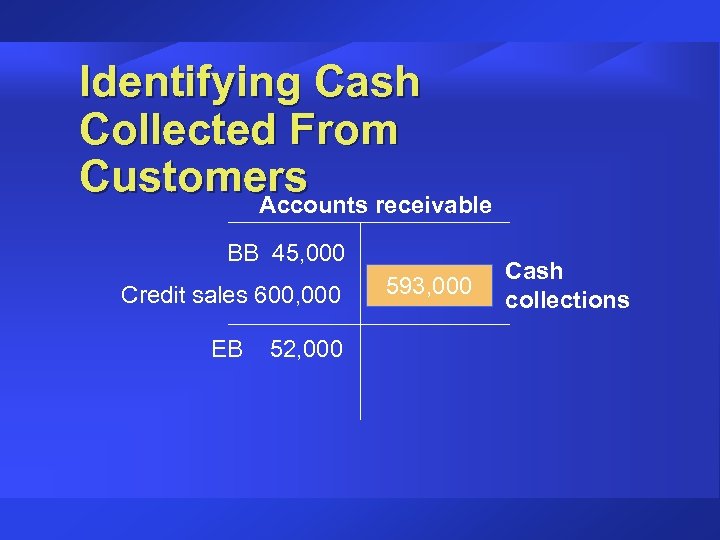 Identifying Cash Collected From Customers Accounts receivable BB 45, 000 Credit sales 600, 000 EB 52, 000 593, 000 Cash collections
 Direct Method SCF Another way to reason through this problem is: § AR beginning balance of $45, 000 is collected first. That’s $45, 000 cash inflow. § Then, sales of $600, 000 were made (income statement). Because the AR ending balance is $52, 000, cash sales must have been [$600, 000 52, 000] or $548, 000. § The old AR collected in cash, $45, 000, plus the cash sales for the period, $548, 000, gives total cash collected from customers of $593, 000.
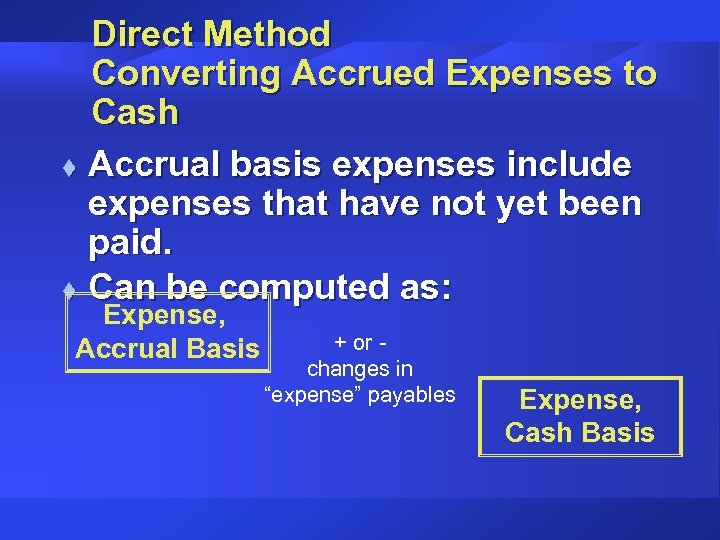 Direct Method Converting Accrued Expenses to Cash t Accrual basis expenses include expenses that have not yet been paid. t Can be computed as: Expense, Accrual Basis + or changes in “expense” payables Expense, Cash Basis
 Example: Direct Method SCF Salary Expense for 2005 was $500, 000. t Salary Payable was $35, 000 on 12/31/04 and $10, 000 on 12/31/05. t How much cash was paid to employees in 2005? t
 Example: Direct Method SCF First, the beginning amount of Salaries Payable was $35, 000. That must have been paid in cash first during 2005. t Salary expense for the year was $500, 000, but at year end, $10, 000 of that amount had not yet been paid. t We know this because Salaries Payable on the 12/31/05 balance sheet is $10, 000. t
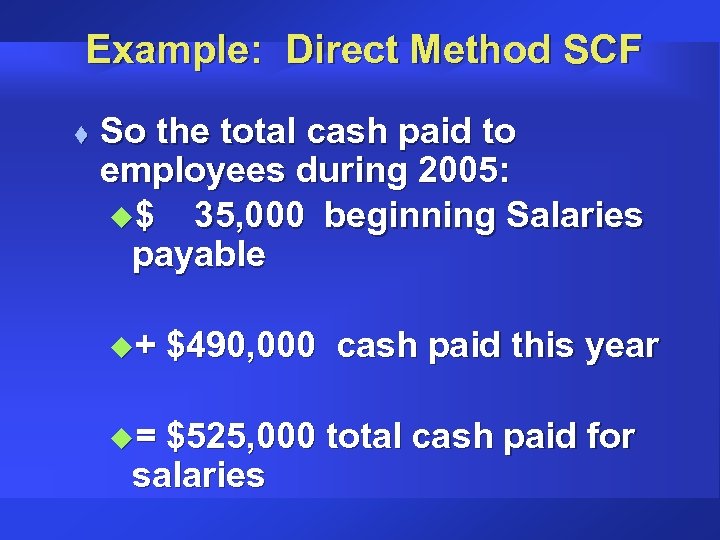 Example: Direct Method SCF t So the total cash paid to employees during 2005: u$ 35, 000 beginning Salaries payable u+ u= $490, 000 cash paid this year $525, 000 total cash paid for salaries
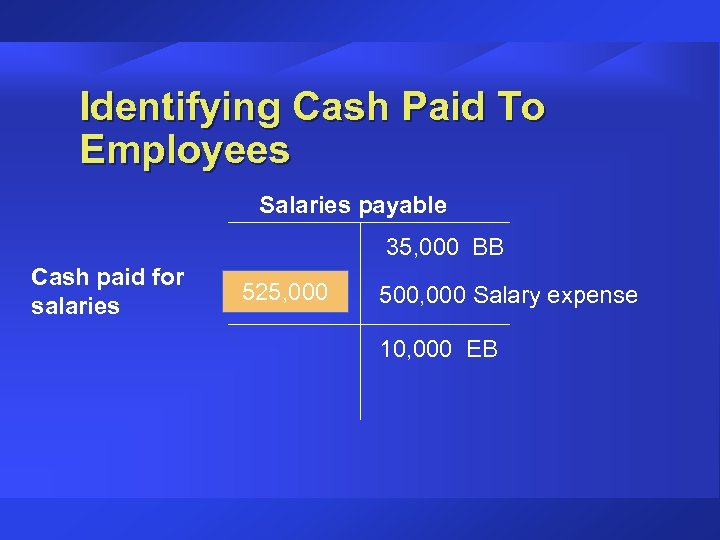 Identifying Cash Paid To Employees Salaries payable 35, 000 BB Cash paid for salaries 525, 000 500, 000 Salary expense 10, 000 EB
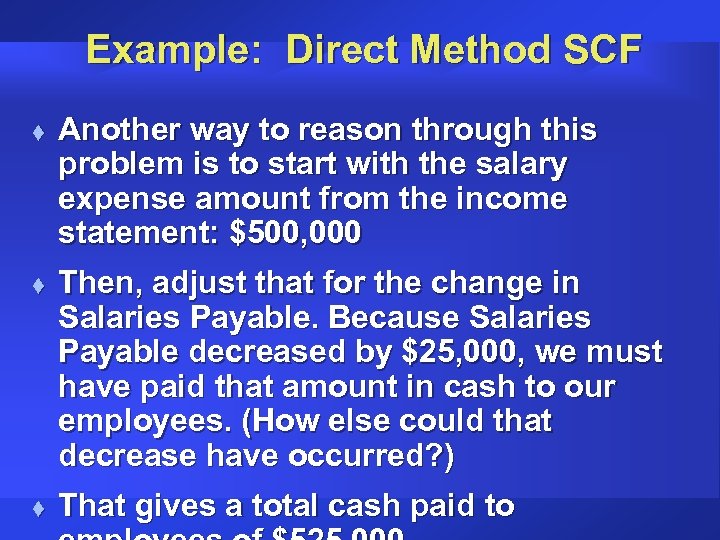 Example: Direct Method SCF t t t Another way to reason through this problem is to start with the salary expense amount from the income statement: $500, 000 Then, adjust that for the change in Salaries Payable. Because Salaries Payable decreased by $25, 000, we must have paid that amount in cash to our employees. (How else could that decrease have occurred? ) That gives a total cash paid to
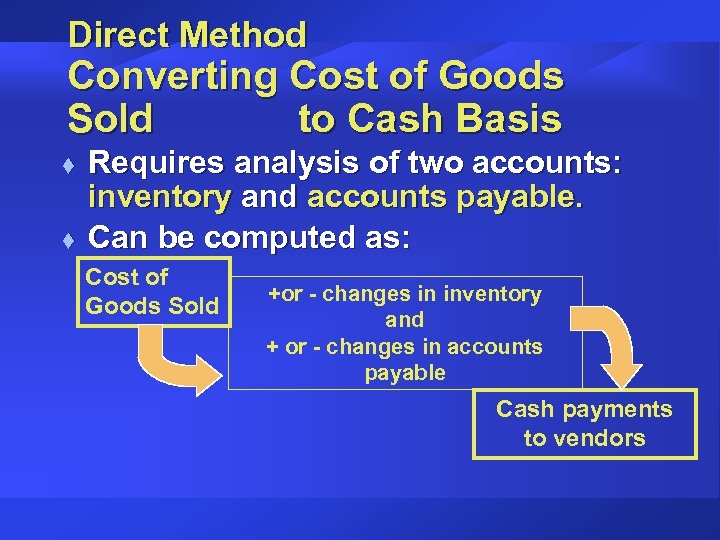 Direct Method Converting Cost of Goods Sold to Cash Basis t t Requires analysis of two accounts: inventory and accounts payable. Can be computed as: Cost of Goods Sold +or - changes in inventory and + or - changes in accounts payable Cash payments to vendors
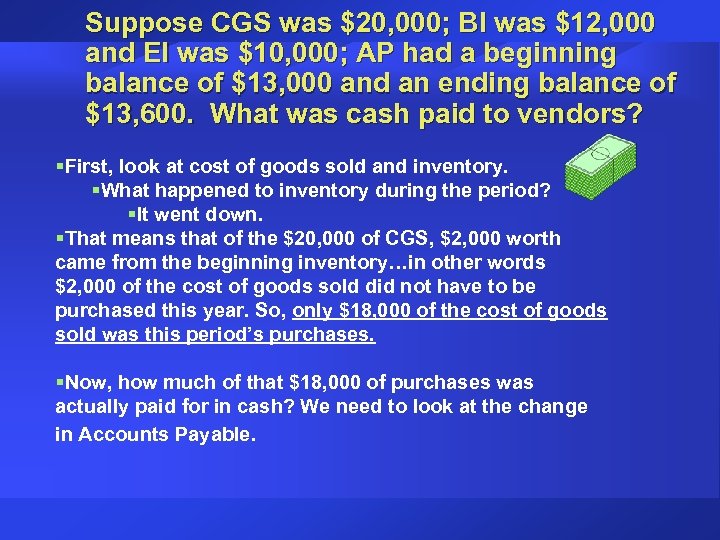 Suppose CGS was $20, 000; BI was $12, 000 and EI was $10, 000; AP had a beginning balance of $13, 000 and an ending balance of $13, 600. What was cash paid to vendors? §First, look at cost of goods sold and inventory. §What happened to inventory during the period? §It went down. §That means that of the $20, 000 of CGS, $2, 000 worth came from the beginning inventory…in other words $2, 000 of the cost of goods sold did not have to be purchased this year. So, only $18, 000 of the cost of goods sold was this period’s purchases. §Now, how much of that $18, 000 of purchases was actually paid for in cash? We need to look at the change in Accounts Payable.
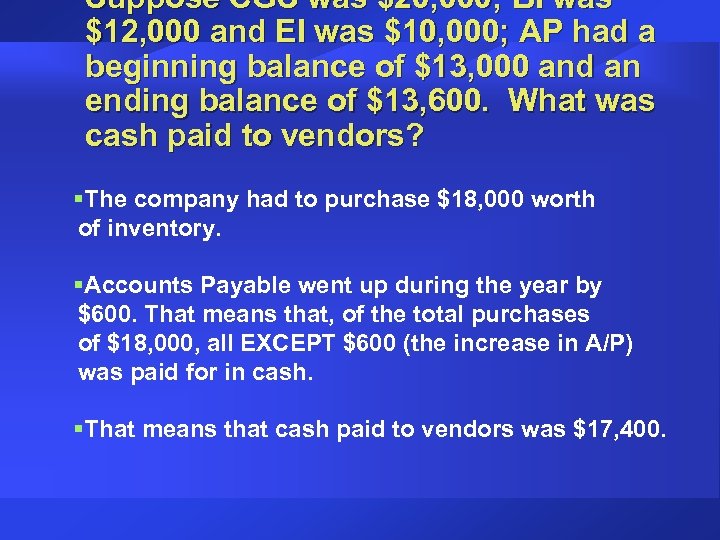 Suppose CGS was $20, 000; BI was $12, 000 and EI was $10, 000; AP had a beginning balance of $13, 000 and an ending balance of $13, 600. What was cash paid to vendors? §The company had to purchase $18, 000 worth of inventory. §Accounts Payable went up during the year by $600. That means that, of the total purchases of $18, 000, all EXCEPT $600 (the increase in A/P) was paid for in cash. §That means that cash paid to vendors was $17, 400.
 Identifying Cash Paid To Vendors t Must analyze two accounts: u. Inventory u. Accounts payable
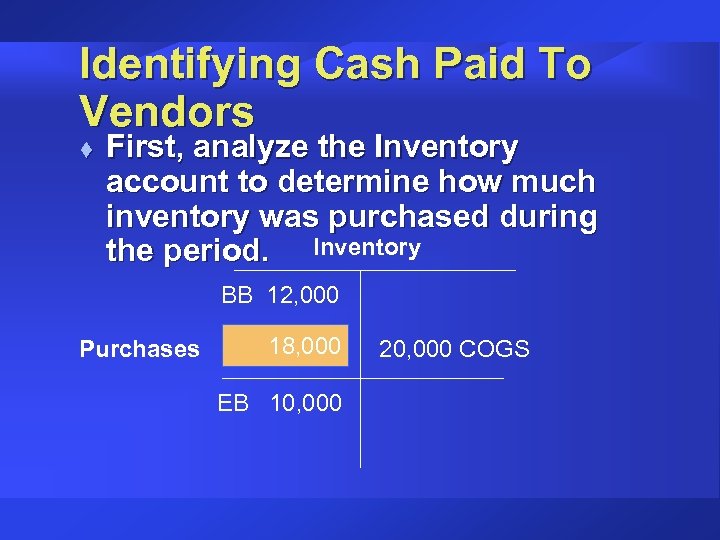 Identifying Cash Paid To Vendors t First, analyze the Inventory account to determine how much inventory was purchased during the period. Inventory BB 12, 000 Purchases 18, 000 EB 10, 000 20, 000 COGS
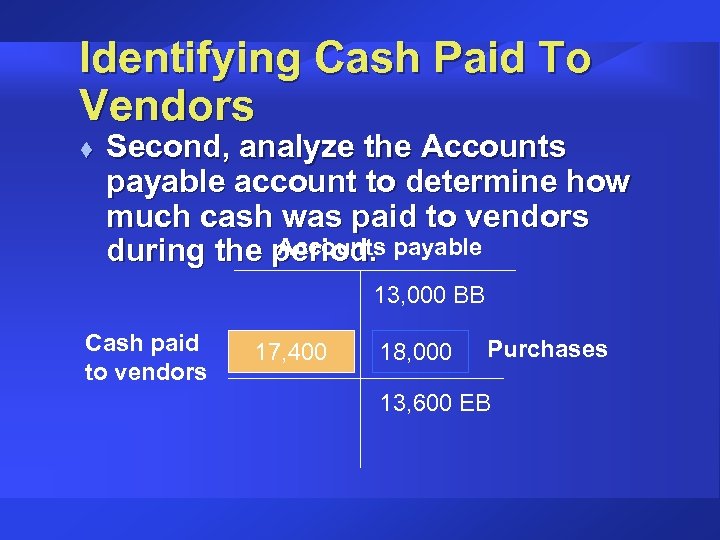 Identifying Cash Paid To Vendors t Second, analyze the Accounts payable account to determine how much cash was paid to vendors Accounts during the period. payable 13, 000 BB Cash paid to vendors 17, 400 18, 000 Purchases 13, 600 EB
 To Summarize This Problem t t Why is COST OF GOODS SOLD (from the income statement) not equal to cash? First, we might have sold some goods that we already had in the inventory or we may have had to buy all of the goods we sold PLUS some more that we put into building up the inventory. So, we must look at the change in inventory to see if cost of goods sold is more or less than the inventory we bought during the period. Here our inventory went down, from $12, 000 to $10, 000. That means we only had to buy $18, 000 worth of the goods we sold (the other $2, 000 came out of the beginning inventory).
 To Summarize This Problem n Now, did we actually have to pay for all $18, 000 worth of those goods? (Or did we pay for those plus some we purchased the period before? ) n To figure that out, we have to look at Accounts Payable (A/P). n Since A/P went UP, that means we bought some things we didn’t pay for yet. How many? $600 worth—that’s how much A/P went up. n So, rather than paying for all $18, 000 worth of our purchase, we only paid for
 To Summarize: t What kinds of accounts need to be examined to see if there is a difference between our accrual accounting records and actual cash? versus General Ledger
 To Summarize: t t t Accounts Receivable Prepaids Inventory Accounts Payable Other Payables All current assets and current liabilities need to be examined in conjunction with revenue and expense accounts.
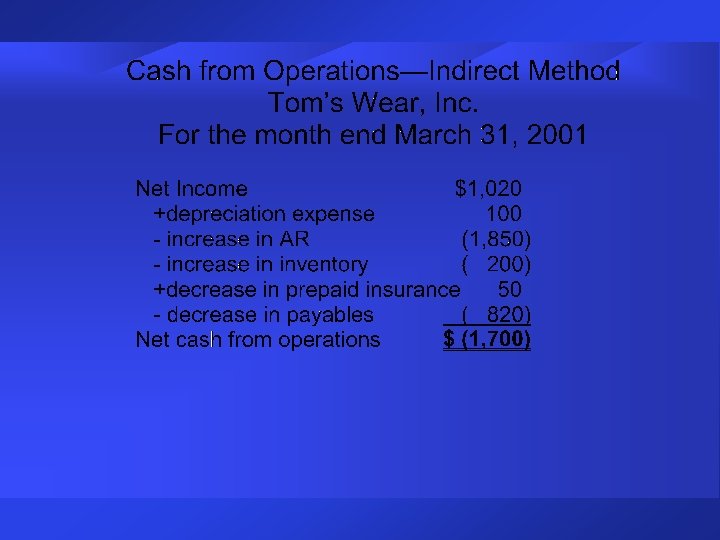
 An Example: Tom’s Wear Inc. : March 2001 To use the indirect method of preparing a statement of cash flows, we’ll examine each item on the income statement and make it “cash. ” t We’ll need the income statement and beginning and ending balance sheets for the period. t
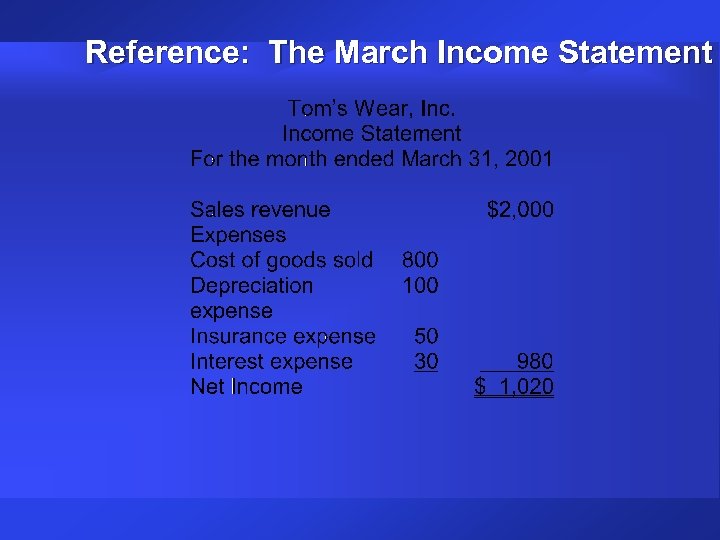 Reference: The March Income Statement
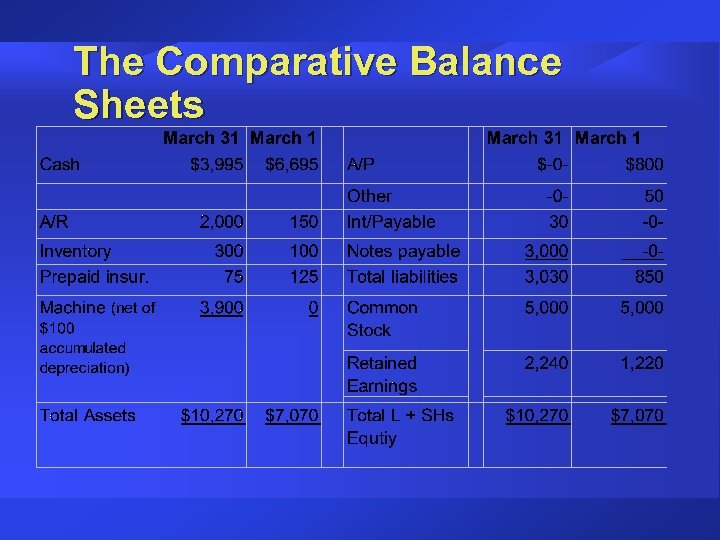 The Comparative Balance Sheets
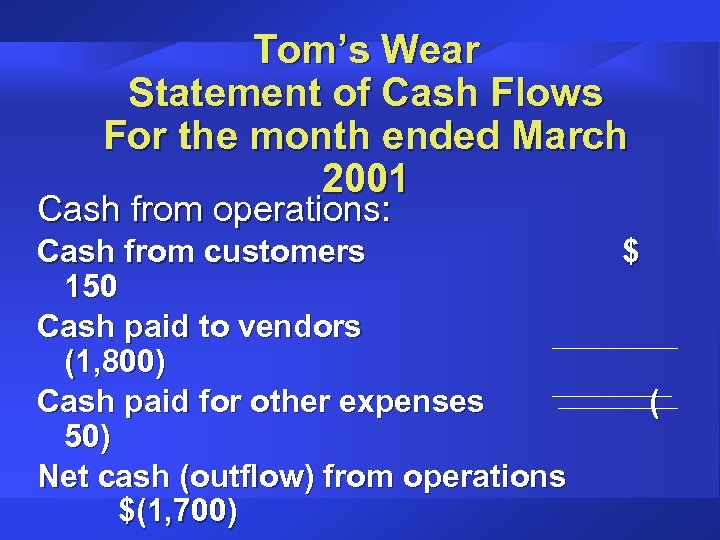
 Tom’s Wear Inc. -- March 2001 We’ll start on the income statement with Sales. How much CASH was collected from customers? t t t Sales for March were $2, 000. But Accounts Receivable went from a beginning balance of $150 to an ending balance of $2, 000. Because AR increased by $1, 850, we must have only collected $150 cash.
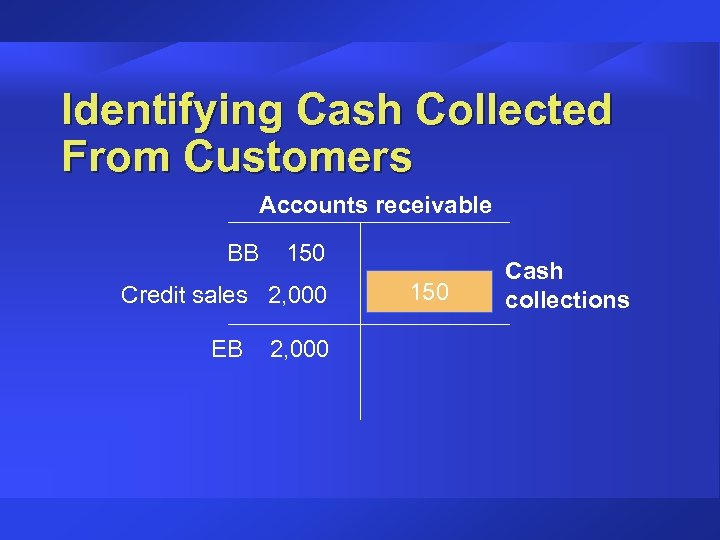 Identifying Cash Collected From Customers Accounts receivable BB 150 Credit sales 2, 000 EB 2, 000 150 Cash collections
 Tom’s Wear Inc. -- March 2001 Cost of goods sold is $800. And inventory increased from 100 to 300. That means that $1, 000 worth of inventory must have been purchased -- enough to sell $800 worth and build up the inventory by another $200. How much cash was paid to vendors? We need to check out what happened to Accounts Payable during the month.
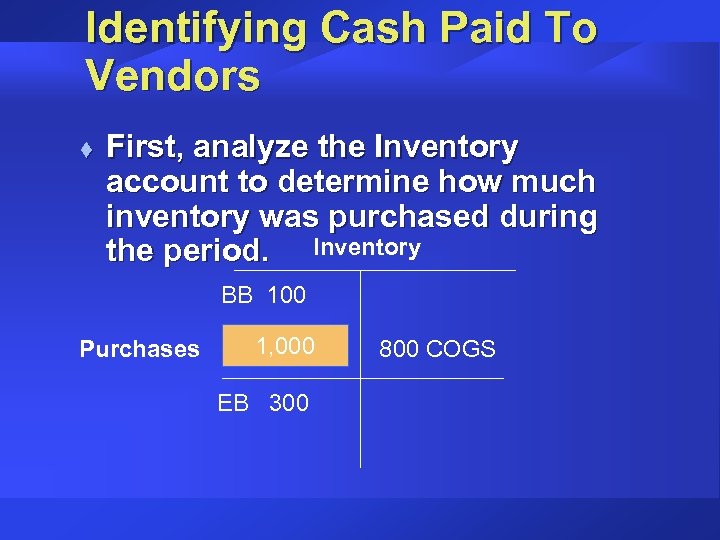 Identifying Cash Paid To Vendors t First, analyze the Inventory account to determine how much inventory was purchased during the period. Inventory BB 100 Purchases 1, 000 EB 300 800 COGS
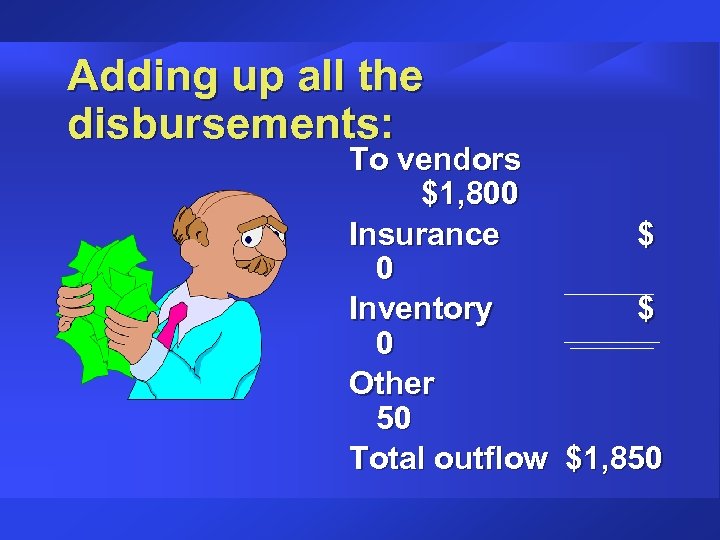
 Tom’s Wear Inc. -- March 2001 Accounts Payable started the month at $800. That means Tom’s Wear owed $800 to vendors at the beginning of March. At the end of March, the Accounts Payable balance is $0. That means Tom’s Wear paid for ALL of the month’s purchases ($1, 000) PLUS $800 owned from February.
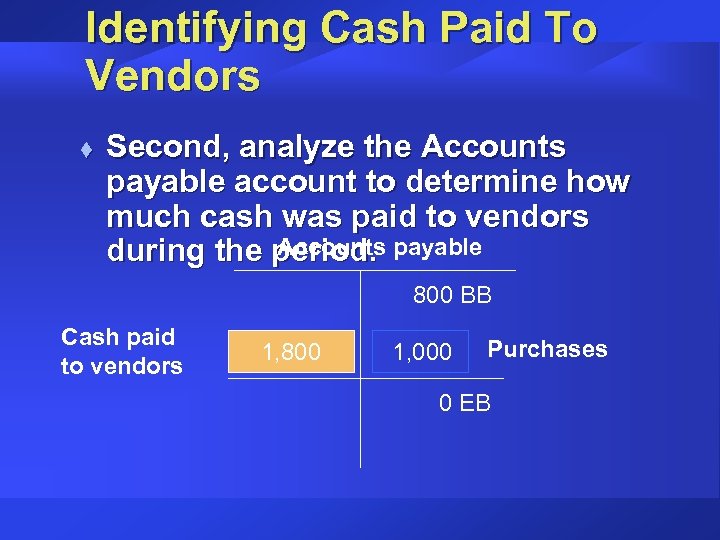 Identifying Cash Paid To Vendors t Second, analyze the Accounts payable account to determine how much cash was paid to vendors Accounts during the period. payable 800 BB Cash paid to vendors 1, 800 1, 000 Purchases 0 EB
 Tom’s Wear Inc. -- March 2001 Depreciation expense is a non-cash expense, so we can simply ignore it.
 Tom’s Wear Inc. -- March 2001 t t Insurance expense for the month was $50. To figure out how much cash was actually paid for insurance, we have to look at what happened to Prepaid Insurance. The comparative balance sheets show that Prepaid Insurance went from $125 to $75. That means the insurance expense of $50 came totally from the Prepaid Insurance, so no cash was disbursed for insurance.
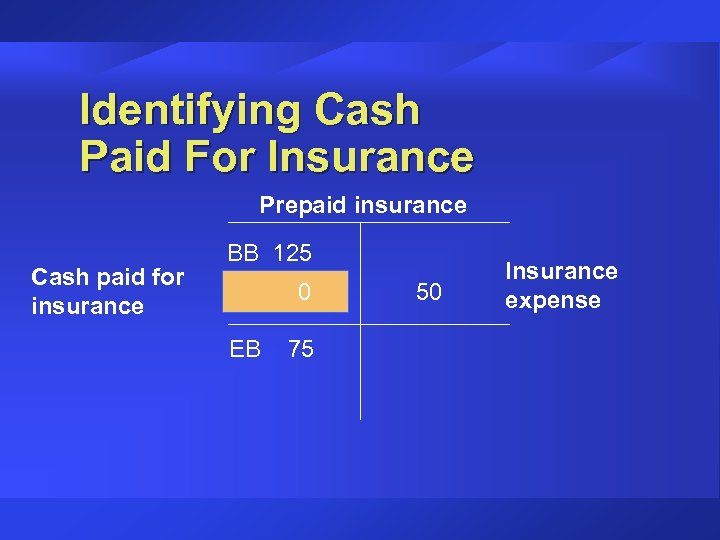 Identifying Cash Paid For Insurance Prepaid insurance Cash paid for insurance BB 125 EB 0 75 50 Insurance expense
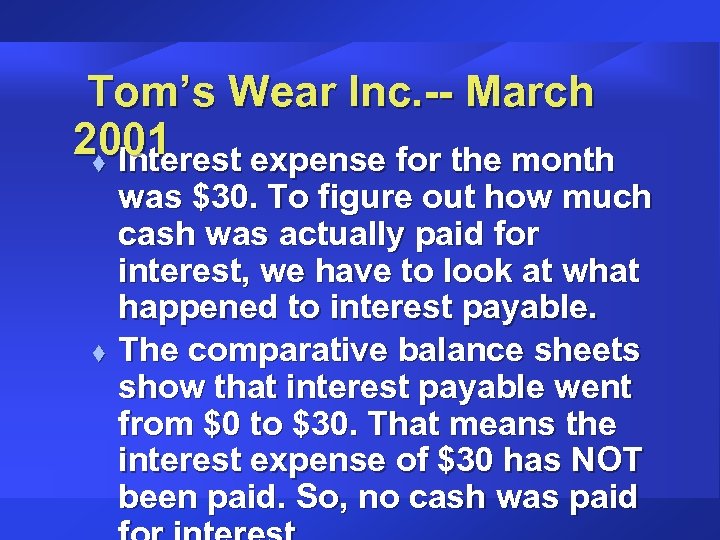 Tom’s Wear Inc. -- March 2001 t Interest expense for the month t was $30. To figure out how much cash was actually paid for interest, we have to look at what happened to interest payable. The comparative balance sheets show that interest payable went from $0 to $30. That means the interest expense of $30 has NOT been paid. So, no cash was paid
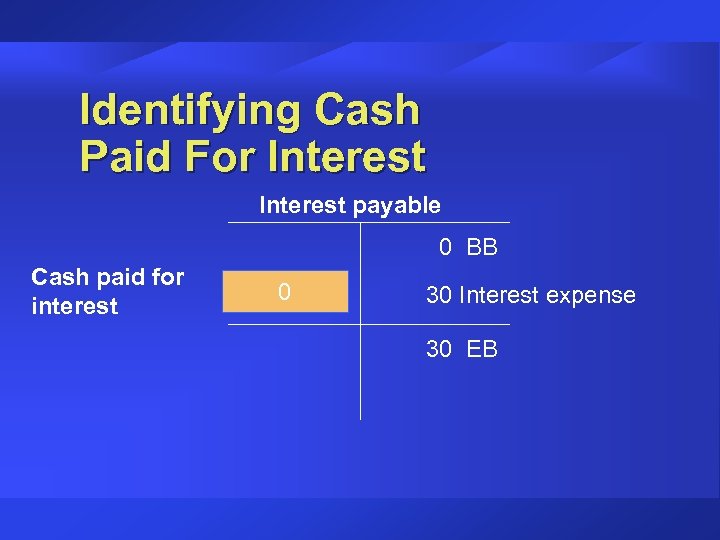 Identifying Cash Paid For Interest payable 0 BB Cash paid for interest 0 30 Interest expense 30 EB
 What Else? t t The only other cash disbursements we have to worry about are any that were made for expenses from a prior year. That means we must look for any payables that were there at the beginning of the year, but are no longer there. In this example, there is a $50 cash disbursement made to pay
 Adding up all the disbursements: To vendors $1, 800 Insurance $ 0 Inventory $ 0 Other 50 Total outflow $1, 850
 Tom’s Wear Statement of Cash Flows For the month ended March 2001 Cash from operations: Cash from customers 150 Cash paid to vendors (1, 800) Cash paid for other expenses 50) Net cash (outflow) from operations $(1, 700) $ (
 Indirect Method § § Net cash flows from operating activities are determined by. . . • Starting with net income, then. . . • Adding and subtracting items that reconcile net income to operating cash flows. Requires an analysis of
 Agenda t Indirect Method
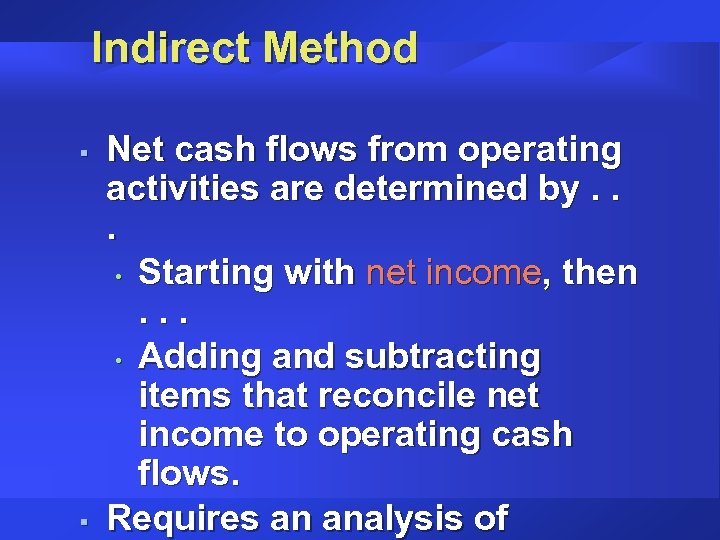
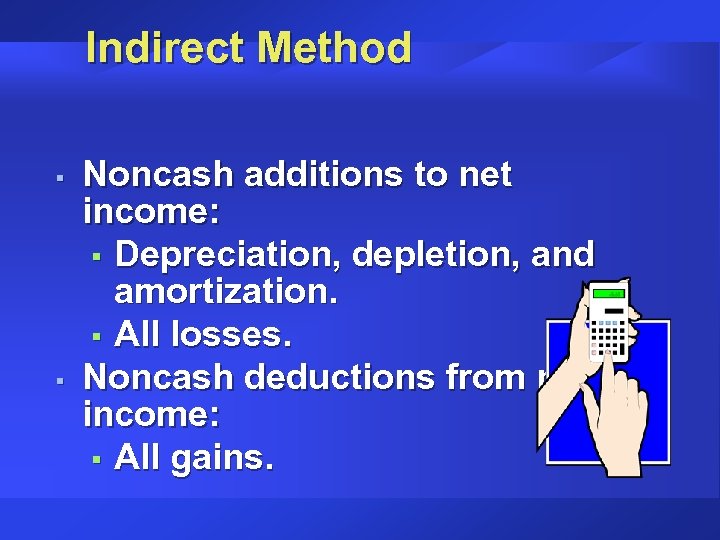 Indirect Method § § Noncash additions to net income: § Depreciation, depletion, and amortization. § All losses. Noncash deductions from net income: § All gains.
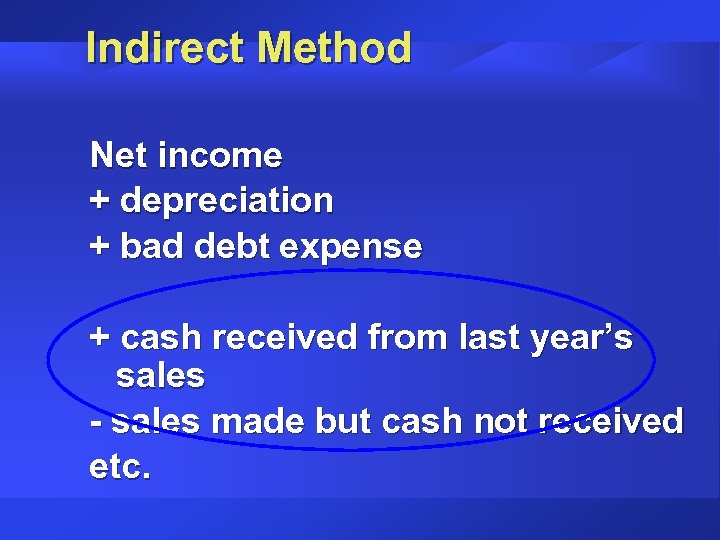 Indirect Method Net income + depreciation + bad debt expense + cash received from last year’s sales - sales made but cash not received etc.
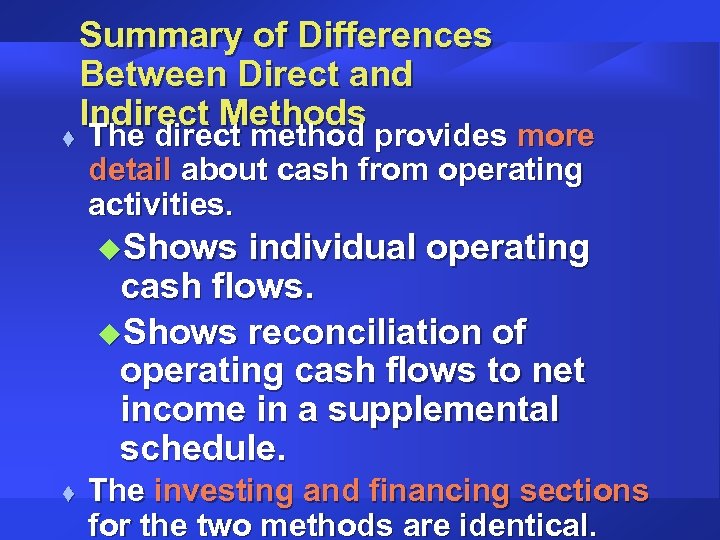 t Summary of Differences Between Direct and Indirect Methods The direct method provides more detail about cash from operating activities. u. Shows individual operating cash flows. u. Shows reconciliation of operating cash flows to net income in a supplemental schedule. t The investing and financing sections for the two methods are identical.
 How Important Is The Statement Of Cash Flows? t t t It is crucial to the presentation of a complete picture of the financial status of a business. Many businesses with great ideas and potential have failed due to their failure to manage their cash flows. Remember, the statement
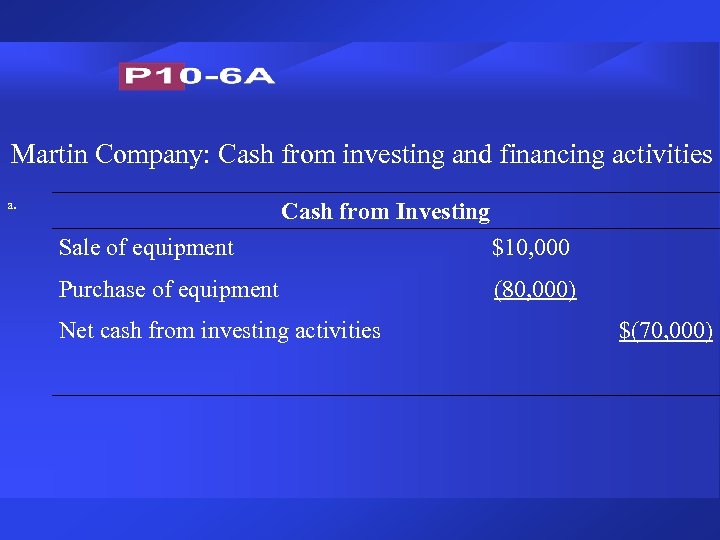 Martin Company: Cash from investing and financing activities a. Cash from Investing Sale of equipment $10, 000 Purchase of equipment (80, 000) Net cash from investing activities $(70, 000)
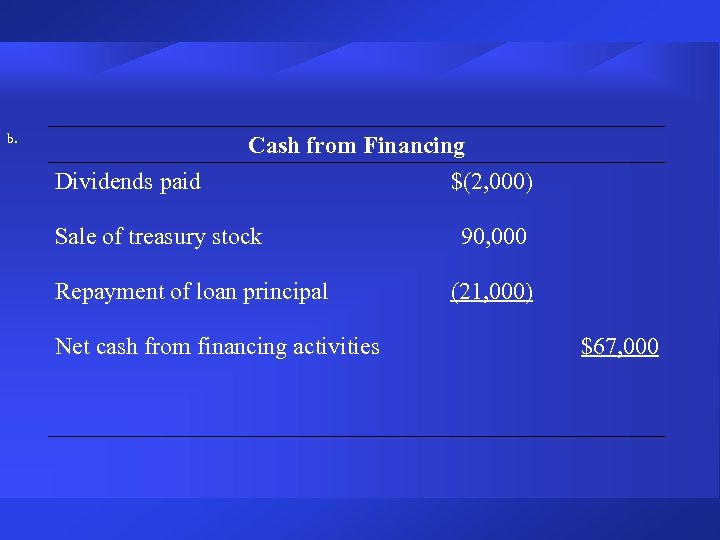 b. Dividends paid Cash from Financing $(2, 000) Sale of treasury stock Repayment of loan principal Net cash from financing activities 90, 000 (21, 000) $67, 000
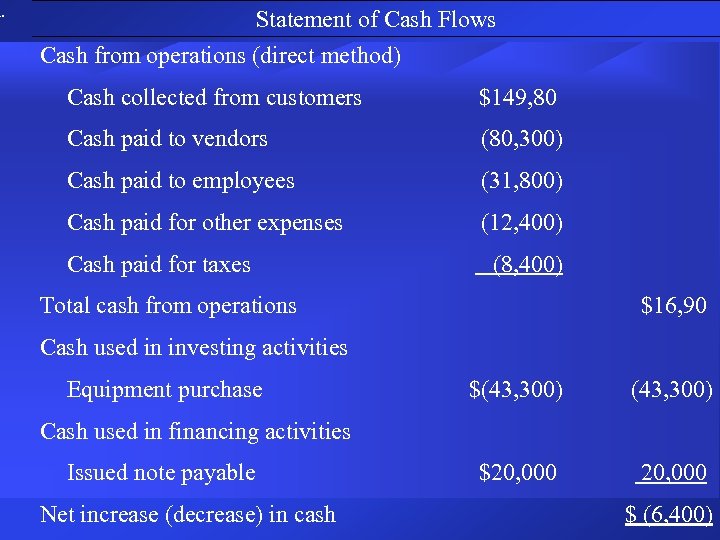 a. Statement of Cash Flows Cash from operations (direct method) Cash collected from customers $149, 80 Cash paid to vendors (80, 300) Cash paid to employees (31, 800) Cash paid for other expenses (12, 400) Cash paid for taxes (8, 400) Total cash from operations $16, 90 Cash used in investing activities Equipment purchase $(43, 300) $20, 000 Cash used in financing activities Issued note payable Net increase (decrease) in cash $ (6, 400)