


 Скачать презентацию Accounting Clinic IV Mc Graw-Hill Irwin The Mc
7bb5e2fb425f9d83abe6226c6c476207.ppt
- Количество слайдов: 36
 Accounting Clinic IV Mc. Graw-Hill/Irwin © The Mc. Graw-Hill Companies, Inc. , 2007 All rights reserved. Clinic 4 -1
 Prepared by: Nir Yehuda With contributions by Stephen H. Penman – Columbia University
 Overview Many corporations have adopted various plans, contracts, and agreements to compensate employees by issuing them stock of the employer corporation. Under traditional stock option and stock purchase plans, an employer corporation grants options to purchase a fixed number of shares of stock of the corporation at a stated price during a specified period or grants rights to purchase shares of stock of the corporation at a stated price, sometimes at a discount from the market price of the stock at the date the rights are granted. Stock options and purchase rights are normally granted for future services of employees. Mc. Graw-Hill/Irwin © The Mc. Graw-Hill Companies, Inc. , 2007 All rights reserved. Clinic 4 -3
 Two Ways of Compensating Employees with Stock 1. Direct Stock Compensation Issue stock to employees at less than market price. The stock is often restricted until a vesting date. 2. Stock option compensation Grant employees stock options that are then exercised if the stock price is greater than exercise price after the vesting date. Mc. Graw-Hill/Irwin © The Mc. Graw-Hill Companies, Inc. , 2007 All rights reserved. Clinic 4 -4
 Direct Stock Compensation Deferred compensation is recognized for the difference between market price and issue price at the time of the stock issue. Deferred compensation is then amortized to the income statement over a service (vesting) period. See chapter 8. The reminder of the clinic deals with stock option compensation. Mc. Graw-Hill/Irwin © The Mc. Graw-Hill Companies, Inc. , 2007 All rights reserved. Clinic 4 -5
 Typical Compensation Plans Typical compensation plans for top executives have the following components Base salary Annual bonus Stock options Long-term incentive plans • restricted stock Mc. Graw-Hill/Irwin © The Mc. Graw-Hill Companies, Inc. , 2007 All rights reserved. Clinic 4 -6
 Motivation for Using Options in Compensation Rewarding performance of current employees Attracting better employees, especially in “new economy” firms’ recruiting process. Providing incentives to employees to increase stock price. Saving on cash reserves. Deferring taxes - when options are granted not in the money, they are not taxable to the employees until they are exercised. Mc. Graw-Hill/Irwin © The Mc. Graw-Hill Companies, Inc. , 2007 All rights reserved. Clinic 4 -7
 Problems Related to Using Options in Compensation Excessive compensation Motivating employees to take on projects that are too risky Motivating employees to manipulate accounting to hide bad news Mc. Graw-Hill/Irwin © The Mc. Graw-Hill Companies, Inc. , 2007 All rights reserved. Clinic 4 -8
 Terminology Exercise price - the price specified in the option contract, at which the holder can buy the common stock. Measurement date - The date at which the stock price that enters into measurement of the fair value of an award of employee stock-based compensation is fixed. Vesting period - the time span between option grant date and the date it becomes exercisable. Expected life - the time span between grant date and the time when options are likely to be exercised. Mc. Graw-Hill/Irwin © The Mc. Graw-Hill Companies, Inc. , 2007 All rights reserved. Clinic 4 -9
 Measuring Compensation for Services Compensation in the form of stock issued through employee stock option, purchase, and award plans should be measured as the quoted market price of the stock at the measurement date less the amount, if any, that the employee is required to pay. Mc. Graw-Hill/Irwin © The Mc. Graw-Hill Companies, Inc. , 2007 All rights reserved. Clinic 4 -10
 APB 25 – Intrinsic Value Compensation cost is based on intrinsic value on the date the option is granted Intrinsic value = Market price of stock (S) exercise price (E) Not equal to fair market price of option If E > = S, no compensation cost recorded Most fixed stock option plans - the most common type of stock compensation plan have no intrinsic value at grant date, and under Opinion 25 no compensation cost is recognized for them. Mc. Graw-Hill/Irwin © The Mc. Graw-Hill Companies, Inc. , 2007 All rights reserved. Clinic 4 -11
 From APB 25 to SFAS 123 APB Opinion No. 25, Accounting for Stock Issued to Employees, was introduced in 1972. The main reason for the choice of the described accounting method was the lack of a reliable option pricing model. In 1995, the FASB issued SFAS 123. Its main goal was to improve stock option accounting, by estimating the fair value of the option on the date the option is granted. This was the result of the following : The Black and Scholes’ option pricing model had become a well-established pricing technique. The increasing popularity of stock options. Mc. Graw-Hill/Irwin © The Mc. Graw-Hill Companies, Inc. , 2007 All rights reserved. Clinic 4 -12
 The Fair Value Method Under the fair value based method, compensation cost is measured at the grant date based on the value of the award and is recognized as an expense over the service period, which is usually the vesting period. Mc. Graw-Hill/Irwin © The Mc. Graw-Hill Companies, Inc. , 2007 All rights reserved. Clinic 4 -13
 From APB 25 to SFAS 123 When FASB was contemplating changing the stock compensation accounting method, advocating the Fair Value Method for all employee stock options, strong opposition arose. The opposition's arguments include: Granting stock options does not represent a cash outflow and therefore is not an expense. Lower net income numbers may cause violation of contract terms, such as debt covenants. Lower earnings number might lead to stock price drop, for investors tend to be fixated on P/E and other valuation ratios. Firms with large employees stock options programs might have trouble raising capital (because earnings would be lower). Mc. Graw-Hill/Irwin © The Mc. Graw-Hill Companies, Inc. , 2007 All rights reserved. Clinic 4 -14
 SFAS 123 introduced the fair value method of accounting for an employee stock option or similar equity instrument and encouraged all entities to adopt that method of accounting for all of their employee stock compensation plans. However, it also allowed an entity to continue to measure compensation cost for those plans using the intrinsic value based method of accounting prescribed by APB 25. The statement states that the fair value based method is preferable to the APB 25 method. Entities that choose to remain with the accounting in APB 25 must make pro forma disclosures (in footnotes) of net income and, if presented, earnings per share, as if the fair value based method of accounting had been applied. Mc. Graw-Hill/Irwin © The Mc. Graw-Hill Companies, Inc. , 2007 All rights reserved. Clinic 4 -15
 SFAS 123 R In 2004, SFAS 123 R made it compulsory for firm to use the fair value method of SFAS 123, effective for fiscal years ending in 2006. So, footnote presentation in no longer allowed: firms must take the stock options expense at grant date to the income statement. The IASB also passed IFRS 2 with similar requirements. Mc. Graw-Hill/Irwin © The Mc. Graw-Hill Companies, Inc. , 2007 All rights reserved. Clinic 4 -16
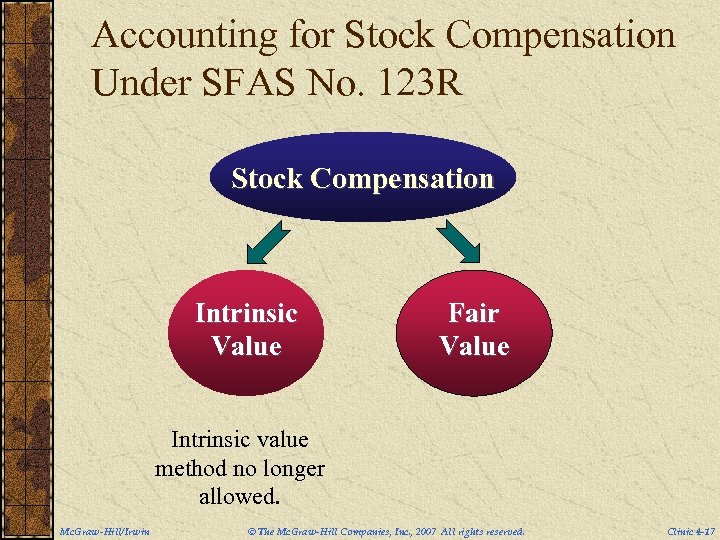 Accounting for Stock Compensation Under SFAS No. 123 R Stock Compensation Intrinsic Value Fair Value Intrinsic value method no longer allowed. Mc. Graw-Hill/Irwin © The Mc. Graw-Hill Companies, Inc. , 2007 All rights reserved. Clinic 4 -17
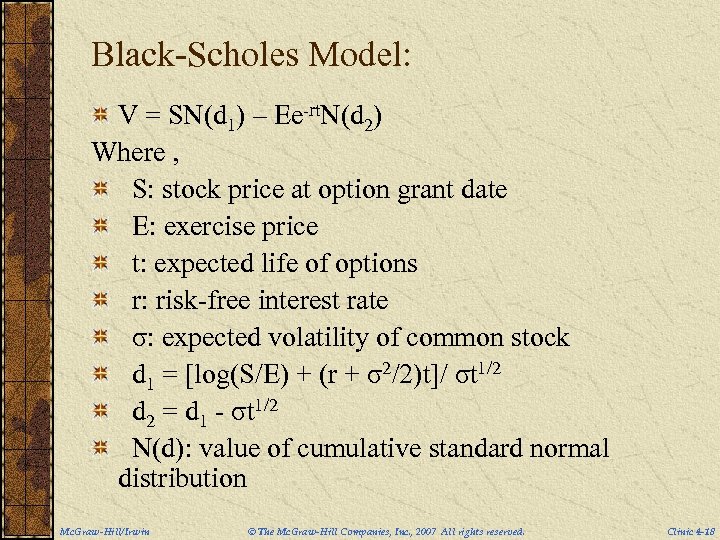 Black-Scholes Model: V = SN(d 1) – Ee-rt. N(d 2) Where , S: stock price at option grant date E: exercise price t: expected life of options r: risk-free interest rate σ: expected volatility of common stock d 1 = [log(S/E) + (r + σ2/2)t]/ σt 1/2 d 2 = d 1 - σt 1/2 N(d): value of cumulative standard normal distribution Mc. Graw-Hill/Irwin © The Mc. Graw-Hill Companies, Inc. , 2007 All rights reserved. Clinic 4 -18
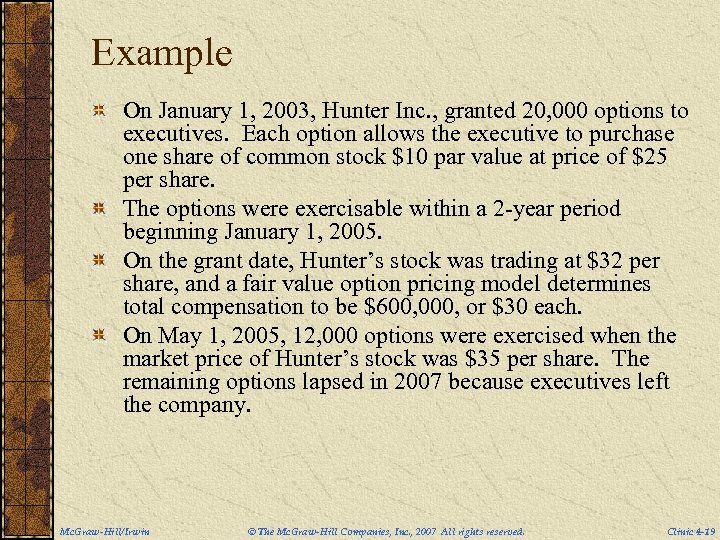 Example On January 1, 2003, Hunter Inc. , granted 20, 000 options to executives. Each option allows the executive to purchase one share of common stock $10 par value at price of $25 per share. The options were exercisable within a 2 -year period beginning January 1, 2005. On the grant date, Hunter’s stock was trading at $32 per share, and a fair value option pricing model determines total compensation to be $600, 000, or $30 each. On May 1, 2005, 12, 000 options were exercised when the market price of Hunter’s stock was $35 per share. The remaining options lapsed in 2007 because executives left the company. Mc. Graw-Hill/Irwin © The Mc. Graw-Hill Companies, Inc. , 2007 All rights reserved. Clinic 4 -19
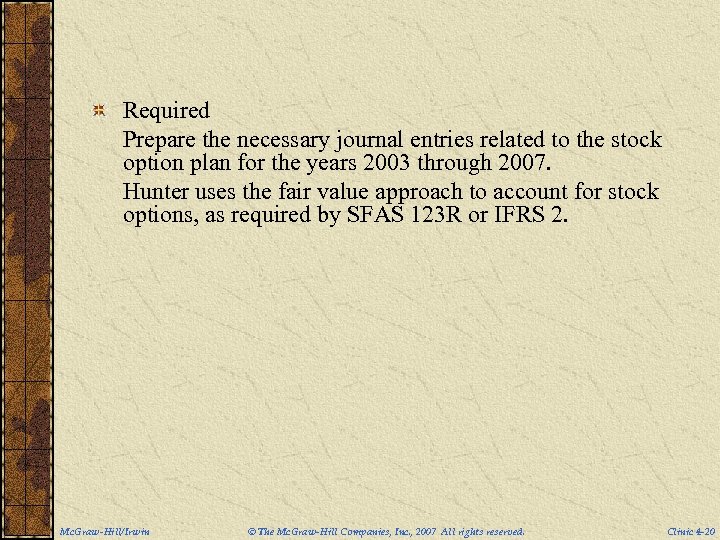 Required Prepare the necessary journal entries related to the stock option plan for the years 2003 through 2007. Hunter uses the fair value approach to account for stock options, as required by SFAS 123 R or IFRS 2. Mc. Graw-Hill/Irwin © The Mc. Graw-Hill Companies, Inc. , 2007 All rights reserved. Clinic 4 -20
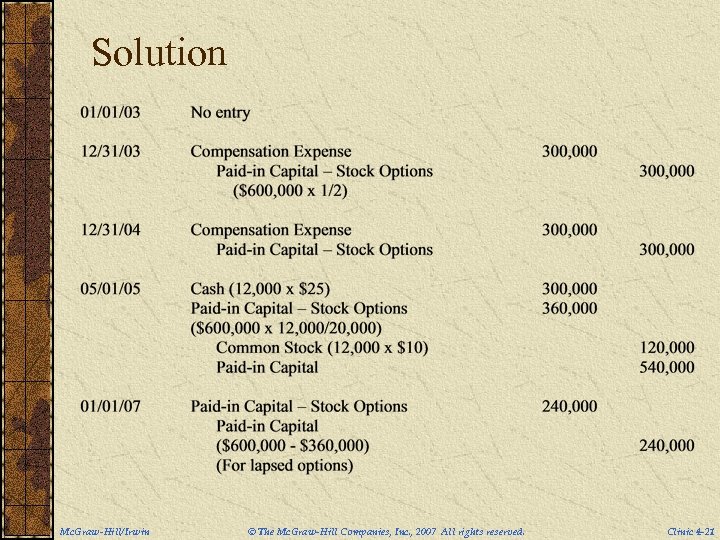 Solution Mc. Graw-Hill/Irwin © The Mc. Graw-Hill Companies, Inc. , 2007 All rights reserved. Clinic 4 -21
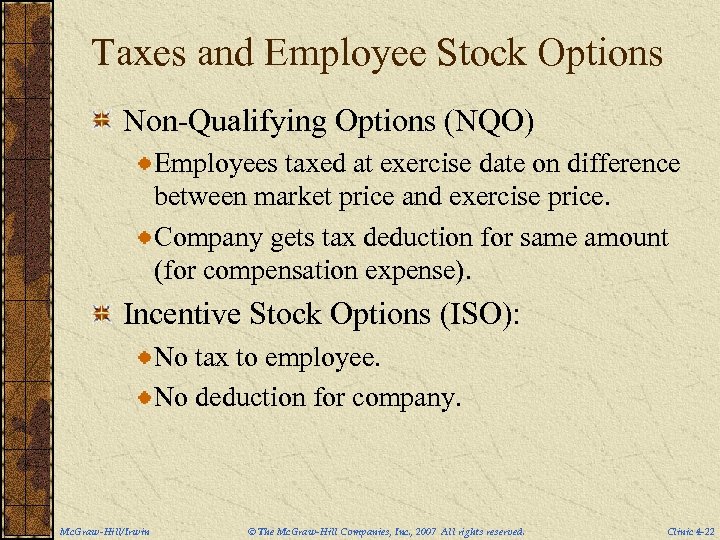 Taxes and Employee Stock Options Non-Qualifying Options (NQO) Employees taxed at exercise date on difference between market price and exercise price. Company gets tax deduction for same amount (for compensation expense). Incentive Stock Options (ISO): No tax to employee. No deduction for company. Mc. Graw-Hill/Irwin © The Mc. Graw-Hill Companies, Inc. , 2007 All rights reserved. Clinic 4 -22
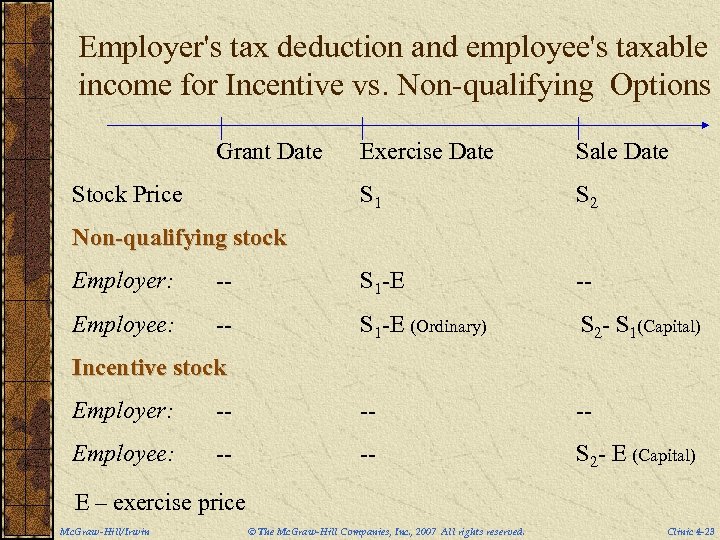 Employer's tax deduction and employee's taxable income for Incentive vs. Non-qualifying Options Grant Date Sale Date S 1 Stock Price Exercise Date S 2 Non-qualifying stock Employer: -- S 1 -E -- Employee: -- S 1 -E (Ordinary) S 2 - S 1(Capital) Incentive stock Employer: -- -- -- Employee: -- -- S 2 - E (Capital) E – exercise price Mc. Graw-Hill/Irwin © The Mc. Graw-Hill Companies, Inc. , 2007 All rights reserved. Clinic 4 -23
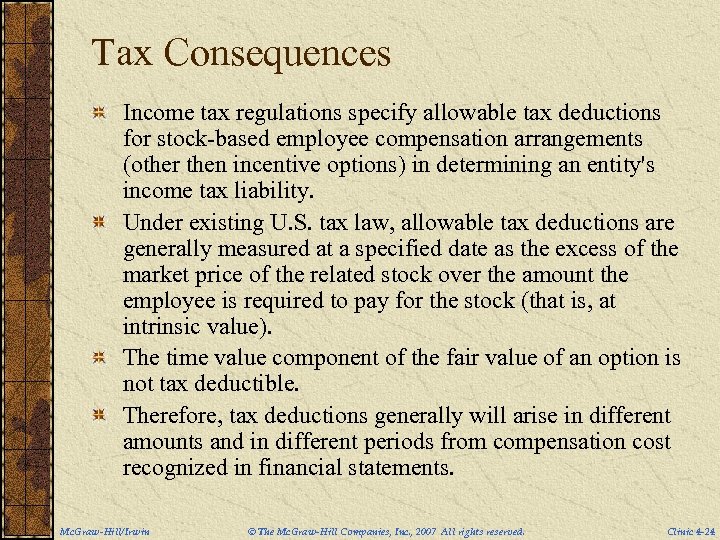 Tax Consequences Income tax regulations specify allowable tax deductions for stock-based employee compensation arrangements (other then incentive options) in determining an entity's income tax liability. Under existing U. S. tax law, allowable tax deductions are generally measured at a specified date as the excess of the market price of the related stock over the amount the employee is required to pay for the stock (that is, at intrinsic value). The time value component of the fair value of an option is not tax deductible. Therefore, tax deductions generally will arise in different amounts and in different periods from compensation cost recognized in financial statements. Mc. Graw-Hill/Irwin © The Mc. Graw-Hill Companies, Inc. , 2007 All rights reserved. Clinic 4 -24
 Tax Consequences The cumulative amount of compensation cost recognized for a stock-based award that ordinarily results in a future tax deduction under existing tax law should be considered to be a deductible temporary difference. The deferred tax benefit (or expense) that results from increases (or decreases) in that temporary difference, for example, as additional service is rendered and the related cost is recognized, should be recognized in the income statement. Mc. Graw-Hill/Irwin © The Mc. Graw-Hill Companies, Inc. , 2007 All rights reserved. Clinic 4 -25
 Tax Consequences If a deduction reported on a tax return for a stock-based award exceeds the cumulative compensation cost for that award recognized for financial reporting, the tax benefit for that excess deduction should be recognized as additional paid-in capital. The same amount is reported as part of Cash From Financing Activities. Note that this amount might be very large if stock prices rise during the vesting period. Mc. Graw-Hill/Irwin © The Mc. Graw-Hill Companies, Inc. , 2007 All rights reserved. Clinic 4 -26
 Tax Consequences If the deduction reported on a tax return is less than the cumulative compensation cost recognized for financial reporting, the write-off of a related deferred tax asset in excess of the benefits of the tax deduction, net of the related valuation allowance, if any, should be recognized in the income statement except to the extent that there is remaining additional paid-in capital from excess tax deductions from previous stock-based employee compensation awards accounted for in accordance with the fair value based method in this Statement. In that situation, the amount of the write-off should be charged against that additional paid-in capital. Mc. Graw-Hill/Irwin © The Mc. Graw-Hill Companies, Inc. , 2007 All rights reserved. Clinic 4 -27
 Grant date and Exercise Date Accounting for Employee Stock Options Grant date accounting records the compensation expense as the (fair value) option value at grant date. Exercise date accounting records the expense as the difference between the market price and exercise price at exercise date (just as the taxation authorities do). SFAS 123 R uses grant date accounting and the example above gives a demonstration. Mc. Graw-Hill/Irwin © The Mc. Graw-Hill Companies, Inc. , 2007 All rights reserved. Clinic 4 -28
 How Exercise Date Accounting Works 1. Recognize the option value at grant date as a contingent liability, along with a deferred (unearned) compensation asset. This is the amount recognized with grant date accounting under SFAS 123 R. The grant date value given to employees is compensation, but it is contingent upon the option going into the money. The deferred compensation asset is similar to that which arises from stock issues to employees at less than market value. 2. Amortize the deferred compensation over an employee service period, usually the vesting period. Mc. Graw-Hill/Irwin © The Mc. Graw-Hill Companies, Inc. , 2007 All rights reserved. Clinic 4 -29
 How Exercise Date Accounting Works (Cont. ) 3. Mark the contingent liability to market as options go into the money to capture the value of the option overhang, and recognize a corresponding unrealized loss from stock options. 4. Extinguish the liability against the share issue (at market value) at exercise date. If options are not exercised, extinguish the liability and recognize a gain from stock options. Mc. Graw-Hill/Irwin © The Mc. Graw-Hill Companies, Inc. , 2007 All rights reserved. Clinic 4 -30
 An Example of Exercise Date Accounting On January 1, 2004, Peabody Inc. granted 10, 000 options to the CEO. These options allowed the CEO to purchase one share at $40, the market price on January 1, 2004 (the options are at the money). The options were exercisable within a 2 year period beginning January 1, 2006. On grant date the value of the (at-themoney options) totaled $65, 000. Mc. Graw-Hill/Irwin © The Mc. Graw-Hill Companies, Inc. , 2007 All rights reserved. Clinic 4 -31
 On December 31, 2004 the stock price stood at $45 per share and the total option value at $105, 000. On December 31, 2005 the stock price stood at $57 per share and the total option value at $198, 000. On February 28, 2006, the CEO exercised the options when the stock price was $68 per share. Mc. Graw-Hill/Irwin © The Mc. Graw-Hill Companies, Inc. , 2007 All rights reserved. Clinic 4 -32
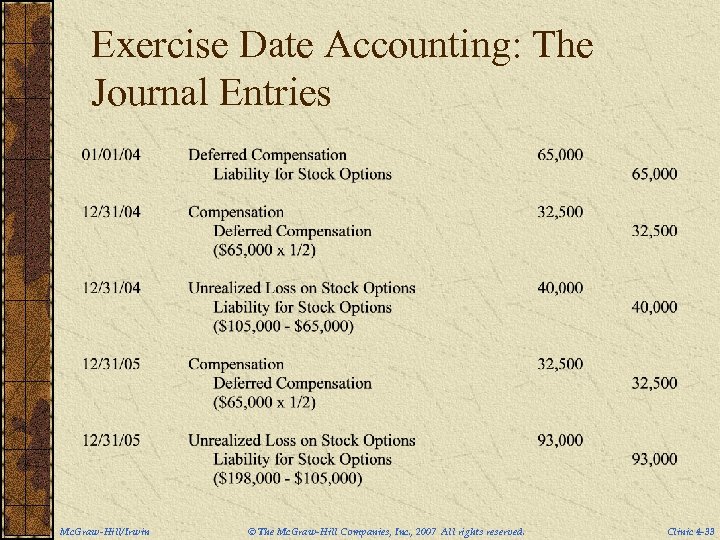 Exercise Date Accounting: The Journal Entries Mc. Graw-Hill/Irwin © The Mc. Graw-Hill Companies, Inc. , 2007 All rights reserved. Clinic 4 -33
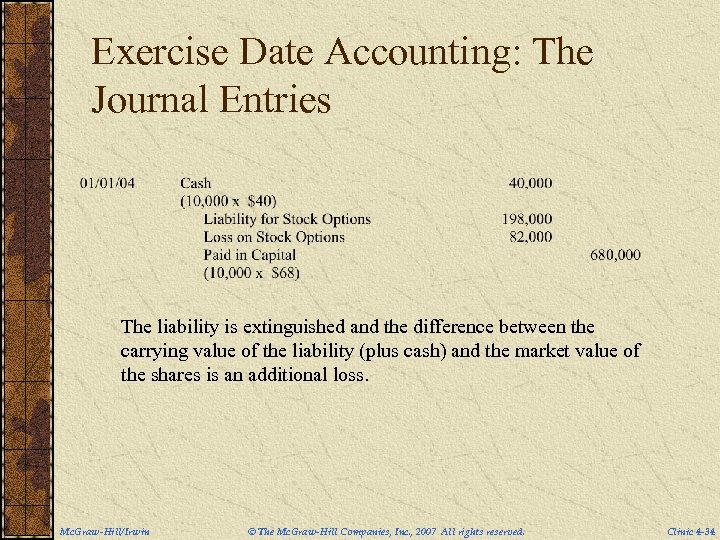 Exercise Date Accounting: The Journal Entries The liability is extinguished and the difference between the carrying value of the liability (plus cash) and the market value of the shares is an additional loss. Mc. Graw-Hill/Irwin © The Mc. Graw-Hill Companies, Inc. , 2007 All rights reserved. Clinic 4 -34
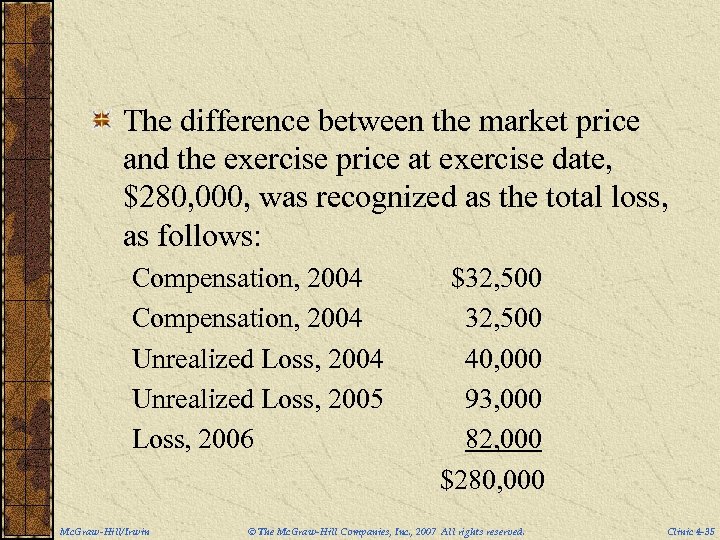 The difference between the market price and the exercise price at exercise date, $280, 000, was recognized as the total loss, as follows: Compensation, 2004 Unrealized Loss, 2005 Loss, 2006 Mc. Graw-Hill/Irwin $32, 500 40, 000 93, 000 82, 000 $280, 000 © The Mc. Graw-Hill Companies, Inc. , 2007 All rights reserved. Clinic 4 -35
 Equity Valuation and Stock Option Accounting With the shareholders in mind, the appropriate accounting is exercise date accounting. This gives the value surrendered by shareholders to compensate employees. Go to Chapter 8 of the text for the explanation. Chapter 13 shows how to correct the GAAP accounting when valuing the company. Mc. Graw-Hill/Irwin © The Mc. Graw-Hill Companies, Inc. , 2007 All rights reserved. Clinic 4 -36