 Скачать презентацию ACCOUNTABILITY IN SOUTH AFRICAN SCHOOLING General propositions
5cf27c904540b6a1d913b3c4105d879f.ppt
- Количество слайдов: 18



ACCOUNTABILITY IN SOUTH AFRICAN SCHOOLING
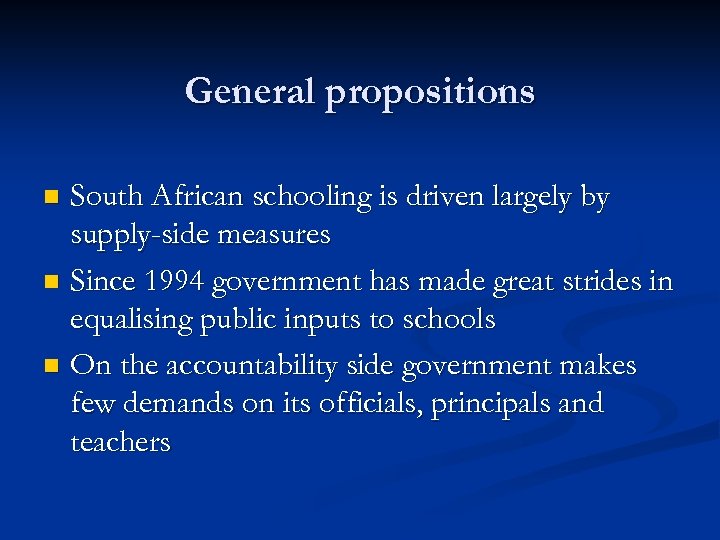
General propositions South African schooling is driven largely by supply-side measures n Since 1994 government has made great strides in equalising public inputs to schools n On the accountability side government makes few demands on its officials, principals and teachers n
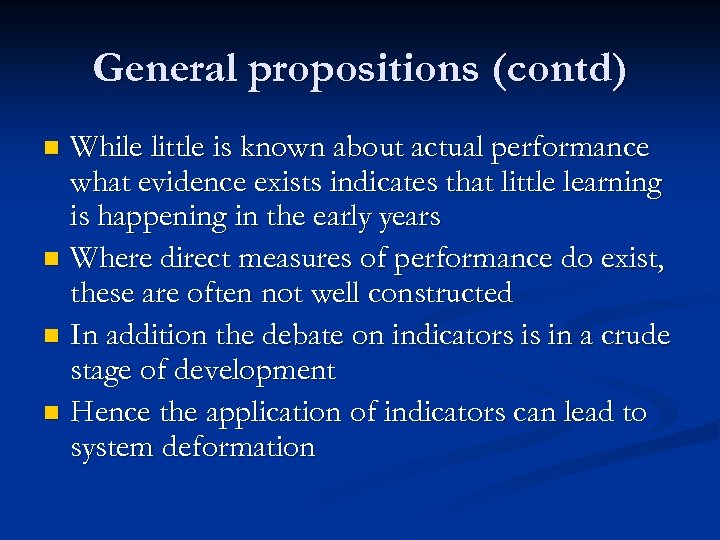
General propositions (contd) While little is known about actual performance what evidence exists indicates that little learning is happening in the early years n Where direct measures of performance do exist, these are often not well constructed n In addition the debate on indicators is in a crude stage of development n Hence the application of indicators can lead to system deformation n
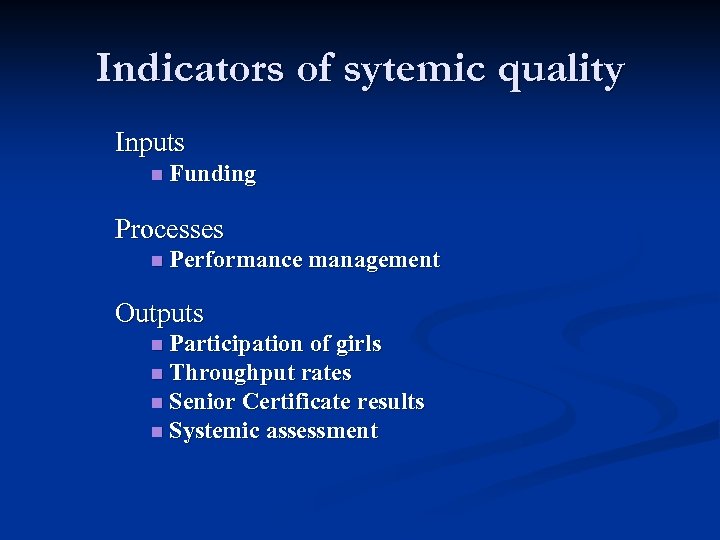
Indicators of sytemic quality Inputs n Funding Processes n Performance management Outputs n Participation of girls n Throughput rates n Senior Certificate results n Systemic assessment
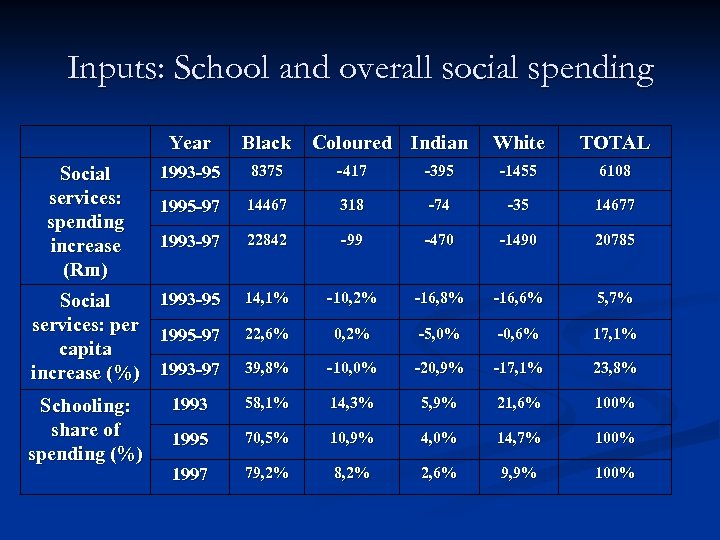
Inputs: School and overall social spending Year Black Coloured Indian White TOTAL 1993 -95 8375 -417 -395 -1455 6108 1995 -97 14467 318 -74 -35 14677 1993 -97 22842 -99 -470 -1490 20785 1993 -95 Social services: per 1995 -97 capita increase (%) 1993 -97 14, 1% -10, 2% -16, 8% -16, 6% 5, 7% 22, 6% 0, 2% -5, 0% -0, 6% 17, 1% 39, 8% -10, 0% -20, 9% -17, 1% 23, 8% 1993 58, 1% 14, 3% 5, 9% 21, 6% 100% 1995 70, 5% 10, 9% 4, 0% 14, 7% 100% 1997 79, 2% 8, 2% 2, 6% 9, 9% 100% Social services: spending increase (Rm) Schooling: share of spending (%)
Processes: performance management n n Standoff with the teacher unions has delayed the establishment of any system for 10 years This is a legacy of apartheid, where school inspection was seen as part of government surveillance In 2003 an accord was signed between Do. E and unions However, this will require a long period of development before it can have any effect on quality of schooling
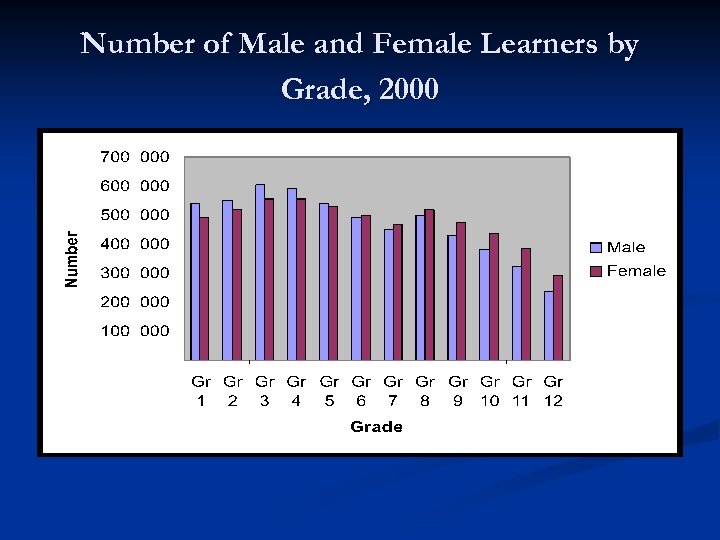
Number of Male and Female Learners by Grade, 2000
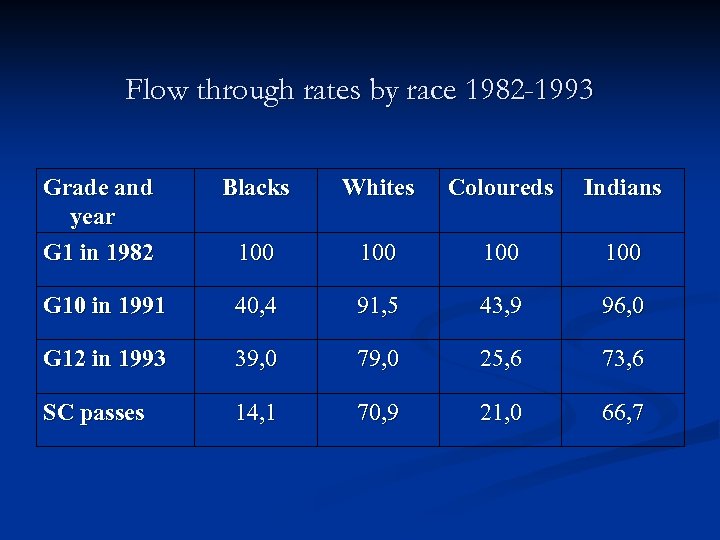
Flow through rates by race 1982 -1993 Grade and year G 1 in 1982 Blacks Whites Coloureds Indians 100 100 G 10 in 1991 40, 4 91, 5 43, 9 96, 0 G 12 in 1993 39, 0 79, 0 25, 6 73, 6 SC passes 14, 1 70, 9 21, 0 66, 7
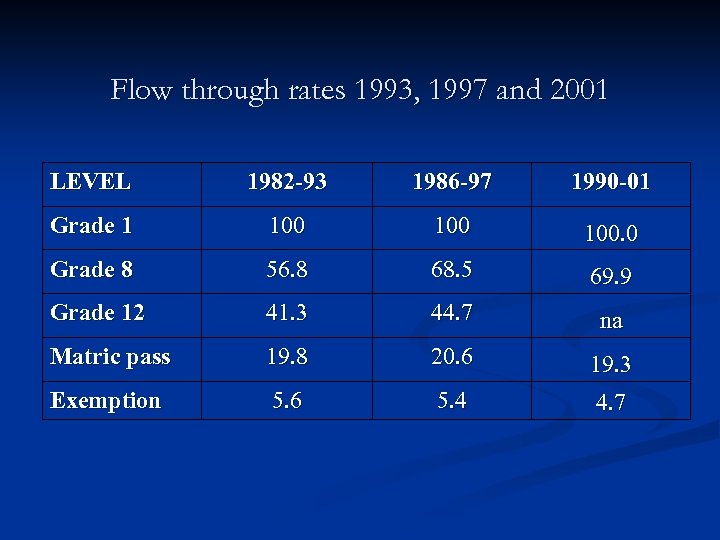
Flow through rates 1993, 1997 and 2001 LEVEL 1982 -93 1986 -97 1990 -01 Grade 1 100 100. 0 Grade 8 56. 8 68. 5 69. 9 Grade 12 41. 3 44. 7 na Matric pass 19. 8 20. 6 19. 3 Exemption 5. 6 5. 4 4. 7
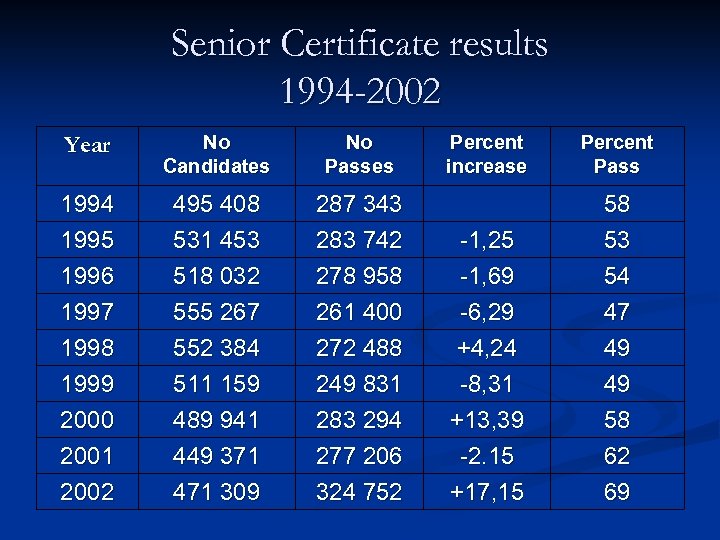
Senior Certificate results 1994 -2002 Year No Candidates No Passes 1994 1995 408 531 453 287 343 283 742 1996 1997 1998 1999 2000 2001 2002 518 032 555 267 552 384 511 159 489 941 449 371 471 309 278 958 261 400 272 488 249 831 283 294 277 206 324 752 Percent increase -1, 25 -1, 69 -6, 29 +4, 24 -8, 31 +13, 39 -2. 15 +17, 15 Percent Pass 58 53 54 47 49 49 58 62 69
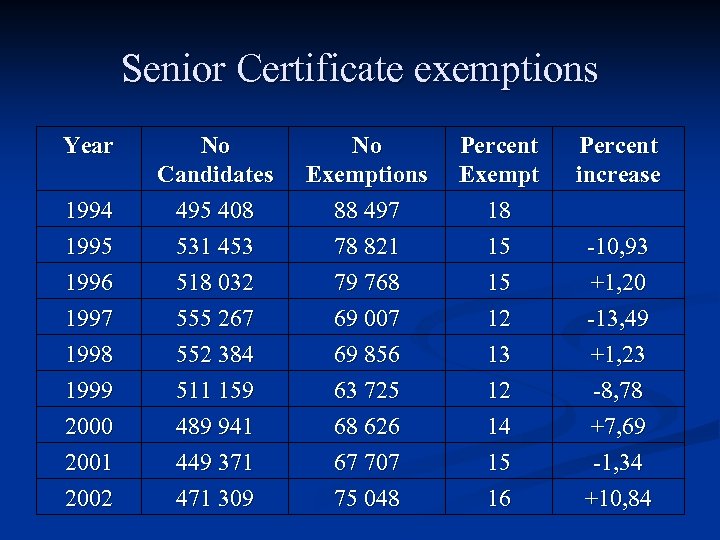
Senior Certificate exemptions Year 1994 1995 No Candidates 495 408 531 453 No Exemptions 88 497 78 821 Percent Exempt 18 15 1996 1997 1998 1999 2000 2001 2002 518 032 555 267 552 384 511 159 489 941 449 371 471 309 79 768 69 007 69 856 63 725 68 626 67 707 75 048 15 12 13 12 14 15 16 Percent increase -10, 93 +1, 20 -13, 49 +1, 23 -8, 78 +7, 69 -1, 34 +10, 84
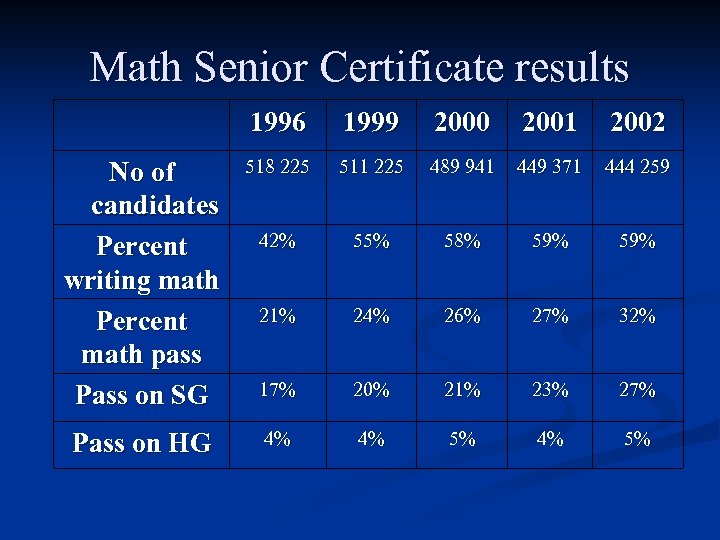
Math Senior Certificate results 1996 1999 2000 2001 2002 No of candidates Percent writing math Percent math pass Pass on SG 518 225 511 225 489 941 449 371 444 259 42% 55% 58% 59% 21% 24% 26% 27% 32% 17% 20% 21% 23% 27% Pass on HG 4% 4% 5%
Systemic assessment: Government Policy promulgated in 1998 for periodic sample testing in grades 3, 6 and 9 n A pilot was conducted in 2001, but the report was delayed for 18 months n When it was finally released at beginning of 2003 it raised more questions than it answered n WC province began administering grade 3 and 6 literacy and numeracy tests in 2002, and plans to repeat these every 2 years n
Systemic assessment: Non-Government TIMSS: 38 countries, including SA at grade 8 in 1998 n Monitoring Learning Achievement: 14 Southern African countries, including SA involved in 1995 (grade 4) and 2003 (grade 6) n
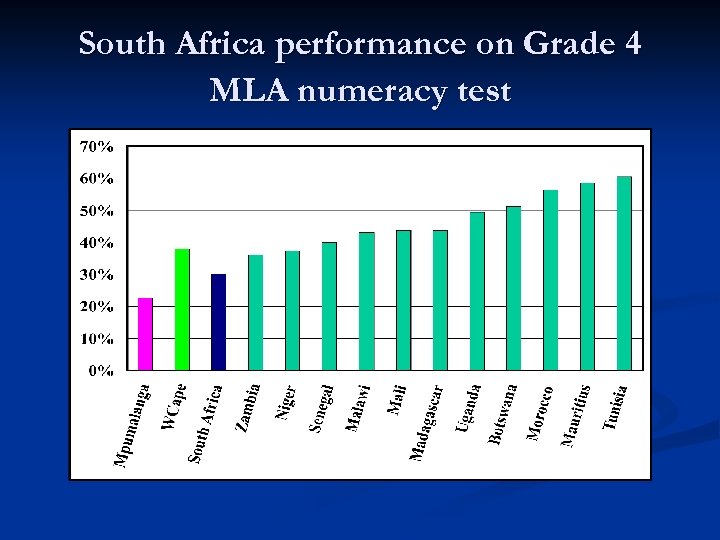
South Africa performance on Grade 4 MLA numeracy test
Systemic assessment: Non-Government JET literacy and numeracy tests for grade 3 and 6 n Commenced in 1999 n Motivated by donor need to establish baselines and track progress in school reform programmes n To date administered in over 1000 schools in 5 languages in 7 provinces n Provided the model for the WC provincial tests
Conclusion: SA What few output indicators exist show the SA school system in a poor state of health n This will not improve without greater demand from stakeholders for information n The greatest inhibitor to developing a climate of accountability is lack of government leadership n Not clear whether government tardiness is due to lack of capacity, or ideological distaste for output measures, probably both n
Conclusion: Role of Ngo sector n n Provide workable models for collecting and using information: eg test now in use in WC Which information? n Balanced picture so as not to distort system n n need info in Inputs, Process, and Outputs Within each of these categories need balance eg on Outputs need info on eg Quantity, Quality and Efficiency Balance sophistication vs ease of collection and ease of public understanding
Скачать презентацию ACCOUNTABILITY IN SOUTH AFRICAN SCHOOLING General propositions
5cf27c904540b6a1d913b3c4105d879f.ppt