


 Скачать презентацию Accomplishments and Challenges in Literature Data Mining for
6a65fe3d343bcf2c14815a918ba4a6f7.ppt
- Количество слайдов: 25
 Accomplishments and Challenges in Literature Data Mining for Biology L. Hirschman et al. Presented by Jing Jiang CS 491 CXZ Spring, 2004
 Outline l Accomplishments – – l Natural Language Processing Perspective Biomedical Applications Challenges – – Organizing A Challenge Evaluation Sample Challenge Problems: l l Extraction of Biological Pathways Automated Database Curation and Ontology Development
 Early Work: to Identify Protein Names Fukuda et al. (1998) l Challenges encountered: – – – l Long compound names Different names for the same protein Common English words as protein names Solutions proposed: – – – Uppercase letters (Src homology 2 domains) Numerals (p 54 SAP kinase) Special endings (EGF receptor)
 Recent Work: to Recognize Interactions between Proteins and Other Molecules l Statistical Approach – – l Stapley & Benoit (2000): co-occurrences of gene names to predict connections Ding et al. (2002): co-occurrences when the unit is an abstract, a sentence, or a phrase NLP Approach – – – Ng & Wong (1999): templates with linguistic structures to recognize interactions Others: extended Ng & Wong’s work All based on grammars
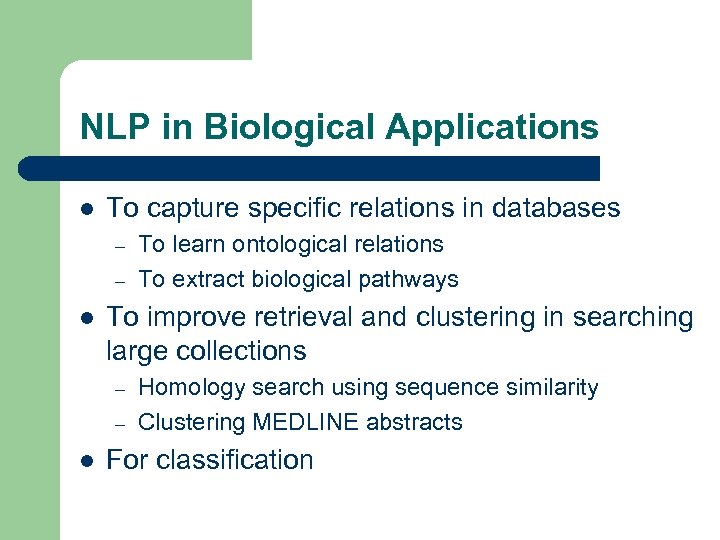 NLP in Biological Applications l To capture specific relations in databases – – l To improve retrieval and clustering in searching large collections – – l To learn ontological relations To extract biological pathways Homology search using sequence similarity Clustering MEDLINE abstracts For classification
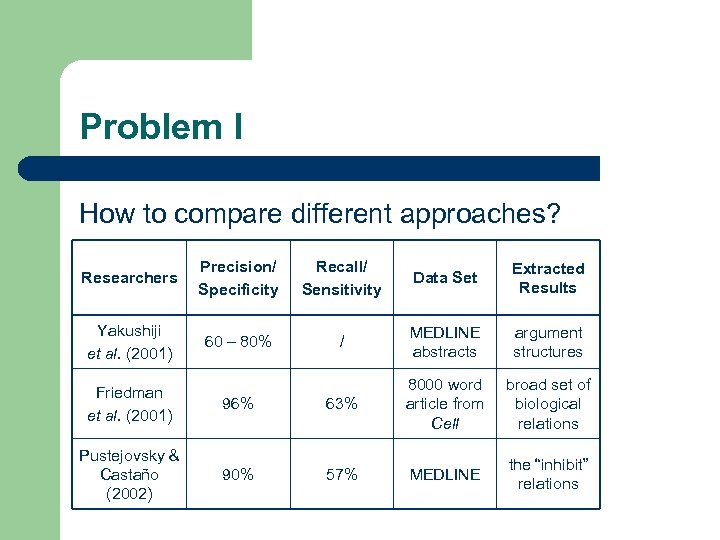 Problem I How to compare different approaches? Researchers Precision/ Specificity Recall/ Sensitivity Data Set Extracted Results Yakushiji et al. (2001) 60 – 80% / MEDLINE abstracts argument structures broad set of biological relations the “inhibit” relations Friedman et al. (2001) 96% 63% 8000 word article from Cell Pustejovsky & Castaño (2002) 90% 57% MEDLINE
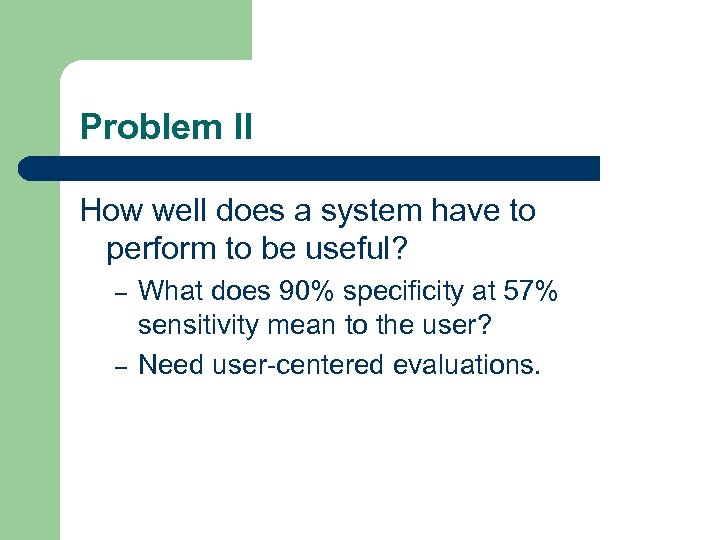 Problem II How well does a system have to perform to be useful? – – What does 90% specificity at 57% sensitivity mean to the user? Need user-centered evaluations.
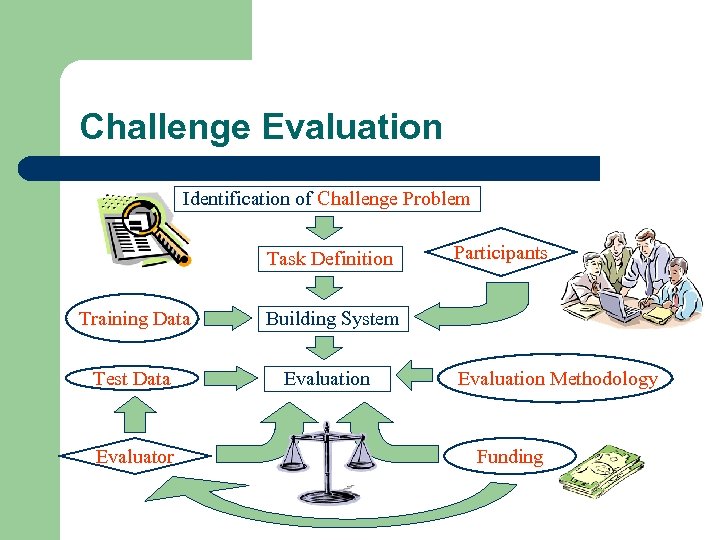 Challenge Evaluation Identification of Challenge Problem Task Definition Training Data Building System Test Data Evaluation Participants Evaluator Evaluation Methodology Funding
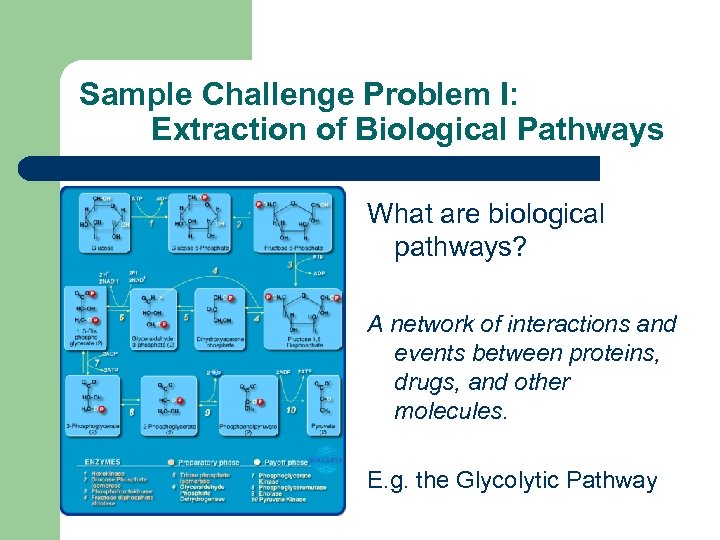 Sample Challenge Problem I: Extraction of Biological Pathways What are biological pathways? A network of interactions and events between proteins, drugs, and other molecules. E. g. the Glycolytic Pathway
 Challenge Problem Three layers of challenges: l To recognize names of proteins, drugs, and other molecules l To recognize basic interaction events between molecules l To recognize the relationships between the basic interaction events
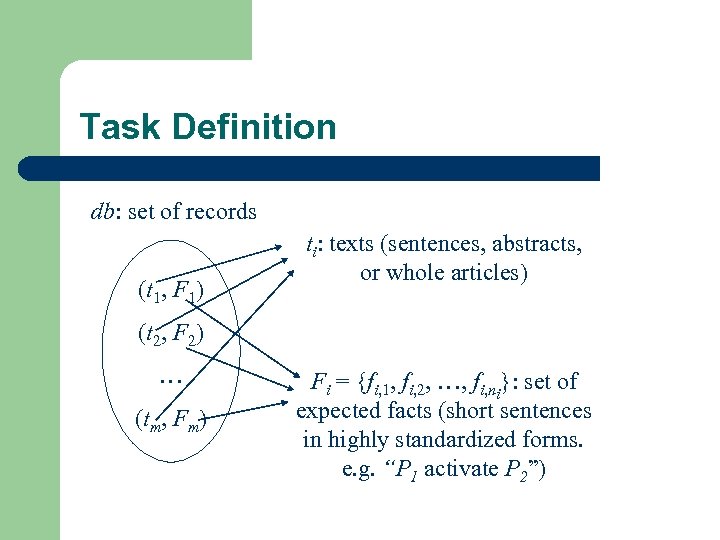 Task Definition db: set of records (t 1, F 1) ti: texts (sentences, abstracts, or whole articles) (t 2, F 2) … (tm, Fm) Fi = {fi, 1, fi, 2, …, fi, ni}: set of expected facts (short sentences in highly standardized forms. e. g. “P 1 activate P 2”)
![Evaluation Methodology recall(E) = TP(E)/[TP(E) + FN(E)] precision(E) = TP(E)/[TP(E) + FP(E)] E: information](https://present5.com/presentation/6a65fe3d343bcf2c14815a918ba4a6f7/image-12.jpg "Evaluation Methodology recall(E) = TP(E)/[TP(E) + FN(E)] precision(E) = TP(E)/[TP(E) + FP(E)] E: information") Evaluation Methodology recall(E) = TP(E)/[TP(E) + FN(E)] precision(E) = TP(E)/[TP(E) + FP(E)] E: information extractor TP: true positive FN: false negative FP: false positive
Evaluation Methodology recall(E) = TP(E)/[TP(E) + FN(E)] precision(E) = TP(E)/[TP(E) + FP(E)] E: information extractor TP: true positive FN: false negative FP: false positive
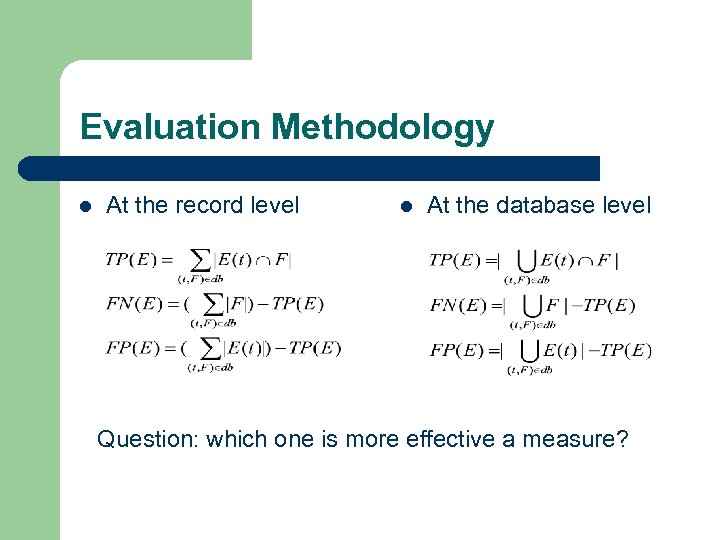 Evaluation Methodology l At the record level l At the database level Question: which one is more effective a measure?
 Test Data l Appendix of Kohn (1999) – – l 200 statements of interaction events Sentences of a fairly complex form MEDLINE abstracts on “Topoisomerase inhibitors” – – 150 – 200 new abstracts each year Less than 1000 names and less than 200 interaction events each year
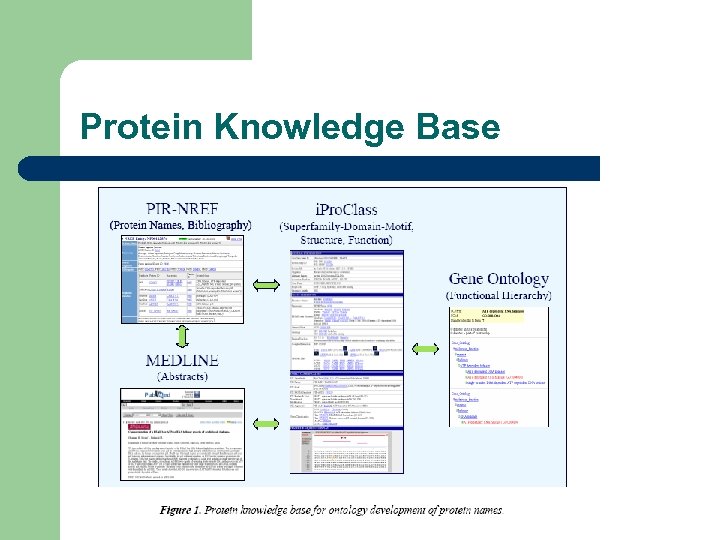
 Sample Challenge Problem II: Automated Database Curation and Ontology Development l Importance: – l The nomenclature problem for proteins: – l protein referred to by names A newly discovered protein may be named based on its functions, sequence features, gene name, cellular location, molecular weight, etc. NLP technologies in information extraction, classification and ontology induction can be applied here
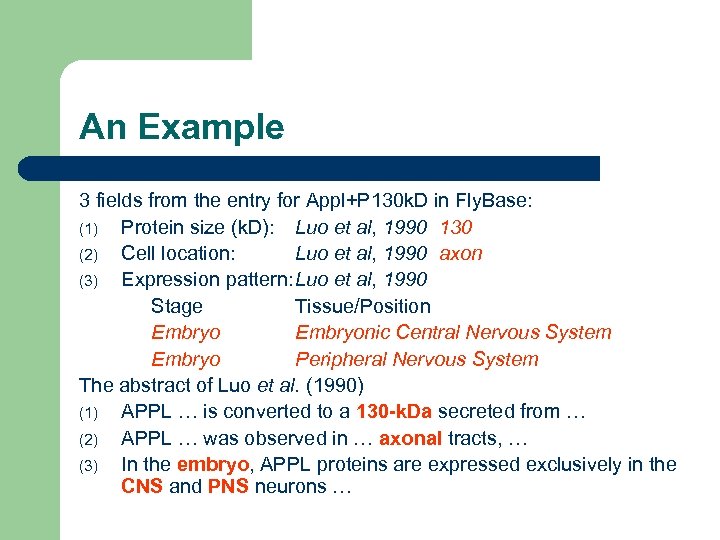 An Example 3 fields from the entry for Appl+P 130 k. D in Fly. Base: (1) Protein size (k. D): Luo et al, 1990 130 (2) Cell location: Luo et al, 1990 axon (3) Expression pattern: Luo et al, 1990 Stage Tissue/Position Embryonic Central Nervous System Embryo Peripheral Nervous System The abstract of Luo et al. (1990) (1) APPL … is converted to a 130 -k. Da secreted from … (2) APPL … was observed in … axonal tracts, … (3) In the embryo, APPL proteins are expressed exclusively in the CNS and PNS neurons …
 Knowledge Discovery and Data Mining Challenge Cup 2002 l Participants are given – – l A collection of journal articles Each labeled with genes mentioned in the article Participants are required to answer – – Does the article contain any experimental results about gene expression that should be put in the database? If so, for each gene in the article, is there experimental evidence for any transcripts (RNA), protein, or polypeptide products of that gene?
 Protein Knowledge Base
 Evaluation of Ontologies l Challenging: – l no established metric for measuring knowledge in terms of content or value Two levels: – – Intrinsic: compare terms and ontological relations discovered by the system against those found by humans Extrinsic: evaluate ontology’s usefulness in manual query expansion
 Summary Contributions of this paper: l Summarized the work done so far in the field of literature data mining for biology l Identified the important ingredients for a successful evaluation l Gave concrete evaluation examples
 End of the Talk
 Identifying Protein Names from Biological Papers (Fukuda et al. ) l Capital letters, numerical figures, and special symbols (core-terms) – – l Key-words (feature-terms) – – l Src homology (SH) 2 and SH 3 domains P 54 SAP kinase EGF receptor Ras GRPase-activating protein (GAP) IE system: – – Core-term extraction from tokenized texts Concatenation of core-terms and f-terms
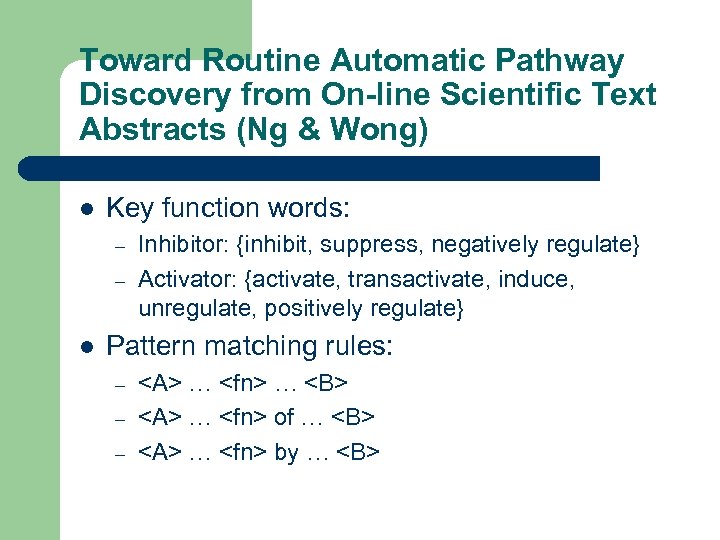 Toward Routine Automatic Pathway Discovery from On-line Scientific Text Abstracts (Ng & Wong) l Key function words: – – l Inhibitor: {inhibit, suppress, negatively regulate} Activator: {activate, transactivate, induce, unregulate, positively regulate} Pattern matching rules: – – – …
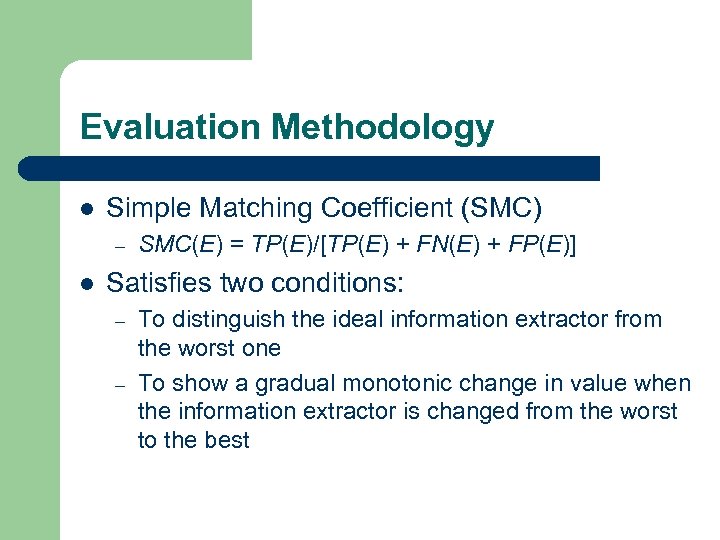 Evaluation Methodology l Simple Matching Coefficient (SMC) – l SMC(E) = TP(E)/[TP(E) + FN(E) + FP(E)] Satisfies two conditions: – – To distinguish the ideal information extractor from the worst one To show a gradual monotonic change in value when the information extractor is changed from the worst to the best
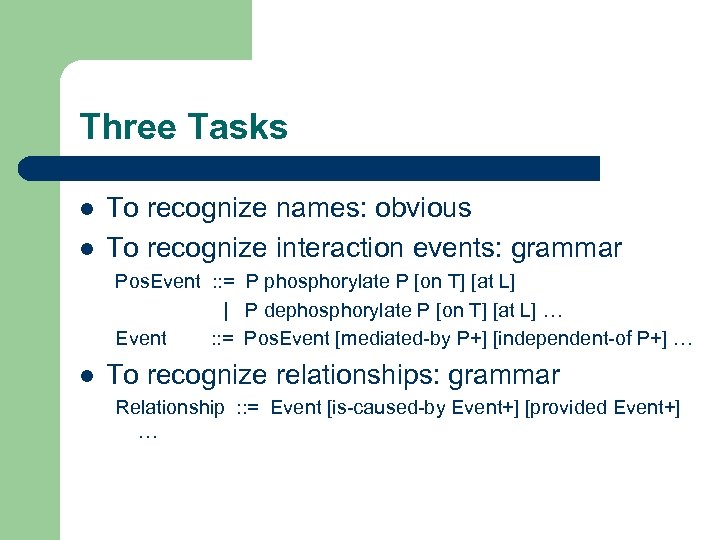 Three Tasks l l To recognize names: obvious To recognize interaction events: grammar Pos. Event : : = P phosphorylate P [on T] [at L] | P dephosphorylate P [on T] [at L] … Event : : = Pos. Event [mediated-by P+] [independent-of P+] … l To recognize relationships: grammar Relationship : : = Event [is-caused-by Event+] [provided Event+] …