 Скачать презентацию Accessing New Chemical Space through Flow-Enabled Forbidden Chemistries
60e1844dff1de18931718f2619170187.ppt
- Количество слайдов: 31



Accessing New Chemical Space through Flow-Enabled “Forbidden” Chemistries Neal Sach Senior Principal Scientist Oncology Medicinal Chemistry 10777 Science Centre Drive La Jolla, CA 92130, USA neal. sach@pfizer. com Flow Chemistry Europe 2011 Munich, Germany 28 -29 th March 2011
Contents Overview of Flow Chemistry Apparatus at Pfizer La Jolla Applications and Examples of the Conjure Segmented Flow Reactor System New Developments Towards a Convenient Micro -Scale Flow Reactor for Drug Discovery Library Synthesis
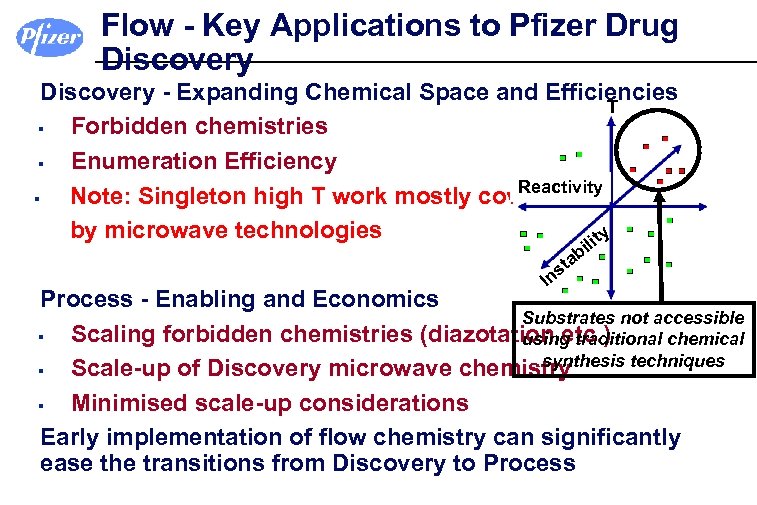
Flow - Key Applications to Pfizer Drug Discovery - Expanding Chemical Space and Efficiencies T § Forbidden chemistries § Enumeration Efficiency Reactivity § Note: Singleton high T work mostly covered by microwave technologies y lit i s In b ta Process - Enabling and Economics Substrates not accessible § Scaling forbidden chemistries (diazotation etc. ) using traditional chemical synthesis techniques § Scale-up of Discovery microwave chemistry § Minimised scale-up considerations Early implementation of flow chemistry can significantly ease the transitions from Discovery to Process
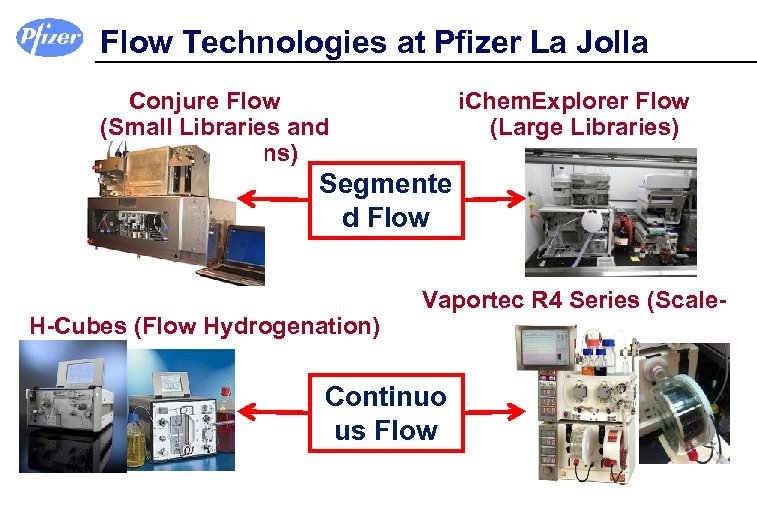
Flow Technologies at Pfizer La Jolla Conjure Flow (Small Libraries and Optimizations) i. Chem. Explorer Flow (Large Libraries) Segmente d Flow H-Cubes (Flow Hydrogenation) Vaportec R 4 Series (Scale. Up) Continuo us Flow
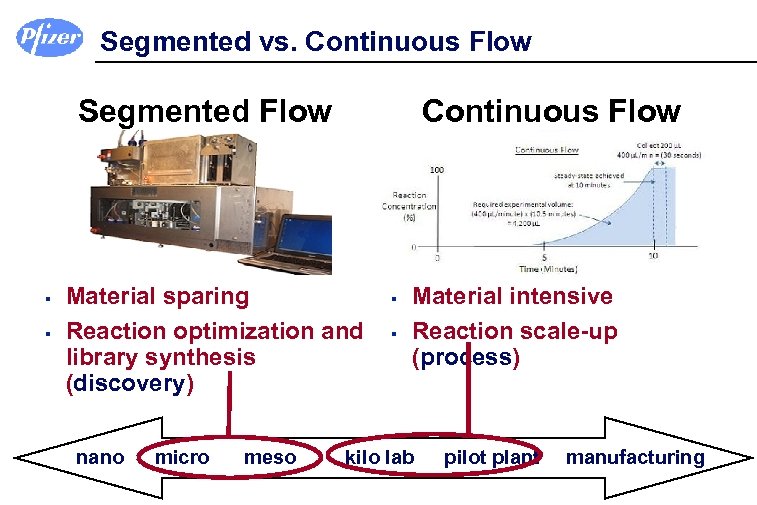
Segmented vs. Continuous Flow Segmented Flow § § Continuous Flow Material sparing Reaction optimization and library synthesis (discovery) nano micro meso § § Material intensive Reaction scale-up (process) kilo lab pilot plant manufacturing
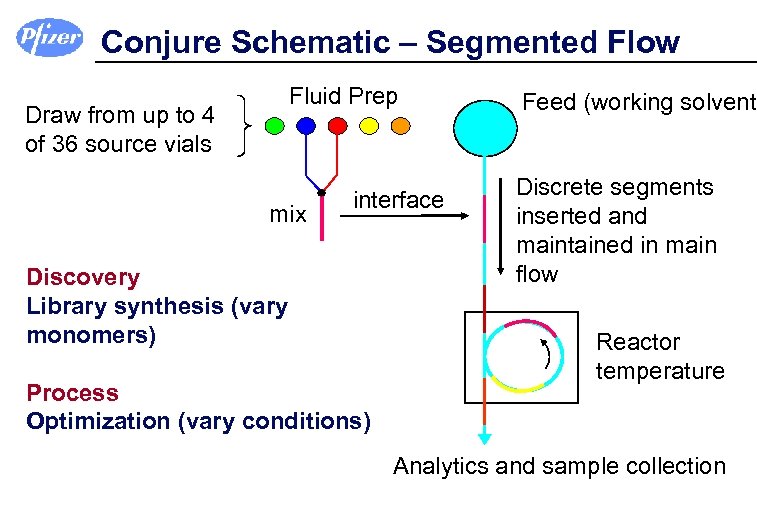
Conjure Schematic – Segmented Flow Fluid Prep Draw from up to 4 of 36 source vials mix interface Discovery Library synthesis (vary monomers) Process Optimization (vary conditions) Feed (working solvent) Discrete segments inserted and maintained in main flow Reactor temperature Analytics and sample collection
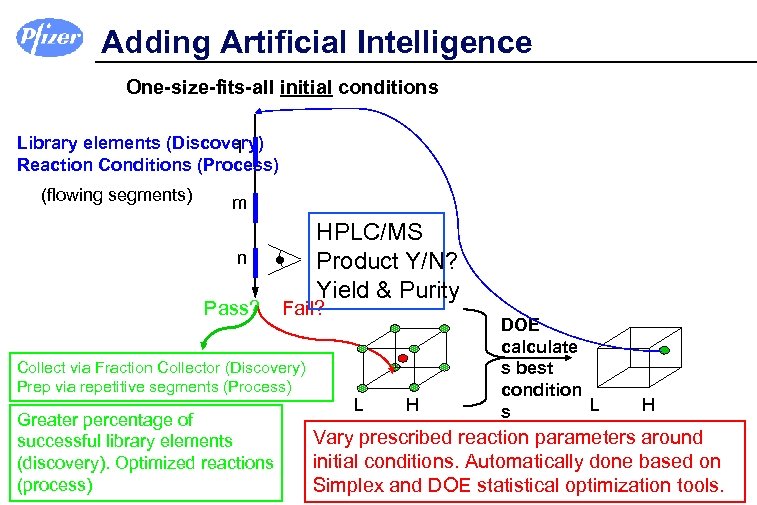
Adding Artificial Intelligence One-size-fits-all initial conditions Library elements (Discovery) l Reaction Conditions (Process) (flowing segments) m n Pass? HPLC/MS Product Y/N? Yield & Purity Fail? Collect via Fraction Collector (Discovery) Prep via repetitive segments (Process) Greater percentage of successful library elements (discovery). Optimized reactions (process) L H DOE calculate s best condition L s H Vary prescribed reaction parameters around initial conditions. Automatically done based on Simplex and DOE statistical optimization tools.
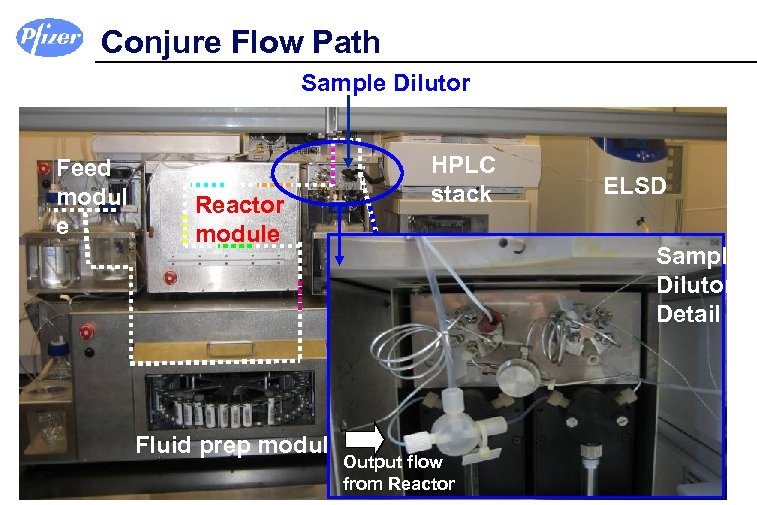
Conjure Flow Path Sample Dilutor Feed modul e Reactor module HPLC stack Sample Dilutor Detail MS Fraction collector Fluid prep module ELSD Output flow from Reactor
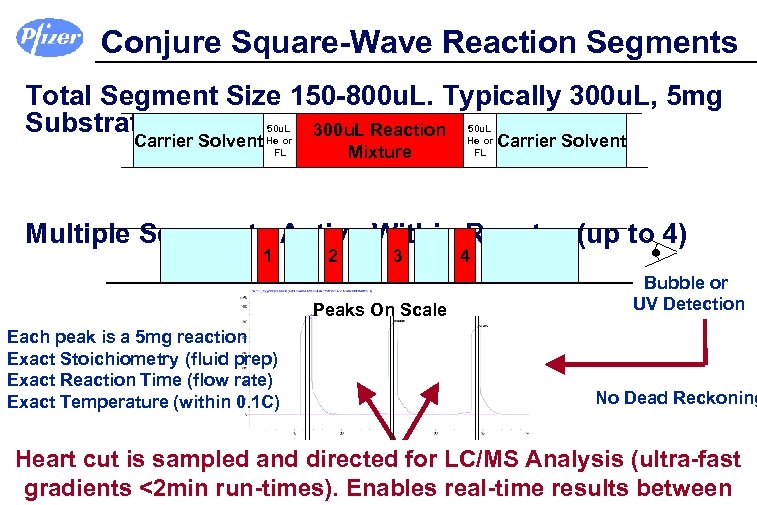
Conjure Square-Wave Reaction Segments Total Segment Size 150 -800 u. L. Typically 300 u. L, 5 mg Substrate 300 u. L Reaction 50 u. L Carrier Solvent He or Mixture FL 50 u. L He or FL Carrier Solvent Multiple Segments Active Within Reactor (up to 4) 1 2 3 Peaks On Scale Each peak is a 5 mg reaction Exact Stoichiometry (fluid prep) Exact Reaction Time (flow rate) Exact Temperature (within 0. 1 C) 4 Bubble or UV Detection No Dead Reckoning Heart cut is sampled and directed for LC/MS Analysis (ultra-fast gradients <2 min run-times). Enables real-time results between No contamination between reaction segments, key.
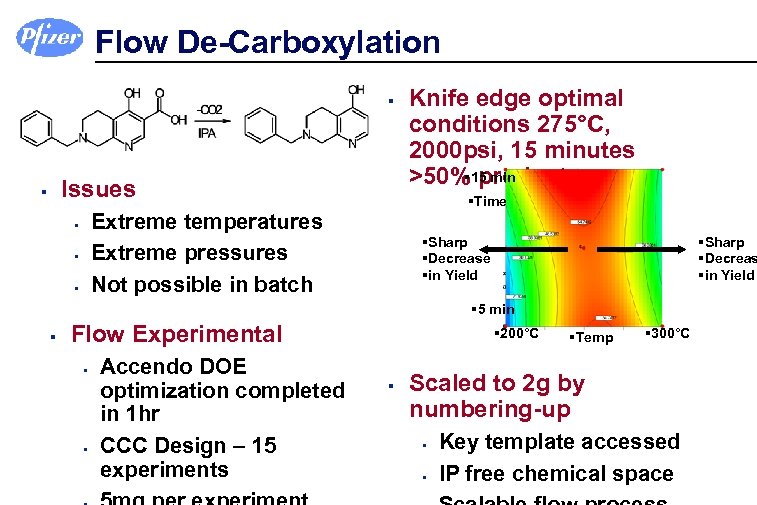
Flow De-Carboxylation § Issues § §Time Extreme temperatures Extreme pressures Not possible in batch § § § Knife edge optimal conditions 275°C, 2000 psi, 15 minutes § product >50%15 min §Sharp §Decrease §in Yield §Sharp §Decreas §in Yield § 5 min § Flow Experimental § § Accendo DOE optimization completed in 1 hr CCC Design – 15 experiments § 200°C § §Temp § 300°C Scaled to 2 g by numbering-up § § Key template accessed IP free chemical space
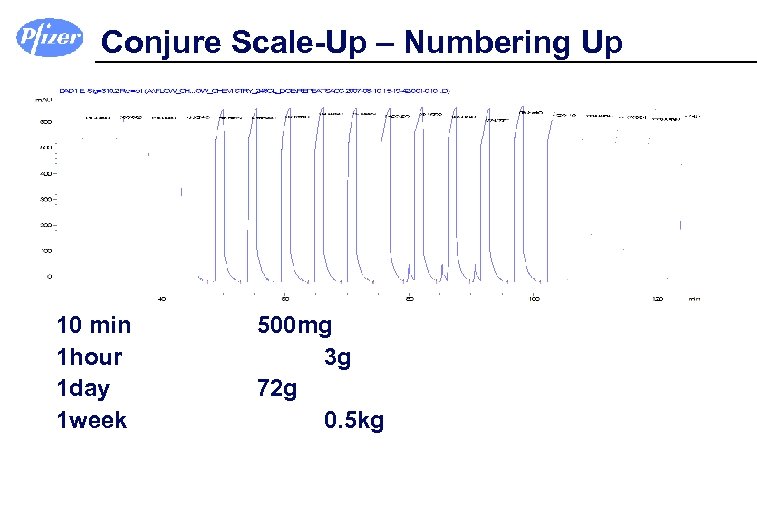
Conjure Scale-Up – Numbering Up 10 min 1 hour 1 day 1 week 500 mg 3 g 72 g 0. 5 kg
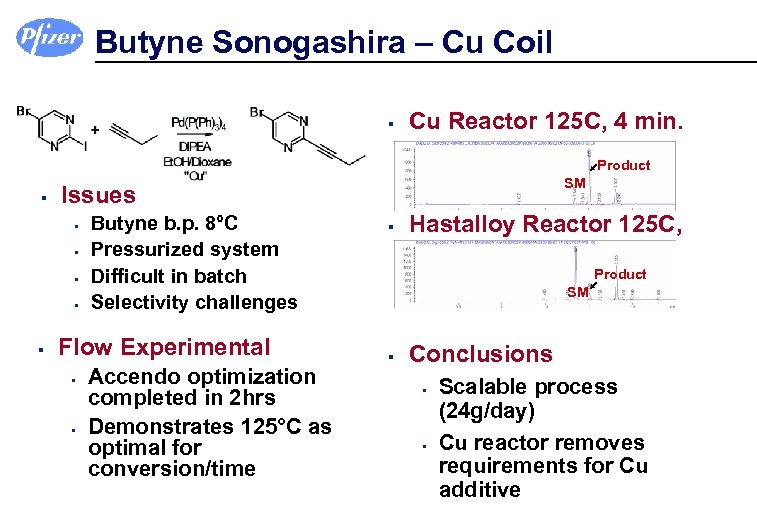
Butyne Sonogashira – Cu Coil § Cu Reactor 125 C, 4 min. Product § § § SM Issues Butyne b. p. 8°C Pressurized system Difficult in batch Selectivity challenges Flow Experimental § § Accendo optimization completed in 2 hrs Demonstrates 125°C as optimal for conversion/time § Hastalloy Reactor 125 C, 4 min. Product SM § Conclusions § § Scalable process (24 g/day) Cu reactor removes requirements for Cu additive
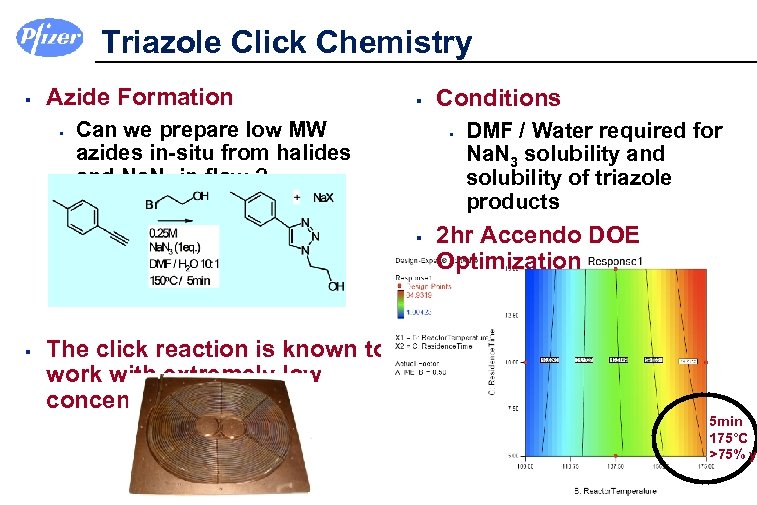
Triazole Click Chemistry § Azide Formation § § Can we prepare low MW azides in-situ from halides and Na. N 3 in flow ? § § § The click reaction is known to work with extremely low concentrations of Cu Conditions DMF / Water required for Na. N 3 solubility and solubility of triazole products 2 hr Accendo DOE Optimization 5 min 175°C >75% y
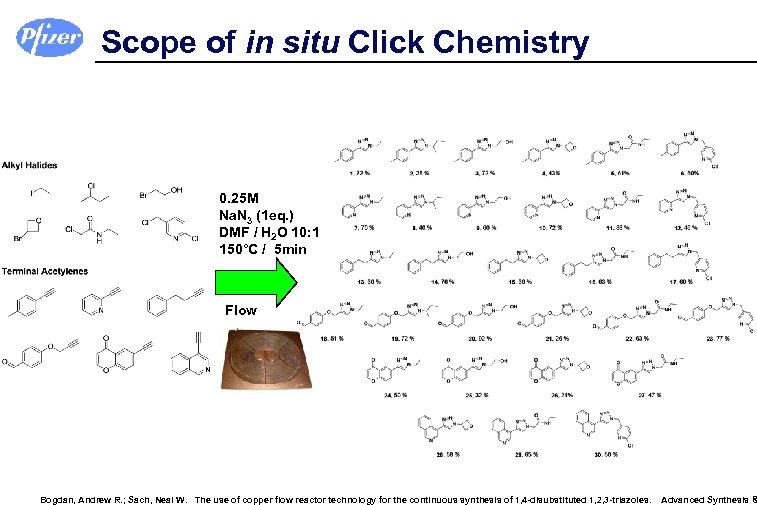
Scope of in situ Click Chemistry 0. 25 M Na. N 3 (1 eq. ) DMF / H 2 O 10: 1 150°C / 5 min Flow Bogdan, Andrew R. ; Sach, Neal W. The use of copper flow reactor technology for the continuous synthesis of 1, 4 -disubstituted 1, 2, 3 -triazoles. Advanced Synthesis &
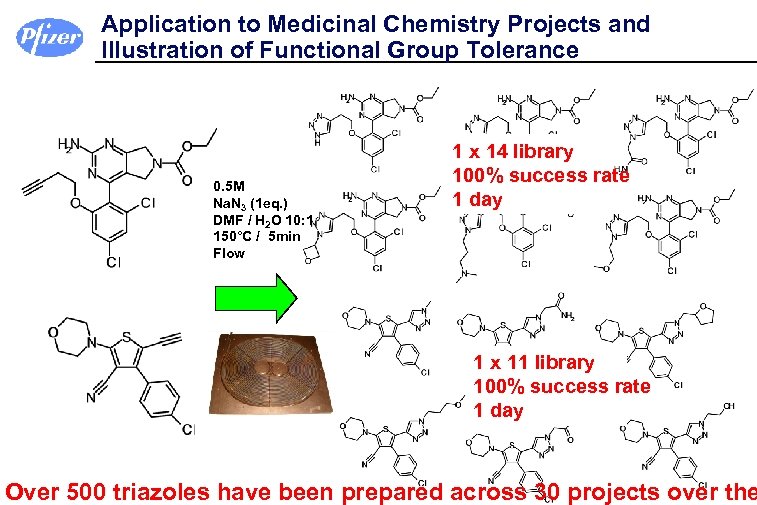
Application to Medicinal Chemistry Projects and Illustration of Functional Group Tolerance 0. 5 M Na. N 3 (1 eq. ) DMF / H 2 O 10: 1 150°C / 5 min Flow 1 x 14 library 100% success rate 1 day 1 x 11 library 100% success rate 1 day Over 500 triazoles have been prepared across 30 projects over the
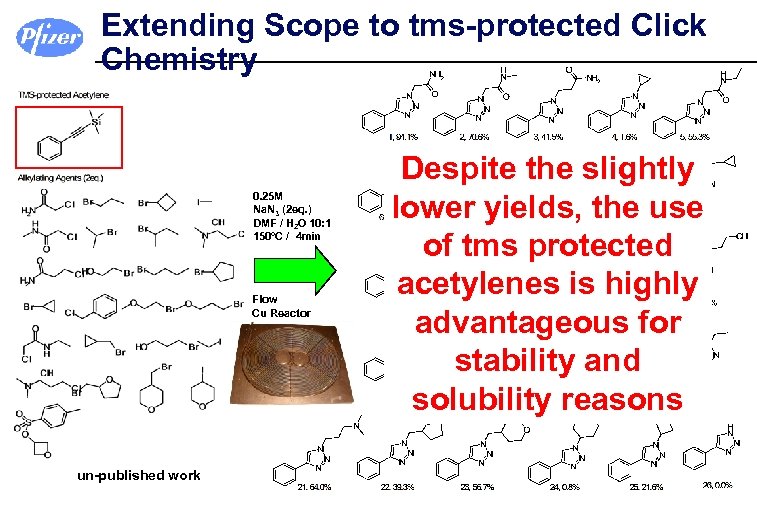
Extending Scope to tms-protected Click Chemistry 0. 25 M Na. N 3 (2 eq. ) DMF / H 2 O 10: 1 150°C / 4 min Flow Cu Reactor un-published work Despite the slightly lower yields, the use of tms protected acetylenes is highly advantageous for stability and solubility reasons
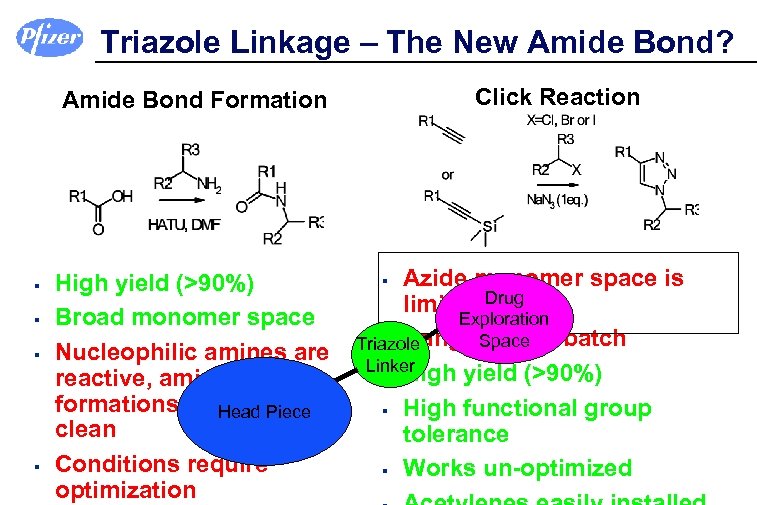
Triazole Linkage – The New Amide Bond? Amide Bond Formation § § Click Reaction § Azide monomer space is High yield (>90%) limited Drug Broad monomer space Exploration § Dangerous in batch Space Nucleophilic amines are Triazole Linker § High yield (>90%) reactive, amide bond formations are. Head Piece not always § High functional group clean tolerance Conditions require § Works un-optimized optimization
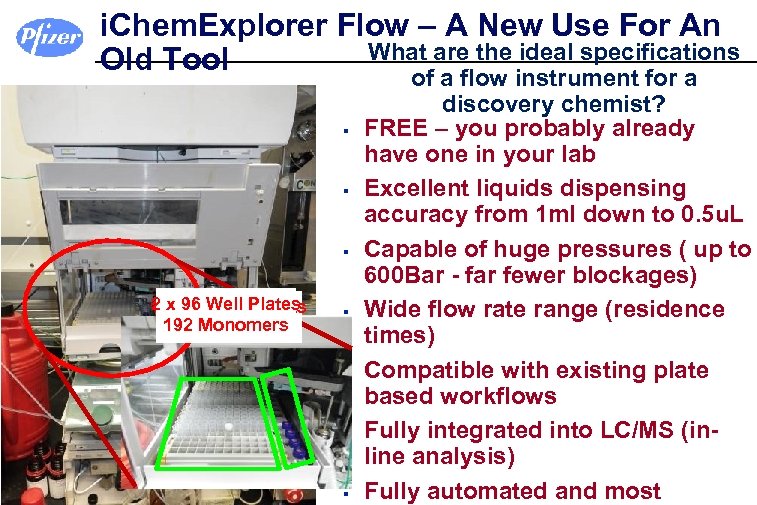
i. Chem. Explorer Flow – A New Use For An What are the ideal specifications Old Tool § § § 2 x 96 Well Plates 10 x 2 ml Reagents 192 Monomers and Templates 2 x 96 -well Monomers Plates § § of a flow instrument for a discovery chemist? FREE – you probably already have one in your lab Excellent liquids dispensing accuracy from 1 ml down to 0. 5 u. L Capable of huge pressures ( up to 600 Bar - far fewer blockages) Wide flow rate range (residence times) Compatible with existing plate based workflows Fully integrated into LC/MS (inline analysis) Fully automated and most
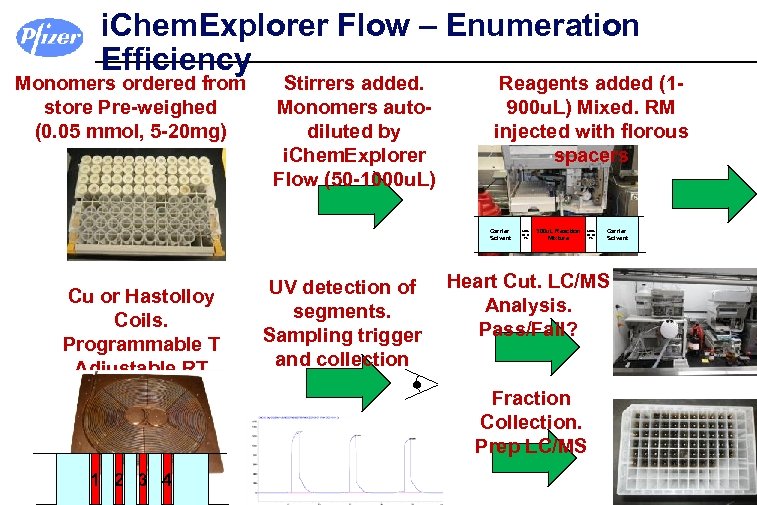
i. Chem. Explorer Flow – Enumeration Efficiency Monomers ordered from store Pre-weighed (0. 05 mmol, 5 -20 mg) Stirrers added. Monomers autodiluted by i. Chem. Explorer Flow (50 -1000 u. L) Reagents added (1900 u. L) Mixed. RM injected with florous spacers Carrier Solvent Cu or Hastolloy Coils. Programmable T Adjustable RT UV detection of segments. Sampling trigger and collection 50 u. L He or FL 300 u. L Reaction Mixture 50 u. L He or FL Heart Cut. LC/MS Analysis. Pass/Fail? Fraction Collection. Prep LC/MS 1 2 3 4 Carrier Solvent
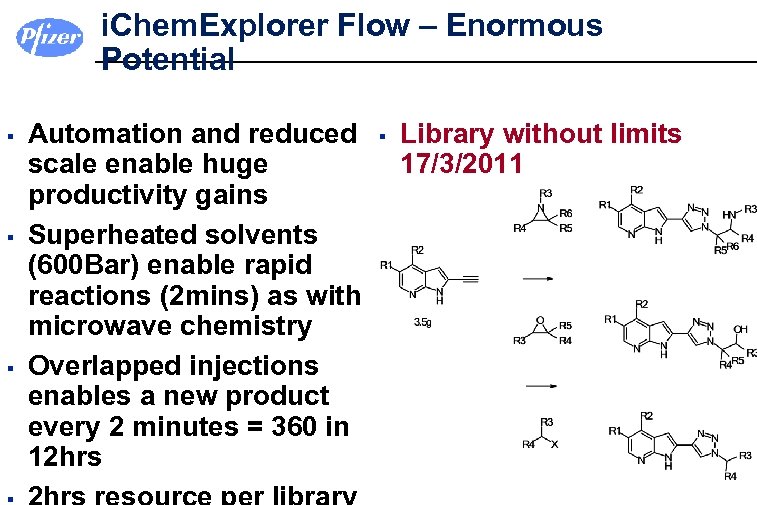
i. Chem. Explorer Flow – Enormous Potential § § § Automation and reduced scale enable huge productivity gains Superheated solvents (600 Bar) enable rapid reactions (2 mins) as with microwave chemistry Overlapped injections enables a new product every 2 minutes = 360 in 12 hrs § Library without limits 17/3/2011
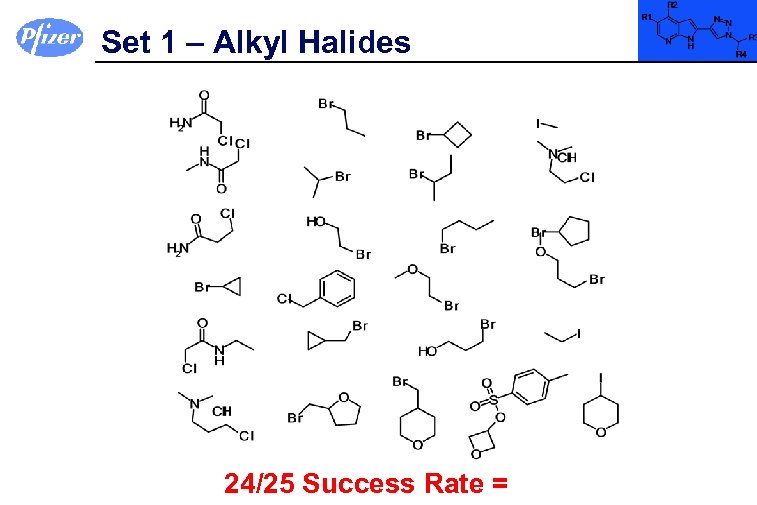
Set 1 – Alkyl Halides 24/25 Success Rate =
Set 2 – Alkyl Halides 40/46 Success Rate =
Set 3 – Epoxides 30/47 Success Rate =
Set 4 – Aziridines 9/14 Success Rate =
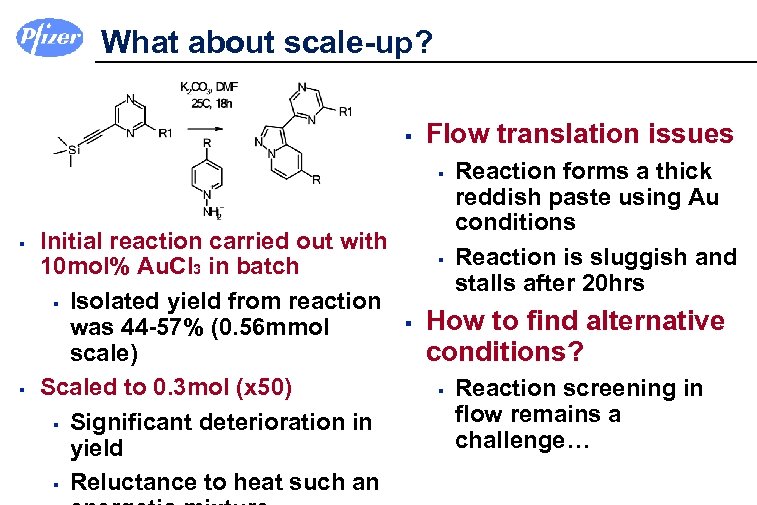
What about scale-up? § Flow translation issues § § § Initial reaction carried out with 10 mol% Au. Cl 3 in batch § Isolated yield from reaction was 44 -57% (0. 56 mmol scale) Scaled to 0. 3 mol (x 50) § Significant deterioration in yield § Reluctance to heat such an § § Reaction forms a thick reddish paste using Au conditions Reaction is sluggish and stalls after 20 hrs How to find alternative conditions? § Reaction screening in flow remains a challenge…
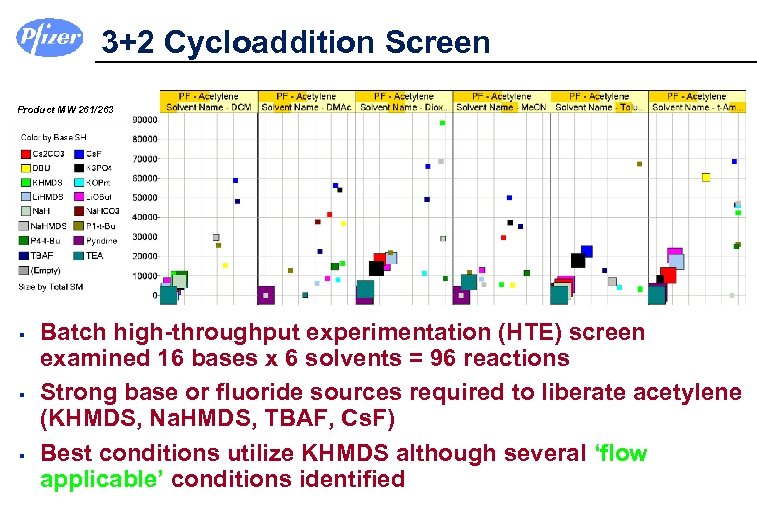
3+2 Cycloaddition Screen Product MW 261/263 § § § Batch high-throughput experimentation (HTE) screen examined 16 bases x 6 solvents = 96 reactions Strong base or fluoride sources required to liberate acetylene (KHMDS, Na. HMDS, TBAF, Cs. F) Best conditions utilize KHMDS although several ‘flow applicable’ conditions identified
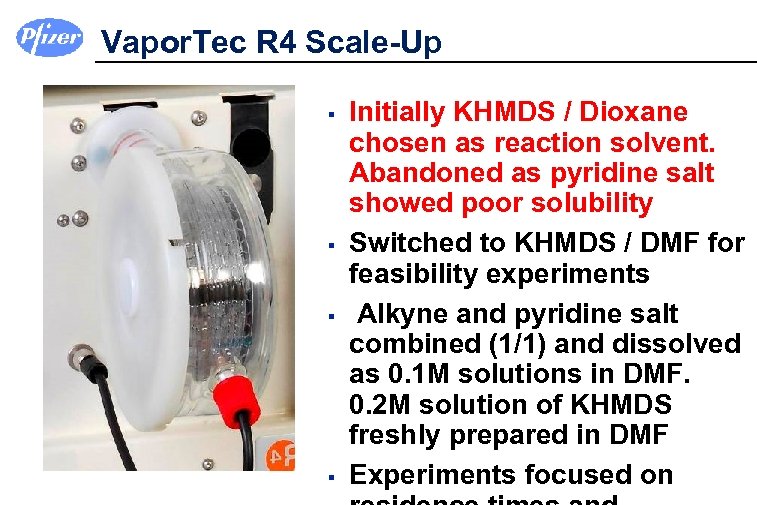
Vapor. Tec R 4 Scale-Up § § Initially KHMDS / Dioxane chosen as reaction solvent. Abandoned as pyridine salt showed poor solubility Switched to KHMDS / DMF for feasibility experiments Alkyne and pyridine salt combined (1/1) and dissolved as 0. 1 M solutions in DMF. 0. 2 M solution of KHMDS freshly prepared in DMF Experiments focused on
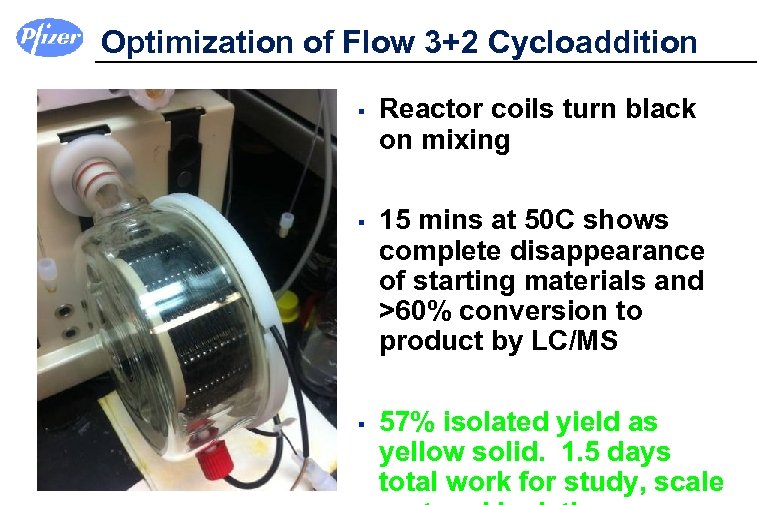
Optimization of Flow 3+2 Cycloaddition § § § Reactor coils turn black on mixing 15 mins at 50 C shows complete disappearance of starting materials and >60% conversion to product by LC/MS 57% isolated yield as yellow solid. 1. 5 days total work for study, scale
Conclusions Two bulk-sparing segmented flow reactors have been presented that are ideal for discovery chemistry applications -: § For accessing novel chemical space ‘safely’ through forbidden chemistries via minioptimization studies on a singleton basis (up to 5 g) § The automated enumeration of a huge click library through the modification of a common laboratory HPLC system The scale-up of a potentially un-safe batch reaction using the Vaportec R 4 in collaboration
Acknowledgements § Technology § Joel Hawkins § Jan Hughes (Accendo) § Terry Long (Accendo) § Kristin Price § Larry Truesdale § Chemistry § Angie Li § Andrew Bogdan (Cornell) § Valery Folkin (Scripps) § Jason Hein (Scripps) § Peter Huang § Kevin Bunker § Paul Richardson § Bryan Li
Questions Contact Neal Sach at Pfizer Inc, La Jolla, CA at neal. sach@pfizer. com
Скачать презентацию Accessing New Chemical Space through Flow-Enabled Forbidden Chemistries
60e1844dff1de18931718f2619170187.ppt