 Скачать презентацию Accessing Credit Ratings for Development of Sub-National Governments
a16309f822e3541f92e11209c7910cf5.ppt
- Количество слайдов: 30



Accessing Credit Ratings for Development of Sub-National Governments of Nigeria World Bank Engagement with Sub. National Entities ABUJA, NIGERIA March 2009 STEVEN DIMITRIYEV Senior Finance and Private Sector Development Specialist Nigeria Country Office Email: SDimitriyev@worldbank. org
Political and fiscal decentralization § Deepening of “DEMOCRATIZATION” pushes “DECENTRALIZATION” v transfers taxing authority as well as investment responsibilities to local governments. v makes local public officials and administrations accountable for public service provision (infrastructure as well as social services). § Today, 60% to 70% of infrastructure services in developing countries is provided at the sub-national level (by local governments or utilities) /1. /1 PIDG, November 9 th, 2006 World Bank staff estimates
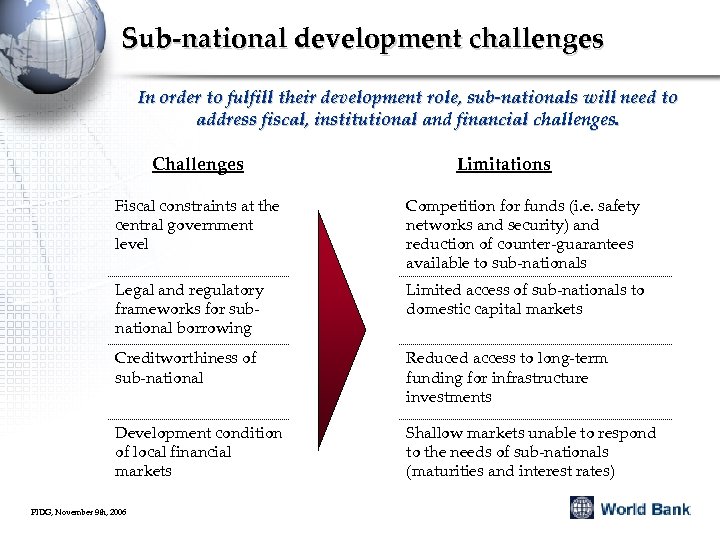
Sub-national development challenges In order to fulfill their development role, sub-nationals will need to address fiscal, institutional and financial challenges. Challenges Limitations Fiscal constraints at the central government level Competition for funds (i. e. safety networks and security) and reduction of counter-guarantees available to sub-nationals Legal and regulatory frameworks for subnational borrowing Limited access of sub-nationals to domestic capital markets Creditworthiness of sub-national Reduced access to long-term funding for infrastructure investments Development condition of local financial markets Shallow markets unable to respond to the needs of sub-nationals (maturities and interest rates) PIDG, November 9 th, 2006
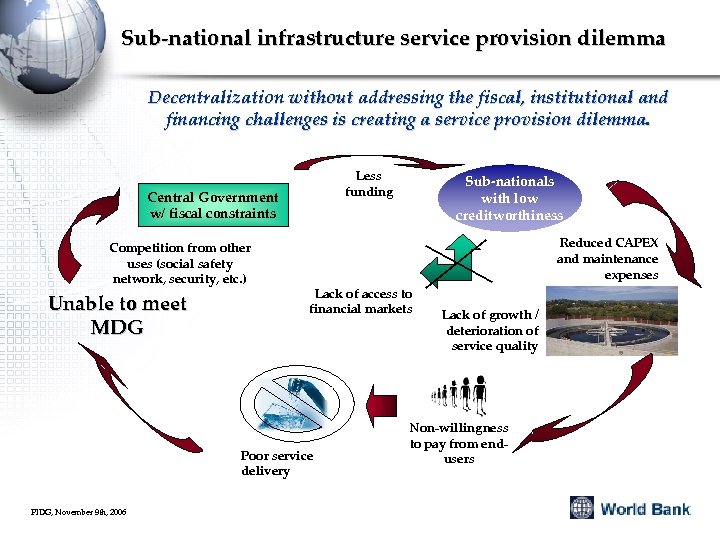
Sub-national infrastructure service provision dilemma Decentralization without addressing the fiscal, institutional and financing challenges is creating a service provision dilemma. Less funding Central Government w/ fiscal constraints Competition from other uses (social safety network, security, etc. ) Unable to meet MDG Reduced CAPEX and maintenance expenses Lack of access to financial markets Poor service delivery PIDG, November 9 th, 2006 Sub-nationals with low creditworthiness Lack of growth / deterioration of service quality Non-willingness to pay from endusers
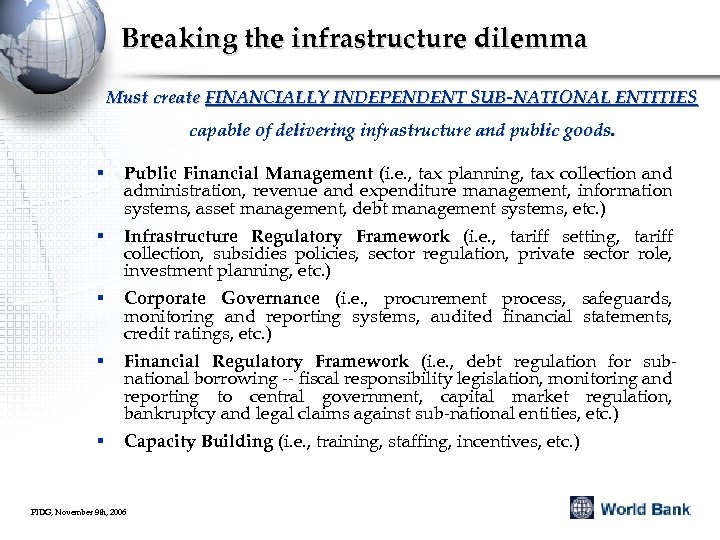
Breaking the infrastructure dilemma Must create FINANCIALLY INDEPENDENT SUB-NATIONAL ENTITIES capable of delivering infrastructure and public goods. § Public Financial Management (i. e. , tax planning, tax collection and administration, revenue and expenditure management, information systems, asset management, debt management systems, etc. ) § Infrastructure Regulatory Framework (i. e. , tariff setting, tariff collection, subsidies policies, sector regulation, private sector role, investment planning, etc. ) § Corporate Governance (i. e. , procurement process, safeguards, monitoring and reporting systems, audited financial statements, credit ratings, etc. ) § Financial Regulatory Framework (i. e. , debt regulation for subnational borrowing -- fiscal responsibility legislation, monitoring and reporting to central government, capital market regulation, bankruptcy and legal claims against sub-national entities, etc. ) § Capacity Building (i. e. , training, staffing, incentives, etc. ) PIDG, November 9 th, 2006
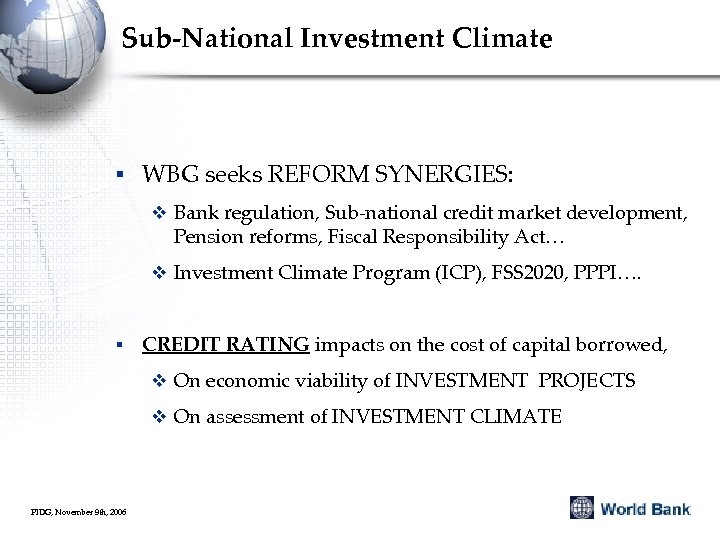
Sub-National Investment Climate § WBG seeks REFORM SYNERGIES: v Bank regulation, Sub-national credit market development, Pension reforms, Fiscal Responsibility Act… v Investment Climate Program (ICP), FSS 2020, PPPI…. § CREDIT RATING impacts on the cost of capital borrowed, v On economic viability of INVESTMENT PROJECTS v On assessment of INVESTMENT CLIMATE PIDG, November 9 th, 2006
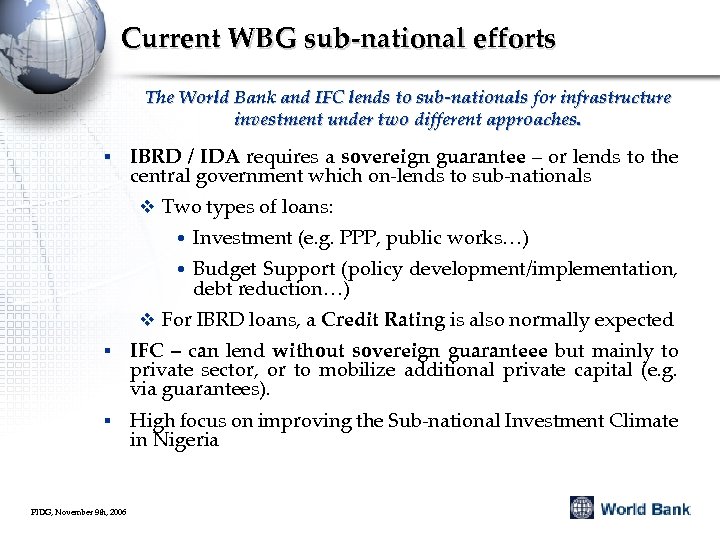
Current WBG sub-national efforts The World Bank and IFC lends to sub-nationals for infrastructure investment under two different approaches. § IBRD / IDA requires a sovereign guarantee – or lends to the central government which on-lends to sub-nationals v Two types of loans: • Investment (e. g. PPP, public works…) • Budget Support (policy development/implementation, debt reduction…) v For IBRD loans, a Credit Rating is also normally expected § IFC – can lend without sovereign guaranteee but mainly to private sector, or to mobilize additional private capital (e. g. via guarantees). § High focus on improving the Sub-national Investment Climate in Nigeria PIDG, November 9 th, 2006
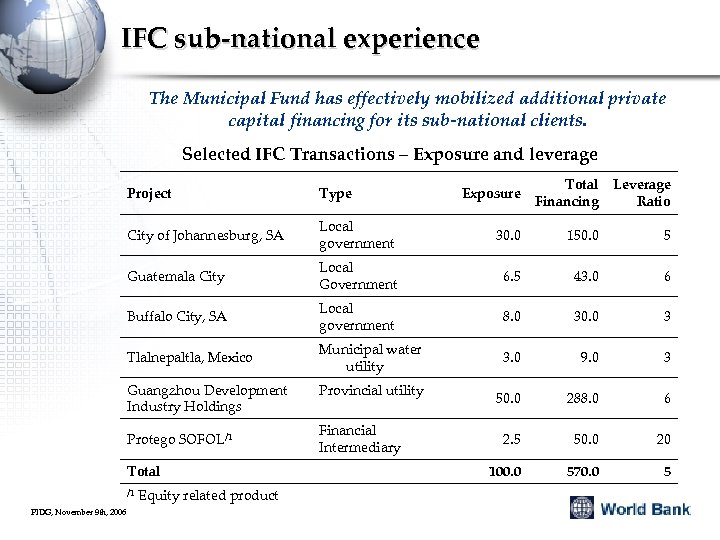
IFC sub-national experience The Municipal Fund has effectively mobilized additional private capital financing for its sub-national clients. Selected IFC Transactions – Exposure and leverage Exposure Total Financing Leverage Ratio Local government 30. 0 150. 0 5 Guatemala City Local Government 6. 5 43. 0 6 Buffalo City, SA Local government 8. 0 30. 0 3 Tlalnepaltla, Mexico Municipal water utility 3. 0 9. 0 3 50. 0 288. 0 6 2. 5 50. 0 20 100. 0 570. 0 5 Project Type City of Johannesburg, SA Guangzhou Development Industry Holdings Protego SOFOL/1 Total /1 PIDG, November 9 th, 2006 Equity related product Provincial utility Financial Intermediary
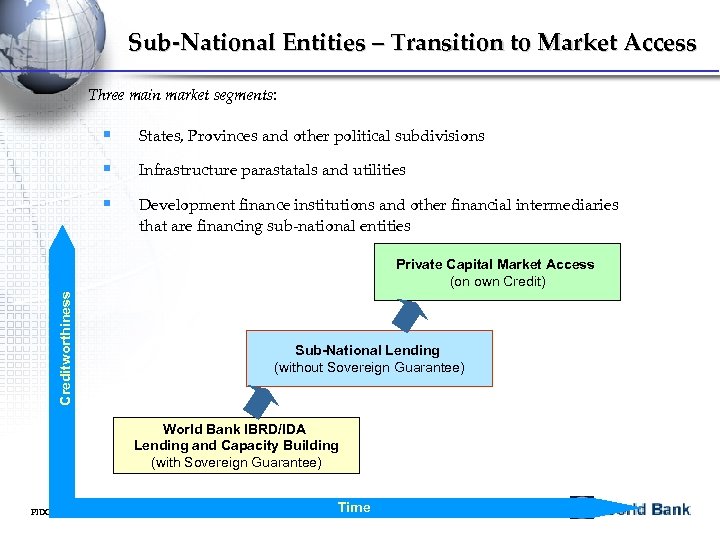
Sub-National Entities – Transition to Market Access Three main market segments: § States, Provinces and other political subdivisions § Infrastructure parastatals and utilities § Development finance institutions and other financial intermediaries that are financing sub-national entities Creditworthiness Private Capital Market Access (on own Credit) Sub-National Lending (without Sovereign Guarantee) World Bank IBRD/IDA Lending and Capacity Building (with Sovereign Guarantee) PIDG, November 9 th, 2006 Time
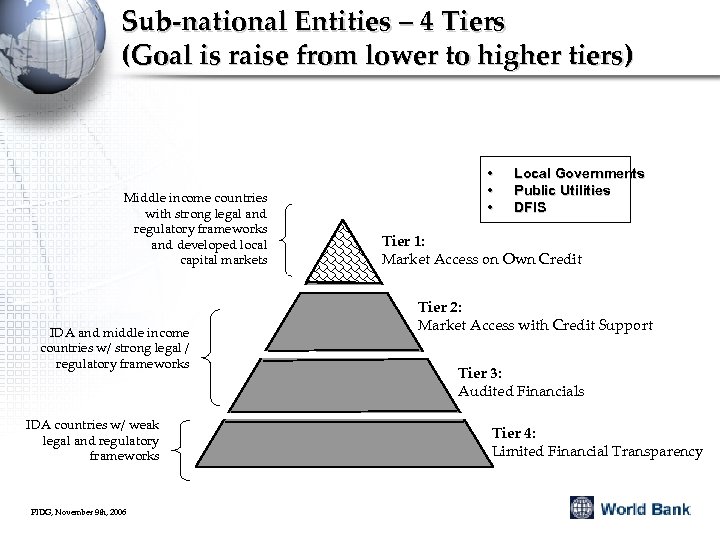
Sub-national Entities – 4 Tiers (Goal is raise from lower to higher tiers) Middle income countries with strong legal and regulatory frameworks and developed local capital markets IDA and middle income countries w/ strong legal / regulatory frameworks IDA countries w/ weak legal and regulatory frameworks PIDG, November 9 th, 2006 • • • Local Governments Public Utilities DFIS Tier 1: Market Access on Own Credit Tier 2: Market Access with Credit Support Tier 3: Audited Financials Tier 4: Limited Financial Transparency
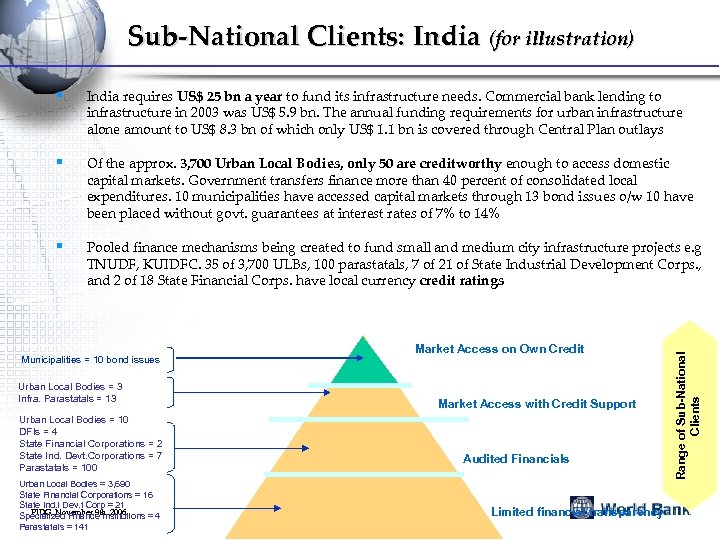
Sub-National Clients: India (for illustration) India requires US$ 25 bn a year to fund its infrastructure needs. Commercial bank lending to infrastructure in 2003 was US$ 5. 9 bn. The annual funding requirements for urban infrastructure alone amount to US$ 8. 3 bn of which only US$ 1. 1 bn is covered through Central Plan outlays § Of the approx. 3, 700 Urban Local Bodies, only 50 are creditworthy enough to access domestic capital markets. Government transfers finance more than 40 percent of consolidated local expenditures. 10 municipalities have accessed capital markets through 13 bond issues o/w 10 have been placed without govt. guarantees at interest rates of 7% to 14% § Pooled finance mechanisms being created to fund small and medium city infrastructure projects e. g TNUDF, KUIDFC. 35 of 3, 700 ULBs, 100 parastatals, 7 of 21 of State Industrial Development Corps. , and 2 of 18 State Financial Corps. have local currency credit ratings Municipalities = 10 bond issues Urban Local Bodies = 3 Infra. Parastatals = 13 Urban Local Bodies = 10 DFIs = 4 State Financial Corporations = 2 State Ind. Devt. Corporations = 7 Parastatals = 100 Urban Local Bodies = 3, 690 State Financial Corporations = 16 State Ind. l Dev. t Corp = 21 PIDG, November 9 th, 2006 Specialized Finance Institutions = 4 Parastatals = 141 Market Access on Own Credit Market Access with Credit Support Audited Financials Limited financial transparency Range of Sub-National Clients §
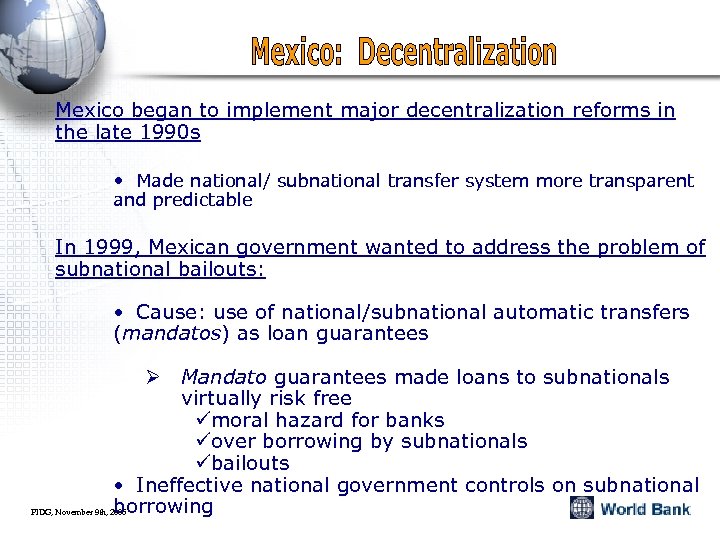
Mexico began to implement major decentralization reforms in the late 1990 s • Made national/ subnational transfer system more transparent and predictable In 1999, Mexican government wanted to address the problem of subnational bailouts: • Cause: use of national/subnational automatic transfers (mandatos) as loan guarantees Ø Mandato guarantees made loans to subnationals virtually risk free ümoral hazard for banks üover borrowing by subnationals übailouts • Ineffective national government controls on subnational borrowing PIDG, November 9 th, 2006
To address these issues, the Mexican Government asked for assistance in developing a market based system • This led to the World Bank’s Decentralization Adjustment Loan of about US$600 million • Dexia Credit Local participated in the loan’s preparation Ø Focus on modernizing the regulatory framework for subnational lending Some key reforms: • Elimination of the mandatos • Requirement for credit ratings for all subnationals for bank borrowing PIDG, November 9 th, 2006
The credit ratings revealed that there are many creditworthy borrowers at the subnational level • 30 out of 31 states are already rated by S&P, Moody’s or Fitch (29 above investment grade on the local scale) • Over 60 municipalities and decentralized entities already been rated ØOf a total of 75 states and municipalities rated by S & P, 50 received a rating of A or above on the local scale Ratings have also created a healthy competition among states and municipalities • Mayors and governors pride themselves on having better ratings PIDG, November 9 th, 2006
Demand for local currency, fixed-income paper growing rapidly due to: • Macroeconomic stability • Mutual funds • Pension reform of 1997 The 1997 pension reform created the private managers of mandatory pension funds: Afores • In five years, these Afores: ØHave accumulated assets in excess of 8% of GDP (US$34 billion as of April 2003) ØAre expected to reach 20% of GDP by 2015 PIDG, November 9 th, 2006
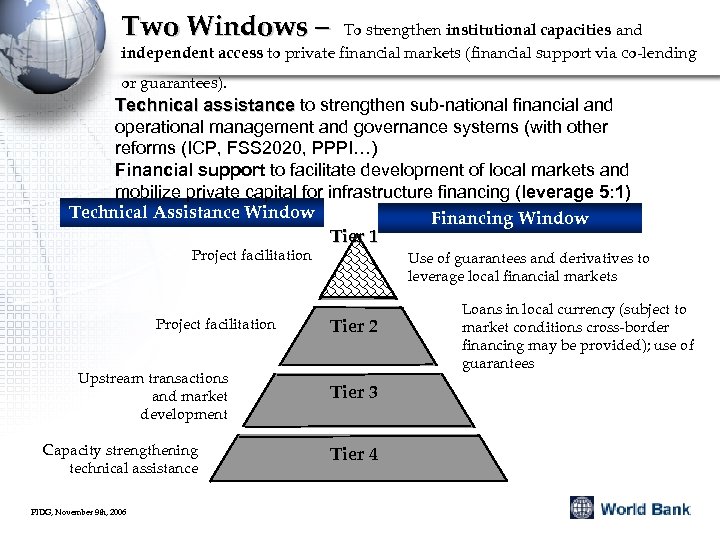
Two Windows – To strengthen institutional capacities and independent access to private financial markets (financial support via co-lending or guarantees). Technical assistance to strengthen sub-national financial and operational management and governance systems (with other reforms (ICP, FSS 2020, PPPI…) Financial support to facilitate development of local markets and mobilize private capital for infrastructure financing (leverage 5: 1) Technical Assistance Window Financing Window Tier 1 Project facilitation Upstream transactions and market development Capacity strengthening technical assistance PIDG, November 9 th, 2006 Use of guarantees and derivatives to leverage local financial markets Tier 2 Tier 3 Tier 4 Loans in local currency (subject to market conditions cross-border financing may be provided); use of guarantees
Public Private Infrastructure Facility (PPIAF) • Multi-donor facility with 14 donors • Established 1999 • Annual budget of $20 million • 50% of portfolio is in Africa • Total Portfolio Value of $115 million • Provides grants (not loans) to support upstream work with Governments to facilitate access to private sector financing and the creation of public private partnerships • Investments are used to support infrastructure development • Recently opened a new Sub-National Grant Facility to specifically assist local authorities to access domestic credit • Can also work with State Owned Enterprises and Municipal Utilities PIDG, November 9 th, 2006 • Managed by the World Bank
PPIAF Operating Characteristics • Demand-driven model. Local Authorities apply for grant resources. • Application and draft Terms of Reference for Assistance is all that is required • Focus on infrastructure, but includes municipal financing • Activities not tied to specific financiers or financing options • 50% of grants under $75, 000 but can be higher • Approval process 3 to 8 weeks depending on size of grant • Website: www. ppiaf. org • Email: nairobirco@ppiaf. org • Contact Abuja office of World Bank (e. g. email shown on title page of this presentation) PIDG, November 9 th, 2006
Examples of Types of Activities under PPIAF Sub-National Program • Financial Management: credit ratings (shadow ratings, advisory services…), tax planning, tax collection and administration, revenue and expenditure management, information systems, asset management, debt management systems, etc. • Infrastructure Management: tariff setting, tariff collection, subsidies policies, sector regulation, private sector role, investment planning, etc. • Corporate Governance: procurement process, monitoring and reporting systems, audited financial statements, etc. • Regulatory Frameworks: debt regulation for sub-national borrowing -- fiscal responsibility legislation, monitoring and reporting to central government, capital market regulation, bankruptcy and legal claims against sub-national entities, etc. • HR issues: training, staffing, incentives, etc. PIDG, November 9 th, 2006
Examples of Approved Grants § Swaziland ($320, 000): Assistance to help two cities borrow from local banks to fund slum upgrading and related infrastructure improvements. § Africa Regional ($315, 000): TA to assist 6 -8 water utilities obtain shadow credit rating; creditworthy utilities may go on to formal ratings and financings. § Ningbo City, China ($75, 000): In-country training on municipal financing options. Ningbo first city in China authorized to borrow on own account § Philippines ($45, 000): Assistance to small water providers and potential lenders to bring them together on specific financing transactions. PIDG, November 9 th, 2006
LGU Financing Framework in the Philippines Kamran M. Khan Infrastructure Finance Advisor East Asia and the Pacific Region, the World Bank October 11, 2008
Agenda 1. LGU segmentation by credit quality 2. Financing options for Tier 1 LGUs 3. Innovative financing of tier 2 -3 LGUs via GFI 4. Performance grants and tier 4 LGUs 5. Disaster Risk Management for LGUs PIDG, November 9 th, 2006
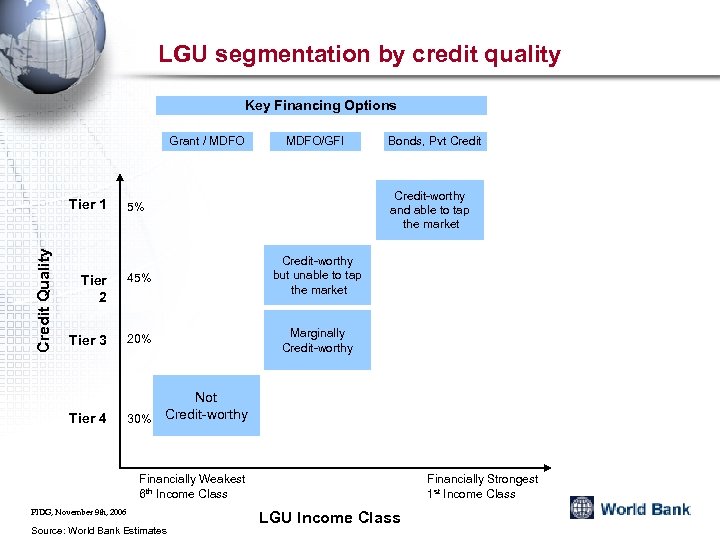
LGU segmentation by credit quality Key Financing Options Grant / MDFO Credit Quality Tier 1 MDFO/GFI Bonds, Pvt Credit-worthy and able to tap the market 5% Tier 2 45% Credit-worthy but unable to tap the market Tier 3 20% Marginally Credit-worthy Tier 4 Not 30% Credit-worthy Financially Weakest 6 th Income Class PIDG, November 9 th, 2006 Source: World Bank Estimates Financially Strongest 1 st Income Class LGU Income Class
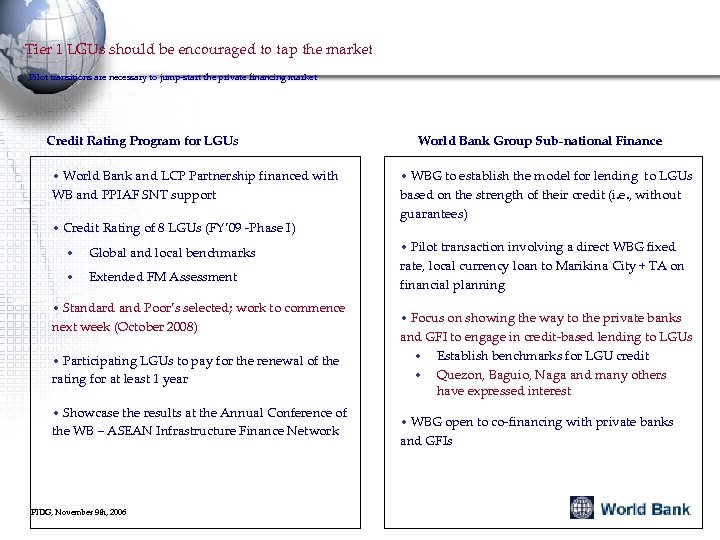
Tier 1 LGUs should be encouraged to tap the market Pilot transitions are necessary to jump-start the private financing market Credit Rating Program for LGUs World Bank Group Sub-national Finance • World Bank and LCP Partnership financed with • WBG to establish the model for lending to LGUs WB and PPIAF SNT support based on the strength of their credit (i. e. , without guarantees) • Credit Rating of 8 LGUs (FY’ 09 -Phase I) • Global and local benchmarks • Extended FM Assessment • Standard and Poor’s selected; work to commence next week (October 2008) • Participating LGUs to pay for the renewal of the rating for at least 1 year • Showcase the results at the Annual Conference of the WB – ASEAN Infrastructure Finance Network PIDG, November 9 th, 2006 • Pilot transaction involving a direct WBG fixed rate, local currency loan to Marikina City + TA on financial planning • Focus on showing the way to the private banks and GFI to engage in credit-based lending to LGUs • Establish benchmarks for LGU credit • Quezon, Baguio, Naga and many others have expressed interest • WBG open to co-financing with private banks and GFIs
WB and GFIs can explore innovative models for financing tier 2 -3 LGUs § GFI-based World Bank funded facility designed to buy loans made by private banks to credit-worthy LGUs v Bridge the gap between GFIs and private banks v Provide liquidity to private banks for LGU financing § LGU financing of municipal infrastructure PPPs v GFI-based WB funds used for the public sector contribution to PPPs v Associated TA fund to help LGUs prepare bankable projects § Credit enhancement to help GFI securitize their LGU loan portfolio v Provide liquidity to the GFIs v Benchmark GFI credit analysis capacity PIDG, November 9 th, 2006
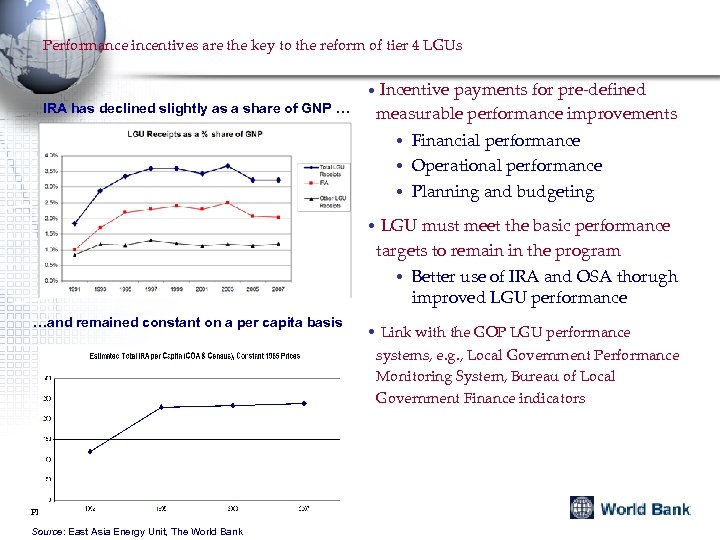
Performance incentives are the key to the reform of tier 4 LGUs • IRA has declined slightly as a share of GNP … Incentive payments for pre-defined measurable performance improvements • Financial performance • Operational performance • Planning and budgeting • LGU must meet the basic performance targets to remain in the program • Better use of IRA and OSA thorugh improved LGU performance …and remained constant on a per capita basis • Link with the GOP LGU performance systems, e. g. , Local Government Performance Monitoring System, Bureau of Local Government Finance indicators PIDG, November 9 th, 2006 Source: East Asia Energy Unit, The World Bank
Disaster Risk Management (DRM) remains a key priority for the LGUs § Philipines faces a high degree of natural disaster risk v Between 1990 -1996 an estimated $480 mil in losses per year (0. 5% of GDP) v Average of 1, 009 lives are lost every year due to natural disasters § Strategic, comprehensive approach to DRM § Map, quantify and model the risk v Anticipate the low risk, high probablity events v Identify the high risk, low probability events § Layer and match the risk + the mitigation strategy + financial instrument v Technical Assistance available through WB and other donors § Consider a comprehensive set of financial instruments v Establish the framework for disbursing funds to “qualified” LGUs PIDG, November 9 th, 2006
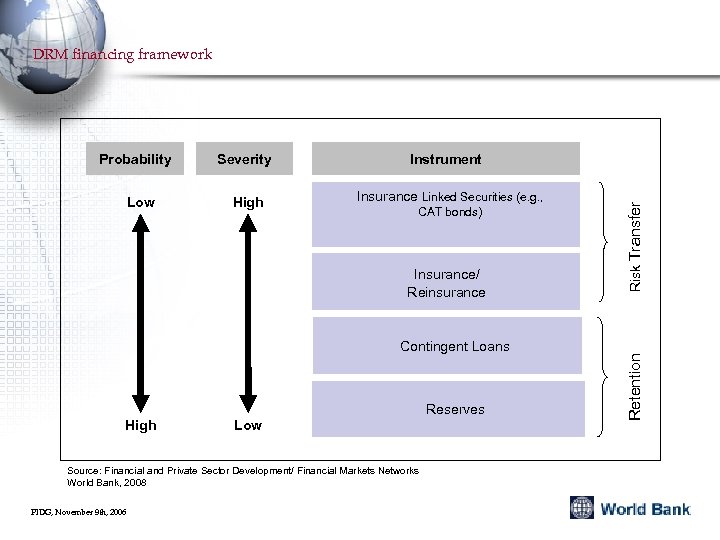
DRM financing framework High Instrument Insurance Linked Securities (e. g. , CAT bonds) Insurance/ Reinsurance Contingent Loans Reserves High Low Source: Financial and Private Sector Development/ Financial Markets Networks World Bank, 2008 PIDG, November 9 th, 2006 Risk Transfer Low Severity Retention Probability
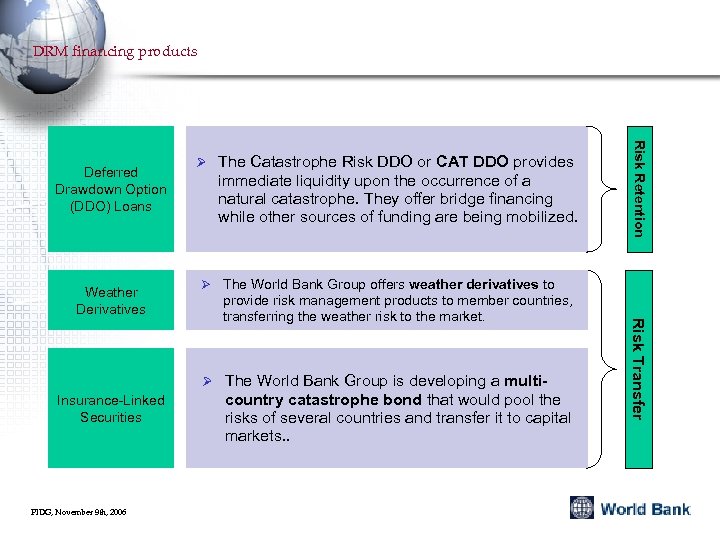
DRM financing products Weather Derivatives Ø The Catastrophe Risk DDO or CAT DDO provides immediate liquidity upon the occurrence of a natural catastrophe. They offer bridge financing while other sources of funding are being mobilized. Ø Ø The World Bank Group is developing a multi. Insurance-Linked Securities PIDG, November 9 th, 2006 country catastrophe bond that would pool the risks of several countries and transfer it to capital markets. . Risk Transfer The World Bank Group offers weather derivatives to provide risk management products to member countries, transferring the weather risk to the market. Risk Retention Deferred Drawdown Option (DDO) Loans
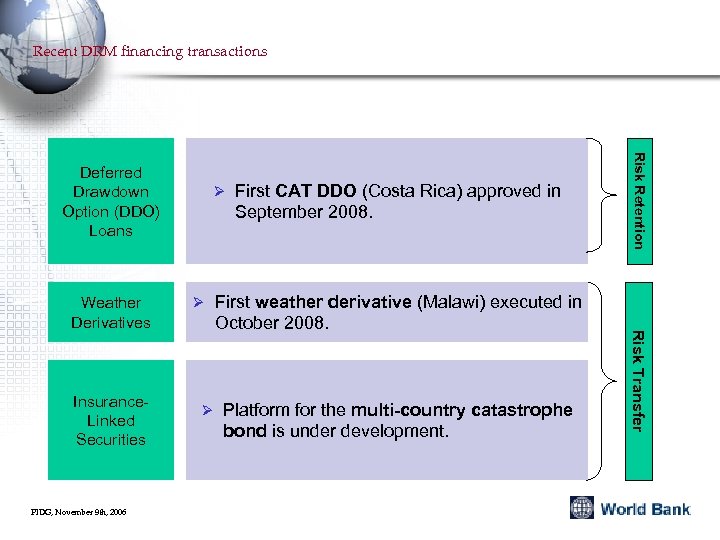
Recent DRM financing transactions Ø First CAT DDO (Costa Rica) approved in September 2008. Ø First weather derivative (Malawi) executed in Insurance. Linked Securities Ø Platform for the multi-country catastrophe PIDG, November 9 th, 2006 October 2008. bond is under development. Risk Transfer Weather Derivatives Risk Retention Deferred Drawdown Option (DDO) Loans
Скачать презентацию Accessing Credit Ratings for Development of Sub-National Governments
a16309f822e3541f92e11209c7910cf5.ppt