


 Скачать презентацию Access to the Corridors Utilities Access to the
96bb4d4616ac7f81c1beb635ef45aa23.ppt
- Количество слайдов: 151
 Access to the Corridors Utilities Access to the Transport Corridors National Code of Practice Implementation Workshop 1 – 20 May 2009
 Outline of programme • Introduction and background • Outline of the Code – Latest submissions • Implementing the Code – Implementation issues • Case study and discussion • Next steps – Completing the Code – Governance • Review of the day and feedback
 Introductory session • Introductions • Housekeeping • Objectives for the day • The journey so far • Report on legislative progress
 Housekeeping • Emergency procedures • Ground-rules for the day • Cell phones • Handouts • Feedback forms • Parking lot
 Objectives for the day • To explain the content of the Code • To provide a simple process for every -one to implement the Code in a nationally consistent manner • To identify and address any impediments to implementing the Code • To provide advice and support across all sectors
 The Journey So Far
 Why the Code was developed • Government’s economic strategy – constant concerns being raised • Nationally consistent process • Formalise current industry best practice • Third party damage problems • Need to update Working in the Road: stakeholders not getting enough out of it • If we didn’t, Government would!
 Government Policy Objectives 2006 a. b. c. “To reduce the costs and inefficiencies arising from the current statutory framework, including avoidable damage to roads and utility networks, delays and disputes, inconsistencies between statutes, and poor coordination To provide for better management of the multi-use of road corridors in the public interest, including road safety, and balancing the provision of utility services with efficient transport and universal access to roads To provide the potential for increased utility access to rail and motorway corridors while recognising the transport and safety responsibilities of Transit NZ, and the transport, safety and business interests of ONTRACK. ”
 The context • Utilities’ right of access to the corridor • Corridor managers’ rights to manage the corridor – setting reasonable conditions • Definition of roles and responsibilities of the parties • Planning, liaison and coordination • Maintaining the integrity of the corridor • Safe work site minimising public inconvenience • Collaboration in good faith
 Who developed the Code? By the stakeholders for the stakeholders – – – Electricity, gas, telecommunications sectors Local authorities: Roads/ Waters/ Wastewaters Transit NZ ONTRACK Contracting sector Other participating parties include: – Government departments and agencies – Agents of any of the above – consultants, contractors
 How the Code was developed • NZUAG/LGNZ seminar 19 February 2007 • Pan-sector meetings • Statement of Intent • Directors group • Working groups • Industry peer review processes • Independent technical edit • Legal review
 Current status of the Code • Living document • Some chapters work in progress • Will be reviewed later this year – fix any implementation issues – align with the legislation
 Future status of the Code • Authorised by the proposed Utilities Access Bill (expected 2009) • Consistent with legislation • Replaces existing Codes/ Handbooks
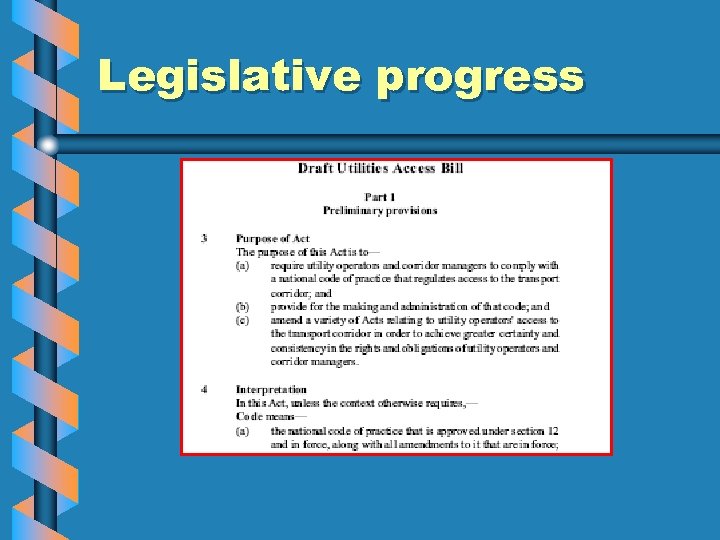 Legislative progress
 Report from MED • To be done as late as possible
 Draft Utilities Access Bill • Gives legal status to the Code • Identifies the content • Requirements to have the Code approved by the Minister • Process for amending the Code • Publication • Amends various utility Acts to achieve consistency
 Purpose of the Code • NZ Inc – benefits to public • Fair and equitable to all users of the road • Minimising disruptions to traffic, public, neighbours • Nationally consistent approach
 Content of Draft Utilities Access Bill • Purpose of the Code • Utility operators and corridor managers must comply with the Code • Court can order compliance • Powers to regulate if no Code • On legislative programme 2009
 MED consultation • • • Improving understanding both ways Input on process Joint approach on long-term governance • Opportunity to put forward some ideas for draft bill • Pushing for exposure draft for early industry input – awaiting outcome
 Legislative process • Bill introduced to the House of Representatives with first reading no less than three days later. • If ‘voted’ to go to second reading, next step select committee process • The select committee: – hears public submissions, – recommends amendments, and – reports recommendations back to Parliament • Second reading takes into account Select Committee Report • Third reading (if ‘voted’ to go) • Royal assent • Enactment three months later
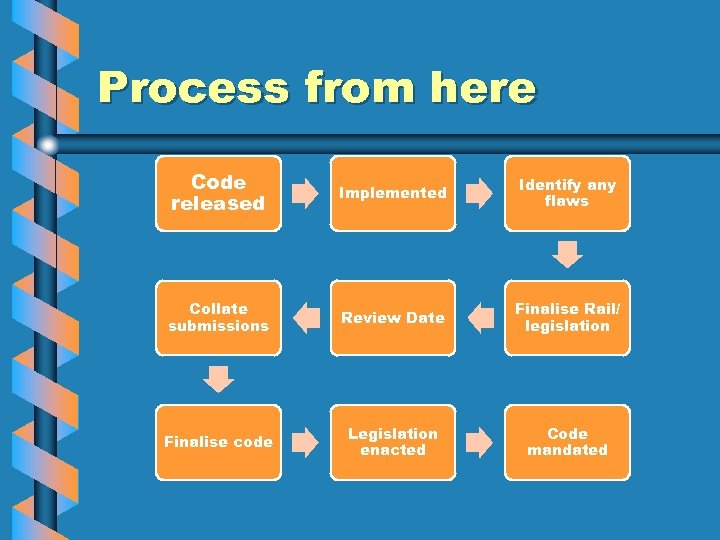 Process from here Code released Implemented Identify any flaws Collate submissions Review Date Finalise Rail/ legislation Finalise code Legislation enacted Code mandated
 Outline of the Code
 Document is in Hand • This is a document that has been collaborative effort • Consider the balance is appropriate • Socialised now operationalise • Review to eliminate the fatal flaws • Alignment with legislation • Needs to be used – little point changing until it has been
 Purpose of the Code To provide a consistent and cooperative framework for the CM and UO to manage the corridor by providing access rights to the UO
 Principles supporting the Code • Working together – regular liaison • Consistency – process, reasonable conditions • Technical excellence – best practice • Equity and fairness - respect • Quality – reducing costs, protecting all assets • Health and safety – staff and the public • Constructive resolution of differences
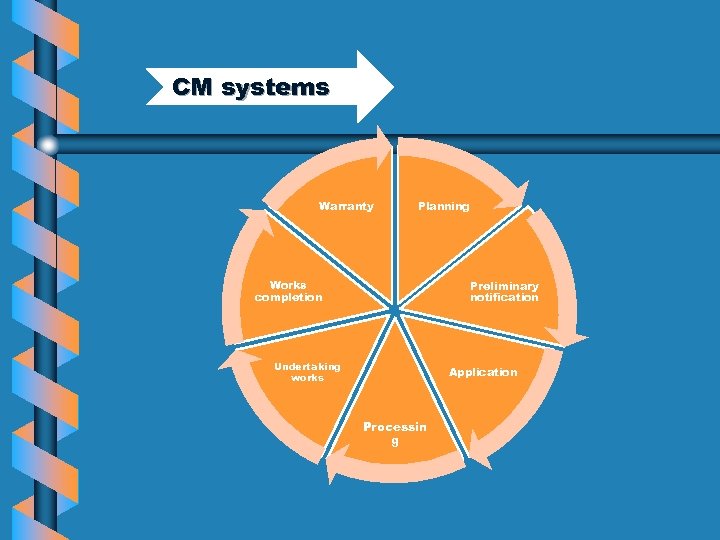 CM systems Warranty Planning Works completion Preliminary notification Undertaking works Application Processin g
 General Provisions • Explanatory, guidelines and specifications • Expanded to cover full gamut of the access process • Process is generic – parties will still need to agree in some areas • Principles and general outcomes agreed – options for specifics • Delivers nationwide consistency
 General Provisions cont • Government had defined goals • Code meets all requirements specified by Govt • Underlying data is patchy – got to go forward • Willingness by team to consider any aspect
 Intention • Share forward plans (eg LTCCP, District Plans, utility work plans) • Work towards a balance of interest • Maintain integrity of transport corridor/road/utility assets • Safety and efficiency • Eliminate, isolate or minimise road safety hazards
 Overview of Code Contents • Introduction • Principles supporting the Code • Roles and Responsibilities • Sharing Key Information • Planning for Access to the Road Corridor • Working in the Road Corridor • Access to Motorways
 Code Contents Overview cont. • Access to Rail Corridors • Applying for Corridor Access • Reasonable Conditions • Compliance • Cost Sharing • Dispute Resolution • Continuous Improvement
 Code Contents Overview • Schedules concl. – Interpretation & Construction – Forms – Template for Reasonable Conditions – Process – Risk Management Process – Referenced documents
 Motorway issues • Need to keep community connected • Working on motorways problematic • Fastest growing need for capacity • If space, should be for the highest level community need
 Rail issues
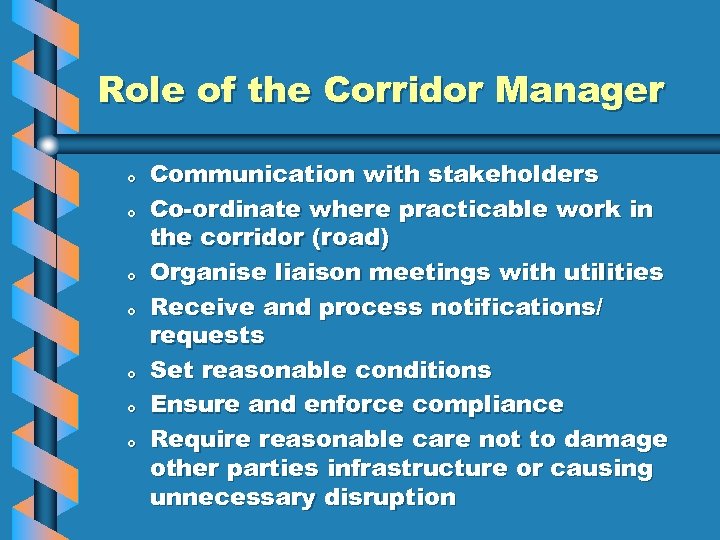 Role of the Corridor Manager o o o o Communication with stakeholders Co-ordinate where practicable work in the corridor (road) Organise liaison meetings with utilities Receive and process notifications/ requests Set reasonable conditions Ensure and enforce compliance Require reasonable care not to damage other parties infrastructure or causing unnecessary disruption
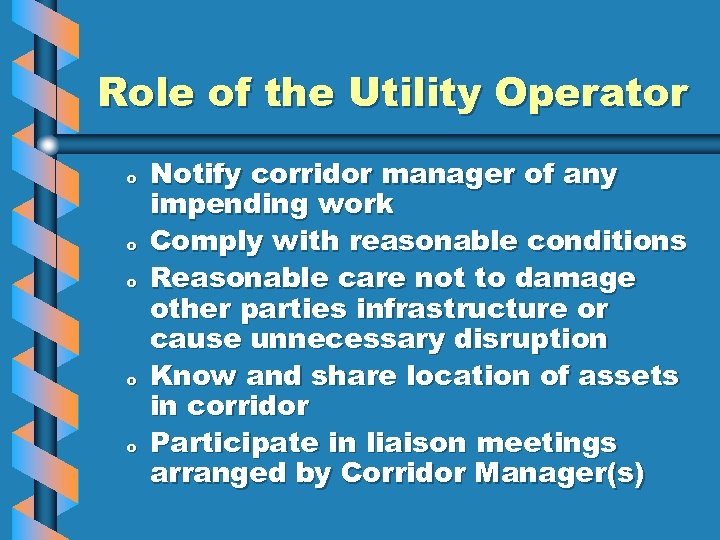 Role of the Utility Operator o o o Notify corridor manager of any impending work Comply with reasonable conditions Reasonable care not to damage other parties infrastructure or cause unnecessary disruption Know and share location of assets in corridor Participate in liaison meetings arranged by Corridor Manager(s)
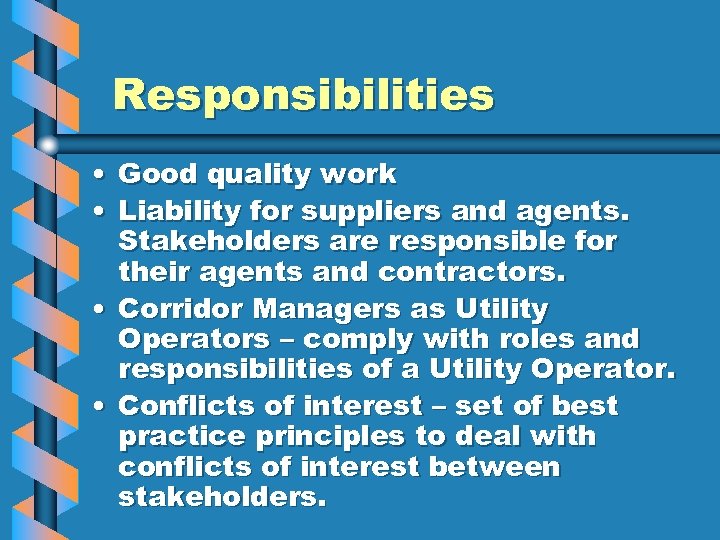 Responsibilities • Good quality work • Liability for suppliers and agents. Stakeholders are responsible for their agents and contractors. • Corridor Managers as Utility Operators – comply with roles and responsibilities of a Utility Operator. • Conflicts of interest – set of best practice principles to deal with conflicts of interest between stakeholders.
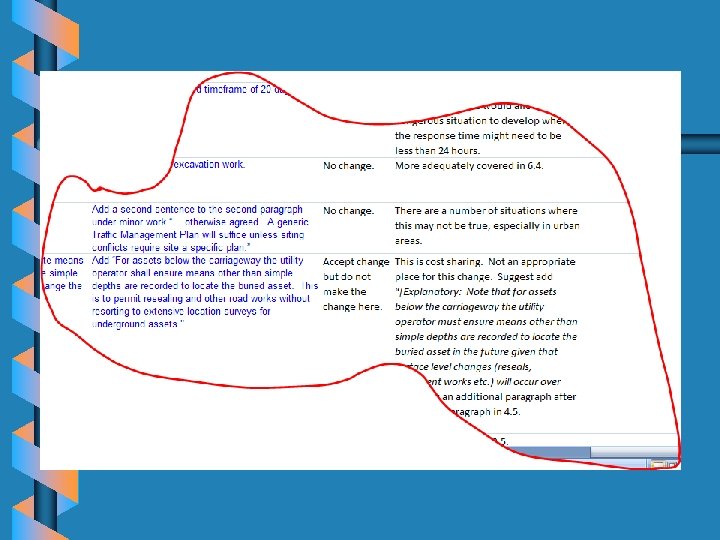
 Submissions Thank you to all submitters • Helped to significantly refine the Code • Biggest issue is how some of the provisions may be applied • Agreement on principle, not use • Good consensus on technical issues • Some decisions pending
 Topics included in submissions • Treating utilities differently and separately • Ensuring that any party cannot abdicate from its responsibilities • Prioritisation of space • Designations • Information sharing • Marking services on roads
 Submission issues pending • Chapter 8: Access to the rail corridor • Chapter 12: Cost allocation • Chapter 14: Code management
 What next? • Trust to be earned - relationship • Monitor and review • Want to hear back about areas where the Code has not been/ cannot be used as intended • Can use website (particularly FAQs) to get assistance • Will provide back-up: what do you want?
 Processes • Co-ordination (liaison meetings, forward planning, information sharing) • Applications (applying, processing, setting conditions) • Cost allocation • Quality and Compliance • Dispute resolution
 Dispute Resolution • Any matter • Either party can initiate • Step-by-step • Conciliatory • Four options • Process is best practice • Can pick and choose, but reduces options
 Dispute resolution • Dispute process – will be mandated • Anything disputable and any party – learn to get along • Emphasis on communication • Do you need NZUAG to support dispute process – find expertise? • Knowledgeable mediators
 Reasonable conditions • Template as part of work approval • Conditions in template will always apply • Special and local conditions • Begin process of developing Local Conditions at any time • Contestability
 Other Codes • Replaces other Codes • Need to phase out • Legislation will replace
 Questions?
 Session 2 How to implement the Code
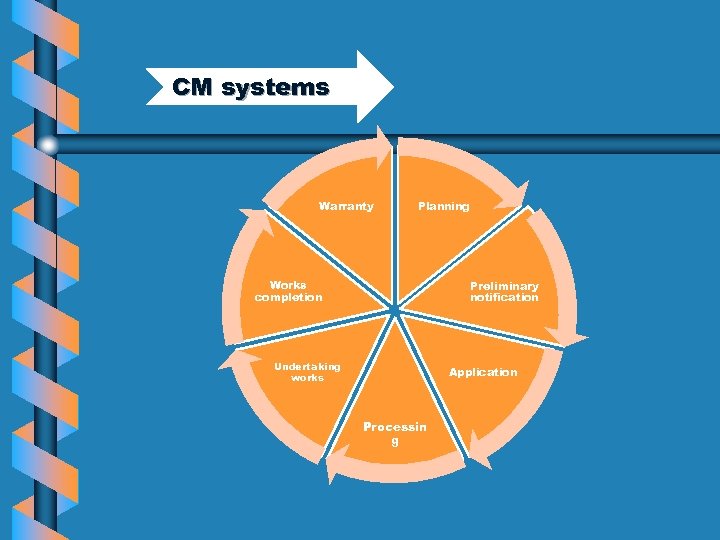 CM systems Warranty Planning Works completion Preliminary notification Undertaking works Application Processin g
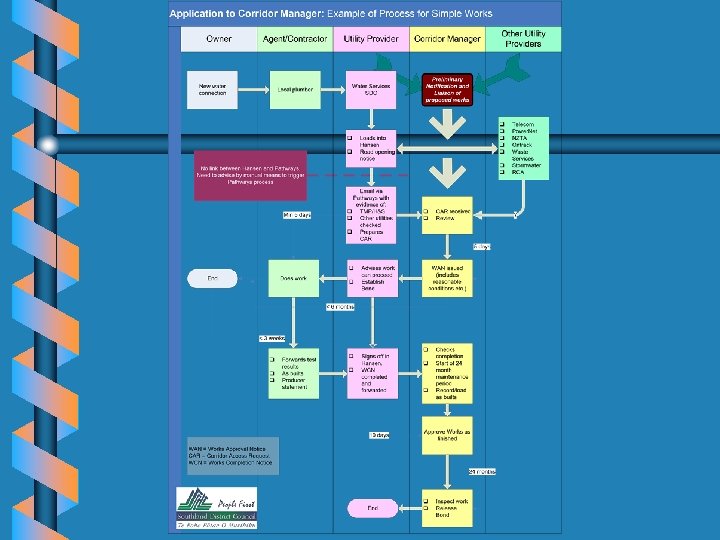
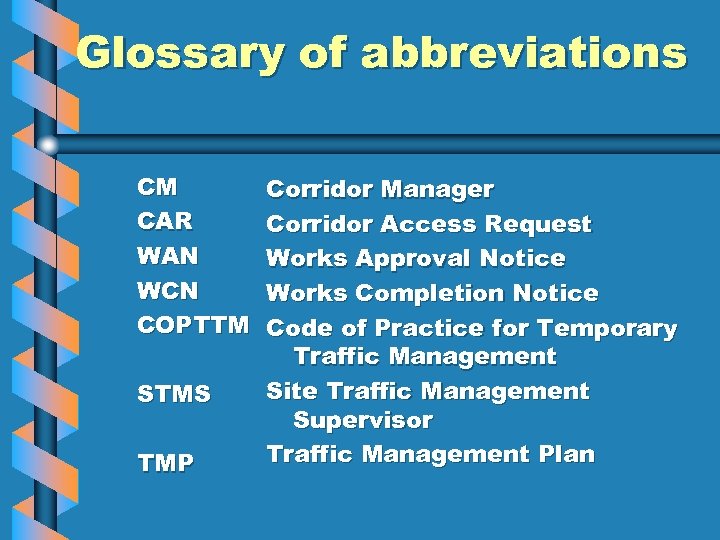 Glossary of abbreviations CM CAR WAN WCN COPTTM STMS TMP Corridor Manager Corridor Access Request Works Approval Notice Works Completion Notice Code of Practice for Temporary Traffic Management Site Traffic Management Supervisor Traffic Management Plan
 Corridor Manager’s preparations • Defining the role • Managing where utilities are located in the corridor – Competing demands from UOs • Systems and processes • Staff with defined responsibilities • Others?
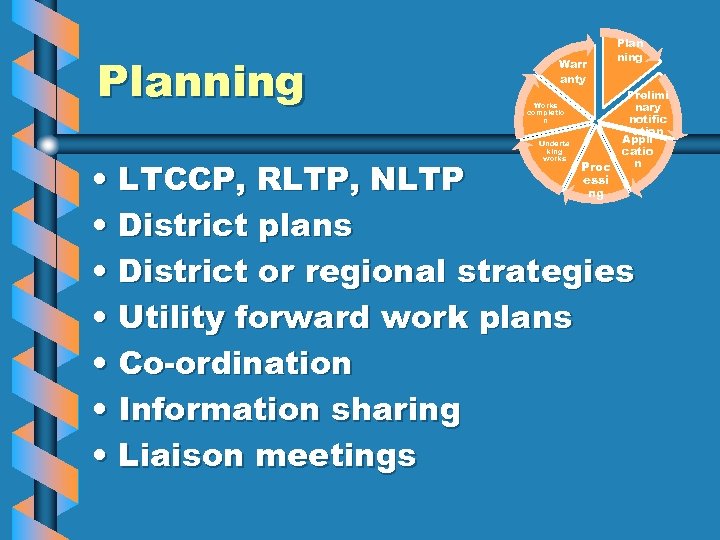 Planning Warr anty Works completio n Underta king works Plan ning Prelimi nary notific ation Appli catio n • LTCCP, RLTP, NLTP • District plans • District or regional strategies • Utility forward work plans • Co-ordination • Information sharing • Liaison meetings Proc essi ng
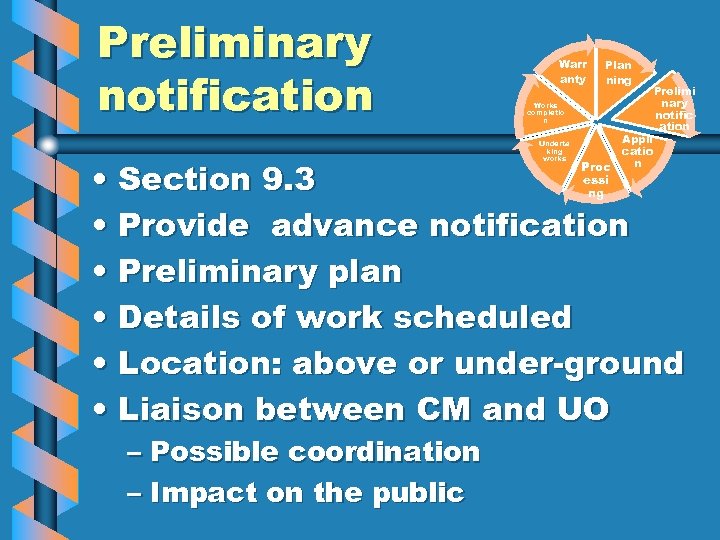 Preliminary notification Warr anty Plan ning Works completio n Underta king works Appli catio n Prelimi nary notific ation • Section 9. 3 • Provide advance notification • Preliminary plan • Details of work scheduled • Location: above or under-ground • Liaison between CM and UO – Possible coordination – Impact on the public Proc essi ng
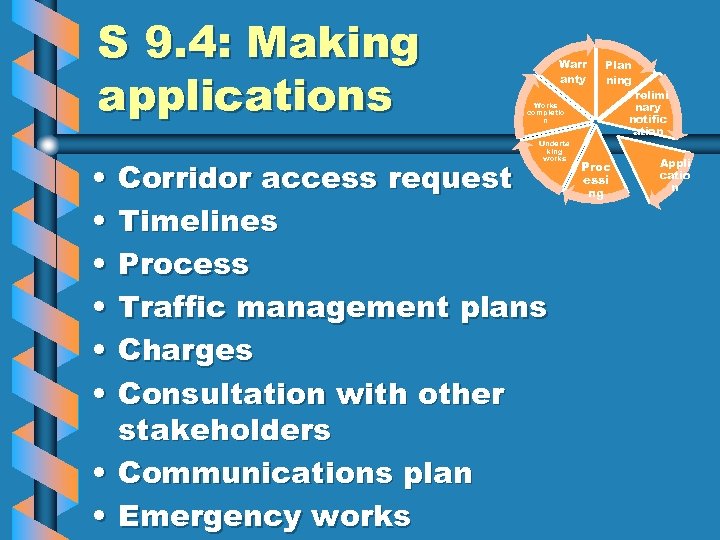 S 9. 4: Making applications • • • Warr anty Works completio n Underta king works Corridor access request Timelines Process Traffic management plans Charges Consultation with other stakeholders • Communications plan • Emergency works Plan ning Prelimi nary notific ation Proc essi ng Appli catio n
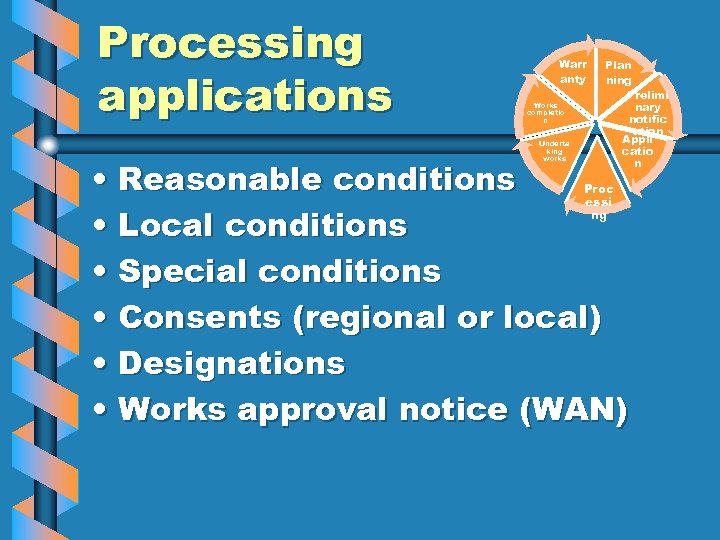 Processing applications Warr anty Works completio n Underta king works Plan ning Prelimi nary notific ation Appli catio n • Reasonable conditions • Local conditions • Special conditions • Consents (regional or local) • Designations • Works approval notice (WAN) Proc essi ng
 Reasonable Conditions • Reasonable conditions defined – these are default conditions • If no response from Corridor Manager, base conditions apply • Still a notice and UO can commence • Three categories of conditions • Template in Code • Process for defining local and special conditions • Relate to guidelines for above ground structures as required
 What is a Reasonable Condition? • Based on criteria in Telecommunications Act • RCAs provided their standard conditions • Good degree of uniformity • Debated: outcome in Code template • Amenity outcomes identified in, and consistent with, LTCCPs eg special paving
 What isn’t a Reasonable Condition? • Preventing, frustrating or unreasonably delaying installation or maintenance • Unreasonably avoiding future costs • RMA issues • Too unreasonable • Appropriateness of the work • Requiring amenity outcomes not specified in LTCCPs
 Local Conditions • Related to condition or event or area, not work • May not be time dependent • Issue to all relevant parties for comment • Must attempt to reach agreement • If cannot, may be imposed • If imposed, can then go to dispute
 Special Conditions • Particular to the works • Notify in draft and seek comments • Must attempt to reach agreement • If cannot, must be imposed • Can then go to dispute
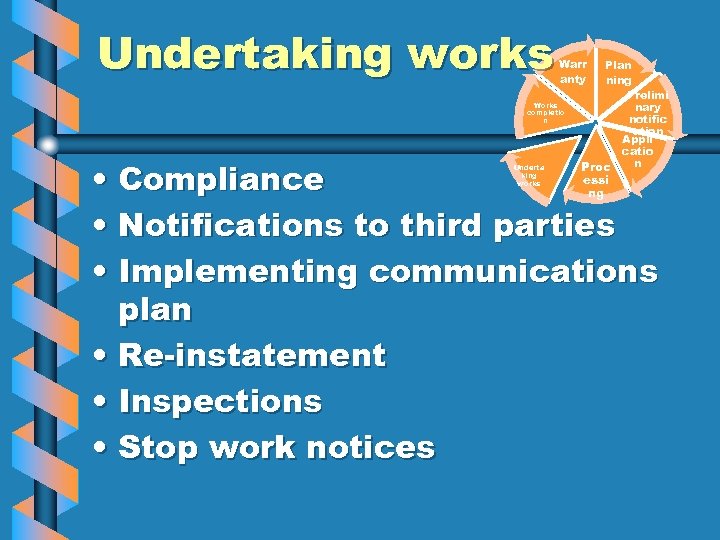 Undertaking works Warr anty Works completio n Plan ning Prelimi nary notific ation Appli catio n Proc • Compliance • Notifications to third parties • Implementing communications plan • Re-instatement • Inspections • Stop work notices Underta king works essi ng
 Code Compliance • Utility operator responsible for its contractors’ work • Corridor manager wants confidence that standards will be met • All principals are seeking the work to be carried out “right first time”, and for good behaviour to be developed and maintained by all parties, especially contractors • Audits provide the proof that standards are being met • Utility operator provides warranty for its work • Non-compliance is included • Quality plans required.
 General Principles for Placement of Utilities: Chapter 5 Consider • Protect finite resource • Statutory spacing and depth • Multiple ducting • Trench sharing • Innovative approaches encouraged • Traversing of carriageway minimised
 Preferred Lay Positions (S 5. 7. 1) Eight key situations addressed: o o o o Greenfields Developed urban areas Congested urban areas Rural lifestyle Other rural areas State highways Motorways Railways
 Notifications to third parties • Identifying third parties • Responsibility still on working party to identify parties • Importance of good records • Peg is in the ground
 Implementing communications plan • Appropriate communications strategy for public, adjacent property owners, etc • Leaflets • Advertising • Signage
 Re-instatement: chap 6 • Trenches • Surface layer • Roadmarkings etc
 Inspections/audit • What to inspect? • How often? • Who defines? What about questionable work? • Evidence of compliance • Independent audit
 Non-compliance: S 11. 4 • Failure to meet: - The requirements of the WAN - The Code - Reasonable conditions - Traffic management plan • Stop-work notice requires an approval to recommence work • Non-actioned notices
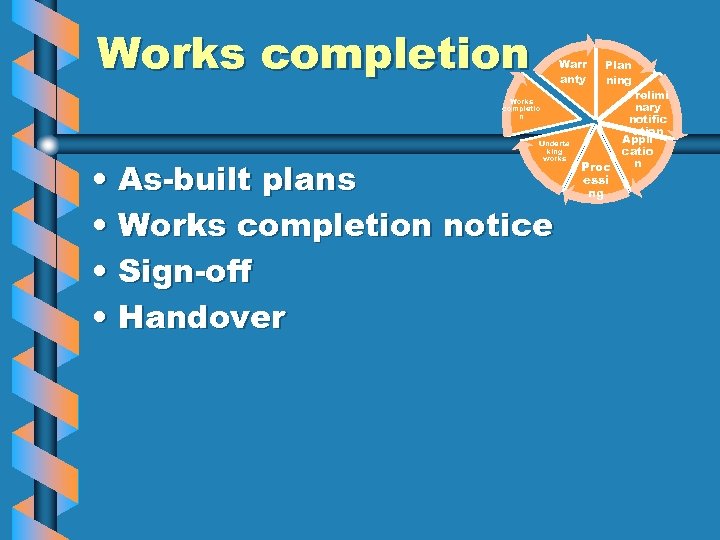 Works completion Warr anty Works completio n Underta king works • As-built plans • Works completion notice • Sign-off • Handover Plan ning Prelimi nary notific ation Appli catio n Proc essi ng
 As-built plans • All parties must keep accurate records • All parties are responsible for their own records and must make them available • Required to update if new/unknown service located • Timeliness • Electronic / paper-based
 Works completion notice: S 9. 7 • • • Lodge within 3 weeks of completion Any changes to the work approved QA records (s 6. 26) As-builts Signed confirmation of compliance Any work yet to be done
 Sign-off
 Handover
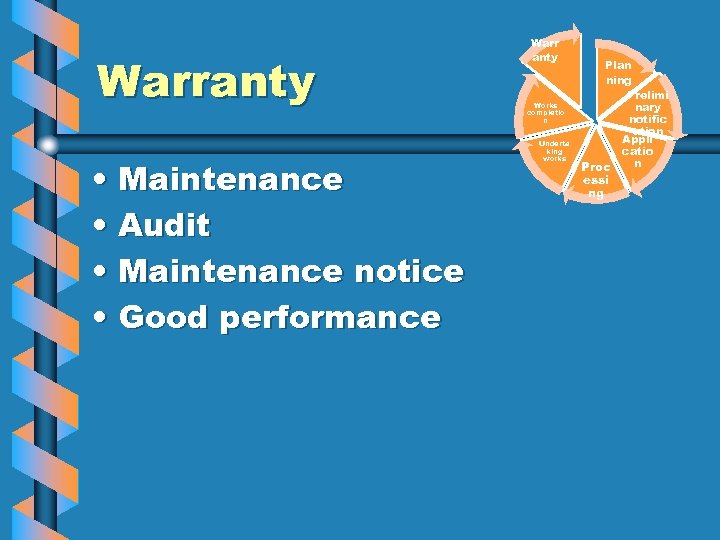 Warranty • Maintenance • Audit • Maintenance notice • Good performance Warr anty Works completio n Underta king works Plan ning Prelimi nary notific ation Appli catio n Proc essi ng
 Maintenance • UO responsible for damage to – Road corridor – Road asset – Other property – Other infrastructure • includes – Subsidence – Road surface deterioration • Common law proof
 Maintenance notice • At completion of two-year warranty • Template • No outstanding works
 Other implementation issues
 Quality control • Letting contracts • Layers of sub-contractors • Supervision • Audit • Quality systems • Guidelines on procurement processes?
 Quality assurance requirements • Quality system required appropriate to job • Equivalent to NZTA TQS 1 • Covers from Go to Whoa • List of requirements in section 6. 26 – check ref
 Letting contracts • Define minimum requirements in tender • Quality standards • Competence • Limitations on sub-contractors
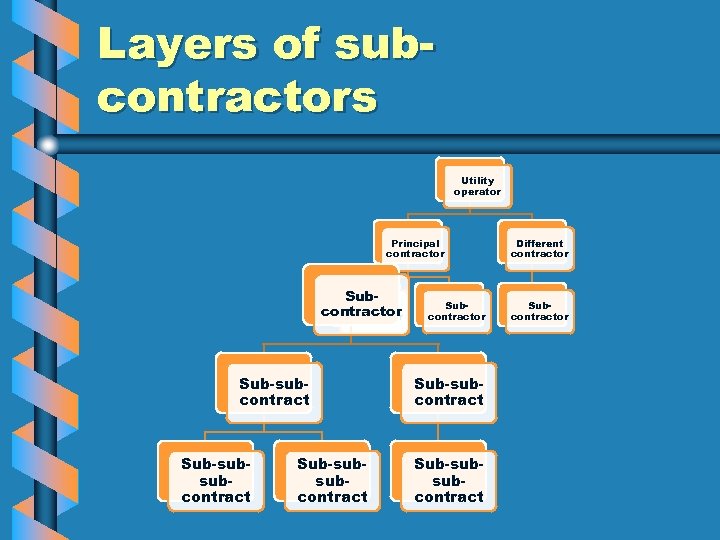 Layers of subcontractors Utility operator Principal contractor Subcontractor Sub-subcontract Sub-subsubcontract Different contractor Subcontractor
 Supervision • Why supervise? • What do you supervise?
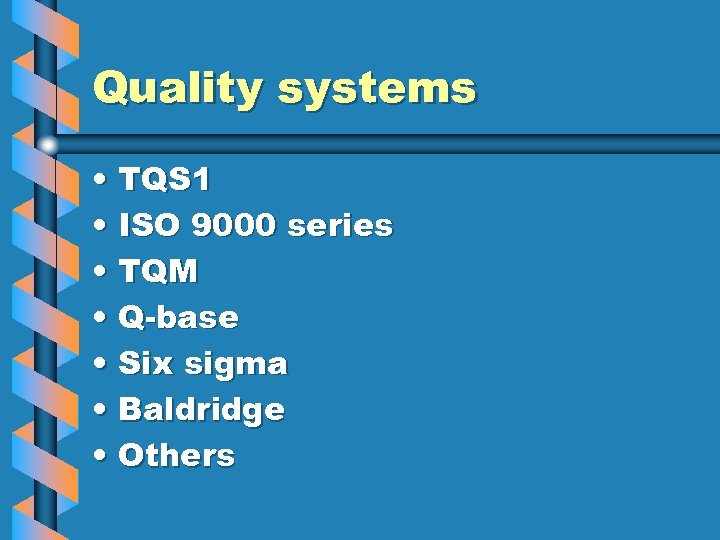 Quality systems • TQS 1 • ISO 9000 series • TQM • Q-base • Six sigma • Baldridge • Others
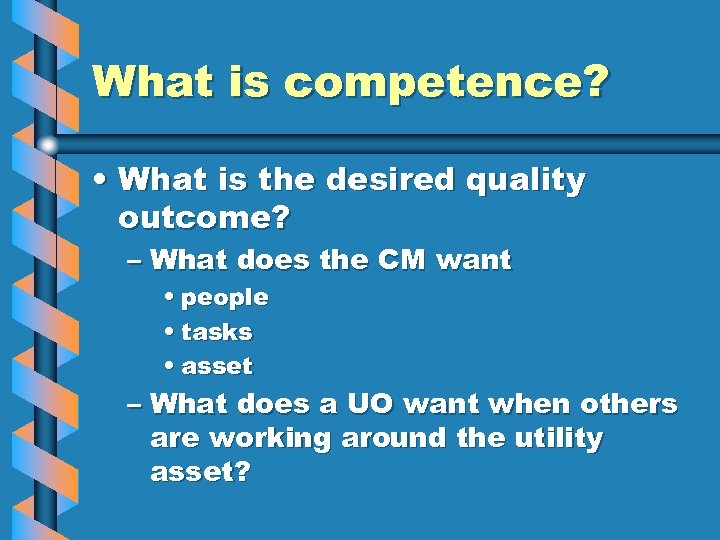 What is competence? • What is the desired quality outcome? – What does the CM want • people • tasks • asset – What does a UO want when others are working around the utility asset?
 What is competence? • Skilled in the job being done • Accurate performance • Timeliness • No complaints • No third party damage • Experienced • Qualified? In what?
 Training • On-job • Off job – In-house – External provider • Industry certificate • National qualification
 Accredited or preferred suppliers Issues to consider: • Available to all • Clearly defined standard • Variable standard for low/high value contracts • Monitoring
 Other implementation considerations • Risk assessment • Cost share • Performance reporting • Any others?
 Risk assessment For above ground structures • Primarily safety issues • Sections 5. 9. 1 and Schedule E For underground utilities • Separation • Depth • Road factors • Third party factors
 Cost share: chapter 12 • Based on current legislation • May agree as long as it is not inconsistent with legislation • Principles – Equity – Causer pays with care – Direct costs only – Betterment – Wrongly located services – CM admin costs – Optimal overall solution
 Session 3 • Case studies • Discussion • Next steps


 National Code of Practice for Utilities’ Access to the Transport Corridors A Nelson City Council Case Study Alec Louverdis
 Background v NCC is a Unitary Authority v 5 Private Utility Operators v NCC processes around 50 ROA’s per month v So what has NCC done wrt the new code and in particular the 7 key areas? ?
 Planning Regular co-ordinated meetings – Commenced in June 2005, with strong desire to work together v Initially 3 -4 meetings per year - now meet every 6 weeks at request of UO’s v Standing item at each meeting – update on capital and major O&M works v UO’s include private and internal NCC departments (utilities, roading and capital projects) v
 Planning continued v Attended by Contractors’ Federation & NZTA representative v Facilitated and chaired by CM, formally minuted and well attended. v NCC shares LTCCP & annual plans with UO’s. v All NCC capital works plans sent to UO’s at design stage giving opportunity to comment on all works.
 Planning continued v Council capital as-builts sent to all UO’s v UO’s have access to NCC GIS for services v Clear understanding of roles v Clear understanding of information sharing
 Planning continued v Agreement on service locations, service locates, potholing and stand-overs v Potholing of services by all parties at design stage to avoid conflict v Agreement on cost sharing v Ownership of private cables v Graffiti – zero tolerance
 Planning continued v Aligning conditions to District Plan v Understanding importance of accuracy of service information v Compliance qualifications – National certificates in road opening and water reticulation v Trenching by private individuals
 Planning continued Service – requires potholing at time of design to determine depth v Structural layers – requires testing of structural layers to effect long-term road stability through registered engineer v Imported material requirement for all excavations v
 Preliminary notification v Not done specifically wrt actual works but commenced 1 May 2009 as per Code
 Application of CAR v Currently UO’s apply for CAR – contractors do not wish to accept this responsibility v NCC costs - From $35/application to $75/application but with additional inspection costs v Standard practice to submit TMP’s v At request of UO’s, CAR includes full contact UO details wrt notification and stand-overs
 Application continued v All emergency work retrospective v Work <1 m 2 currently deemed minor. UO’s forward schedule to CM each month to check work. Not working as well as envisaged v Trialling electronic processing and working well
 Application continued v All UO’s pay for ROA fee and 2 inspections up front v New CAR format implemented 1 May 2009
 Processing v Currently takes between 1 and 5 days for more complex applications v Request made for NCC to put more details on invoicing – cross reference CAR details v Local conditions – Engineering standards
 Processing continued v Special conditions include: Ø Qualification requirements Ø Full reinstatement of footpaths in CBD Ø District plan requirements - noise & hours of work Ø Time to reinstate (including PMB and road markings) Ø Temporary reinstatement
 Actual Works v Staff inspect most works v Provision exists to issue Stop Work Notice – new form to be used 1 May 2009 v NCC inspections not a substitute for UG QA system v Photographs not accepted in lieu of inspections by NCC
 Work Completion v Currently CM checks completion of works v No WCN currently issued but implemented 1 May 09 v UO understand importance of as-builts
 Warranty 2 year warranty period consistent with NCC requirements v Following essential to ensure longevity of infrastructure: Ø Pre-design work Ø Thorough and workable UO QA systems Ø Proper Reinstatement Ø Detailed compaction records
 Comments and discussion
 National Code of Practice for Utilities’ Access to the Transport Corridors Southland District Council Experience To Date Presented by Russell Hawkes Asset Manager Roading
 Background § Before the Draft Code – SDC operated two systems • Hanson for internal road openings • Paper based system for other utility operators – Systems were not complementary – Sign-off somewhat haphazard – Maintenance requirements often not followed through
 Draft Code § Draft Code Release – Code identified as benefit to SDC – SDC reviewed draft – SDC attended workshops – SDC made submissions on draft – Council approved adoption of code – No action taken until implementation version released
 Implementation § Implementation – Document reviewed December 08 – Local conditions developed – Meetings with internal utility group – Decision made on implementation timeframe – Review of procedures and systems required undertaken
 Implementation § Implementation – Management systems put in place – Standard documentation developed – Rollout presentation developed – Utility companies advised of Road Show – Local rollout meetings in May 09
 Cluster Group § Southland RCAs – Three Road Controlling Authorities in Southland plus NZTA – SDC approached all for joint approach to implementation – SDC approached adjoining RCAs who will attend rollout meetings. – Uniform approach should eventuate
 Lessons § Lessons to date – Approach adjoining RCAs for joint rollout – Develop an implementation plan – Have your systems in place to manage process – Get your internal utilities onside – Ensure Local Conditions are accepted – Keep local utility & contractors in the loop – Do not rush the process
 Where to from here § SDC Plan – Confirm Corridor Manager – Process flow charts to be completed – Rollout meeting May 09 – First co-ordination meeting June 09 – Full implementation 1 July 09 – Three monthly co-ordination meeting planned – Six monthly procedure review
 Advantages to SDC – Code will be operational before it becomes mandatory – Forced a rethink on Roading project planning – Co-ordinated planning of utilities – System in place for management – Maintenance responsibilities defined – Over time utility records will be available inhouse – All party communication lines will be established
 Discussion
 Case Study – Implementing the Code #3 Other Regions
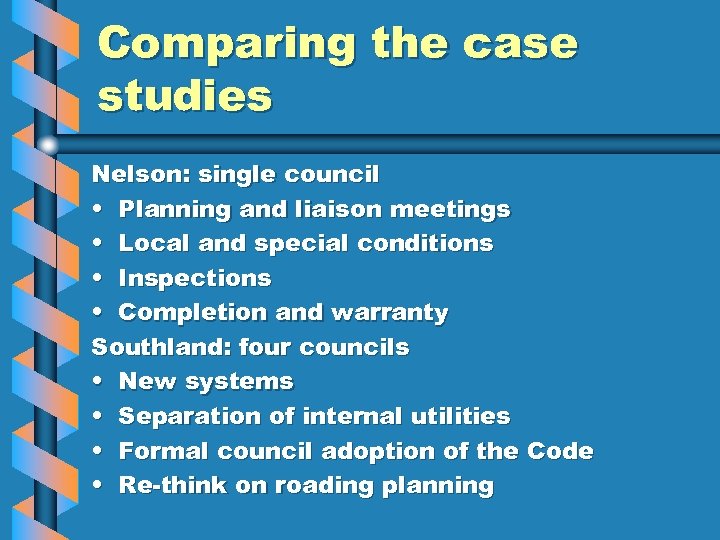 Comparing the case studies Nelson: single council • Planning and liaison meetings • Local and special conditions • Inspections • Completion and warranty Southland: four councils • New systems • Separation of internal utilities • Formal council adoption of the Code • Re-think on roading planning
 Impediments
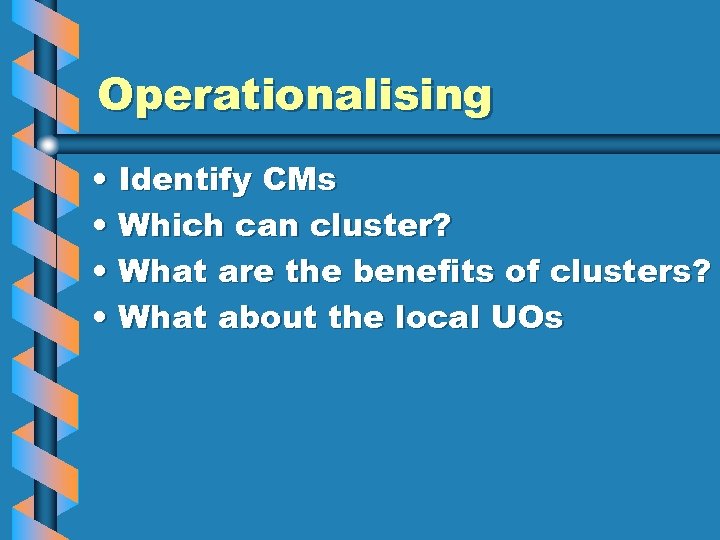 Operationalising • Identify CMs • Which can cluster? • What are the benefits of clusters? • What about the local UOs
 Clusters
 Regional cooperation • Regional launches • Information sharing • RLTP regional or technical advisory groups • Others? Help!
 Forward Issues for NZUAG
 Next Steps – Managing the Code • Your actions • Our actions • Government actions
 Next Steps – Managing the Code Your actions are: • CM preliminary planning (if no systems already in place) • Establish and maintain good working relationships • Manage QA and compliance with the Code • Provide feedback later this year
 Our actions: Completing the Code • Access to Rail • Cost allocation • Chapter 14: Code management
 Review of the Code • Post-implementation • To align with legislation – Start when Bill introduced in House • Formal review process – Seek submissions – Small team to review – Wider sector endorsement • Timing dependent on the Bill
 Getting the Code approved • Agreed Code following review • Formal submission to the Minister • Supporting evidence of consultation and support • MED review development process for compliance with legal requirements • Check that Code contents meet legal requirements • Ministerial approval
 Ongoing Code review process • Needs to be structured to avoid ad hoc changes • Managed to provide regular updates • Still requires BALANCE • Smaller group required to make process workable – expert support as necessary • Data collection
 Code amendment approval process • Minister to make final decision on changes • Same procedures as for getting Code approved • Expecting industry to manage process • Sorting out sector representation
 Government Actions • Legislative process • Approving Code • Long-term involvement • Meeting objectives
 Next Steps – Managing the Code • Code management body • Need to ensure all sectors fairly represented – rebalance? • Supporting structure – formalise • Working on governance – draft rules of engagement • Guidelines on procurement processes?
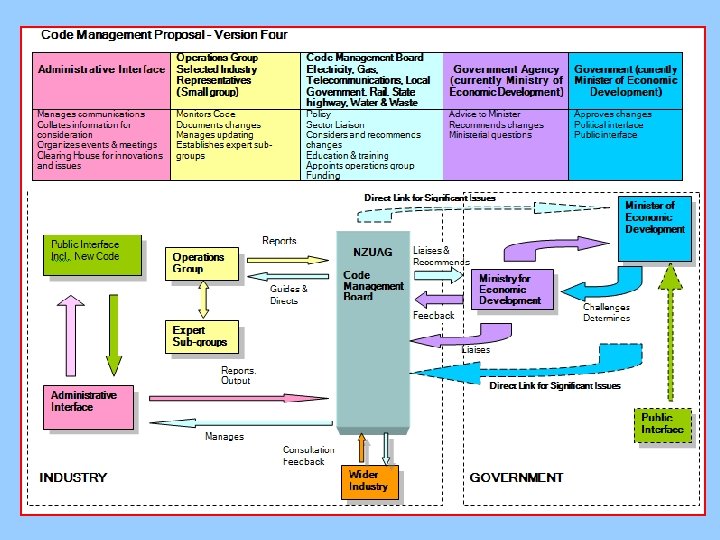
 Restructuring • Clear lines of sector accountability • Clear representation for each sector • All sectors at the table • Balanced representation • Selection of Chair? • Charter or incorporation?
 Strategic Approach • Code is not the only purpose for existence of NZUAG • Expectation from Government that NZUAG or similar represents industry • Clear positioning and development strategy needed • For restructured group to finalise strategic directions
 Performance Monitoring • Need basic information/data to support industry going forward • Changes have purpose but are based on conjecture/perception • No basis to negotiate change with Government • Efficiencies? How to demonstrate that Government objectives met
 Performance Monitoring cont • Trialling to avoid onerous requirements - collection • Government wants industry to decide but will demand at some stage • Want to stay ahead of the game
 Feedback • Are we providing enough? • What else do you want to see? • Is website enough or the wrong method? • Do you want it supplemented? • How? Newsletters? Seminars? • Availability of expert advice?
 Funding • Government expects industry to support itself – self funding • Need to find equitable funding solution – across sectors • Suggested solution based on add -on cost per CAR/WAN • Corridor Manager collects and pays on basis of requests
 Review of the day • Review of sessions • Parking Lot • Evaluation and feedback forms • Next steps
 Thanks to the presenters Thanks for your attendance Please complete the Evaluation form Have a safe journey home Get in behind!
 Contact us www. nzuag. org. nz info@nzuag. org. nz