


 Скачать презентацию Access to National Resources IDF Foundation 17 May
84d84e7c7d55ba7c00757fae073ae62e.ppt
- Количество слайдов: 26
 Access to National Resources IDF Foundation 17 May 2008 Brussels Jill Cousins
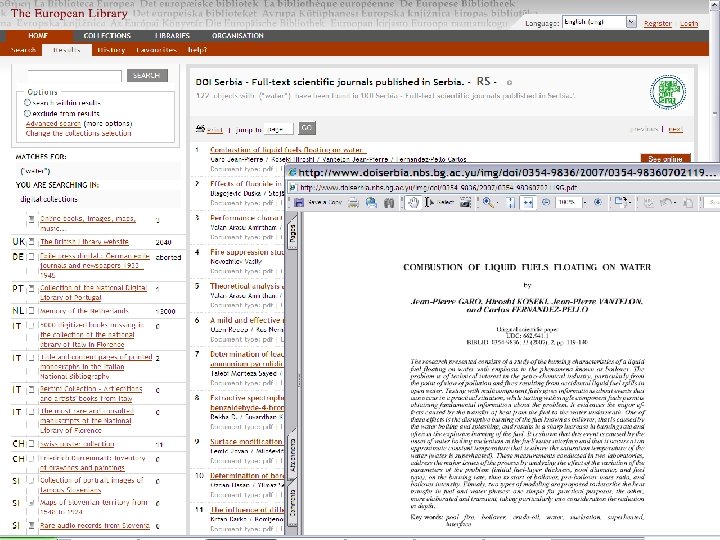
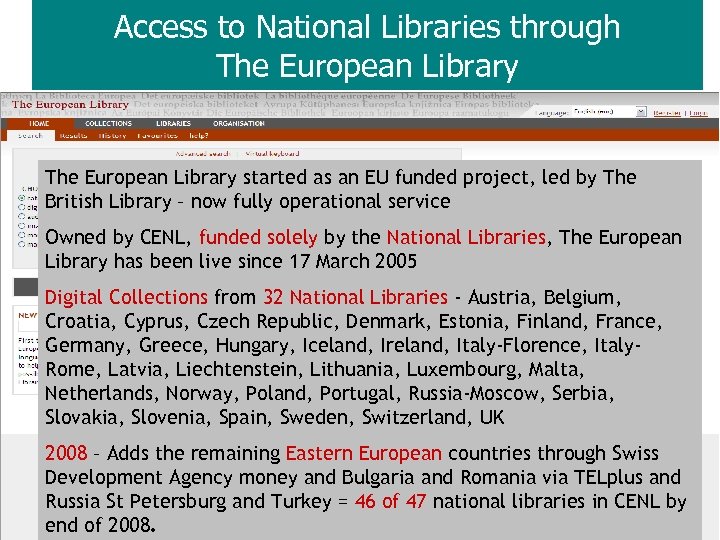 Access to National Libraries through The European Library started as an EU funded project, led by The British Library – now fully operational service Owned by CENL, funded solely by the National Libraries, The European Library has been live since 17 March 2005 Digital Collections from 32 National Libraries - Austria, Belgium, Croatia, Cyprus, Czech Republic, Denmark, Estonia, Finland, France, Germany, Greece, Hungary, Iceland, Ireland, Italy-Florence, Italy. Rome, Latvia, Liechtenstein, Lithuania, Luxembourg, Malta, Netherlands, Norway, Poland, Portugal, Russia-Moscow, Serbia, Slovakia, Slovenia, Spain, Sweden, Switzerland, UK 2008 – Adds the remaining Eastern European countries through Swiss Development Agency money and Bulgaria and Romania via TELplus and Russia St Petersburg and Turkey = 46 of 47 national libraries in CENL by end of 2008.
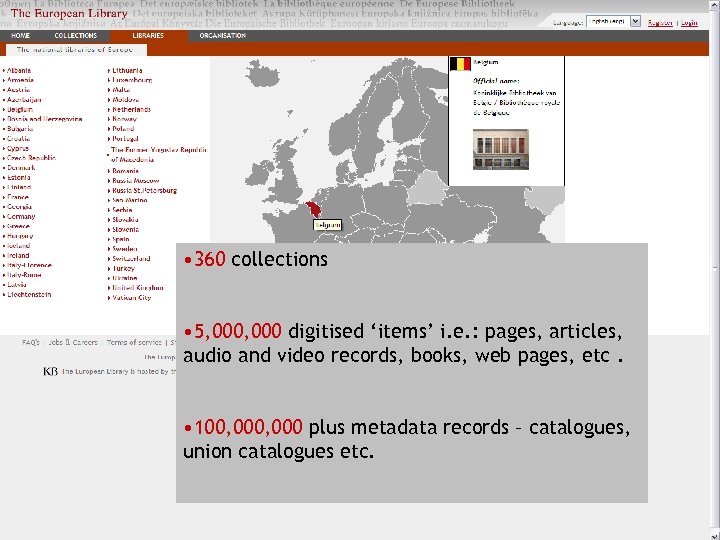 • 360 collections • 5, 000 digitised ‘items’ i. e. : pages, articles, audio and video records, books, web pages, etc. • 100, 000 plus metadata records – catalogues, union catalogues etc.
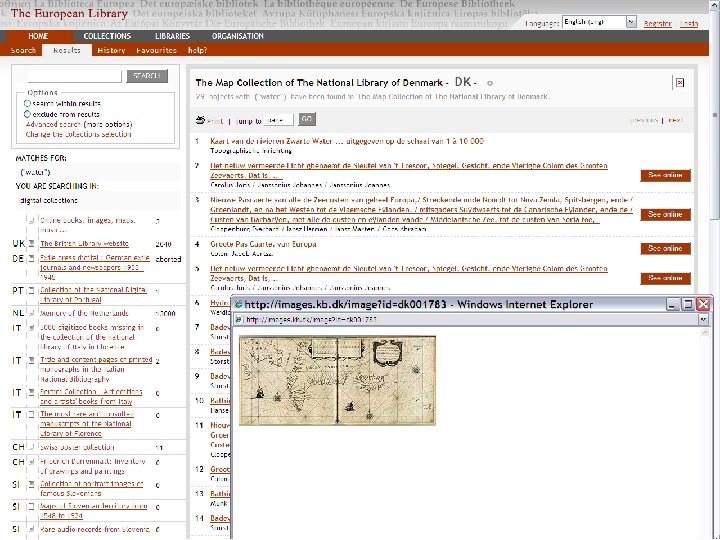
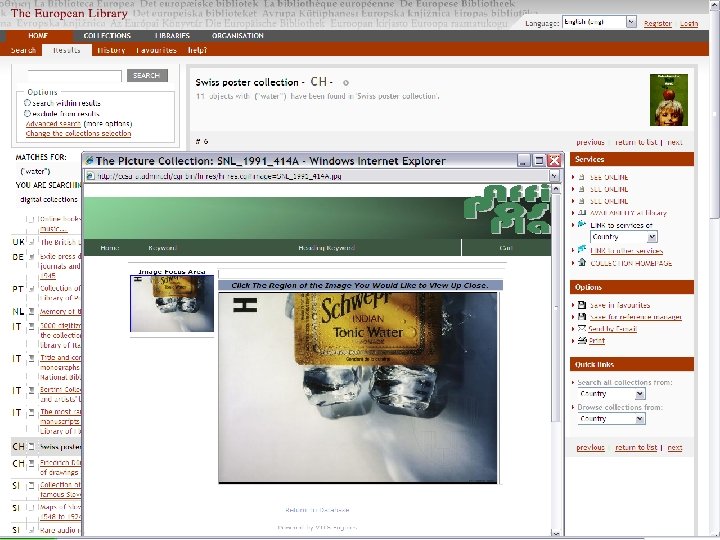
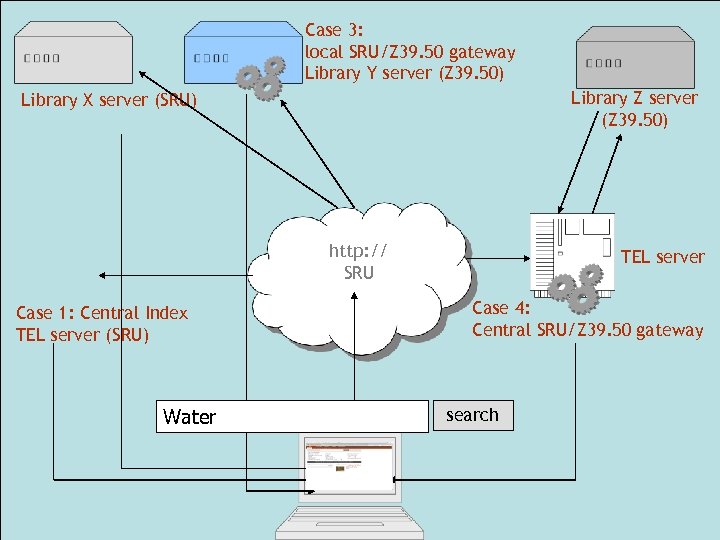 Case 3: local SRU/Z 39. 50 gateway Library Y server (Z 39. 50) Library Z server (Z 39. 50) Library X server (SRU) http: // SRU Case 1: Central Index TEL server (SRU) Water TEL server Case 4: Central SRU/Z 39. 50 gateway search
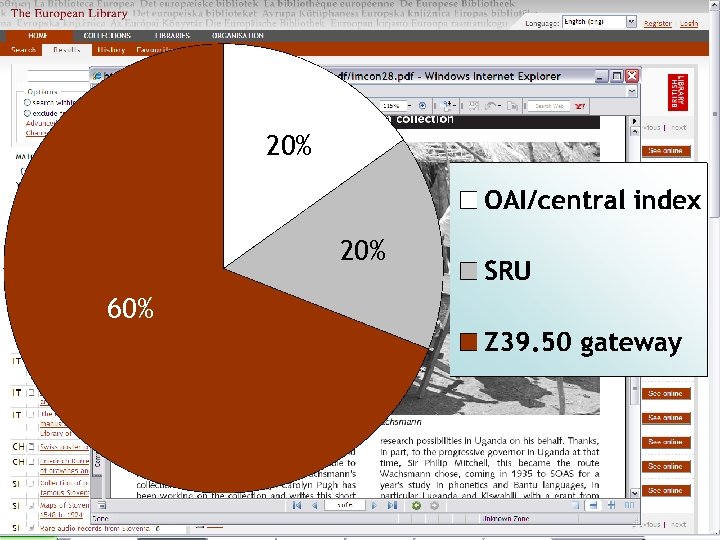 20% 60% T&S
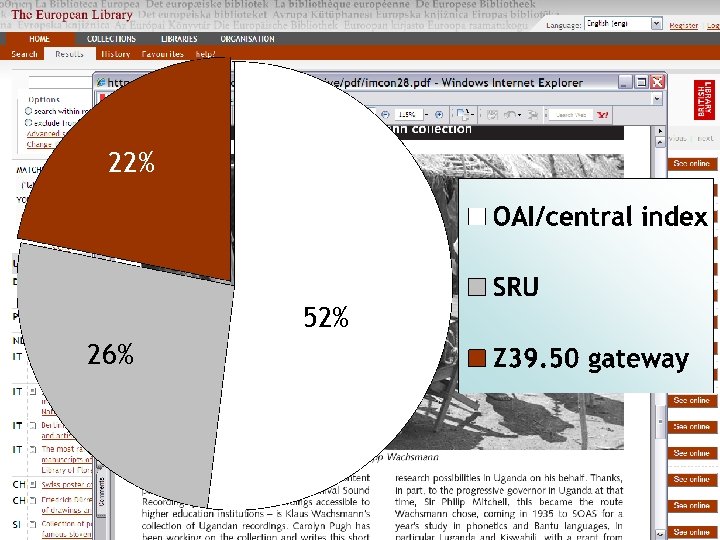 22% 52% 26%
 Access to National Libraries Resources & the need for Persistent Identifiers q. Little digitised – no clamour q. Most was under the z 39: 50 protocol and held in proprietary library systems using internal reference linking But q. Over next 2 -5 years 100 million plus works to be digitised q. Born digital q. OAI-PMH for harvesting
 Access to National Libraries Resources & Current Status of Persistent Identifiers q. CENL recommendations q. NBN’s q. Appropriate Copy q. SURFnet q. IDF Foundation
 Access to National Libraries Resources & Current Status of Persistent Identifiers q CENL recommendations q As guarantors of durable independent access to digital collections a resolution service has to be put in place q This resolution service to be based on URN’s primarily from the NBN namespace q Each National Library has or will set up own resolver service to provide persistent access to its own collections. q By agreeing and deploying standards and coordination for the local set up of such services automatically achieve the National Libraries Resolver Discovery Service q URN service to also take into account other existing persistent identifier schemes q To guarantee long term resolutions of DOI’s, beyond commercial interest the requesters, under specified conditions, to be redirected by the DOI system to the National Libraries Resolver Service and therefore to digital deposit collections.
 Access to National Libraries Resources & Current Status of Persistent Identifiers q NBN’s q Because these were already in use q ‘Item’ not ‘Work’ q Appropriate Copy q Resolver to possibly support enforcement of authorisation with additional identity management in place q SURFnet q Norway, Sweden, Finland, and the Netherlands proposal for a Global Resolver of Persistent Identifiers. In cooperation with representatives of the Hopkins and Berkley Universities (US) a working proof of concept has been developed. (https: //www. surfgroepen. nl/sites/surfshare/public/software/pihandler q IDF Foundation q Costs of belonging perceived to be not worth the return q Would like to resolve the issue of ‘copy of last resort’
 Access to National Libraries Resources Barriers to using DOI’s q. Lack of real or perceived need q. Not invented here q. Not in hock to someone else q. No centralised will q. Competition for Appropriate Copy q. Cost But these are also opportunities
 EU Vision for a European digital library “A common multilingual access point would make it possible to search Europe’s distributed – that is to say, held in different places by different organisations – digital cultural heritage online. Such an access point would increase its visibility and underline common features. The access point should build on existing initiatives such as The European Library (TEL), in which Europe’s libraries already cooperate. It should where possible closely associate private holders of rights in cultural material and all interested stakeholders. A strong commitment by the Member states and cultural institutions to arrive at such an access point should be encouraged. ” European Union Communiqué August 2006
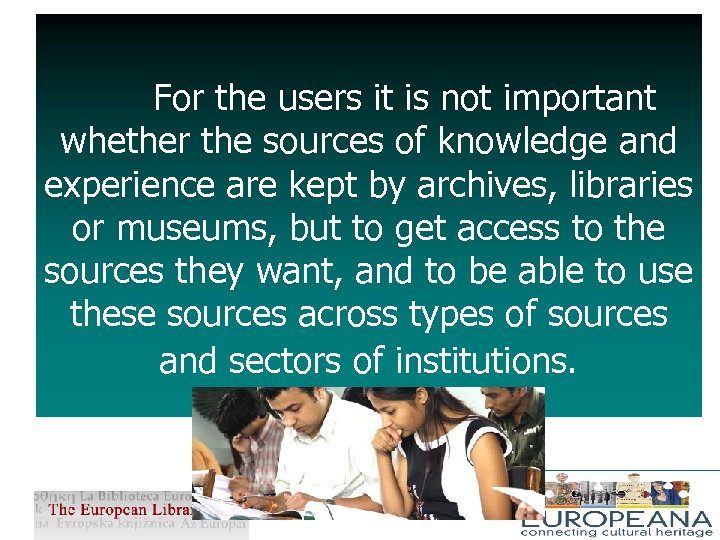 For the users it is not important whether the sources of knowledge and experience are kept by archives, libraries or museums, but to get access to the sources they want, and to be able to use these sources across types of sources and sectors of institutions.
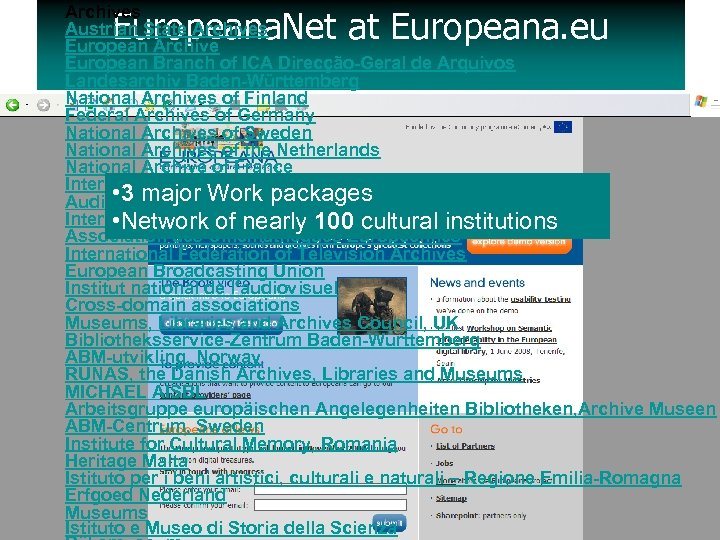 Archives Austrian State Archives European Archive European Branch of ICA Direcção-Geral de Arquivos Landesarchiv Baden-Württemberg National Archives of Finland Federal Archives of Germany National Archives of Sweden National Archives of the Netherlands National Archive of France International Institute for Social History • 3 major Work packages Audio-visual collections International Association of Soundcultural institutions • Network of nearly 100 and Audiovisual Archives Association des Cinémathèques Européennes International Federation of Television Archives European Broadcasting Union Institut national de l'audiovisuel Cross-domain associations Museums, Libraries and Archives Council, UK Bibliotheksservice-Zentrum Baden-Württemberg ABM-utvikling, Norway RUNAS, the Danish Archives, Libraries and Museums MICHAEL AISBL Arbeitsgruppe europäischen Angelegenheiten Bibliotheken, Archive Museen ABM-Centrum, Sweden Institute for Cultural Memory, Romania Heritage Malta Istituto per i beni artistici, culturali e naturali – Regione Emilia-Romagna Erfgoed Nederland Museums Istituto e Museo di Storia della Scienza Europeana. Net at Europeana. eu
 s Cite de la Musique and Salle Pleyel ediatheque. cite. EDLnet – Europeana: the European digital library. fr/masc/? URL=play. asp? ID=0240474 Abbado, XXe anniversaire du Chamber orchestra of Thematic Network Partner Group across Museums, Archives, Lieder de Franz Schubert orchestrés par Johannes Audio-Visual Archives & Libraries Max Reger, Arnold Schoenberg et Anton Webern : started July 07 enregistré à la Cité de la musique le 28 mai 2002 / Andy , réal. ; Thomas Quasthoff, baryton basse. Paris : Cité Primary aims: sique ; Bel Air Média ; Mezzo ; Arte, 2002. 58 min • Bringing together cultural institutions across Europe • Creatng a user defined prototype by November 08 • Making recommendations for a sustainable service Results so far: • 6 million digitised works, items, objects • No standards for unique identification
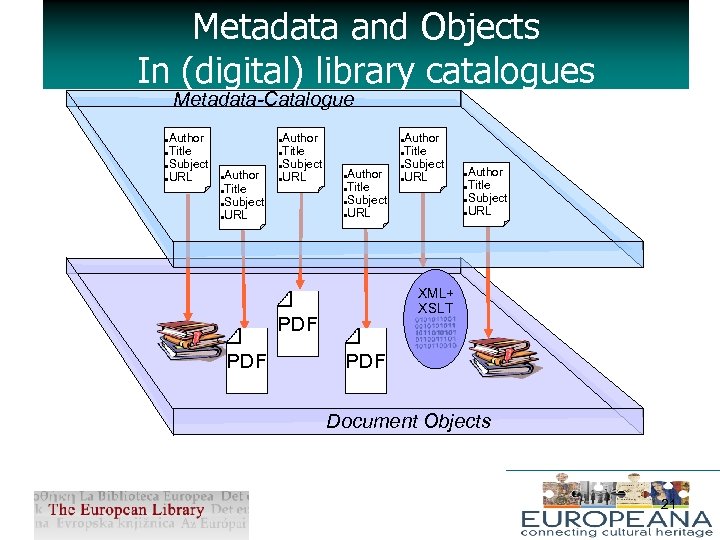 Metadata and Objects In (digital) library catalogues Metadata-Catalogue Author Title Subject URL Author Title Subject URL XML+ XSLT PDF Author Title Subject URL PDF Document Objects 21
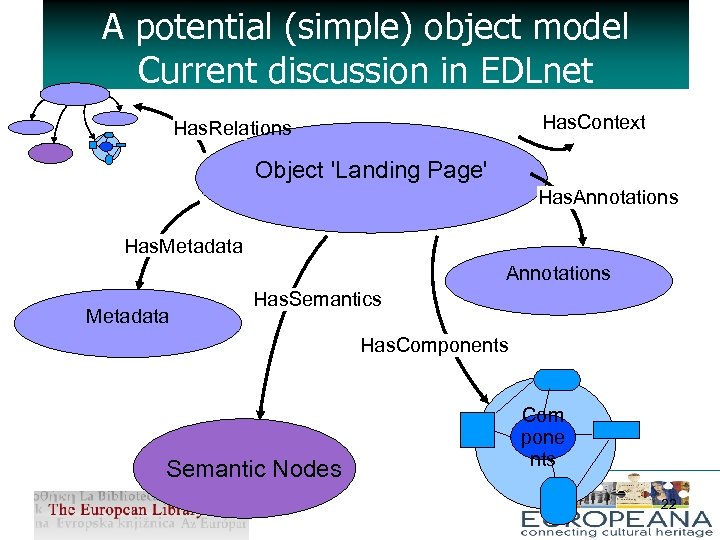 A potential (simple) object model Current discussion in EDLnet Has. Context Has. Relations Object 'Landing Page' Has. Annotations Has. Metadata Annotations Metadata Has. Semantics Has. Components Semantic Nodes Com pone nts 22
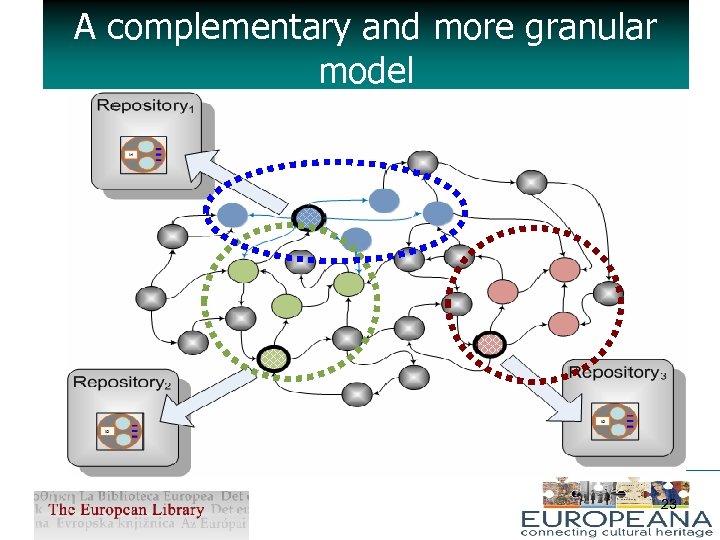 A complementary and more granular model Object Reuse and Exchange (ORE) 23
 Europeana. eu and Persistent Identifiers q. Huge amount of digitised material q. Need Persistent Identifiers to: q prevent broken links, q ensure appropriate copy
 Europeana. eu – whither Persistent Identifiers? q. Each domain needs to be convinced q. A standard should be promoted q. A simple registry or ? q. How shall we do this?
 Cutting the road……….