


 Скачать презентацию Access to Medical Care for Work-Related Injuries and
7edaf3320012adc7f7b36abd8c22e94c.ppt
- Количество слайдов: 27
 Access to Medical Care for Work-Related Injuries and Illnesses “Why comprehensive insurance coverage is not enough to assure timely and appropriate care” Allard E. Dembe, Sc. D. Associate Professor and Senior Research Scientist Center for Health Policy and Research University of Massachusetts Medical School
 What is meant by “Access to Care”?
 Aday and Anderson (1981): “Entry of a given population group to the health care delivery system”
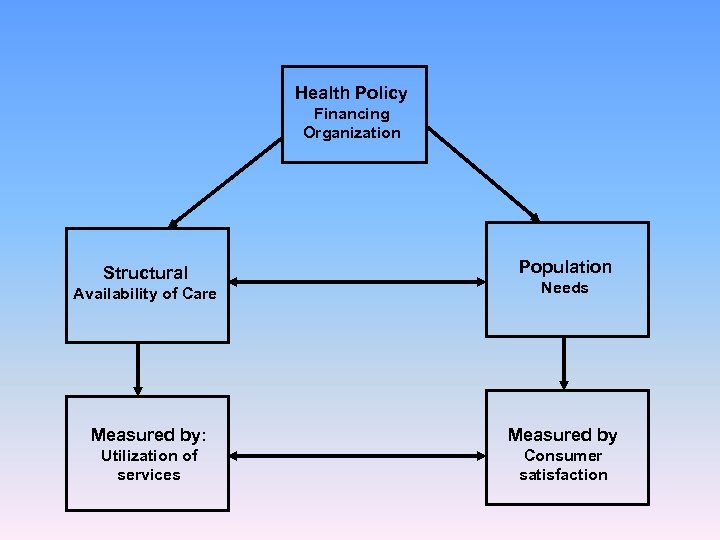 Health Policy Financing Organization Structural Population Availability of Care Needs Measured by: Measured by Utilization of services Consumer satisfaction
 Weissman and Epstein (1994): “Access is the attainment of timely, sufficient, and appropriate health care of adequate quality such that health outcomes are maximized”
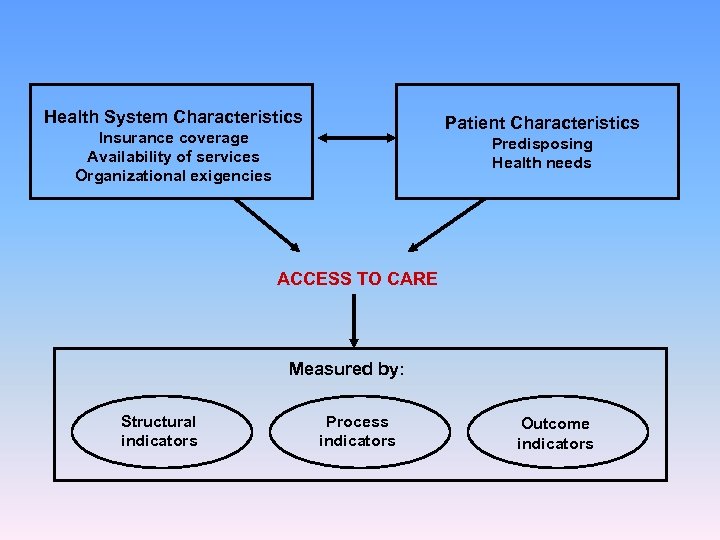 Health System Characteristics Patient Characteristics Insurance coverage Availability of services Organizational exigencies Predisposing Health needs ACCESS TO CARE Measured by: Structural indicators Process indicators Outcome indicators
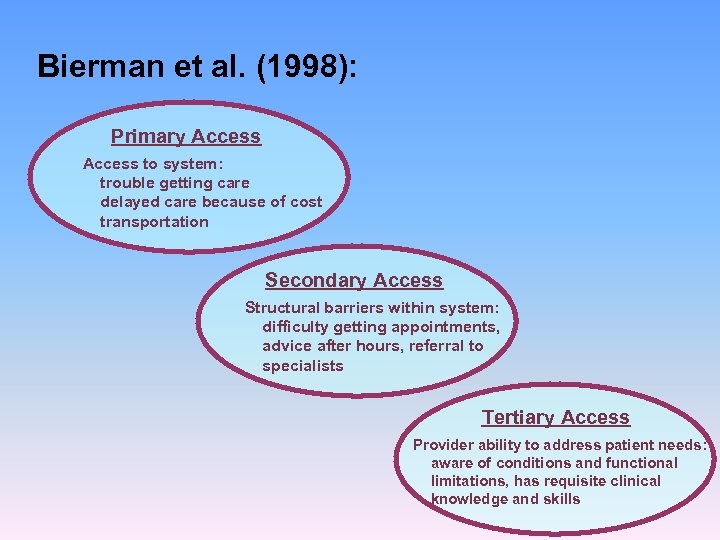 Bierman et al. (1998): Primary Access to system: trouble getting care delayed care because of cost transportation Secondary Access Structural barriers within system: difficulty getting appointments, advice after hours, referral to specialists Tertiary Access Provider ability to address patient needs: aware of conditions and functional limitations, has requisite clinical knowledge and skills
 General Medical Care Major access-to-care problem is the lack of affordable health insurance


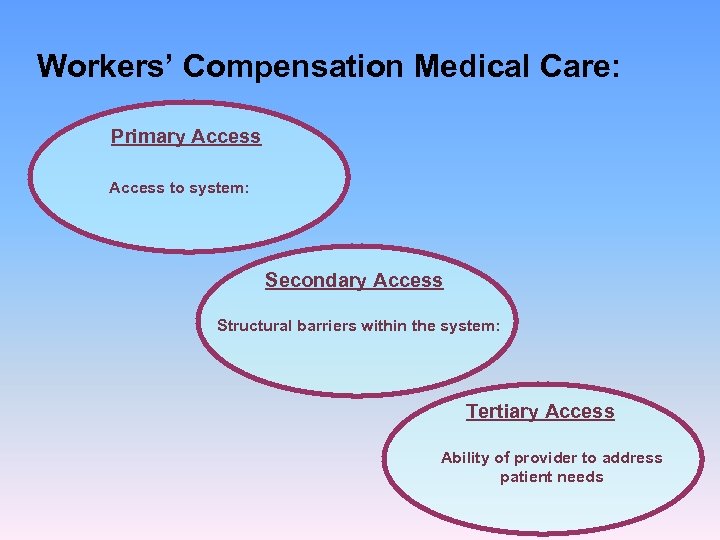 Workers’ Compensation Medical Care: Primary Access to system: Secondary Access Structural barriers within the system: Tertiary Access Ability of provider to address patient needs
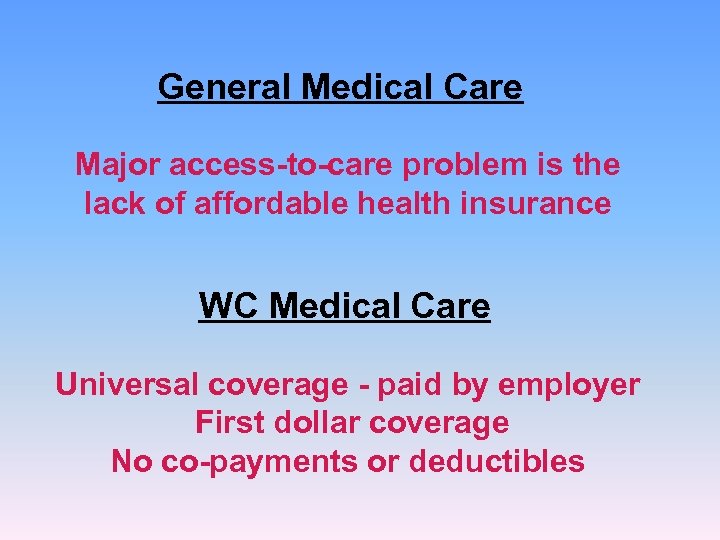 General Medical Care Major access-to-care problem is the lack of affordable health insurance WC Medical Care Universal coverage - paid by employer First dollar coverage No co-payments or deductibles
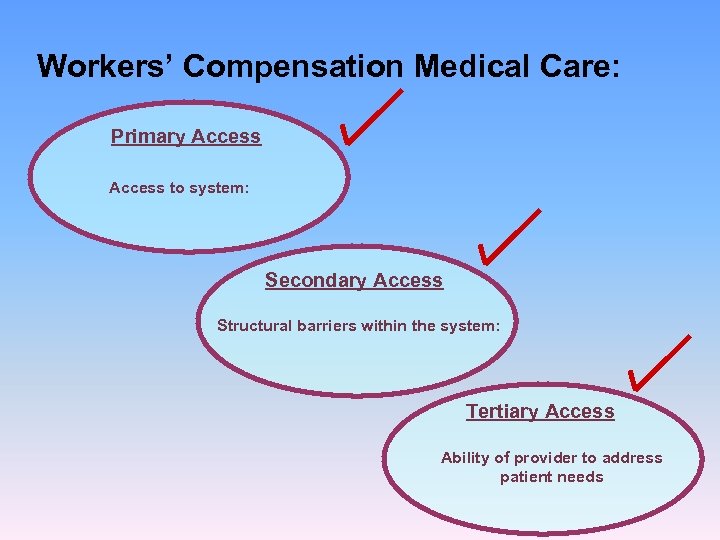 Workers’ Compensation Medical Care: Primary Access to system: Secondary Access Structural barriers within the system: Tertiary Access Ability of provider to address patient needs
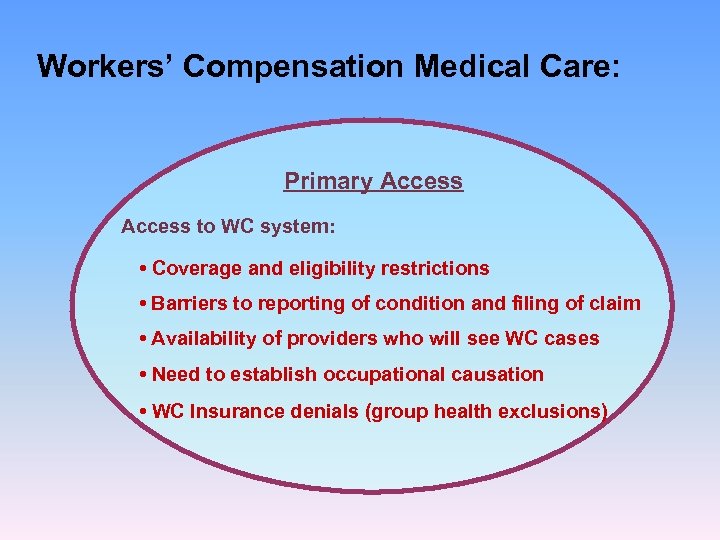 Workers’ Compensation Medical Care: Primary Access to WC system: • Coverage and eligibility restrictions • Barriers to reporting of condition and filing of claim • Availability of providers who will see WC cases • Need to establish occupational causation • WC Insurance denials (group health exclusions)
 WC Reporting Problems (Azafoff et al. 2002): • Employer disincentives (e. g. , safety award programs) • Employer reprisals (e. g. , fear of job loss) • Stigmatization and labor market consequences • Lack of employer or employee knowledge about WC • Language and cultural barriers • Failure of clinicians to diagnosis work-related conditions • Waiting times and masking of lost work days • Employer in-house first aid and medical care
 Insurance Denials: An Example Union of Needletrades and Industrial Textile Employees UNITE Health Center in New York City: Low-wage, female, immigrant textile workers diagnosed with occupational carpal tunnel syndrome: • 79% of claims denied (96% eventually accepted) • Average of 429 days from claim filing to judge’s ruling • 226 days from physician authorization to treatment • 318 days from physician authorization to surgery • Likelihood of rejection linked to ethnicity and social class
 Workers’ Compensation Medical Care: Secondary Access Structural barriers within the WC system: • Limitations regarding choice of provider • Low fee schedules inhibit provider availability • Need for out-of-pocket payments (prescription drugs) • Extensive UR requirements and authorization for care • Lack of trained occ. medicine providers (e. g. rural)
 Utilization Review: Examples Authorization for care was required approximately four times more often for WC cases compared to cases paid for by general (non-WC) health insurance, after controlling for diagnosis, age, gender, region, location of care, and other factors source: Dembe et al (2002): Among patients with low-back pain in New York State, the need to obtain insurer authorization delayed access to specialists and physical therapists, increasing costs by 25%. source: Gallagher and Myers (1996):
 Out-of-Pocket Expenses: An Example 69% of WC claimants in the New York state civil service obtain prescription medications for their work-related injuries using their group health plan. source: Stapleton (2003):
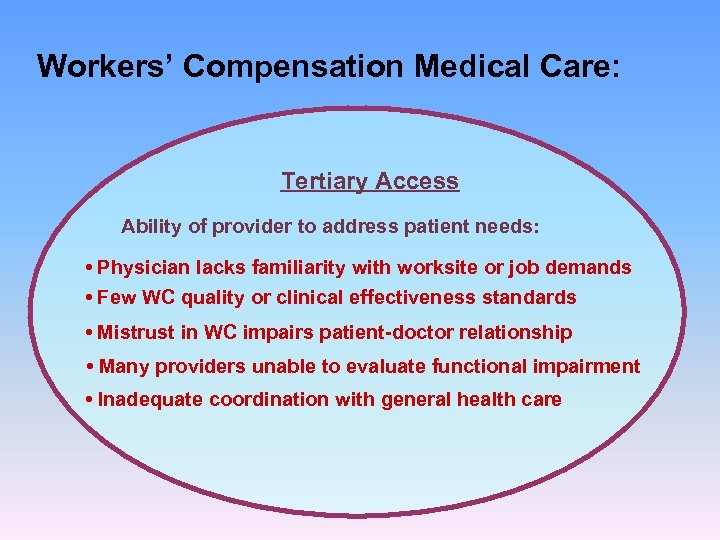 Workers’ Compensation Medical Care: Tertiary Access Ability of provider to address patient needs: • Physician lacks familiarity with worksite or job demands • Few WC quality or clinical effectiveness standards • Mistrust in WC impairs patient-doctor relationship • Many providers unable to evaluate functional impairment • Inadequate coordination with general health care
 Tertiary Access Problems in WC: Examples Injury prevention was discussed at only 11. 4% of medical visits for work-related disorders. Patients receiving care for work-related musculoskeletal disorders under WC have their blood pressure taken 42% less often than patients receiving care for musculoskeletal disorders under general health plans, after controlling for age, gender, and other confounders. source: Dembe (2002)
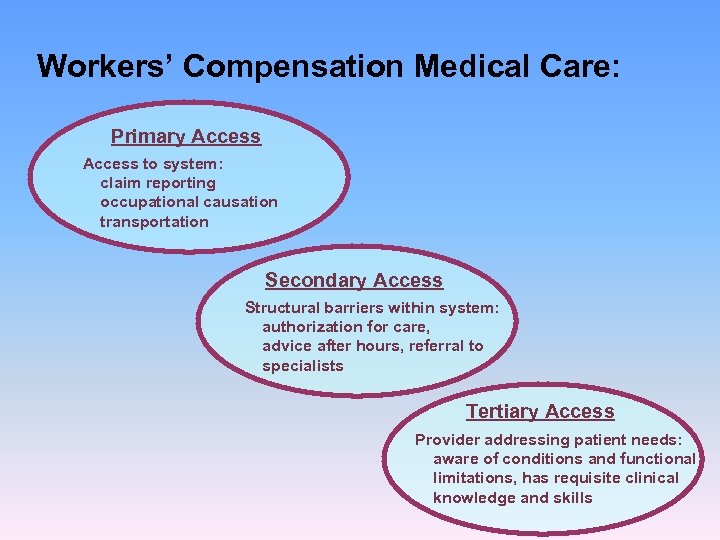 Workers’ Compensation Medical Care: Primary Access to system: claim reporting occupational causation transportation Secondary Access Structural barriers within system: authorization for care, advice after hours, referral to specialists Tertiary Access Provider addressing patient needs: aware of conditions and functional limitations, has requisite clinical knowledge and skills

 So, what can be done to ensure appropriate access to WC medical care?
 Protective measures include: • Worker involvement in design and selection of WC health care plan • Guarantees on choice of primary provider and specialists • Provisions in purchaser’s contract to ensure adequate access • Government oversight & regulation specifying access requirements • Certification and accreditation standards regarding access • Internal/external audit procedures aimed at access problems • Methods to ensure access during periods of controversion • Appeals and complaint procedures for injured workers From Dembe, 1999
 Specific access requirements might include: • Precise time requirements for responding to requests for care • Distance requirements for location of care facilities • Minimum staffing levels to ensure availability of clinicians • Patient surveys to monitor satisfaction with access to care • Educational programs about WC care for workers and providers • Specific information for employees about contacting providers • Cultural and language accommodations for specific populations
 Access to Medical Care for Work-Related Injuries and Illnesses “Why comprehensive insurance coverage is not enough to assure timely and appropriate care” Allard E. Dembe, Sc. D. Associate Professor and Senior Research Scientist Center for Health Policy and Research University of Massachusetts Medical School Allard. Dembe@umassmed. edu