


 Скачать презентацию Access to care and treatment for PLWHA RC RC
46785a641e67a2a1b988ebb195848c66.ppt
- Количество слайдов: 20
 Access to care and treatment for PLWHA RC/RC service delivery model International Federation of Red Cross and Red Crescent Societies
 Objectives of the mission The objectives are to : Ø assess capacity, major gaps and opportunities Ø get insight on the political commitment and level of preparation Ø develop Federation service delivery model 4
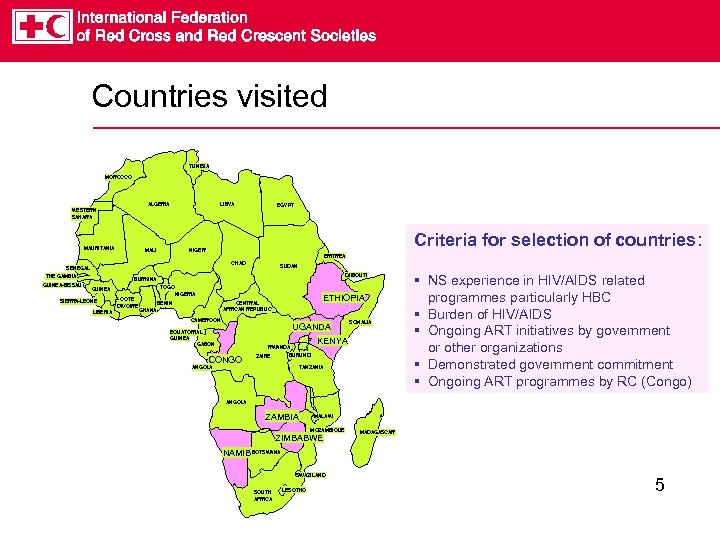 Countries visited TUNISIA MOROCCO ALGERIA LIBYA EGYPT WESTERN SAHARA MAURITANIA MALI Criteria for selection of countries: NIGER ERITREA CHAD SENEGAL THE GAMBIA GUINEA-BISSAU SUDAN DJIBOUTI BURKINA TOGO NIGERIA GUINEA SIERRA-LEONE LIBERIA COTE D'IVOIRE ETHIOPIA CENTRAL AFRICAN REPUBLIC BENIN GHANA CAMEROON UGANDA EQUATORIAL GUINEA GABON KENYA RWANDA CONGO SOMALIA BURUNDI ZAIRE ANGOLA TANZANIA § NS experience in HIV/AIDS related programmes particularly HBC § Burden of HIV/AIDS § Ongoing ART initiatives by government or other organizations § Demonstrated government commitment § Ongoing ART programmes by RC (Congo) ANGOLA ZAMBIA MALAWI MOZAMBIQUE ZIMBABWE MADAGASCAR BOTSWANA NAMIBIA SWAZILAND SOUTH AFRICA LESOTHO 5
 Method used in the study Combination of empirical (observational) and examination of documents conducted through : Ø Organizing visits to selected organizations and dialogue with key informants (>100) Ø Collection of pertinent information from organizations using pre-designed format Ø Site visits to ART pilot areas 6
 Conclusion Ø Governments are strongly on the move for provision of ARVs Ø ART implementation in resource-limited countries is feasible Ø RC/RC NSs are well placed to collaborate in ART provision Ø The biggest constraint is funding at community level 7
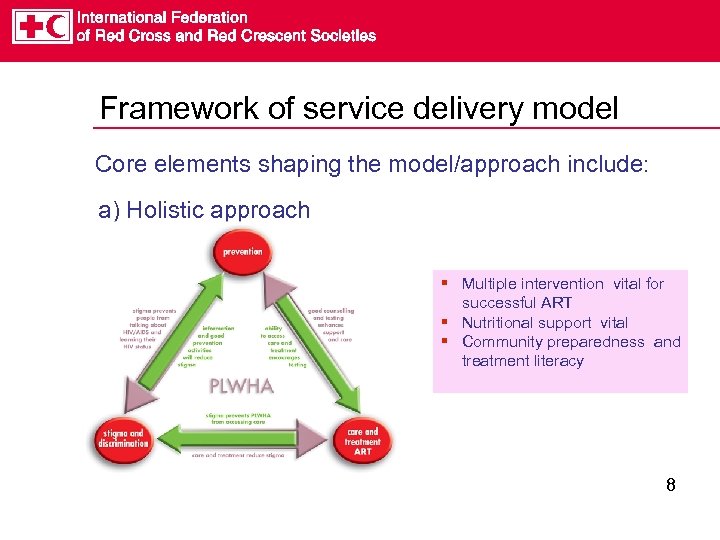 Framework of service delivery model Core elements shaping the model/approach include: a) Holistic approach § Multiple intervention vital for successful ART § Nutritional support vital § Community preparedness and treatment literacy 8
 Framework of service delivery modelcontinue b) Continuum of care: Ø Systematic linkage of services from hospitals to home and vice versa Ø ART must be integral part of continuum of care, treatment and prevention c) Phased approach: Ø Gradual expansion Ø VCT – PMTCT/ART 9
 Framework of service delivery model continue d) Use of existing structure –government/ private: Ø Base on existing technical competence Ø Consider long term management e) Partnership: Ø Need of multisectoral approach (food, IEC, counselling etc. ) Ø Magnitude of the problem Ø Concerted effort f) NS niche: Ø Define entry point based on competence and experience 10
 Framework of service delivery modelcontinue g) Focus on vulnerable groups: Ø Ø Target the marginalized ones / poor Include RC/RC NS operation site h) Advocacy: Ø Universal access Ø Urgency, replacement feeding, PMTCT- plus etc. Ø Sustainable funding, price reduction i) Resource mobilization: Ø Federation Secretariat & NSs need to exert maximum effort Ø Need for designing innovative approach 11
 Framework of service delivery modelcontinue j) Capacity building: Ø Effective intervention and expansion requires capacity Ø It is an ongoing process focusing at all levels k) Sustainability: Ø Implies continuous resource mobilization Ø Managerial efficiency- drug distribution 12
 Critical components of effective ART intervention a) Foundation: Ø Community preparation & treatment literacy Ø VCT – Increased sites and accessible Ø Affordability – proximity, minimize financial barrier b) Psychological support: Ø Increased number of counsellors needed Ø Use professional counsellors and trained volunteers – lay counsellors c) Prevention (IEC, protective means): Ø PLWHA and all community members need IEC Ø Apply peer education, information campaign, mass media, formal education 13
 Critical components of effective ART intervention continue d) Food security and nutrition: Ø Short term–food parcel for PLWA & family members Ø Education on proper diet Ø Medium term – Agricultural inputs for rural and semi-urban. Mobilize community support e) Other support: Ø Provision of potable water-helps replacement feeding too Ø Environmental sanitation Ø Support to OVC (schooling, nutrition, legal support) 14
 Critical components of effective ART intervention - continue f) PMTCT and PMTCT-plus: Ø Education and sensitization Ø Counselling Ø ART – preventive and HAART Ø Monitor adherence g) Clinical management - ART and OIs: Ø DX and clinical management as per protocol (country /WHO) Ø Patient selection - clinical and social criteria, committee Ø Simplification of ART regimen – standardization, fixed combination, involve mid level HCWs 15
 Critical components of effective ART intervention continue h) Promotion of adherence to ART: Ø Ø Ø Minimize pill count – triple combination Family support DOTS approach Nutritional support Community support- destigmatization, peer support Patient education 16
 Critical components of effective ART intervention continue j) Drug procurement and distribution Ø Drug selection Ø Suppliers selection Ø Quality control Ø Distribution and rational use of drugs N/B The procurement of drugs will be done using the already Existing government approved system. 17
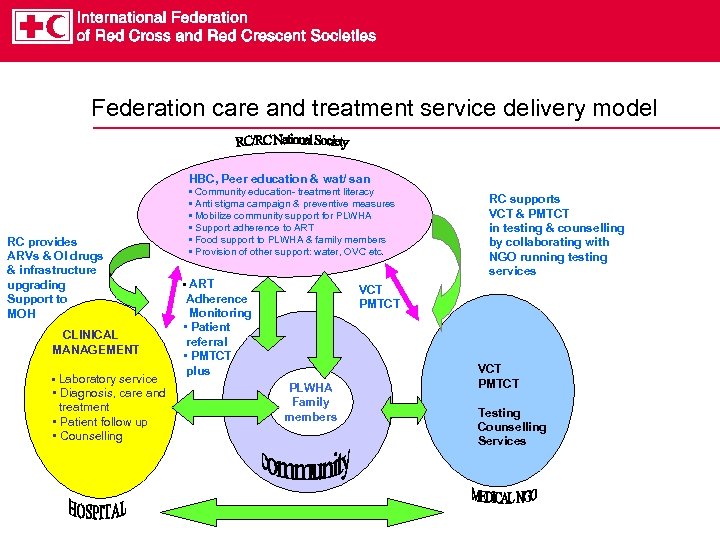 Federation care and treatment service delivery model HBC, Peer education & wat/ san RC provides ARVs & OI drugs & infrastructure upgrading Support to MOH CLINICAL MANAGEMENT • Laboratory service • Diagnosis, care and treatment • Patient follow up • Counselling • Community education- treatment literacy • Anti stigma campaign & preventive measures • Mobilize community support for PLWHA • Support adherence to ART • Food support to PLWHA & family members • Provision of other support: water, OVC etc. • ART RC supports VCT & PMTCT in testing & counselling by collaborating with NGO running testing services VCT PMTCT Adherence Monitoring • Patient referral • PMTCT plus PLWHA Family members VCT PMTCT Testing Counselling Services
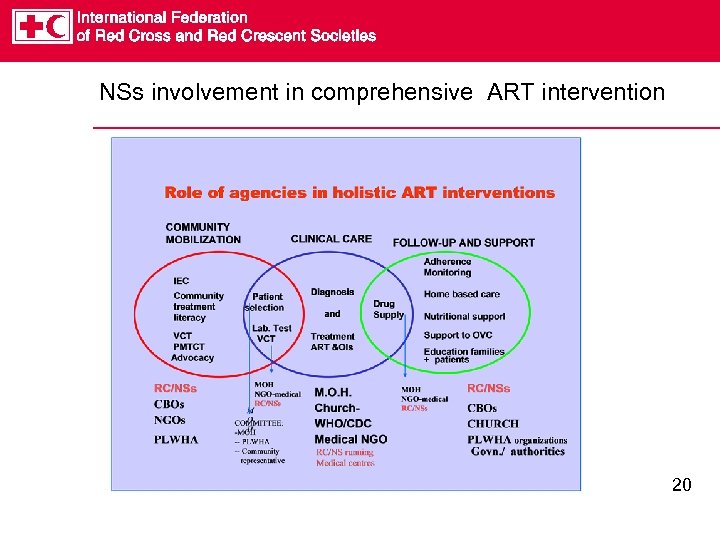 NSs involvement in comprehensive ART intervention 20
 Elements to be considered in programme management Put in place sound management structure that expedites efficiency. Some aspects to consider include: a) Coordination : Ø Involve stakeholders from planning to implementation Ø Establish smooth information exchange mechanism Ø Establish small coordination committee b) Financial administration: Ø Put in place a system that promote transparency and accountability 21
 Elements to be considered in programme management continue c) Reporting: Ø User friendly format that captures relevant information Ø Regularity in reporting based on agreed frequency d) Monitoring and evaluation: Ø Define process, output and impact indicators Ø Strong monitoring mechanism needs to be in place Ø Mid term evaluation after 2 years and final end 5 years 22
 Elements to be considered in programme management continue e) Institutional arrangement Well defined collaborative arrangement is vital; thus the need for MOU which captures: Ø Ø Ø Areas of responsibility Division of task- areas of implementation Information exchange mechanism Target population Mechanism for expediting collaborative efforts i. e. committee, etc. 23