


 Скачать презентацию Access Networks Connecting the final mile to homes
085a00333823caa9b68c68d882db0ff6.ppt
- Количество слайдов: 19
 Access Networks: Connecting the ‘final mile’ to homes and small businesses Ian Pratt University of Cambridge Computer Laboratory
 Requirements ¾more bandwidth & reduced latency § avoiding the world wide wait • e-commerce § better quality audio/video • VOD, special interest TV § IP telephony/video conferencing ¾“always-on” § remote access to home servers § instant messaging
 Connectivity options ¾conventional modems / ISDN ¾x. DSL ¾cable modems ¾fixed wireless : microwave/laser ¾fiber to the home/kerb ¾satellite : LEO/GEO/HAA ¾mobile wireless : GSM/GPRS/3 G & 802. 11
 Telephone Network ¾conventional modems § digital-analogue-(digital)-analogue-digital • more advanced modulation techniques • 9. 6, 14. 4, 28. 8, 36. 4 Kbps § use direct digital connection at ISP • 56 Kbps downlink (still 36 KBps uplink) ¾ISDN digital telephone line § 64+64 Kbps with rapid connection setup § requires fairly good quality line
 x. DSL: Digital Subscriber Line ¾Use existing twisted pair copper plant § point-to-point link ¾but, not a great transmission medium: § single pair, long, gauge & material changes § high freq loss, bridge taps and load coils ¾interference sources § RF pickup/egress, thermal noise, reflections § Near End crosstalk (NEXT), Far End (FEXT) ¾Throw DSP at the problem. . .
 x. DSL variants ¾ HDSL: 1. 5 Mbps, symmetric, 2 pair, no POTS, up to 12 kft § T 1/E 1 delivery (old) ¾ SDSL: 1. 5 Mbps, symmetric, 1 pair, up to 18 kft ¾ ADSL: 640 -8 Mbps ds, 64 -800 kbps us, 1 pair, POTS/ISDN, up to 18 kft ¾ ADSL G. Lite: as above but 1. 5 Mbsp ds, 512 Kbps us § “self install” splitter-less ADSL ¾ VDSL: 6 -52 Mbps ds, 2 Mbps us, 1 pair, POTS, 1 -16 Kft also 1, 2, 4, 6, 8, 12 Mbps symmetric ¾ Bandwidth negotiation and noise monitoring ¾ Asymmetric variants to reflect current traffic patterns
 Competing x. DSL technologies ¾CAP/QAM § single "carrier" § lower symbol (baud) rate by encoding multiple bits per symbol ¾DMT – current winner § many carriers e. g. ADSL has 249 x 4 k. Hz channels with 15 bit QAM = 249 x 60 kbps § poor channels can be discarded/down-coded • Reduce symbol rate, fewer bits; more FEC § requires lots of DSP
 x. DSL regulatory issues ¾Incumbent Local Exchange Carrier (ILEC) e. g. BT vs. Competitive LEC (CLEC) ¾How to ‘open-up’ the market? § Physical level vs. DSL level vs. ISP level § issues of maintenance responsibility, exchange access etc ¾Maintaining ‘life-line’ phone service
 Cable Modems ¾Uses CATV coax tree from Head End § serves 1000’s of customers • rapid rollout -- can split tree later ¾ 30 -40 Mb/s shared downstream bw § single 6 MHz channel (same as a TV station) § 64/256 QAM encoding § head-end scheduled
 Cable Modems ¾Upstream channel is harder (320 -10 Mbps) § 16 QAM § need MAC protocol for Collision Detect and retransmission, fair bandwidth sharing § large distances require ranging optimizations § DOCSIS 1. 1 ¾Encryption necessary for both channels § DES block cipher
 Fixed Wireless ¾Microwave and free-space laser § line-of-sight between rooftop antennas • avoids multi-path interference, lower power ¾Free-space laser systems § 2 -155 Mbps and up § relatively narrow beam requires stable fixtures § Wavelength Division Multiplex systems
 Fixed Wireless ¾Microwave § point-to-point and multi-point systems § MMDS: 2 GHz, 20 -50 km, 0. 2 -2 Mbps § LMDS: 28 GHz, 5 km, 1 -20 MBps § MVDS: 40 GHz, 3 km, 100 MBps+ ¾Free spectrum above 5 GHz § but, limited propagation, ‘rain-fade’, requires high-speed electronics. . .
 Satellite ¾ GEO stationary § 36, 000 km orbit § e. g. 2 x 120 ms RTT ¾ LEO constellations § 20+ in 1, 500 km orbits (2 hr) § latency typically sub 100 ms, 300 Mbps+ § interconnect options: • 1. forward to ground station • 2. Uplink to a GEO network • 3. LEO to LEO laser
 “Near-satellite” ¾Avoid LEO roll-out costs § target your market audience ¾Fuel efficient planes § 55, 000 ft, 2 pilots on 8 hr shifts § NASA Helios : solar-powered wing ¾high-altitude balloons § above most weather systems § use ion engines to stay in place
 Fiber to the kerb / home ¾A reasonable solution for new properties § fiber is cheap, termination costs dropping ¾Digging up the street is very expensive § Especially into every home ¾Fiber to the ‘kerb-side box’ § remaining short length of existing copper good for 100’s of Mbps.
 Public mobile wireless ¾ GSM currently provides 9600 and 14400 bps circuit data service § Slow connection setup, no stat-mux gain, 600 ms RTT ¾ GPRS – packet data over GSM § 32 Kb/s - 100 Kb/s, 900 -1500 ms RTT! § HTTP/TCP behaves very poorly ¾ UMTS “ 3 G” services optimized for data § 384 kbps quoted for pedestrians ¾ Public mobile b/w capabilities look set to remain poor & expensive in contrast to fixed
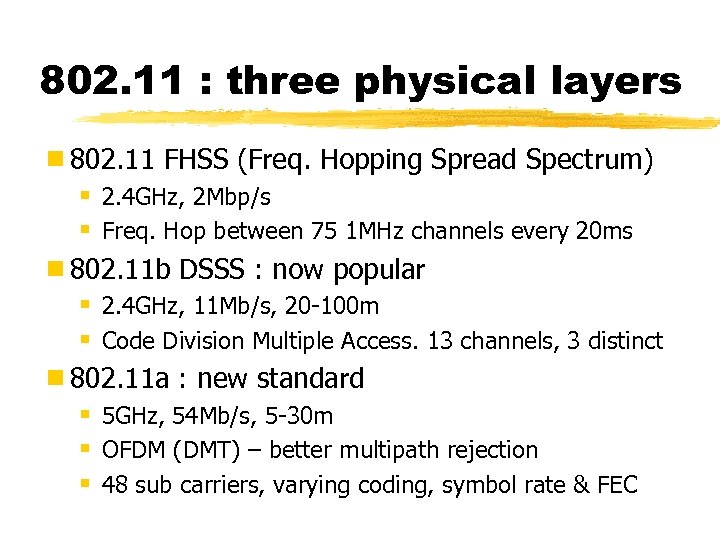 802. 11 : three physical layers ¾ 802. 11 FHSS (Freq. Hopping Spread Spectrum) § 2. 4 GHz, 2 Mbp/s § Freq. Hop between 75 1 MHz channels every 20 ms ¾ 802. 11 b DSSS : now popular § 2. 4 GHz, 11 Mb/s, 20 -100 m § Code Division Multiple Access. 13 channels, 3 distinct ¾ 802. 11 a : new standard § 5 GHz, 54 Mb/s, 5 -30 m § OFDM (DMT) – better multipath rejection § 48 sub carriers, varying coding, symbol rate & FEC
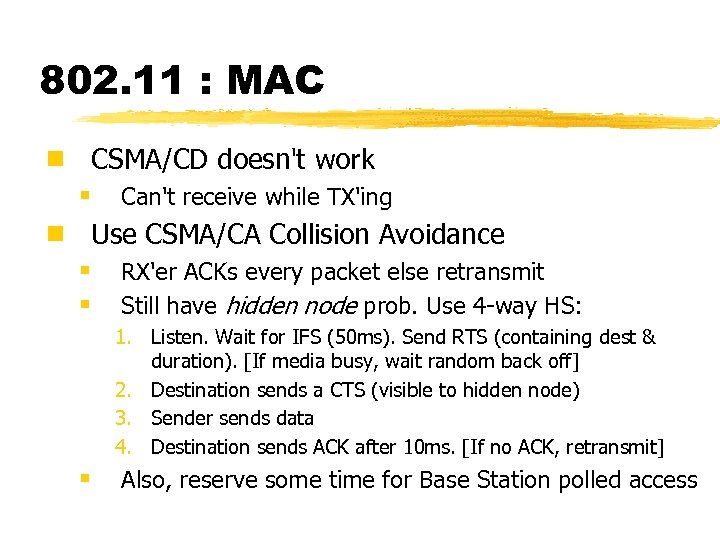 802. 11 : MAC ¾ CSMA/CD doesn't work § Can't receive while TX'ing ¾ Use CSMA/CA Collision Avoidance § RX'er ACKs every packet else retransmit § Still have hidden node prob. Use 4 -way HS: 1. Listen. Wait for IFS (50 ms). Send RTS (containing dest & duration). [If media busy, wait random back off] 2. Destination sends a CTS (visible to hidden node) 3. Sender sends data 4. Destination sends ACK after 10 ms. [If no ACK, retransmit] § Also, reserve some time for Base Station polled access
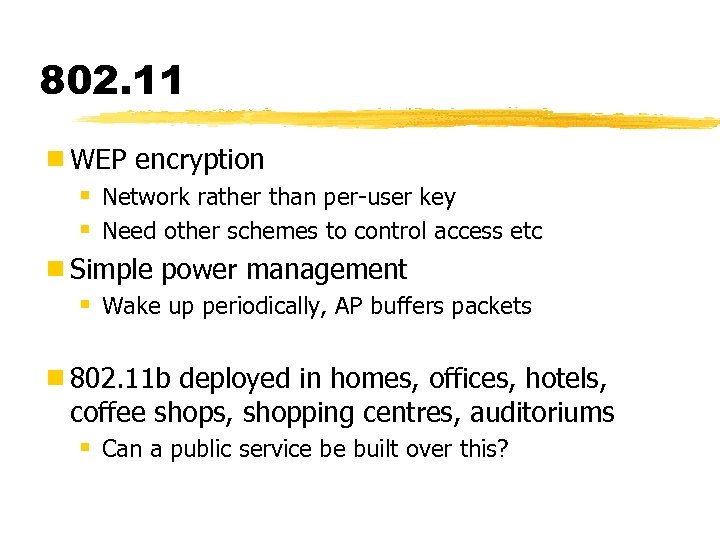 802. 11 ¾ WEP encryption § Network rather than per-user key § Need other schemes to control access etc ¾ Simple power management § Wake up periodically, AP buffers packets ¾ 802. 11 b deployed in homes, offices, hotels, coffee shops, shopping centres, auditoriums § Can a public service be built over this?