


 Скачать презентацию Acceptance Commitment Therapy With Couples Dr Russ
061e6fe2af7e2ad4bd326b741860041c.ppt
- Количество слайдов: 39
 Acceptance & Commitment Therapy With Couples Dr Russ Harris, M. B. B. S. , M. A. C. Psych. Medical Practitioner, Psychotherapist russharris@actmindfully. com. au www. actmindfully. com. au
 Aims of the Workshop ACT conceptualisation of relationship issues 2. ACT interventions for relationship issues 3. Interspersed with experiential exercises 1. 2
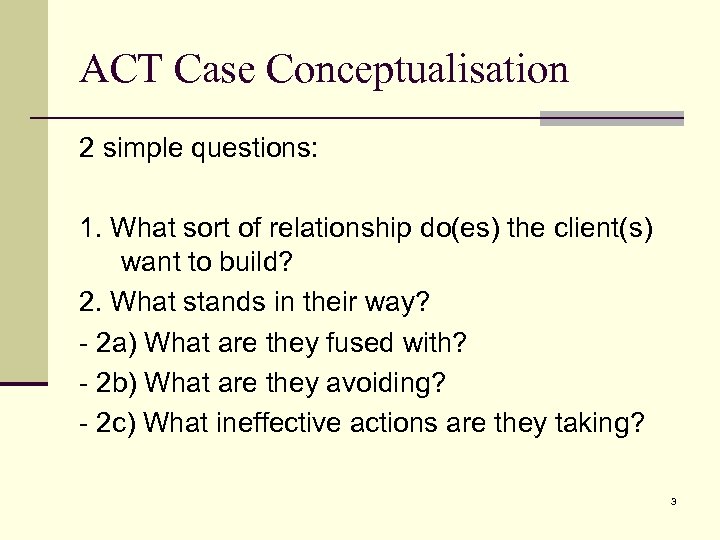 ACT Case Conceptualisation 2 simple questions: 1. What sort of relationship do(es) the client(s) want to build? 2. What stands in their way? - 2 a) What are they fused with? - 2 b) What are they avoiding? - 2 c) What ineffective actions are they taking? 3
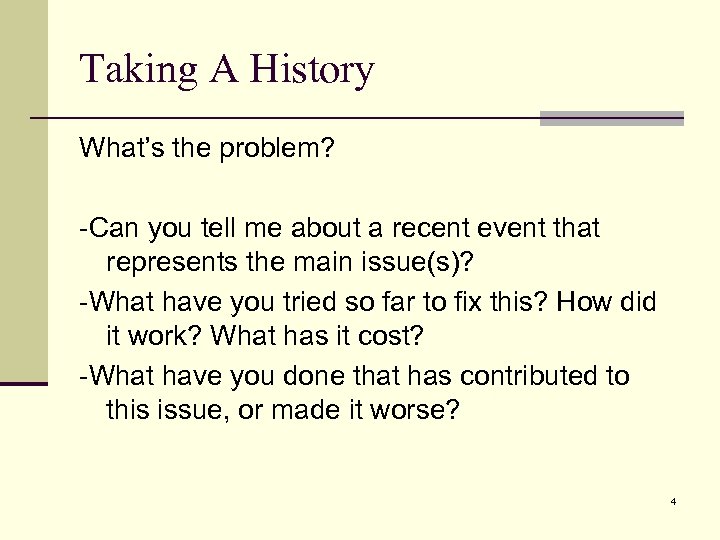 Taking A History What’s the problem? -Can you tell me about a recent event that represents the main issue(s)? -What have you tried so far to fix this? How did it work? What has it cost? -What have you done that has contributed to this issue, or made it worse? 4
 Taking A History Relationship history: how did you meet, what attracted you, wedding day etc. What do you value in your relationship & your partner, currently? (What did you value in your relationship & your partner back then? ) 5
 Taking A History On a scale of 1 -10, how sure are you about staying in this relationship? On a scale of 1 -10, how much work are you willing to do to improve the relationship? 6
 Stay or leave? n Assess pros & cons of each n Have you given it your best shot? n Whichever option you choose, you’ll need to make room for anxiety, doubt, worry etc n Sitting on the fence metaphor n Live by your values, whether you stay or leave 7
 Taking A History What sort of partner do you want to be? What sort of relationship do you want to build? - Magic wand - Visualise: self as ideal partner vs self as reactive partner – reflect & share - 80 th birthday – partner gives a speech - Valued living questionnaire - Share values 8
 Typical Core Values n Connection n Caring n Contribution 9
 Values to Goals What’s a small step you can take? What’s a little thing you could do? 10
 Values to Goals If your partner actually does that, what difference would it make to you? How will you let them know that? 11
 Values to Goals If client makes positive changes: n What was that like for you? n What happened to your relationship as a result? n What’s another little step you can take? 12
 Values to Goals If client doesn’t make positive changes: n What was that like for you? n What happened to your relationship as a result? n What got in the way? 13
 The Barriers to change: F. E. A. R. Official ACT version: Fusion Evaluation Avoidance Reason-giving 14
 The Barriers to change: F. E. A. R. Alternative version: Fusion Excessive expectations Avoidance Remoteness from values 15
 The Antidote to FEAR is DARE Defusion Acceptance Realistic expectations Embrace values 16
 Key Issues 4 approaches to any problem situation 1. Leave 2. Stay & Change what can be changed & live by your values 3. Stay & Accept what can’t be changed & live by your values 4. Stay & Give up & increase your suffering through self-defeating behaviours 17
 Key Issues Behaviour change 101: What’s in your control, and what’s not? Carrot versus stick 18
 Key Issues Communication 101: Ask clearly for what you want, (and explain why) Express clearly what you don’t want, (and why) As you do this, be the partner you want to be! Boundaries & consequences 19
 Key Issues When you’re upset: n Breathe out n I notice I’m feeling x n I’m having the thought that. . n Get present; ground yourself n If necessary leave the situation n If you do leave, practise mindfulness & acceptance (practise letting go of unhelpful stories) 20
 Key Issues Once grounded, ask yourself n What sort of partner do I want to be? What are my values here? n If I could be that ideal partner, I would respond by doing … n Then take action, guided by those values n Visualise/write/rehearse those responses 21
 Key Issues In other words: ACT n Accept your thoughts and feelings n Connect with your values n Take effective action Or more simply: Be present & do what matters! 22
 Key Issues CONFLICT n Stop arguments in session n Do mindfulness then and there n What’s your body doing? Breathe into it. n What’s your mind saying? Name it. 23
 Key Issues CONFLICT n What judgments does your mind make about him/her? n What happens if you buy those judgments? n I’m making the judgment that. . 24
 Key Issues CONFLICT n Being right versus being loving n I’m right; you’re wrong 25
 Key Issues CONFLICT n Rigid rules n What are your rules? n What are your partner’s rules? n Where did these rules come from? n What happens when you fuse with them? 26
 Key Issues CONFLICT : Defusion of Rigid rules n Expect them n Notice them n Name them 27
 Key Issues CONFLICT n Discuss inevitability n Increase awareness of triggers n Increase acceptance n ‘Pet arguments’ n Name your stories n Being right versus being loving n ‘But’ vs ‘And’ n Anger management if necessary 28
 Key Issues CONFLICT n Repair attempts n What’s the tiniest step you could take that might repair some of the damage? n Acknowledge & accept repair attempts n John Gottman: 7 Principles of Making Marriage Work 29
 Key Issues REFRAMING PROBLEMS n How can I grow from this? n What can I learn from this? n What ACT skills will this enable me to improve? n Imagine your partner is a teacher: what is the lesson? 30
 Key Issues THE PERFECT PARTNER n Do they exist? n Do you always act the way you expect yourself to act? n Acceptance exercise: if I could give you a choice - a) no painful feelings, but no capacity to love or care; b) you get to love and care, and that means that at times you have these painful feelings – which would you choose? 31
 Key Issues CHANGING BEHAVIOUR n Willingness to change, versus wanting to change n Facilitate willingness through values n Distinguish values-driven change from: resentful change/ guilt-induced change/ trying to ‘keep her happy’/ trying to ‘put up with him’ 32
 Key Issues CHANGING BEHAVIOUR n Identify barriers: FEAR n N. B. reason-giving n Discuss ‘relapse’ n When your partner stuffs up, how will you respond? 33
 Key Issues LOVE n Distinguish the action of love from the feeling of love n Magic wand 34
 Key Issues INTIMACY n Be present n Share valued activities n Practise connection n ‘Eyes on’ 35
 Key Issues COMPASSION n Kindness n Commonality n Mindfulness 36
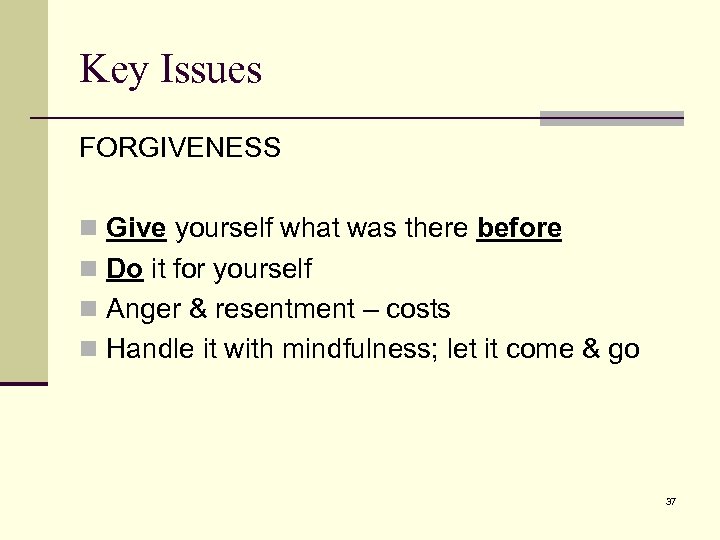 Key Issues FORGIVENESS n Give yourself what was there before n Do it for yourself n Anger & resentment – costs n Handle it with mindfulness; let it come & go 37
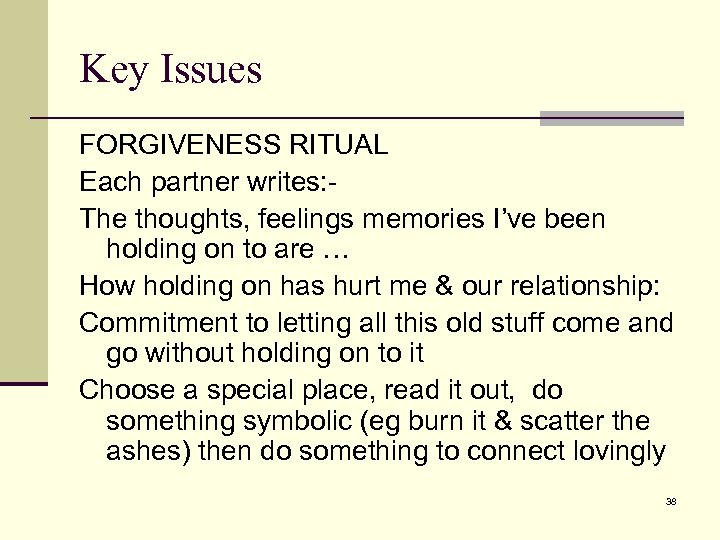 Key Issues FORGIVENESS RITUAL Each partner writes: The thoughts, feelings memories I’ve been holding on to are … How holding on has hurt me & our relationship: Commitment to letting all this old stuff come and go without holding on to it Choose a special place, read it out, do something symbolic (eg burn it & scatter the ashes) then do something to connect lovingly 38
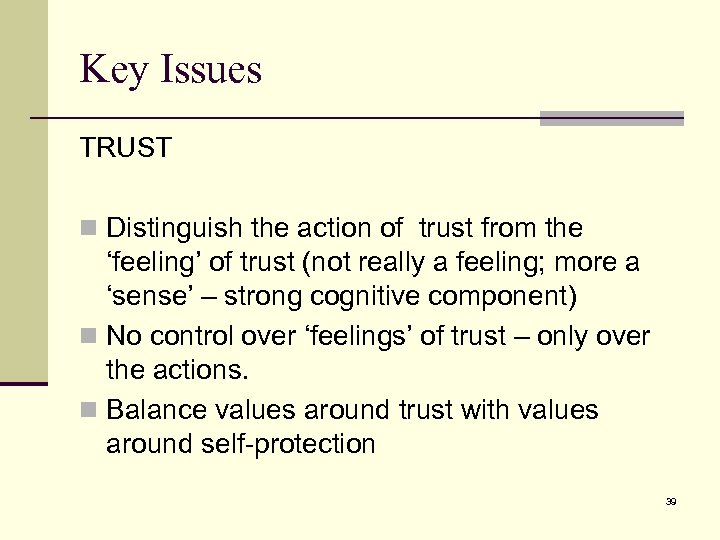 Key Issues TRUST n Distinguish the action of trust from the ‘feeling’ of trust (not really a feeling; more a ‘sense’ – strong cognitive component) n No control over ‘feelings’ of trust – only over the actions. n Balance values around trust with values around self-protection 39