


 Скачать презентацию Accelerator Test Facility Vitaly Yakimenko April 18 2006
a28668e2281d569d50e52591be831edd.ppt
- Количество слайдов: 28
 Accelerator Test Facility Vitaly Yakimenko April 18, 2006 DOE Annual High Energy Physics Program Review Brookhaven National Laboratory
 Outline: • • • What is ATF CO 2 laser at terawatt level (5 ps, 5 J) Ion beam generation experiment 1 micron laser upgrade Facility infrastructure upgrades for useroperated Accelerator Beam compression studies Plasma Wakefield experiments Polarized Positron Source for ILC/CLIC development Optical Stochastic Cooling studies at ATF Vitaly Yakimenko (2/28)
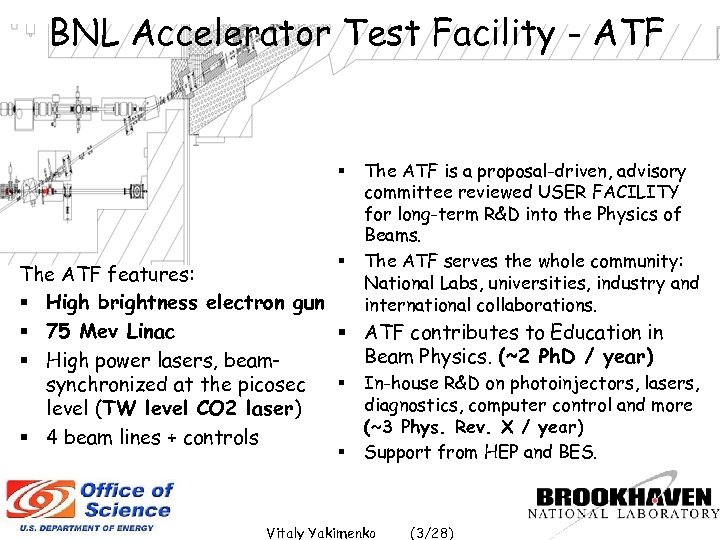 BNL Accelerator Test Facility - ATF § § The ATF is a proposal-driven, advisory committee reviewed USER FACILITY for long-term R&D into the Physics of Beams. The ATF serves the whole community: National Labs, universities, industry and international collaborations. The ATF features: § High brightness electron gun § 75 Mev Linac § ATF contributes to Education in Beam Physics. (~2 Ph. D / year) § High power lasers, beam§ In-house R&D on photoinjectors, lasers, synchronized at the picosec diagnostics, computer control and more level (TW level CO 2 laser) (~3 Phys. Rev. X / year) § 4 beam lines + controls § Support from HEP and BES. Vitaly Yakimenko (3/28)
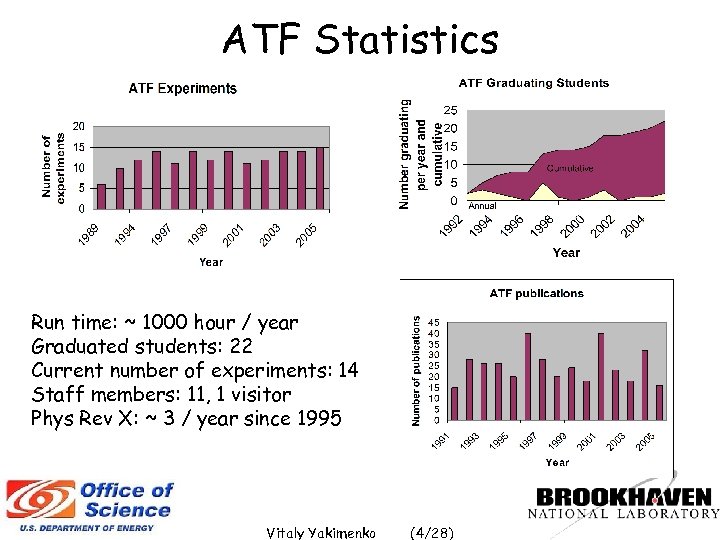 ATF Statistics Run time: ~ 1000 hour / year Graduated students: 22 Current number of experiments: 14 Staff members: 11, 1 visitor Phys Rev X: ~ 3 / year since 1995 Vitaly Yakimenko (4/28)
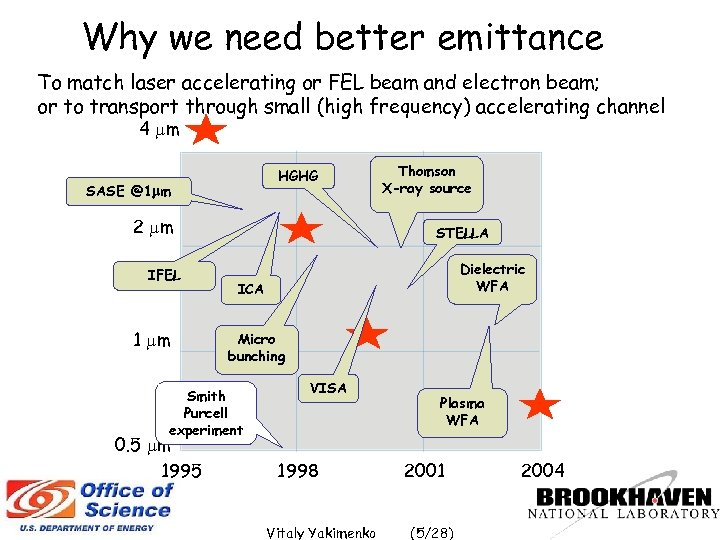 Why we need better emittance To match laser accelerating or FEL beam and electron beam; or to transport through small (high frequency) accelerating channel 4 m HGHG SASE @1 mm 2 m IFEL 1 m STELLA Dielectric WFA ICA Micro bunching Smith Purcell experiment 0. 5 m 1995 Thomson X-ray source VISA 1998 Vitaly Yakimenko Plasma WFA 2001 (5/28) 2004
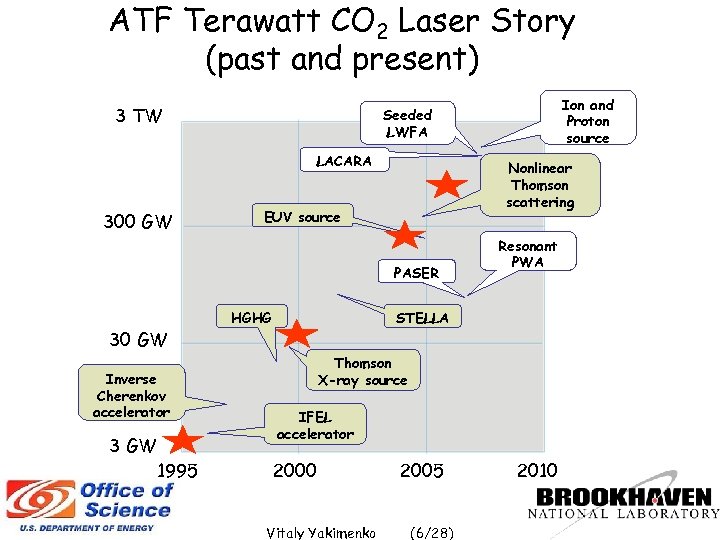 ATF Terawatt CO 2 Laser Story (past and present) 3 TW LACARA 300 GW Nonlinear Thomson scattering EUV source PASER 30 GW Inverse Cherenkov accelerator 3 GW 1995 Ion and Proton source Seeded LWFA HGHG Resonant PWA STELLA Thomson X-ray source IFEL accelerator 2000 Vitaly Yakimenko 2005 (6/28) 2010
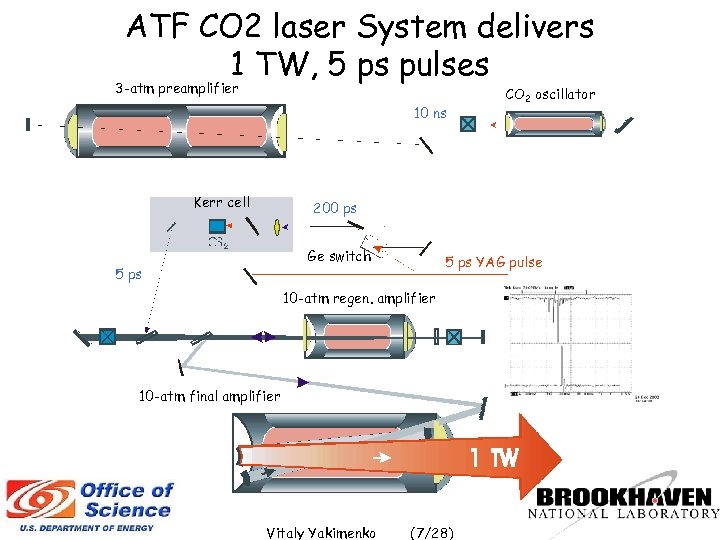 ATF CO 2 laser System delivers 1 TW, 5 ps pulses 3 -atm preamplifier 10 ns Kerr cell CO 2 oscillator 200 ps Ge switch 5 ps YAG pulse 10 -atm regen. amplifier 10 -atm final amplifier Vitaly Yakimenko (7/28)
 ATF CO 2 Laser System Status and Prospects • Combination of four commercial and custom high-pressure lasers allows versatile regimes of operation to satisfy ATF users requirements: • – – Strong-Field regime (LWFA, LACARA, Compton, Ion Accelerator) 1 TW, 5 ps, 1 pulse every 20 sec Microbunching regime (PWFA, PASER) 1 GW, 200 ps, 1 pulse every 3 sec Near-term plan: – Improving stability, reproducibility, diagnostics and data collection • Long-term plan: – reduce pulse length below 1 ps by implementing power broadening and frequency chirping with dispersion compression Vitaly Yakimenko (8/28)
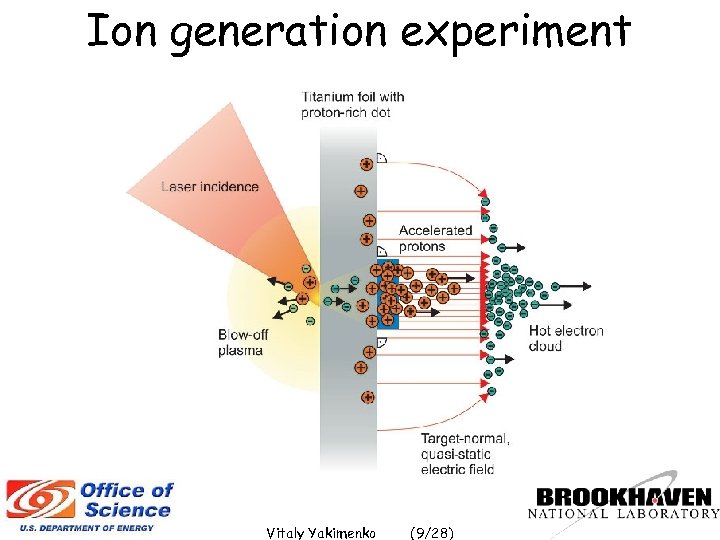 Ion generation experiment Vitaly Yakimenko (9/28)
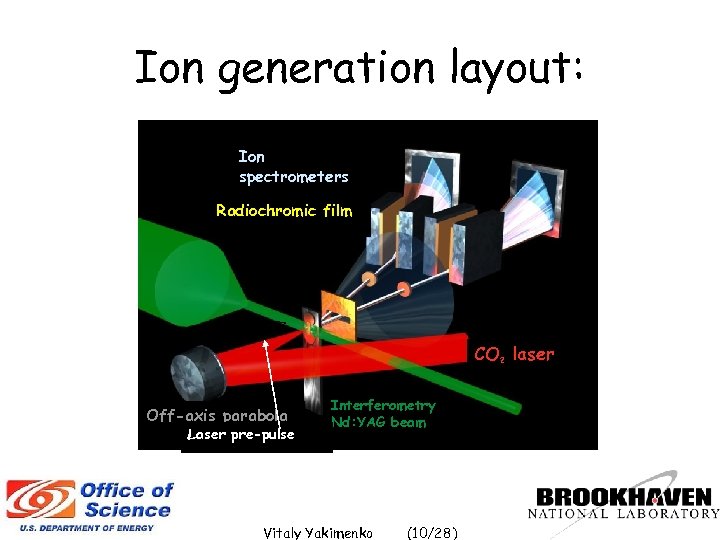 Ion generation layout: Ion spectrometers Radiochromic film CO 2 laser Off-axis parabola Laser pre-pulse Interferometry Nd: YAG beam Vitaly Yakimenko (10/28)
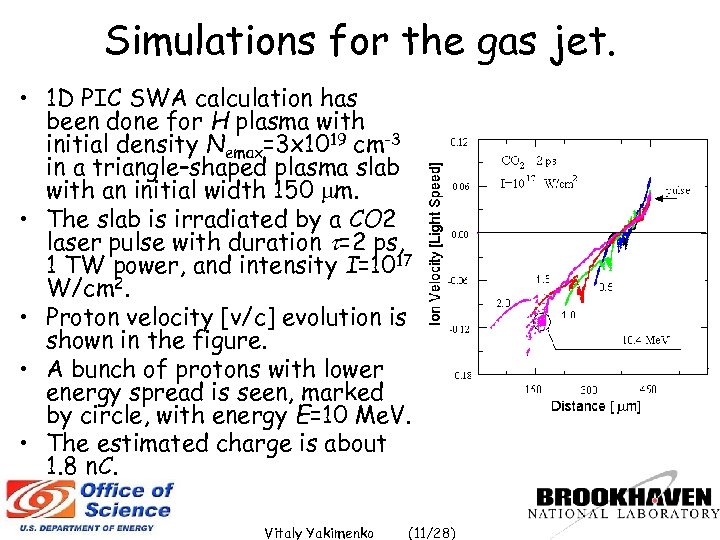 Simulations for the gas jet. • 1 D PIC SWA calculation has been done for H plasma with initial density Nemax=3 x 1019 cm-3 in a triangle–shaped plasma slab with an initial width 150 m. • The slab is irradiated by a CO 2 laser pulse with duration t=2 ps, 1 TW power, and intensity I=1017 W/cm 2. • Proton velocity [v/c] evolution is shown in the figure. • A bunch of protons with lower energy spread is seen, marked by circle, with energy E=10 Me. V. • The estimated charge is about 1. 8 n. C. Vitaly Yakimenko (11/28)
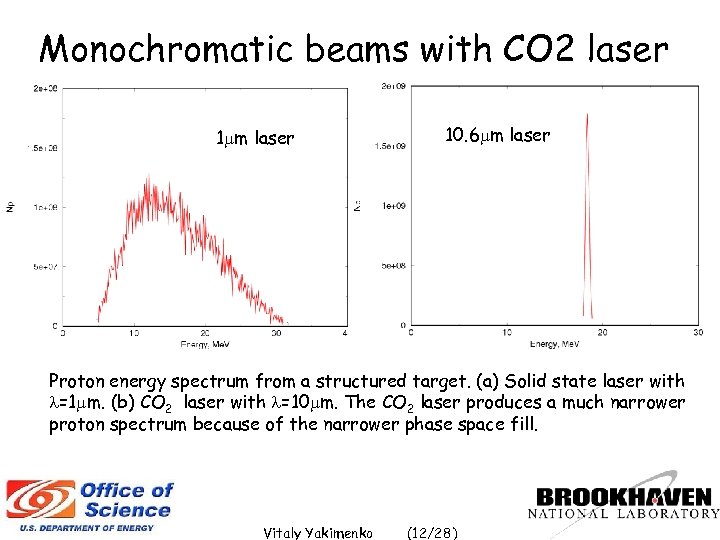 Monochromatic beams with CO 2 laser 1 m laser 10. 6 m laser Proton energy spectrum from a structured target. (a) Solid state laser with =1 m. (b) CO 2 laser with =10 m. The CO 2 laser produces a much narrower proton spectrum because of the narrower phase space fill. Vitaly Yakimenko (12/28)
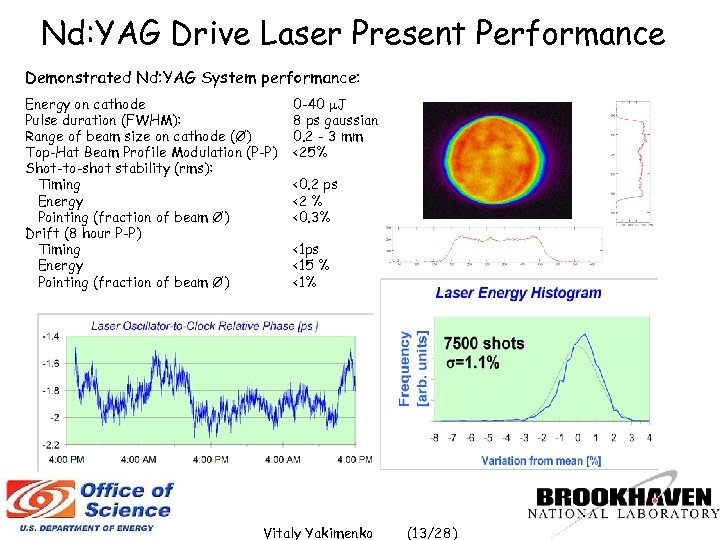 Nd: YAG Drive Laser Present Performance Demonstrated Nd: YAG System performance: Energy on cathode Pulse duration (FWHM): Range of beam size on cathode (Ø) Top-Hat Beam Profile Modulation (P-P) Shot-to-shot stability (rms): Timing Energy Pointing (fraction of beam Ø) Drift (8 hour P-P) Timing Energy Pointing (fraction of beam Ø) 0 -40 J 8 ps gaussian 0. 2 - 3 mm <25% <0. 2 ps <2 % <0. 3% <1 ps <15 % <1% Vitaly Yakimenko (13/28)
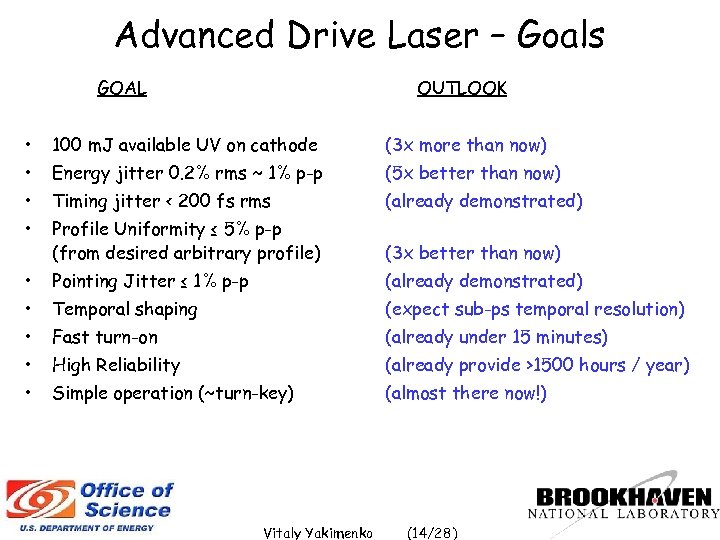 Advanced Drive Laser – Goals GOAL OUTLOOK • 100 m. J available UV on cathode (3 x more than now) • Energy jitter 0. 2% rms ~ 1% p-p (5 x better than now) • Timing jitter < 200 fs rms (already demonstrated) • Profile Uniformity ≤ 5% p-p (from desired arbitrary profile) (3 x better than now) • Pointing Jitter ≤ 1% p-p (already demonstrated) • Temporal shaping (expect sub-ps temporal resolution) • Fast turn-on (already under 15 minutes) • High Reliability (already provide >1500 hours / year) • Simple operation (~turn-key) (almost there now!) Vitaly Yakimenko (14/28)
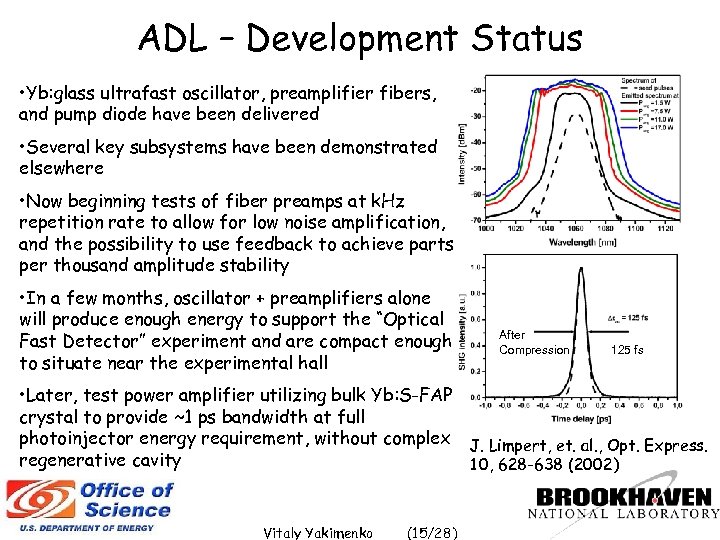 ADL – Development Status • Yb: glass ultrafast oscillator, preamplifier fibers, and pump diode have been delivered • Several key subsystems have been demonstrated elsewhere • Now beginning tests of fiber preamps at k. Hz repetition rate to allow for low noise amplification, and the possibility to use feedback to achieve parts per thousand amplitude stability • In a few months, oscillator + preamplifiers alone will produce enough energy to support the “Optical Fast Detector” experiment and are compact enough to situate near the experimental hall After Compression 125 fs • Later, test power amplifier utilizing bulk Yb: S-FAP crystal to provide ~1 ps bandwidth at full photoinjector energy requirement, without complex J. Limpert, et. al. , Opt. Express. regenerative cavity 10, 628 -638 (2002) Vitaly Yakimenko (15/28)
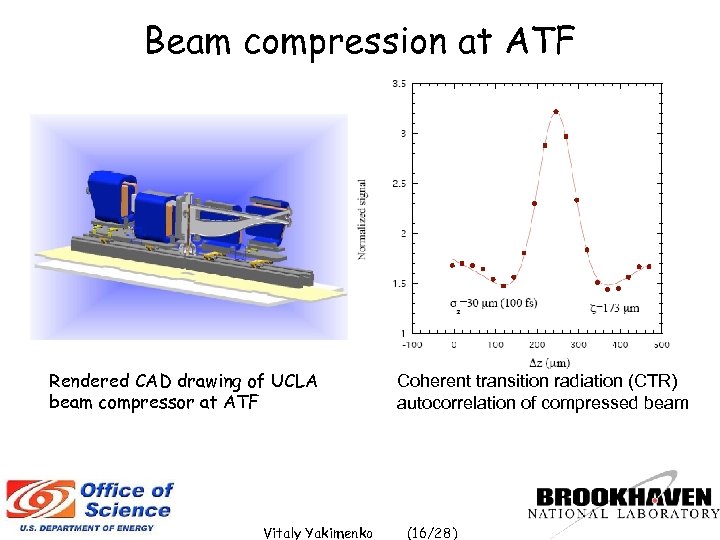 Beam compression at ATF Rendered CAD drawing of UCLA beam compressor at ATF Vitaly Yakimenko Coherent transition radiation (CTR) autocorrelation of compressed beam (16/28)
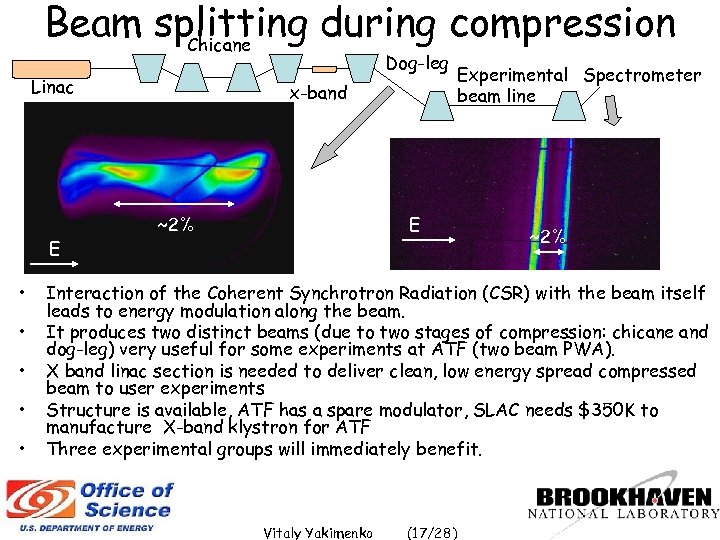 Beam splitting during compression Chicane Dog-leg Linac E • • • x-band ~2% E Experimental Spectrometer beam line ~2% Interaction of the Coherent Synchrotron Radiation (CSR) with the beam itself leads to energy modulation along the beam. It produces two distinct beams (due to two stages of compression: chicane and dog-leg) very useful for some experiments at ATF (two beam PWA). X band linac section is needed to deliver clean, low energy spread compressed beam to user experiments Structure is available, ATF has a spare modulator, SLAC needs $350 K to manufacture X-band klystron for ATF Three experimental groups will immediately benefit. Vitaly Yakimenko (17/28)
 Plasma Wakefield experiments at ATF • Multi-bunch Plasma Wakefield Acceleration at ATF, AE 31. Spokepersons T. Katsouleas and P. Muggli, Univ. Southern California. • Laser Wakefield Acceleration Driven by a CO 2 Laser, AE 32, Spokesperson W. Kimura, STI Optronics • Ion Motion in Intense Beam-Driven Plasma Wakefield (UCLA, J. Rosenzweig) • Plasma density measurement 1016 -1019 by Stark broadening Vitaly Yakimenko (18/28)
 STELLA-LW: Staged Electron Laser Acceleration – Laser Wakefield • Experiment investigates two new plasma-based acceleration schemes – Seeded SM-LWFA – use seed e-beam bunch to create wakefield, amplify wakefield using ATF TW CO 2 laser beam. – Pseudo-resonant LWFA – use laser/plasma interaction to sharpen laser pulse shape thereby enabling near-resonant generation of wakefield • Performed initial test of seed and witness e-beam bunches sent into capillary discharge – Seed breaks apart into mini-seed and mini-witness bunches – Witness bunch follows ~10 ps after mini-witness bunch – Observed acceleration of mini-witness and witness electrons implying good wakefield formation – >300 Me. V/m gradient measured Vitaly Yakimenko (19/28)
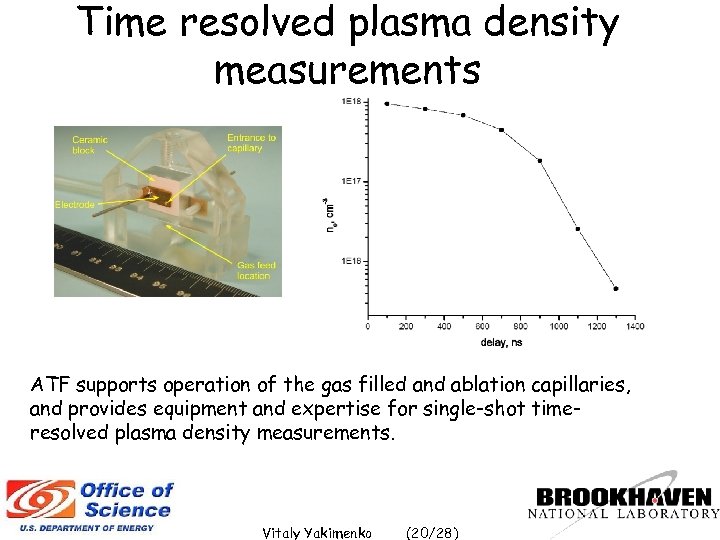 Time resolved plasma density measurements ATF supports operation of the gas filled and ablation capillaries, and provides equipment and expertise for single-shot timeresolved plasma density measurements. Vitaly Yakimenko (20/28)
 2006/2007 Facility upgrades • Diagnostics for the chicane bunch compressor • Interferometer for beam pulse length measurements • Laser interaction chamber • Degauss relays for magnets • Vacuum valve interlocks • Temperature/humidity/pressure monitoring (more than 30 sensors) • Linac phase shifter upgrade • CO 2 laser transport line to the laser lab Vitaly Yakimenko (21/28)
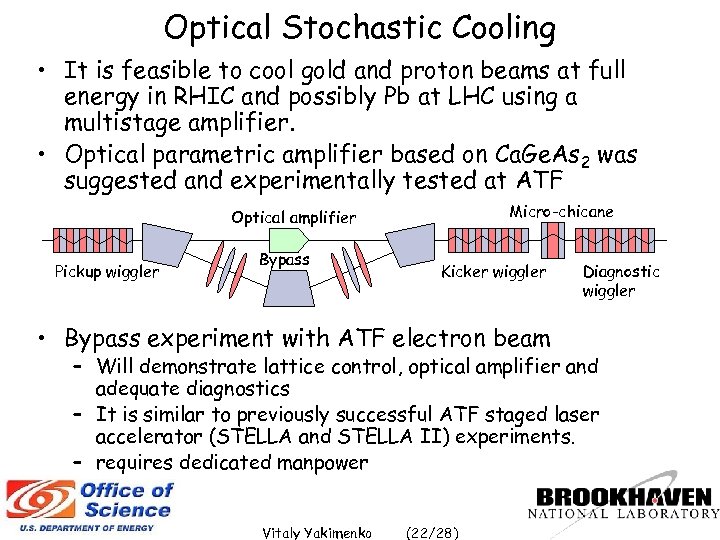 Optical Stochastic Cooling • It is feasible to cool gold and proton beams at full energy in RHIC and possibly Pb at LHC using a multistage amplifier. • Optical parametric amplifier based on Ca. Ge. As 2 was suggested and experimentally tested at ATF Micro-chicane Optical amplifier Pickup wiggler Bypass Kicker wiggler • Bypass experiment with ATF electron beam Diagnostic wiggler – Will demonstrate lattice control, optical amplifier and adequate diagnostics – It is similar to previously successful ATF staged laser accelerator (STELLA and STELLA II) experiments. – requires dedicated manpower Vitaly Yakimenko (22/28)
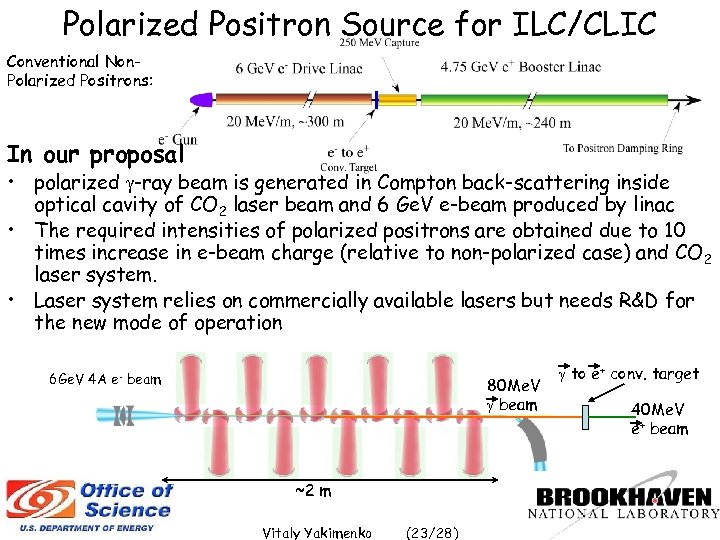 Polarized Positron Source for ILC/CLIC Conventional Non. Polarized Positrons: In our proposal • polarized g-ray beam is generated in Compton back-scattering inside optical cavity of CO 2 laser beam and 6 Ge. V e-beam produced by linac • The required intensities of polarized positrons are obtained due to 10 times increase in e-beam charge (relative to non-polarized case) and CO 2 laser system. • Laser system relies on commercially available lasers but needs R&D for the new mode of operation 6 Ge. V 4 A e- beam 80 Me. V g beam ~2 m Vitaly Yakimenko (23/28) g to e+ conv. target 40 Me. V e+ beam
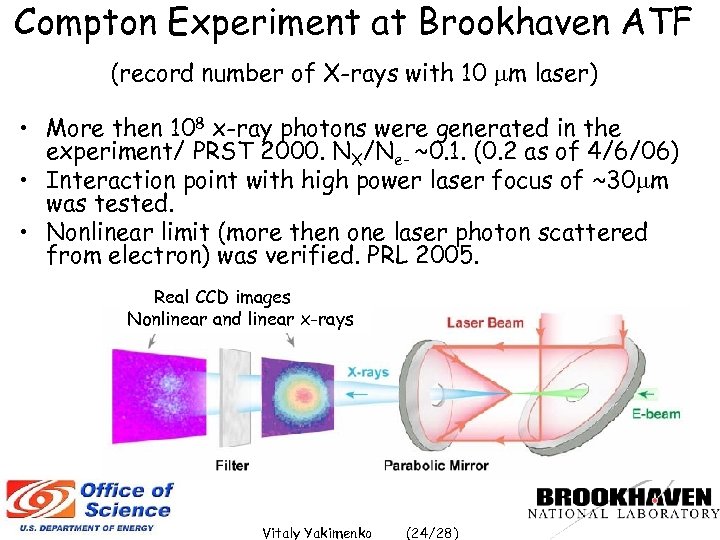 Compton Experiment at Brookhaven ATF (record number of X-rays with 10 m laser) • More then 108 x-ray photons were generated in the experiment/ PRST 2000. NX/Ne- ~0. 1. (0. 2 as of 4/6/06) • Interaction point with high power laser focus of ~30 m was tested. • Nonlinear limit (more then one laser photon scattered from electron) was verified. PRL 2005. Real CCD images Nonlinear and linear x-rays Vitaly Yakimenko (24/28)
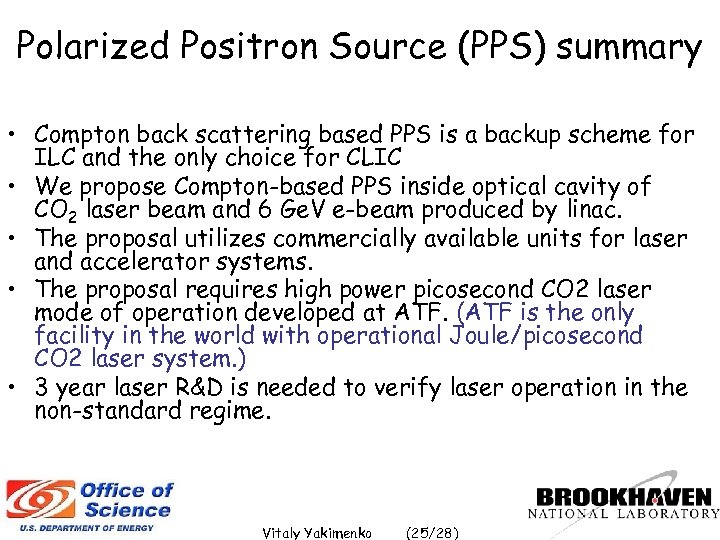 Polarized Positron Source (PPS) summary • Compton back scattering based PPS is a backup scheme for ILC and the only choice for CLIC • We propose Compton-based PPS inside optical cavity of CO 2 laser beam and 6 Ge. V e-beam produced by linac. • The proposal utilizes commercially available units for laser and accelerator systems. • The proposal requires high power picosecond CO 2 laser mode of operation developed at ATF. (ATF is the only facility in the world with operational Joule/picosecond CO 2 laser system. ) • 3 year laser R&D is needed to verify laser operation in the non-standard regime. Vitaly Yakimenko (25/28)
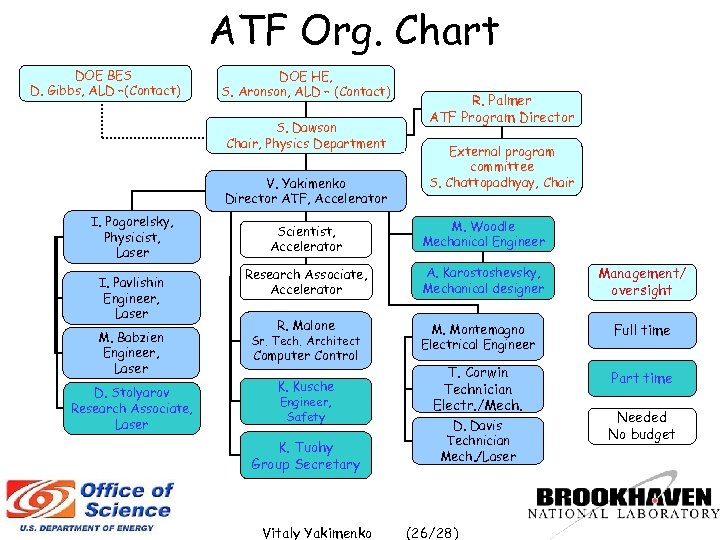 ATF Org. Chart DOE BES D. Gibbs, ALD –(Contact) DOE HE, S. Aronson, ALD – (Contact) S. Dawson Chair, Physics Department V. Yakimenko Director ATF, Accelerator I. Pogorelsky, Physicist, Laser I. Pavlishin Engineer, Laser R. Palmer ATF Program Director External program committee S. Chattopadhyay, Chair Scientist, Accelerator M. Woodle Mechanical Engineer Research Associate, Accelerator A. Karostoshevsky, Mechanical designer R. Malone Management/ oversight M. Babzien Engineer, Laser Sr. Tech. Architect M. Montemagno Electrical Engineer Full time D. Stolyarov Research Associate, Laser K. Kusche T. Corwin Technician Electr. /Mech. Part time Computer Control Engineer, Safety K. Tuohy Group Secretary Vitaly Yakimenko D. Davis Technician Mech. /Laser (26/28) Needed No budget
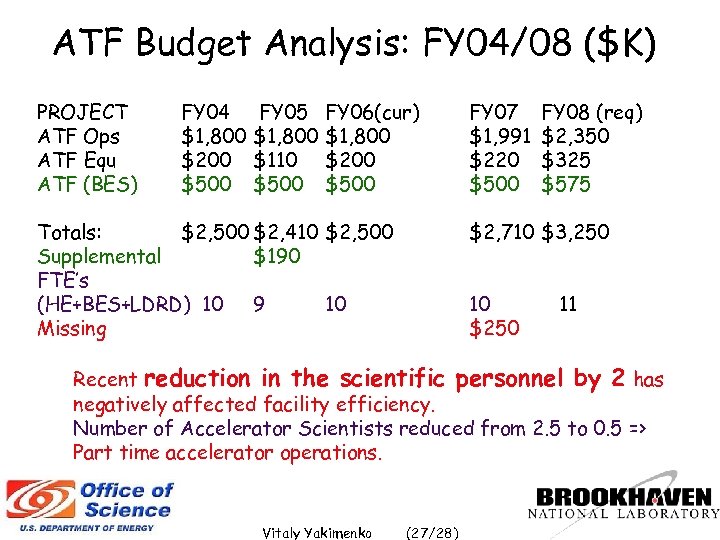 ATF Budget Analysis: FY 04/08 ($K) PROJECT ATF Ops ATF Equ ATF (BES) FY 04 $1, 800 $200 $500 FY 05 $1, 800 $110 $500 FY 06(cur) $1, 800 $200 $500 Totals: $2, 500 $2, 410 $2, 500 Supplemental $190 FTE’s (HE+BES+LDRD) 10 9 10 Missing FY 07 $1, 991 $220 $500 FY 08 (req) $2, 350 $325 $575 $2, 710 $3, 250 10 $250 11 Recent reduction in the scientific personnel by 2 has negatively affected facility efficiency. Number of Accelerator Scientists reduced from 2. 5 to 0. 5 => Part time accelerator operations. Vitaly Yakimenko (27/28)
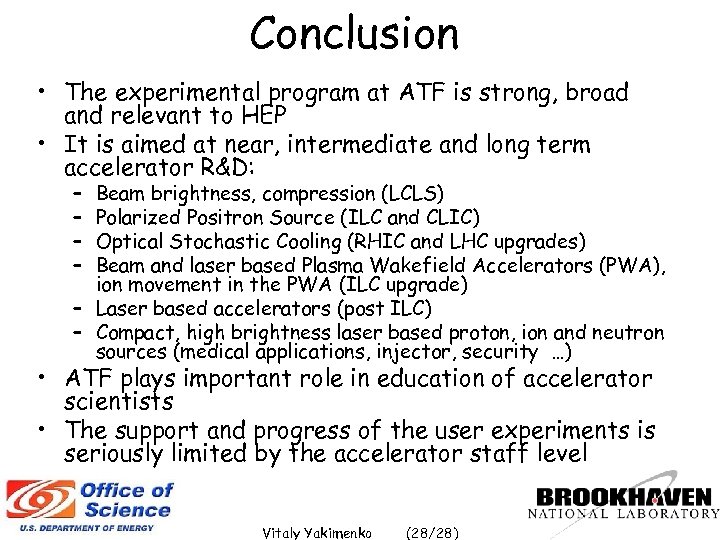 Conclusion • The experimental program at ATF is strong, broad and relevant to HEP • It is aimed at near, intermediate and long term accelerator R&D: – – Beam brightness, compression (LCLS) Polarized Positron Source (ILC and CLIC) Optical Stochastic Cooling (RHIC and LHC upgrades) Beam and laser based Plasma Wakefield Accelerators (PWA), ion movement in the PWA (ILC upgrade) – Laser based accelerators (post ILC) – Compact, high brightness laser based proton, ion and neutron sources (medical applications, injector, security …) • ATF plays important role in education of accelerator scientists • The support and progress of the user experiments is seriously limited by the accelerator staff level Vitaly Yakimenko (28/28)