


 Скачать презентацию Accelerator Plans at KEK John W Flanagan KEK
960d733b4a14e3e1a91a9004ac2ed1f2.ppt
- Количество слайдов: 46
 Accelerator Plans at KEK John W. Flanagan, KEK Super B Factory Workshop Honolulu 19 January 2004
 Lo. I: Accelerator Design for a Super B Factory at KEK • • • Machine Parameters Beam-Beam Interactions Lattice Design Interaction Region Magnet System Impedance and Collective Effects RF System Vacuum System Beam Instrumentation Injector Linac Damping Ring Construction Scenario
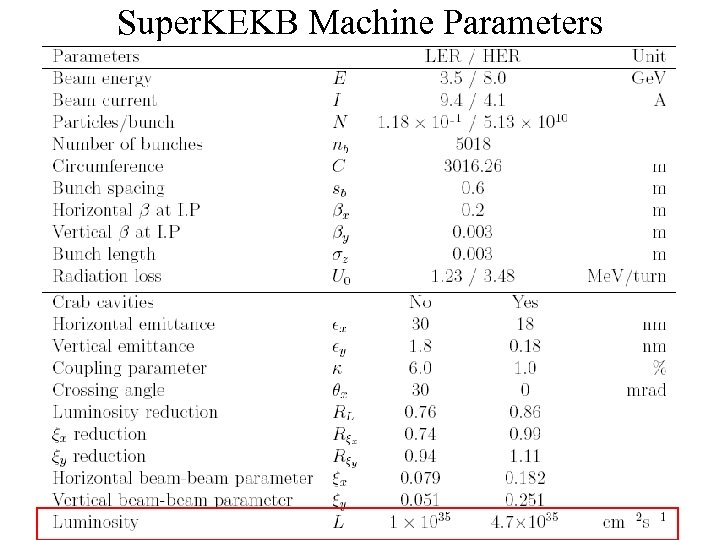 Super. KEKB Machine Parameters
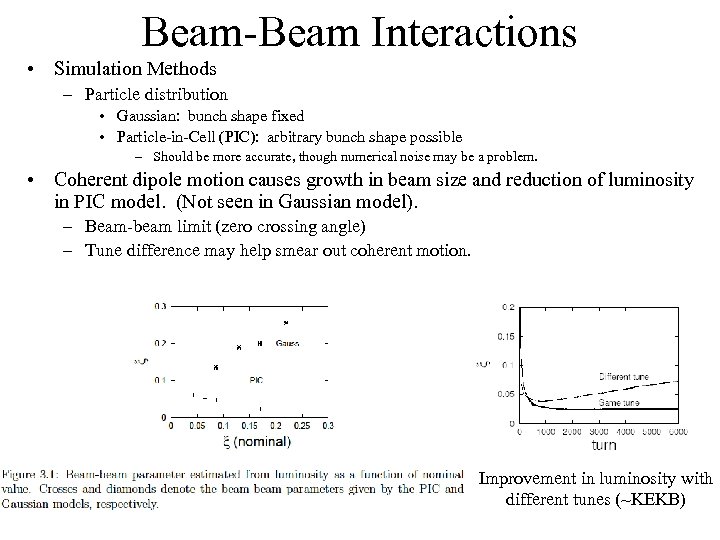 Beam-Beam Interactions • Simulation Methods – Particle distribution • Gaussian: bunch shape fixed • Particle-in-Cell (PIC): arbitrary bunch shape possible – Should be more accurate, though numerical noise may be a problem. • Coherent dipole motion causes growth in beam size and reduction of luminosity in PIC model. (Not seen in Gaussian model). – Beam-beam limit (zero crossing angle) – Tune difference may help smear out coherent motion. Improvement in luminosity with different tunes (~KEKB)
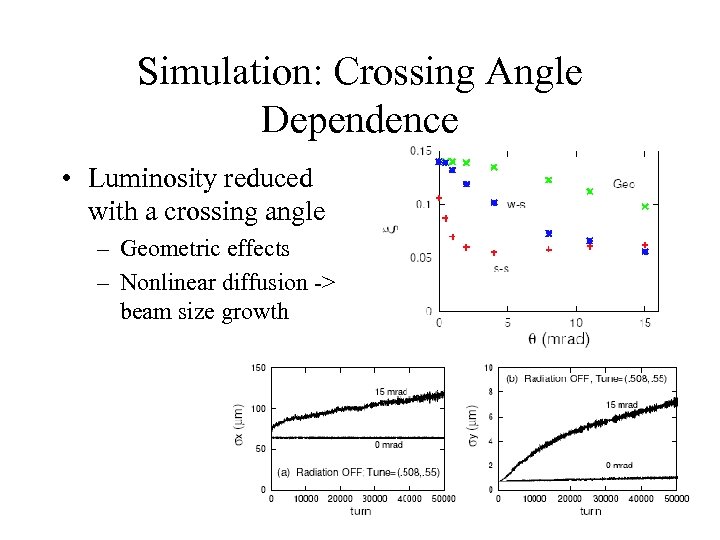 Simulation: Crossing Angle Dependence • Luminosity reduced with a crossing angle – Geometric effects – Nonlinear diffusion -> beam size growth
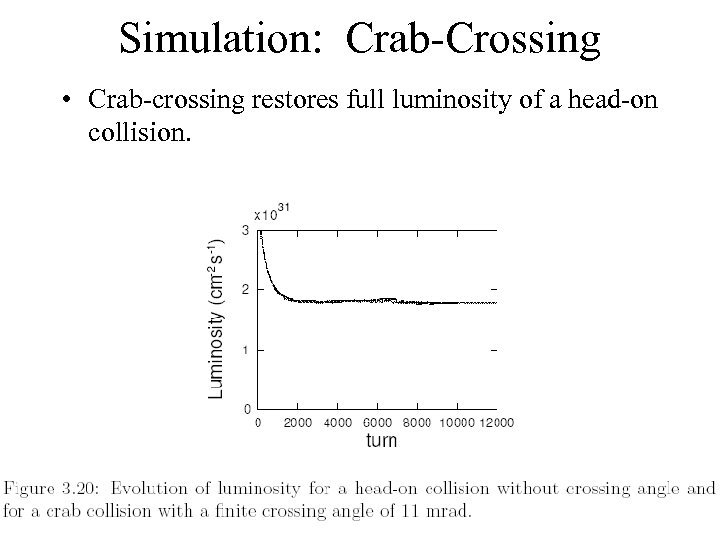 Simulation: Crab-Crossing • Crab-crossing restores full luminosity of a head-on collision.
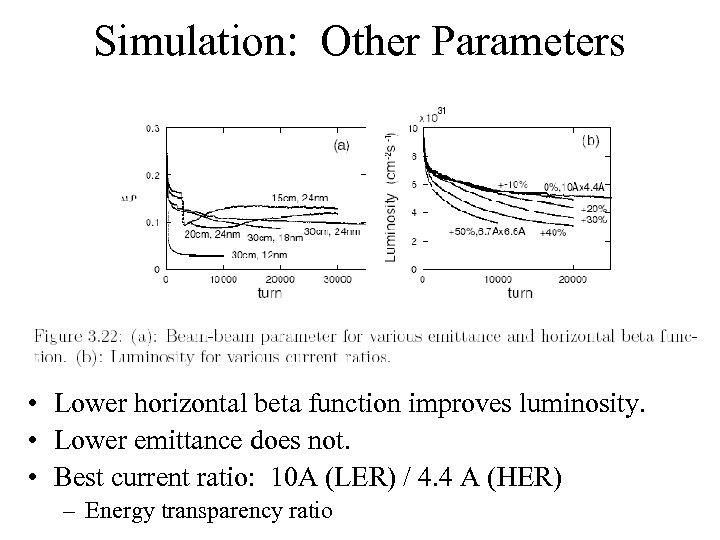 Simulation: Other Parameters • Lower horizontal beta function improves luminosity. • Lower emittance does not. • Best current ratio: 10 A (LER) / 4. 4 A (HER) – Energy transparency ratio
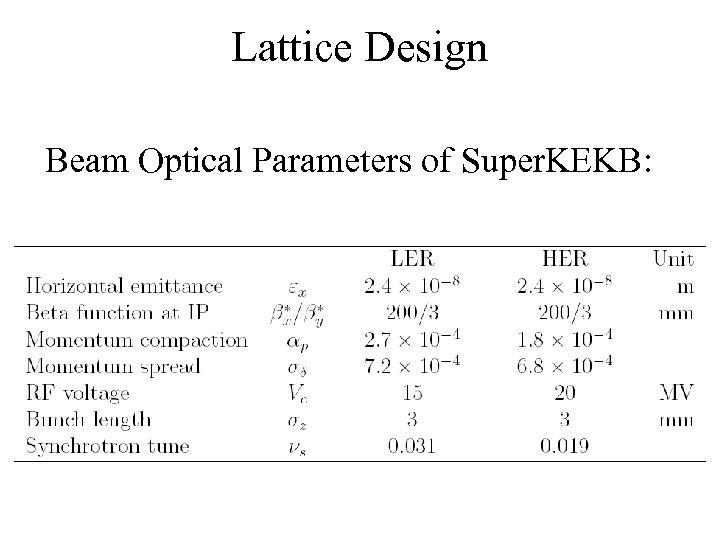 Lattice Design Beam Optical Parameters of Super. KEKB:
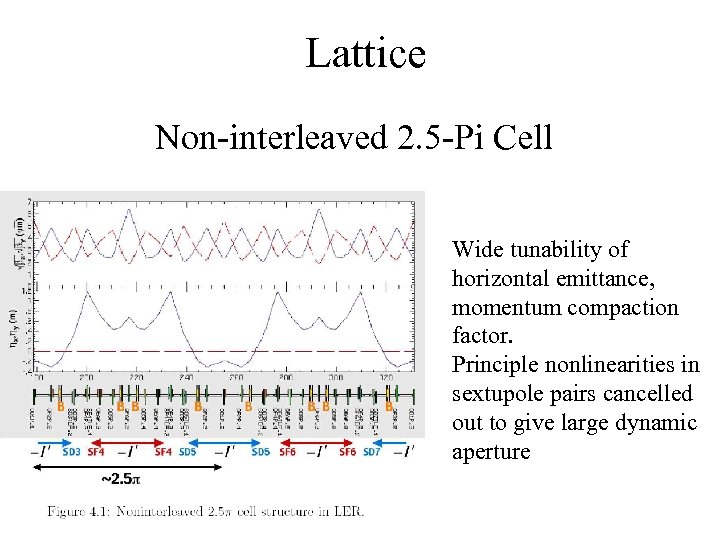 Lattice Non-interleaved 2. 5 -Pi Cell Wide tunability of horizontal emittance, momentum compaction factor. Principle nonlinearities in sextupole pairs cancelled out to give large dynamic aperture
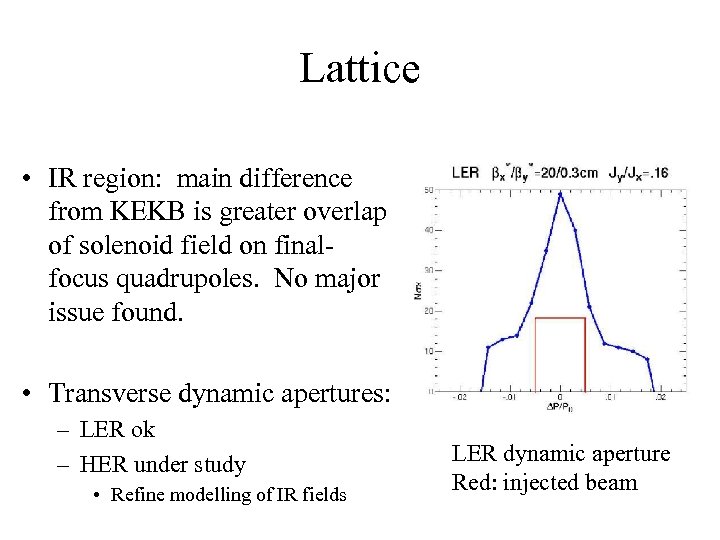 Lattice • IR region: main difference from KEKB is greater overlap of solenoid field on finalfocus quadrupoles. No major issue found. • Transverse dynamic apertures: – LER ok – HER under study • Refine modelling of IR fields LER dynamic aperture Red: injected beam
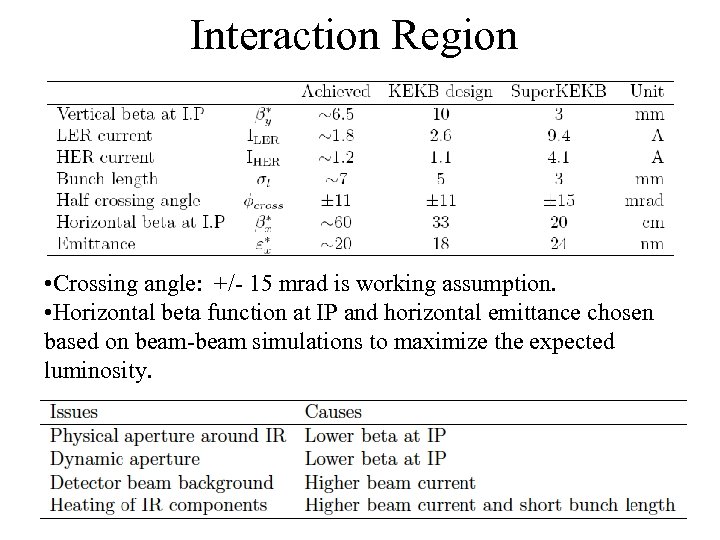 Interaction Region • Crossing angle: +/- 15 mrad is working assumption. • Horizontal beta function at IP and horizontal emittance chosen based on beam-beam simulations to maximize the expected luminosity.
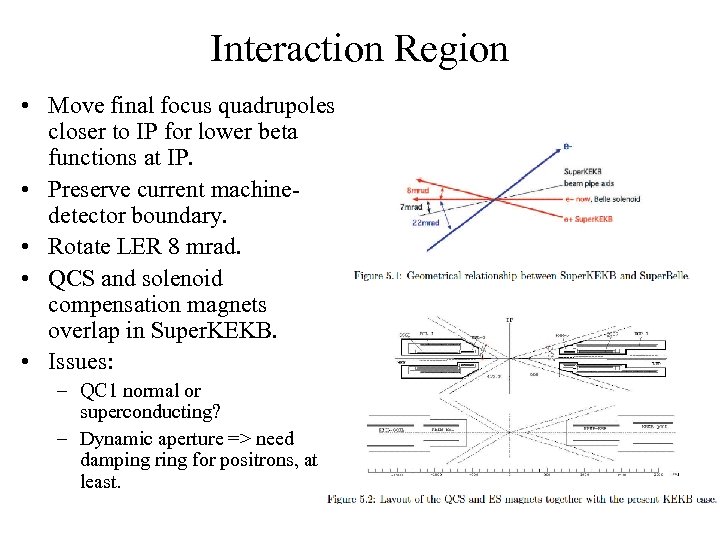 Interaction Region • Move final focus quadrupoles closer to IP for lower beta functions at IP. • Preserve current machinedetector boundary. • Rotate LER 8 mrad. • QCS and solenoid compensation magnets overlap in Super. KEKB. • Issues: – QC 1 normal or superconducting? – Dynamic aperture => need damping ring for positrons, at least.
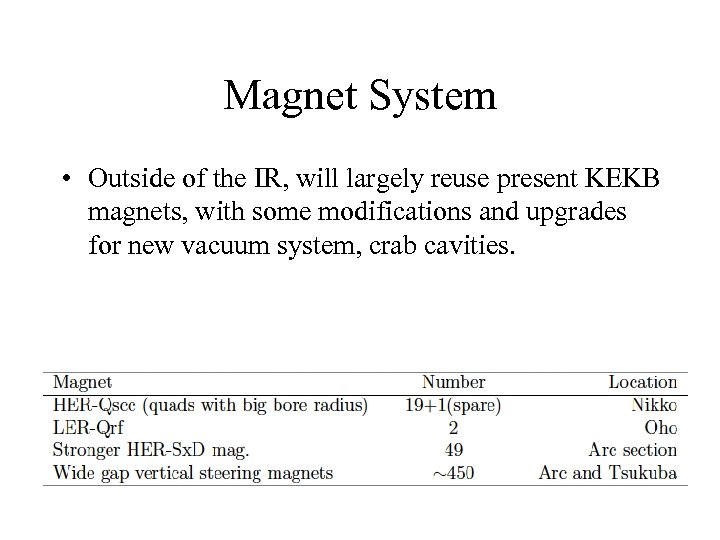 Magnet System • Outside of the IR, will largely reuse present KEKB magnets, with some modifications and upgrades for new vacuum system, crab cavities.
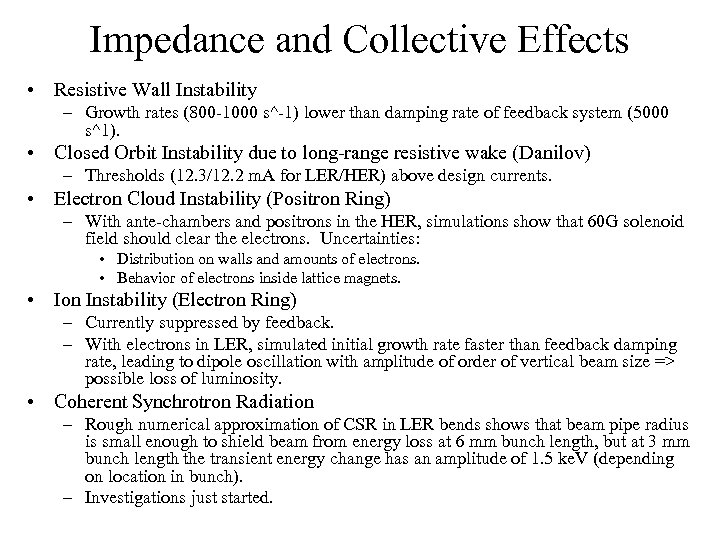 Impedance and Collective Effects • Resistive Wall Instability – Growth rates (800 -1000 s^-1) lower than damping rate of feedback system (5000 s^1). • Closed Orbit Instability due to long-range resistive wake (Danilov) – Thresholds (12. 3/12. 2 m. A for LER/HER) above design currents. • Electron Cloud Instability (Positron Ring) – With ante-chambers and positrons in the HER, simulations show that 60 G solenoid field should clear the electrons. Uncertainties: • Distribution on walls and amounts of electrons. • Behavior of electrons inside lattice magnets. • Ion Instability (Electron Ring) – Currently suppressed by feedback. – With electrons in LER, simulated initial growth rate faster than feedback damping rate, leading to dipole oscillation with amplitude of order of vertical beam size => possible loss of luminosity. • Coherent Synchrotron Radiation – Rough numerical approximation of CSR in LER bends shows that beam pipe radius is small enough to shield beam from energy loss at 6 mm bunch length, but at 3 mm bunch length the transient energy change has an amplitude of 1. 5 ke. V (depending on location in bunch). – Investigations just started.
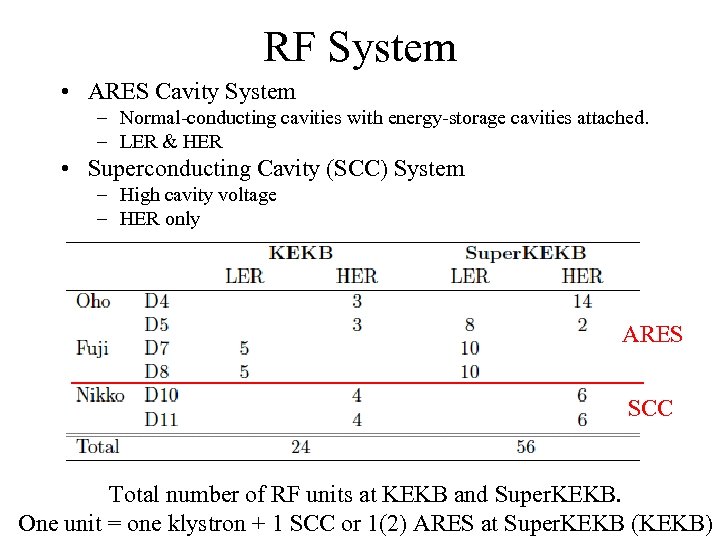 RF System • ARES Cavity System – Normal-conducting cavities with energy-storage cavities attached. – LER & HER • Superconducting Cavity (SCC) System – High cavity voltage – HER only ARES SCC Total number of RF units at KEKB and Super. KEKB. One unit = one klystron + 1 SCC or 1(2) ARES at Super. KEKB (KEKB)
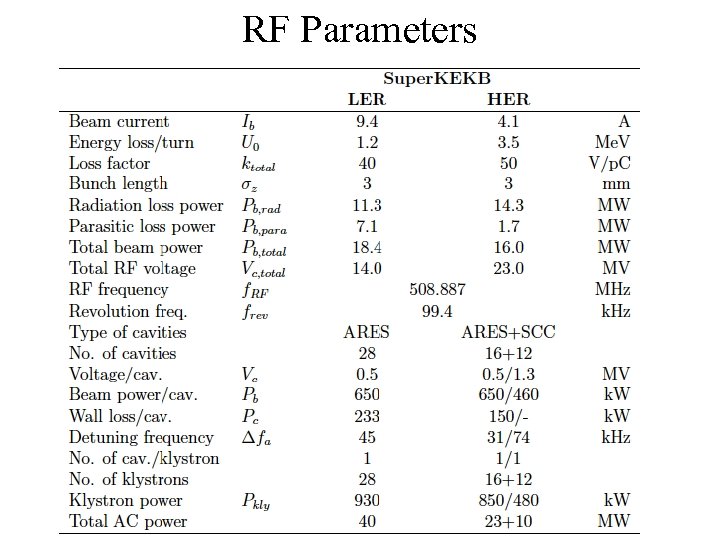 RF Parameters
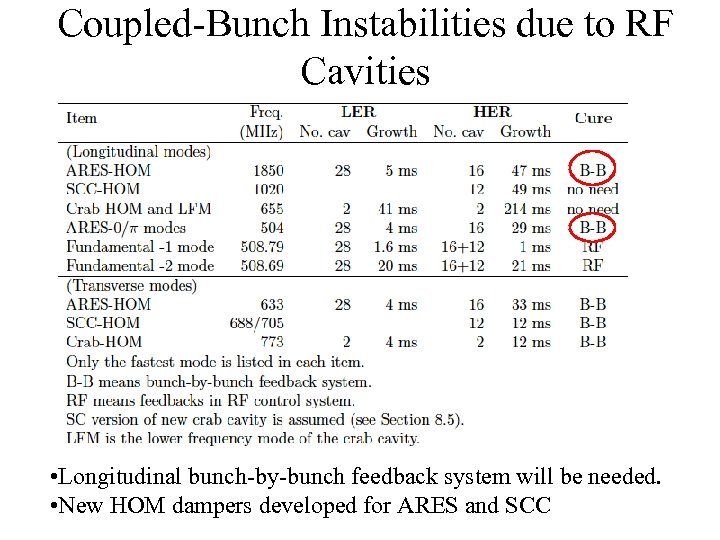 Coupled-Bunch Instabilities due to RF Cavities • Longitudinal bunch-by-bunch feedback system will be needed. • New HOM dampers developed for ARES and SCC
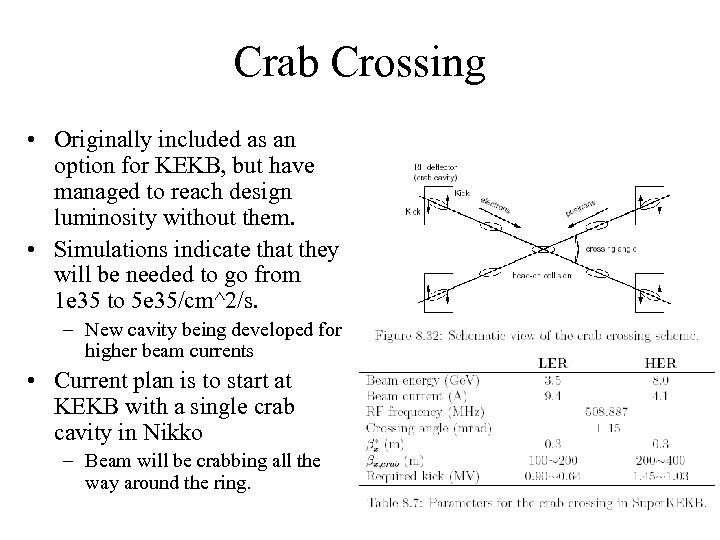 Crab Crossing • Originally included as an option for KEKB, but have managed to reach design luminosity without them. • Simulations indicate that they will be needed to go from 1 e 35 to 5 e 35/cm^2/s. – New cavity being developed for higher beam currents • Current plan is to start at KEKB with a single crab cavity in Nikko – Beam will be crabbing all the way around the ring.
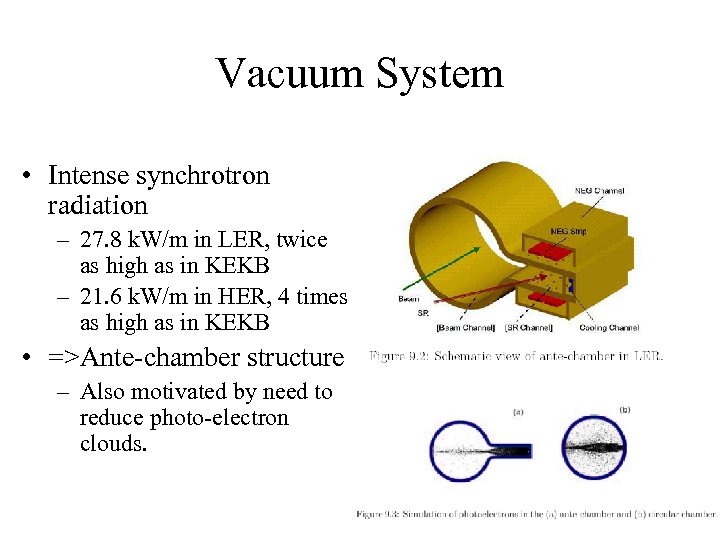 Vacuum System • Intense synchrotron radiation – 27. 8 k. W/m in LER, twice as high as in KEKB – 21. 6 k. W/m in HER, 4 times as high as in KEKB • =>Ante-chamber structure – Also motivated by need to reduce photo-electron clouds.
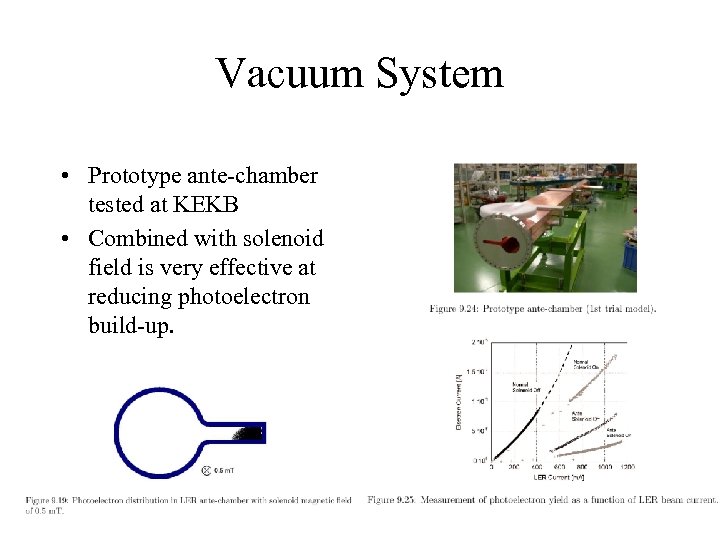 Vacuum System • Prototype ante-chamber tested at KEKB • Combined with solenoid field is very effective at reducing photoelectron build-up.
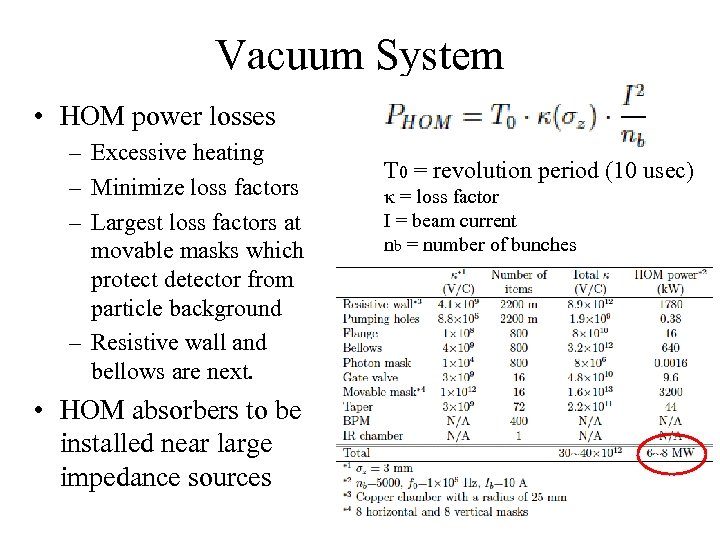 Vacuum System • HOM power losses – Excessive heating – Minimize loss factors – Largest loss factors at movable masks which protect detector from particle background – Resistive wall and bellows are next. • HOM absorbers to be installed near large impedance sources T 0 = revolution period (10 usec) k = loss factor I = beam current nb = number of bunches
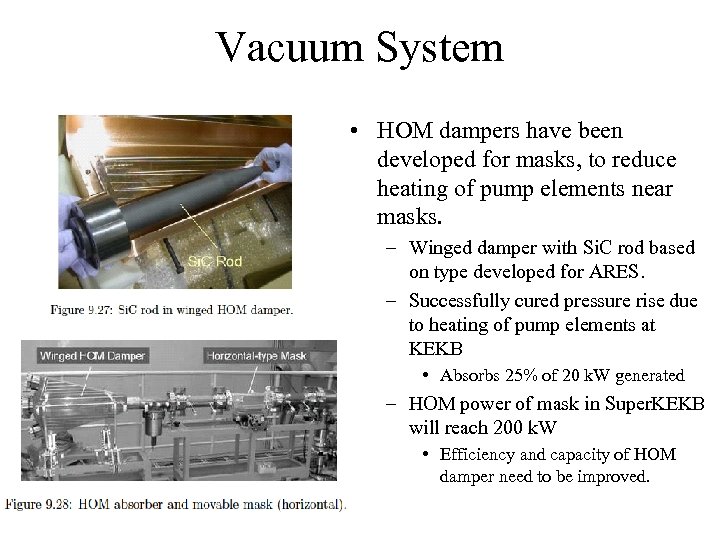 Vacuum System • HOM dampers have been developed for masks, to reduce heating of pump elements near masks. – Winged damper with Si. C rod based on type developed for ARES. – Successfully cured pressure rise due to heating of pump elements at KEKB • Absorbs 25% of 20 k. W generated – HOM power of mask in Super. KEKB will reach 200 k. W • Efficiency and capacity of HOM damper need to be improved.
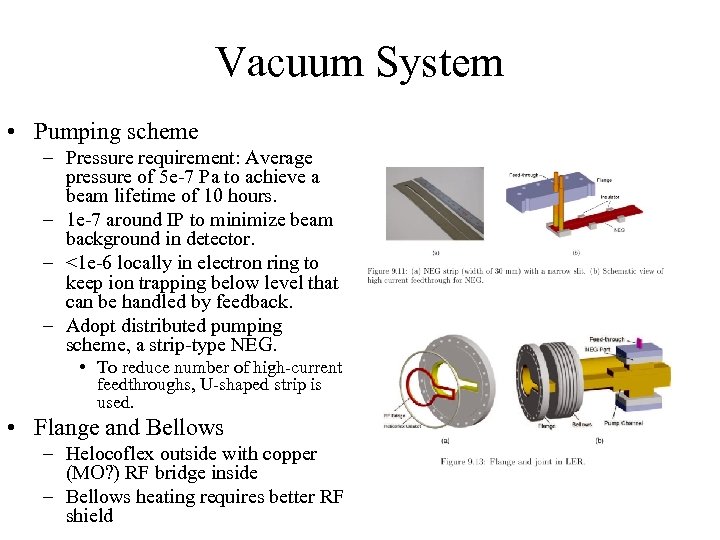 Vacuum System • Pumping scheme – Pressure requirement: Average pressure of 5 e-7 Pa to achieve a beam lifetime of 10 hours. – 1 e-7 around IP to minimize beam background in detector. – <1 e-6 locally in electron ring to keep ion trapping below level that can be handled by feedback. – Adopt distributed pumping scheme, a strip-type NEG. • To reduce number of high-current feedthroughs, U-shaped strip is used. • Flange and Bellows – Helocoflex outside with copper (MO? ) RF bridge inside – Bellows heating requires better RF shield
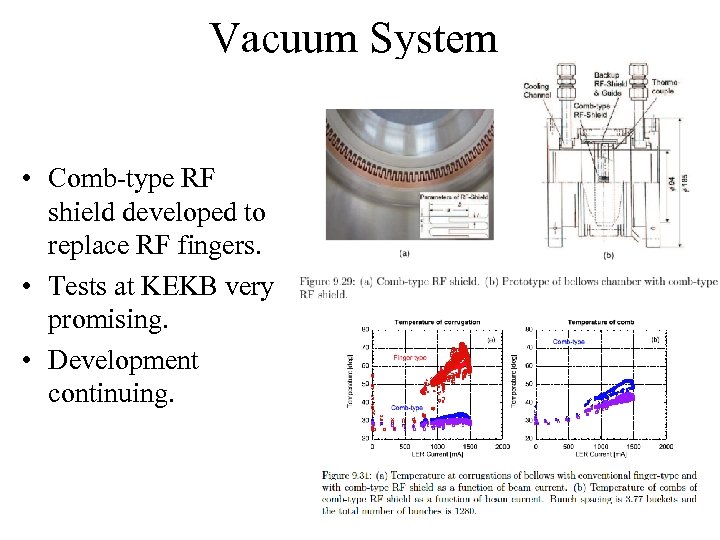 Vacuum System • Comb-type RF shield developed to replace RF fingers. • Tests at KEKB very promising. • Development continuing.
 Beam Instrumentation • Beam Position Monitors • Bunch-by-Bunch Feedback System • Synchrotron Radiation Monitors – HER and LER SR Monitors – Damping Ring SR Monitor
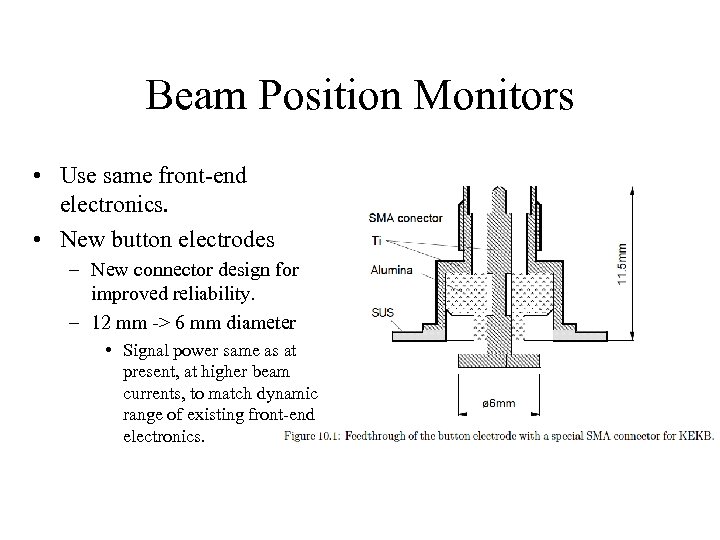 Beam Position Monitors • Use same front-end electronics. • New button electrodes – New connector design for improved reliability. – 12 mm -> 6 mm diameter • Signal power same as at present, at higher beam currents, to match dynamic range of existing front-end electronics.
 Bunch-by-Bunch Feedback • New BPMs for higher beam currents. • Transverse feedback similar to present design – Detection frequency 2. 0 -> 2. 5 GHz. – Automated LO phase and DC offset tuning. – Transverse kicker needs work to handle higher currents • Improved cooling, supports for kicker plates. • Longitudinal feedback to handle ARES HOM and 0/Pi mode instability – Use DAf. NE-type (low-Q cavity) kicker. – QPSK modulation with center frequency 1145 MHz (2. 25 x RF freq. ) • Digital FIR and memory board to be replaced by new GBoard under development at/with SLAC. – Low noise, high speed (1. 5 GHz), with custom filtering functions possible. – Extensive beam diagnostics.
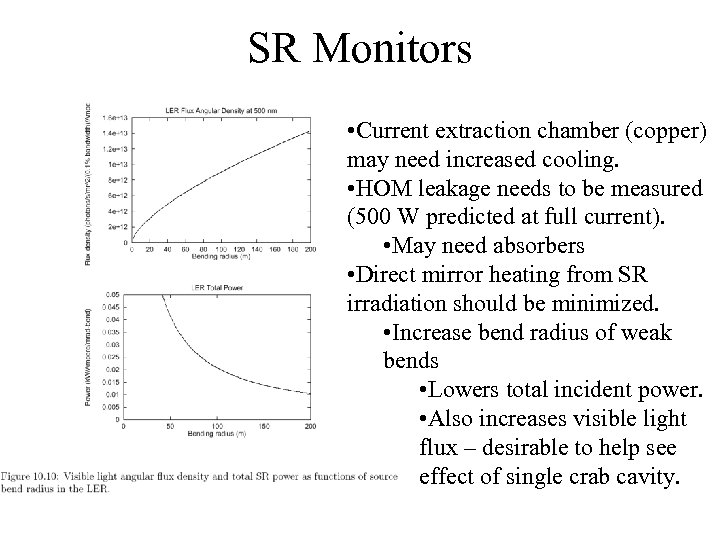 SR Monitors • Current extraction chamber (copper) may need increased cooling. • HOM leakage needs to be measured (500 W predicted at full current). • May need absorbers • Direct mirror heating from SR irradiation should be minimized. • Increase bend radius of weak bends • Lowers total incident power. • Also increases visible light flux – desirable to help see effect of single crab cavity.
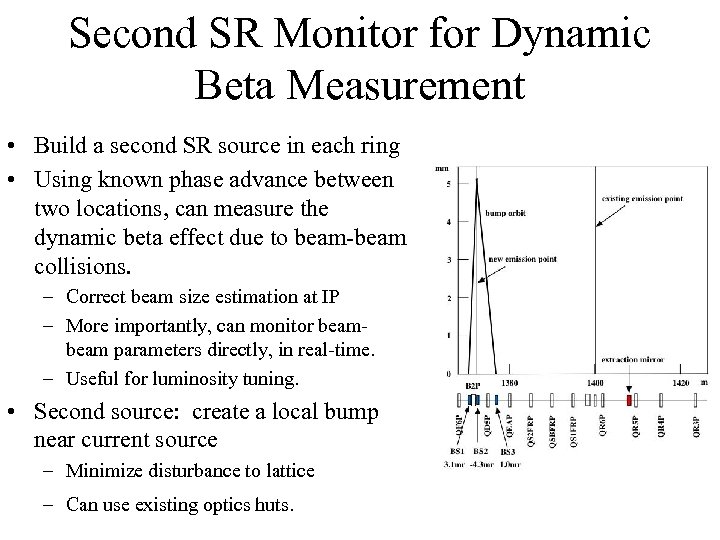 Second SR Monitor for Dynamic Beta Measurement • Build a second SR source in each ring • Using known phase advance between two locations, can measure the dynamic beta effect due to beam-beam collisions. – Correct beam size estimation at IP – More importantly, can monitor beam parameters directly, in real-time. – Useful for luminosity tuning. • Second source: create a local bump near current source – Minimize disturbance to lattice – Can use existing optics huts.
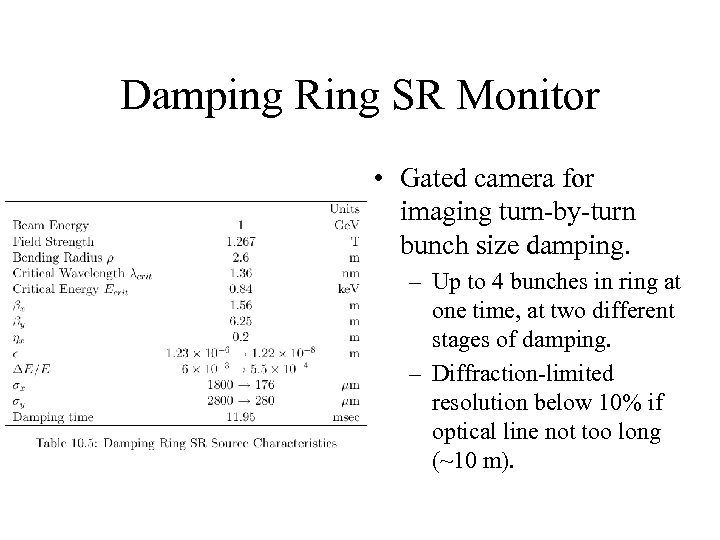 Damping Ring SR Monitor • Gated camera for imaging turn-by-turn bunch size damping. – Up to 4 bunches in ring at one time, at two different stages of damping. – Diffraction-limited resolution below 10% if optical line not too long (~10 m).
 Injector Linac • Intensity Upgrades – Electron: increase bunch current from preinjector – Positron: stronger focusing field in capture section after target • Energy Upgrade – Replace S-band (2856 MHz) RF system with Cband (5712 MHz) system to double field gradient in downstream section of linac.
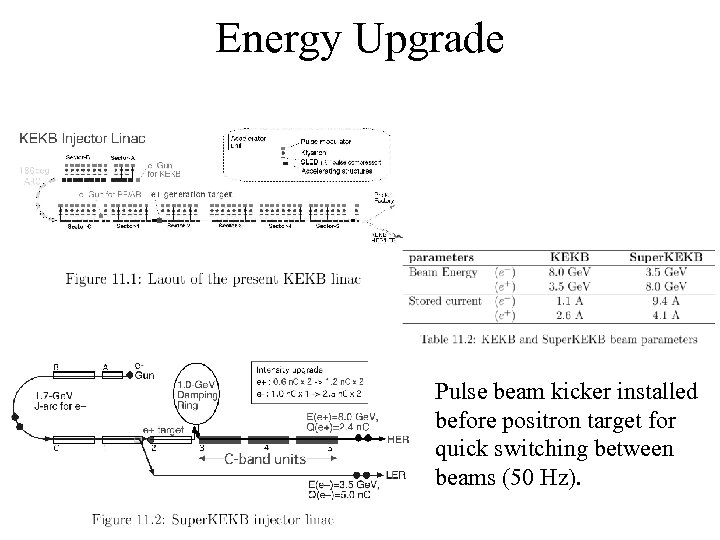 Energy Upgrade Pulse beam kicker installed before positron target for quick switching between beams (50 Hz).
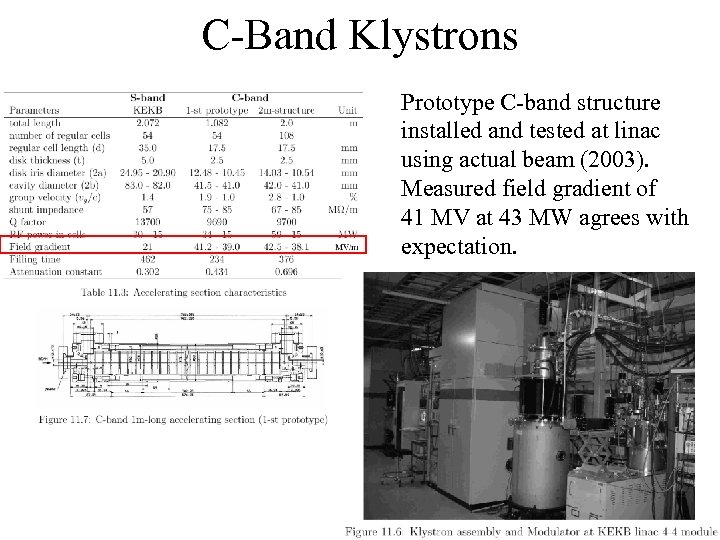 C-Band Klystrons Prototype C-band structure installed and tested at linac using actual beam (2003). Measured field gradient of 41 MV at 43 MW agrees with expectation.
 Linac BPMs • Upgrade read-out oscilloscopes with newer models capable of full 50 -Hz read-out.
 Damping Ring • Positron emittance needs to be damped, to pass reduced aperture of C-Band section and to meet IR dynamic aperture restrictions. – Electron DR may be considered later to reduce injection backgrounds in physics detector, but for now only positron DR considered. • Damping ring located downstream of positron target, before C-Band accelerating section.
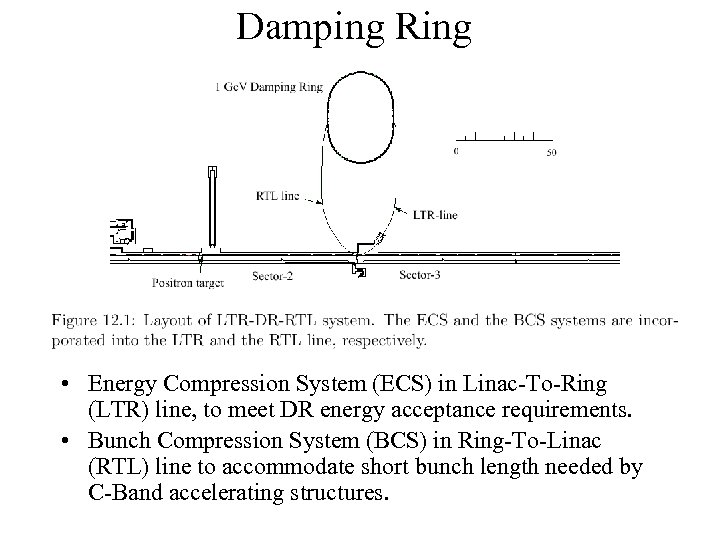 Damping Ring • Energy Compression System (ECS) in Linac-To-Ring (LTR) line, to meet DR energy acceptance requirements. • Bunch Compression System (BCS) in Ring-To-Linac (RTL) line to accommodate short bunch length needed by C-Band accelerating structures.
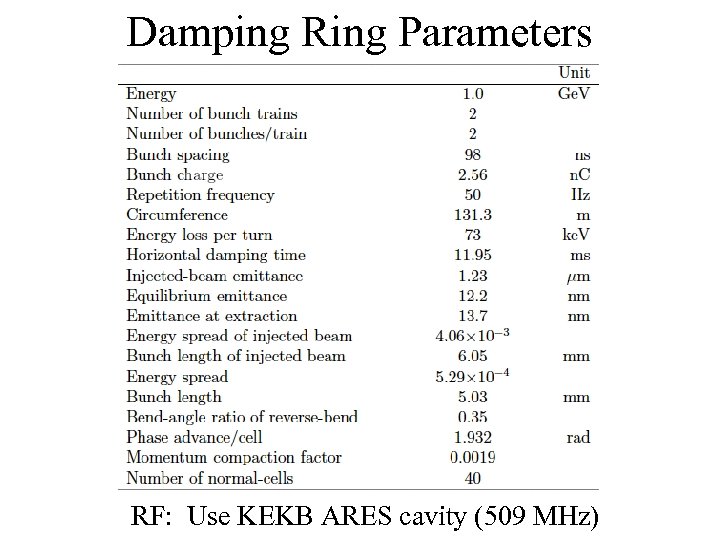 Damping Ring Parameters RF: Use KEKB ARES cavity (509 MHz)
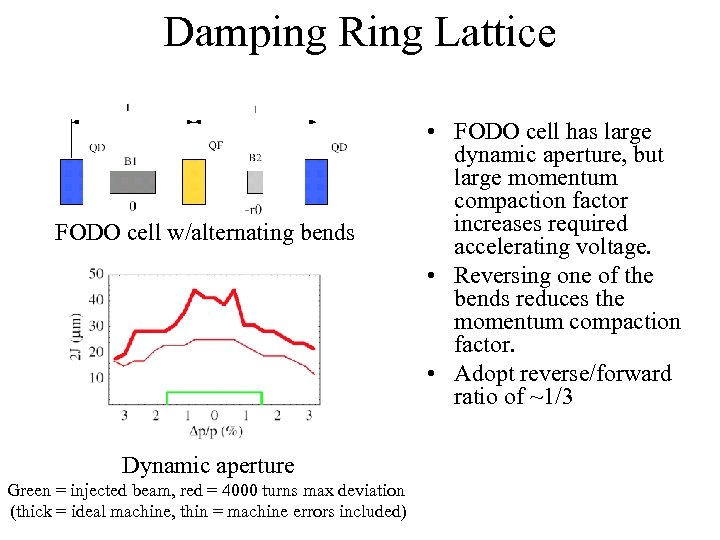 Damping Ring Lattice FODO cell w/alternating bends Dynamic aperture Green = injected beam, red = 4000 turns max deviation (thick = ideal machine, thin = machine errors included) • FODO cell has large dynamic aperture, but large momentum compaction factor increases required accelerating voltage. • Reversing one of the bends reduces the momentum compaction factor. • Adopt reverse/forward ratio of ~1/3
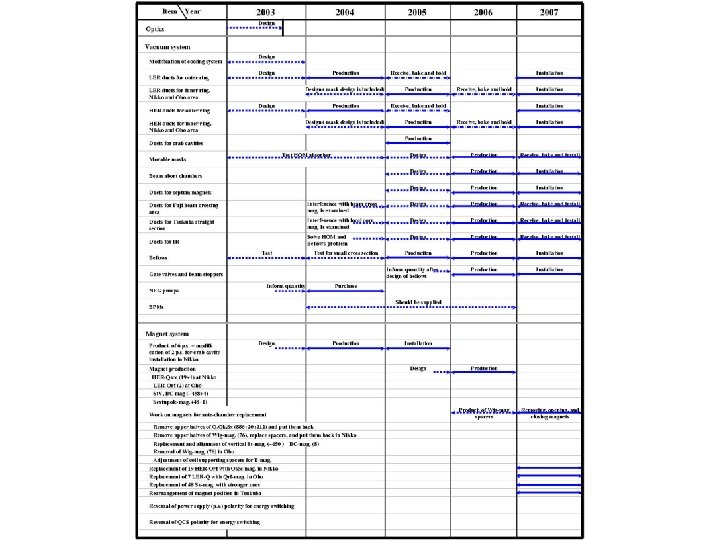
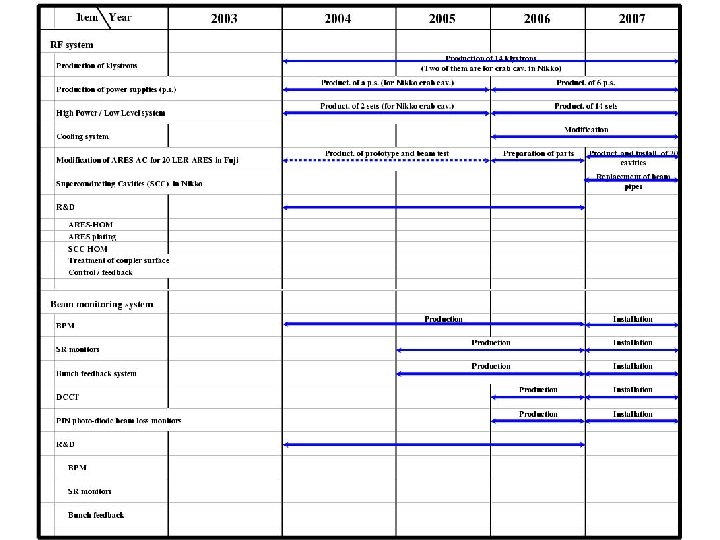
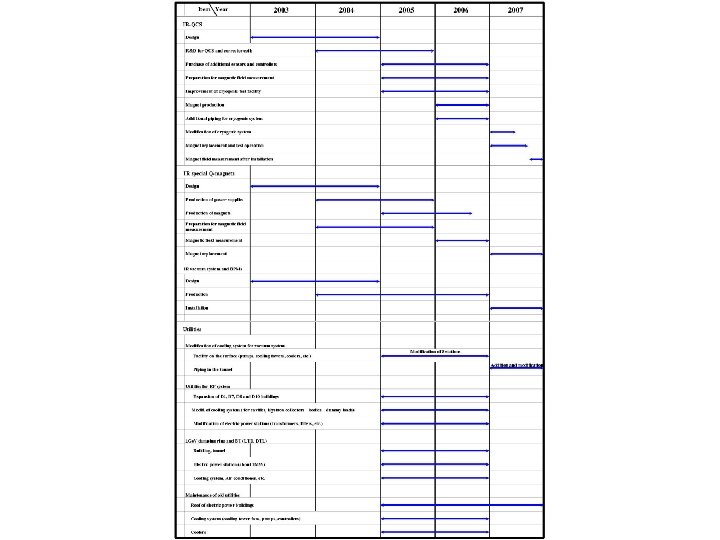
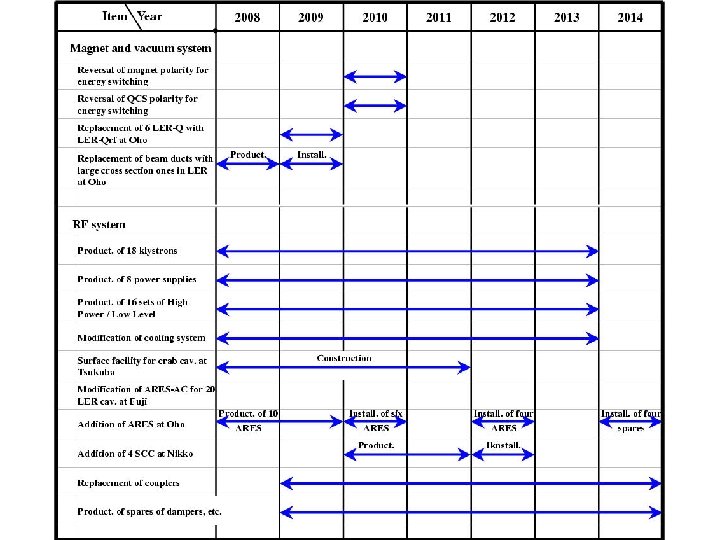
 Construction Scenario • The upgrade of KEKB to Super. KEKB is proposed for around 2007. • R&D and production of various components will be done in the first four years in parallel with the physics experiment at KEKB. • The installation will be done during a one year shutdown in 2007, and then the commissioning of Super. KEKB will begin.
 Summary • Lo. I is in draft stage. • Super. KEKB at L=~5 e 35/cm^2/s can be built.
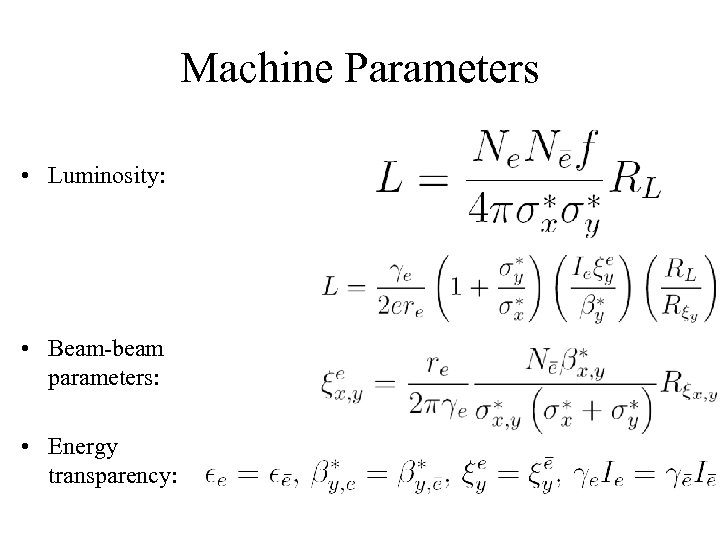 Machine Parameters • Luminosity: • Beam-beam parameters: • Energy transparency:
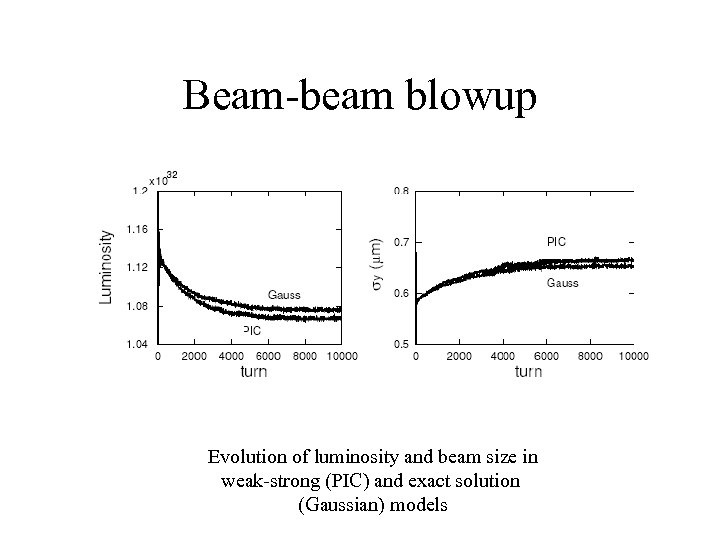 Beam-beam blowup Evolution of luminosity and beam size in weak-strong (PIC) and exact solution (Gaussian) models