 Скачать презентацию Accelerator Neutrino Oscillation Physics Lecture II Deborah Harris
06eaeefeadef31c8b2b3b60492d9fd2c.ppt
- Количество слайдов: 56



Accelerator Neutrino Oscillation Physics Lecture II Deborah Harris Fermilab SUSSP August 16, 2006 16 August 2006 Deborah Harris Accelerator Neutrino Oscillation Physics Lecture II
Outline of this Lecture • Introduction – What are the detector goals? – Particle Interactions in Matter • Detectors – Fully Active • Liquid Argon Time Projection • Cerenkov (covered mostly in Atmospheric Lectures) – Sampling Detectors • • 16 August 2006 Overview: Absorber and Readout Steel/Lead Emulsion Scintillator/Absorber Steel-Scintillator Deborah Harris Accelerator Neutrino Oscillation Physics Lecture II 2
For Each Detector • Underlying principle • Example from real life • What do events look like? – Quasi-elastic Charged Current – Inelastic Charged Current – Neutral Currents • Backgrounds • Neutrino Energy Reconstruction • What else do we want to know? Warning: this lecture is a set of mini-lectures about different detector technologies… All detector questions are far from answered! 16 August 2006 Deborah Harris Accelerator Neutrino Oscillation Physics Lecture II 3
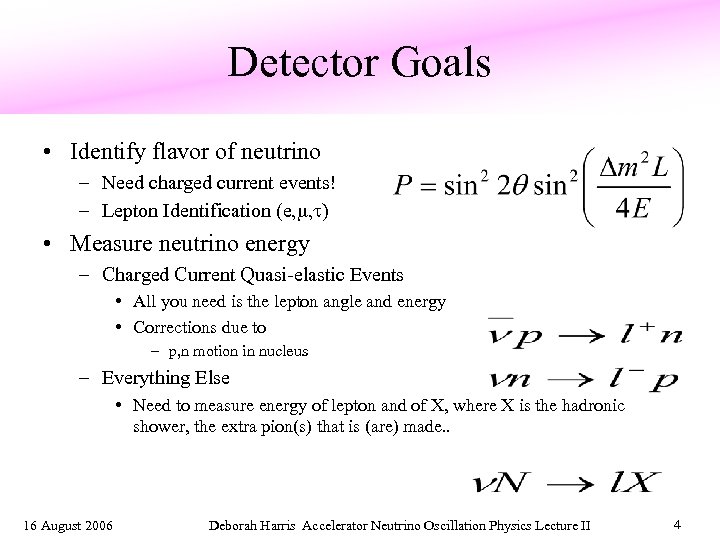
Detector Goals • Identify flavor of neutrino – Need charged current events! – Lepton Identification (e, m, ) • Measure neutrino energy – Charged Current Quasi-elastic Events • All you need is the lepton angle and energy • Corrections due to – p, n motion in nucleus – Everything Else • Need to measure energy of lepton and of X, where X is the hadronic shower, the extra pion(s) that is (are) made. . 16 August 2006 Deborah Harris Accelerator Neutrino Oscillation Physics Lecture II 4
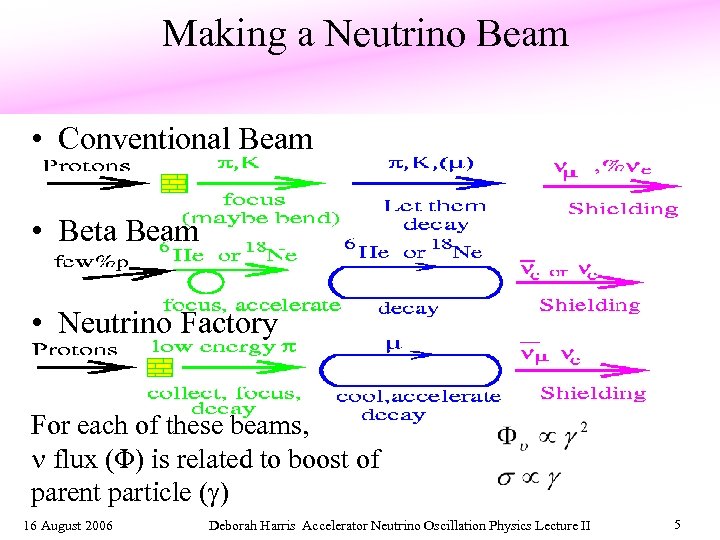
Making a Neutrino Beam • Conventional Beam • Beta Beam • Neutrino Factory For each of these beams, flux (Φ) is related to boost of parent particle ( ) 16 August 2006 Deborah Harris Accelerator Neutrino Oscillation Physics Lecture II 5
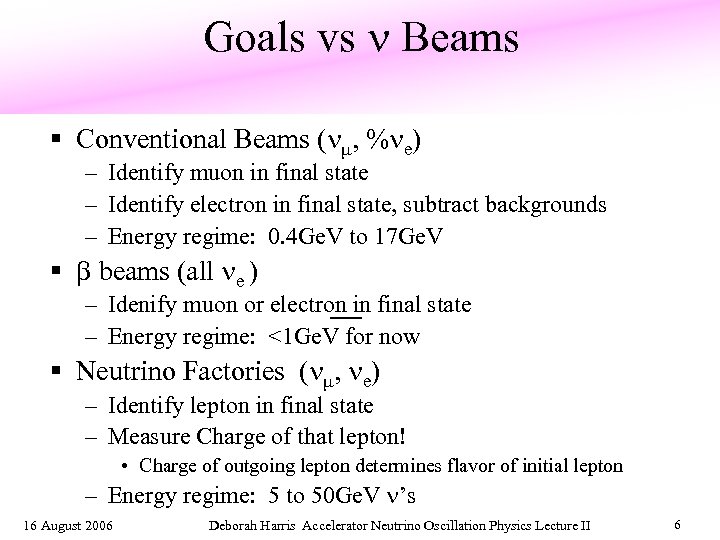
Goals vs Beams § Conventional Beams ( m, % e) – Identify muon in final state – Identify electron in final state, subtract backgrounds – Energy regime: 0. 4 Ge. V to 17 Ge. V § b beams (all e ) – Idenify muon or electron in final state – Energy regime: <1 Ge. V for now § Neutrino Factories ( m, e) – Identify lepton in final state – Measure Charge of that lepton! • Charge of outgoing lepton determines flavor of initial lepton – Energy regime: 5 to 50 Ge. V ’s 16 August 2006 Deborah Harris Accelerator Neutrino Oscillation Physics Lecture II 6
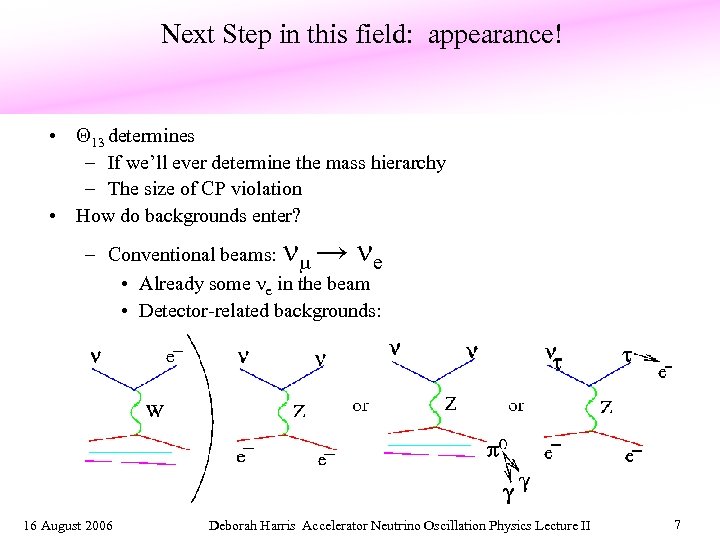
Next Step in this field: appearance! • Q 13 determines – If we’ll ever determine the mass hierarchy – The size of CP violation • How do backgrounds enter? – Conventional beams: m → e • Already some e in the beam • Detector-related backgrounds: 16 August 2006 Deborah Harris Accelerator Neutrino Oscillation Physics Lecture II 7
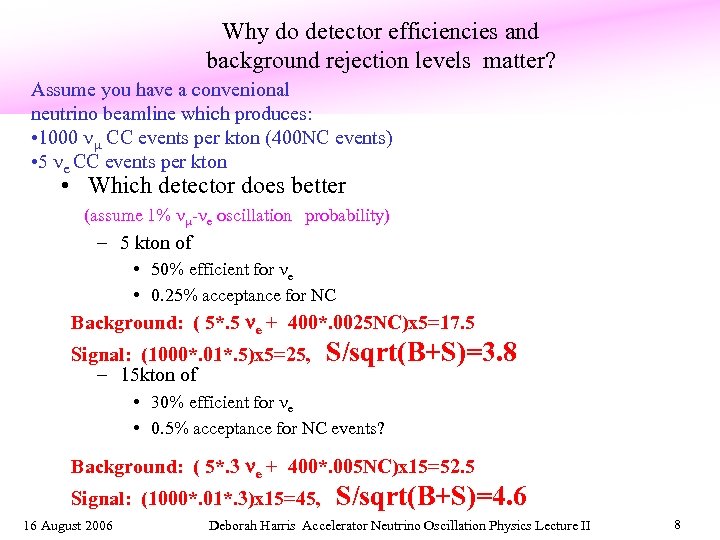
Why do detector efficiencies and background rejection levels matter? Assume you have a convenional neutrino beamline which produces: • 1000 m CC events per kton (400 NC events) • 5 e CC events per kton • Which detector does better (assume 1% m- e oscillation probability) – 5 kton of • 50% efficient for e • 0. 25% acceptance for NC Background: ( 5*. 5 e + 400*. 0025 NC)x 5=17. 5 Signal: (1000*. 01*. 5)x 5=25, – 15 kton of S/sqrt(B+S)=3. 8 • 30% efficient for e • 0. 5% acceptance for NC events? Background: ( 5*. 3 e + 400*. 005 NC)x 15=52. 5 Signal: (1000*. 01*. 3)x 15=45, 16 August 2006 S/sqrt(B+S)=4. 6 Deborah Harris Accelerator Neutrino Oscillation Physics Lecture II 8
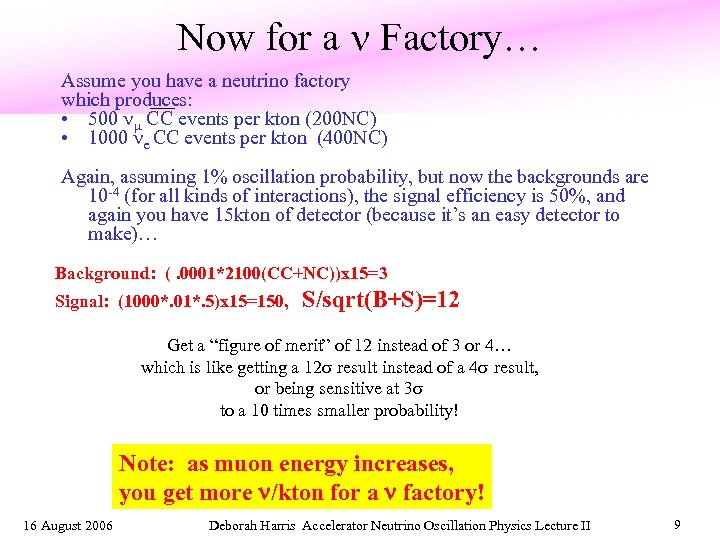
Now for a Factory… Assume you have a neutrino factory which produces: • 500 m CC events per kton (200 NC) • 1000 e CC events per kton (400 NC) Again, assuming 1% oscillation probability, but now the backgrounds are 10 -4 (for all kinds of interactions), the signal efficiency is 50%, and again you have 15 kton of detector (because it’s an easy detector to make)… Background: (. 0001*2100(CC+NC))x 15=3 Signal: (1000*. 01*. 5)x 15=150, S/sqrt(B+S)=12 Get a “figure of merit” of 12 instead of 3 or 4… which is like getting a 12 s result instead of a 4 s result, or being sensitive at 3 s to a 10 times smaller probability! Note: as muon energy increases, you get more /kton for a factory! 16 August 2006 Deborah Harris Accelerator Neutrino Oscillation Physics Lecture II 9
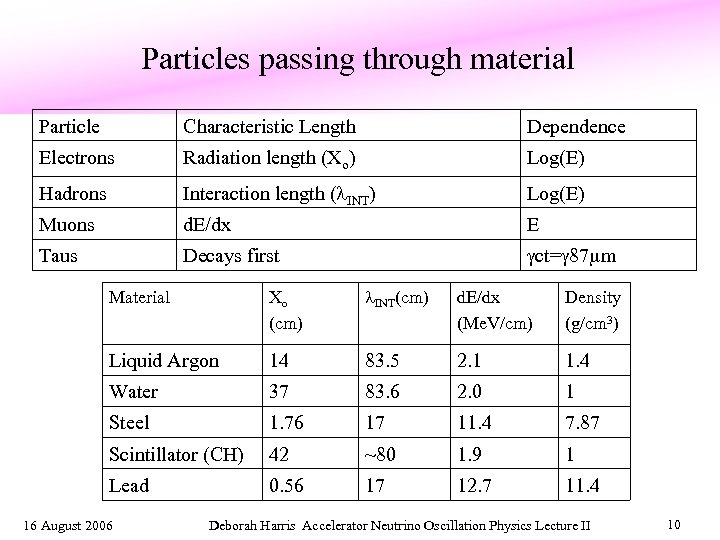
Particles passing through material Particle Characteristic Length Dependence Electrons Radiation length (Xo) Log(E) Hadrons Interaction length (l. INT) Log(E) Muons d. E/dx E Taus Decays first ct= 87 mm Material Xo (cm) l. INT(cm) d. E/dx (Me. V/cm) Density (g/cm 3) Liquid Argon 14 83. 5 2. 1 1. 4 Water 37 83. 6 2. 0 1 Steel 1. 76 17 11. 4 7. 87 Scintillator (CH) 42 ~80 1. 9 1 Lead 0. 56 17 12. 7 11. 4 16 August 2006 Deborah Harris Accelerator Neutrino Oscillation Physics Lecture II 10
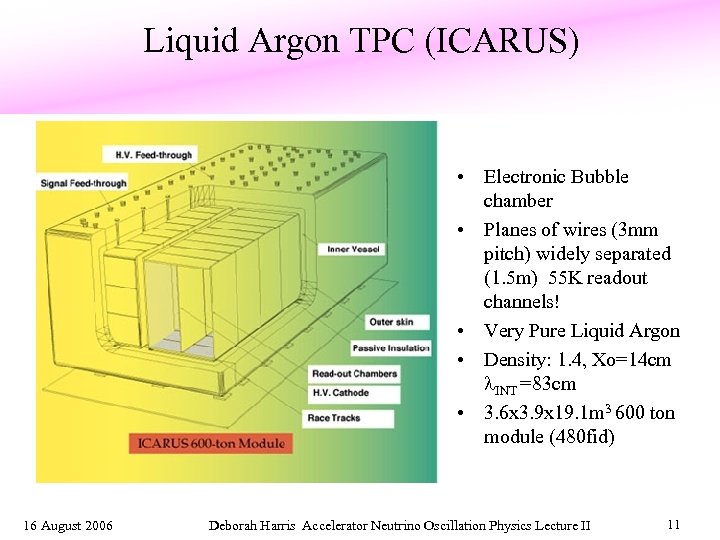
Liquid Argon TPC (ICARUS) • Electronic Bubble chamber • Planes of wires (3 mm pitch) widely separated (1. 5 m) 55 K readout channels! • Very Pure Liquid Argon • Density: 1. 4, Xo=14 cm l. INT =83 cm • 3. 6 x 3. 9 x 19. 1 m 3 600 ton module (480 fid) 16 August 2006 Deborah Harris Accelerator Neutrino Oscillation Physics Lecture II 11
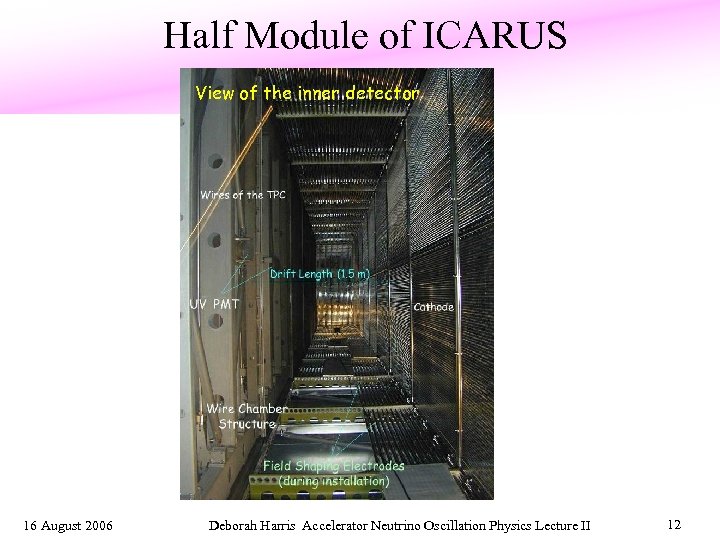
Half Module of ICARUS View of the inner detector 16 August 2006 Deborah Harris Accelerator Neutrino Oscillation Physics Lecture II 12
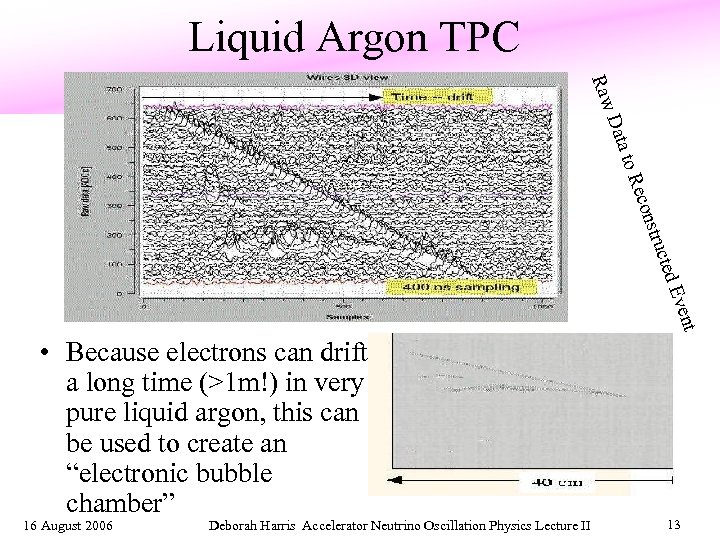
Liquid Argon TPC Raw Data to R cted stru econ nt Eve • Because electrons can drift a long time (>1 m!) in very pure liquid argon, this can be used to create an “electronic bubble chamber” 16 August 2006 Deborah Harris Accelerator Neutrino Oscillation Physics Lecture II 13
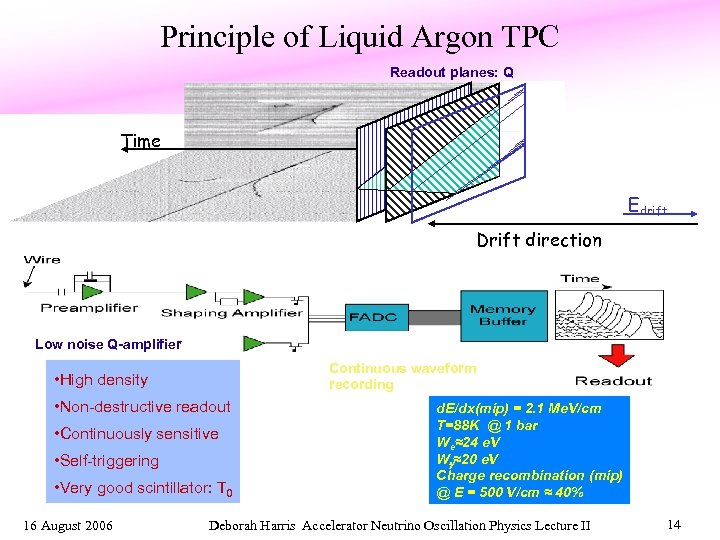
Principle of Liquid Argon TPC Readout planes: Q Time Edrift Drift direction Low noise Q-amplifier Continuous waveform recording • High density • Non-destructive readout • Continuously sensitive • Self-triggering • Very good scintillator: T 0 16 August 2006 d. E/dx(mip) = 2. 1 Me. V/cm T=88 K @ 1 bar We≈24 e. V Wg≈20 e. V Charge recombination (mip) @ E = 500 V/cm ≈ 40% Deborah Harris Accelerator Neutrino Oscillation Physics Lecture II 14
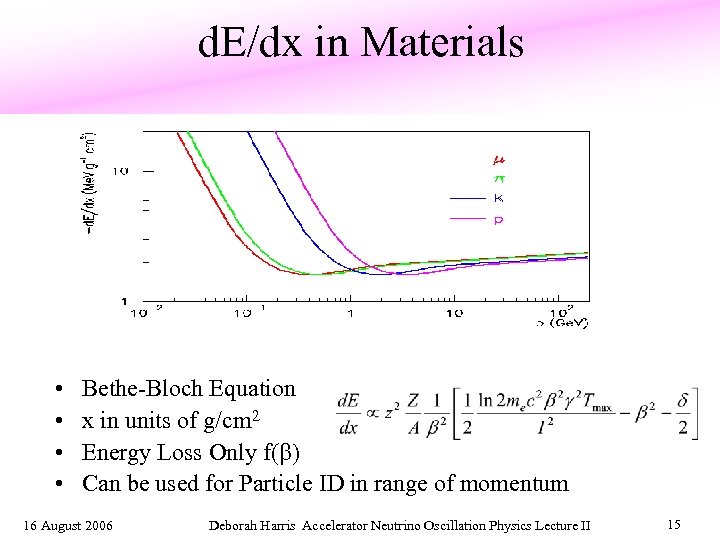
d. E/dx in Materials • • Bethe-Bloch Equation x in units of g/cm 2 Energy Loss Only f(b) Can be used for Particle ID in range of momentum 16 August 2006 Deborah Harris Accelerator Neutrino Oscillation Physics Lecture II 15
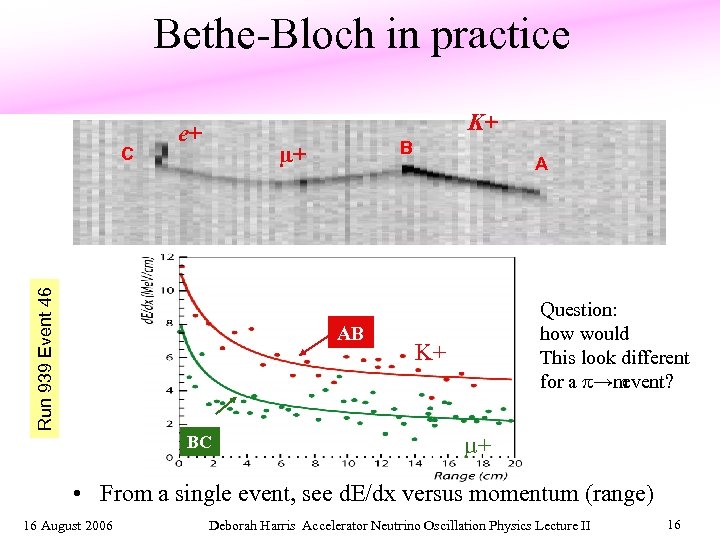
Bethe-Bloch in practice B µ+ Run 939 Event 46 C K+ e+ AB BC A Question: how would This look different for a →m event? K+ µ+ • From a single event, see d. E/dx versus momentum (range) 16 August 2006 Deborah Harris Accelerator Neutrino Oscillation Physics Lecture II 16
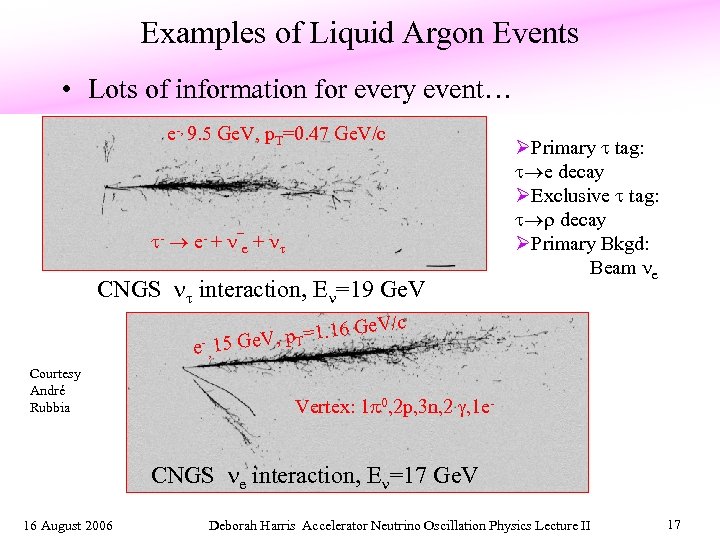
Examples of Liquid Argon Events • Lots of information for every event… e-, 9. 5 Ge. V, p. T=0. 47 Ge. V/c - e- + _ e + CNGS interaction, E =19 Ge. V ØPrimary tag: e decay ØExclusive tag: r decay ØPrimary Bkgd: Beam e c e- , Courtesy André Rubbia e. V/ , p T=1. 16 G 15 Ge. V Vertex: 1 0, 2 p, 3 n, 2 , 1 e- CNGS e interaction, E =17 Ge. V 16 August 2006 Deborah Harris Accelerator Neutrino Oscillation Physics Lecture II 17
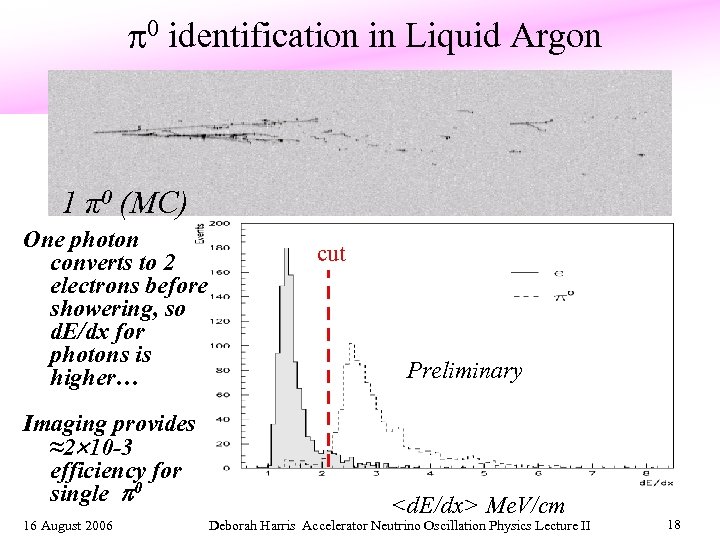
0 identification in Liquid Argon 1 π0 (MC) One photon converts to 2 electrons before showering, so d. E/dx for photons is higher… Imaging provides ≈2 10 -3 efficiency for single p 0 16 August 2006 cut Preliminary <d. E/dx> Me. V/cm Deborah Harris Accelerator Neutrino Oscillation Physics Lecture II 18
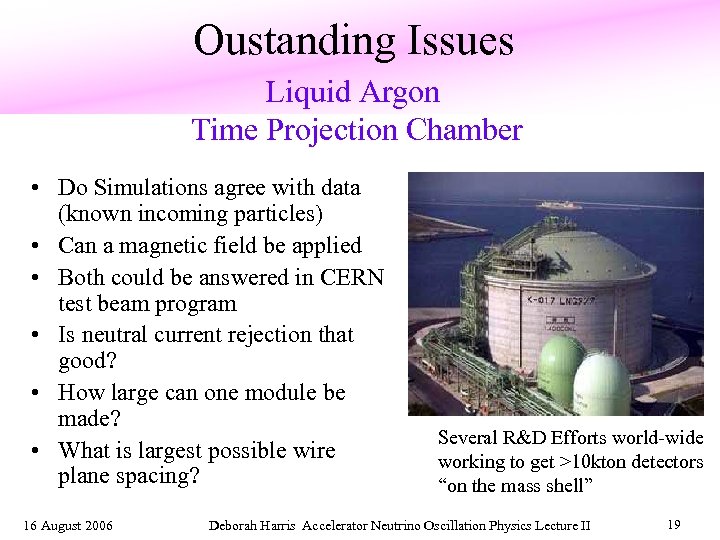
Oustanding Issues Liquid Argon Time Projection Chamber • Do Simulations agree with data (known incoming particles) • Can a magnetic field be applied • Both could be answered in CERN test beam program • Is neutral current rejection that good? • How large can one module be made? • What is largest possible wire plane spacing? 16 August 2006 Several R&D Efforts world-wide working to get >10 kton detectors “on the mass shell” Deborah Harris Accelerator Neutrino Oscillation Physics Lecture II 19
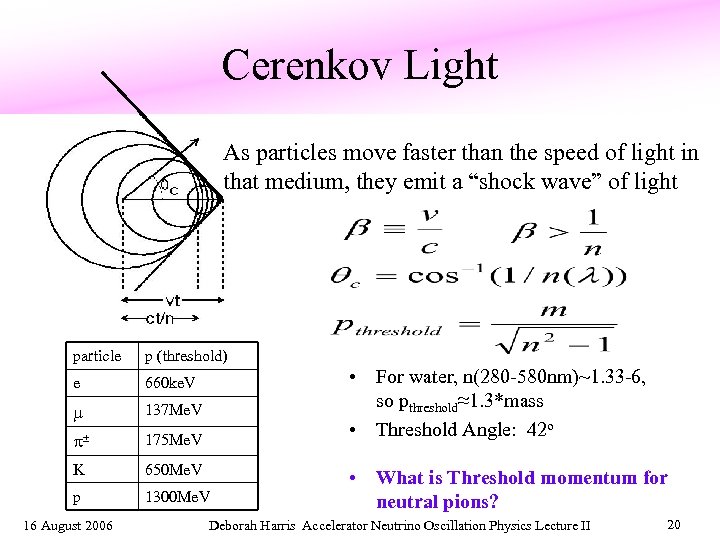
Cerenkov Light As particles move faster than the speed of light in that medium, they emit a “shock wave” of light particle p (threshold) e 660 ke. V m 137 Me. V ± 175 Me. V K 650 Me. V p 1300 Me. V 16 August 2006 • For water, n(280 -580 nm)~1. 33 -6, so pthreshold≈1. 3*mass • Threshold Angle: 42 o • What is Threshold momentum for neutral pions? Deborah Harris Accelerator Neutrino Oscillation Physics Lecture II 20
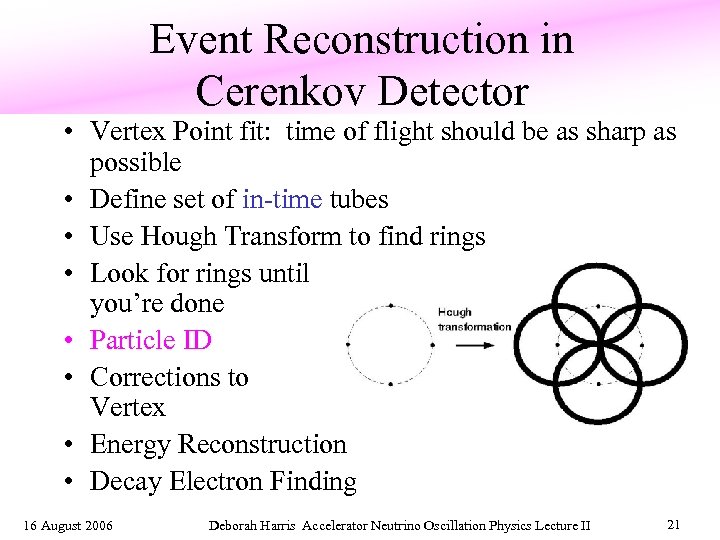
Event Reconstruction in Cerenkov Detector • Vertex Point fit: time of flight should be as sharp as possible • Define set of in-time tubes • Use Hough Transform to find rings • Look for rings until you’re done • Particle ID • Corrections to Vertex • Energy Reconstruction • Decay Electron Finding 16 August 2006 Deborah Harris Accelerator Neutrino Oscillation Physics Lecture II 21
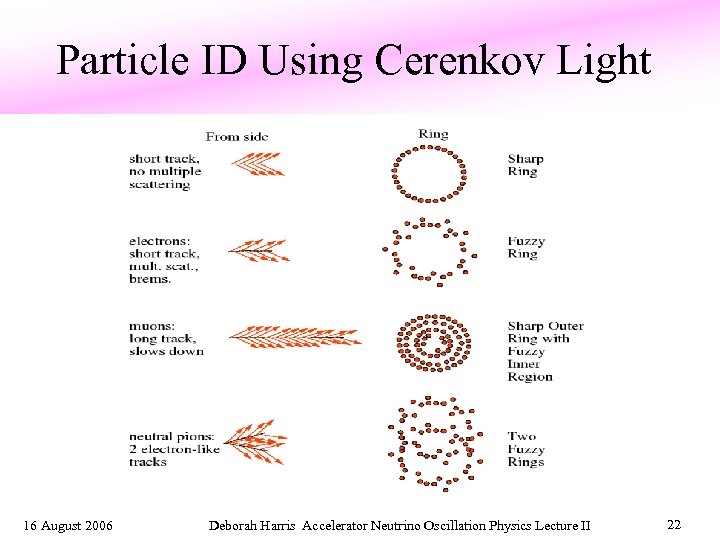
Particle ID Using Cerenkov Light 16 August 2006 Deborah Harris Accelerator Neutrino Oscillation Physics Lecture II 22
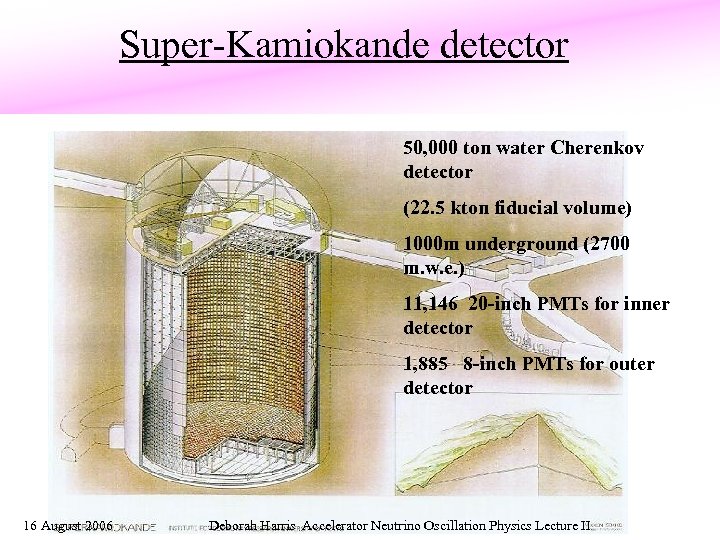
Super-Kamiokande detector 50, 000 ton water Cherenkov detector (22. 5 kton fiducial volume) 1000 m underground (2700 m. w. e. ) 11, 146 20 -inch PMTs for inner detector 1, 885 8 -inch PMTs for outer detector 16 August 2006 Deborah Harris Accelerator Neutrino Oscillation Physics Lecture II
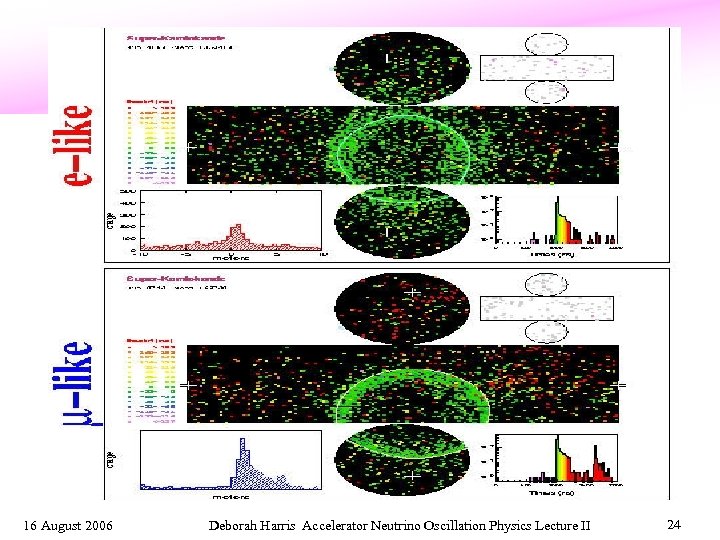
16 August 2006 Deborah Harris Accelerator Neutrino Oscillation Physics Lecture II 24
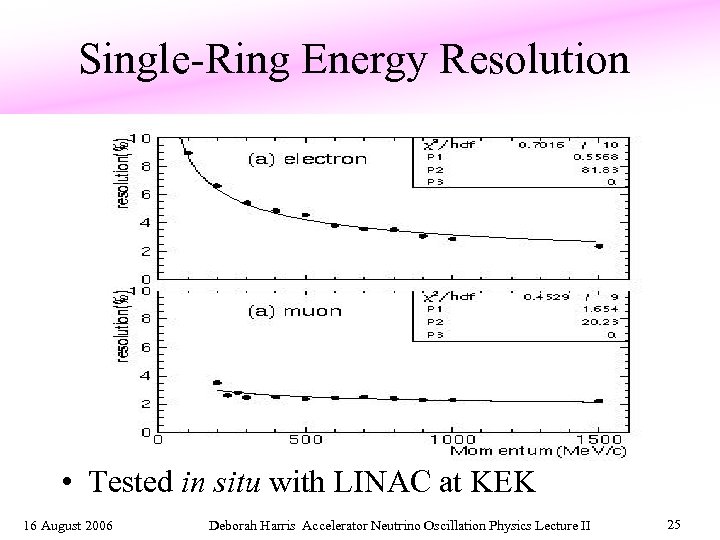
Single-Ring Energy Resolution • Tested in situ with LINAC at KEK 16 August 2006 Deborah Harris Accelerator Neutrino Oscillation Physics Lecture II 25
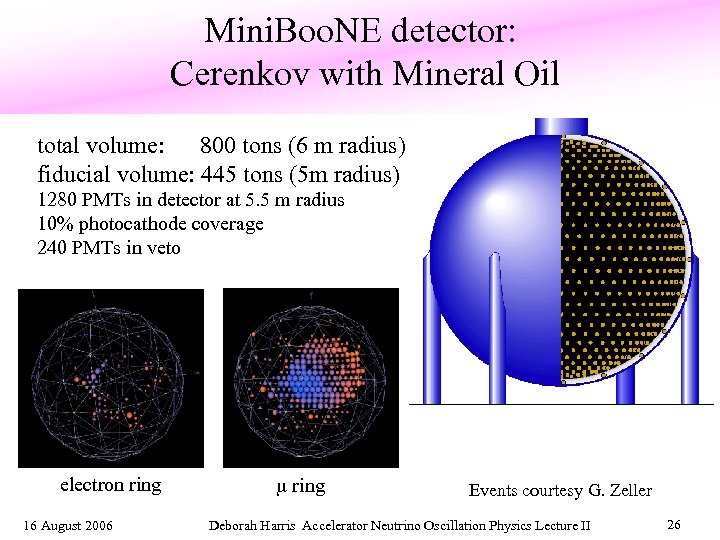
Mini. Boo. NE detector: Cerenkov with Mineral Oil total volume: 800 tons (6 m radius) fiducial volume: 445 tons (5 m radius) 1280 PMTs in detector at 5. 5 m radius 10% photocathode coverage 240 PMTs in veto electron ring 16 August 2006 m ring Events courtesy G. Zeller Deborah Harris Accelerator Neutrino Oscillation Physics Lecture II 26
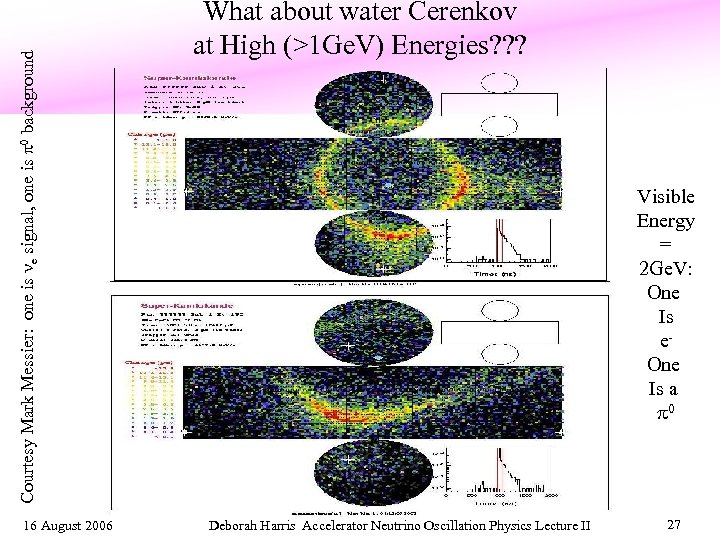
Courtesy Mark Messier: one is e signal, one is 0 background 16 August 2006 What about water Cerenkov at High (>1 Ge. V) Energies? ? ? Visible Energy = 2 Ge. V: One Is e. One Is a 0 Deborah Harris Accelerator Neutrino Oscillation Physics Lecture II 27
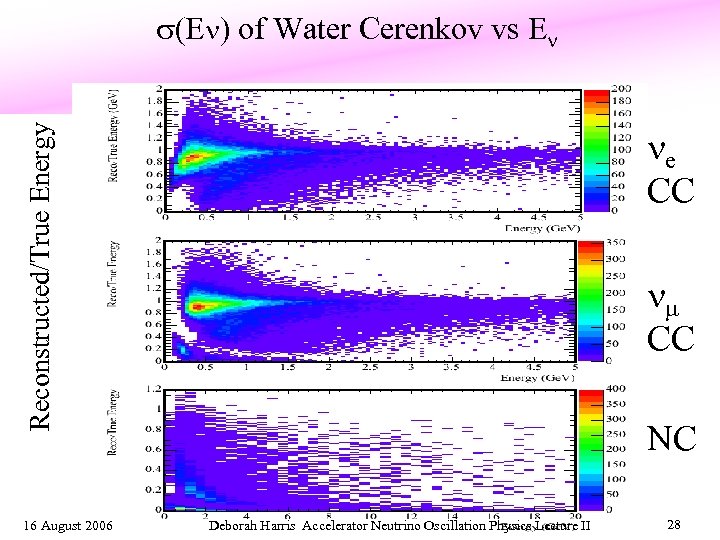
Reconstructed/True Energy s(E ) of Water Cerenkov vs E 16 August 2006 e CC m CC NC Deborah Harris Accelerator Neutrino Oscillation Physics Lecture II 28
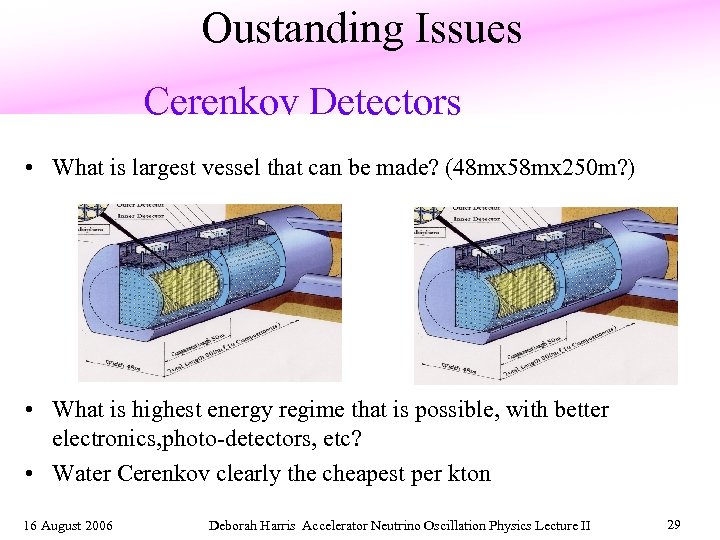
Oustanding Issues Cerenkov Detectors • What is largest vessel that can be made? (48 mx 58 mx 250 m? ) • What is highest energy regime that is possible, with better electronics, photo-detectors, etc? • Water Cerenkov clearly the cheapest per kton 16 August 2006 Deborah Harris Accelerator Neutrino Oscillation Physics Lecture II 29
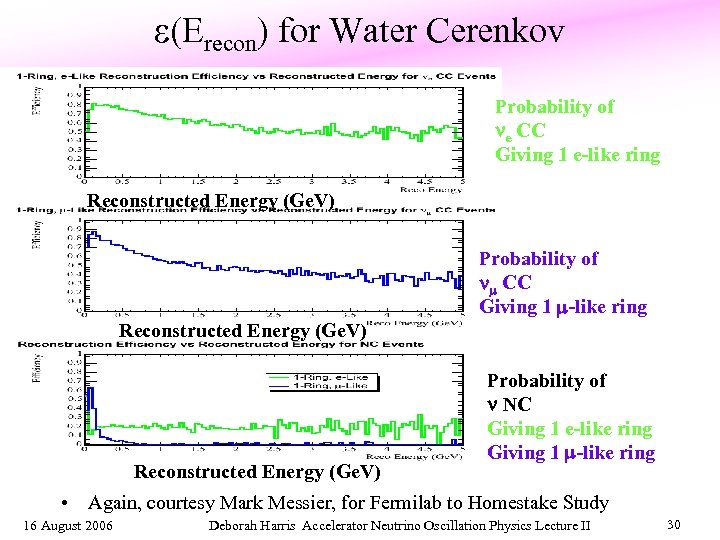
e(Erecon) for Water Cerenkov Probability of e CC Giving 1 e-like ring Reconstructed Energy (Ge. V) Probability of CC Giving 1 -like ring Reconstructed Energy (Ge. V) Probability of NC Giving 1 e-like ring Giving 1 -like ring • Again, courtesy Mark Messier, for Fermilab to Homestake Study 16 August 2006 Deborah Harris Accelerator Neutrino Oscillation Physics Lecture II 30
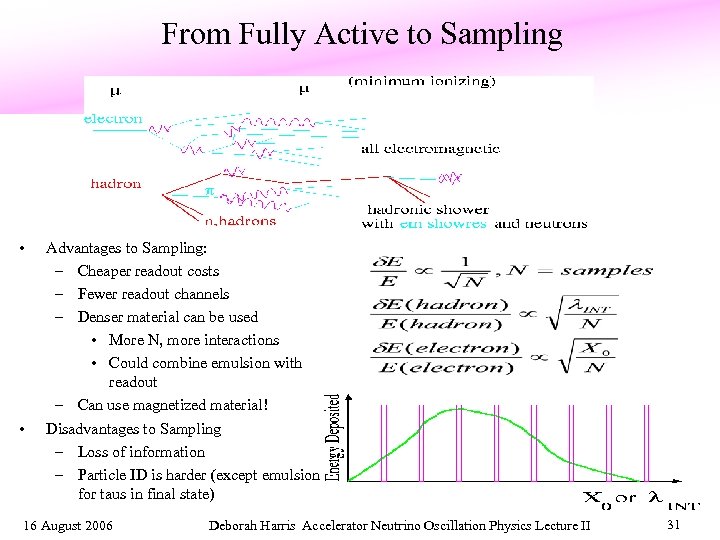
From Fully Active to Sampling • • Advantages to Sampling: – Cheaper readout costs – Fewer readout channels – Denser material can be used • More N, more interactions • Could combine emulsion with readout – Can use magnetized material! Disadvantages to Sampling – Loss of information – Particle ID is harder (except emulsion for taus in final state) 16 August 2006 Deborah Harris Accelerator Neutrino Oscillation Physics Lecture II 31
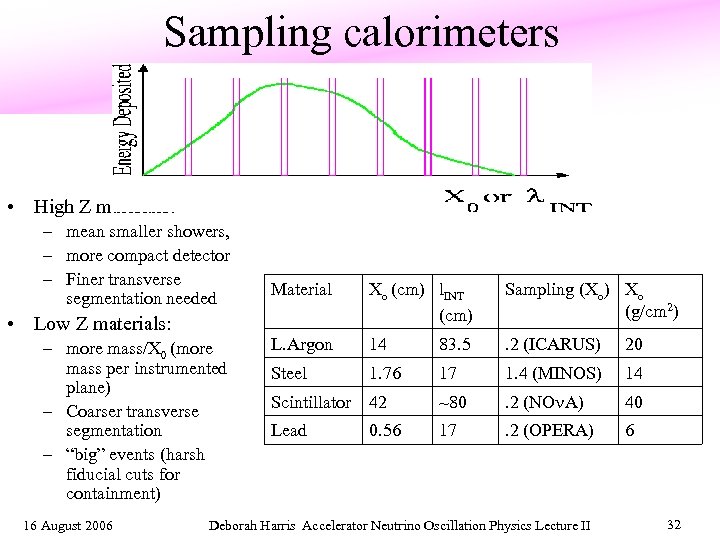
Sampling calorimeters • High Z materials: – mean smaller showers, – more compact detector – Finer transverse segmentation needed • Low Z materials: – more mass/X 0 (more mass per instrumented plane) – Coarser transverse segmentation – “big” events (harsh fiducial cuts for containment) 16 August 2006 Material Xo (cm) l. INT (cm) Sampling (Xo) Xo (g/cm 2) L. Argon 14 83. 5 . 2 (ICARUS) 20 Steel 1. 76 17 1. 4 (MINOS) 14 Scintillator 42 ~80 . 2 (NO A) 40 Lead 0. 56 17 . 2 (OPERA) 6 Deborah Harris Accelerator Neutrino Oscillation Physics Lecture II 32
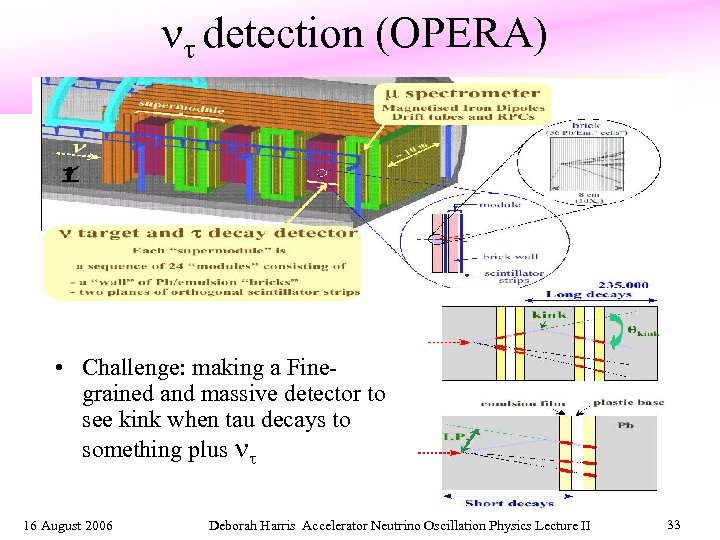
detection (OPERA) • Challenge: making a Finegrained and massive detector to see kink when tau decays to something plus 16 August 2006 Deborah Harris Accelerator Neutrino Oscillation Physics Lecture II 33
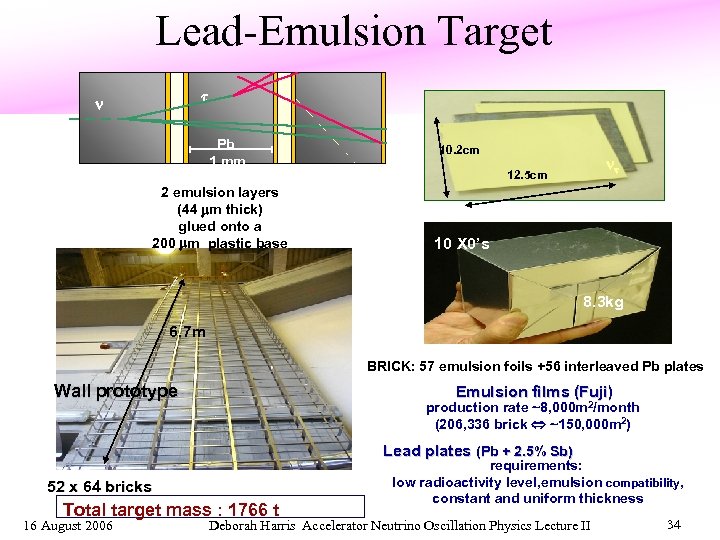
Lead-Emulsion Target Pb 1 mm 2 emulsion layers (44 m thick) glued onto a 200 m plastic base 10. 2 cm 12. 5 cm 10 X 0’s 8. 3 kg 6. 7 m BRICK: 57 emulsion foils +56 interleaved Pb plates Wall prototype Emulsion films (Fuji) production rate ~8, 000 m 2/month (206, 336 brick ~150, 000 m 2) Lead plates (Pb + 2. 5% Sb) 52 x 64 bricks Total target mass : 1766 t 16 August 2006 requirements: low radioactivity level, emulsion compatibility, constant and uniform thickness Deborah Harris Accelerator Neutrino Oscillation Physics Lecture II 34
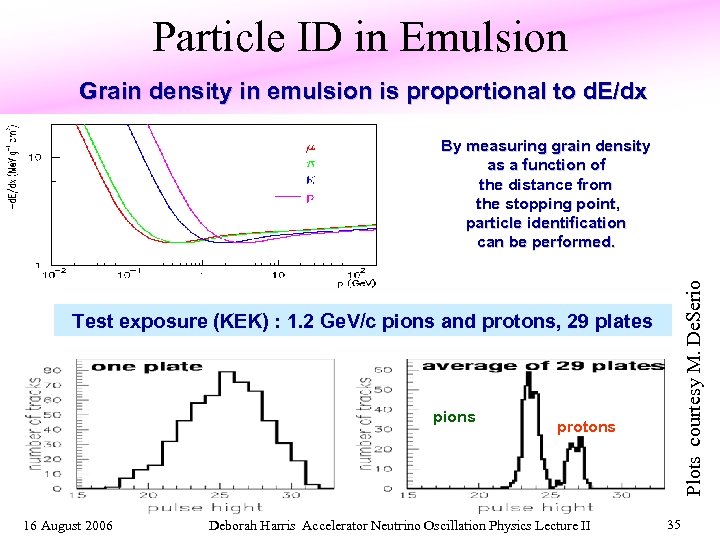
Particle ID in Emulsion Grain density in emulsion is proportional to d. E/dx Plots courtesy M. De. Serio By measuring grain density as a function of the distance from the stopping point, particle identification can be performed. Test exposure (KEK) : 1. 2 Ge. V/c pions and protons, 29 plates pions 16 August 2006 protons Deborah Harris Accelerator Neutrino Oscillation Physics Lecture II 35
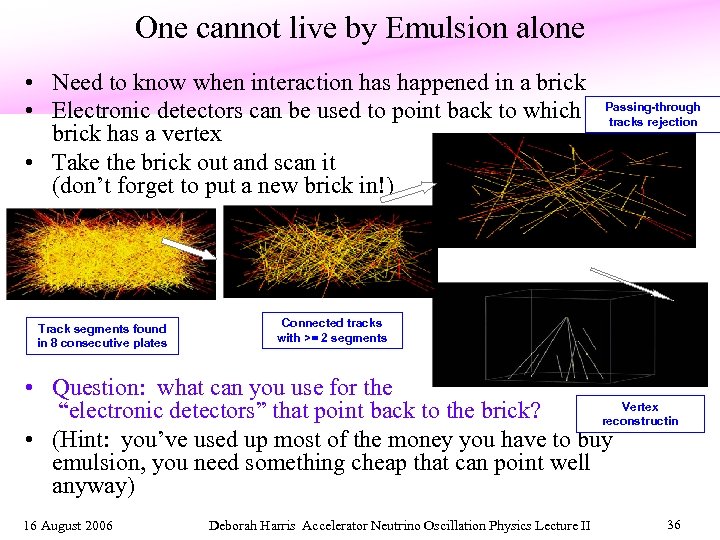
One cannot live by Emulsion alone • Need to know when interaction has happened in a brick • Electronic detectors can be used to point back to which brick has a vertex • Take the brick out and scan it (don’t forget to put a new brick in!) Track segments found in 8 consecutive plates Passing-through tracks rejection Connected tracks with >= 2 segments • Question: what can you use for the Vertex “electronic detectors” that point back to the brick? reconstructin • (Hint: you’ve used up most of the money you have to buy emulsion, you need something cheap that can point well anyway) 16 August 2006 Deborah Harris Accelerator Neutrino Oscillation Physics Lecture II 36
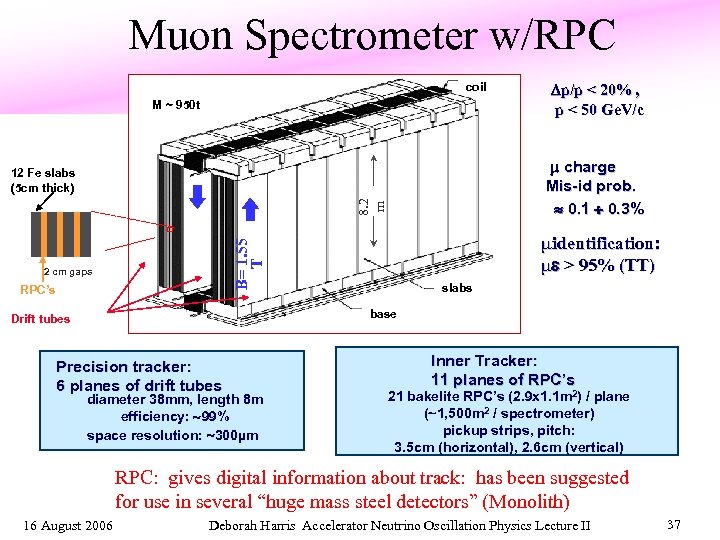
Muon Spectrometer w/RPC coil M ~ 950 t charge Mis-id prob. 0. 1 0. 3% 8. 2 m 12 Fe slabs (5 cm thick) midentification: m > 95% (TT) B= 1. 55 T 2 cm gaps RPC’s p/p < 20% , p < 50 Ge. V/c slabs base Drift tubes Precision tracker: 6 planes of drift tubes diameter 38 mm, length 8 m efficiency: 99% space resolution: 300µm Inner Tracker: 11 planes of RPC’s 21 bakelite RPC’s (2. 9 x 1. 1 m 2) / plane (~1, 500 m 2 / spectrometer) pickup strips, pitch: 3. 5 cm (horizontal), 2. 6 cm (vertical) RPC: gives digital information about track: has been suggested for use in several “huge mass steel detectors” (Monolith) 16 August 2006 Deborah Harris Accelerator Neutrino Oscillation Physics Lecture II 37
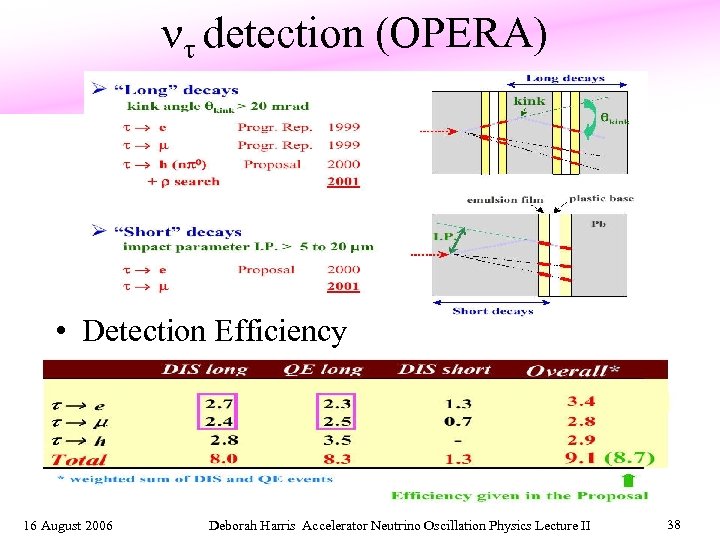
detection (OPERA) • Detection Efficiency 16 August 2006 Deborah Harris Accelerator Neutrino Oscillation Physics Lecture II 38
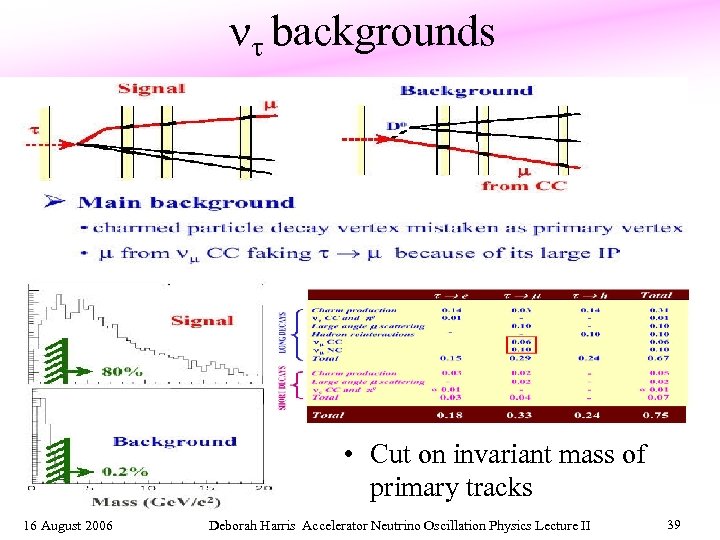
backgrounds • Cut on invariant mass of primary tracks 16 August 2006 Deborah Harris Accelerator Neutrino Oscillation Physics Lecture II 39
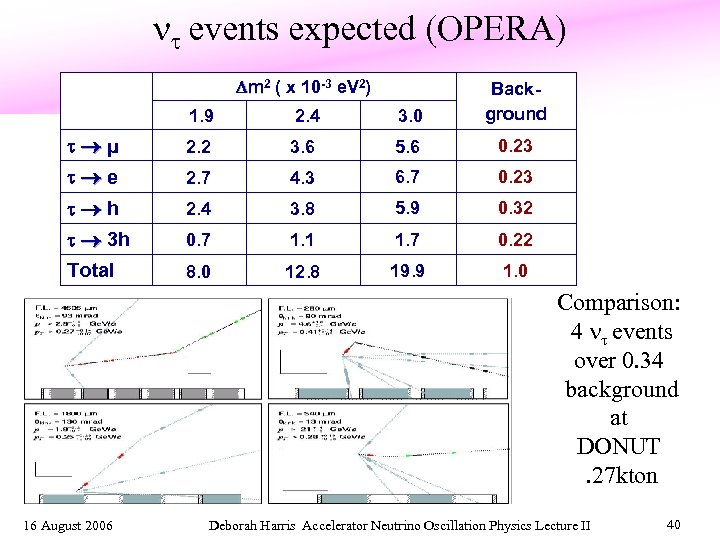
events expected (OPERA) m 2 ( x 10 -3 e. V 2) 1. 9 2. 4 3. 0 Background µ 2. 2 3. 6 5. 6 0. 23 e 2. 7 4. 3 6. 7 0. 23 h 2. 4 3. 8 5. 9 0. 32 3 h 0. 7 1. 1 1. 7 0. 22 Total 8. 0 12. 8 19. 9 1. 0 Comparison: 4 events over 0. 34 background at DONUT. 27 kton 16 August 2006 Deborah Harris Accelerator Neutrino Oscillation Physics Lecture II 40
Outstanding Issues Emulsion Sampling • If LSND signature is oscillations, appearance will be much more important in the future • For future neutrino factory experiments, could study e → • For either of these topics, need to understand if/how magnetic field can be made… • Any way to make this detector more massive? 16 August 2006 Deborah Harris Accelerator Neutrino Oscillation Physics Lecture II 41
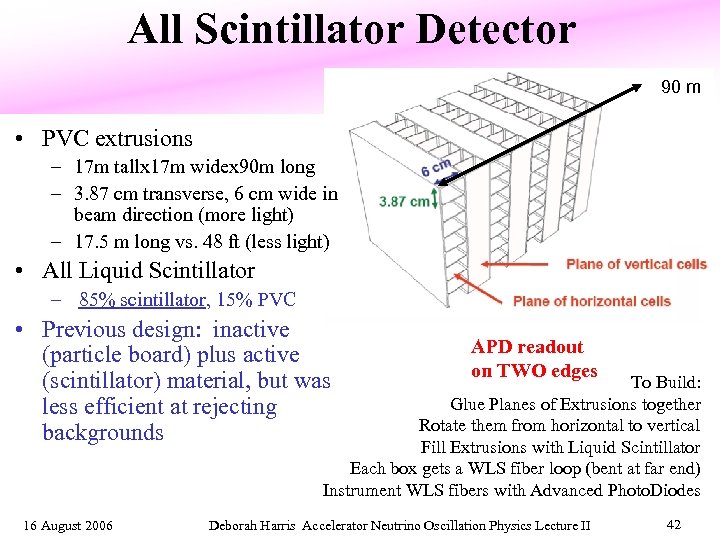
All Scintillator Detector 90 m • PVC extrusions – 17 m tallx 17 m widex 90 m long – 3. 87 cm transverse, 6 cm wide in beam direction (more light) – 17. 5 m long vs. 48 ft (less light) • All Liquid Scintillator – 85% scintillator, 15% PVC • Previous design: inactive (particle board) plus active (scintillator) material, but was less efficient at rejecting backgrounds APD readout on TWO edges To Build: Glue Planes of Extrusions together Rotate them from horizontal to vertical Fill Extrusions with Liquid Scintillator Each box gets a WLS fiber loop (bent at far end) Instrument WLS fibers with Advanced Photo. Diodes 16 August 2006 Deborah Harris Accelerator Neutrino Oscillation Physics Lecture II 42
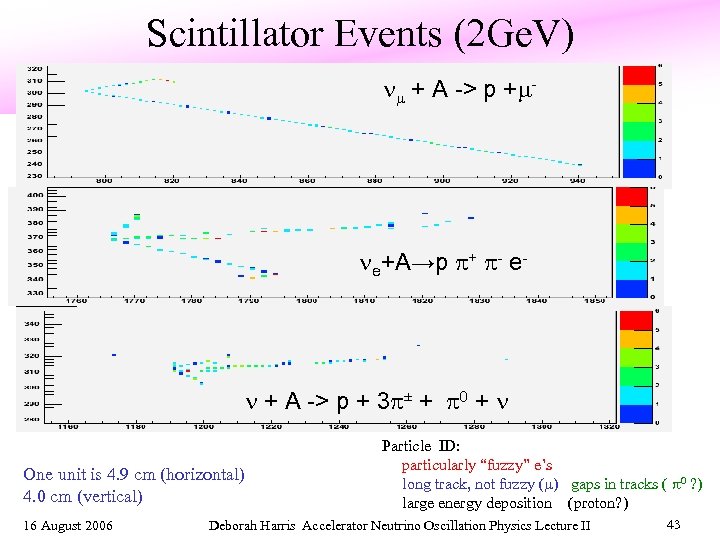
Scintillator Events (2 Ge. V) m + A -> p +m- e+A→p + - e- + A -> p + 3 ± + 0 + One unit is 4. 9 cm (horizontal) 4. 0 cm (vertical) 16 August 2006 Particle ID: particularly “fuzzy” e’s long track, not fuzzy (m) gaps in tracks ( 0 ? ) large energy deposition (proton? ) Deborah Harris Accelerator Neutrino Oscillation Physics Lecture II 43
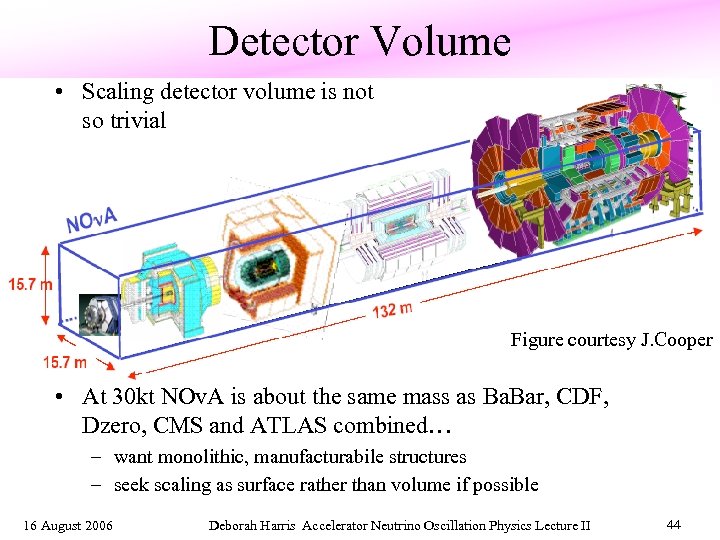
Detector Volume • Scaling detector volume is not so trivial Figure courtesy J. Cooper • At 30 kt NOv. A is about the same mass as Ba. Bar, CDF, Dzero, CMS and ATLAS combined… – want monolithic, manufacturabile structures – seek scaling as surface rather than volume if possible 16 August 2006 Deborah Harris Accelerator Neutrino Oscillation Physics Lecture II 44
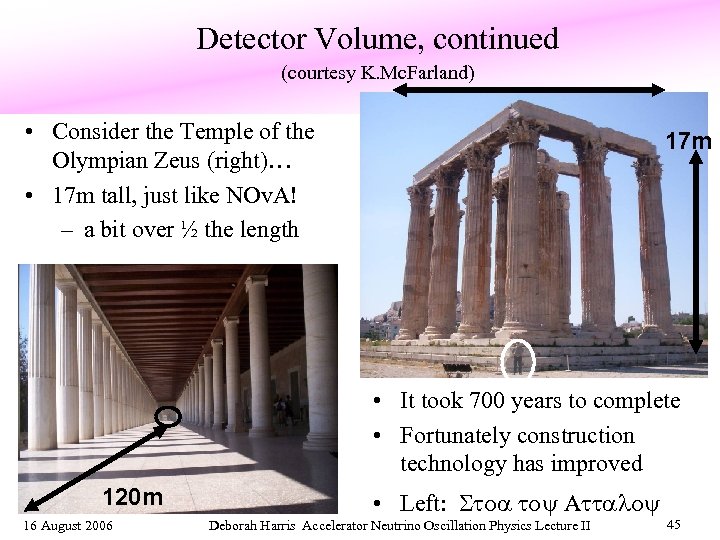
Detector Volume, continued (courtesy K. Mc. Farland) • Consider the Temple of the Olympian Zeus (right)… • 17 m tall, just like NOv. A! – a bit over ½ the length 17 m • It took 700 years to complete • Fortunately construction technology has improved 120 m 16 August 2006 • Left: S oa oy A aloy Deborah Harris Accelerator Neutrino Oscillation Physics Lecture II 45
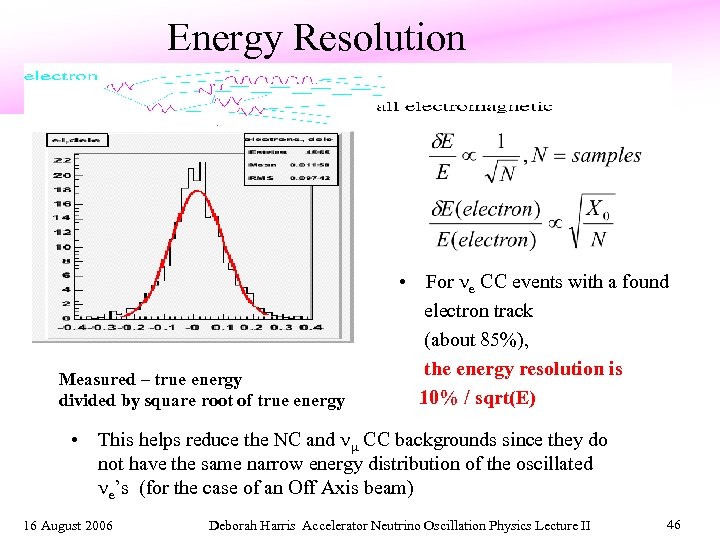
Energy Resolution Measured – true energy divided by square root of true energy • For e CC events with a found electron track (about 85%), the energy resolution is 10% / sqrt(E) • This helps reduce the NC and m CC backgrounds since they do not have the same narrow energy distribution of the oscillated e’s (for the case of an Off Axis beam) 16 August 2006 Deborah Harris Accelerator Neutrino Oscillation Physics Lecture II 46
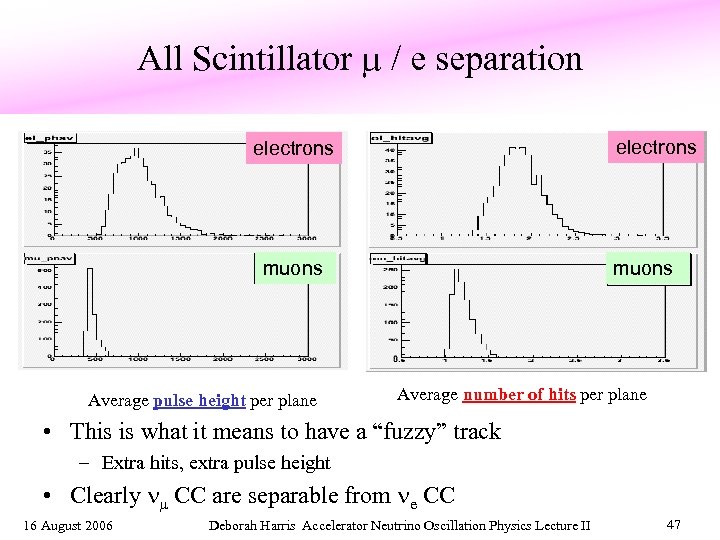
All Scintillator m / e separation electrons muons Average pulse height per plane muons Average number of hits per plane • This is what it means to have a “fuzzy” track – Extra hits, extra pulse height • Clearly m CC are separable from e CC 16 August 2006 Deborah Harris Accelerator Neutrino Oscillation Physics Lecture II 47
Outstanding Issues Fine Grained Scintillator • • How cheaply can this be made? Do you need any passive absorber? What is best choice for readout? Must have confidence in ability to reduce Neutral Current Backgrounds 16 August 2006 Deborah Harris Accelerator Neutrino Oscillation Physics Lecture II 48
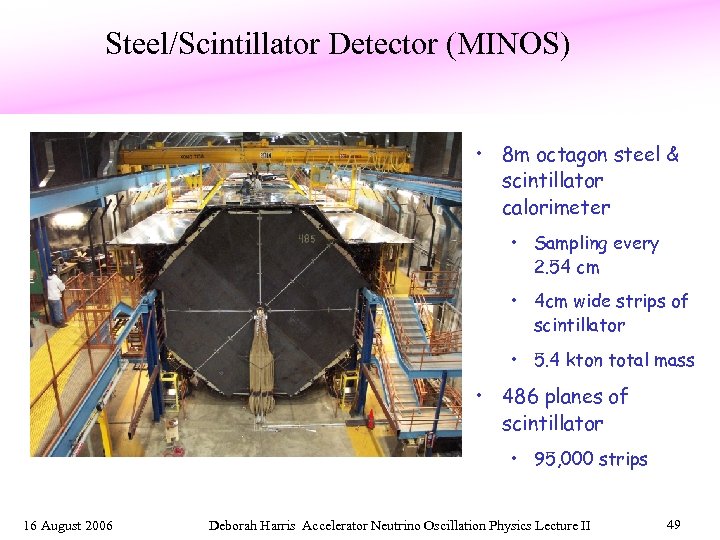
Steel/Scintillator Detector (MINOS) • 8 m octagon steel & scintillator calorimeter • Sampling every 2. 54 cm • 4 cm wide strips of scintillator • 5. 4 kton total mass • 486 planes of scintillator • 95, 000 strips 16 August 2006 Deborah Harris Accelerator Neutrino Oscillation Physics Lecture II 49
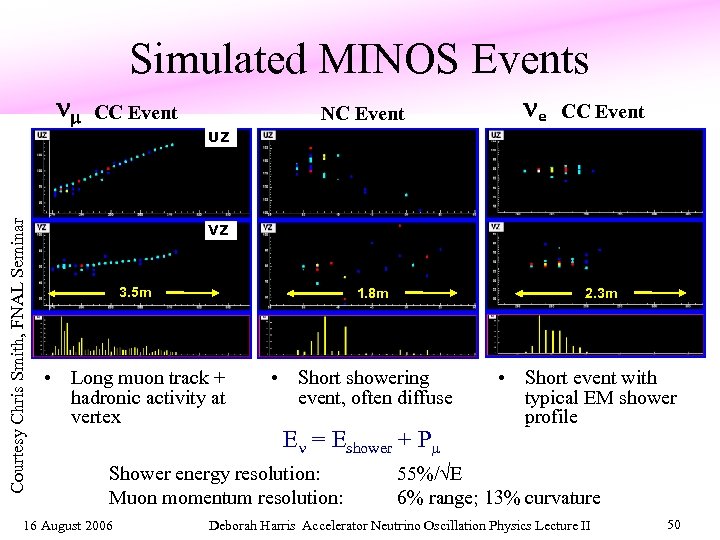
Simulated MINOS Events CC Event NC Event e CC Event Courtesy Chris Smith, FNAL Seminar UZ VZ 3. 5 m 1. 8 m • Long muon track + hadronic activity at vertex • Short showering event, often diffuse E = Eshower + Pm Shower energy resolution: Muon momentum resolution: 16 August 2006 2. 3 m • Short event with typical EM shower profile 55%/√E 6% range; 13% curvature Deborah Harris Accelerator Neutrino Oscillation Physics Lecture II 50
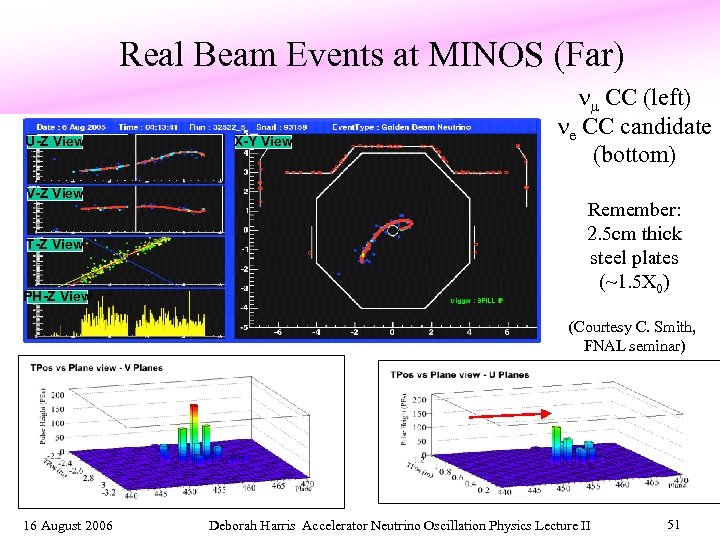
Real Beam Events at MINOS (Far) U-Z View V-Z View T-Z View PH-Z View X-Y View m CC (left) e CC candidate (bottom) Remember: 2. 5 cm thick steel plates (~1. 5 X 0) (Courtesy C. Smith, FNAL seminar) 16 August 2006 Deborah Harris Accelerator Neutrino Oscillation Physics Lecture II 51
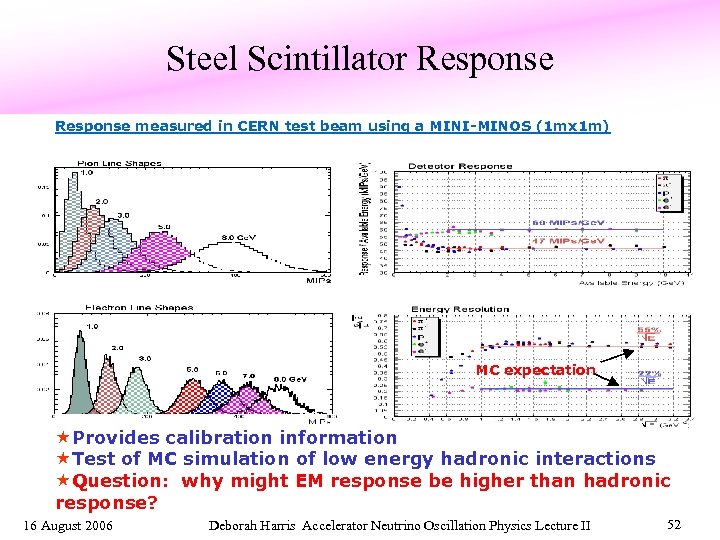
Steel Scintillator Response measured in CERN test beam using a MINI-MINOS (1 mx 1 m) MC expectation «Provides calibration information «Test of MC simulation of low energy hadronic interactions «Question: why might EM response be higher than hadronic response? 16 August 2006 Deborah Harris Accelerator Neutrino Oscillation Physics Lecture II 52
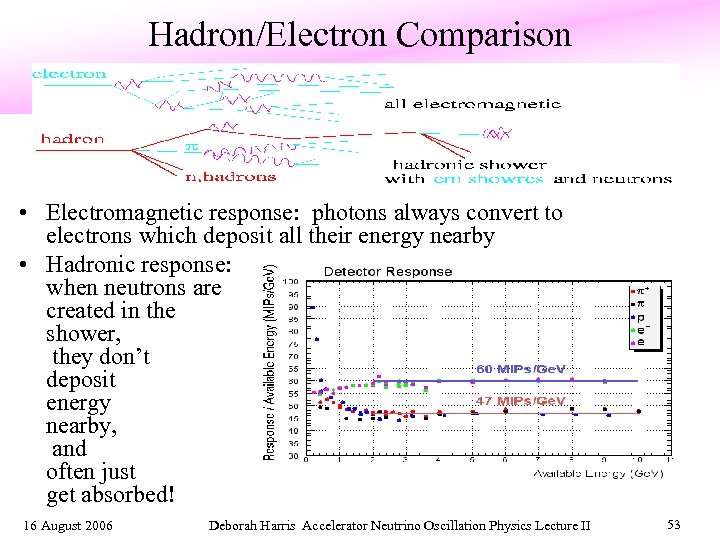
Hadron/Electron Comparison • Electromagnetic response: photons always convert to electrons which deposit all their energy nearby • Hadronic response: when neutrons are created in the shower, they don’t deposit energy nearby, and often just get absorbed! 16 August 2006 Deborah Harris Accelerator Neutrino Oscillation Physics Lecture II 53
Outstanding Issues Steel/Scintillator • For Neutrino factory Application: what transverse and longitudinal segmentation is needed? • Any way to make this detector cheaper? 16 August 2006 Deborah Harris Accelerator Neutrino Oscillation Physics Lecture II 54
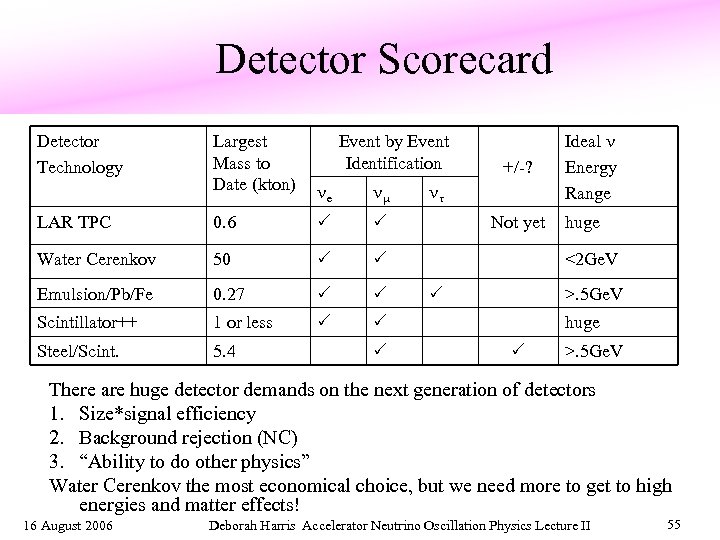
Detector Scorecard Detector Technology Largest Mass to Date (kton) Event by Event Identification e m LAR TPC 0. 6 50 Emulsion/Pb/Fe 0. 27 Scintillator++ 1 or less Steel/Scint. 5. 4 Water Cerenkov +/-? Not yet Ideal Energy Range huge <2 Ge. V >. 5 Ge. V huge >. 5 Ge. V There are huge detector demands on the next generation of detectors 1. Size*signal efficiency 2. Background rejection (NC) 3. “Ability to do other physics” Water Cerenkov the most economical choice, but we need more to get to high energies and matter effects! 16 August 2006 Deborah Harris Accelerator Neutrino Oscillation Physics Lecture II 55
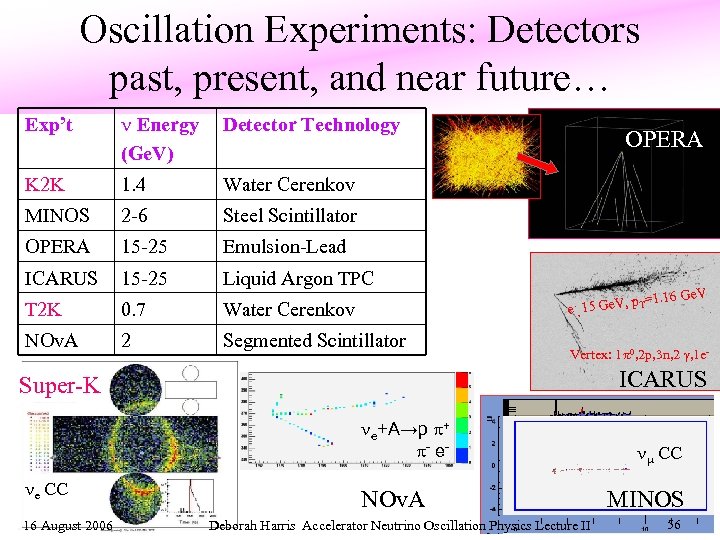
Oscillation Experiments: Detectors past, present, and near future… Exp’t Energy (Ge. V) Detector Technology K 2 K 1. 4 Water Cerenkov MINOS 2 -6 Steel Scintillator OPERA 15 -25 Emulsion-Lead ICARUS 15 -25 Liquid Argon TPC T 2 K 0. 7 Water Cerenkov NOv. A 2 Segmented Scintillator OPERA =1. 16 Ge. V 15 Ge. V, p T e, - Vertex: 1 0, 2 p, 3 n, 2 , 1 e- ICARUS Super-K e+A→p + - e e CC 16 August 2006 NOv. A Deborah Harris Accelerator Neutrino Oscillation Physics Lecture II m CC MINOS 56
Скачать презентацию Accelerator Neutrino Oscillation Physics Lecture II Deborah Harris
06eaeefeadef31c8b2b3b60492d9fd2c.ppt