


 Скачать презентацию Accelerator Design and Integration towards an updated ILC
2f65b4ae900fb47d69e88aa468ac8209.ppt
- Количество слайдов: 44
 Accelerator Design and Integration towards an updated ILC Baseline for TDP 2 SB 2009 Strawman Baseline Studies Status Report Presented to the PAC, November 2009 Ewan Paterson (presented by Marc Ross) 3/18/2018 PAC Meeting, Pohang, Korea 1
 Rationale and Goals • Cost constraint in TDR – Updated cost estimate in 2012 6. 7 BILCU – Need margin against possible increased component costs • Process forces critical review of RDR design – Errors and design issues identified – Iteration and refinement of design – More critical attention on difficult issues We believe this will lead to a more - Robust - Mature - Defendable Design. • Balance for risk mitigating R&D – Majority of global resources focused in R&D Basically a better design. – Important to prepare / re-focus projectorientated activities for TDP-2 • Need for design options and flexibility – Unknown site location 3/18/2018 PAC Meeting, Pohang, Korea Presented by NJW at ALCPG 09 on 9/23/09 2
 Siting ‘Flexibility’ • Main Linac tunnel / surface building structure configuration depends strongly on High Level RF system • We intend to develop two different HLRF systems to provide workable technical solutions for possible different site topography – Parallel HLRF R & D underway to support each option – Parallel design work – CFS etc. • Important component of CFS strategy 3/18/2018 PAC Meeting, Pohang, Korea 3
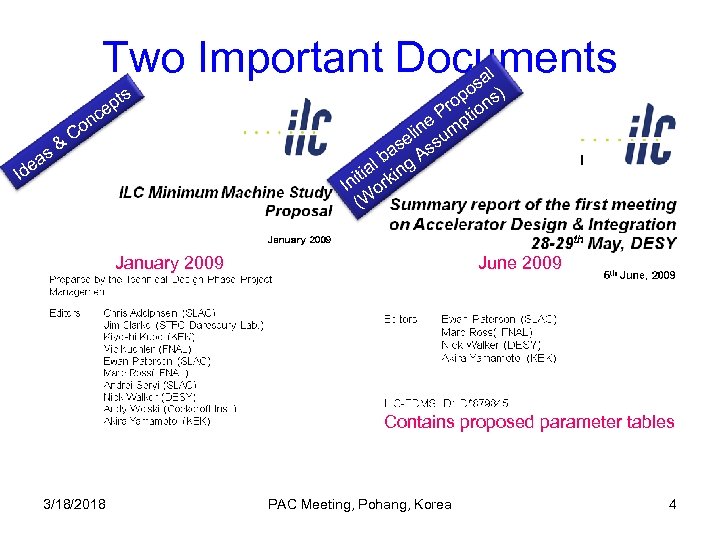 Two Important Documents l sa s& a ts ep c on C e Id o ) op ons Pr ti p e lin um e as Ass b al ing i nit ork I (W January 2009 June 2009 Contains proposed parameter tables 3/18/2018 PAC Meeting, Pohang, Korea 4
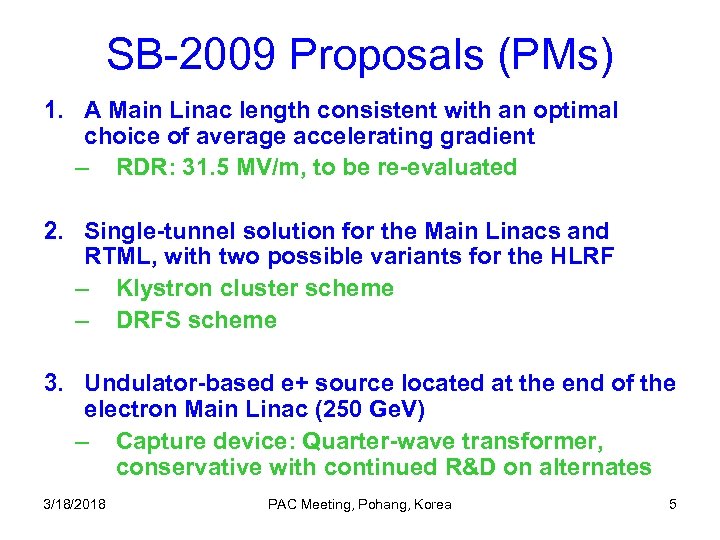 SB-2009 Proposals (PMs) 1. A Main Linac length consistent with an optimal choice of average accelerating gradient – RDR: 31. 5 MV/m, to be re-evaluated 2. Single-tunnel solution for the Main Linacs and RTML, with two possible variants for the HLRF – Klystron cluster scheme – DRFS scheme 3. Undulator-based e+ source located at the end of the electron Main Linac (250 Ge. V) – Capture device: Quarter-wave transformer, conservative with continued R&D on alternates 3/18/2018 PAC Meeting, Pohang, Korea 5
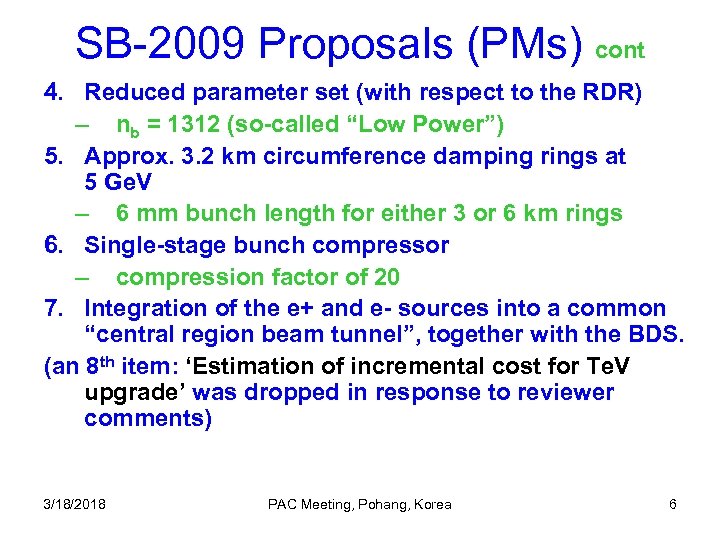 SB-2009 Proposals (PMs) cont 4. Reduced parameter set (with respect to the RDR) – nb = 1312 (so-called “Low Power”) 5. Approx. 3. 2 km circumference damping rings at 5 Ge. V – 6 mm bunch length for either 3 or 6 km rings 6. Single-stage bunch compressor – compression factor of 20 7. Integration of the e+ and e- sources into a common “central region beam tunnel”, together with the BDS. (an 8 th item: ‘Estimation of incremental cost for Te. V upgrade’ was dropped in response to reviewer comments) 3/18/2018 PAC Meeting, Pohang, Korea 6
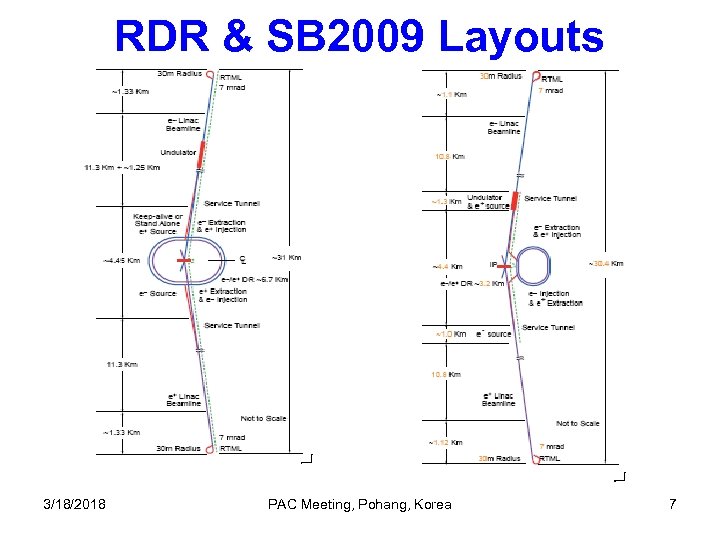 RDR & SB 2009 Layouts 3/18/2018 PAC Meeting, Pohang, Korea 7
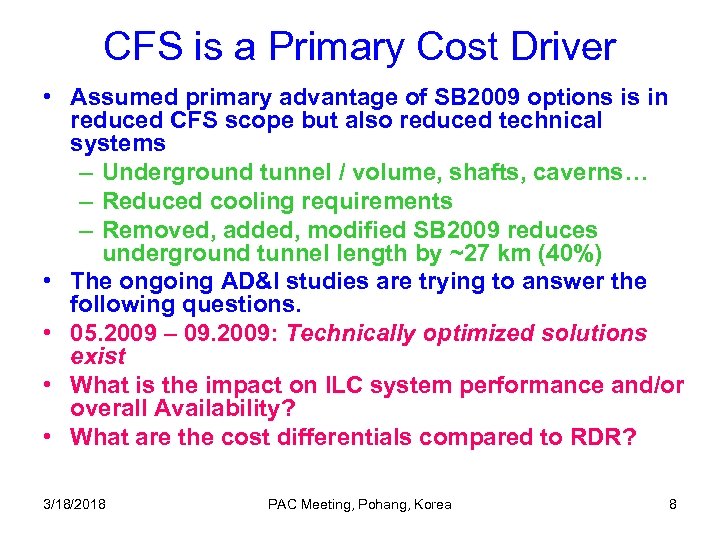 CFS is a Primary Cost Driver • Assumed primary advantage of SB 2009 options is in reduced CFS scope but also reduced technical systems – Underground tunnel / volume, shafts, caverns… – Reduced cooling requirements – Removed, added, modified SB 2009 reduces underground tunnel length by ~27 km (40%) • The ongoing AD&I studies are trying to answer the following questions. • 05. 2009 – 09. 2009: Technically optimized solutions exist • What is the impact on ILC system performance and/or overall Availability? • What are the cost differentials compared to RDR? 3/18/2018 PAC Meeting, Pohang, Korea 8
 Now a Review of the AD&I/SB 2009 Topics 1) Accelerating Gradient and Linac Length • Parameter with largest cost-leverage – Major focus of global R&D effort (‘S 0’) • For TDP-2 baseline, unlikely to change current Working Assumption (31. 5 MV/m) • Change of gradient at later stage only affects length of linacs assuming centralised sources. – At 10% level easily scalable – No other subsystems affected • See Akira’s presentation 3/18/2018 PAC Meeting, Pohang, Korea 9
 2) A Single Linac Tunnel • The RDR Twin Tunnel design was justified on the grounds that it was necessary to have access to equipment ( such as RF systems) during accelerator operation. • The parallel support tunnel would be a part of the safety egress design. • Both assumptions need to be addressed and there are multiple solutions. 3/18/2018 PAC Meeting, Pohang, Korea 10
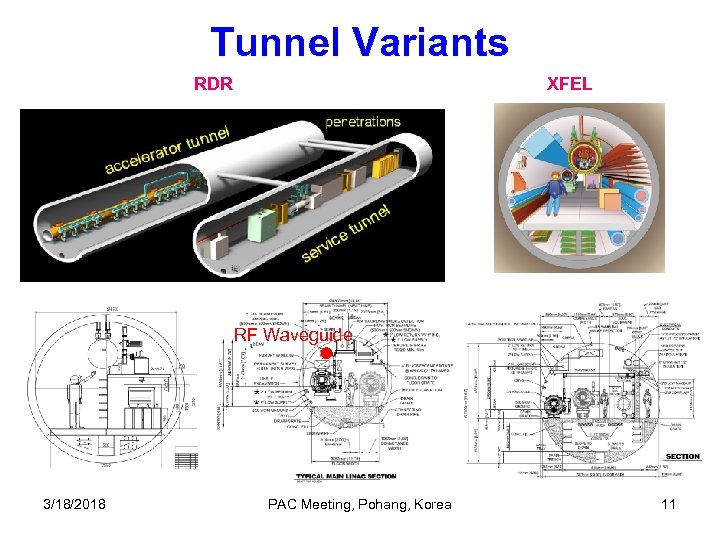 Tunnel Variants RDR XFEL RF Waveguide 3/18/2018 PAC Meeting, Pohang, Korea 11
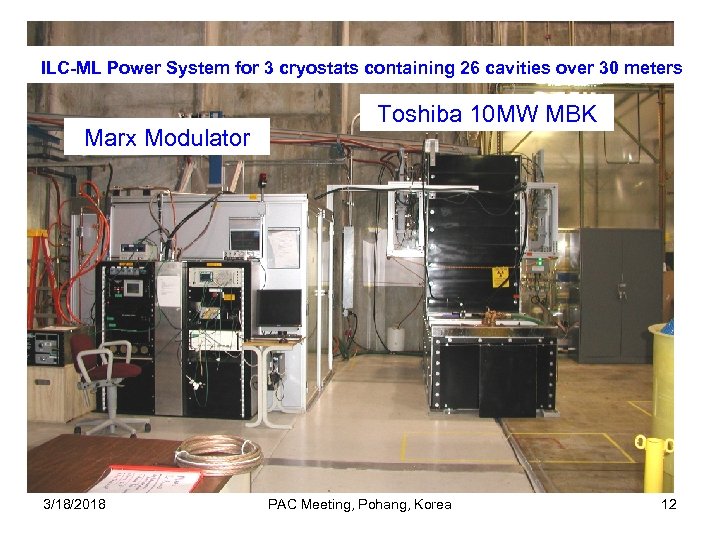 RF IILC-ML Power System for 3 cryostats containing 26 cavities over 30 meters Marx Modulator 3/18/2018 Toshiba 10 MW MBK PAC Meeting, Pohang, Korea 12
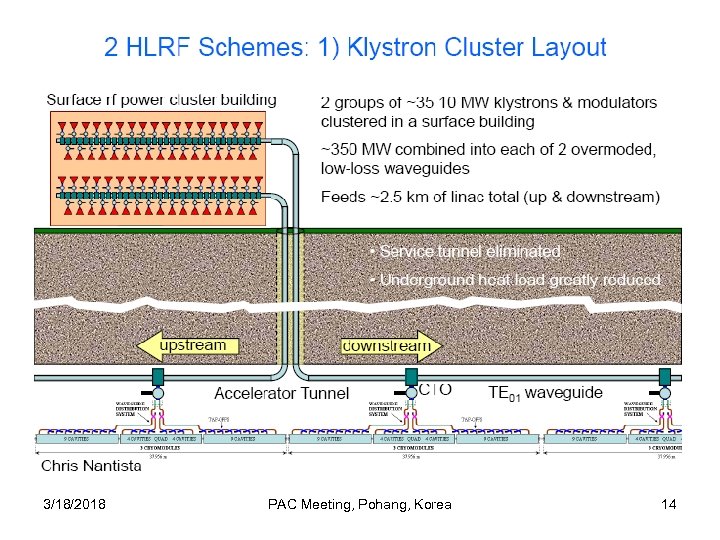
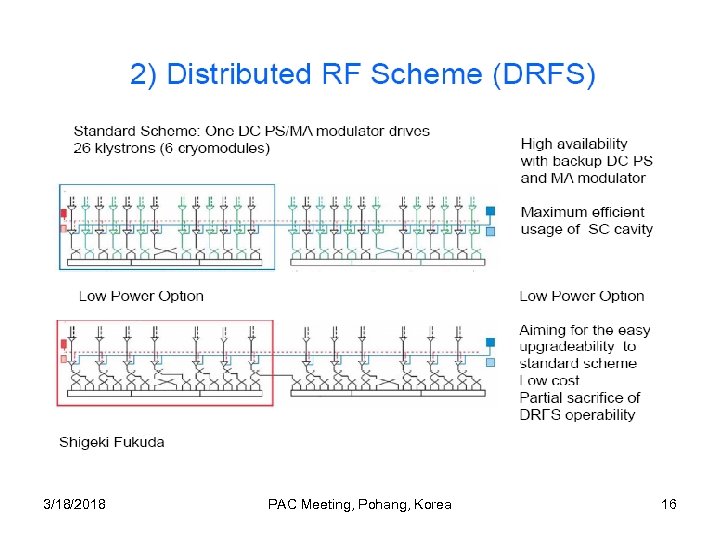
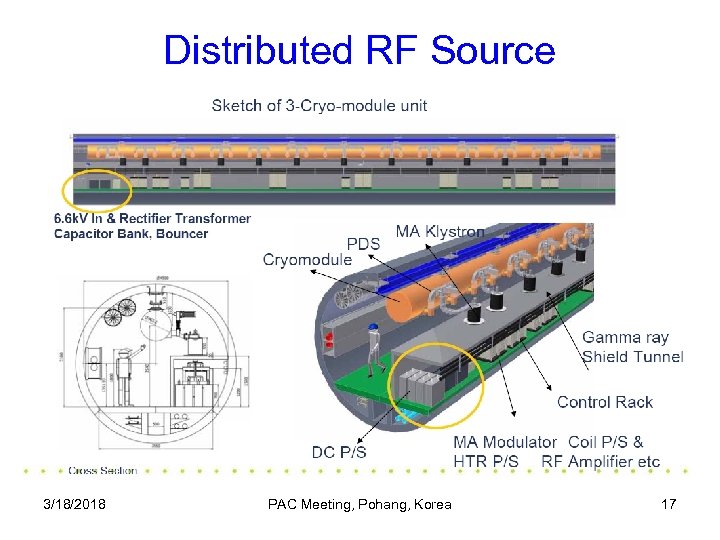
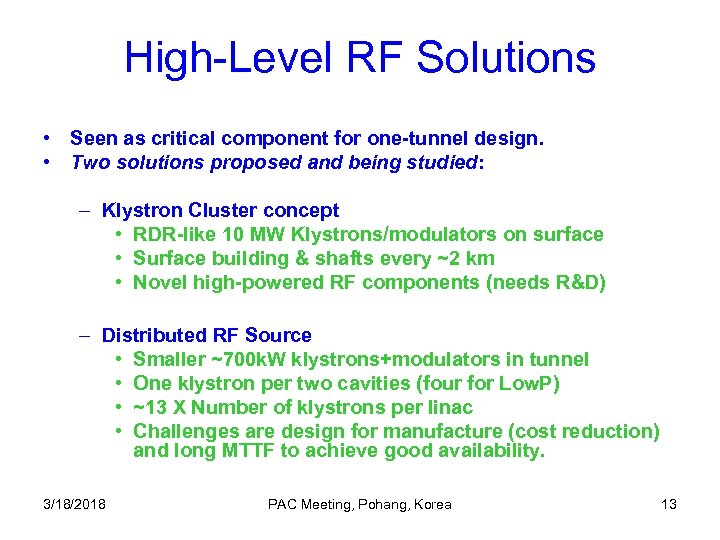 High-Level RF Solutions • Seen as critical component for one-tunnel design. • Two solutions proposed and being studied: – Klystron Cluster concept • RDR-like 10 MW Klystrons/modulators on surface • Surface building & shafts every ~2 km • Novel high-powered RF components (needs R&D) – Distributed RF Source • Smaller ~700 k. W klystrons+modulators in tunnel • One klystron per two cavities (four for Low. P) • ~13 X Number of klystrons per linac • Challenges are design for manufacture (cost reduction) and long MTTF to achieve good availability. 3/18/2018 PAC Meeting, Pohang, Korea 13
 3/18/2018 PAC Meeting, Pohang, Korea 14
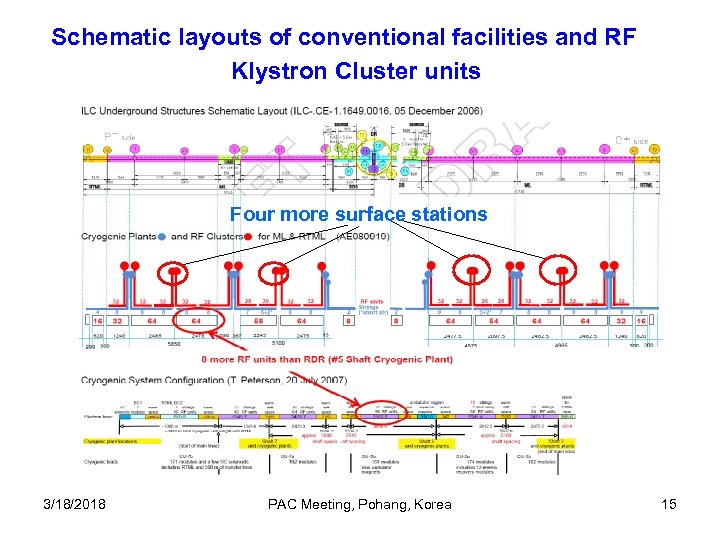 Schematic layouts of conventional facilities and RF Klystron Cluster units Four more surface stations 3/18/2018 PAC Meeting, Pohang, Korea 15
 3/18/2018 PAC Meeting, Pohang, Korea 16
 Distributed RF Source 3/18/2018 PAC Meeting, Pohang, Korea 17
 HLRF Issues needing R&D • DRFS – Klystron lifetime – Modulator cost with redundancy – Layout (map RDR components into single tunnel) and issues of ceiling mounted CM • Klystron Cluster – RF breakdown in transmission line or components – Transmission line --- vacuum -vs- pressurized operation – LLRF control 3/18/2018 PAC Meeting, Pohang, Korea 18
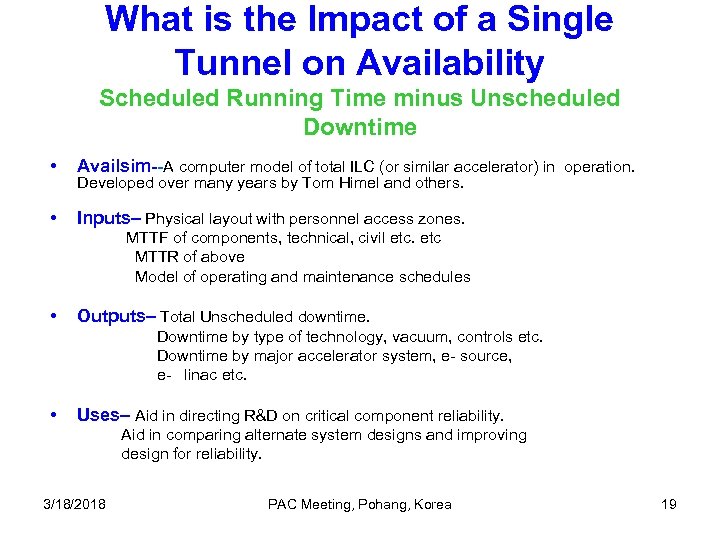 What is the Impact of a Single Tunnel on Availability Scheduled Running Time minus Unscheduled Downtime • Availsim--A computer model of total ILC (or similar accelerator) in operation. • Inputs– Physical layout with personnel access zones. Developed over many years by Tom Himel and others. MTTF of components, technical, civil etc MTTR of above Model of operating and maintenance schedules • Outputs– Total Unscheduled downtime. Downtime by type of technology, vacuum, controls etc. Downtime by major accelerator system, e- source, e- linac etc. • Uses– Aid in directing R&D on critical component reliability. Aid in comparing alternate system designs and improving design for reliability. 3/18/2018 PAC Meeting, Pohang, Korea 19
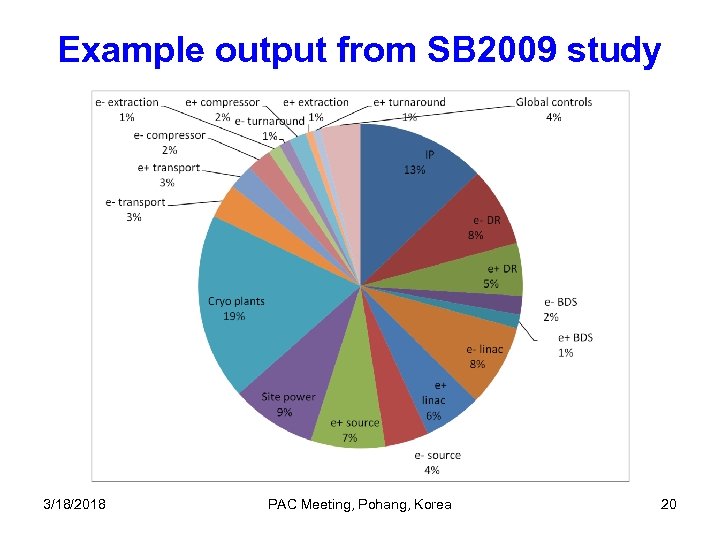 Example output from SB 2009 study 3/18/2018 PAC Meeting, Pohang, Korea 20
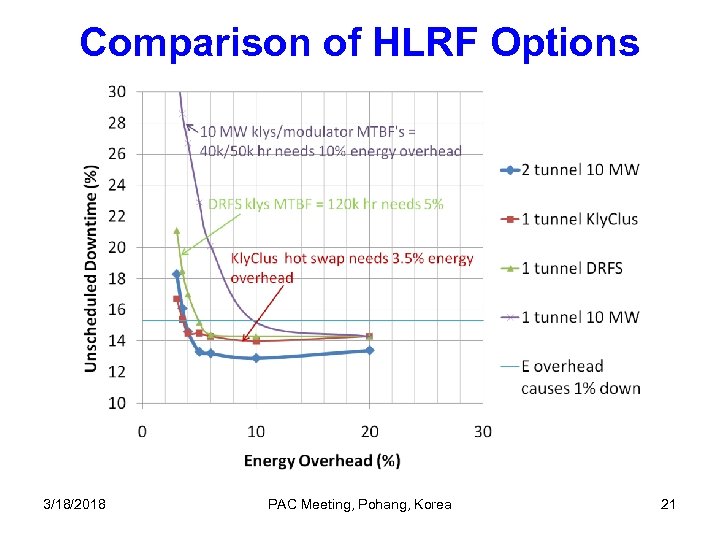 Comparison of HLRF Options 3/18/2018 PAC Meeting, Pohang, Korea 21
 Preliminary conclusions of impact of single ‘linac only’ tunnel on availability • There are two alternate RF power system designs proposed for single tunnel linac operation. (The Klystron Cluster and the Distributed RF System). Either approach would give adequate availability with the present assumptions. The Distributed RF System requires about 1. 5 percent more energy overhead than the Klystron Cluster Scheme to give the same availability for all other assumptions the same. This small effect may well be compensated by other non availability related issues. • With the component failure rates and operating models assumed today, the unscheduled lost time integrating luminosity with a single main linac tunnel is only 1% more than the two tunnel RDR design given reasonable energy overheads. Note that all non-linac areas were modeled with support equipment accessible with beam on. 3/18/2018 PAC Meeting, Pohang, Korea 22
 3) Undulator-based e+ source located at the end of the electron Main Linac • In the RDR: – the e+ undulator source was positioned at the 150 Ge. V point in the linac – For operation at 300 Gev c. o. m. and above the first half of the e- linac would operate at maximum fixed gradient with the final E- energy adjustment being done in the second half. – For energies below 300, eg 200 to 300 Ge. V the e- beam must be decelerated. (A potential problem) – This puts some constraints on operation or early staged energy scenarios. (Less flexibility) 3/18/2018 PAC Meeting, Pohang, Korea 23
 Re-Consider E+ Source Layout • Move the source to the end of the E- linac…. . > Share many systems : - Machine protection, Auxiliary E+ source etc Avoid duplicate systems While on access into the IR all systems operate and the main e- drive beam would go to the tune up dump, a shared dump. We save >450 m, of the positron system length. But we also shorten the low energy e+ transport by several kilometers and integrated AUX source shares 5 Ge. V Booster accelerator All systems except the linac are now within +/- 2. 5 km of the IR. A cost effective Central Campus------ but what about operation at low energies, less than ~ 300 Ge. V c. o. m 3/18/2018 PAC Meeting, Pohang, Korea 24
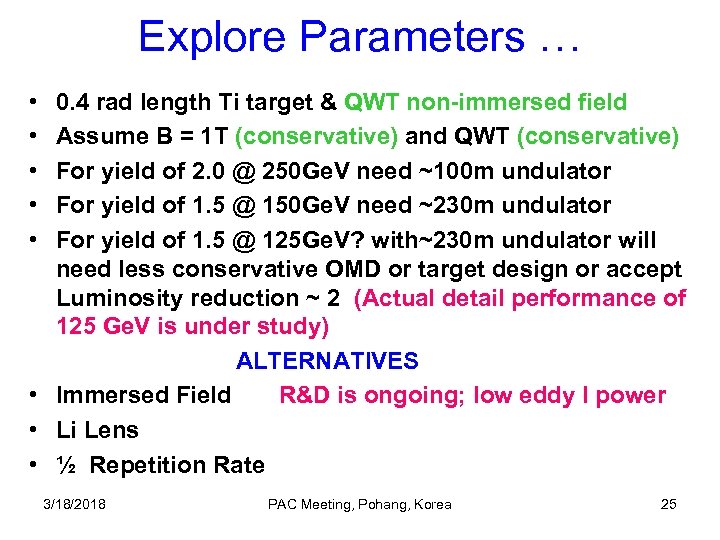 Explore Parameters … • • • 0. 4 rad length Ti target & QWT non-immersed field Assume B = 1 T (conservative) and QWT (conservative) For yield of 2. 0 @ 250 Ge. V need ~100 m undulator For yield of 1. 5 @ 150 Ge. V need ~230 m undulator For yield of 1. 5 @ 125 Ge. V? with~230 m undulator will need less conservative OMD or target design or accept Luminosity reduction ~ 2 (Actual detail performance of 125 Ge. V is under study) ALTERNATIVES • Immersed Field R&D is ongoing; low eddy I power • Li Lens • ½ Repetition Rate 3/18/2018 PAC Meeting, Pohang, Korea 25
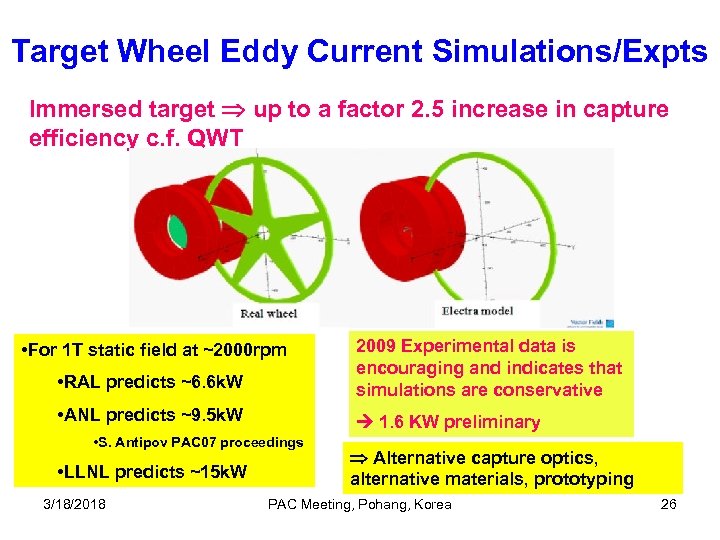 Target Wheel Eddy Current Simulations/Expts Immersed target up to a factor 2. 5 increase in capture efficiency c. f. QWT • RAL predicts ~6. 6 k. W 2009 Experimental data is encouraging and indicates that simulations are conservative • ANL predicts ~9. 5 k. W 1. 6 KW preliminary • For 1 T static field at ~2000 rpm • S. Antipov PAC 07 proceedings • LLNL predicts ~15 k. W 3/18/2018 Alternative capture optics, alternative materials, prototyping PAC Meeting, Pohang, Korea 26
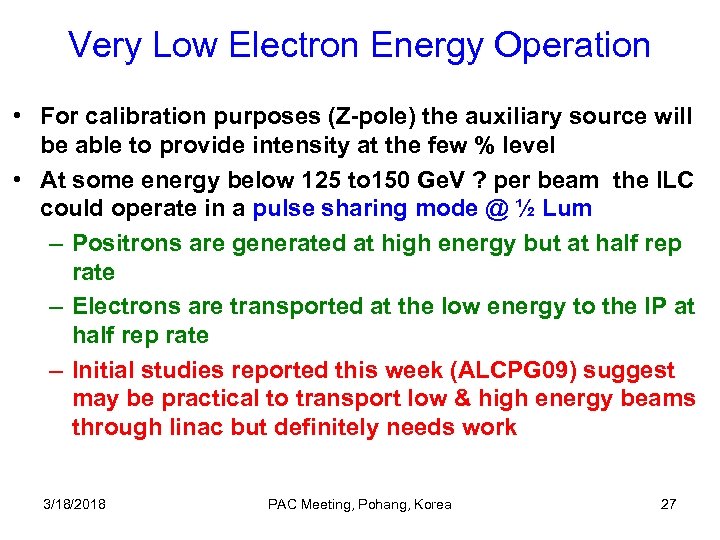 Very Low Electron Energy Operation • For calibration purposes (Z-pole) the auxiliary source will be able to provide intensity at the few % level • At some energy below 125 to 150 Ge. V ? per beam the ILC could operate in a pulse sharing mode @ ½ Lum – Positrons are generated at high energy but at half rep rate – Electrons are transported at the low energy to the IP at half rep rate – Initial studies reported this week (ALCPG 09) suggest may be practical to transport low & high energy beams through linac but definitely needs work 3/18/2018 PAC Meeting, Pohang, Korea 27
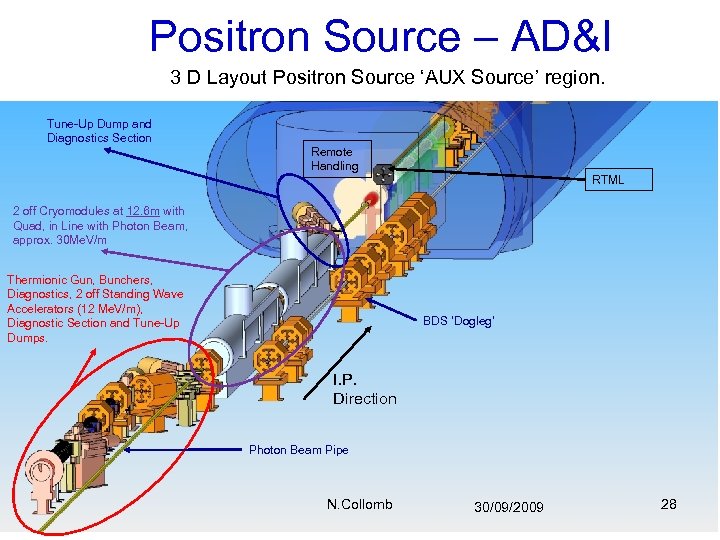 Positron Source – AD&I 3 D Layout Positron Source ‘AUX Source’ region. Tune-Up Dump and Diagnostics Section Remote Handling RTML 2 off Cryomodules at 12. 6 m with Quad, in Line with Photon Beam, approx. 30 Me. V/m Thermionic Gun, Bunchers, Diagnostics, 2 off Standing Wave Accelerators (12 Me. V/m), Diagnostic Section and Tune-Up Dumps. BDS ‘Dogleg’ I. P. Direction Photon Beam Pipe 3/18/2018 PAC Meeting, Pohang, Korea N. Collomb 30/09/2009 28
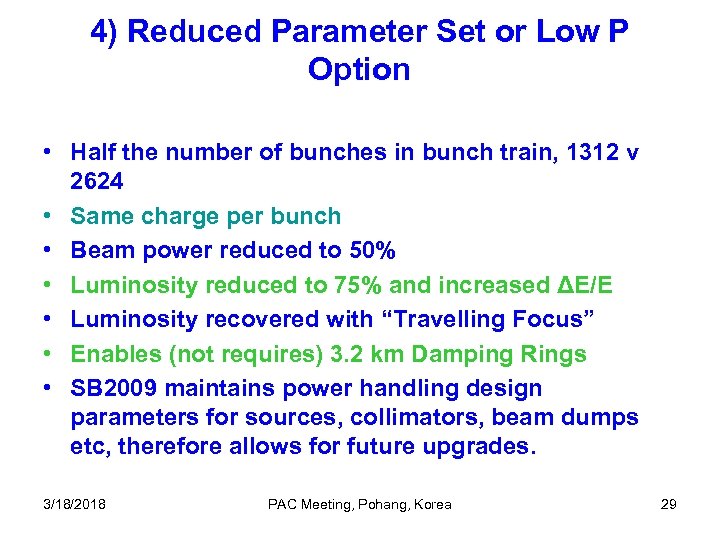 4) Reduced Parameter Set or Low P Option • Half the number of bunches in bunch train, 1312 v 2624 • Same charge per bunch • Beam power reduced to 50% • Luminosity reduced to 75% and increased ΔE/E • Luminosity recovered with “Travelling Focus” • Enables (not requires) 3. 2 km Damping Rings • SB 2009 maintains power handling design parameters for sources, collimators, beam dumps etc, therefore allows for future upgrades. 3/18/2018 PAC Meeting, Pohang, Korea 29
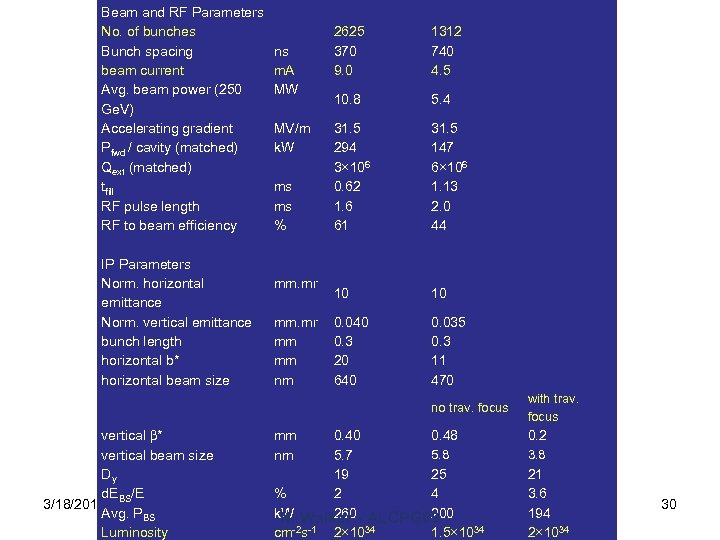 Beam and RF Parameters No. of bunches Bunch spacing beam current Avg. beam power (250 Ge. V) Accelerating gradient Pfwd / cavity (matched) Qext (matched) tfill RF pulse length RF to beam efficiency IP Parameters Norm. horizontal emittance Norm. vertical emittance bunch length horizontal b* horizontal beam size ns m. A MW MV/m k. W ms ms % mm. mr mm mm nm 2625 370 9. 0 1312 740 4. 5 10. 8 5. 4 31. 5 294 3× 10⁶ 0. 62 1. 6 61 31. 5 147 6× 10⁶ 1. 13 2. 0 44 10 10 0. 040 0. 3 20 640 0. 035 0. 3 11 470 no trav. focus vertical b* vertical beam size Dy d. EBS/E 3/18/2018 Avg. PBS Luminosity mm nm 0. 40 0. 48 5. 7 19 25 % 2 4 PAC Meeting, Pohang, Korea k. W 260 200 N. Walker - ALCPG 09 cm-2 s-1 2× 1034 1. 5× 1034 with trav. focus 0. 2 3. 8 21 3. 6 194 2× 1034 30
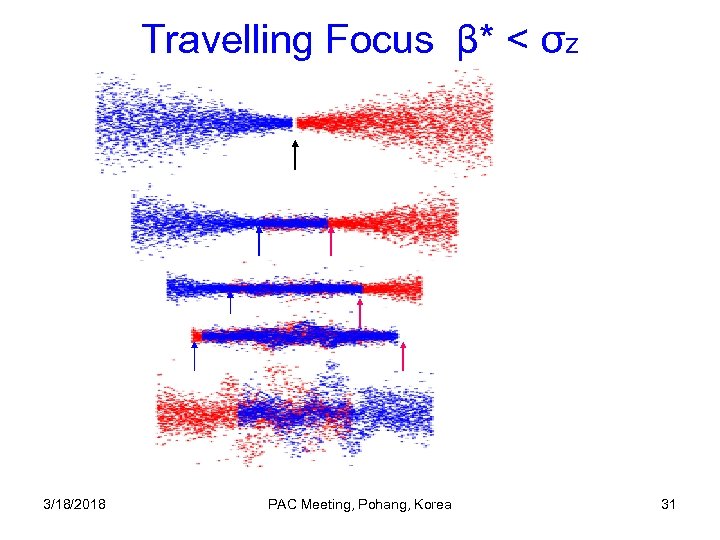 Travelling Focus β* < σz 3/18/2018 PAC Meeting, Pohang, Korea 31
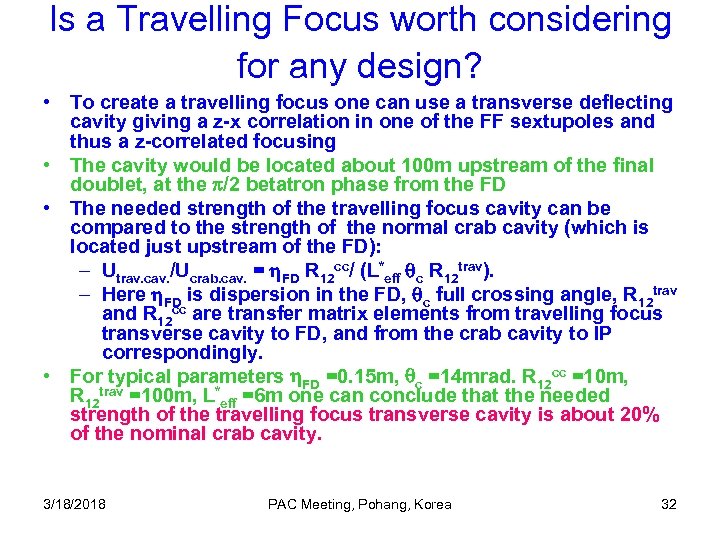 Is a Travelling Focus worth considering for any design? • To create a travelling focus one can use a transverse deflecting cavity giving a z-x correlation in one of the FF sextupoles and thus a z-correlated focusing • The cavity would be located about 100 m upstream of the final doublet, at the p/2 betatron phase from the FD • The needed strength of the travelling focus cavity can be compared to the strength of the normal crab cavity (which is located just upstream of the FD): – Utrav. cav. /Ucrab. cav. = h. FD R 12 cc/ (L*eff qc R 12 trav). – Here h. FD is dispersion in the FD, qc full crossing angle, R 12 trav and R 12 cc are transfer matrix elements from travelling focus transverse cavity to FD, and from the crab cavity to IP correspondingly. • For typical parameters h. FD =0. 15 m, qc =14 mrad. R 12 cc =10 m, R 12 trav =100 m, L*eff =6 m one can conclude that the needed strength of the travelling focus transverse cavity is about 20% of the nominal crab cavity. 3/18/2018 PAC Meeting, Pohang, Korea 32
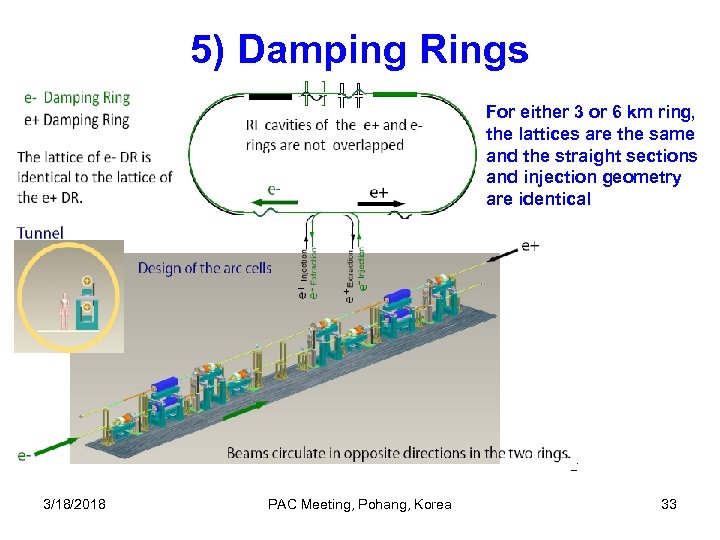 5) Damping Rings For either 3 or 6 km ring, the lattices are the same and the straight sections and injection geometry are identical 3/18/2018 PAC Meeting, Pohang, Korea 33
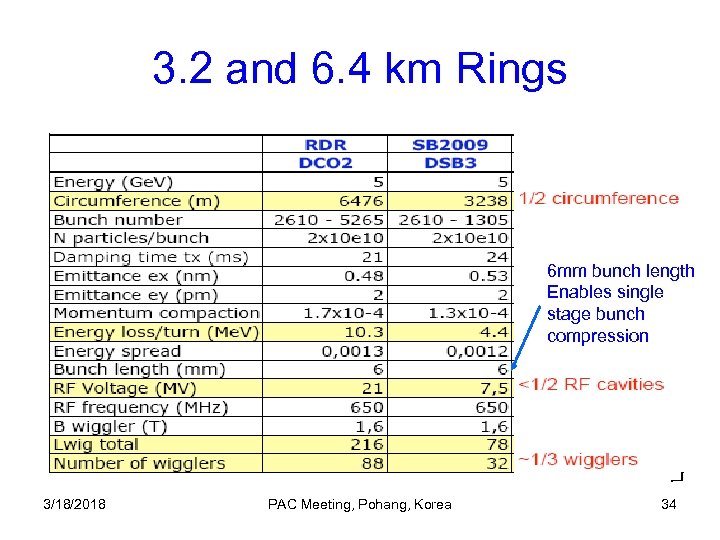 3. 2 and 6. 4 km Rings 6 mm bunch length Enables single stage bunch compression 3/18/2018 PAC Meeting, Pohang, Korea 34
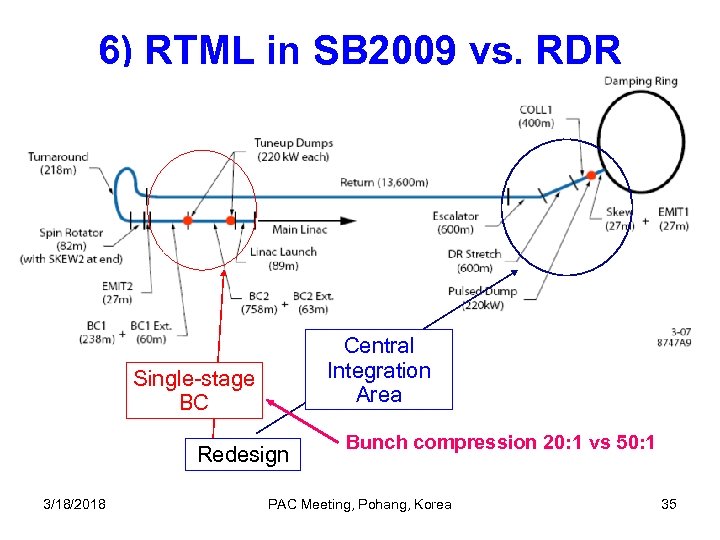 6) RTML in SB 2009 vs. RDR Central Integration Area Single-stage BC Redesign 3/18/2018 Bunch compression 20: 1 vs 50: 1 PAC Meeting, Pohang, Korea 35
 RTML Summary • Single stage Bunch Compressor is designed and studied. Design looks feasible: – Emittance growth in bunch compressor can be effectively controlled, by using movers to adjust tilt of the cryomodules. • MPS /tune-up dump lines redesigned to accommodate bunch with a larger energy spread after BC. • Proposal for changes of RTML lattice in central area. Next step – lattice design. Time scale – 2 -3 months • Cost estimation and CFS design in progress 3/18/2018 PAC Meeting, Pohang, Korea 36
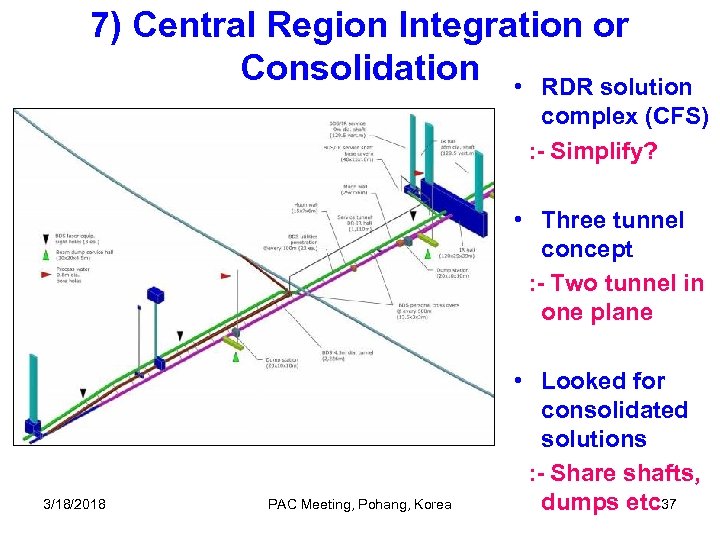 7) Central Region Integration or Consolidation • RDR solution complex (CFS) : - Simplify? • Three tunnel concept : - Two tunnel in one plane 3/18/2018 PAC Meeting, Pohang, Korea • Looked for consolidated solutions : - Share shafts, dumps etc 37
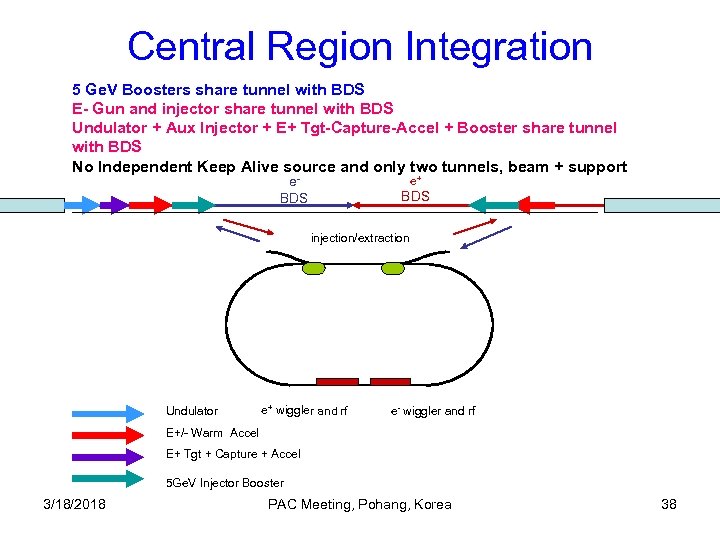 Central Region Integration 5 Ge. V Boosters share tunnel with BDS E- Gun and injector share tunnel with BDS Undulator + Aux Injector + E+ Tgt-Capture-Accel + Booster share tunnel with BDS No Independent Keep Alive source and only two tunnels, beam + support e+ e. BDS injection/extraction Undulator e+ wiggler and rf e- wiggler and rf E+/- Warm Accel E+ Tgt + Capture + Accel 5 Ge. V Injector Booster 3/18/2018 PAC Meeting, Pohang, Korea 38
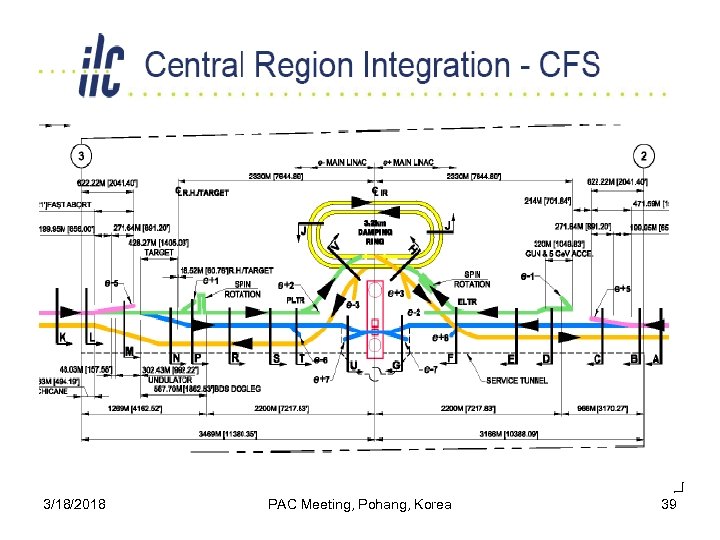 3/18/2018 PAC Meeting, Pohang, Korea 39
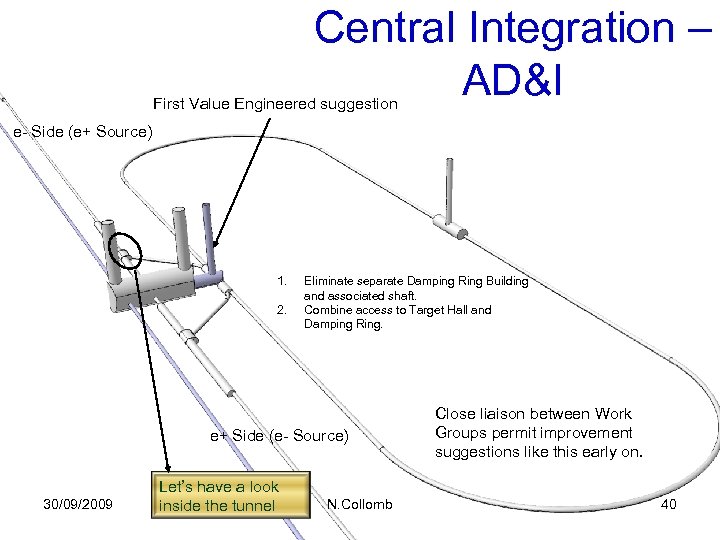 Central Integration – AD&I First Value Engineered suggestion e- Side (e+ Source) 1. 2. Eliminate separate Damping Ring Building and associated shaft. Combine access to Target Hall and Damping Ring. e+ Side (e- Source) 3/18/2018 30/09/2009 Close liaison between Work Groups permit improvement suggestions like this early on. Let’s have a look PAC Meeting, Pohang, Korea N. Collomb inside the tunnel 40
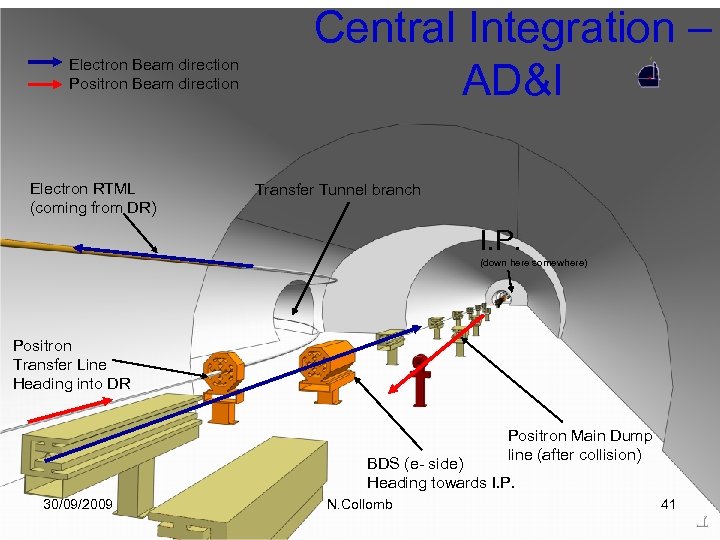 Electron Beam direction Positron Beam direction Electron RTML (coming from DR) Central Integration – AD&I Transfer Tunnel branch I. P. (down here somewhere) Positron Transfer Line Heading into DR Positron Main Dump line (after collision) BDS (e- side) Heading towards I. P. 3/18/2018 30/09/2009 PAC Meeting, Pohang, Korea N. Collomb 41
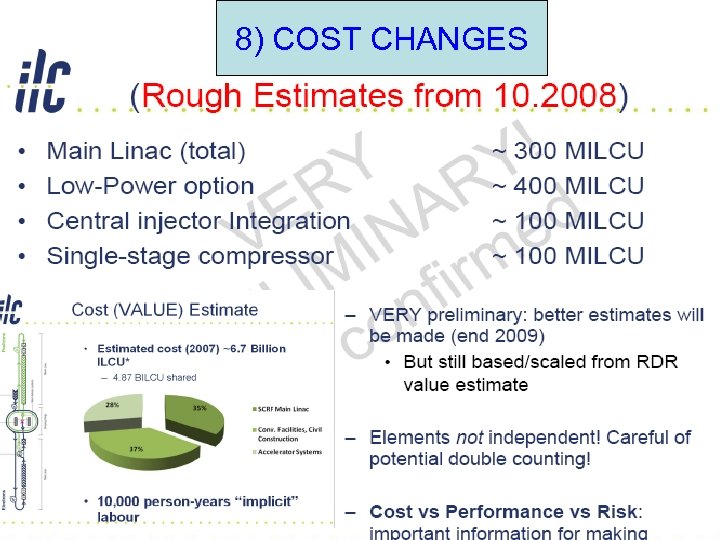 +/- 3 km Central Region to scale and some 8) COST CHANGES tunnel sections required to accommodate beam lines 3/18/2018 PAC Meeting, Pohang, Korea 42
 Next Steps (2009) • GDE focus at present time is to consolidate SB 2009 Working Assumptions, Questions and Solutions – Review action items and outstanding issues from DESY and Albuquerque meetings including working with physics/detector groups to develop more detailed parameters associated with SB 2009 – Produce a first-guess estimate of cost changes – Begin to prepare Proposal Document • AD&I meeting 2 -3. 12 (DESY) – 1 st draft of Proposal Document – Resolve remaining issues Including designated representatives from Physics & Detector community & AAP members • Proposal Document final draft made public 18. 12. 09 – Formally to Director/EC • Forwarded to AAP for review – Entire community for comment/feedback 3/18/2018 PAC Meeting, Pohang, Korea 43
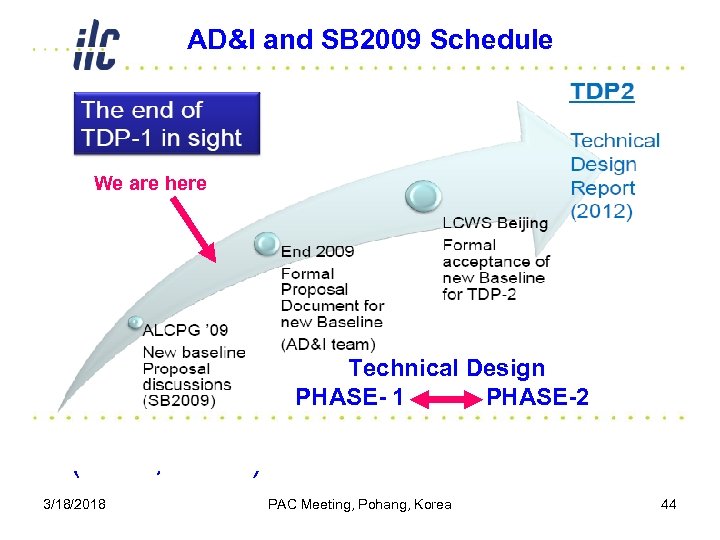 AD&I and SB 2009 Schedule Next Steps (2010) • AAP formal review (4 -6. 01. 10) We are here Review/include feedback from AAP and ILC community • Final establishment of TDP-2 ILC baseline at LCWS (Beijing, 03. 10) Preparation / planning for TDP 2 activities Technical Design PHASE- 1 PHASE-2 • Presentation of new baseline at ICHEPP (Paris, 07. 10) Formal start of TDP-2 3/18/2018 PAC Meeting, Pohang, Korea 44