 Скачать презентацию Acceleration Schemes for PAMELA Carl Beard ASTe C
dd7fe2304efc7bbd3c20b00c5bef49bf.ppt
- Количество слайдов: 26



Acceleration Schemes for PAMELA Carl Beard ASTe. C, Daresbury Laboratory 3 rd September 2008 FFAG 08 Carl Beard
Pamela • Conceptual design study of a combined proton and light-ion Charged Particle Therapy (CPT) facility – PAMELA must accelerate both carbon and protons – From 50 to 250 Me. V extraction energy Protons – 70 Me. V/u to 450 Me. V/u for Carbon • • Energy range (beta) 0. 2 – 0. 7 2 or 3 rings concentric rings 3 rd September 2008 FFAG 08 Carl Beard
Practical Considerations • Facility – Cyclotron footprint – Services • Power Supplies (magnets & RF) • RF • Diagnostics • Vacuum • Control system – Complex acceleration scheme!!! • Cryogenics Cooling • RF system – Large energy range (velocity factors) • Conversely – Achieve the design parameters, and then consider the practical aspect… 3 rd September 2008 FFAG 08 Carl Beard
Design Constraints • Longitudinal Space (0. 6 – 1 m) • Aperture (10 – 15 cm) • Energy range (beta) 0. 1 (Carbon) – (0. 7 Proton) – Energy gain/range per ring, undefined • Energy gain per turn cavity – 50 KV – 5 MV – Voltage change • Frequency range? ? – – Low frequency (up to 40 MHz) Medium Frequency (200 MHz say…) High Frequency (800 MHz up to 1. 3 GHz) Rate of change of Frequency • Phase and Amplitude stability – this will depend on the acceleration regime • System has to be simple to operate – No in-house RF engineers planned to supervise the system 3 rd September 2008 FFAG 08 Carl Beard
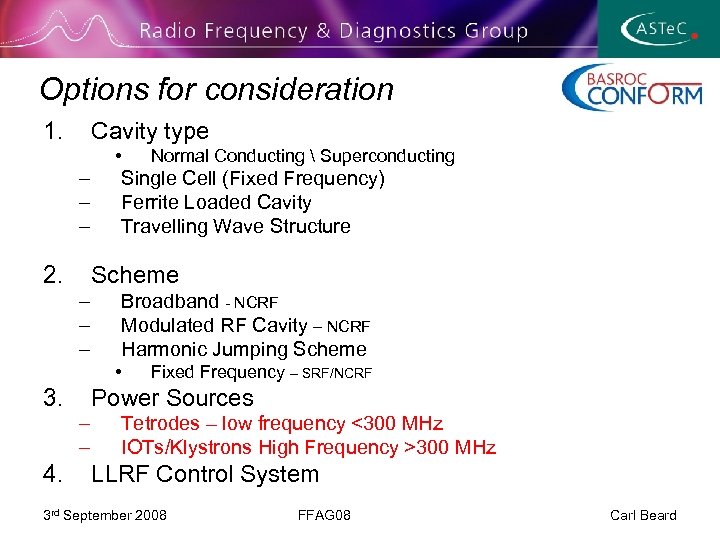
Options for consideration 1. Cavity type • – – – 2. Single Cell (Fixed Frequency) Ferrite Loaded Cavity Travelling Wave Structure Scheme – – – Broadband - NCRF Modulated RF Cavity – NCRF Harmonic Jumping Scheme • 3. Fixed Frequency – SRF/NCRF Power Sources – – 4. Normal Conducting Superconducting Tetrodes – low frequency <300 MHz IOTs/Klystrons High Frequency >300 MHz LLRF Control System 3 rd September 2008 FFAG 08 Carl Beard
Examples of Cavity Types N. B. Bespoke systems recommended 3 rd September 2008 FFAG 08 Carl Beard
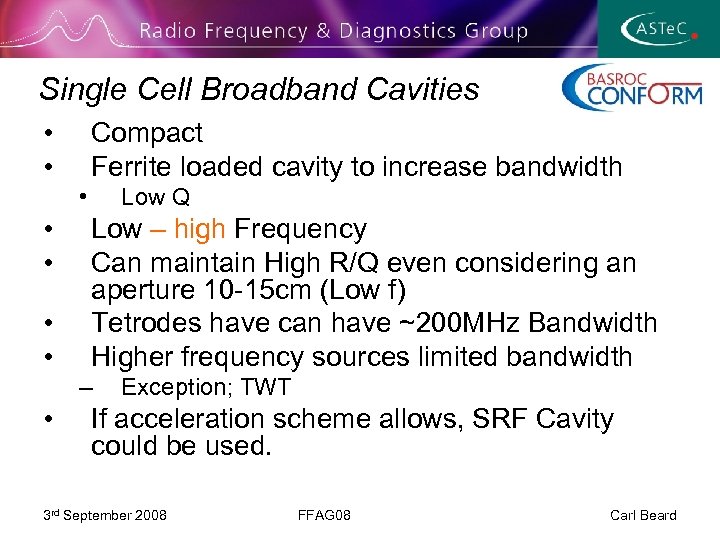
Single Cell Broadband Cavities • • Compact Ferrite loaded cavity to increase bandwidth • • • Low Q Low – high Frequency Can maintain High R/Q even considering an aperture 10 -15 cm (Low f) Tetrodes have can have ~200 MHz Bandwidth Higher frequency sources limited bandwidth – • Exception; TWT If acceleration scheme allows, SRF Cavity could be used. 3 rd September 2008 FFAG 08 Carl Beard
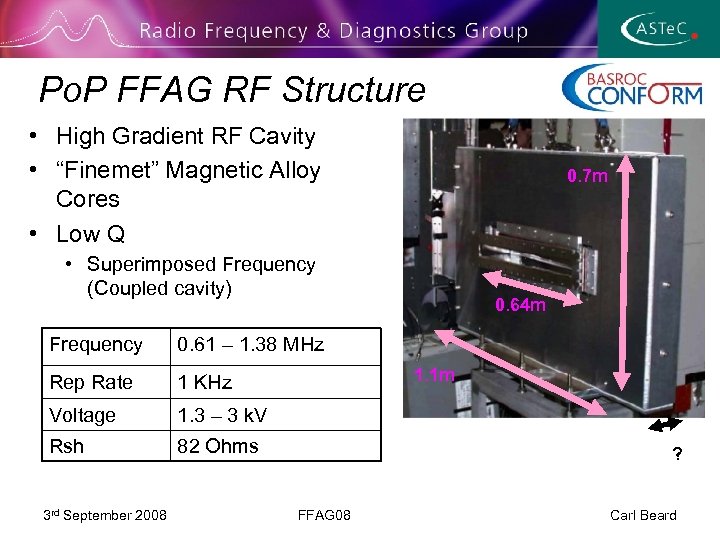
Po. P FFAG RF Structure • High Gradient RF Cavity • “Finemet” Magnetic Alloy Cores • Low Q 0. 7 m • Superimposed Frequency (Coupled cavity) Frequency 0. 61 – 1. 38 MHz Rep Rate 1 KHz Voltage 1. 3 – 3 k. V Rsh 82 Ohms 0. 64 m 3 rd September 2008 1. 1 m ? FFAG 08 Carl Beard
Muons, Inc. Compact, Tunable RF Cavities New developments in the design of fixed-field alternating gradient (FFAG) synchrotrons have sparked interest in their use as rapid-cycling, high intensity accelerators of ions, protons, muons, and electrons. Potential applications include proton drivers for neutron or muon production, rapid muon accelerators, electron accelerators for synchrotron light sources, and medical accelerators of protons and light ions for cancer therapy. Compact RF cavities that tune rapidly over various frequency ranges are needed to provide the acceleration in FFAG lattices. An innovative design of a compact RF cavity that uses orthogonally biased ferrite or garnet for fast frequency tuning and liquid dielectric to adjust the frequency range and cool the cores is being developed using physical prototypes and computer models. The first example will be to provide 2 nd Harmonic RF for the Fermilab Booster Synchrotron. 5/24/2008 3 rd September 2008 Compact, Tunable RF Cavities 9 FFAG 08 Carl Beard
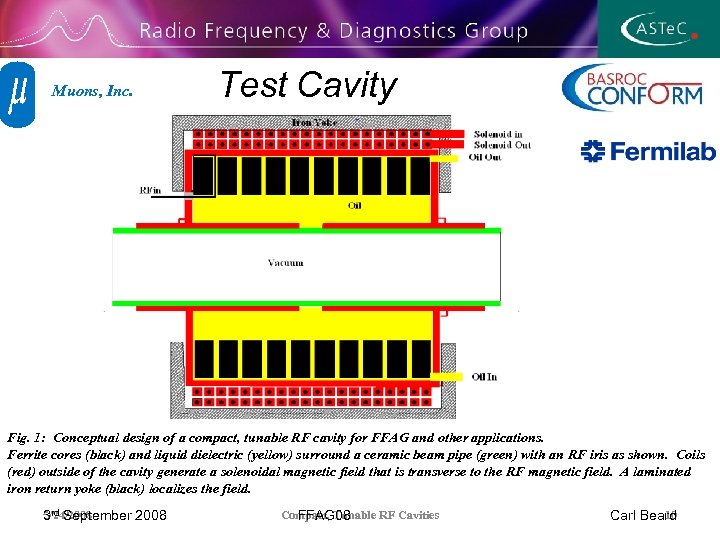
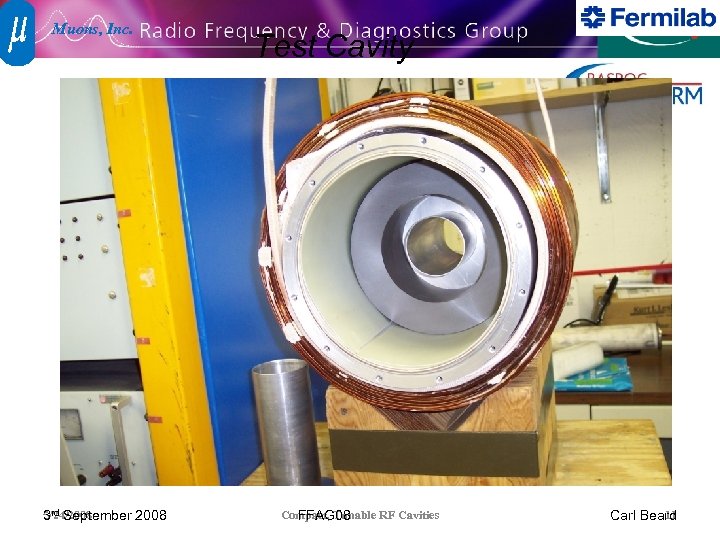
Muons, Inc. Test Cavity Fig. 1: Conceptual design of a compact, tunable RF cavity for FFAG and other applications. Ferrite cores (black) and liquid dielectric (yellow) surround a ceramic beam pipe (green) with an RF iris as shown. Coils (red) outside of the cavity generate a solenoidal magnetic field that is transverse to the RF magnetic field. A laminated iron return yoke (black) localizes the field. 5/24/2008 3 rd September 2008 Compact, Tunable RF Cavities 10 FFAG 08 Carl Beard
Muons, Inc. 5/24/2008 3 rd September 2008 Test Cavity Compact, Tunable RF Cavities 11 FFAG 08 Carl Beard
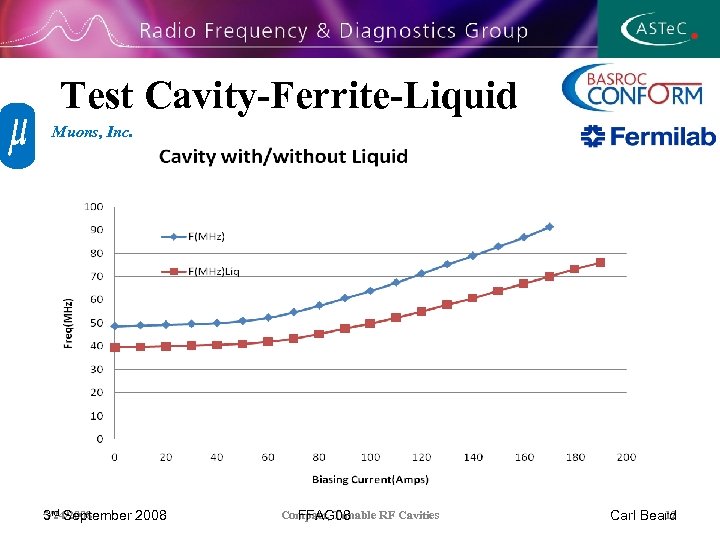
Test Cavity-Ferrite-Liquid Muons, Inc. 5/24/2008 3 rd September 2008 Compact, Tunable RF Cavities 12 FFAG 08 Carl Beard
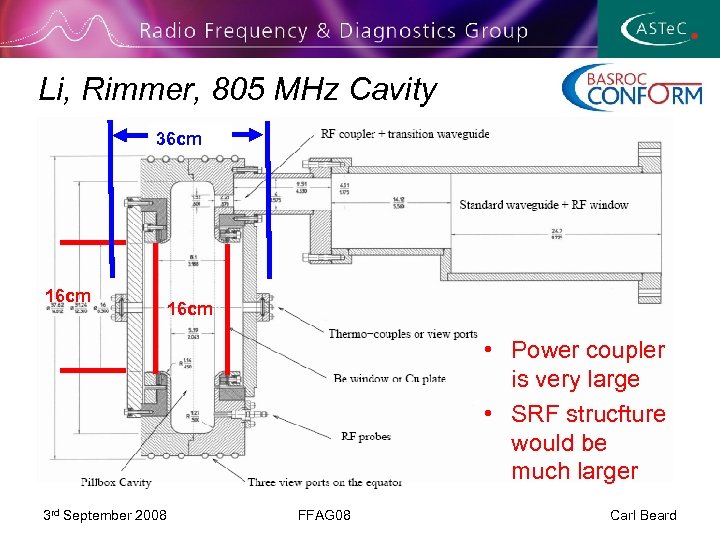
Li, Rimmer, 805 MHz Cavity 36 cm 16 cm • Power coupler is very large • SRF strucfture would be much larger 3 rd September 2008 FFAG 08 Carl Beard
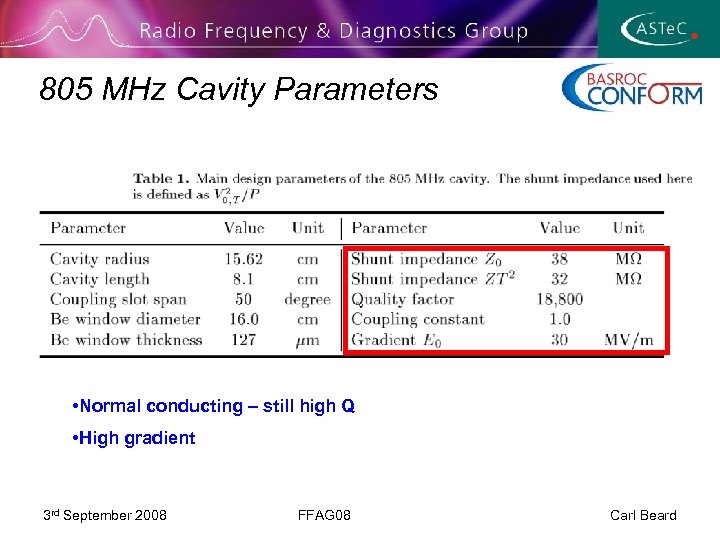
805 MHz Cavity Parameters • Normal conducting – still high Q • High gradient 3 rd September 2008 FFAG 08 Carl Beard
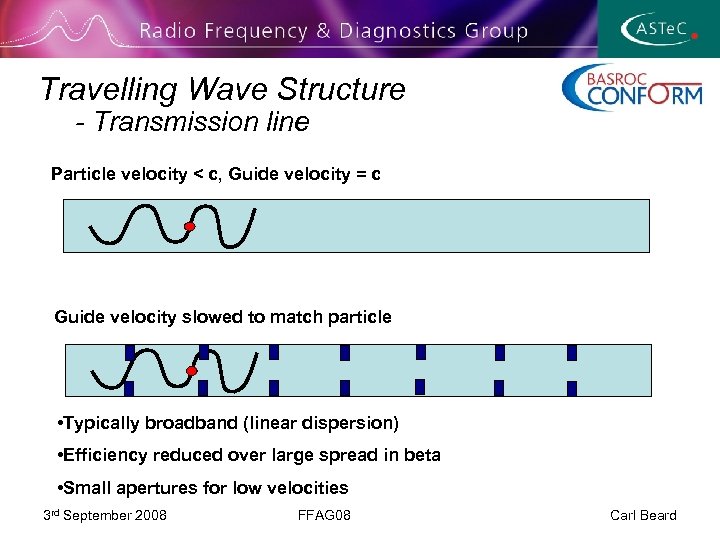
Travelling Wave Structure - Transmission line Particle velocity < c, Guide velocity = c Guide velocity slowed to match particle • Typically broadband (linear dispersion) • Efficiency reduced over large spread in beta • Small apertures for low velocities 3 rd September 2008 FFAG 08 Carl Beard
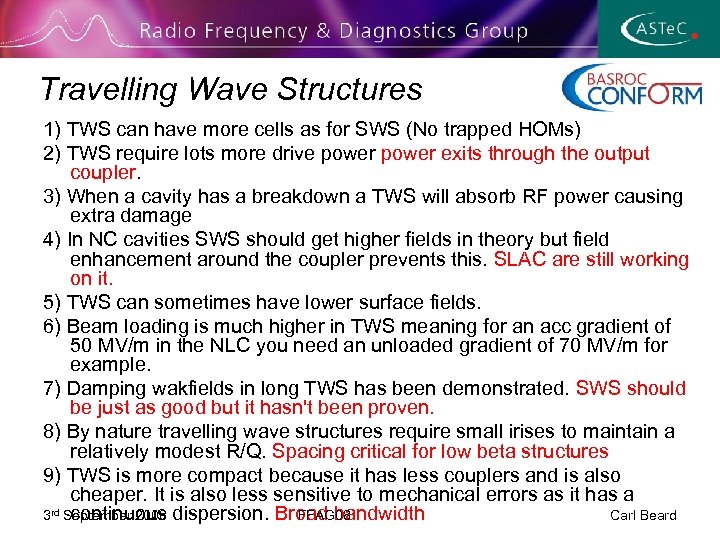
Travelling Wave Structures 1) TWS can have more cells as for SWS (No trapped HOMs) 2) TWS require lots more drive power exits through the output coupler. 3) When a cavity has a breakdown a TWS will absorb RF power causing extra damage 4) In NC cavities SWS should get higher fields in theory but field enhancement around the coupler prevents this. SLAC are still working on it. 5) TWS can sometimes have lower surface fields. 6) Beam loading is much higher in TWS meaning for an acc gradient of 50 MV/m in the NLC you need an unloaded gradient of 70 MV/m for example. 7) Damping wakfields in long TWS has been demonstrated. SWS should be just as good but it hasn't been proven. 8) By nature travelling wave structures require small irises to maintain a relatively modest R/Q. Spacing critical for low beta structures 9) TWS is more compact because it has less couplers and is also cheaper. It is also less sensitive to mechanical errors as it has a rd September 2008 3 continuous dispersion. Broad bandwidth FFAG 08 Carl Beard
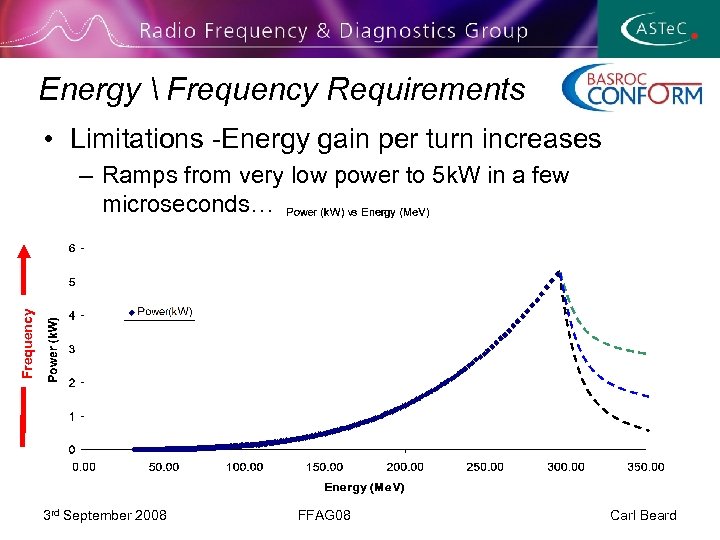
Energy Frequency Requirements • Limitations -Energy gain per turn increases Frequency – Ramps from very low power to 5 k. W in a few microseconds… 3 rd September 2008 FFAG 08 Carl Beard
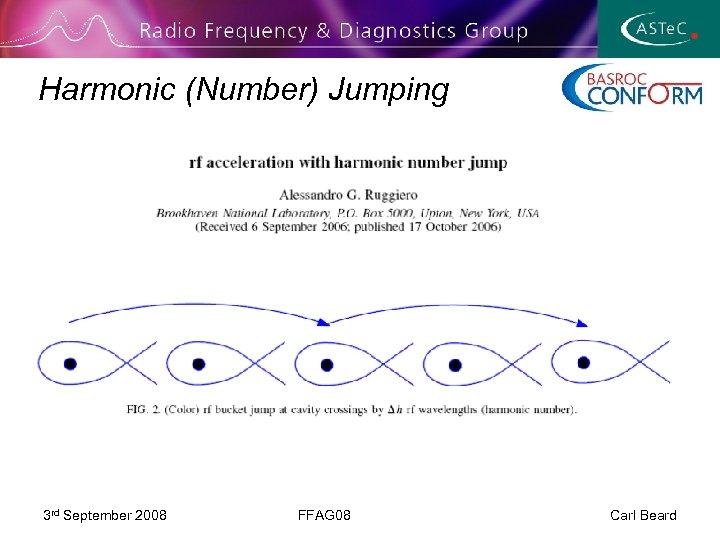
Harmonic (Number) Jumping 3 rd September 2008 FFAG 08 Carl Beard
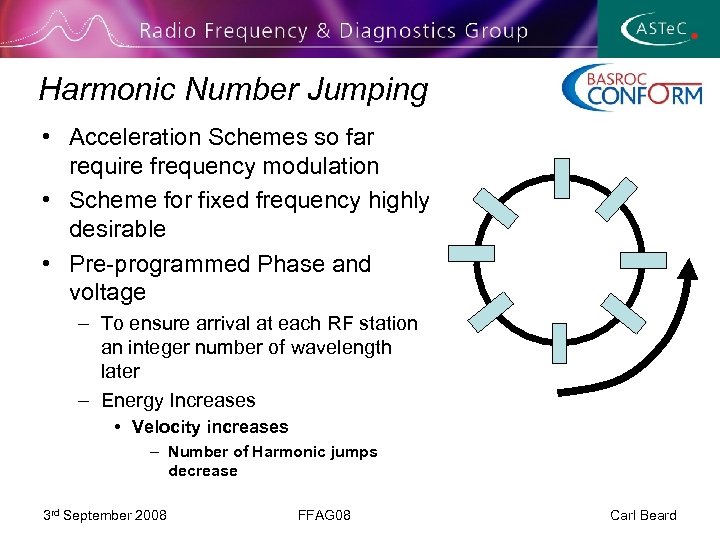
Harmonic Number Jumping • Acceleration Schemes so far require frequency modulation • Scheme for fixed frequency highly desirable • Pre-programmed Phase and voltage – To ensure arrival at each RF station an integer number of wavelength later – Energy Increases • Velocity increases – Number of Harmonic jumps decrease 3 rd September 2008 FFAG 08 Carl Beard
Harmonic Jumping • Fixed RF frequency – High frequency option possible – Stability may be an issue – LLRF Control – As velocity increases TTF changes • Acceleration per cavity will change • Could be advantageous – starting further off phase • Superconducting RF is a possible solution – Larger beam apertures by default • Stray (High) fields – heating flanges etc. – Local BPMs 3 rd September 2008 FFAG 08 Carl Beard
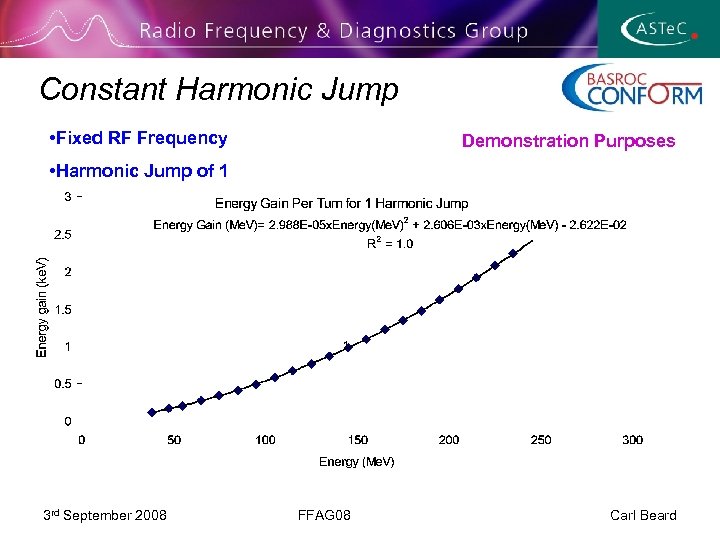
Constant Harmonic Jump • Fixed RF Frequency Demonstration Purposes • Harmonic Jump of 1 3 rd September 2008 FFAG 08 Carl Beard
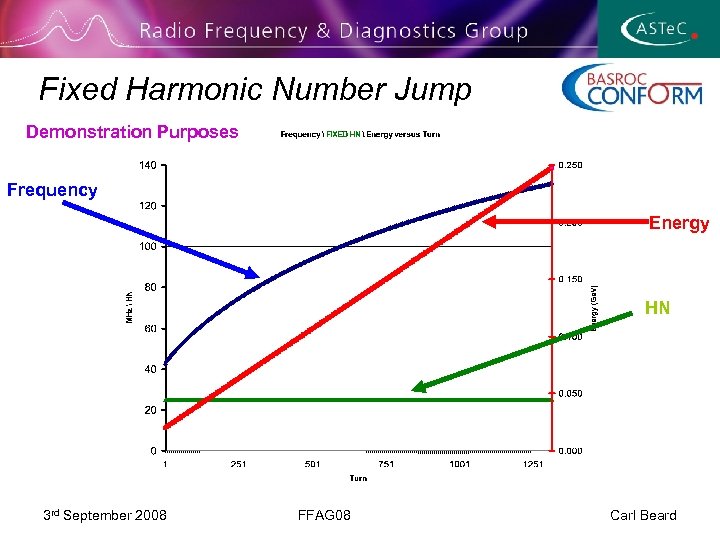
Fixed Harmonic Number Jump Demonstration Purposes Frequency Energy HN 3 rd September 2008 FFAG 08 Carl Beard
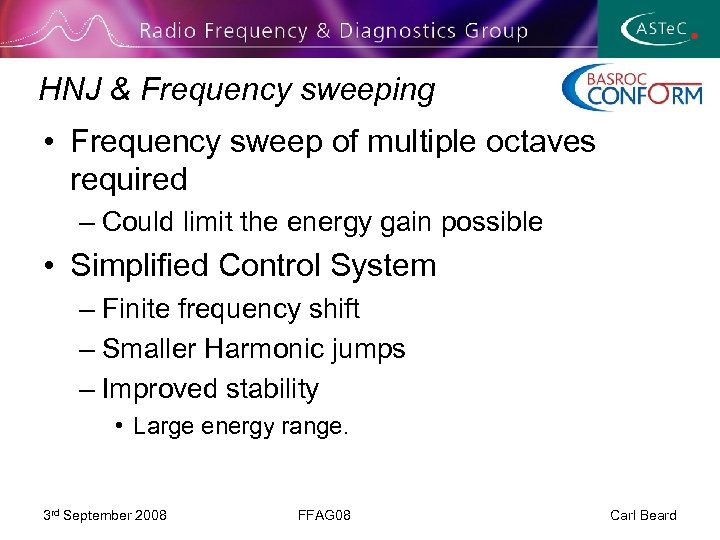
HNJ & Frequency sweeping • Frequency sweep of multiple octaves required – Could limit the energy gain possible • Simplified Control System – Finite frequency shift – Smaller Harmonic jumps – Improved stability • Large energy range. 3 rd September 2008 FFAG 08 Carl Beard
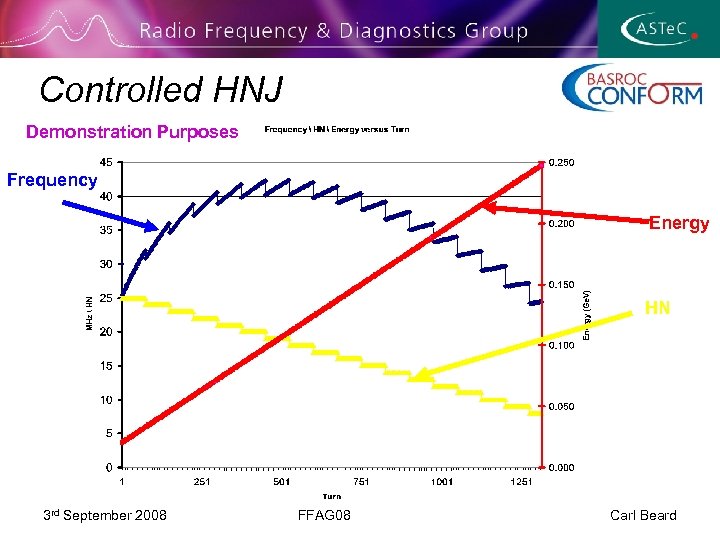
Controlled HNJ Demonstration Purposes Frequency Energy HN 3 rd September 2008 FFAG 08 Carl Beard
Frequency & HNJ Modulation • Reduction in operating bandwidth – Achievable for Ferrite loaded and broadband cavity • Increased efficiency – Frequency returns back to initial frequency to allow continuous operation • Constant energy gain. – Fixed Power per cavity • Stepped “controlled” ramping of the Harmonic number 3 rd September 2008 FFAG 08 Carl Beard
Summary • Standard acceleration scheme – Modulated RF – Broadband • Ramping of RF power limits the use • Bandwidth could be a number of octaves • Harmonic Number Jump – Large advantages • Reduce the required bandwidth • Fixed frequency – Low Level RF Control looks possible, but difficult • Hybrid of HNJ + Cavity (Modulated or Broadband) – Looks promising – Could this system work independently and reliably? – More comprehensive study required 3 rd September 2008 FFAG 08 Carl Beard
Скачать презентацию Acceleration Schemes for PAMELA Carl Beard ASTe C
dd7fe2304efc7bbd3c20b00c5bef49bf.ppt