


 Скачать презентацию Acceleration of Cosmic Rays Pankaj Jain IIT Kanpur
918629e857c5c86fa03cb2dee3e5af10.ppt
- Количество слайдов: 79
 Acceleration of Cosmic Rays Pankaj Jain IIT Kanpur
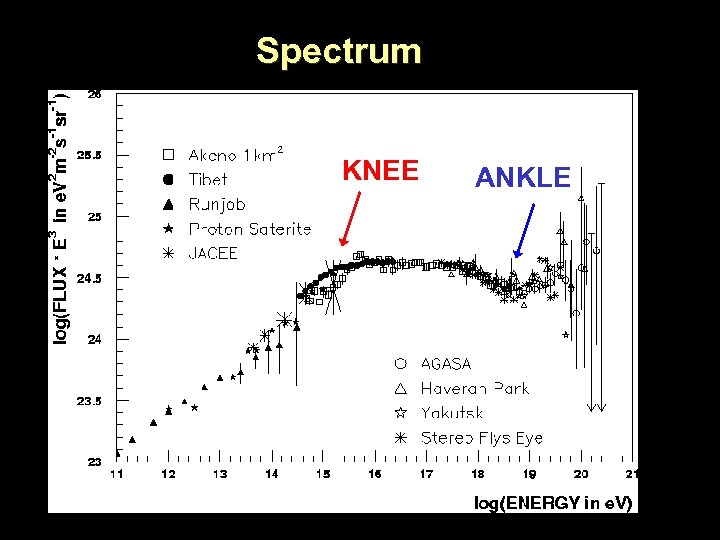
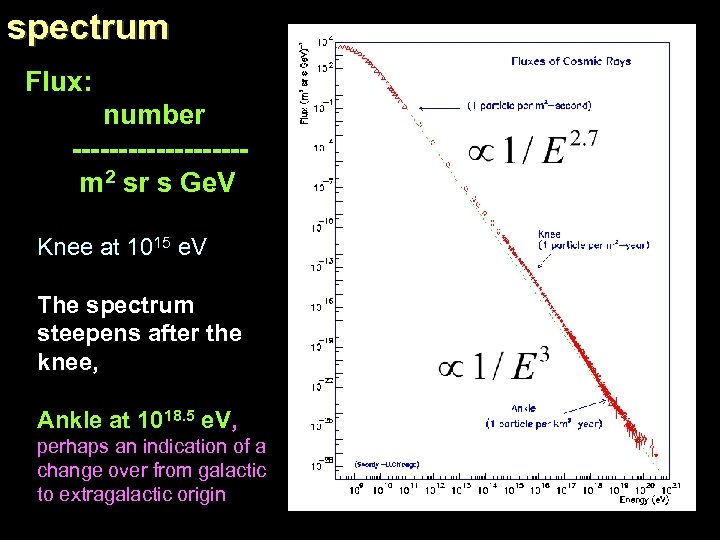 spectrum Flux: number ---------m 2 sr s Ge. V Knee at 1015 e. V The spectrum steepens after the knee, Ankle at 1018. 5 e. V, perhaps an indication of a change over from galactic to extragalactic origin
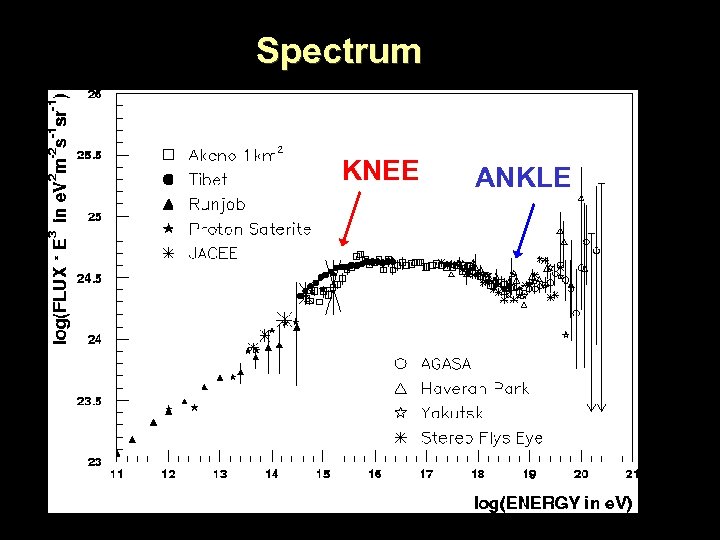 Spectrum KNEE ANKLE
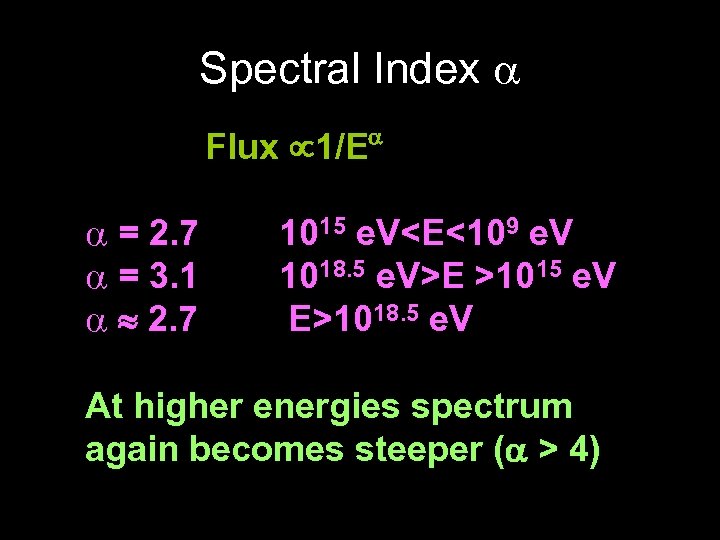 Spectral Index Flux 1/E = 2. 7 = 3. 1 2. 7 1015 e. V
 Origin The high energy cosmic rays probably arise due to acceleration of charged particles at some astrophysical sites Ø Ø Ø supernova shock waves Active galactic nuclei gamma ray bursts pulsars galaxy mergers Bottom up model
 Origin Alternatively very massive objects might decay in our galaxy and produce the entire spectrum of high energy cosmic rays The massive objects would be a relic from early universe with mass M > 1015 mass of proton Top Down Model
 Origin These massive objects could be: Topological defects Super heavy particles Primordial black holes
 Origin Here we shall focus on the Bottom Up Model where the particles are accelerated at some astrophysical sites
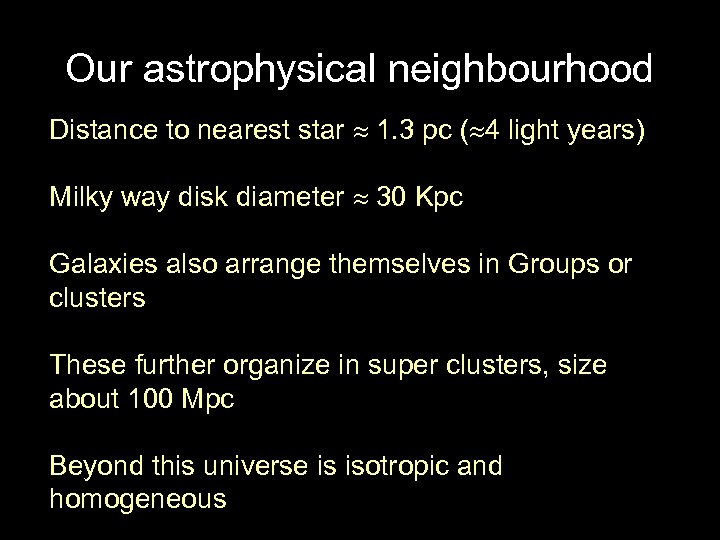 Our astrophysical neighbourhood Distance to nearest star 1. 3 pc ( 4 light years) Milky way disk diameter 30 Kpc Galaxies also arrange themselves in Groups or clusters These further organize in super clusters, size about 100 Mpc Beyond this universe is isotropic and homogeneous
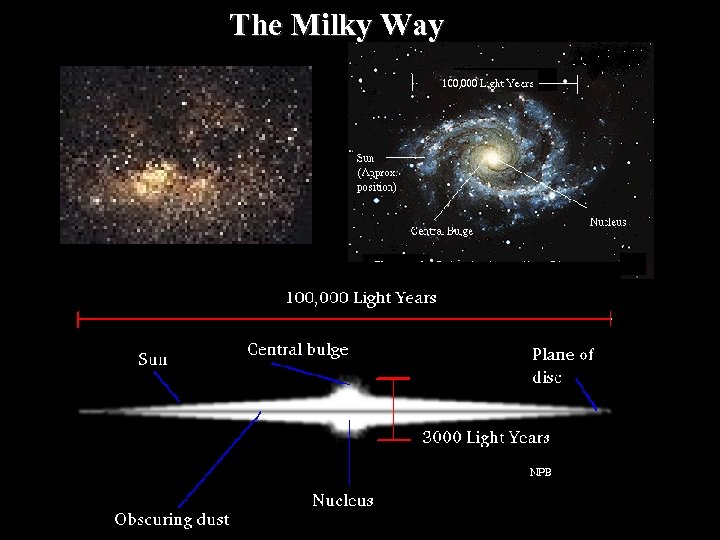 The Milky Way
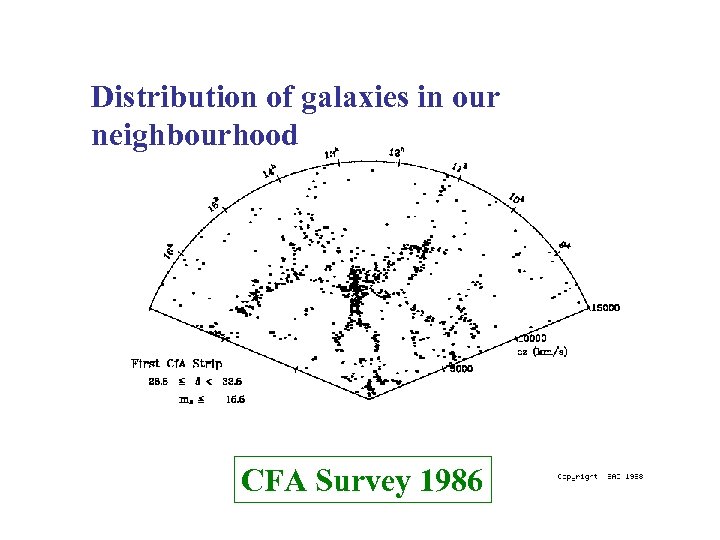 Distribution of galaxies in our neighbourhood CFA Survey 1986
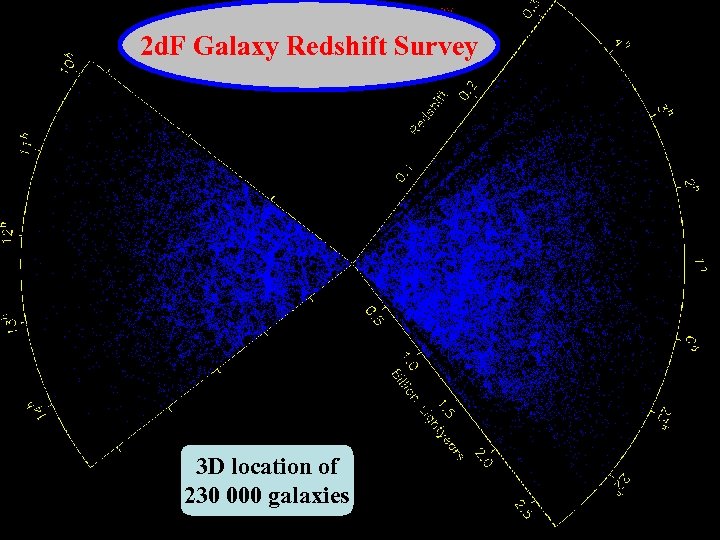 2 d. F Galaxy Redshift Survey 3 D location of 230 000 galaxies
 As we go to distances larger than 100 Mpc we enter the regime of cosmology z = v/c = H 0 d (Hubble Law) z 1 at distances of order 1 Gpc As we go to large z (or distance), the Universe looks very different. It has much higher population of exotic objects like Active Galactic Nuclei Gamma Ray Bursts
 Acceleration Mechanisms Fermi acceleration Betatron acceleration: acceleration due to time varying electromagnetic fields
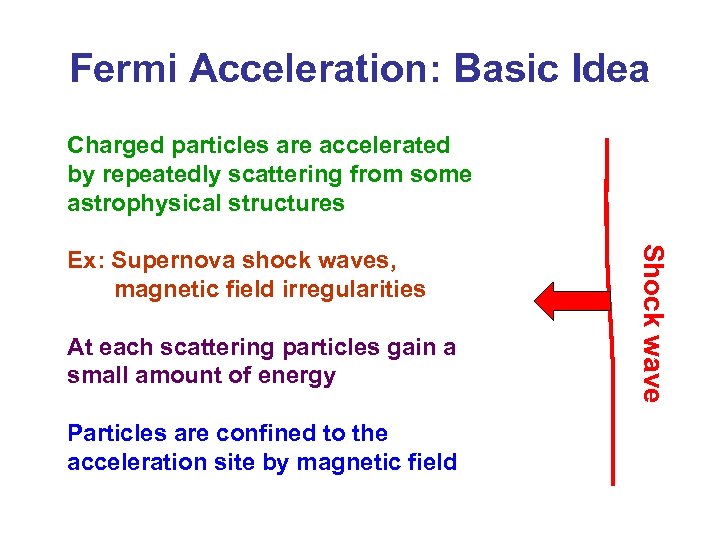 Fermi Acceleration: Basic Idea Charged particles are accelerated by repeatedly scattering from some astrophysical structures At each scattering particles gain a small amount of energy Particles are confined to the acceleration site by magnetic field Shock wave Ex: Supernova shock waves, magnetic field irregularities
 Supernova Explosion Stars more massive than 3 solar masses end their life in a supernova explosion. This happens when either C or O is ignited in the core. The ignition is explosive and blows up the entire star. For more massive stars the core becomes dominated by iron. Explosion occurs due to collapse of the iron core. The core becomes a neutron star or a black hole
 Supernova Explosion Supernova explosions also happen in binary star systems In this case one of the stars accretes or captures matter from its binary partner, becomes unstable and explodes For example, the star may be a white dwarf MWD < 1. 44 Solar Mass Chandrasekhar limit If its mass exceeds this limit, it collapses and explodes into a supernova
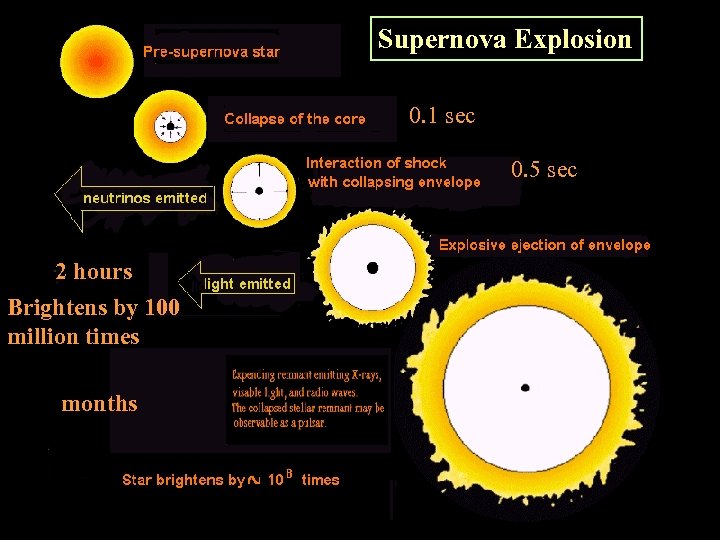 Supernova Explosion 0. 1 sec 0. 5 sec 2 hours Brightens by 100 million times months
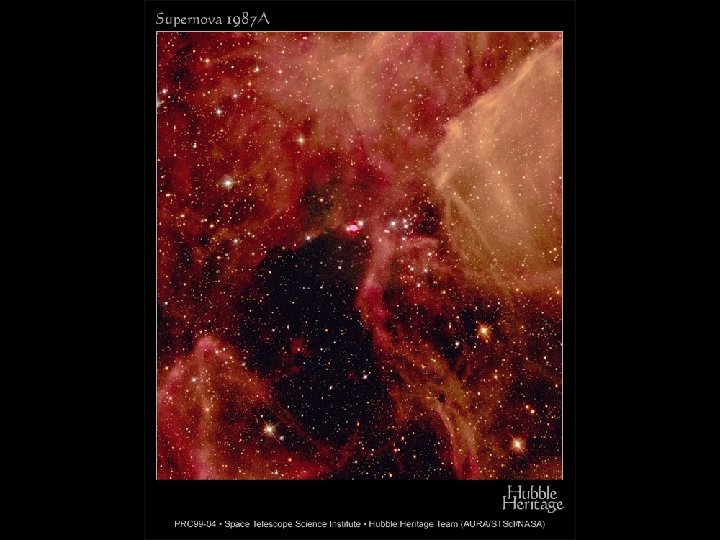
 Supernova Explosion, Aftermath The explosion sends out matter into interstellar space at very high speed, exceeding the sound speed in the medium, leading to a strong shock wave For sufficiently massive star the core becomes a pulsar (neutron star) or a black hole
 Brightest supernova observed SN 1006 visible in day time 3 times size of Venus Intensity comparable to Moon
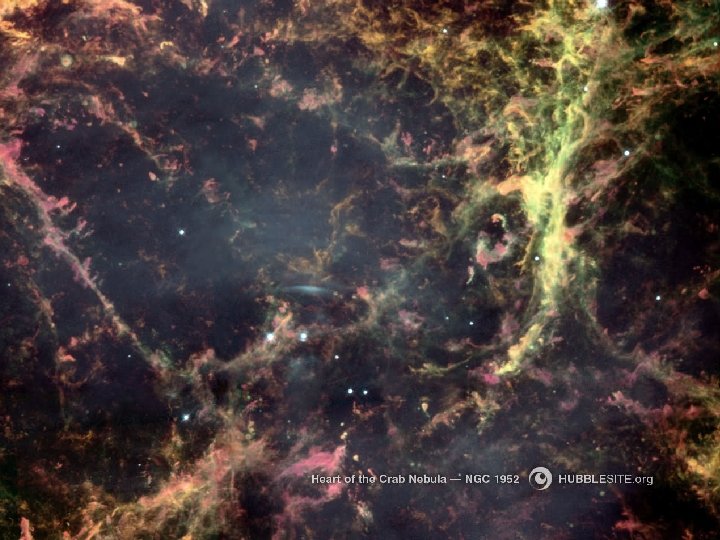
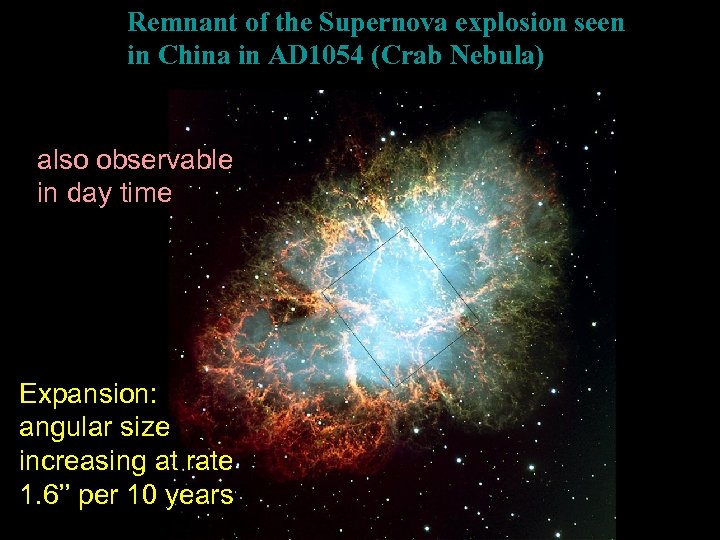 Remnant of the Supernova explosion seen in China in AD 1054 (Crab Nebula) also observable in day time Expansion: angular size increasing at rate 1. 6’’ per 10 years
 Magnetic Fields in Astrophysics Magnetic fields are associated with almost all astrophysical sites Our galaxy has a magnetic field of mean strength 3 G The field is turbulent
 Magnetic Fields in Astrophysics Cosmic rays are confined at the astrophysical sites by magnetic field They may also scatter on the magnetic field irregularities and gain or loose energy
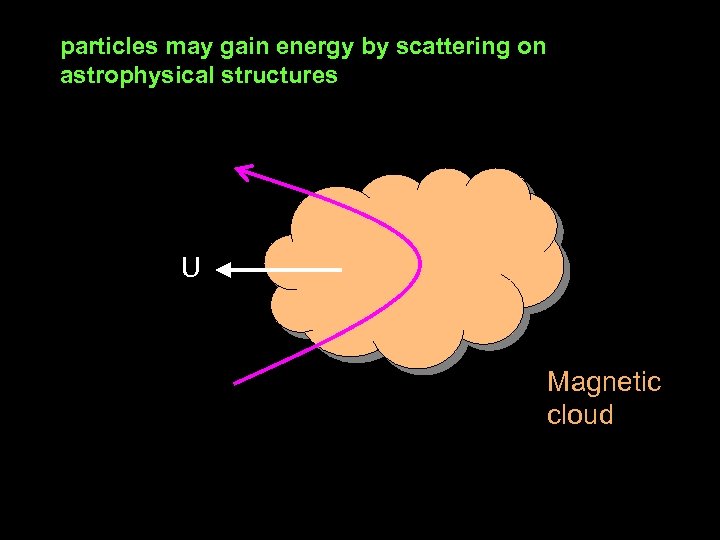 particles may gain energy by scattering on astrophysical structures U Magnetic cloud
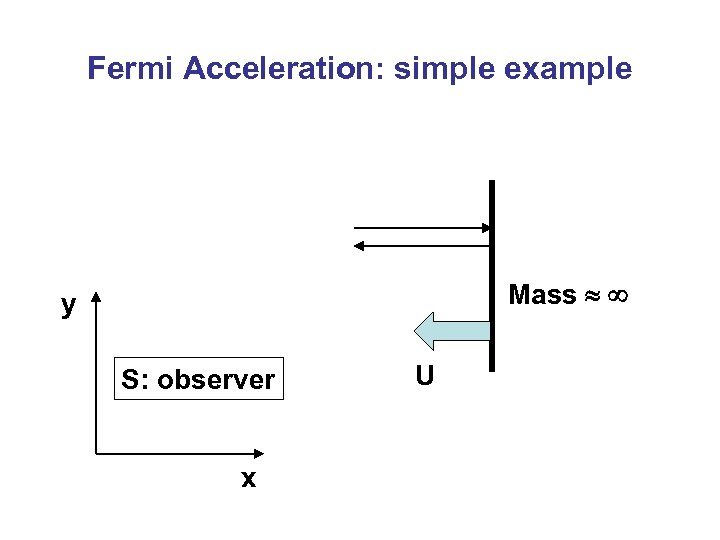 Fermi Acceleration: simple example Mass y S: observer x U
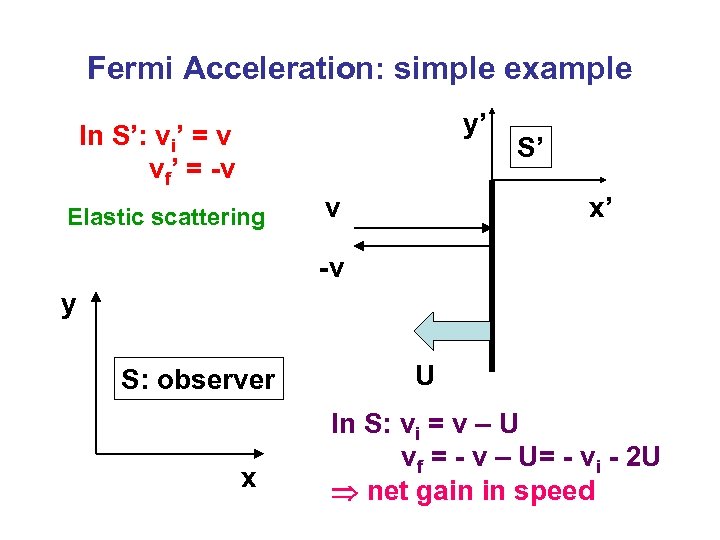 Fermi Acceleration: simple example y’ In S’: vi’ = v vf’ = -v Elastic scattering v S’ x’ -v y S: observer x U In S: vi = v – U vf = - v – U= - vi - 2 U net gain in speed
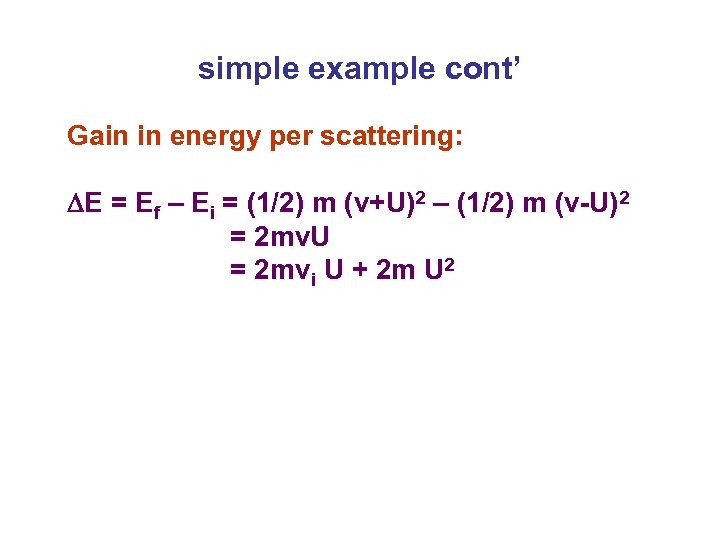 simple example cont’ Gain in energy per scattering: E = Ef – Ei = (1/2) m (v+U)2 – (1/2) m (v-U)2 = 2 mv. U = 2 mvi U + 2 m U 2
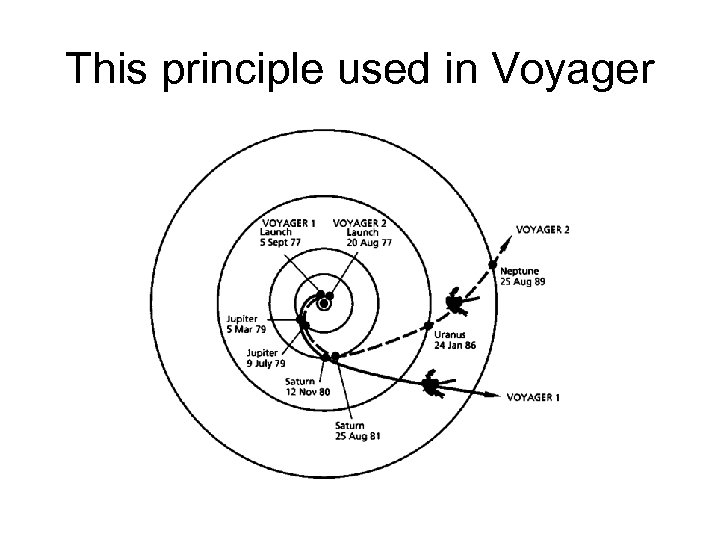 This principle used in Voyager
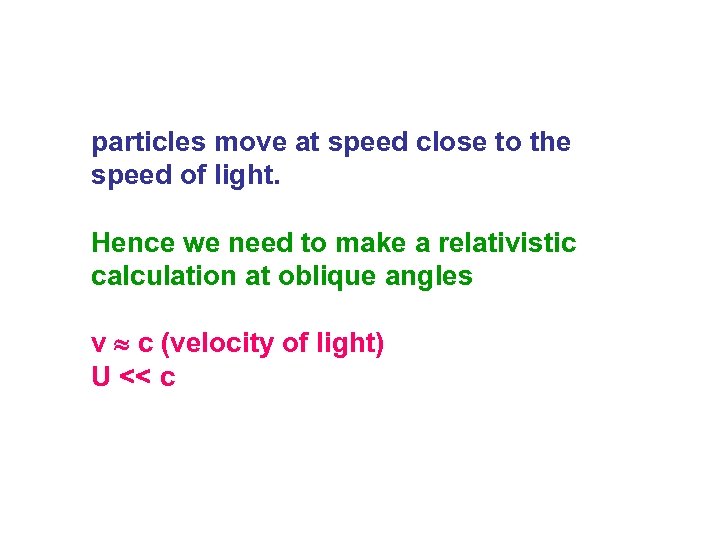 particles move at speed close to the speed of light. Hence we need to make a relativistic calculation at oblique angles v c (velocity of light) U << c
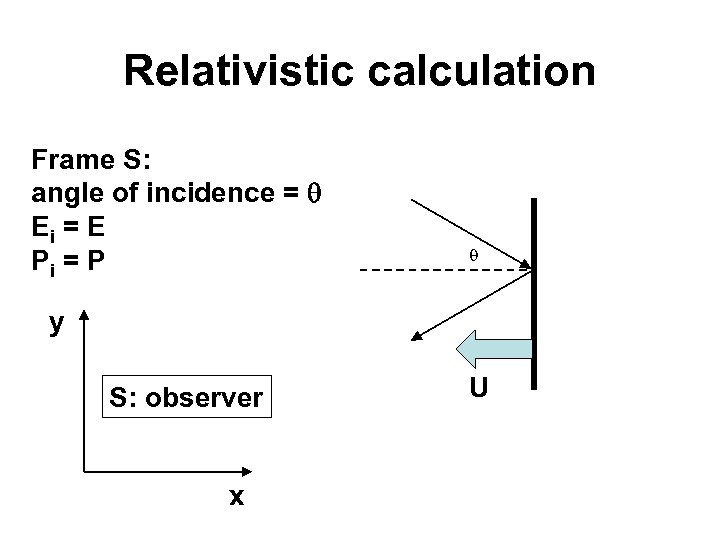 Relativistic calculation Frame S: angle of incidence = Ei = E Pi = P y S: observer x U
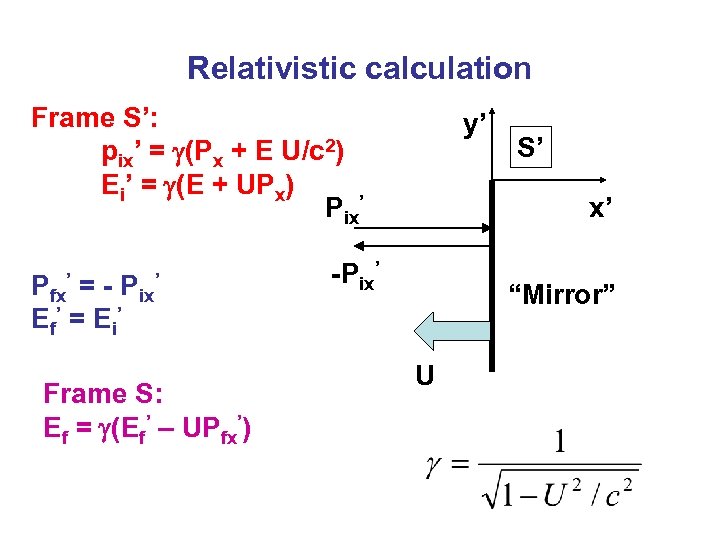 Relativistic calculation Frame S’: pix’ = (Px + E U/c 2) Ei’ = (E + UPx) Pix’ Pfx = - Pix E f’ = E i ’ ’ ’ Frame S: Ef = (Ef’ – UPfx’) y’ S’ x’ -Pix’ “Mirror” U
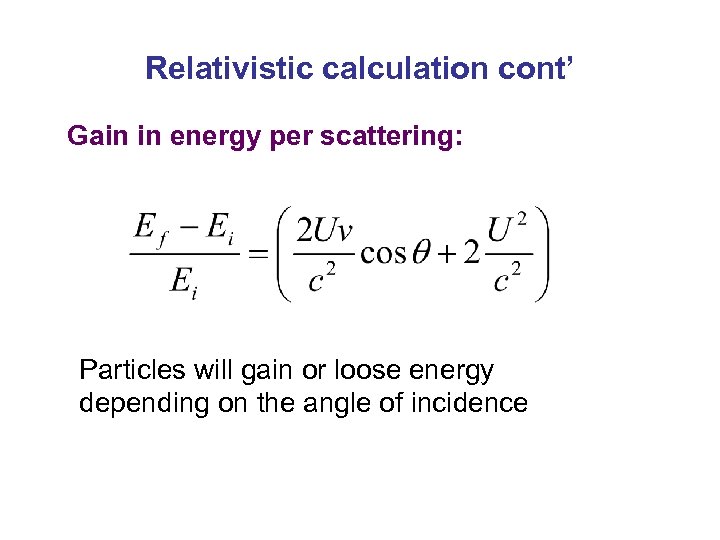 Relativistic calculation cont’ Gain in energy per scattering: Particles will gain or loose energy depending on the angle of incidence
 Fermi Acceleration Lets assume that initially N 0 charged particles with mean energy E 0 per particle are confined in the accelerating region by magnetic field. they undergo repeated interactions with the magnetic clouds
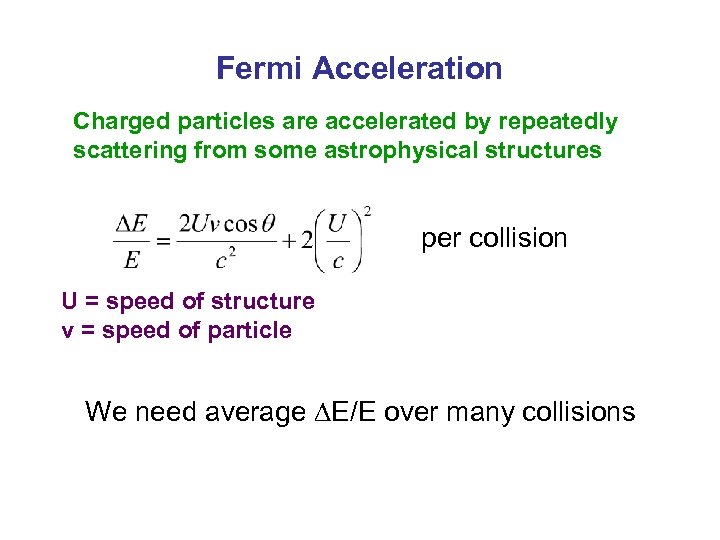 Fermi Acceleration Charged particles are accelerated by repeatedly scattering from some astrophysical structures per collision U = speed of structure v = speed of particle We need average E/E over many collisions
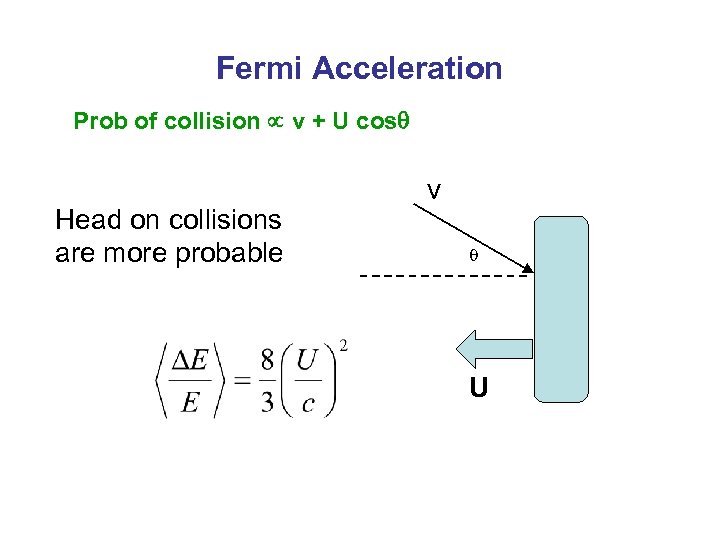 Fermi Acceleration Prob of collision v + U cos Head on collisions are more probable v U
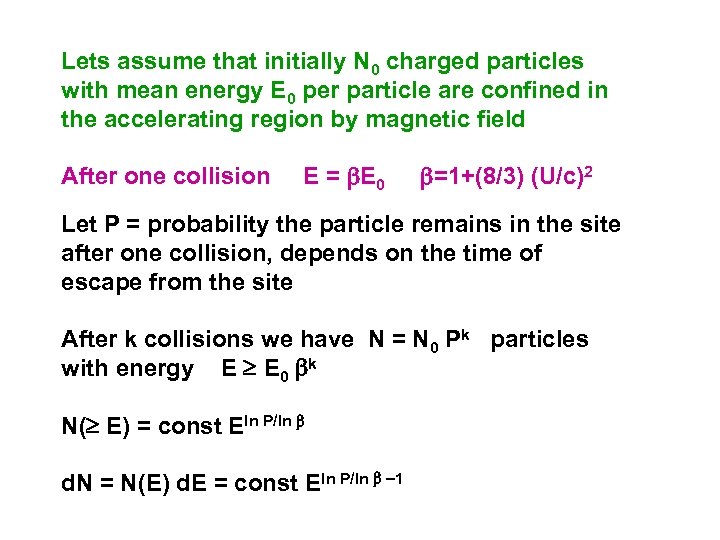 Lets assume that initially N 0 charged particles with mean energy E 0 per particle are confined in the accelerating region by magnetic field After one collision E = E 0 =1+(8/3) (U/c)2 Let P = probability the particle remains in the site after one collision, depends on the time of escape from the site After k collisions we have N = N 0 Pk particles with energy E E 0 k N( E) = const Eln P/ln d. N = N(E) d. E = const Eln P/ln 1
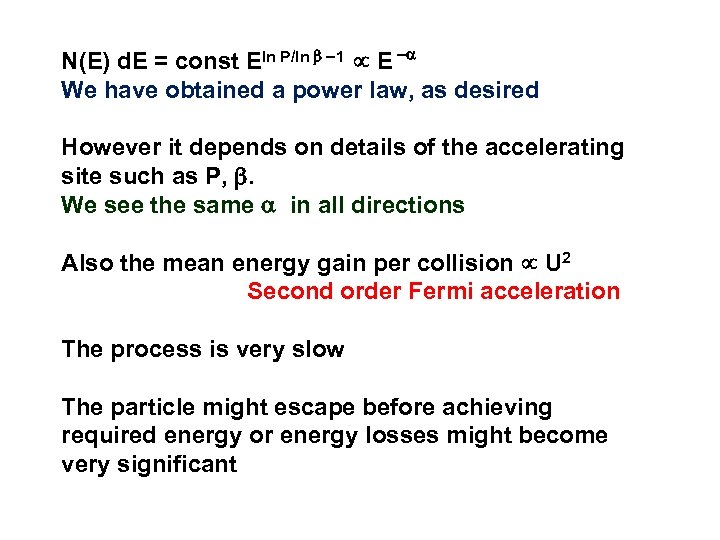 N(E) d. E = const Eln P/ln 1 E We have obtained a power law, as desired However it depends on details of the accelerating site such as P, . We see the same in all directions Also the mean energy gain per collision U 2 Second order Fermi acceleration The process is very slow The particle might escape before achieving required energy or energy losses might become very significant
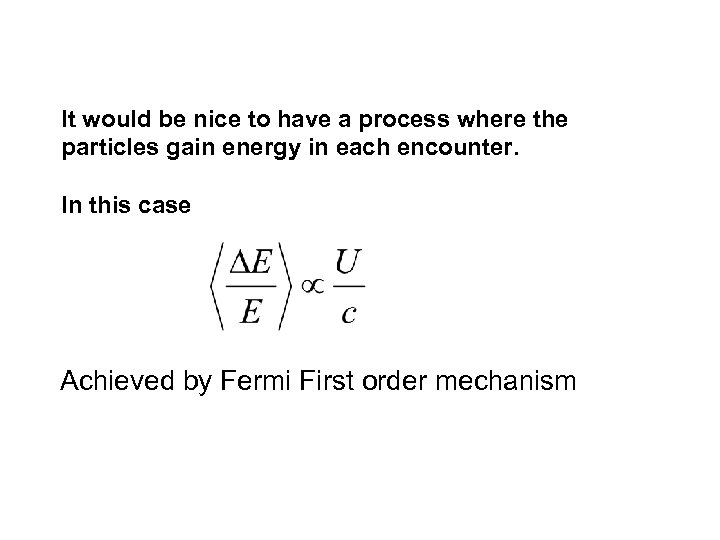 It would be nice to have a process where the particles gain energy in each encounter. In this case Achieved by Fermi First order mechanism
 Reference: High Energy Astrophysics by Malcolm S. Longair
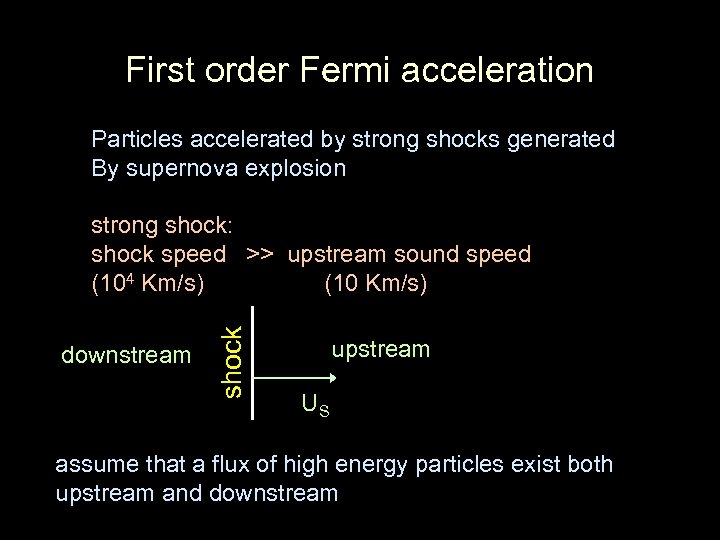 First order Fermi acceleration Particles accelerated by strong shocks generated By supernova explosion downstream shock strong shock: shock speed >> upstream sound speed (104 Km/s) (10 Km/s) upstream US assume that a flux of high energy particles exist both upstream and downstream
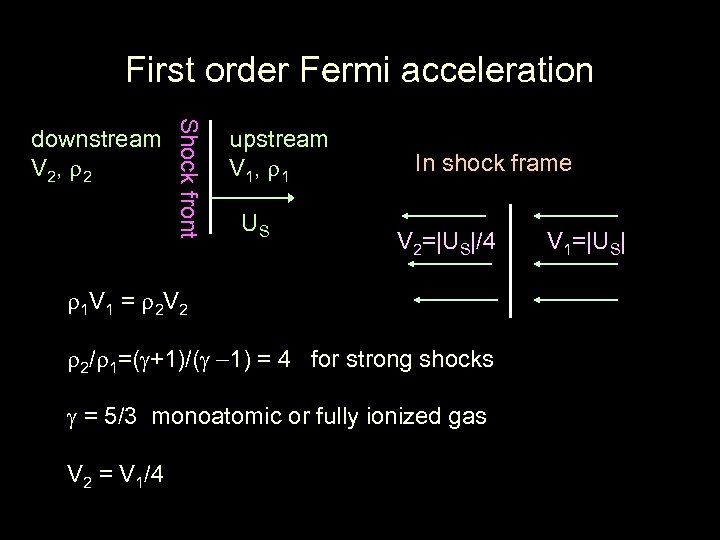 First order Fermi acceleration Shock front downstream V 2, 2 upstream V 1, 1 US In shock frame V 2=|US|/4 1 V 1 = 2 V 2 2/ 1=( +1)/( 1) = 4 for strong shocks = 5/3 monoatomic or fully ionized gas V 2 = V 1/4 V 1=|US|
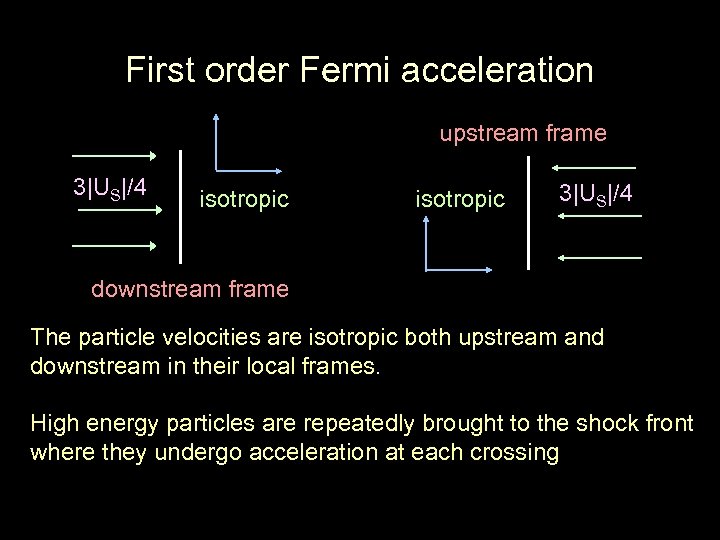 First order Fermi acceleration upstream frame 3|US|/4 isotropic 3|US|/4 downstream frame The particle velocities are isotropic both upstream and downstream in their local frames. High energy particles are repeatedly brought to the shock front where they undergo acceleration at each crossing
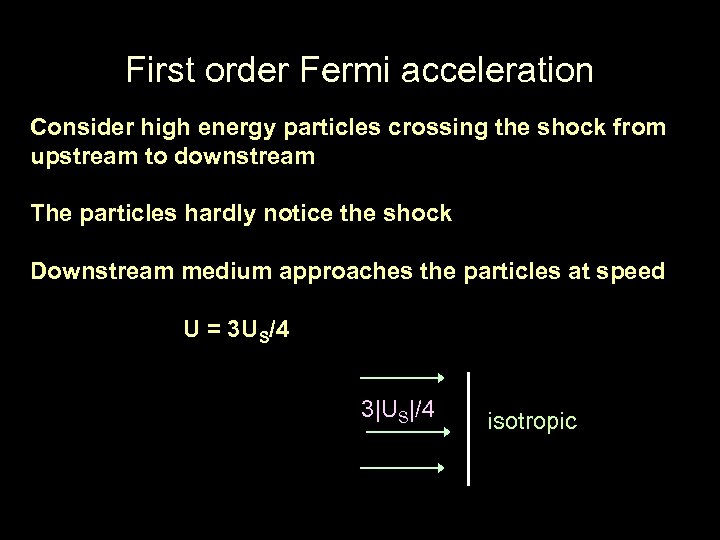 First order Fermi acceleration Consider high energy particles crossing the shock from upstream to downstream The particles hardly notice the shock Downstream medium approaches the particles at speed U = 3 US/4 3|US|/4 isotropic
 First order Fermi acceleration The particles undergo repeated scattering on magnetic irregularities and become isotropic in downstream medium Let’s determine the energy of the particle in the frame in which the downstream particles are isotropic
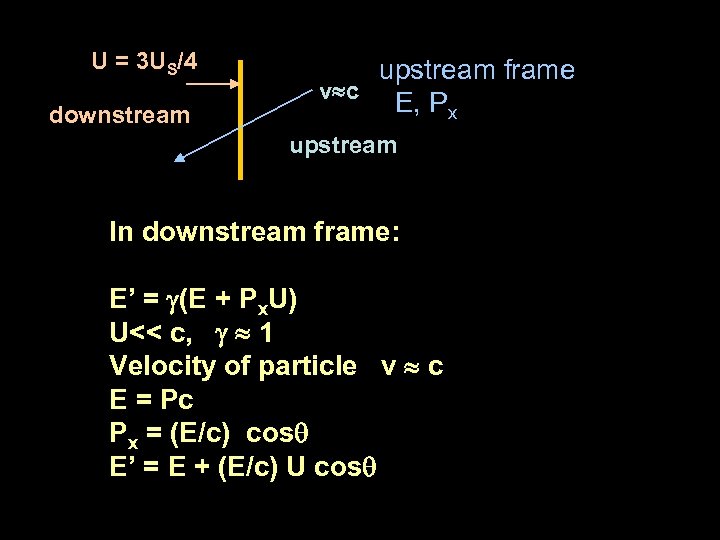 U = 3 US/4 downstream upstream frame v c E, Px upstream In downstream frame: E’ = (E + Px. U) U<< c, 1 Velocity of particle v c E = Pc Px = (E/c) cos E’ = E + (E/c) U cos
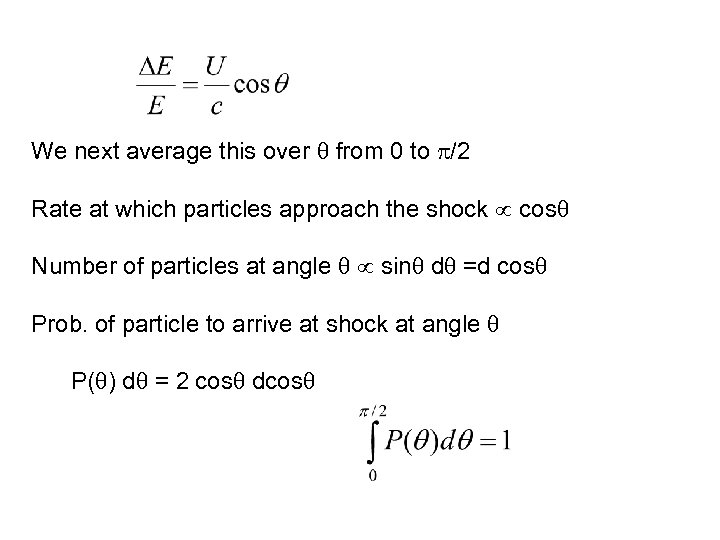 We next average this over from 0 to /2 Rate at which particles approach the shock cos Number of particles at angle sin d =d cos Prob. of particle to arrive at shock at angle P( ) d = 2 cos dcos
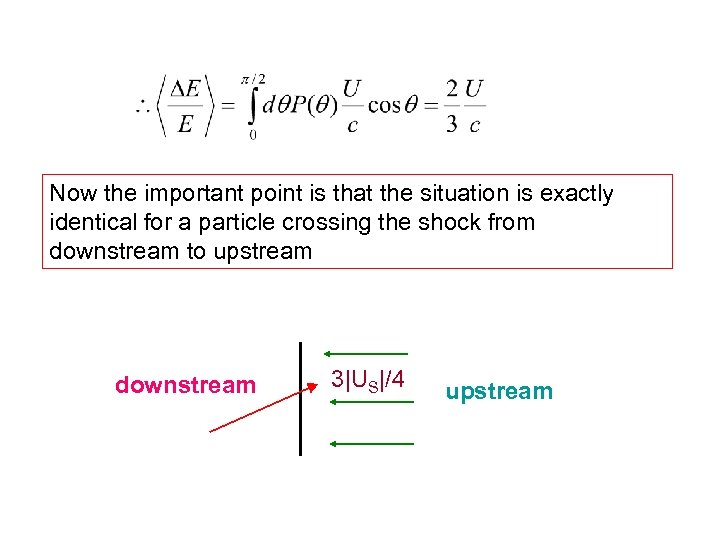 Now the important point is that the situation is exactly identical for a particle crossing the shock from downstream to upstream downstream 3|US|/4 upstream
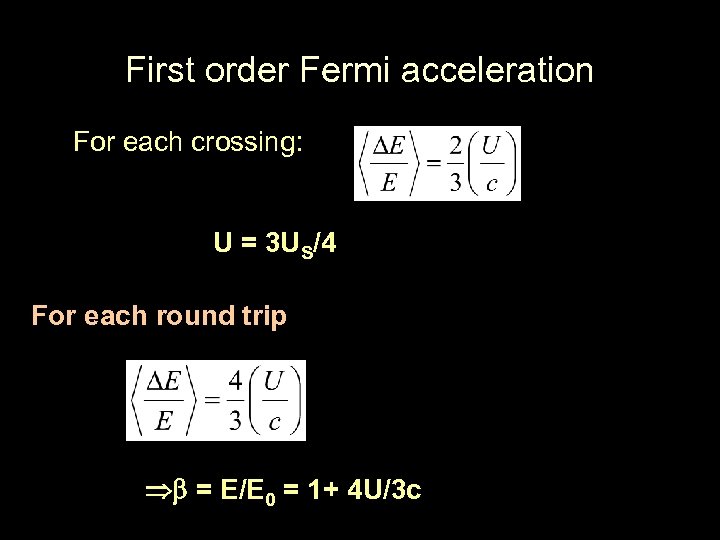 First order Fermi acceleration For each crossing: U = 3 US/4 For each round trip = E/E 0 = 1+ 4 U/3 c
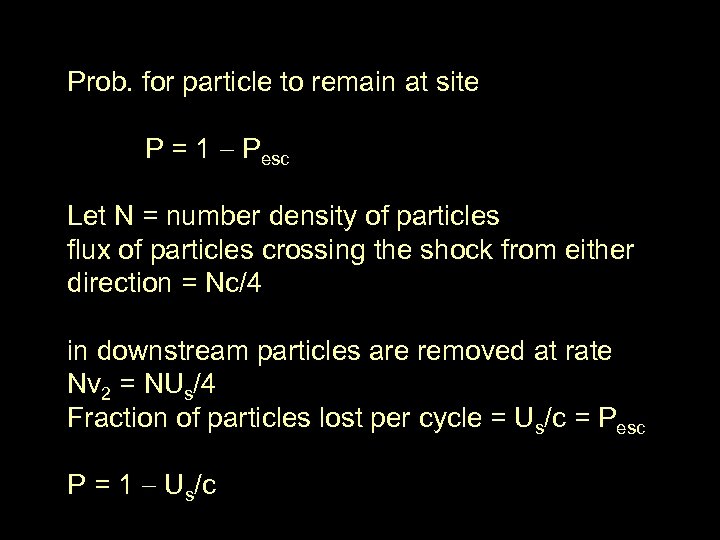 Prob. for particle to remain at site P = 1 Pesc Let N = number density of particles flux of particles crossing the shock from either direction = Nc/4 in downstream particles are removed at rate Nv 2 = NUs/4 Fraction of particles lost per cycle = Us/c = Pesc P = 1 Us/c
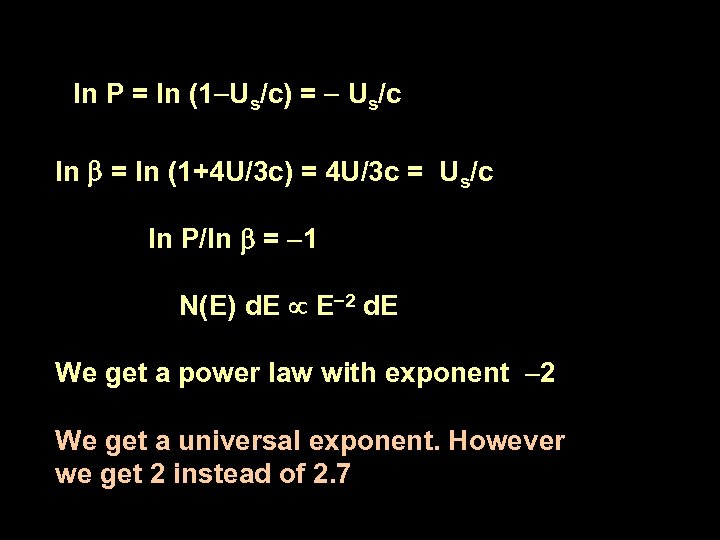 ln P = ln (1 Us/c) = Us/c ln = ln (1+4 U/3 c) = 4 U/3 c = Us/c ln P/ln = 1 N(E) d. E E 2 d. E We get a power law with exponent 2 We get a universal exponent. However we get 2 instead of 2. 7
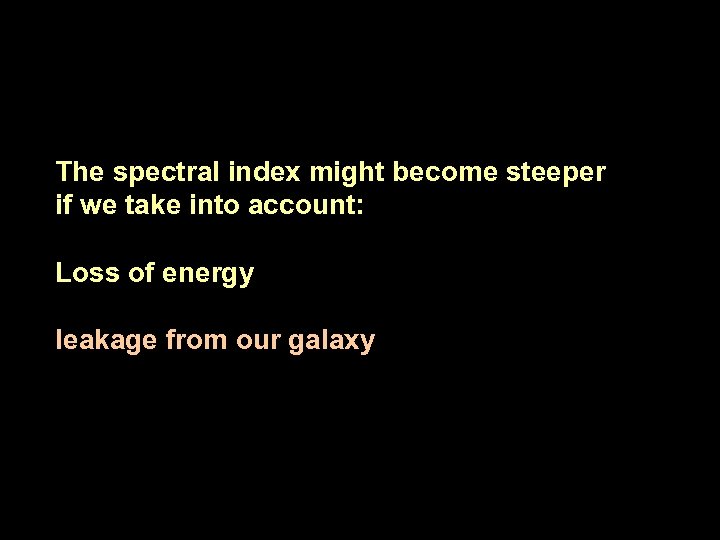 The spectral index might become steeper if we take into account: Loss of energy leakage from our galaxy
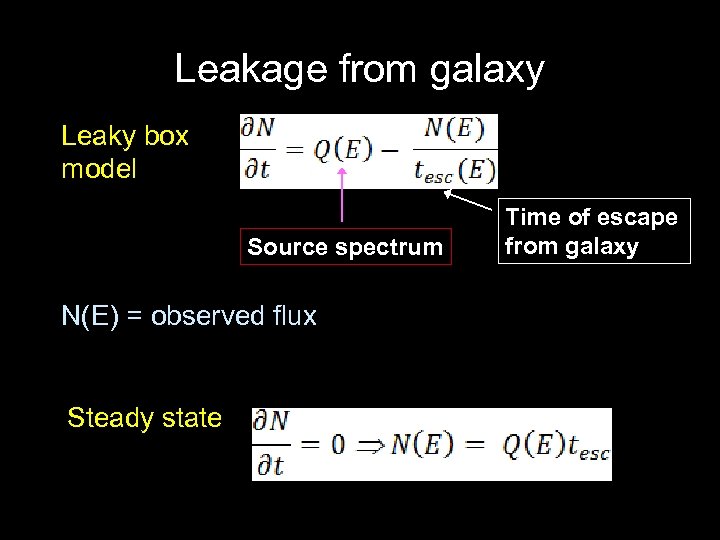 Leakage from galaxy Leaky box modell Source spectrum N(E) = observed flux Steady state Time of escape from galaxy
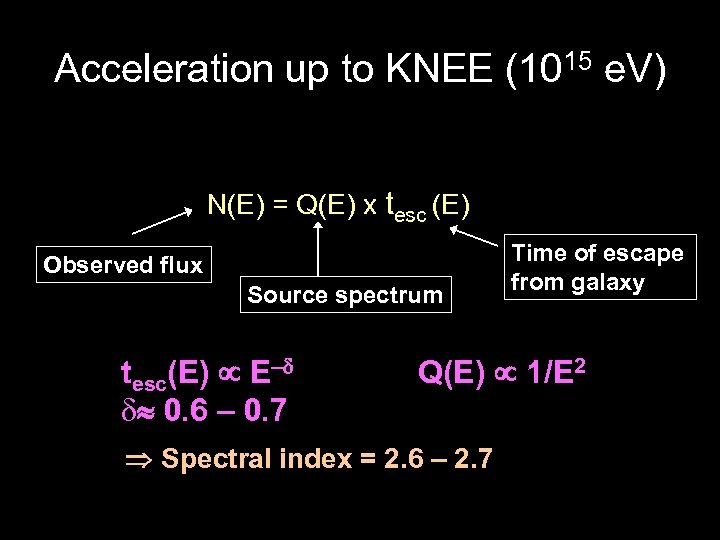 Acceleration up to KNEE (1015 e. V) N(E) = Q(E) x tesc (E) Observed flux Source spectrum tesc(E) E d 0. 6 – 0. 7 Time of escape from galaxy Q(E) 1/E 2 Spectral index = 2. 6 – 2. 7
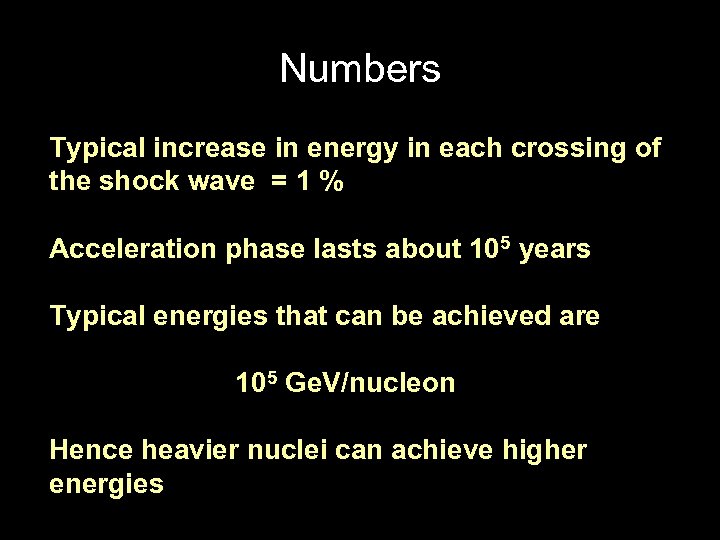 Numbers Typical increase in energy in each crossing of the shock wave = 1 % Acceleration phase lasts about 105 years Typical energies that can be achieved are 105 Ge. V/nucleon Hence heavier nuclei can achieve higher energies
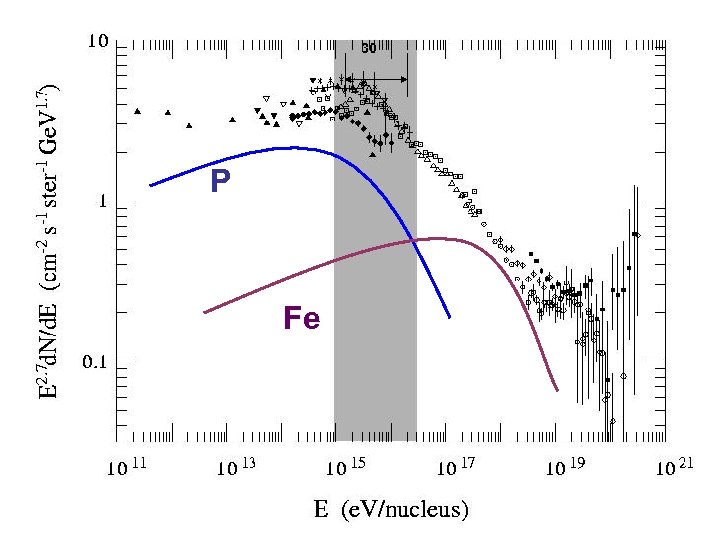 30 P Fe
 Acceleration beyond KNEE Furthermore beyond the KNEE milky way magnetic fields may not be able to confine protons However they can confine heavier nuclei, which may also be accelerated by supernova shock waves Hence the composition becomes heavier beyond the KNEE
 Evidence for supernova acceleration If high energy particles originate at supernova remnants, then we should also observe gamma rays from these sites Gamma rays are produced by interaction with other particles. These gamma rays have been seen and partially confirm the model
 Do supernovae produce enough energy to account for cosmic ray energy? K. E. per supernova 1051 ergs about 3 supernovae per century release energy at rate 1042 ergs per sec in the milky way This is enough to power cosmic rays if 15% goes into these particles
 • At E < 1018. 5 e. V (ankle), the cosmic rays are believed to originate inside the milky way • At E > 1018. 5 e. V, their origin is probably extragalactic, beyond the milky way
 Spectrum KNEE ANKLE
 • At E > 1020 e. V, it is very difficulty to find an astrophysical site which can accelerate particles to such high energies
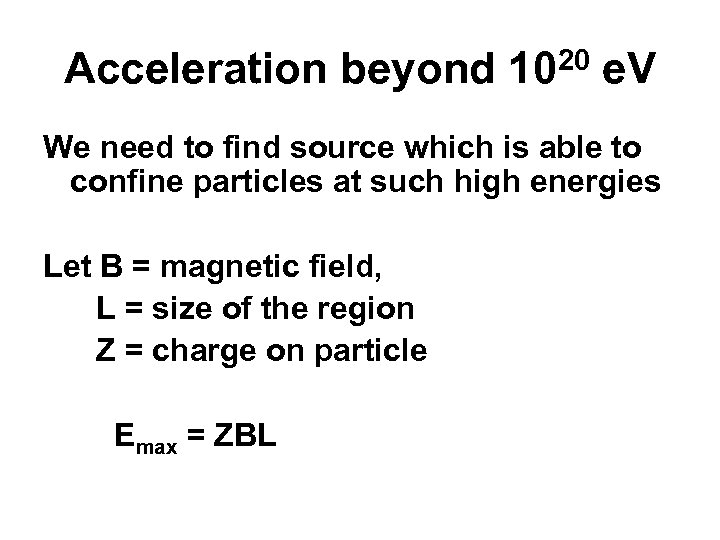 Acceleration beyond 1020 e. V We need to find source which is able to confine particles at such high energies Let B = magnetic field, L = size of the region Z = charge on particle Emax = ZBL
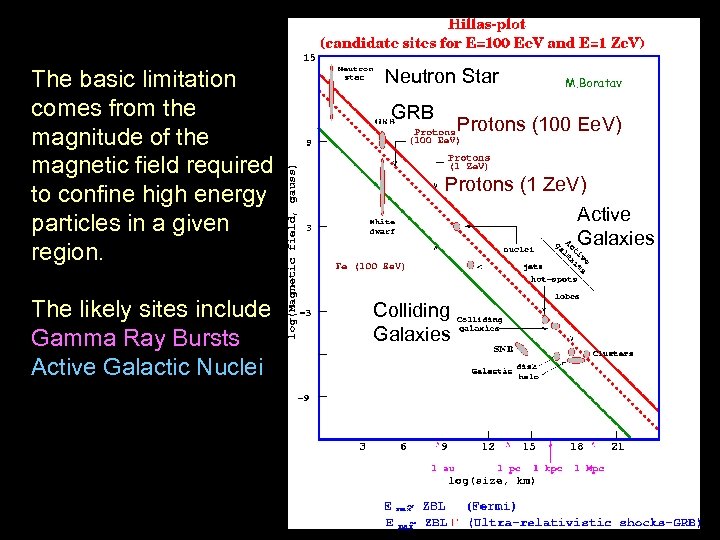 The basic limitation comes from the magnitude of the magnetic field required to confine high energy particles in a given region. The likely sites include Gamma Ray Bursts Active Galactic Nuclei Neutron Star GRB M. Boratav Protons (100 Ee. V) Protons (1 Ze. V) Active Galaxies Colliding Galaxies
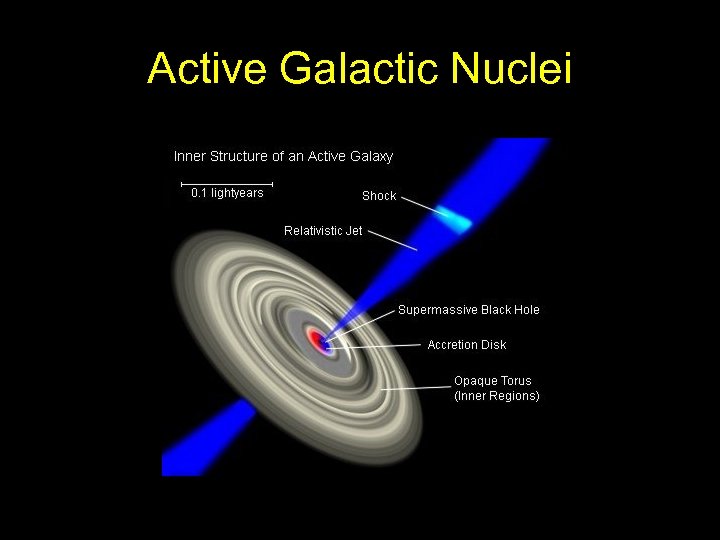 Active Galactic Nuclei
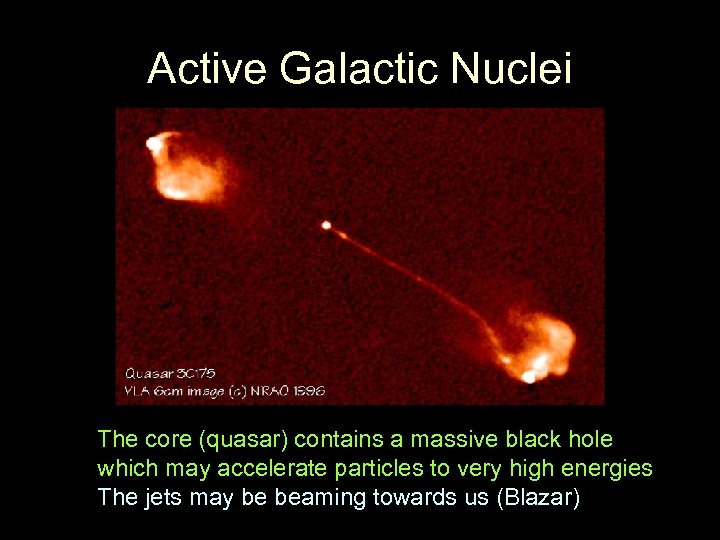 Active Galactic Nuclei The core (quasar) contains a massive black hole which may accelerate particles to very high energies The jets may be beaming towards us (Blazar)
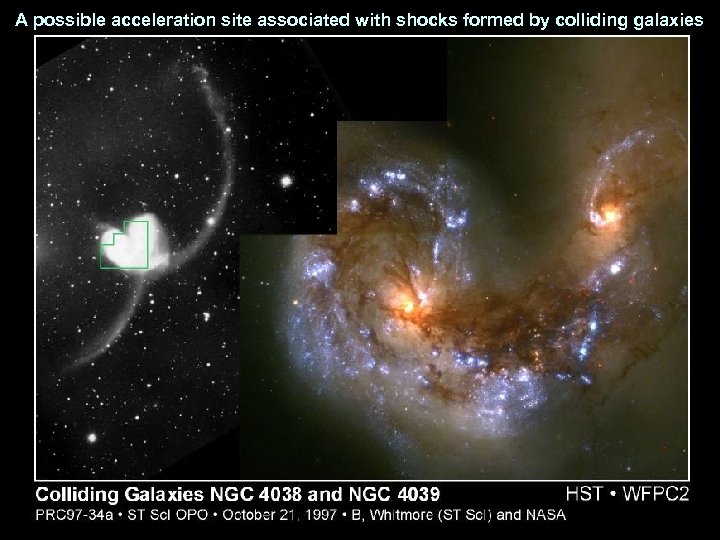 A possible acceleration site associated with shocks formed by colliding galaxies
 Time varying magnetic fields • Some objects such as pulsars have very strong magnetic fields • As the object rotates the magnetic field changes with time • This can create very large electric field which can accelerate particles very quickly • However normally these magnetic fields occur in dense regions, where the particles may also loose considerable energy
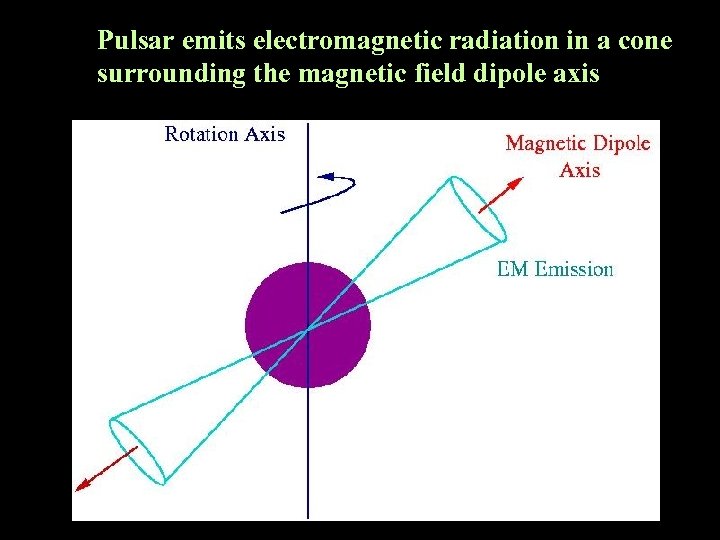 Pulsar emits electromagnetic radiation in a cone surrounding the magnetic field dipole axis
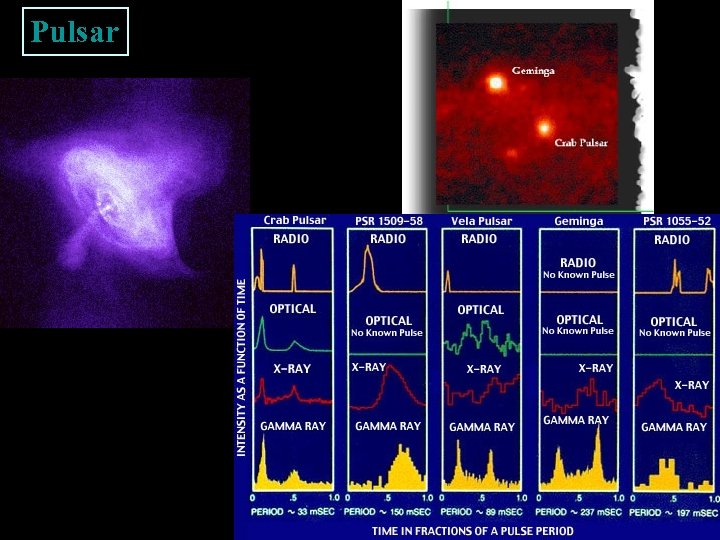 Pulsar
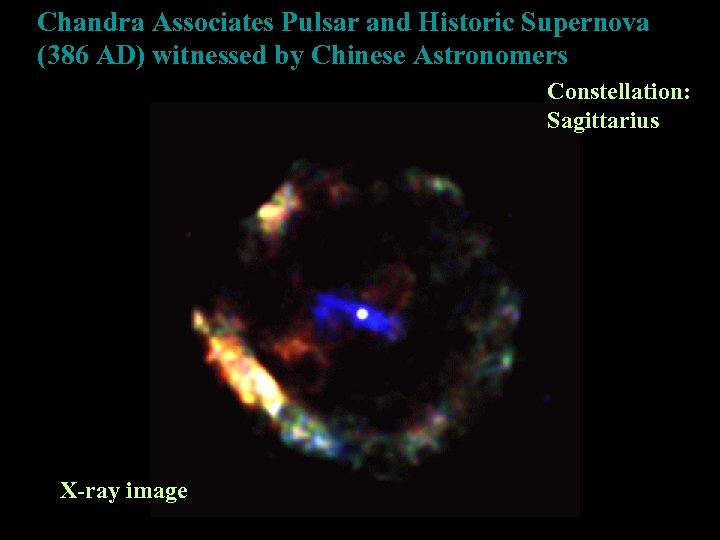 Chandra Associates Pulsar and Historic Supernova (386 AD) witnessed by Chinese Astronomers Constellation: Sagittarius X-ray image
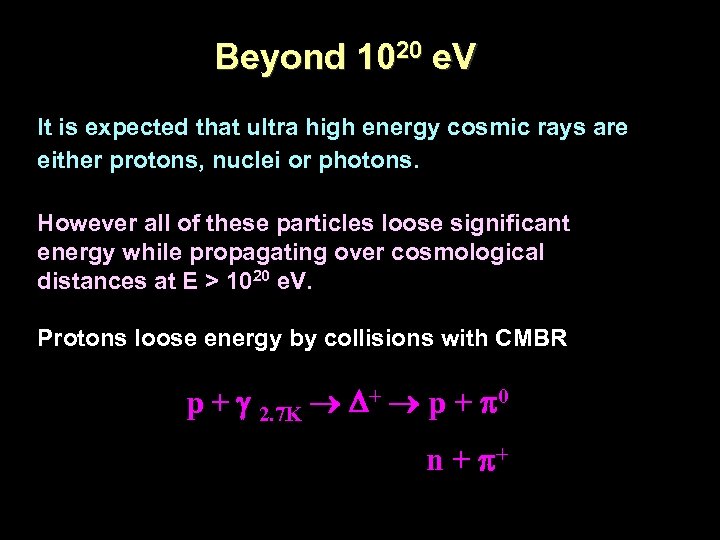 Beyond 1020 e. V It is expected that ultra high energy cosmic rays are either protons, nuclei or photons. However all of these particles loose significant energy while propagating over cosmological distances at E > 1020 e. V. Protons loose energy by collisions with CMBR p + 2. 7 K + p + 0 n + +
 Beyond 1020 e. V Photons (pair production on background photons), Nuclei (photo-disintegration) are also attenuated. Hence either the source of these particles is within 100 Mpc or spectrum should strongly decay at E>1020 e. V (GZK cutoff, Greisen-Zatsepin-Kuzmin, 1966)
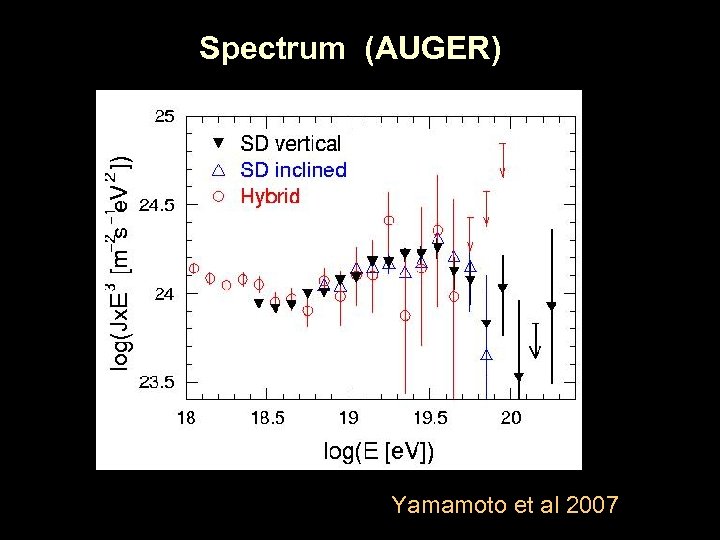 Spectrum (AUGER) Yamamoto et al 2007
 Conclusions Supernova shocks in our galaxy are the most likely sites for acceleration upto 1018 e. V The acceleration probably occurs through first order Fermi mechanism Beyond 1018 e. V, the cosmic rays probably originate outside our galaxy Beyond 1020 e. V, there are very few sites which can accelerate particles to such high energies
 The KNEE Furthermore we should observe an anisotropy in the arrival directions of cosmic rays. This is because we have more supernovas in the center of the galaxy We are located far from the galactic center
 The KNEE The knee, however, cannot be explained easily If the protons cannot be accelerated beyond the KNEE and/or cannot be confined by the galactic magnetic fields, then we might expect an exponential decay. This would later meet a harder spectrum ( =2. 7) due to heavier nucleus, such a Helium …
 The KNEE Hence we should see more cosmic rays from the galactic center in comparison to the opposite direction. Such an anisotropy has not been seen Hence the cause of KNEE is not understood