 Скачать презентацию Accelerating the global effort to create an AIDS
d3d91fecaae4ed60162c6825890f6753.ppt
- Количество слайдов: 39



Accelerating the global effort to create an AIDS vaccine: IP issues for future global public goods products Workshop of Differential Pricing and Financing of Essential Drugs, WHO/WTO Norway Dr. Seth Berkley President & CEO
Global AIDS Goals Ø Short Term: to prevent further spread of the virus, to treat those that are infected and to mitigate the societal consequences of infection Ø Long Term: to create the tools necessary to end the epidemic
Five years ago (circa 1996) Ø Vaccine pipeline limited Ø Little investment in products by public or private Ø Ø sectors (market failure) Little public interest in HIV vaccines No vaccine ever tested for efficacy Limited attention to vaccine issues specific to high incidence countries Few vaccine advocates
Today Ø Pipeline is more robust (depth & breadth) Ø Industry coming back in with shareholder’s resources Ø First vaccine efficacy testing about to be completed Ø Enhanced efforts by public sector institutions u NIH, EC, WRAIR, ANRS, UNAIDS/WHO Ø New Players & models u VRC, Waterford Project, IAVI Ø Political leadership is clearly stronger
Different Challenges in 2001 Ø Consolidate gains in pipeline (assure breadth and depth of approaches) u Solve neutralizing antibody problem Ø Focus on critical needs of high incidence countries Ø Assure access policies, delivery systems and adequate manufacturing are/will be in place Ø Provide incentives for further pharmaceutical company investments and protect their primary markets Ø Speed matters with HIV— 10 new infections a minute therefore: Speed, Speed…
IAVI’s New Vision - requires dual commitment Private Sector Responsibilities - Supply life-saving patented drugs & vaccines to the very poor at cost plus (immediately); differential pricing for other groups based upon ability to pay Public Sector Responsibilities – Protect primary markets, protect IP, assure no parallel trade back to OECD, finance R&D for products with poor commercial potential, provide finance & distribution systems for getting these products to those who need them, help with industrial scale up if necessary
IAVI’s mission is to ensure the development of safe, effective, accessible, preventive HIV vaccines for use throughout the world.
IAVI’s Four Strategies Ø Build worldwide demand & support for HIV vaccines Ø Push: Accelerate scientific progress Ø Pull: Create incentives for industrial involvement & investment Ø Create the policies necessary for assuring global access
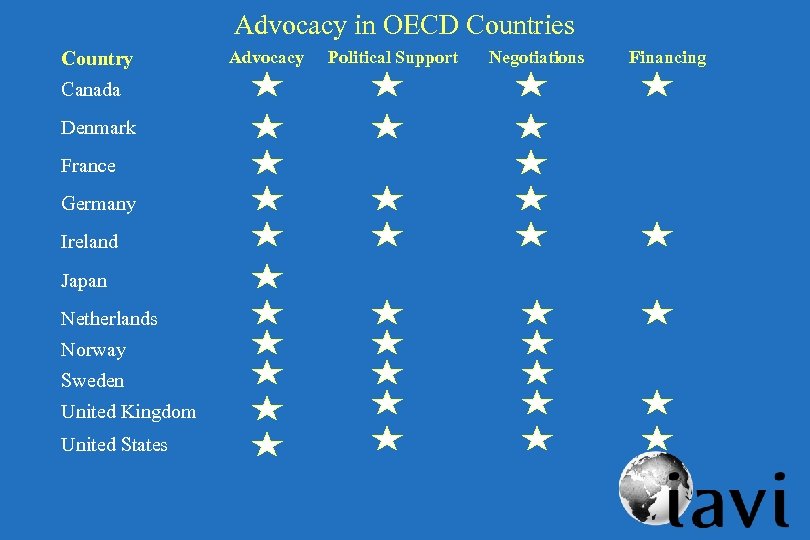
Advocacy in OECD Countries Country Canada Denmark France Germany Ireland Japan Netherlands Norway Sweden United Kingdom United States Advocacy Political Support Negotiations Financing
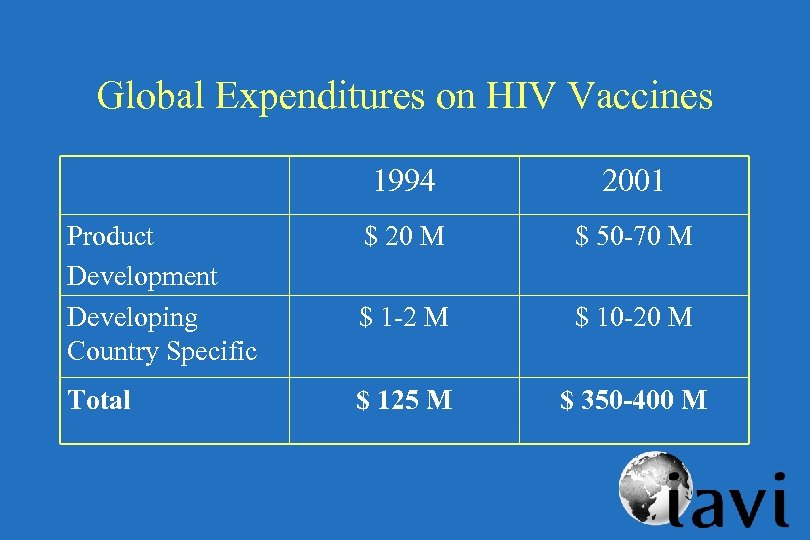
Global Expenditures on HIV Vaccines 1994 Product Development Developing Country Specific Total 2001 $ 20 M $ 50 -70 M $ 1 -2 M $ 10 -20 M $ 125 M $ 350 -400 M
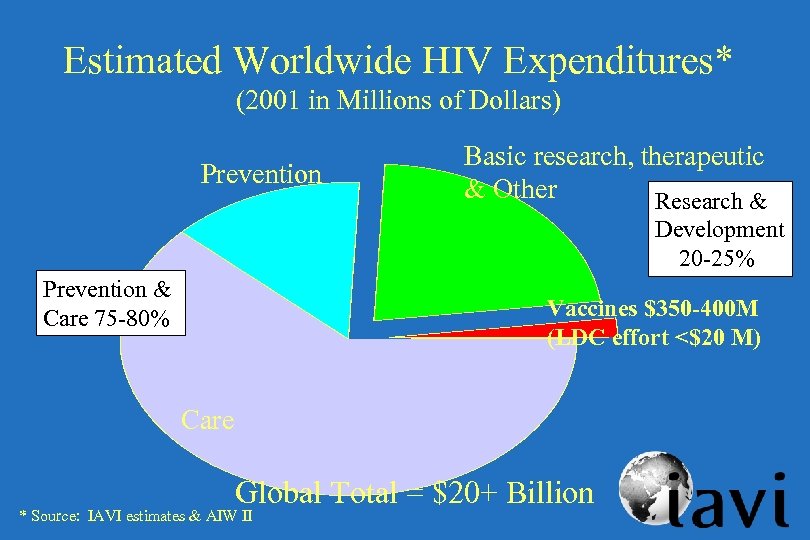
Estimated Worldwide HIV Expenditures* (2001 in Millions of Dollars) Prevention Basic research, therapeutic & Other Research & Development 20 -25% Prevention & Care 75 -80% Vaccines $350 -400 M (LDC effort <$20 M) Care Global Total = $20+ Billion * Source: IAVI estimates & AIW II
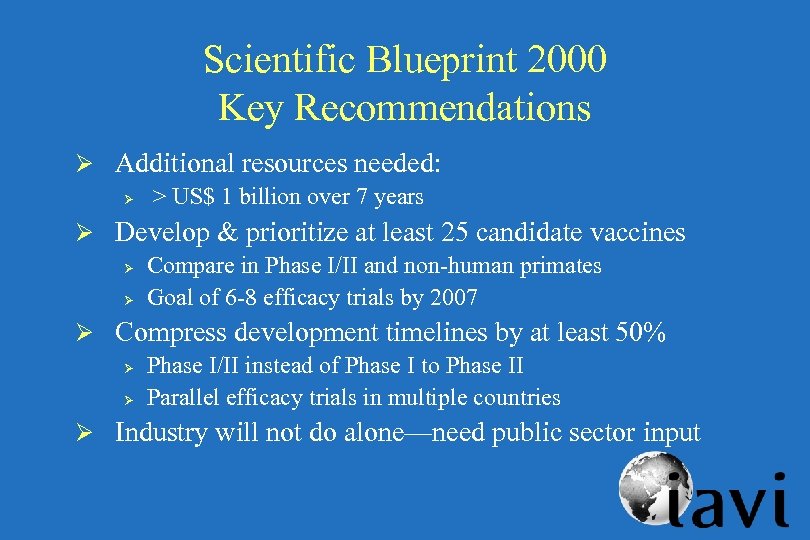
Scientific Blueprint 2000 Key Recommendations Ø Additional resources needed: Ø > US$ 1 billion over 7 years Ø Develop & prioritize at least 25 candidate vaccines Ø Compare in Phase I/II and non-human primates Ø Goal of 6 -8 efficacy trials by 2007 Ø Compress development timelines by at least 50% Ø Phase I/II instead of Phase I to Phase II Ø Parallel efficacy trials in multiple countries Ø Industry will not do alone—need public sector input
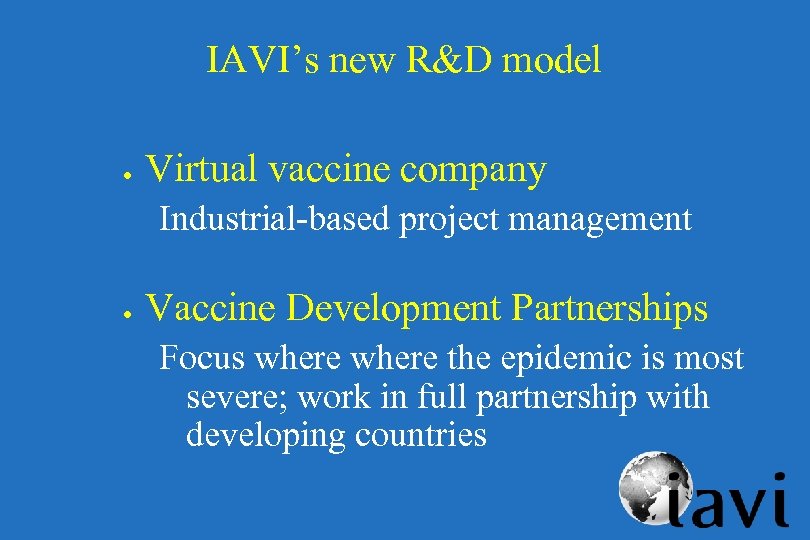
IAVI’s new R&D model · Virtual vaccine company Industrial-based project management · Vaccine Development Partnerships Focus where the epidemic is most severe; work in full partnership with developing countries
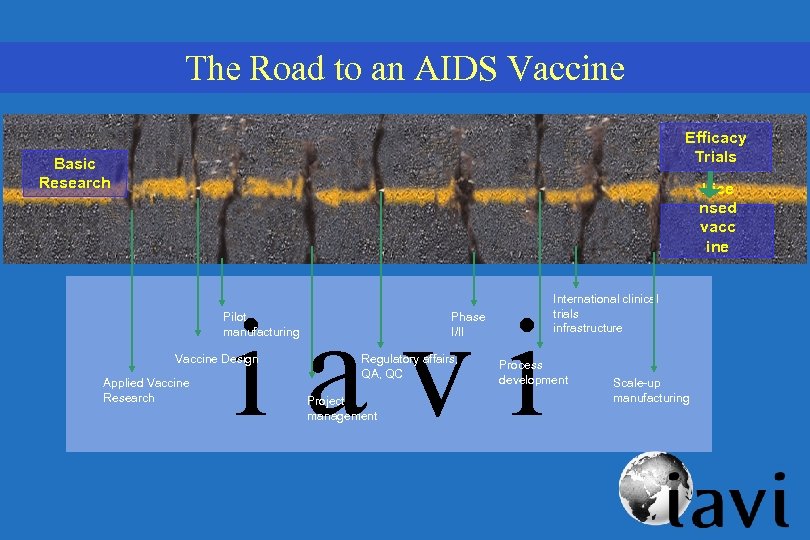
The Road to an AIDS Vaccine Efficacy Trials Basic Research Lice nsed vacc ine iavi Pilot manufacturing Vaccine Design Applied Vaccine Research Phase I/II Regulatory affairs, QA, QC Project management International clinical trials infrastructure Process development Scale-up manufacturing
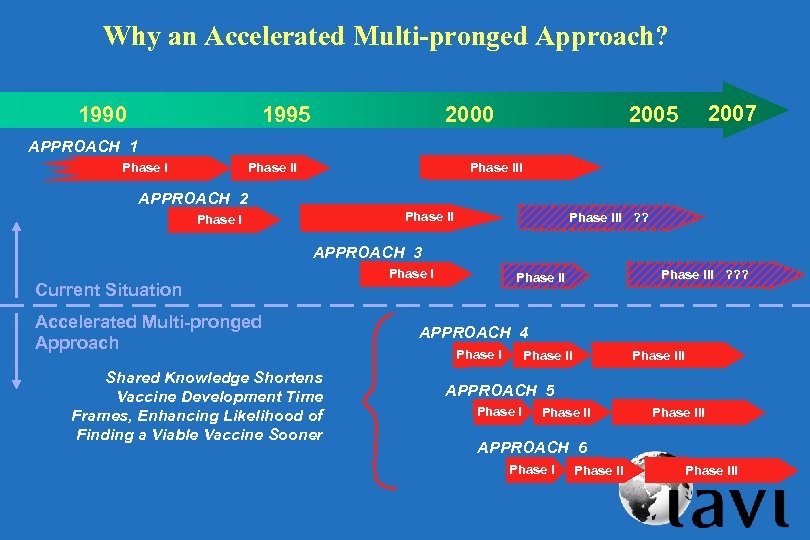
Why an Accelerated Multi-pronged Approach? 1990 1995 2000 2007 2005 APPROACH 1 Phase III APPROACH 2 Phase III ? ? APPROACH 3 Current Situation Accelerated Multi-pronged Approach Shared Knowledge Shortens Vaccine Development Time Frames, Enhancing Likelihood of Finding a Viable Vaccine Sooner Phase III ? ? ? Phase II APPROACH 4 Phase III APPROACH 5 Phase III APPROACH 6 Phase III
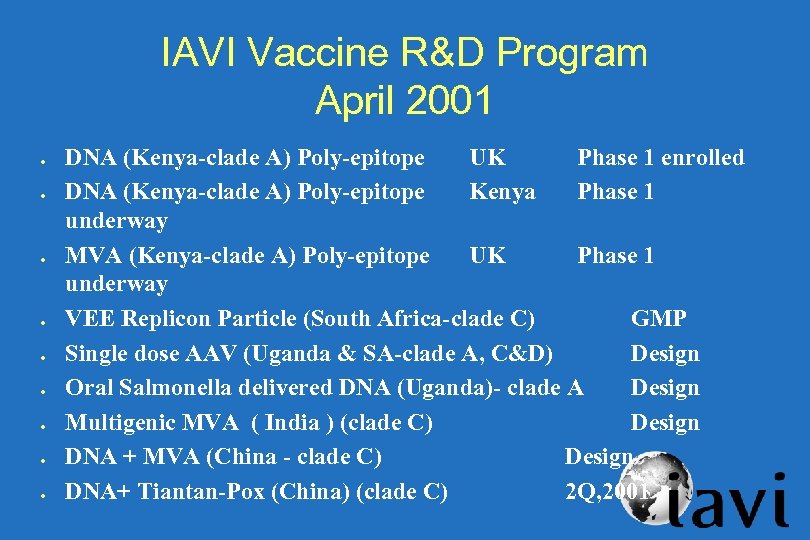
IAVI Vaccine R&D Program April 2001 · · · · · DNA (Kenya-clade A) Poly-epitope UK Phase 1 enrolled DNA (Kenya-clade A) Poly-epitope Kenya Phase 1 underway MVA (Kenya-clade A) Poly-epitope UK Phase 1 underway VEE Replicon Particle (South Africa-clade C) GMP Single dose AAV (Uganda & SA-clade A, C&D) Design Oral Salmonella delivered DNA (Uganda)- clade A Design Multigenic MVA ( India ) (clade C) Design DNA + MVA (China - clade C) Design DNA+ Tiantan-Pox (China) (clade C) 2 Q, 2001
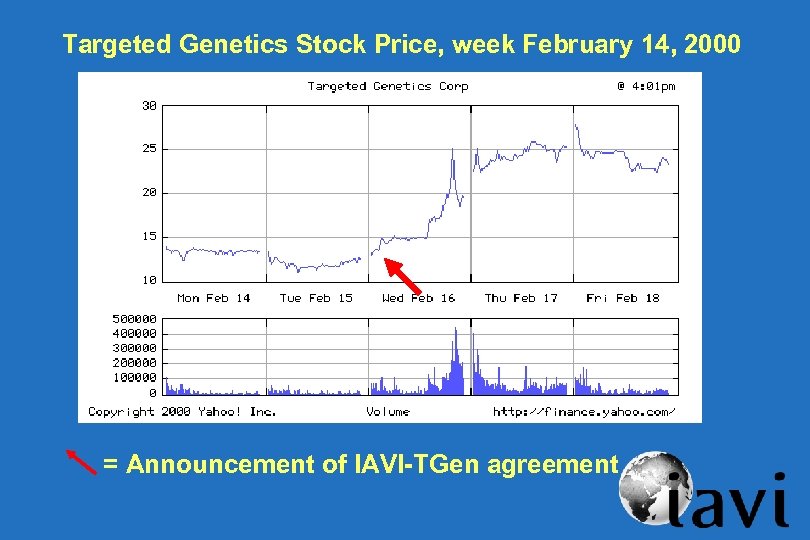
Targeted Genetics Stock Price, week February 14, 2000 = Announcement of IAVI-TGen agreement
IAVI Intellectual Property Negotiating Strategy Ø Critical that both sides have needs met ü Company: IP rights remain with the company & they have the freedom to operate in profitable markets ü Philanthropic: If company does not make vaccine available to poorest populations in reasonable quantity and at reasonable cost, IAVI has the right to make other arrangements for vaccine manufacture
Social Venture Capital Ø Use significant public sector investments to negotiate an Intellectual Property position. Use this IP position to ensure access rather than profit u Do not dilute equity or IP position Ø Work with companies using all of our resources (as a VC would) to ensure their success and therefore ensure a win-win strategy
Narrow request Ø R. O. W. : Markets of no or little interest. Ones which Ø Ø they would not serve during peak patent monopoly position anyway Non-exclusive & geographically restricted Only marching if doesn’t supply “reasonable” quantity, speed and price Only HIV vaccines, and only for public sector of LDCs Flexible—industry can define terms
Advantages for companies Ø Test platform technologies Ø Freedom to operate in primary, commercially attractive Ø Ø markets IAVI assistance (where appropriate) with product development, testing, regulatory submissions as well as fund raising, management, etc. Remove controversy as to supply of the poor IAVI acts as honest broker Good PR
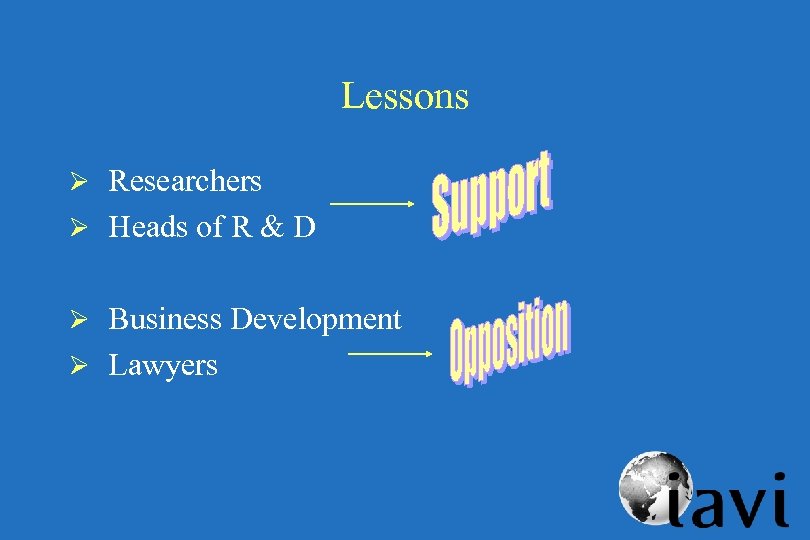
Lessons Ø Researchers Ø Heads of R & D Ø Business Development Ø Lawyers
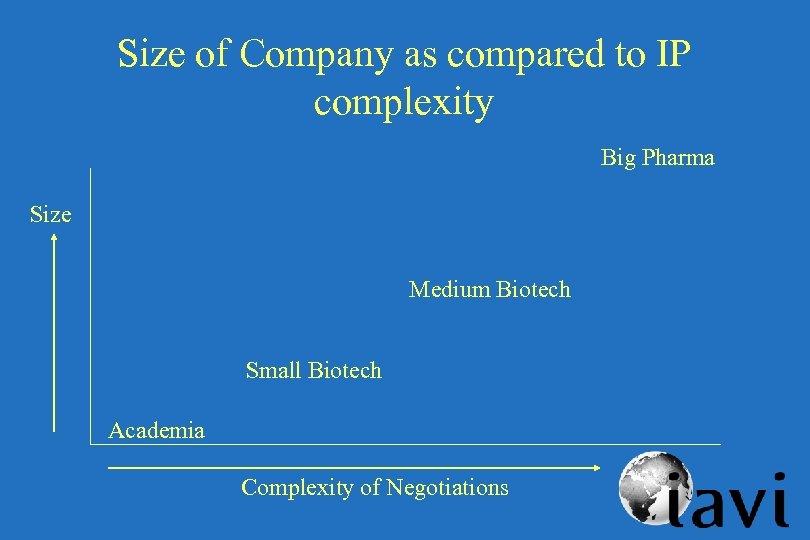
Size of Company as compared to IP complexity Big Pharma Size Medium Biotech Small Biotech Academia Complexity of Negotiations
Potential models for supplying the poor Ø Company produces globally; price tiering Ø Company produces globally; bulk packaging for South Ø Company produces for OECD; joint venture for LDC provision Ø Company produces for OECD; IP for LDCs stays in trust and is produced through contract manufacturing/technology transfers Ø Regardless, political acceptance of price tiering, quality and no IP leakage is critical to success
Create incentives for Industrial Investment Ø Active dialogue with the vaccine industry Ø Policy program including political support for strongly tiered pricing Ø Create credible market in developing countries through vaccine purchase funds Ensure availability u Increase profits/reduce cost of manufacturing u Remove controversies related to supply for the poor u
Create incentives for Industrial Investment II Ø Reduce R & D costs by directly financing research & preparing for clinical testing Ø Target other areas of concern to industry such as regulatory simplicity & liability Ø Tax credits and sales incentives Ø Active collaborative program working with World Bank, EC & individual OECD Governments
Why Now? Still years before having a licensed vaccine… ü Extraordinary complex planning required if we are to create new paradigm of N/S parallel introduction ü Production capacity & scale up decisions have long lead time ü Novel delivery systems required ü Moral, Political & Ethical dilemmas will need to be tackled ü Lessons for other problems; sides less entrenched
Access Action Plan I Ø Effective pricing and global financing mechanisms to assure prompt use where they are needed. u u Develop tiered pricing structure that enhances access by permitting poorer countries to pay what they can afford whilst permitting companies a satisfactory return on investment. Create purchase and delivery mechanisms within OECD nations with immediate credible financial commitments
Features of Financing Mechanisms Ø Level of financing adequate to the need Ø Ø >$1 B/year Choice for countries to allow mix & match instruments Incentives for early adoption of vaccine Efficiency & credibility Transparency and accountability
Financing options Ø Grant fund (like GFCV) Ø Leveraged grant financing (use grant funds to pay off World Bank IDA credit or use grant funds to subsidize IBRD rates) Ø Enhanced loan financing with some grant component Ø ALL should include purchase and distribution
Access Action Plan II Ø Mechanisms must be developed to make reliable estimates of demand for specific vaccines and to ensure timely creation of production capacity to permit accelerated worldwide access WHO/UNAIDS – IAVI process underway u World Bank – EC effort u
Access Action Plan III Ø Appropriate delivery systems, policies, and procedures must be developed for vaccination of adolescents, sexually active adults, and other atrisk populations u e. g. Hepatitis B
Access Action Plan IV Ø Harmonize national regulations and international guidelines governing vaccine approval and use Ø Demonstrate to industry global commitment to effective worldwide deployment by maximizing use of one or more currently underutilized non. HIV vaccines working with GAVI
IAVI’s Special Characteristics Ø Mandate: Laser focus on preventive HIV vaccines Ø Customer focus: Global put particularly developing Ø Ø Ø Ø countries Mechanism: Public-private partnerships; willing to use any instrument Management: Industrial style project management Critical goal: speed Rewards: Access rather than profit: social venture capital Engagement: Full developing country involvement Style: Full integration of communications/science Financing: Push and pull; public and private Access: Solve before licensure
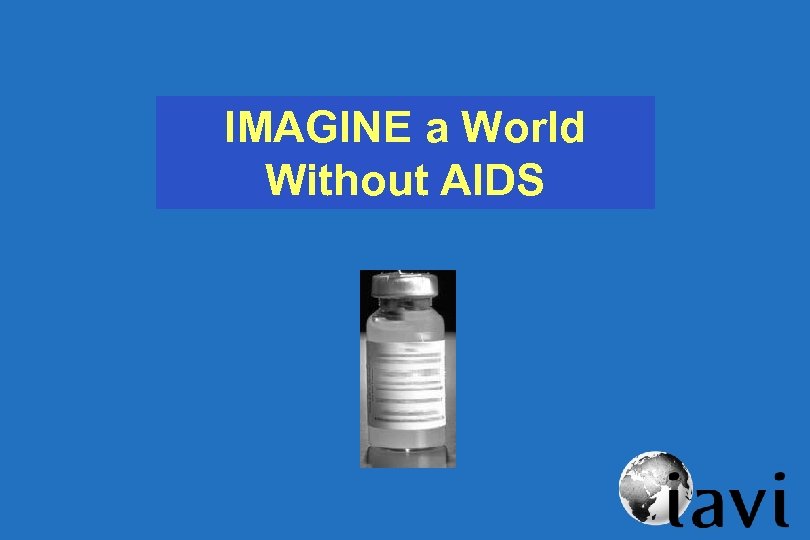
IMAGINE a World Without AIDS
Скачать презентацию Accelerating the global effort to create an AIDS
d3d91fecaae4ed60162c6825890f6753.ppt