 Скачать презентацию Academy of Economic Studies Faculty of International Business
f830ffd98d86b0ce5940106d4c0cd5c9.ppt
- Количество слайдов: 31



Academy of Economic Studies Faculty of International Business and Economics “International Finance and Payments” Lecture VI “International FX Markets” Lect. Cristian PĂUN Email: cpaun@ase. ro URL: http: //www. finint. ase. ro Lecture 6: International FX Markets
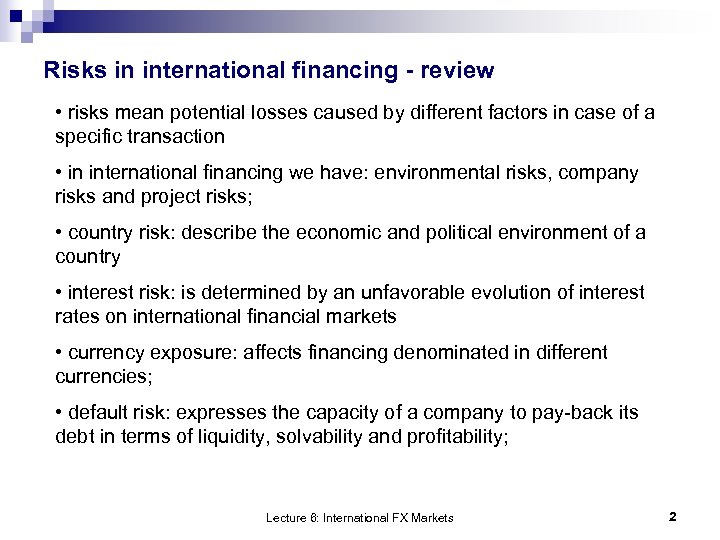
Risks in international financing - review • risks mean potential losses caused by different factors in case of a specific transaction • in international financing we have: environmental risks, company risks and project risks; • country risk: describe the economic and political environment of a country • interest risk: is determined by an unfavorable evolution of interest rates on international financial markets • currency exposure: affects financing denominated in different currencies; • default risk: expresses the capacity of a company to pay-back its debt in terms of liquidity, solvability and profitability; Lecture 6: International FX Markets 2
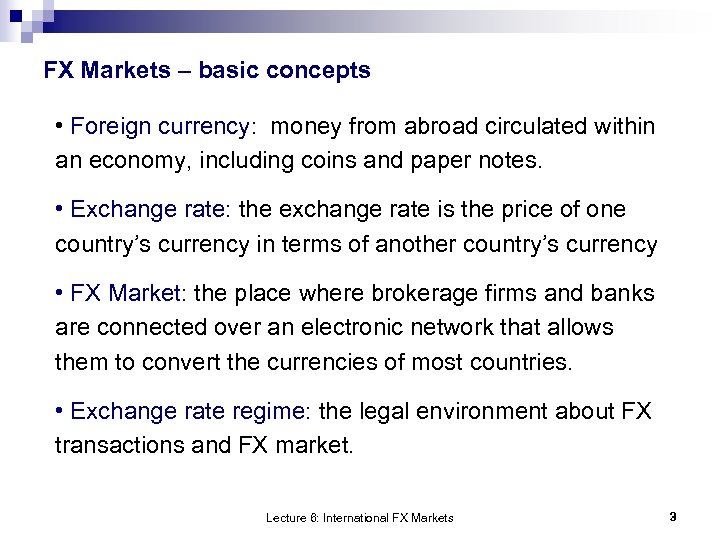
FX Markets – basic concepts • Foreign currency: money from abroad circulated within an economy, including coins and paper notes. • Exchange rate: the exchange rate is the price of one country’s currency in terms of another country’s currency • FX Market: the place where brokerage firms and banks are connected over an electronic network that allows them to convert the currencies of most countries. • Exchange rate regime: the legal environment about FX transactions and FX market. Lecture 6: International FX Markets 3
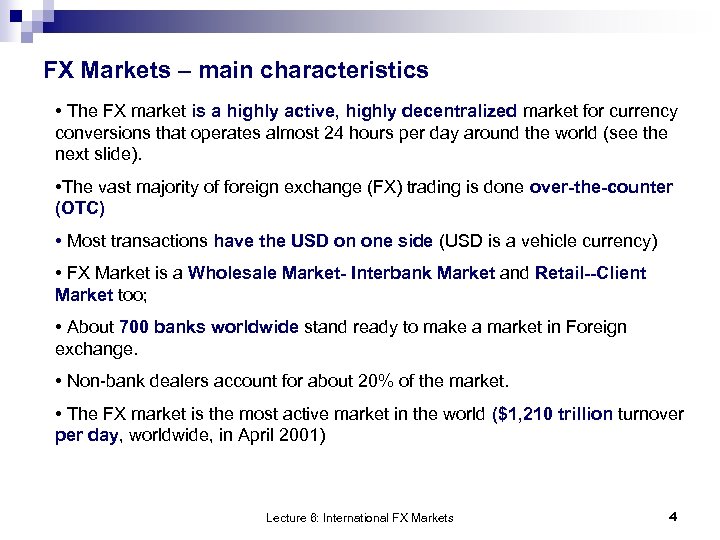
FX Markets – main characteristics • The FX market is a highly active, highly decentralized market for currency conversions that operates almost 24 hours per day around the world (see the next slide). • The vast majority of foreign exchange (FX) trading is done over-the-counter (OTC) • Most transactions have the USD on one side (USD is a vehicle currency) • FX Market is a Wholesale Market- Interbank Market and Retail--Client Market too; • About 700 banks worldwide stand ready to make a market in Foreign exchange. • Non-bank dealers account for about 20% of the market. • The FX market is the most active market in the world ($1, 210 trillion turnover per day, worldwide, in April 2001) Lecture 6: International FX Markets 4
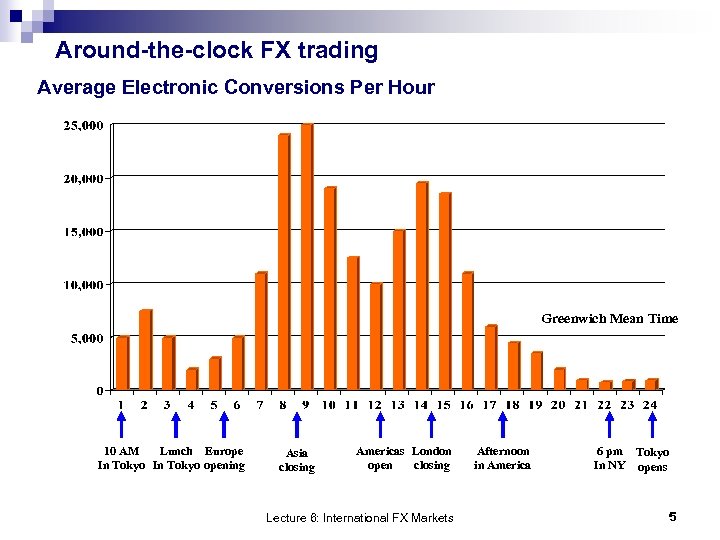
Around-the-clock FX trading Average Electronic Conversions Per Hour Greenwich Mean Time 10 AM Lunch Europe In Tokyo opening Asia closing Americas London open closing Lecture 6: International FX Markets Afternoon in America 6 pm Tokyo In NY opens 5
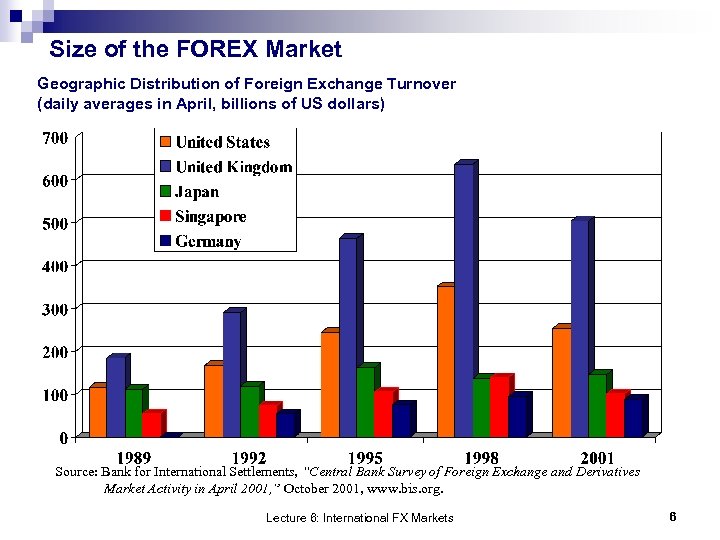
Size of the FOREX Market Geographic Distribution of Foreign Exchange Turnover (daily averages in April, billions of US dollars) Source: Bank for International Settlements, “Central Bank Survey of Foreign Exchange and Derivatives Market Activity in April 2001, ” October 2001, www. bis. org. Lecture 6: International FX Markets 6
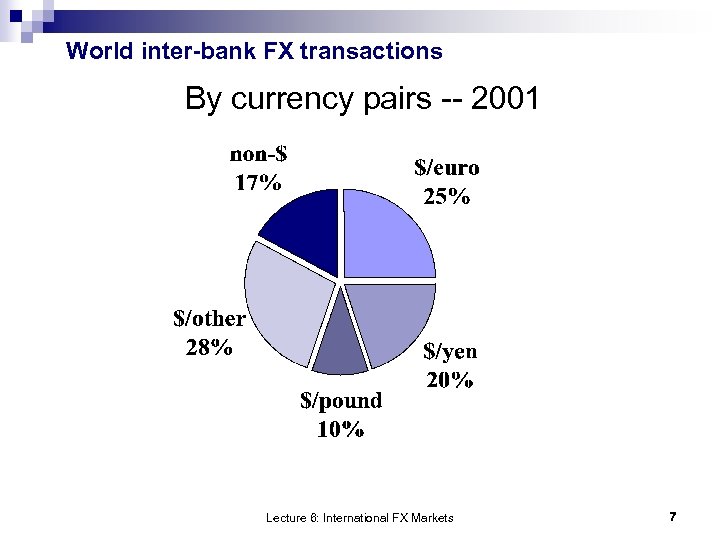
World inter-bank FX transactions By currency pairs -- 2001 Lecture 6: International FX Markets 7
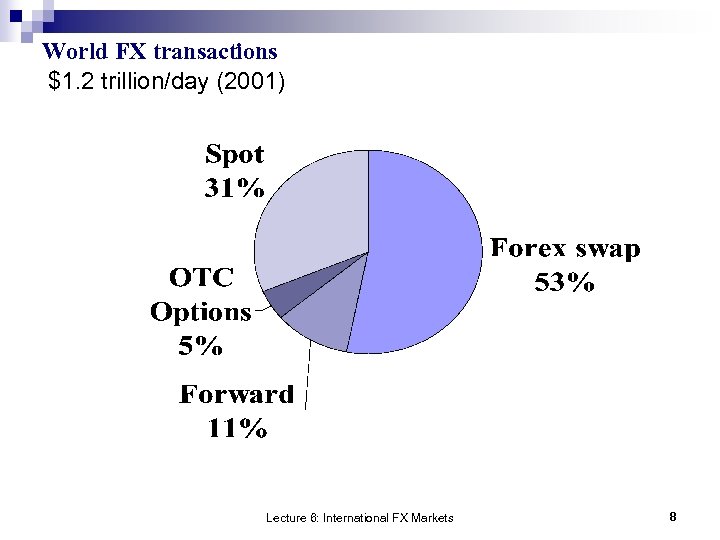
World FX transactions $1. 2 trillion/day (2001) Lecture 6: International FX Markets 8
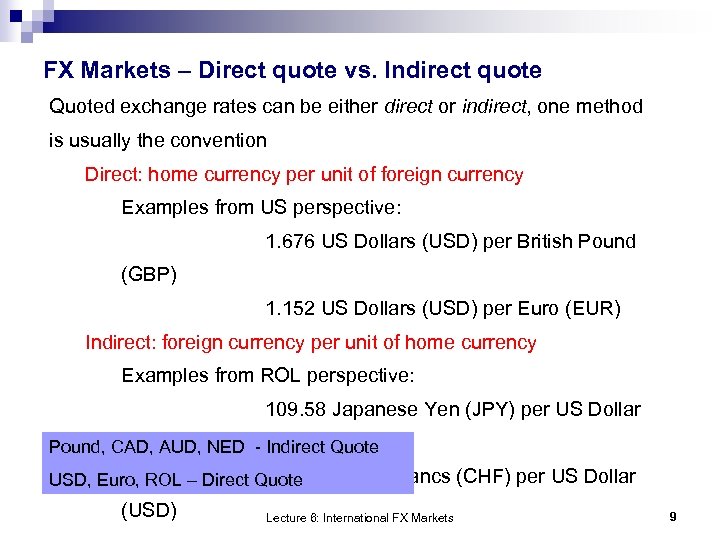
FX Markets – Direct quote vs. Indirect quote Quoted exchange rates can be either direct or indirect, one method is usually the convention Direct: home currency per unit of foreign currency Examples from US perspective: 1. 676 US Dollars (USD) per British Pound (GBP) 1. 152 US Dollars (USD) per Euro (EUR) Indirect: foreign currency per unit of home currency Examples from ROL perspective: 109. 58 Japanese Yen (JPY) per US Dollar (USD) Pound, CAD, AUD, NED - Indirect Quote 1. 3664 Swiss Francs (CHF) per US Dollar USD, Euro, ROL – Direct Quote (USD) Lecture 6: International FX Markets 9
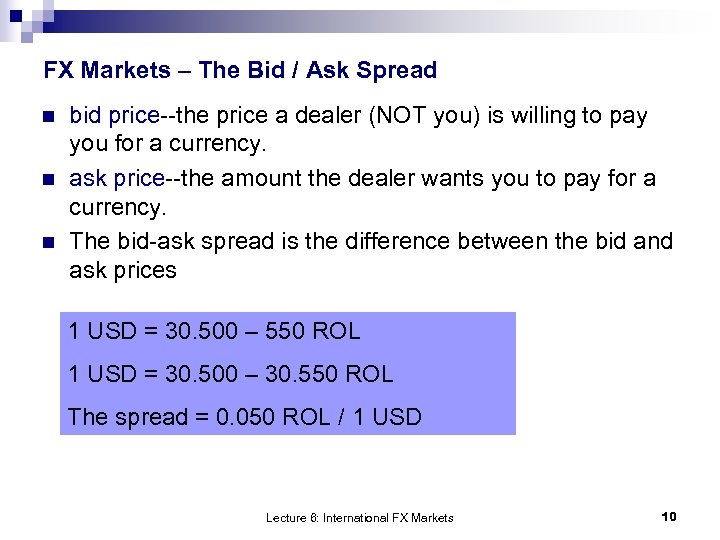
FX Markets – The Bid / Ask Spread n n n bid price--the price a dealer (NOT you) is willing to pay you for a currency. ask price--the amount the dealer wants you to pay for a currency. The bid-ask spread is the difference between the bid and ask prices 1 USD = 30. 500 – 550 ROL 1 USD = 30. 500 – 30. 550 ROL The spread = 0. 050 ROL / 1 USD Lecture 6: International FX Markets 10
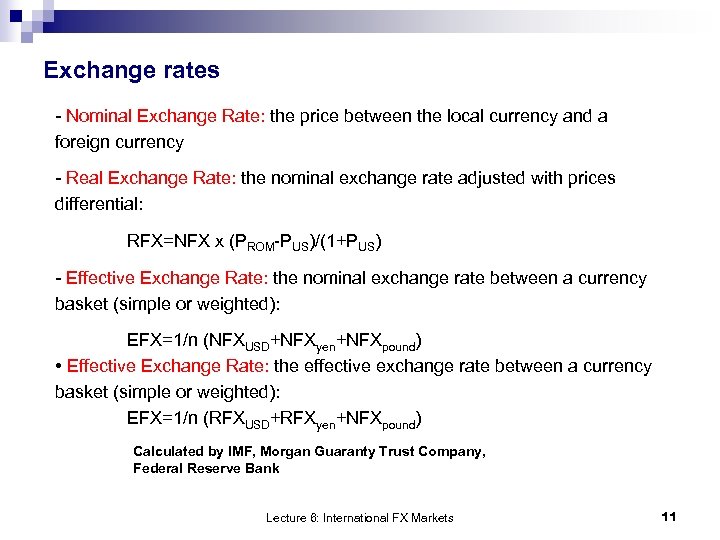
Exchange rates - Nominal Exchange Rate: the price between the local currency and a foreign currency - Real Exchange Rate: the nominal exchange rate adjusted with prices differential: RFX=NFX x (PROM-PUS)/(1+PUS) - Effective Exchange Rate: the nominal exchange rate between a currency basket (simple or weighted): EFX=1/n (NFXUSD+NFXyen+NFXpound) • Effective Exchange Rate: the effective exchange rate between a currency basket (simple or weighted): EFX=1/n (RFXUSD+RFXyen+NFXpound) Calculated by IMF, Morgan Guaranty Trust Company, Federal Reserve Bank Lecture 6: International FX Markets 11
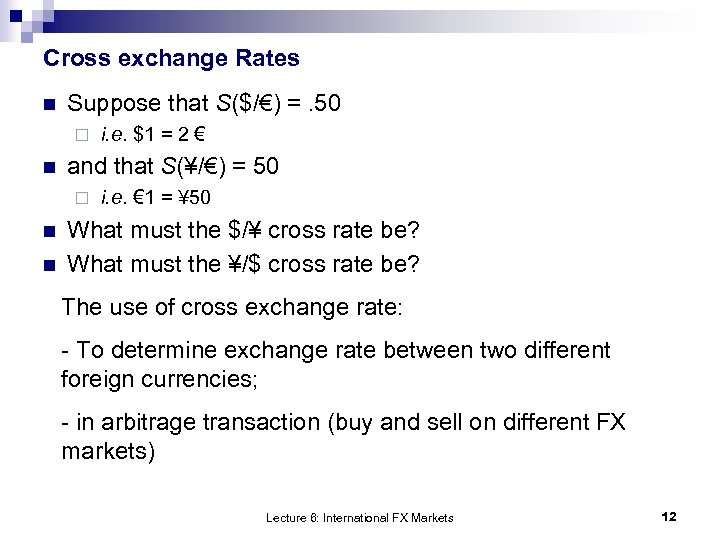
Cross exchange Rates n Suppose that S($/€) =. 50 ¨ n and that S(¥/€) = 50 ¨ n n i. e. $1 = 2 € i. e. € 1 = ¥ 50 What must the $/¥ cross rate be? What must the ¥/$ cross rate be? The use of cross exchange rate: - To determine exchange rate between two different foreign currencies; - in arbitrage transaction (buy and sell on different FX markets) Lecture 6: International FX Markets 12
Depreciation and Appreciation of a currency n A depreciation of the local currency means that it takes more local currency to buy a unit of foreign currency An appreciation of the local currency is the opposite Example: ¨ If the $/€ exchange rate goes up from 1. 20 to 1. 30 the dollar has depreciated against the euro ¨ but, the euro has appreciated against the dollar. ¨ The relationship between depreciation of local currency and export development !!! Valuation / Devaluation of a currency -When a government interviews on FX market to manage (to fix) the exchange rate at a specific level (value) - Specific in the case of fixed exchange regimes Lecture 6: International FX Markets 13
Currency regimes n n n Define the regulations related to the FX Rate mechanism (Central Bank intervention on FX Market, official exchange rate, exchange rate control) Fixed Exchange Regime Hybrid Exchange Regimes n n n n Dirty Float or Managed Float Fixed Band Crawling Band Fixed Peg Crawling Peg Currency Board. Free Floating Exchange Regimes Lecture 6: International FX Markets 14
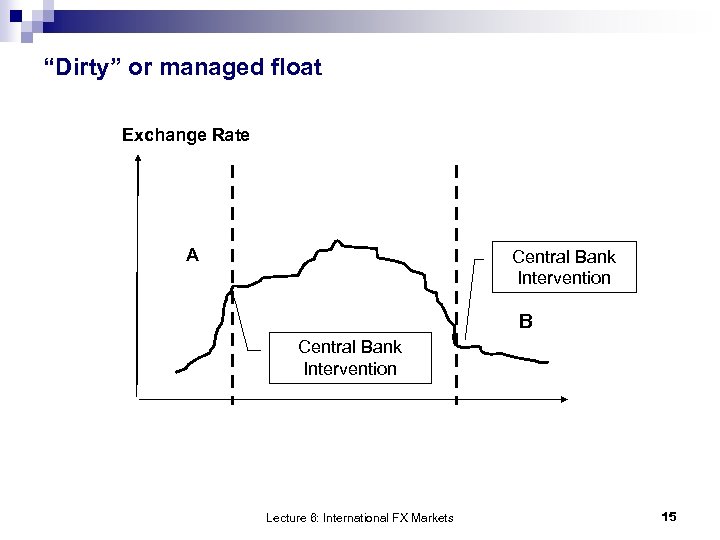
“Dirty” or managed float Exchange Rate A Central Bank Intervention B Central Bank Intervention Lecture 6: International FX Markets 15
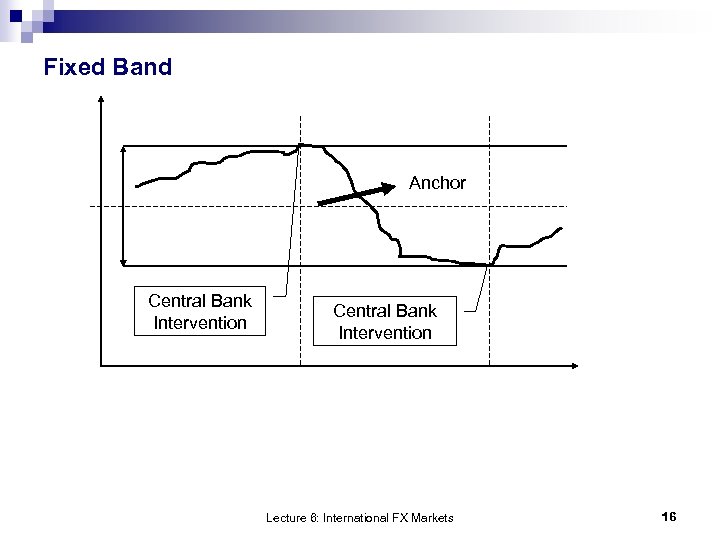
Fixed Band Anchor Central Bank Intervention Lecture 6: International FX Markets 16
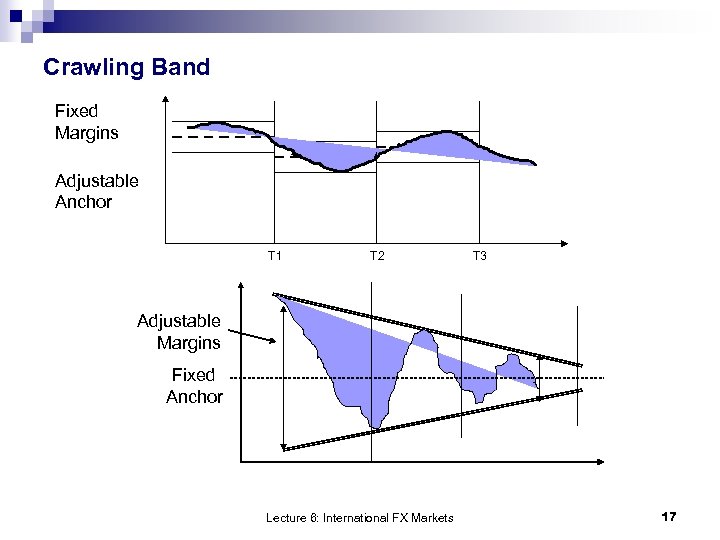
Crawling Band Fixed Margins Adjustable Anchor T 1 T 2 T 3 Adjustable Margins Fixed Anchor Lecture 6: International FX Markets 17
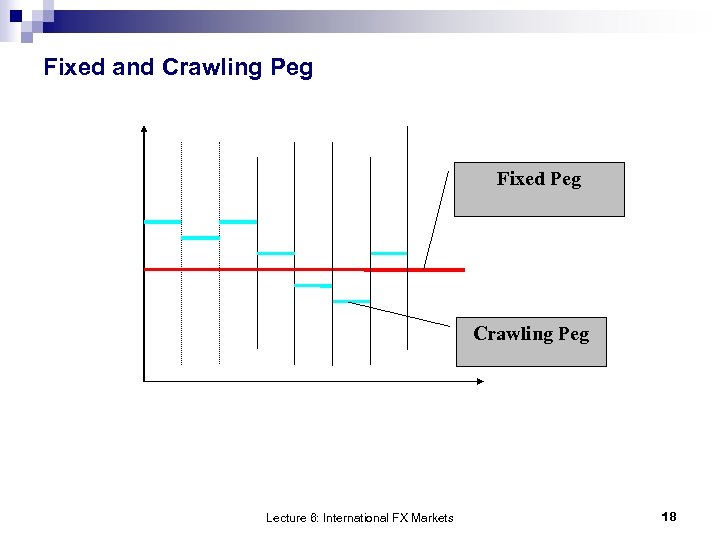
Fixed and Crawling Peg Fixed Peg Crawling Peg Lecture 6: International FX Markets 18
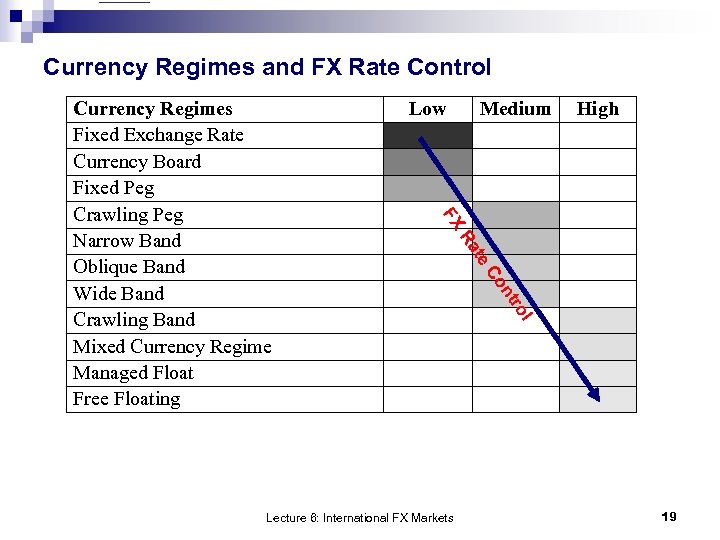
Currency Regimes and FX Rate Control Low Medium High FX te l ro nt Co Lecture 6: International FX Markets Ra Currency Regimes Fixed Exchange Rate Currency Board Fixed Peg Crawling Peg Narrow Band Oblique Band Wide Band Crawling Band Mixed Currency Regime Managed Float Free Floating 19
Convertibility of a currency n n Full convertible currency: no restrictions in terms of transactions volume, capital transfers and FX Market access for residents and nonresidents; Partial convertible currency: ¨ Current Account Convertibility ¨ Capital Account Convertibility n No Convertibility: FX Market is very restrictive Lecture 6: International FX Markets 20
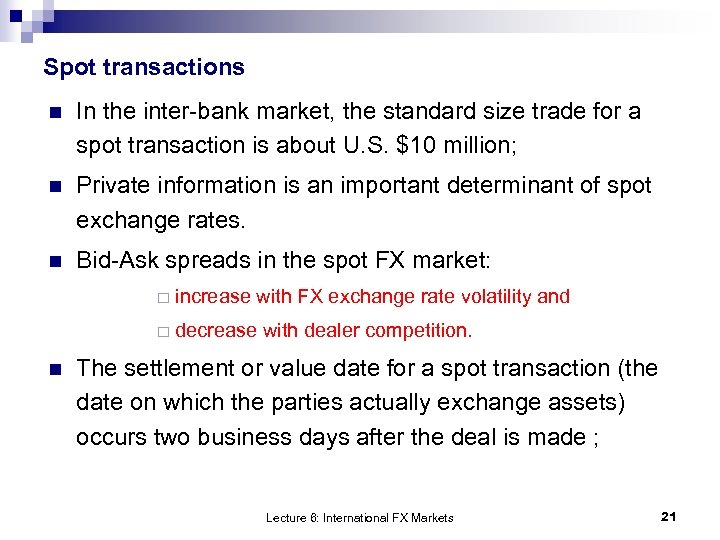
Spot transactions n In the inter-bank market, the standard size trade for a spot transaction is about U. S. $10 million; n Private information is an important determinant of spot exchange rates. n Bid-Ask spreads in the spot FX market: ¨ ¨ n increase with FX exchange rate volatility and decrease with dealer competition. The settlement or value date for a spot transaction (the date on which the parties actually exchange assets) occurs two business days after the deal is made ; Lecture 6: International FX Markets 21
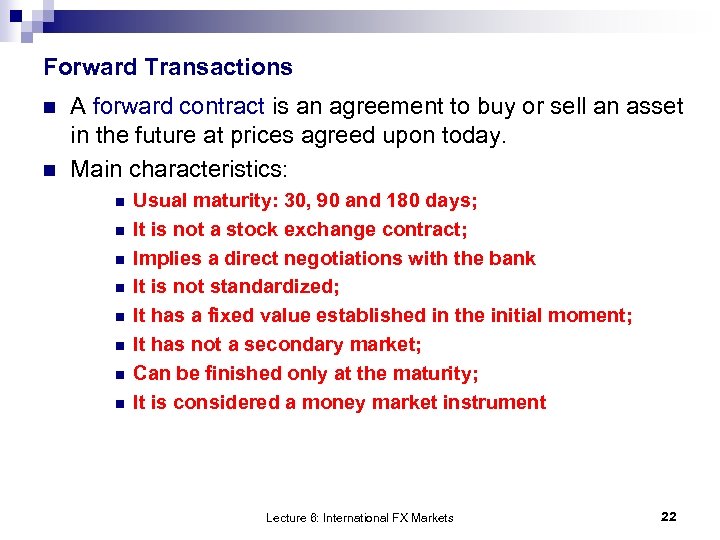
Forward Transactions n n A forward contract is an agreement to buy or sell an asset in the future at prices agreed upon today. Main characteristics: n n n n Usual maturity: 30, 90 and 180 days; It is not a stock exchange contract; Implies a direct negotiations with the bank It is not standardized; It has a fixed value established in the initial moment; It has not a secondary market; Can be finished only at the maturity; It is considered a money market instrument Lecture 6: International FX Markets 22
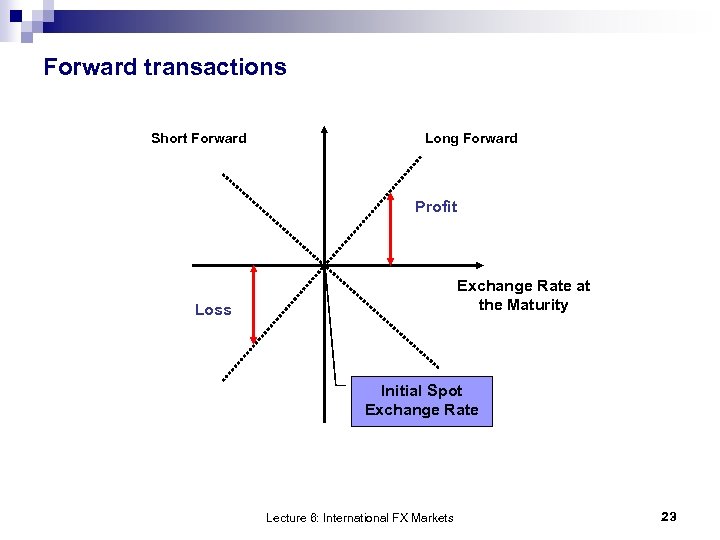
Forward transactions Short Forward Long Forward Profit Exchange Rate at the Maturity Loss Initial Spot Exchange Rate Lecture 6: International FX Markets 23
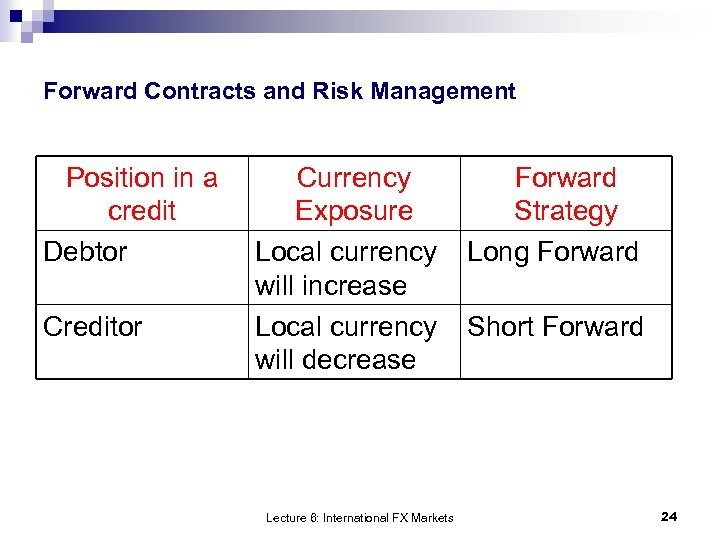
Forward Contracts and Risk Management Position in a credit Debtor Creditor Currency Exposure Local currency will increase Local currency will decrease Lecture 6: International FX Markets Forward Strategy Long Forward Short Forward 24
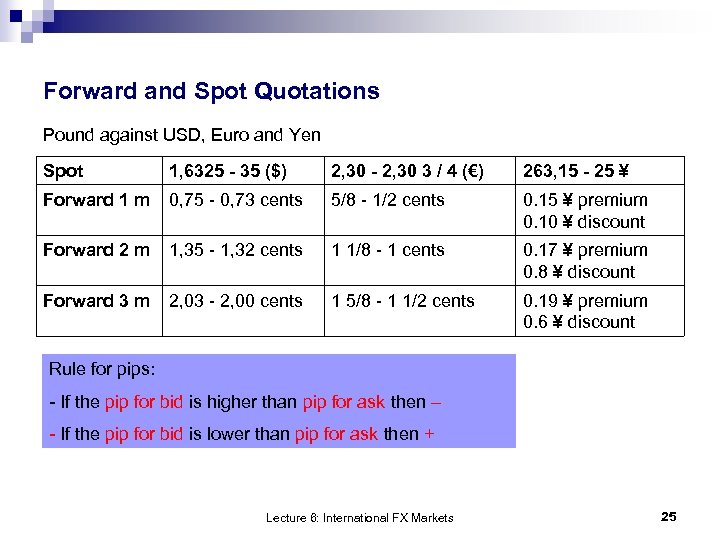
Forward and Spot Quotations Pound against USD, Euro and Yen Spot 1, 6325 - 35 ($) 2, 30 - 2, 30 3 / 4 (€) 263, 15 - 25 ¥ Forward 1 m 0, 75 - 0, 73 cents 5/8 - 1/2 cents 0. 15 ¥ premium 0. 10 ¥ discount Forward 2 m 1, 35 - 1, 32 cents 1 1/8 - 1 cents 0. 17 ¥ premium 0. 8 ¥ discount Forward 3 m 2, 03 - 2, 00 cents 1 5/8 - 1 1/2 cents 0. 19 ¥ premium 0. 6 ¥ discount Rule for pips: - If the pip for bid is higher than pip for ask then – - If the pip for bid is lower than pip for ask then + Lecture 6: International FX Markets 25
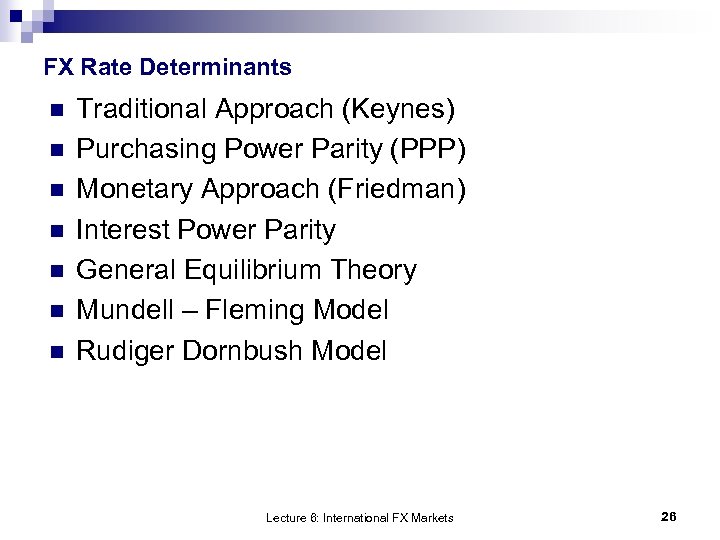
FX Rate Determinants n n n n Traditional Approach (Keynes) Purchasing Power Parity (PPP) Monetary Approach (Friedman) Interest Power Parity General Equilibrium Theory Mundell – Fleming Model Rudiger Dornbush Model Lecture 6: International FX Markets 26
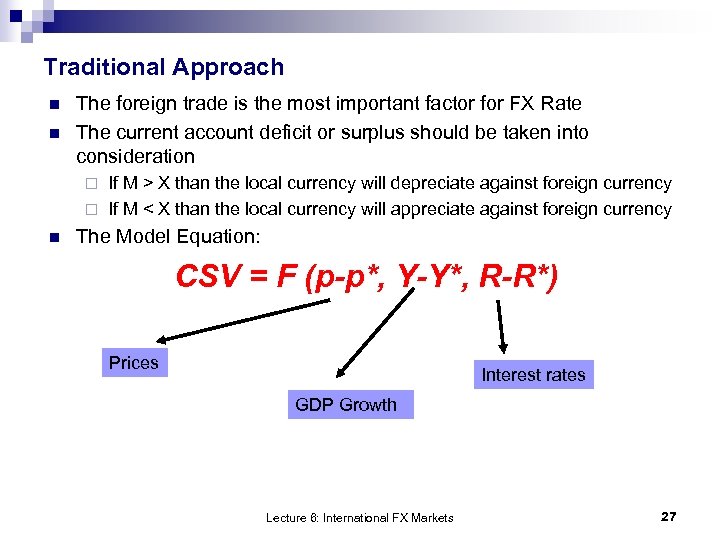
Traditional Approach n n The foreign trade is the most important factor for FX Rate The current account deficit or surplus should be taken into consideration If M > X than the local currency will depreciate against foreign currency ¨ If M < X than the local currency will appreciate against foreign currency ¨ n The Model Equation: CSV = F (p-p*, Y-Y*, R-R*) Prices Interest rates GDP Growth Lecture 6: International FX Markets 27
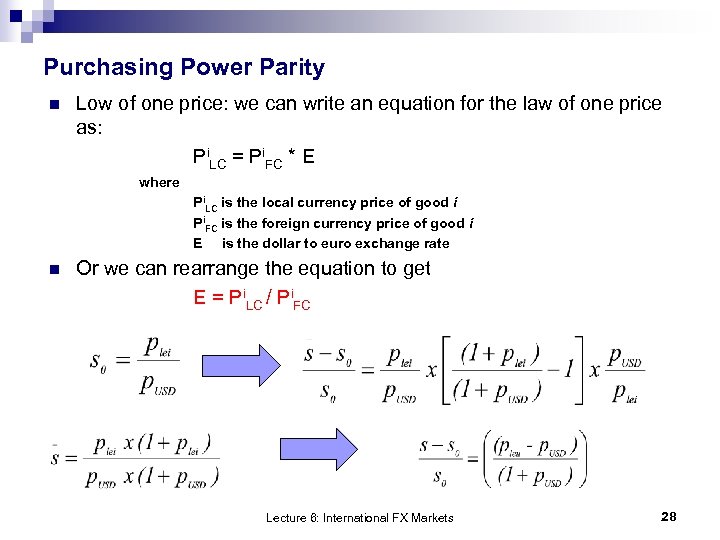
Purchasing Power Parity n Low of one price: we can write an equation for the law of one price as: Pi. LC = Pi. FC * E where Pi. LC is the local currency price of good i Pi. FC is the foreign currency price of good i E is the dollar to euro exchange rate n Or we can rearrange the equation to get E = Pi. LC / Pi. FC Lecture 6: International FX Markets 28
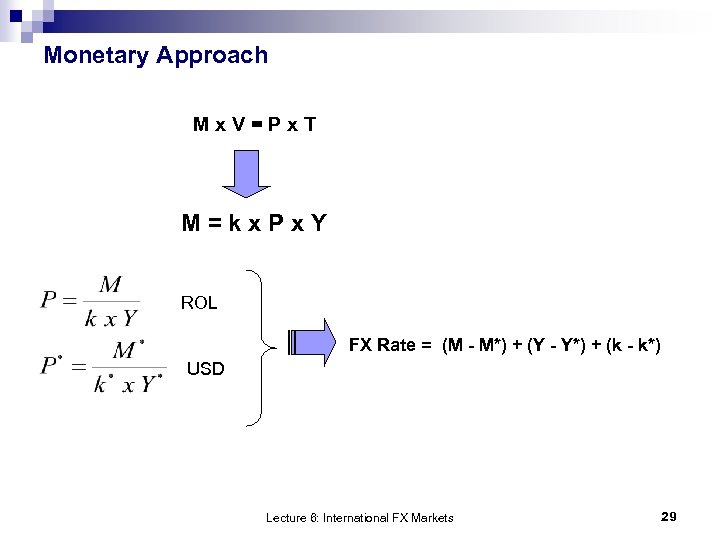
Monetary Approach Mx. V=Px. T M=kx. Px. Y ROL FX Rate = (M - M*) + (Y - Y*) + (k - k*) USD Lecture 6: International FX Markets 29
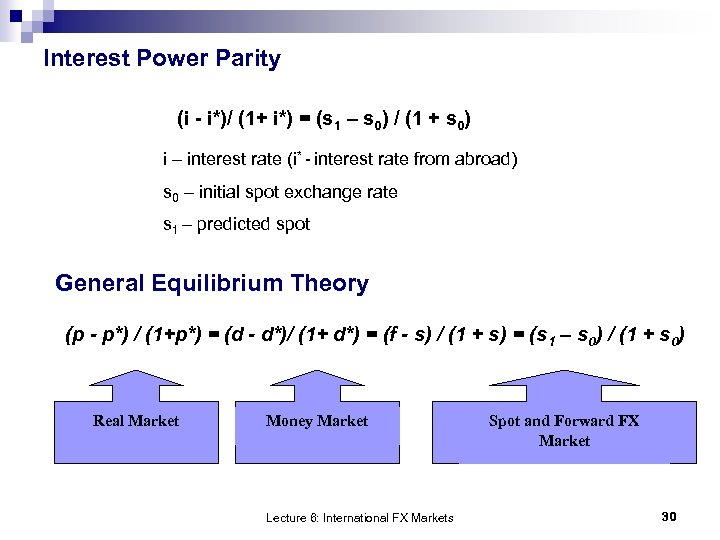
Interest Power Parity (i - i*)/ (1+ i*) = (s 1 – s 0) / (1 + s 0) i – interest rate (i* - interest rate from abroad) s 0 – initial spot exchange rate s 1 – predicted spot General Equilibrium Theory (p - p*) / (1+p*) = (d - d*)/ (1+ d*) = (f - s) / (1 + s) = (s 1 – s 0) / (1 + s 0) Real Market Money Market Lecture 6: International FX Markets Spot and Forward FX Market 30
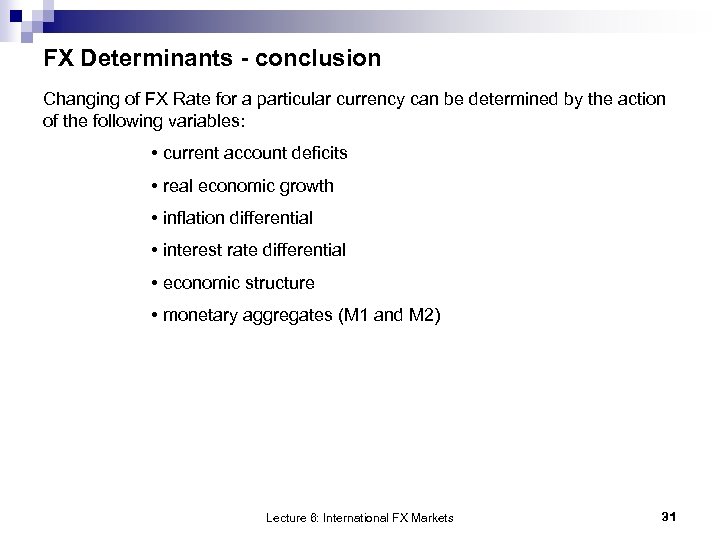
FX Determinants - conclusion Changing of FX Rate for a particular currency can be determined by the action of the following variables: • current account deficits • real economic growth • inflation differential • interest rate differential • economic structure • monetary aggregates (M 1 and M 2) Lecture 6: International FX Markets 31
Скачать презентацию Academy of Economic Studies Faculty of International Business
f830ffd98d86b0ce5940106d4c0cd5c9.ppt