


 Скачать презентацию Academy of Economic Studies Doctoral School of Finance
c338ca3f9d21eda1ca38648e58b2798d.ppt
- Количество слайдов: 33
 Academy of Economic Studies Doctoral School of Finance and Banking Credit risk of non-financial companies in the context of financial stability MSc Student: Romulus Mircea Supervisor: Professor Moisă Altăr Bucharest, July 2007
 Topics 1. 2. 3. 4. 5. 6. Preliminary aspects Credit risk models in practice Methodology and input data Results Stress-testing Conclusions
 1. Preliminary aspects 1. 1. Importance of credit risk assessment models: - Entities who buy and sell credit risk Stakeholders - Central authorities 1. 2. Objectives: - Determinants of default for non-financial companies - Estimate probabilities of default - Evaluate risks to financial stability - Stress-testing Conclusions
 2. Credit risk models in practice – • • Logit models are among the best alternatives to model credit risk of non-publicly traded companies Currently used by central banks from euro-zone area, in order to determine eligible collateral for refinancing operations (Oe. NB, BUBA, BDE) Ohlson (1980), Lennox (1999), Bernhardsen (2001), Bunn (2003) Multivariate discriminant analysis: Beaver(1966), Altman(1968), Bardos(1998), Bd. F current methodology as an ECAI Does not produce a probability of default directly Rather restrictive assumptions on underlying explanatory variables
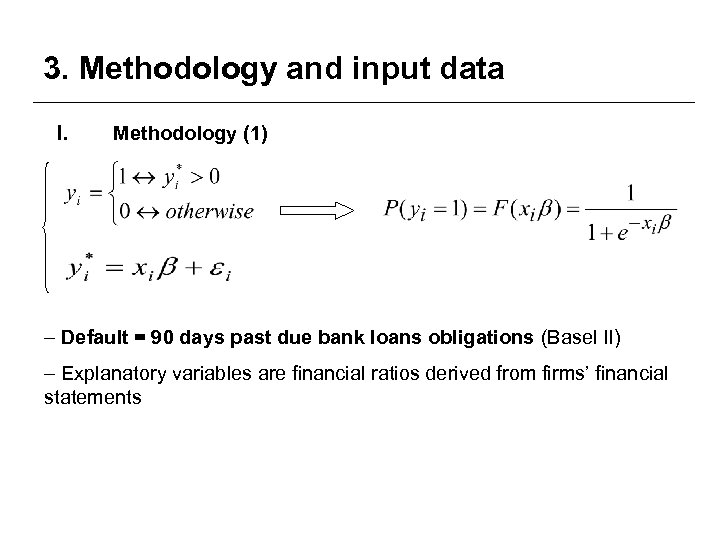 3. Methodology and input data I. Methodology (1) – Default = 90 days past due bank loans obligations (Basel II) – Explanatory variables are financial ratios derived from firms’ financial statements
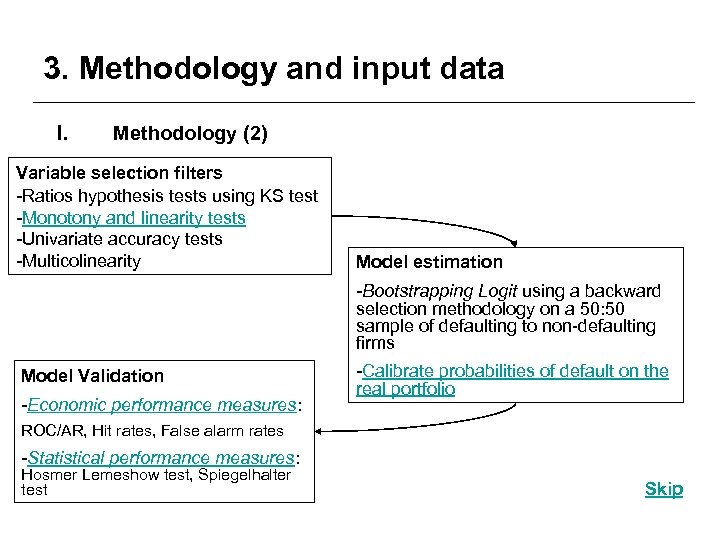 3. Methodology and input data I. Methodology (2) Variable selection filters -Ratios hypothesis tests using KS test -Monotony and linearity tests -Univariate accuracy tests -Multicolinearity Model estimation -Bootstrapping Logit using a backward selection methodology on a 50: 50 sample of defaulting to non-defaulting firms Model Validation -Economic performance measures: -Calibrate probabilities of default on the real portfolio ROC/AR, Hit rates, False alarm rates -Statistical performance measures: Hosmer Lemeshow test, Spiegelhalter test Skip
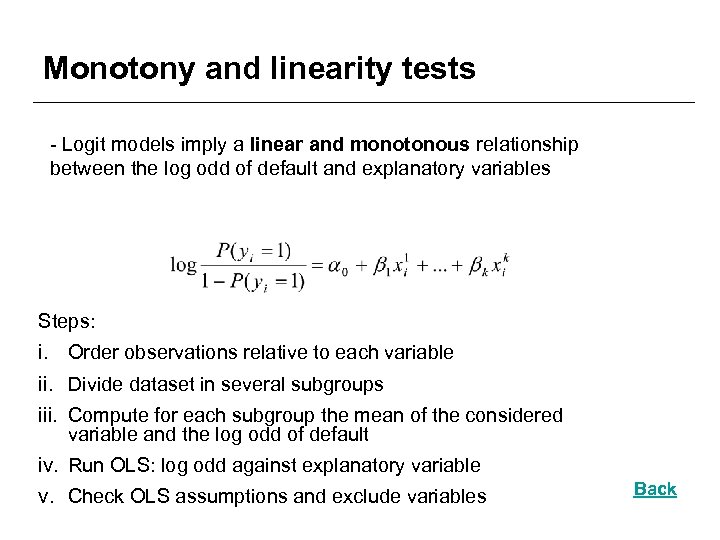 Monotony and linearity tests - Logit models imply a linear and monotonous relationship between the log odd of default and explanatory variables Steps: i. Order observations relative to each variable ii. Divide dataset in several subgroups iii. Compute for each subgroup the mean of the considered variable and the log odd of default iv. Run OLS: log odd against explanatory variable v. Check OLS assumptions and exclude variables Back
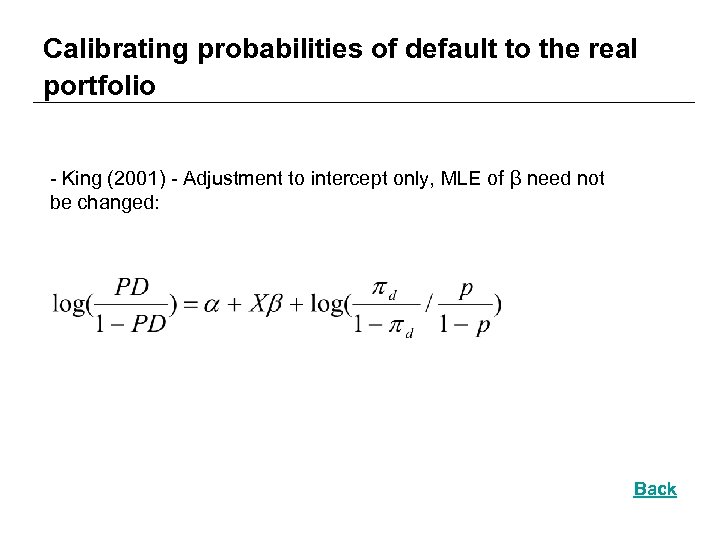 Calibrating probabilities of default to the real portfolio - King (2001) - Adjustment to intercept only, MLE of β need not be changed: Back
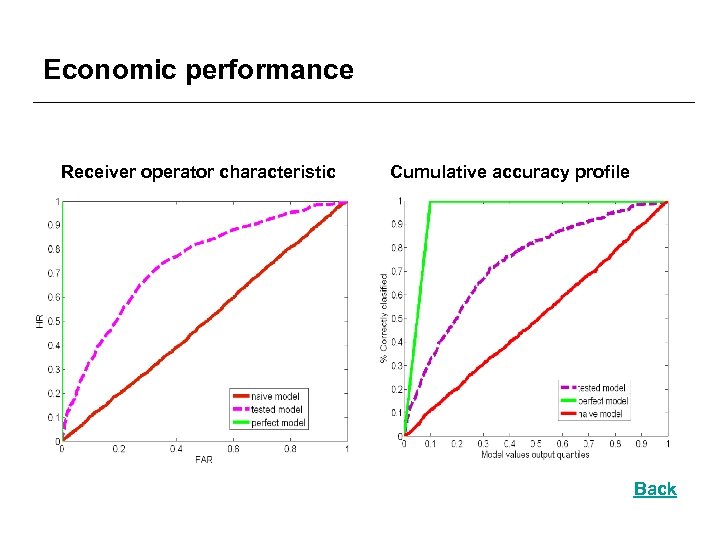 Economic performance Receiver operator characteristic Cumulative accuracy profile Back
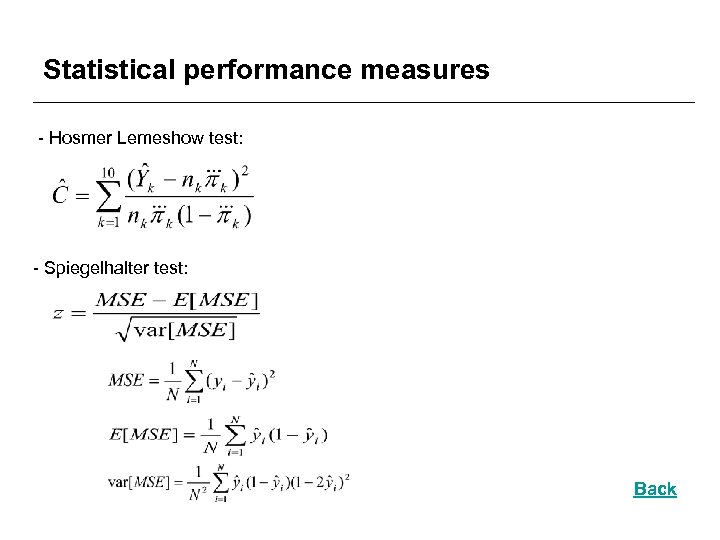 Statistical performance measures - Hosmer Lemeshow test: - Spiegelhalter test: Back
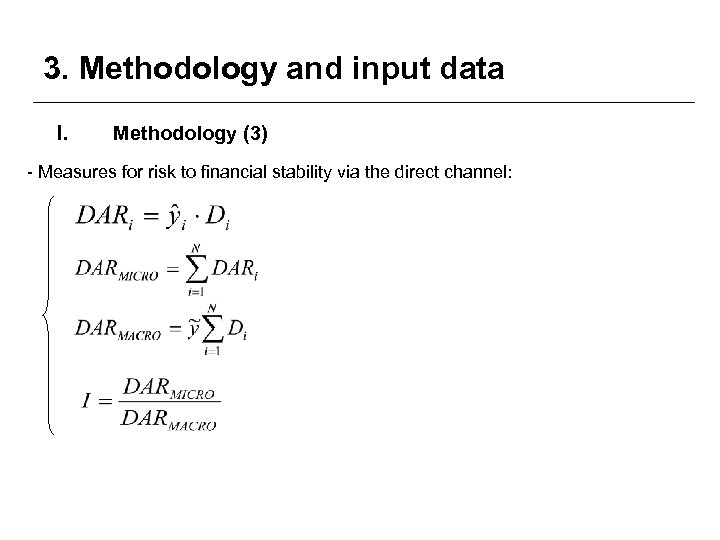 3. Methodology and input data I. Methodology (3) - Measures for risk to financial stability via the direct channel:
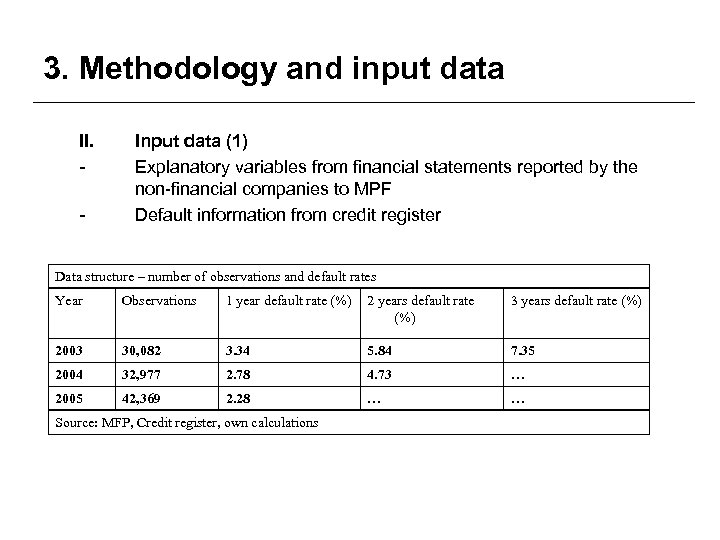 3. Methodology and input data II. - Input data (1) Explanatory variables from financial statements reported by the non-financial companies to MPF Default information from credit register Data structure – number of observations and default rates Year Observations 1 year default rate (%) 2 years default rate (%) 3 years default rate (%) 2003 30, 082 3. 34 5. 84 7. 35 2004 32, 977 2. 78 4. 73 … 2005 42, 369 2. 28 … … Source: MFP, Credit register, own calculations
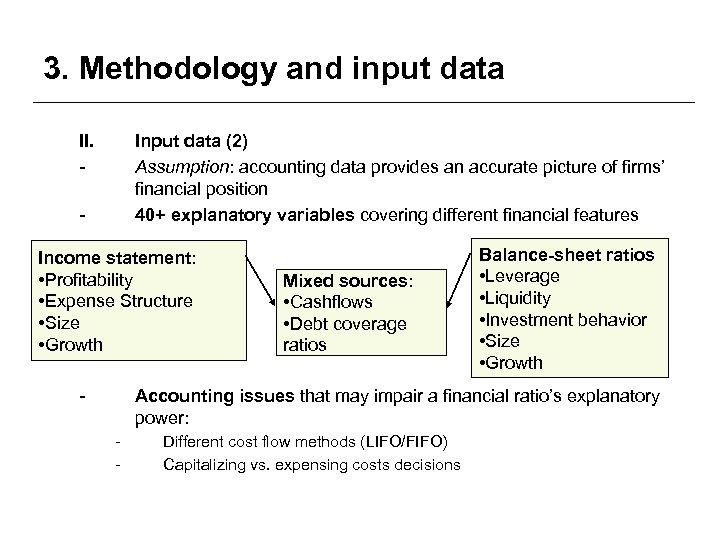 3. Methodology and input data II. - Input data (2) Assumption: accounting data provides an accurate picture of firms’ financial position 40+ explanatory variables covering different financial features - Income statement: • Profitability • Expense Structure • Size • Growth - Mixed sources: • Cashflows • Debt coverage ratios Balance-sheet ratios • Leverage • Liquidity • Investment behavior • Size • Growth Accounting issues that may impair a financial ratio’s explanatory power: - Different cost flow methods (LIFO/FIFO) Capitalizing vs. expensing costs decisions
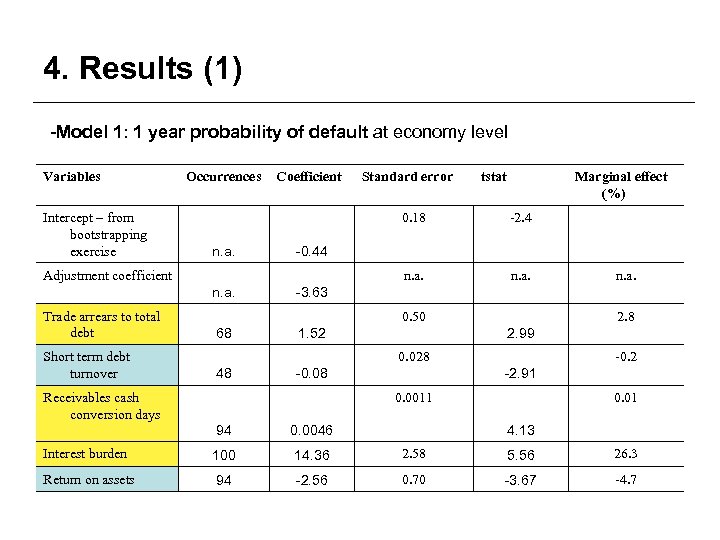 4. Results (1) -Model 1: 1 year probability of default at economy level Variables Intercept – from bootstrapping exercise Occurrences Coefficient Receivables cash conversion days Marginal effect (%) -2. 4 n. a. Short term debt turnover tstat 0. 18 n. a. -0. 44 Adjustment coefficient Trade arrears to total debt Standard error -3. 63 0. 50 68 1. 52 2. 8 2. 99 0. 028 48 n. a. -0. 08 -0. 2 -2. 91 0. 0011 0. 01 94 0. 0046 4. 13 Interest burden 100 14. 36 2. 58 5. 56 26. 3 Return on assets 94 -2. 56 0. 70 -3. 67 -4. 7
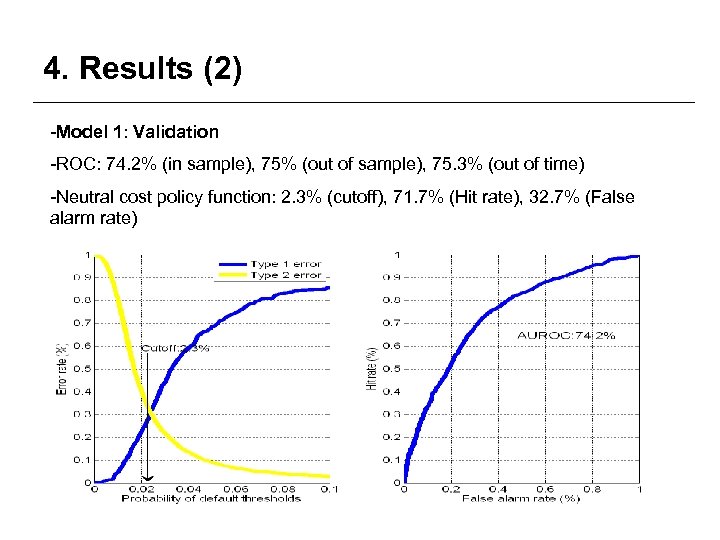 4. Results (2) -Model 1: Validation -ROC: 74. 2% (in sample), 75% (out of sample), 75. 3% (out of time) -Neutral cost policy function: 2. 3% (cutoff), 71. 7% (Hit rate), 32. 7% (False alarm rate)
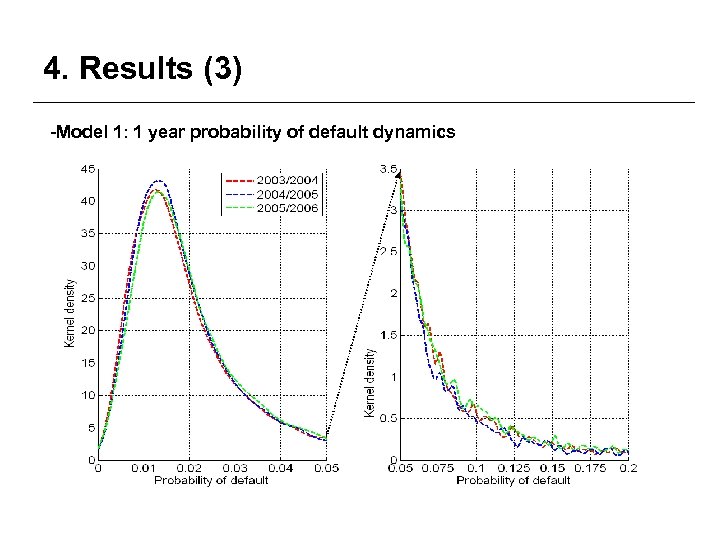 4. Results (3) -Model 1: 1 year probability of default dynamics
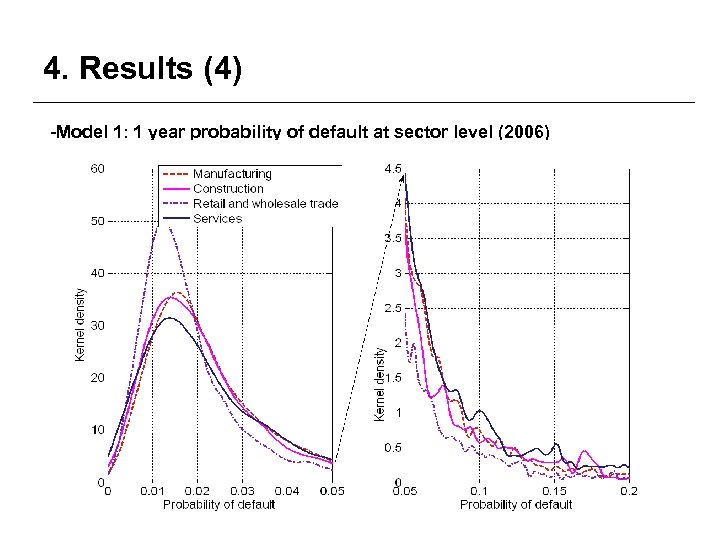 4. Results (4) -Model 1: 1 year probability of default at sector level (2006)
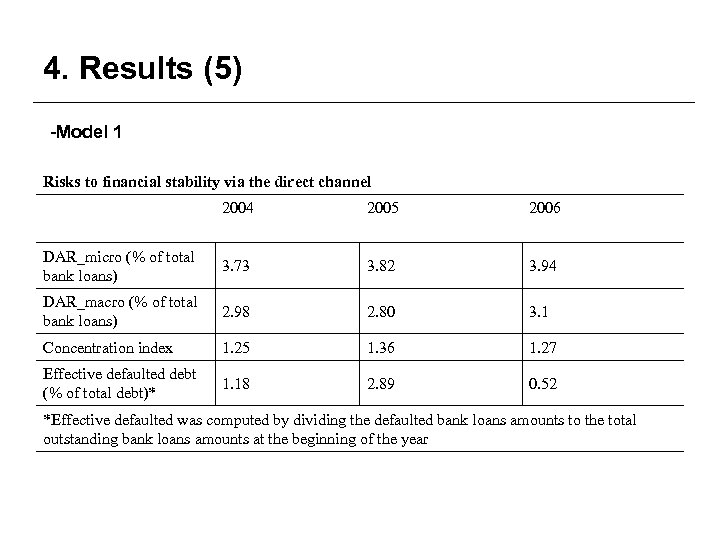 4. Results (5) -Model 1 Risks to financial stability via the direct channel 2004 2005 2006 DAR_micro (% of total bank loans) 3. 73 3. 82 3. 94 DAR_macro (% of total bank loans) 2. 98 2. 80 3. 1 Concentration index 1. 25 1. 36 1. 27 Effective defaulted debt (% of total debt)* 1. 18 2. 89 0. 52 *Effective defaulted was computed by dividing the defaulted bank loans amounts to the total outstanding bank loans amounts at the beginning of the year
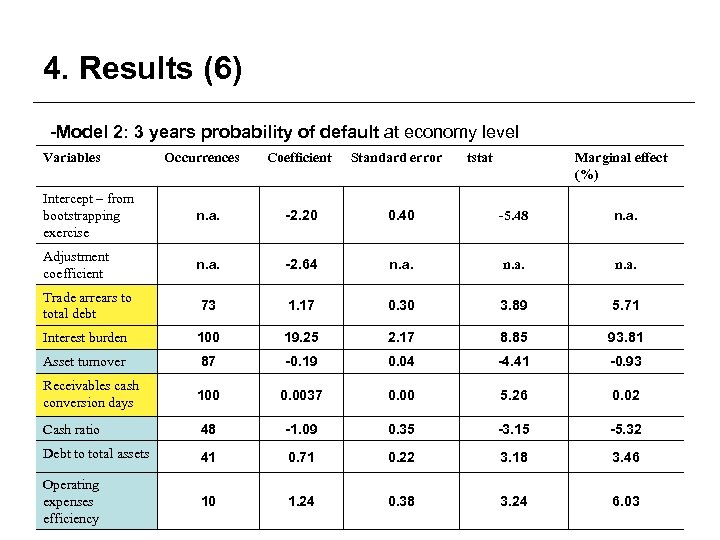 4. Results (6) -Model 2: 3 years probability of default at economy level Variables Occurrences Coefficient Standard error tstat Marginal effect (%) Intercept – from bootstrapping exercise n. a. -2. 20 0. 40 -5. 48 n. a. Adjustment coefficient n. a. -2. 64 n. a. Trade arrears to total debt 73 1. 17 0. 30 3. 89 5. 71 Interest burden 100 19. 25 2. 17 8. 85 93. 81 Asset turnover 87 -0. 19 0. 04 -4. 41 -0. 93 Receivables cash conversion days 100 0. 0037 0. 00 5. 26 0. 02 Cash ratio 48 -1. 09 0. 35 -3. 15 -5. 32 Debt to total assets 41 0. 71 0. 22 3. 18 3. 46 Operating expenses efficiency 10 1. 24 0. 38 3. 24 6. 03
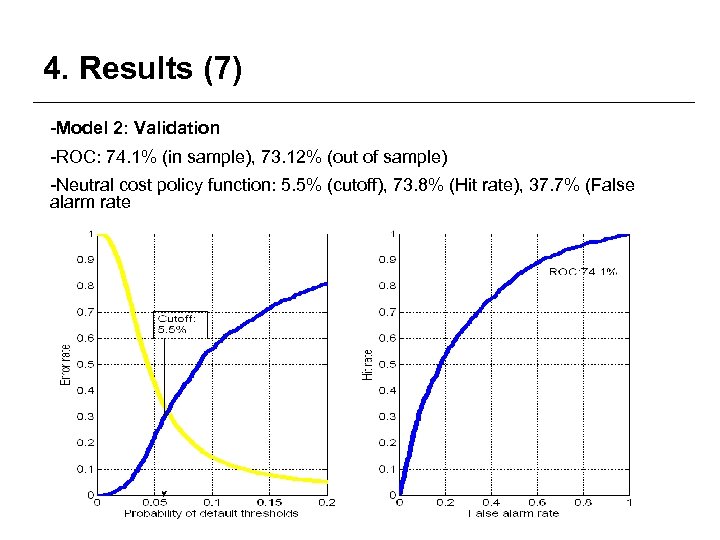 4. Results (7) -Model 2: Validation -ROC: 74. 1% (in sample), 73. 12% (out of sample) -Neutral cost policy function: 5. 5% (cutoff), 73. 8% (Hit rate), 37. 7% (False alarm rate
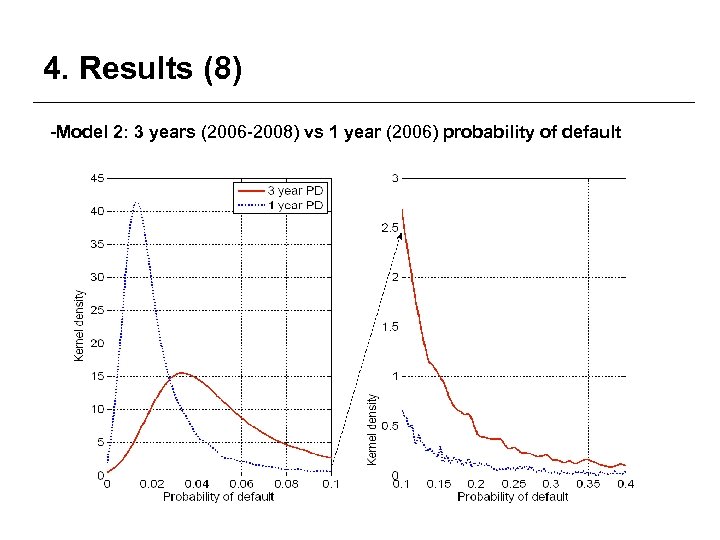 4. Results (8) -Model 2: 3 years (2006 -2008) vs 1 year (2006) probability of default
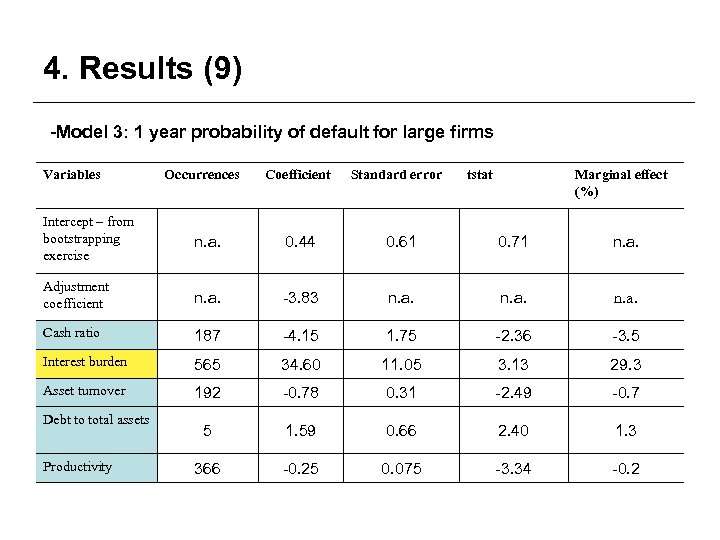 4. Results (9) -Model 3: 1 year probability of default for large firms Variables Occurrences Coefficient Standard error tstat Marginal effect (%) Intercept – from bootstrapping exercise n. a. 0. 44 0. 61 0. 71 n. a. Adjustment coefficient n. a. -3. 83 n. a. Cash ratio 187 -4. 15 1. 75 -2. 36 -3. 5 Interest burden 565 34. 60 11. 05 3. 13 29. 3 Asset turnover 192 -0. 78 0. 31 -2. 49 -0. 7 5 1. 59 0. 66 2. 40 1. 3 366 -0. 25 0. 075 -3. 34 -0. 2 Debt to total assets Productivity
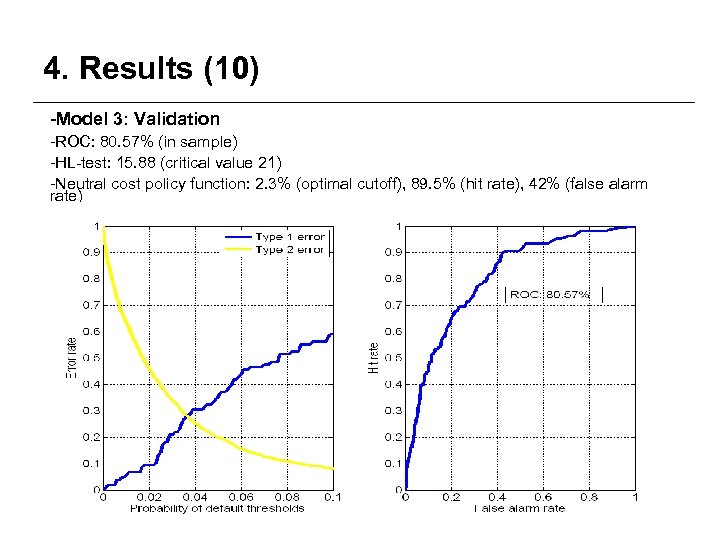 4. Results (10) -Model 3: Validation -ROC: 80. 57% (in sample) -HL-test: 15. 88 (critical value 21) -Neutral cost policy function: 2. 3% (optimal cutoff), 89. 5% (hit rate), 42% (false alarm rate)
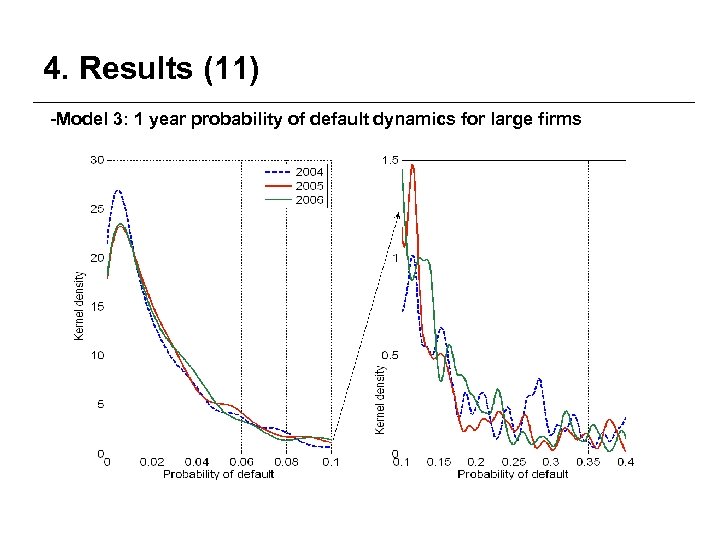 4. Results (11) -Model 3: 1 year probability of default dynamics for large firms
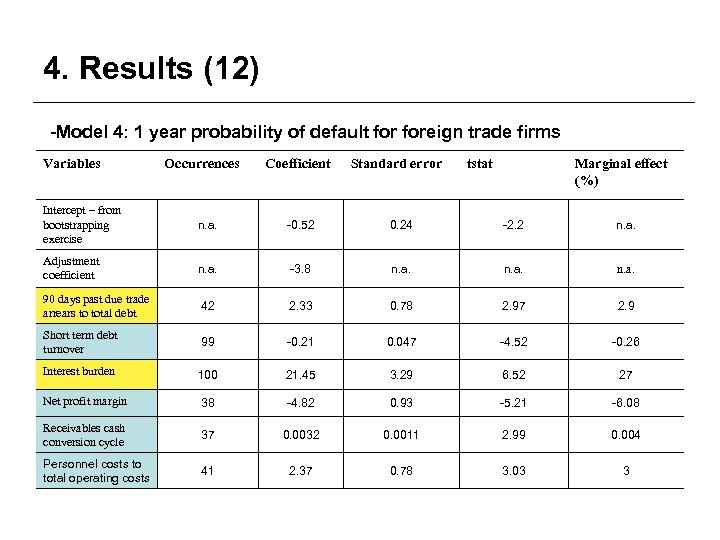 4. Results (12) -Model 4: 1 year probability of default foreign trade firms Variables Occurrences Coefficient Standard error tstat Marginal effect (%) Intercept – from bootstrapping exercise n. a. -0. 52 0. 24 -2. 2 n. a. Adjustment coefficient n. a. -3. 8 n. a. 90 days past due trade arrears to total debt 42 2. 33 0. 78 2. 97 2. 9 Short term debt turnover 99 -0. 21 0. 047 -4. 52 -0. 26 Interest burden 100 21. 45 3. 29 6. 52 27 Net profit margin 38 -4. 82 0. 93 -5. 21 -6. 08 Receivables cash conversion cycle 37 0. 0032 0. 0011 2. 99 0. 004 Personnel costs to total operating costs 41 2. 37 0. 78 3. 03 3
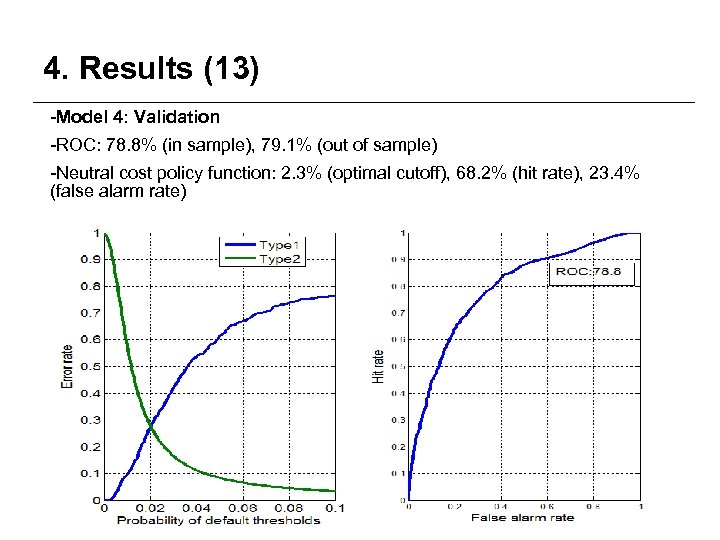 4. Results (13) -Model 4: Validation -ROC: 78. 8% (in sample), 79. 1% (out of sample) -Neutral cost policy function: 2. 3% (optimal cutoff), 68. 2% (hit rate), 23. 4% (false alarm rate)
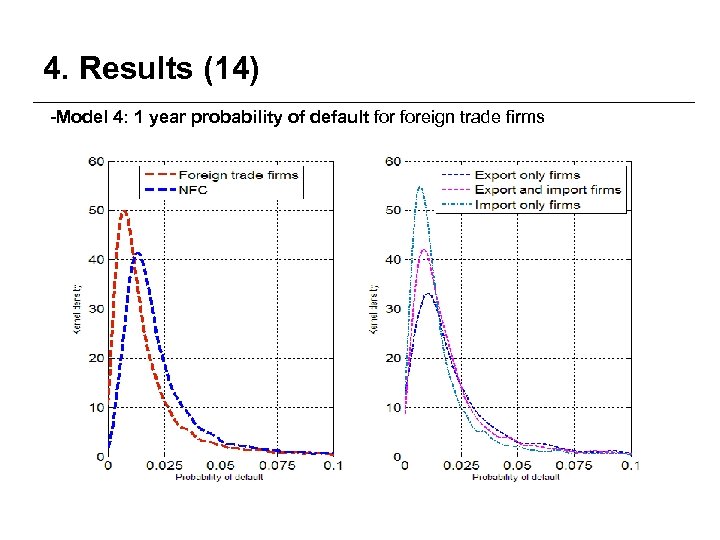 4. Results (14) -Model 4: 1 year probability of default foreign trade firms
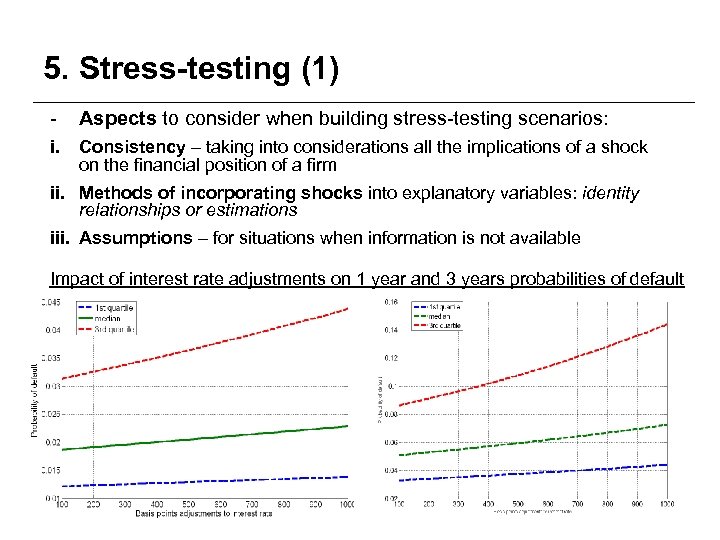 5. Stress-testing (1) - Aspects to consider when building stress-testing scenarios: i. Consistency – taking into considerations all the implications of a shock on the financial position of a firm ii. Methods of incorporating shocks into explanatory variables: identity relationships or estimations iii. Assumptions – for situations when information is not available Impact of interest rate adjustments on 1 year and 3 years probabilities of default
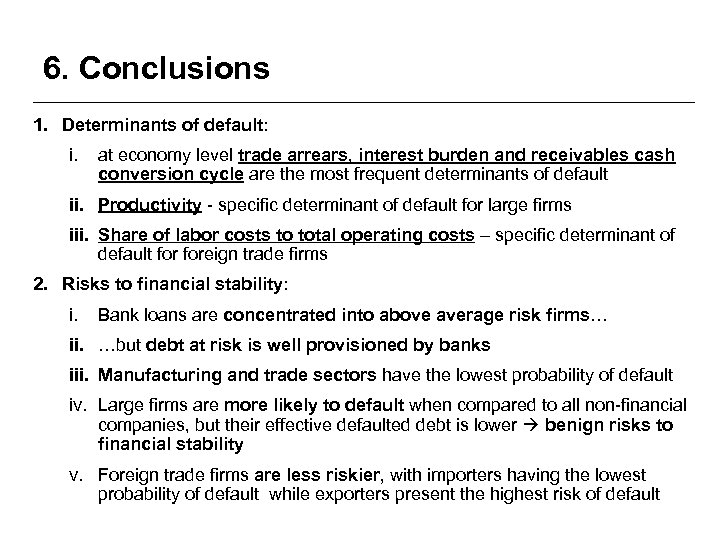 6. Conclusions 1. Determinants of default: i. at economy level trade arrears, interest burden and receivables cash conversion cycle are the most frequent determinants of default ii. Productivity - specific determinant of default for large firms iii. Share of labor costs to total operating costs – specific determinant of default foreign trade firms 2. Risks to financial stability: i. Bank loans are concentrated into above average risk firms… ii. …but debt at risk is well provisioned by banks iii. Manufacturing and trade sectors have the lowest probability of default iv. Large firms are more likely to default when compared to all non-financial companies, but their effective defaulted debt is lower benign risks to financial stability v. Foreign trade firms are less riskier, with importers having the lowest probability of default while exporters present the highest risk of default
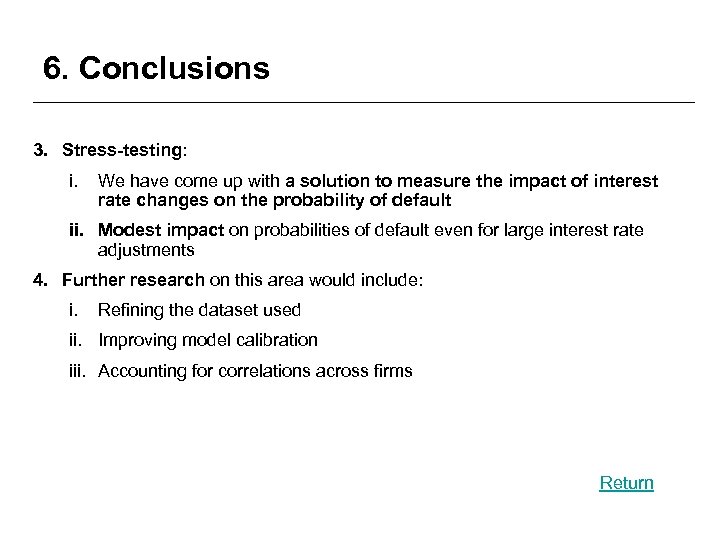 6. Conclusions 3. Stress-testing: i. We have come up with a solution to measure the impact of interest rate changes on the probability of default ii. Modest impact on probabilities of default even for large interest rate adjustments 4. Further research on this area would include: i. Refining the dataset used ii. Improving model calibration iii. Accounting for correlations across firms Return
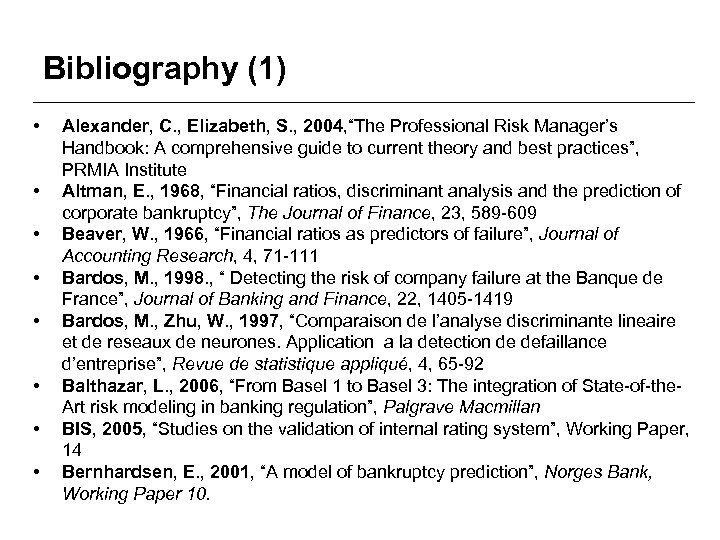 Bibliography (1) • • Alexander, C. , Elizabeth, S. , 2004, “The Professional Risk Manager’s Handbook: A comprehensive guide to current theory and best practices”, PRMIA Institute Altman, E. , 1968, “Financial ratios, discriminant analysis and the prediction of corporate bankruptcy”, The Journal of Finance, 23, 589 -609 Beaver, W. , 1966, “Financial ratios as predictors of failure”, Journal of Accounting Research, 4, 71 -111 Bardos, M. , 1998. , “ Detecting the risk of company failure at the Banque de France”, Journal of Banking and Finance, 22, 1405 -1419 Bardos, M. , Zhu, W. , 1997, “Comparaison de l’analyse discriminante lineaire et de reseaux de neurones. Application a la detection de defaillance d’entreprise”, Revue de statistique appliqué, 4, 65 -92 Balthazar, L. , 2006, “From Basel 1 to Basel 3: The integration of State-of-the. Art risk modeling in banking regulation”, Palgrave Macmillan BIS, 2005, “Studies on the validation of internal rating system”, Working Paper, 14 Bernhardsen, E. , 2001, “A model of bankruptcy prediction”, Norges Bank, Working Paper 10.
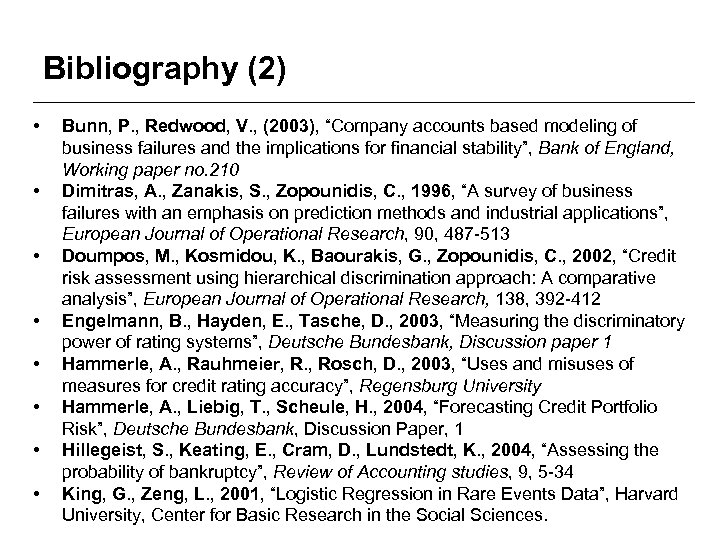 Bibliography (2) • • Bunn, P. , Redwood, V. , (2003), “Company accounts based modeling of business failures and the implications for financial stability”, Bank of England, Working paper no. 210 Dimitras, A. , Zanakis, S. , Zopounidis, C. , 1996, “A survey of business failures with an emphasis on prediction methods and industrial applications”, European Journal of Operational Research, 90, 487 -513 Doumpos, M. , Kosmidou, K. , Baourakis, G. , Zopounidis, C. , 2002, “Credit risk assessment using hierarchical discrimination approach: A comparative analysis”, European Journal of Operational Research, 138, 392 -412 Engelmann, B. , Hayden, E. , Tasche, D. , 2003, “Measuring the discriminatory power of rating systems”, Deutsche Bundesbank, Discussion paper 1 Hammerle, A. , Rauhmeier, R. , Rosch, D. , 2003, “Uses and misuses of measures for credit rating accuracy”, Regensburg University Hammerle, A. , Liebig, T. , Scheule, H. , 2004, “Forecasting Credit Portfolio Risk”, Deutsche Bundesbank, Discussion Paper, 1 Hillegeist, S. , Keating, E. , Cram, D. , Lundstedt, K. , 2004, “Assessing the probability of bankruptcy”, Review of Accounting studies, 9, 5 -34 King, G. , Zeng, L. , 2001, “Logistic Regression in Rare Events Data”, Harvard University, Center for Basic Research in the Social Sciences.
 Bibliography (3) • • • Laitinen, E. , Laitinen, T. , 2001, “Bankruptcy prediction: Application of Taylor’s expansion in logistic regression”, University of Vaasa, Department of Accounting and Finance, Finland Lennox, C. , 1999, “Identifying failing companies: A reevaluation of the logit, probit and DA approaches”, Journal of Economics and Business, 51, 347 -364 Morris, R. , 1997, „Early Warning Indicators of Corporate Failure”, Ashgate Publishing Ohlson, J. , 1980, „Financial ratios and the probabilistic prediction of bankruptcy”, Journal of Accounting Research, 18, 109 -131 Ooghe H. , Claus, H. , Sierens N. , Camerlynck J. , 1999, „International Comparison of Failure Prediction models from different countries: An empirical analysis”, Ghent University, Department of Corporate Finance, No. 99/79