 Скачать презентацию Academic Writing Anyone who wishes to become a
AcademicWritingPPT Lectures 1 & 2.pptx
- Количество слайдов: 59



Academic Writing Anyone who wishes to become a good writer should endeavor, before he allows himself to be tempted by the more showy qualities, to be direct, simple, brief, vigorous, and lucid. (Fowler & Fowler, 1906, p. 11)
Lecture Draft: 1. Features of an academic writing 2. Stages in the writing process 3. Titles - requirements for good research paper titles - grammatical constructions in titles - types of titles
Academic vs. non-academic
A paper and an essay
FEATURES OF AN ACADEMIC WRITING Academic writing is: 1. clearly structured. 2. logically developed. 3. analytic. 4. based on sources. 5. explicit. 6. objective, cautious and formal.
STAGES IN THE WRITING PROCESS: 1. Choose a topic. 2. Think (brainstorm). 3. Research. 4. Discover your thesis. 5. Plan (outline). 6. Write. 7. Revise. 8. Edit. 9. Proofread.
TITLES “A good title is the fewest possible words that adequately describe the contents of the paper. ” (Day, 1998, p. 15).
NB: Titles compete for the reader’s attention!!! Make your title a catchy “hook”, or a good teaser!!!
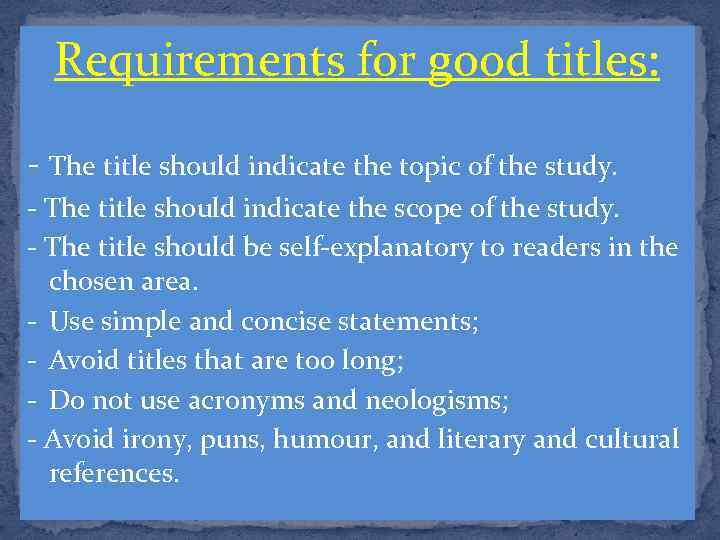
Requirements for good titles: - The title should indicate the topic of the study. - The title should indicate the scope of the study. - The title should be self-explanatory to readers in the chosen area. - Use simple and concise statements; - Avoid titles that are too long; - Do not use acronyms and neologisms; - Avoid irony, puns, humour, and literary and cultural references.
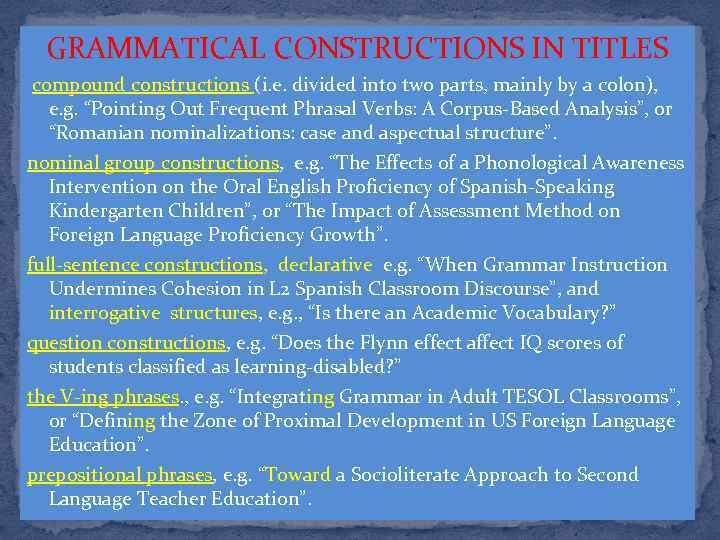
GRAMMATICAL CONSTRUCTIONS IN TITLES compound constructions (i. e. divided into two parts, mainly by a colon), e. g. “Pointing Out Frequent Phrasal Verbs: A Corpus-Based Analysis”, or “Romanian nominalizations: case and aspectual structure”. nominal group constructions, e. g. “The Effects of a Phonological Awareness Intervention on the Oral English Proficiency of Spanish-Speaking Kindergarten Children”, or “The Impact of Assessment Method on Foreign Language Proficiency Growth”. full-sentence constructions, declarative e. g. “When Grammar Instruction Undermines Cohesion in L 2 Spanish Classroom Discourse”, and interrogative structures, e. g. , “Is there an Academic Vocabulary? ” question constructions, e. g. “Does the Flynn effect affect IQ scores of students classified as learning-disabled? ” the V-ing phrases. , e. g. “Integrating Grammar in Adult TESOL Classrooms”, or “Defining the Zone of Proximal Development in US Foreign Language Education”. prepositional phrases, e. g. “Toward a Socioliterate Approach to Second Language Teacher Education”.
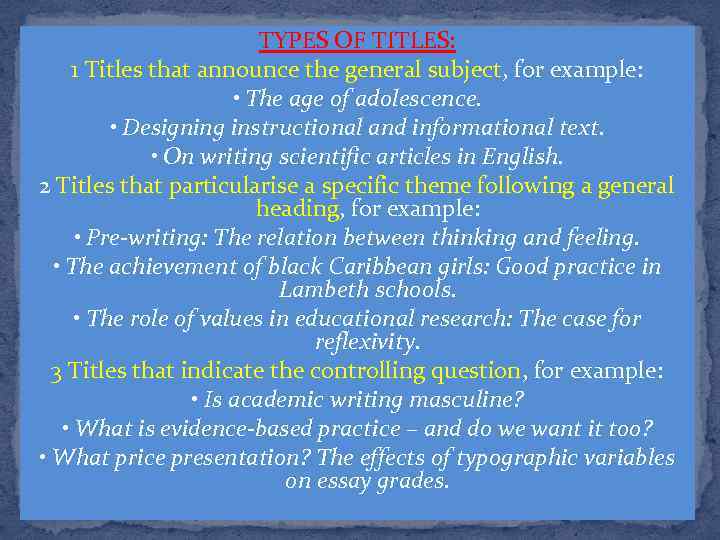
TYPES OF TITLES: 1 Titles that announce the general subject, for example: • The age of adolescence. • Designing instructional and informational text. • On writing scientific articles in English. 2 Titles that particularise a specific theme following a general heading, for example: • Pre-writing: The relation between thinking and feeling. • The achievement of black Caribbean girls: Good practice in Lambeth schools. • The role of values in educational research: The case for reflexivity. 3 Titles that indicate the controlling question, for example: • Is academic writing masculine? • What is evidence-based practice – and do we want it too? • What price presentation? The effects of typographic variables on essay grades.
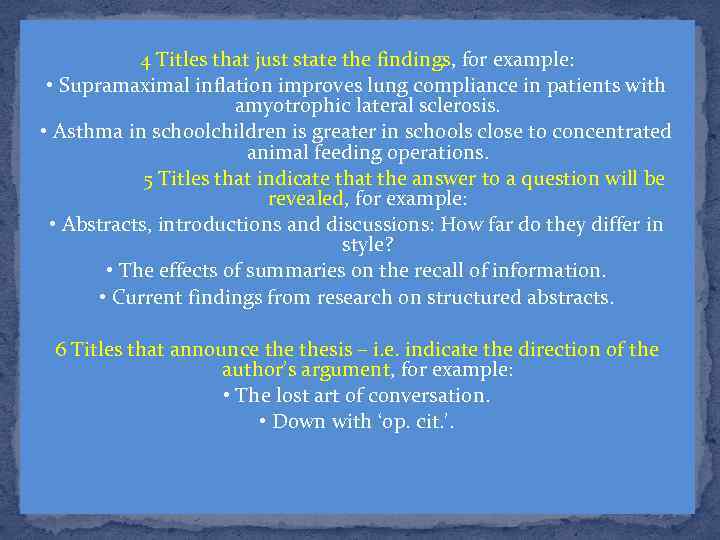
4 Titles that just state the findings, for example: • Supramaximal inflation improves lung compliance in patients with amyotrophic lateral sclerosis. • Asthma in schoolchildren is greater in schools close to concentrated animal feeding operations. 5 Titles that indicate that the answer to a question will be revealed, for example: • Abstracts, introductions and discussions: How far do they differ in style? • The effects of summaries on the recall of information. • Current findings from research on structured abstracts. 6 Titles that announce thesis – i. e. indicate the direction of the author’s argument, for example: • The lost art of conversation. • Down with ‘op. cit. ’.
7 Titles that emphasise the methodology used in the research, for example: • Using colons in titles: A meta-analytic review. • Reading and writing book reviews across the disciplines: A survey of authors. • Is judging text on screen different from judging text in print? A naturalistic email study. 8 Titles that suggest guidelines and/or comparisons, for example: • Seven types of ambiguity. • Eighty ways of improving instructional text. 9 Titles that bid for attention by using startling or effective openings, for example: • ‘Do you ride an elephant’ and ‘never tell them you’re German’: The experiences of British Asian, black and overseas student teachers in the UK. • Making a difference: An exploration of leadership roles in sixth form colleges.
10 Titles that attract by alliteration, for example: • Legal ease and ‘legalese’. 11 Titles that attract by using literary or biblical allusions, for example: • From structured abstracts to structured articles: A modest proposal. 12 Titles that attract by using puns, for example: • Now take this PIL (Patient Information Leaflet). 13 Finally, titles that mystify, for example: • How do you know you’ve alternated? • Is October Brown Chinese?
WHEN OUR EYES DECEIVE US THE CALL OF THE MALL
GATHERING INFORMATION - the primary sources - the full text of articles, books, government and company reports, etc. ; - the secondary sources - dictionaries, encyclopaedias, bibliographies, indexes, abstracts, etc. NB: BE SELECTIVE!!!
RECORDING INFORMATION - Take notes - Avoid plagiarism
PLANNING AND STRUCTURING THE CONTENT: - formulate your central idea - make an outline - add the supporting points - reread your plan - change or add something
Writing Paragraphs NB: Readers need planned pauses or breaks when reading long complex papers in order to understand your presented ideas.
Writing the first draft - Is the argument clear? - Have you provided enough evidence to support your claims? - Have you dealt adequately with conflicting evidence? - Are ideas linked together logically? Redrafting This stage involves improving and refining early drafts.
Editing and proofreading Proofreading means examining your text carefully to find and correct typographical errors and mistakes in grammar, style, and spelling.
Before You Proofread • Be sure you've revised the larger aspects of your text. • Set your text aside for a while (15 min, a day, a week) between writing and proofreading • Eliminate unnecessary words before looking for mistakes.
When You Proofread • Work from a printout, not the computer screen. • Read out loud. • Use a blank sheet of paper to cover up the lines below the one you're reading. • Use the search function of the computer to find mistakes you're likely to make.
• End with a spelling check, using a computer spelling checker or reading backwards word by word. But remember that a spelling checker won't catch mistakes with homonyms (e. g. , "they're, " "their, " "there") or certain typos (like "he" for "the").
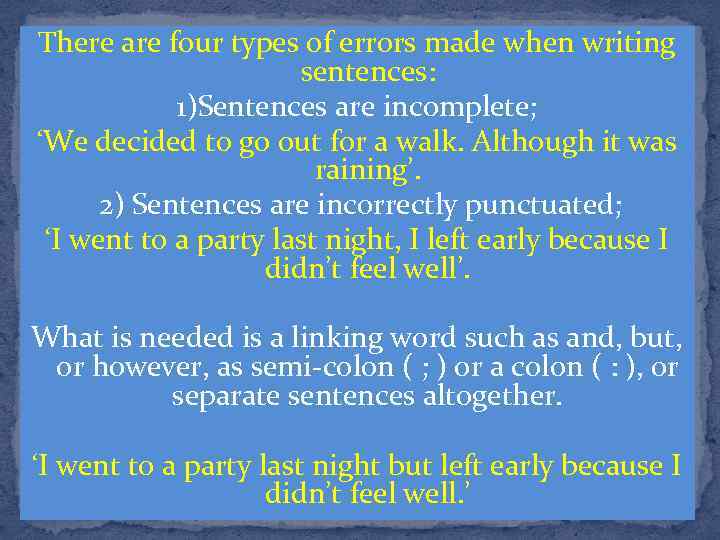
There are four types of errors made when writing sentences: 1)Sentences are incomplete; ‘We decided to go out for a walk. Although it was raining’. 2) Sentences are incorrectly punctuated; ‘I went to a party last night, I left early because I didn’t feel well’. What is needed is a linking word such as and, but, or however, as semi-colon ( ; ) or a colon ( : ), or separate sentences altogether. ‘I went to a party last night but left early because I didn’t feel well. ’
3)Sentences are too long; Your reader will become confused! 4) Sentences are too short; Your writing will become “bitty” and tiring for the reader.
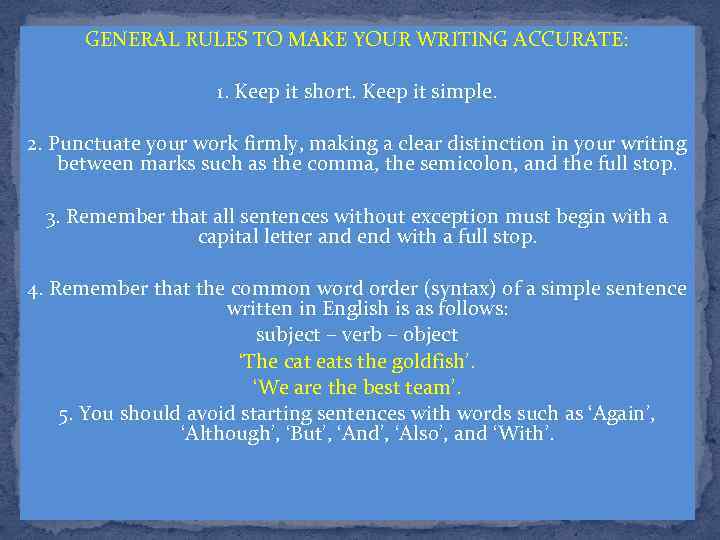
GENERAL RULES TO MAKE YOUR WRITING ACCURATE: 1. Keep it short. Keep it simple. 2. Punctuate your work firmly, making a clear distinction in your writing between marks such as the comma, the semicolon, and the full stop. 3. Remember that all sentences without exception must begin with a capital letter and end with a full stop. 4. Remember that the common word order (syntax) of a simple sentence written in English is as follows: subject – verb – object ‘The cat eats the goldfish’. ‘We are the best team’. 5. You should avoid starting sentences with words such as ‘Again’, ‘Although’, ‘But’, ‘And’, ‘Also’, and ‘With’.
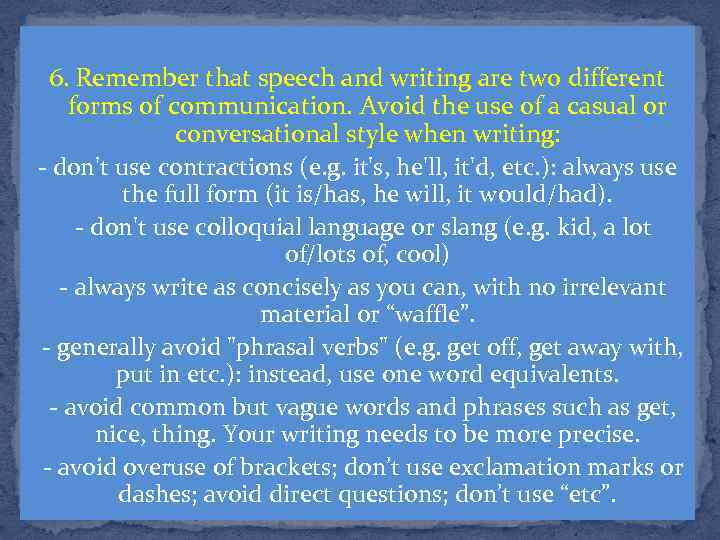
6. Remember that speech and writing are two different forms of communication. Avoid the use of a casual or conversational style when writing: - don't use contractions (e. g. it's, he'll, it'd, etc. ): always use the full form (it is/has, he will, it would/had). - don't use colloquial language or slang (e. g. kid, a lot of/lots of, cool) - always write as concisely as you can, with no irrelevant material or “waffle”. - generally avoid "phrasal verbs" (e. g. get off, get away with, put in etc. ): instead, use one word equivalents. - avoid common but vague words and phrases such as get, nice, thing. Your writing needs to be more precise. - avoid overuse of brackets; don’t use exclamation marks or dashes; avoid direct questions; don’t use “etc”.
7. What follows is an example of a statement which has too many unrelated clauses, which goes on too long, and which eventually skids out of grammatical control. ‘Less smoking would undoubtedly lead to redundancies in the tobacco industry, a consequent rise in the number of unemployed, more people dependent upon State benefits to be supported by a government with subsequently reduced income. ’ The same arguments can be expressed far more clearly and effectively by splitting them up into two separate and shorter sentences. ‘Less smoking would undoubtedly lead to redundancies in the tobacco industry and a consequent rise in the number of unemployed. More people would then become dependent upon State benefits, which would have to be paid out by a government with a reduced income. ’
8. Make your writing formal and impersonal: - avoid too much personal language (I, my, we etc. ); - never use emotive language; be objective rather than subjective; - avoid being too dogmatic and making sweeping generalisations. It is usually best to use some sort of “hedging” language and to qualify statements that you make; - you should consistently use evidence from your source reading to back up what you are saying and reference this correctly; - avoid sexist language, such as chairman, mankind. Don’t refer to “the doctor” as he; instead, make the subject plural and refer to them as they. Avoid he/she, herself/himself etc. - use nominalisation; that is, try to write noun-based phrases rather that verb-based ones. For example, instead of Crime was increasing rapidly and the police were becoming concerned. Write: The rapid increase in crime was causing concern among the police. NB: In general, academic writing tends to be fairly dense, with relatively long sentences and wide use of subordinate clauses. Remember, however, that your main aim is clarity, so don’t be too ambitious, particularly when you’re starting to write.
9. Avoid commitment (hedging) In order to put some distance between what you’re writing and yourself as writer, to be cautious rather than assertive, you should: - avoid overuse of first person pronouns (I, we, my, our) use impersonal subjects instead (It is believed that. . . , it can be argued that. . . ) -use passive verbs to avoid stating the ‘doer’ (Tests have been conducted) - use verbs (often with it as subject) such as imagine, suggest, claim, suppose - use ‘attitudinal signals’ such as apparently, arguably, ideally, strangely, unexpectedly. These words allow you to hint at your attitude to something without using personal language. - use verbs such as would, could, may, might which ‘soften’ what you’re saying. - use qualifying adverbs such as some, several, a minority of, a few, many to avoid making overgeneralisations.
10. Avoid sentence fragments - Sentence fragments usually occur when a sentence is prematurely brought to an end a new sentence unnecessarily started. - Sentence fragments also occur when a nonfinite clause is made into a simple sentence. For example, ‘Considering the complexities of the application procedure. ’ ‘Considering the complexities of the application procedure, it is surprising how many people do apply for a loan. ’
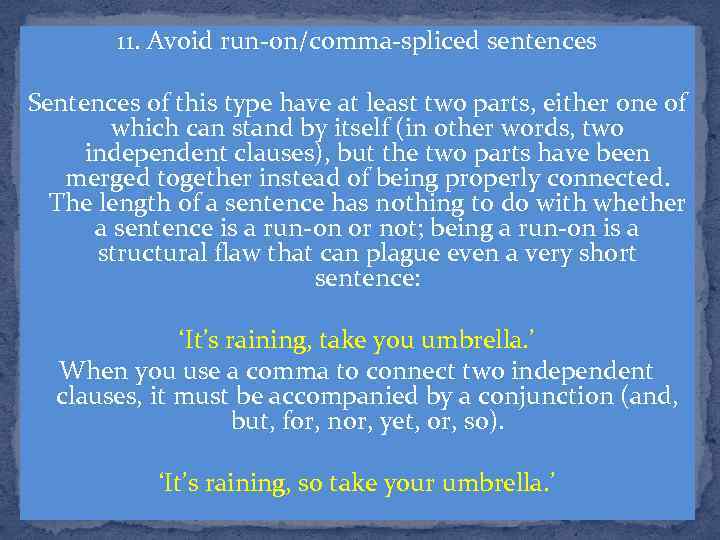
11. Avoid run-on/comma-spliced sentences Sentences of this type have at least two parts, either one of which can stand by itself (in other words, two independent clauses), but the two parts have been merged together instead of being properly connected. The length of a sentence has nothing to do with whether a sentence is a run-on or not; being a run-on is a structural flaw that can plague even a very short sentence: ‘It’s raining, take you umbrella. ’ When you use a comma to connect two independent clauses, it must be accompanied by a conjunction (and, but, for, nor, yet, or, so). ‘It’s raining, so take your umbrella. ’
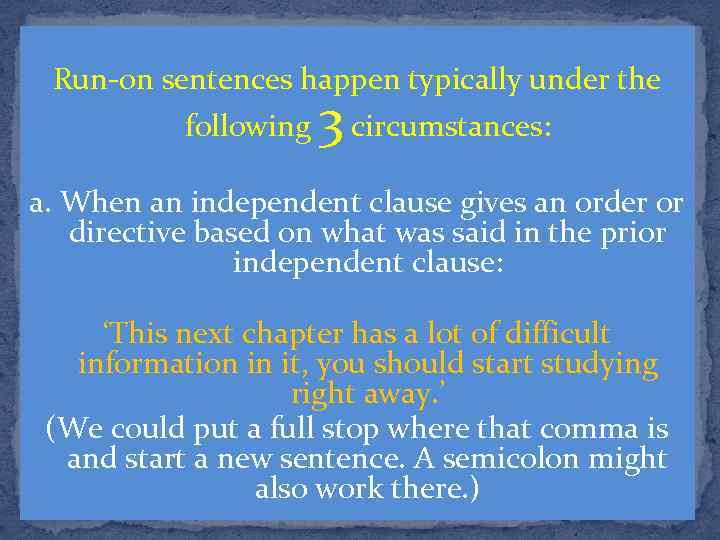
Run-on sentences happen typically under the 3 following circumstances: a. When an independent clause gives an order or directive based on what was said in the prior independent clause: ‘This next chapter has a lot of difficult information in it, you should start studying right away. ’ (We could put a full stop where that comma is and start a new sentence. A semicolon might also work there. )
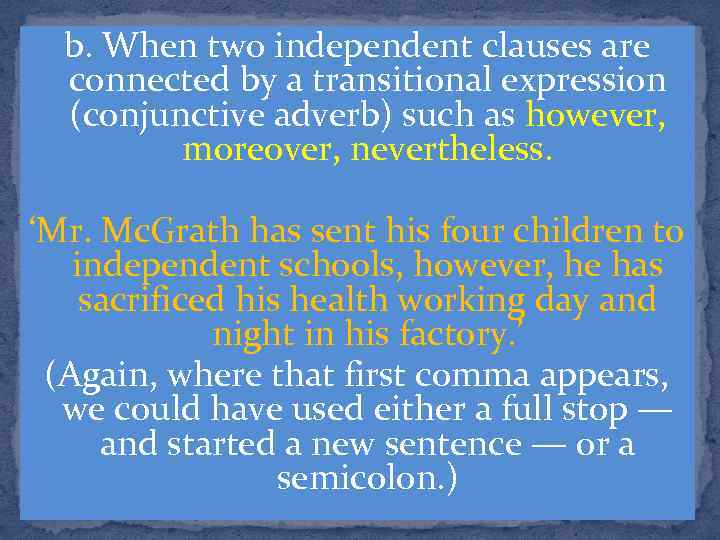
b. When two independent clauses are connected by a transitional expression (conjunctive adverb) such as however, moreover, nevertheless. ‘Mr. Mc. Grath has sent his four children to independent schools, however, he has sacrificed his health working day and night in his factory. ’ (Again, where that first comma appears, we could have used either a full stop — and started a new sentence — or a semicolon. )
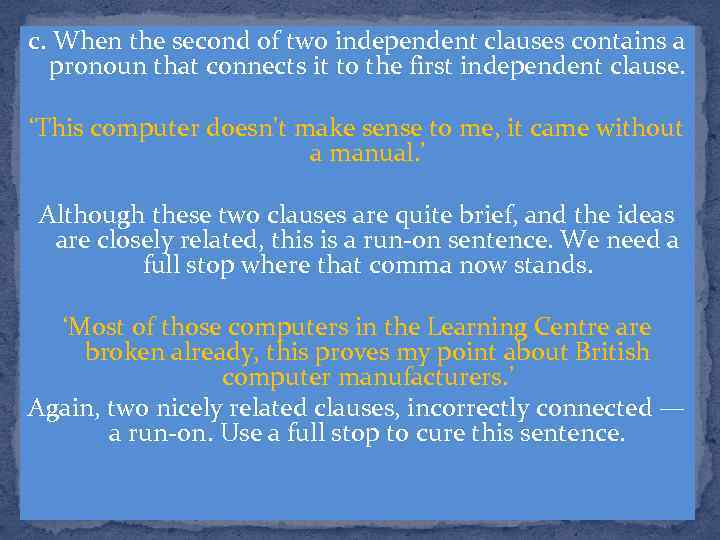
c. When the second of two independent clauses contains a pronoun that connects it to the first independent clause. ‘This computer doesn't make sense to me, it came without a manual. ’ Although these two clauses are quite brief, and the ideas are closely related, this is a run-on sentence. We need a full stop where that comma now stands. ‘Most of those computers in the Learning Centre are broken already, this proves my point about British computer manufacturers. ’ Again, two nicely related clauses, incorrectly connected — a run-on. Use a full stop to cure this sentence.
12. Pronoun reference A pronoun must agree with its antecedent (i. e. the noun to which the pronoun refers) and the relationship between the two must be clear and unambiguous. Vague pronoun reference occurs when this relationship is not clear. For example: Traditional extraction methods have many benefits, including producing oils with a low moisture content, but mechanical extraction methods produce higher yields. Chemical and nutritional analysis has shown that they vary widely depending on the variety of nut used. There are several plural nouns in this paragraph, and it is not clear which noun the pronoun ‘they’ in the second sentence refers to. Using the noun 'yields' instead of the pronoun 'they' solves the problem in this case: Traditional extraction methods have many benefits, including producing oils with a low moisture content, but mechanical extraction methods produce higher yields. Chemical and nutritional analysis has shown that yields vary widely depending on the variety of nut used. Vague pronoun reference is a common cause of ambiguity in student writing. In some cases, replacing the pronoun with a noun is not enough to remove the ambiguity: if the meaning is still unclear after doing this, you may have to rephrase one or more sentences to achieve clarity.
13. Consistency in the use of tenses It is important to use tenses consistently unless there is a good reason for a change. In the following extract the change in tense in the last sentence is not appropriate because the action being described also happened in the past: The data for the study were collected over a three-week period. First, a questionnaire was distributed to all participants. Then, semistructured interviews are conducted with eight of the participants to explore emerging issues. The correct tense in the last sentence is therefore the simple past: The data for the study were collected over a three-week period. First, a questionnaire was distributed to all participants. Then, semistructured interviews were conducted with eight of the participants to explore emerging issues.
14. Punctuation Some guidelines on the use of punctuation marks commonly used in academic writing: • Full stop • Comma • Semicolon • Colon • Apostrophe
Full stop The full stop is used at the end of a sentence. It signals to the reader that the writer has expressed a complete idea. For example: The Germanic languages are a branch of the Indo. European family, which has more speakers than any other group of languages in the world. A common error to avoid: Using a full stop where a comma is required. For example: The Germanic languages are a branch of the Indo. European family. Which has more speakers than any other group of languages in the world.
Comma 1) Commas are used to separate items in a series or list. For example: French, Spanish, Italian and Portuguese descend from Latin. 2) Commas are used between adjectives that can be joined by ‘and’. For example: This is a well-written, beautifully-illustrated book.
3) Commas are used after connectors that link a sentence to the previous one. For example: There has been a significant increase in the price of food. Therefore, it is likely that inflation will rise in the next quarter. There has been a great deal of research into bilingualism. However, little is known about the acquisition of a third or fourth language. Connectors joining a sentence to the previous one may also occur in mid -position in the second sentence. In this position, connectors are both preceded and followed by a comma: There has been a significant increase in the price of food. It is likely, therefore, that inflation will rise in the next quarter. There has been a great deal of research into bilingualism. Little is known, however, about the acquisition of a third of fourth language.
Semicolon The semicolon is used less frequently than the full stop and comma. Some writers avoid it altogether because they are unsure about how to use it. However, it is worth learning how to use the semicolon effectively to link grammatically distinct but closely related ideas. For example: The siege came to an end; the invaders left the city and the local population emerged from hiding. It would of course be possible to use a full stop instead of a semicolon in this example, but the semicolon highlights the strong relationship between the two ideas. For the same reason, the semicolon is often used instead of a full stop before connectors such as ‘therefore’, ‘thus’, ‘however’, ‘nevertheless’, ‘in other words’, ‘conversely’. There has been a significant increase in the price of food; therefore, it is likely that inflation will rise in the next quarter.
Colon The colon has several functions: • To introduce items in a list This paper investigates three aspects of the student experience: first impressions, learning support, and health and wellbeing. • To introduce an explanation Pressure on the available services is greater than ever: the population is growing, resources are limited, and expectations are high. • To introduce a quotation Bennett (1987) writes: ‘For Shakespeare and his age, Agincourt was a sacred time in their national history, one perhaps not approached again until the defeat of the Spanish Armada. ’
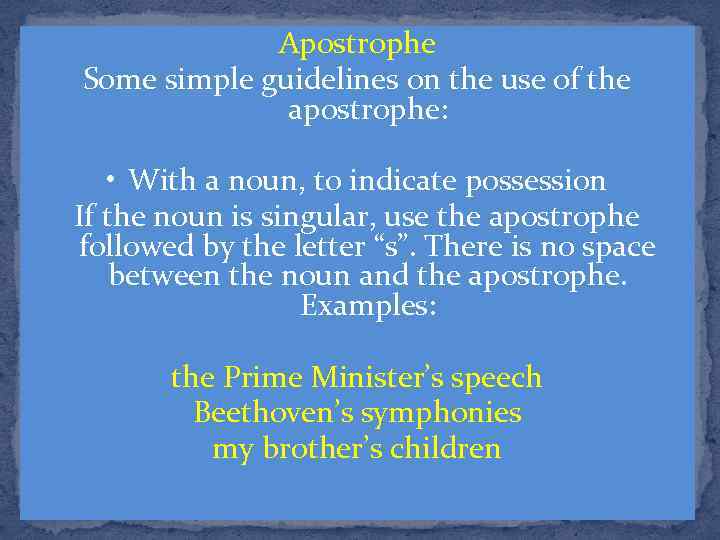
Apostrophe Some simple guidelines on the use of the apostrophe: • With a noun, to indicate possession If the noun is singular, use the apostrophe followed by the letter “s”. There is no space between the noun and the apostrophe. Examples: the Prime Minister’s speech Beethoven’s symphonies my brother’s children
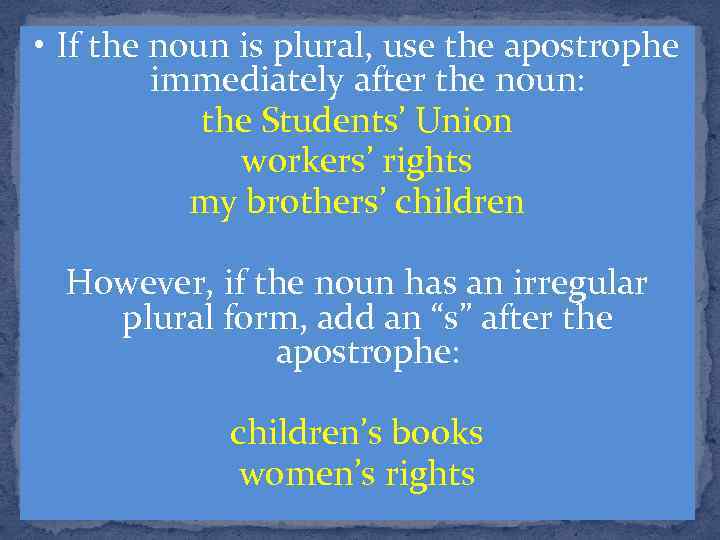
• If the noun is plural, use the apostrophe immediately after the noun: the Students’ Union workers’ rights my brothers’ children However, if the noun has an irregular plural form, add an “s” after the apostrophe: children’s books women’s rights
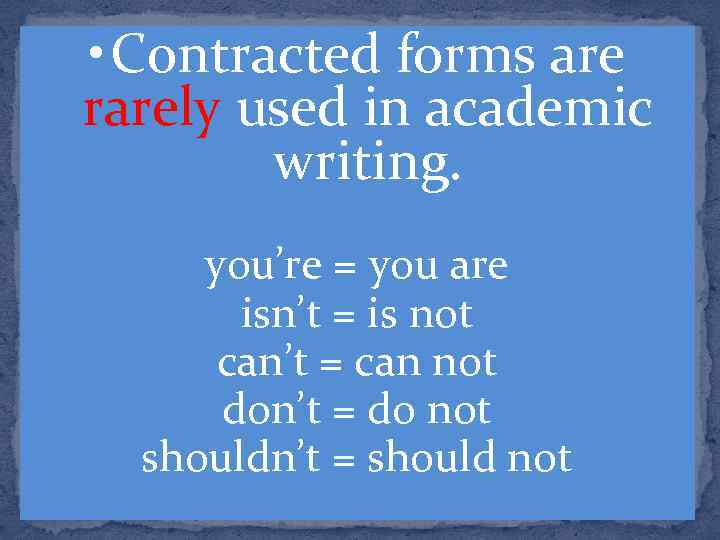
• Сontracted forms are rarely used in academic writing. you’re = you are isn’t = is not can’t = can not don’t = do not shouldn’t = should not
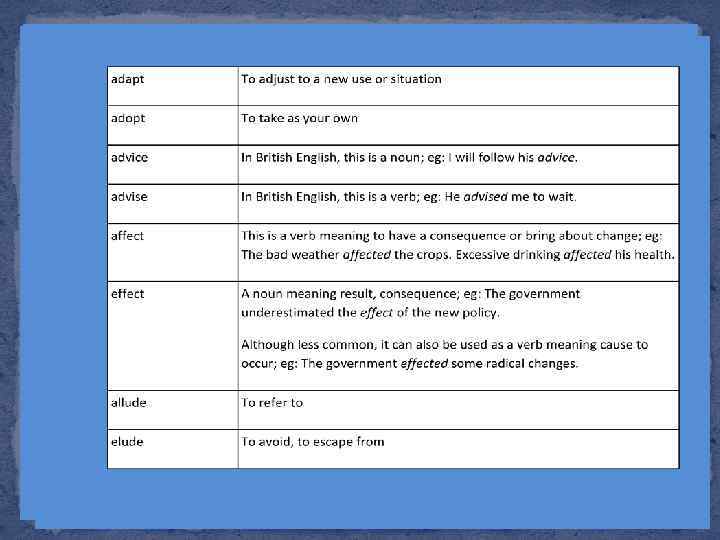
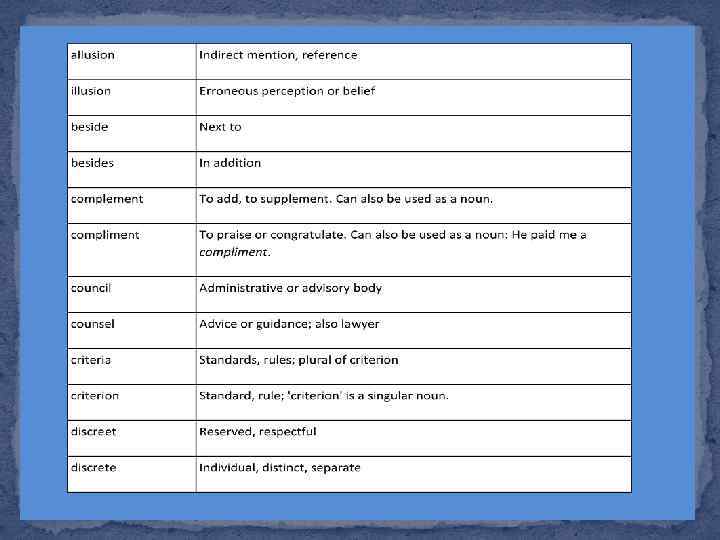
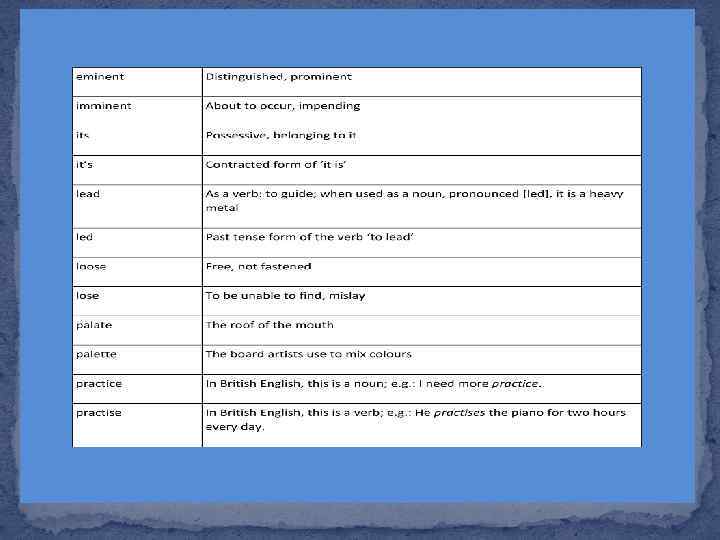
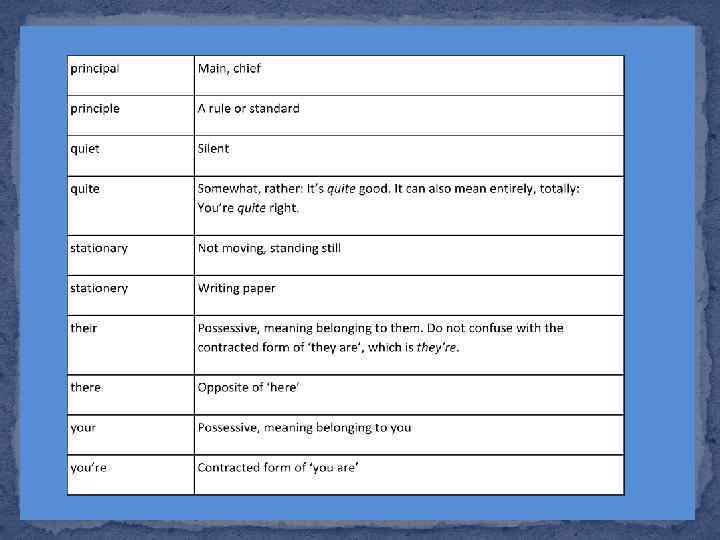
Words often confused The English language has many pairs of words with similar spellings but different meanings. Using the wrong word in the pair may be seen as evidence of carelessness, lack of attention to detail and poor proofreading. The list below should help you to avoid this type of error.
• Сontracted forms are rarely used in academic writing. you’re = you are isn’t = is not can’t = can not don’t = do not shouldn’t = should not
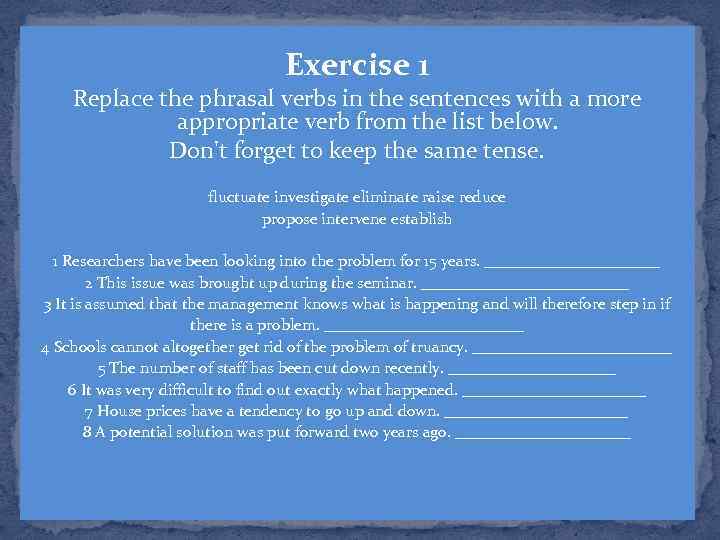
Exercise 1 Replace the phrasal verbs in the sentences with a more appropriate verb from the list below. Don't forget to keep the same tense. fluctuate investigate eliminate raise reduce propose intervene establish 1 Researchers have been looking into the problem for 15 years. ___________ 2 This issue was brought up during the seminar. _____________ 3 It is assumed that the management knows what is happening and will therefore step in if there is a problem. _____________ 4 Schools cannot altogether get rid of the problem of truancy. _____________ 5 The number of staff has been cut down recently. ___________ 6 It was very difficult to find out exactly what happened. ____________ 7 House prices have a tendency to go up and down. ____________ 8 A potential solution was put forward two years ago. ___________
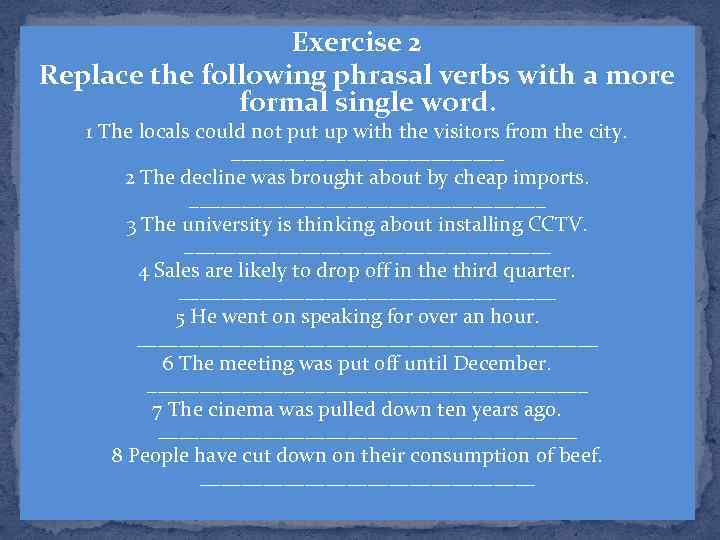
Exercise 2 Replace the following phrasal verbs with a more formal single word. 1 The locals could not put up with the visitors from the city. _____________ 2 The decline was brought about by cheap imports. _________________ 3 The university is thinking about installing CCTV. __________________ 4 Sales are likely to drop off in the third quarter. __________________ 5 He went on speaking for over an hour. ______________________ 6 The meeting was put off until December. _____________________ 7 The cinema was pulled down ten years ago. ____________________ 8 People have cut down on their consumption of beef. ________________
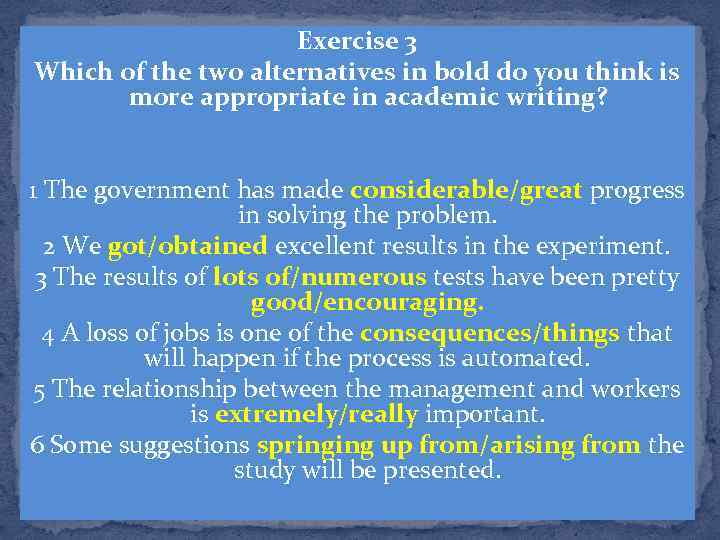
Exercise 3 Which of the two alternatives in bold do you think is more appropriate in academic writing? 1 The government has made considerable/great progress in solving the problem. 2 We got/obtained excellent results in the experiment. 3 The results of lots of/numerous tests have been pretty good/encouraging. 4 A loss of jobs is one of the consequences/things that will happen if the process is automated. 5 The relationship between the management and workers is extremely/really important. 6 Some suggestions springing up from/arising from the study will be presented.
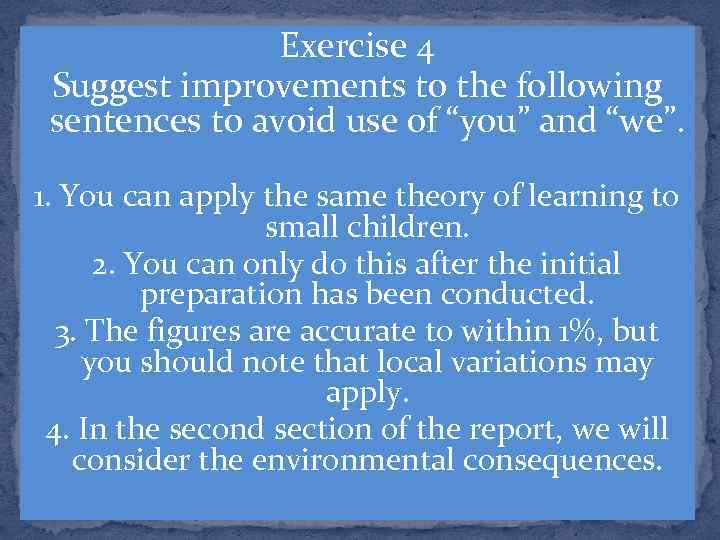
Exercise 4 Suggest improvements to the following sentences to avoid use of “you” and “we”. 1. You can apply the same theory of learning to small children. 2. You can only do this after the initial preparation has been conducted. 3. The figures are accurate to within 1%, but you should note that local variations may apply. 4. In the second section of the report, we will consider the environmental consequences.
Exercise 5 Make these statements more cautious. 1 Today everyone uses credit cards for all their shopping. 2 Drinking wine is bad for you. 3 Global warming will have disastrous consequences for the whole world. 4 Teleworking leads to isolation. 5 Women are worse drivers than men.
Exercise on Sentence Fragments The following paragraph has no capital letters or periods to mark the beginnings and ends of sentences. Add capitals, periods, commas, and/or other punctuation that may be needed to make the word groups into complete sentences. Your goal is to be sure that there are no fragments. . “my brother was always my best friend when I was a child especially as we two were almost alone in the world we lived with our old grandmother in a little house, almost a shack, in the country whenever I think of him now I see a solemn, responsible boy a boy too old for his years who looked out for me no matter what once there was a bully John Anson who looked enormous to me though he was probably an average twelve-year-old John had it in for me because he liked Littice Grant who liked me he decided to beat me up right before her eyes I was lucky my brother came by he didn't interfere any he just stood there somehow though his presence gave me confidence I licked the stuffing out of John Anson if my brother hadn't been there I don't think I could have done it. ”
My brother was always my best friend when I was a child, especially as we two were almost alone in the world. We lived with our old grandmother in a little house, almost a shack, in the country. Whenever I think of him now, I see a solemn, responsible boy, a boy too old for his years, who looked out for me no matter what. Once there was a bully, John Anson, who looked enormous to me, though he was probably an average twelve-year-old. John had it in for me because he liked Littice Grant, who liked me. He decided to beat me up right before her eyes. I was lucky my brother came by. He didn't interfere any. He just stood there. Somehow, though, his presence gave me confidence. I licked the stuffing out of John Anson. If my brother hadn't been there, I don't think I could have done it.
Скачать презентацию Academic Writing Anyone who wishes to become a
AcademicWritingPPT Lectures 1 & 2.pptx